


1 Kings 14:26
Bible text: King James Version (1769 Blayney text) · Public domain
Bible text: King James Version with Strong's numbers · Public domain
Bible text: Berean Standard Bible · Public domain
Bible text: American Standard Version (1901) · Public domain
Bible text: World English Bible, Messianic edition · Public domain
Bible text: Geneva Bible (1599) · Public domain
Bible text: Young's Literal Translation · Public domain
- וַיִּקַּחvai·yi·Kachand he tookH3947Conj-w ¦ V-Qal-ConsecImperf-3msVerb Qal Consecutive Imperfect 3rd Singular Masculineוַandיִּקַּחhe took
- אֶת'et<obj.>H853DirObjMParticle Object Indicator
- אֹצְרוֹת'o·tze·Rot[the] treasures ofH214N-fpcNoun Plural Feminine Construct
- בֵּיתbeit[the] house ofH1004N-mscNoun Singular Masculine Construct
- יְהוָהYah·wehYahwehH3068N-properNoun Proper Title
- וְאֶתve·'Etand <obj.>H853Conj-w ¦ DirObjMParticle Object Indicatorוְandאֶת<obj.>
- אוֹצְרוֹת'otz·rOt[the] treasures ofH214N-fpcNoun Plural Feminine Construct
- בֵּיתbeit[the] house ofH1004N-mscNoun Singular Masculine Construct
- הַמֶּלֶךְha·Me·lekhthe kingH4428Art ¦ N-msNoun Singular Masculine Absoluteהַtheמֶּלֶךְking
- וְאֶתve·'Etand <obj.>H853Conj-w ¦ DirObjMParticle Object Indicatorוְandאֶת<obj.>
- הַכֹּלha·Kol<the> everythingH3605Art ¦ N-msNoun Singular Masculine Absoluteהַ<the>כֹּלeverything
- לָקָחla·Kachhe tookH3947V-Qal-Perf-3msVerb Qal Perfect 3rd Singular Masculine
- וַיִּקַּחvai·yi·Kachand he tookH3947Conj-w ¦ V-Qal-ConsecImperf-3msVerb Qal Consecutive Imperfect 3rd Singular Masculineוַandיִּקַּחhe took
- אֶת'et<obj.>H853DirObjMParticle Object Indicator
- כָּלkolallH3605N-mscNoun Singular Masculine Construct
- מָגִנֵּיma·gi·Nei[the] shields ofH4043N-mpcNoun Plural Masculine Construct
- הַזָּהָבha·za·Hav<the> goldH2091Art ¦ N-msNoun Singular Masculine Absoluteהַ<the>זָּהָבgold
- אֲשֶׁר'a·SherwhichH834RelParticle Relative
- עָשָׂה'a·Sahhe had madeH6213V-Qal-Perf-3msVerb Qal Perfect 3rd Singular Masculine
- שְׁלֹמֹהshe·lo·MohSolomonH8010N-proper-mNoun Proper Masculine
English is a literal word-by-word gloss of the Hebrew, not the KJV's wording. Why?
This is the original text the KJV's translators worked from — each Hebrew word with its own literal English meaning in this verse, prepared by scholars at Tyndale House, Cambridge. The KJV translates whole sentences, not word by word, so its wording differs: one Hebrew word can become several English words, and the KJV may choose “the LORD” where the gloss reads “Yahweh”. Both are faithful — they answer different questions. For the KJV's own rendering, switch to the KJV text.
Details
See on the biblical-era maps
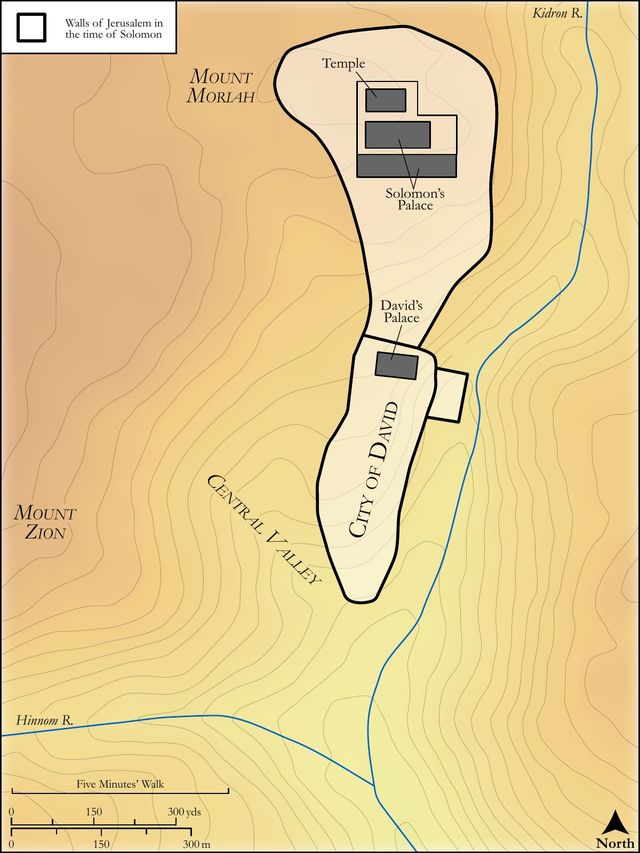
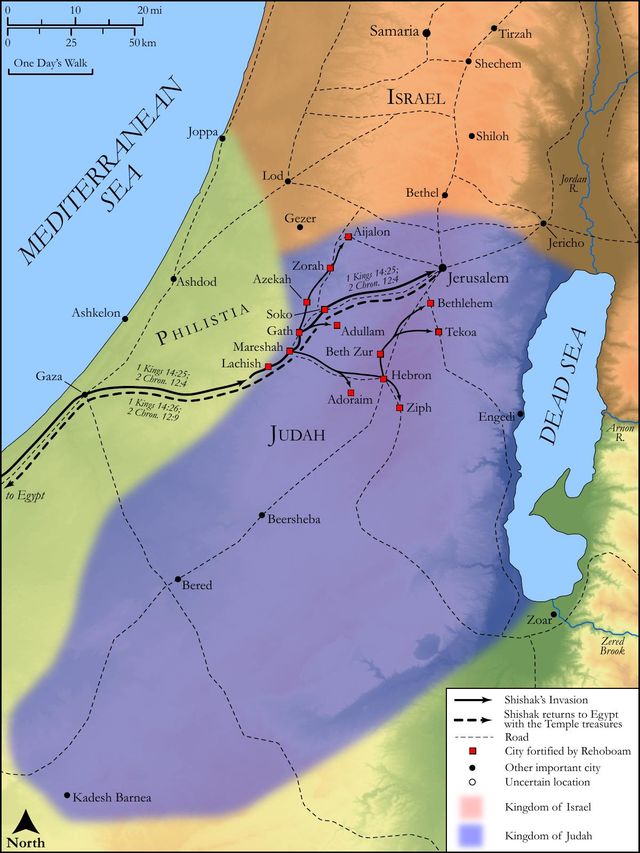
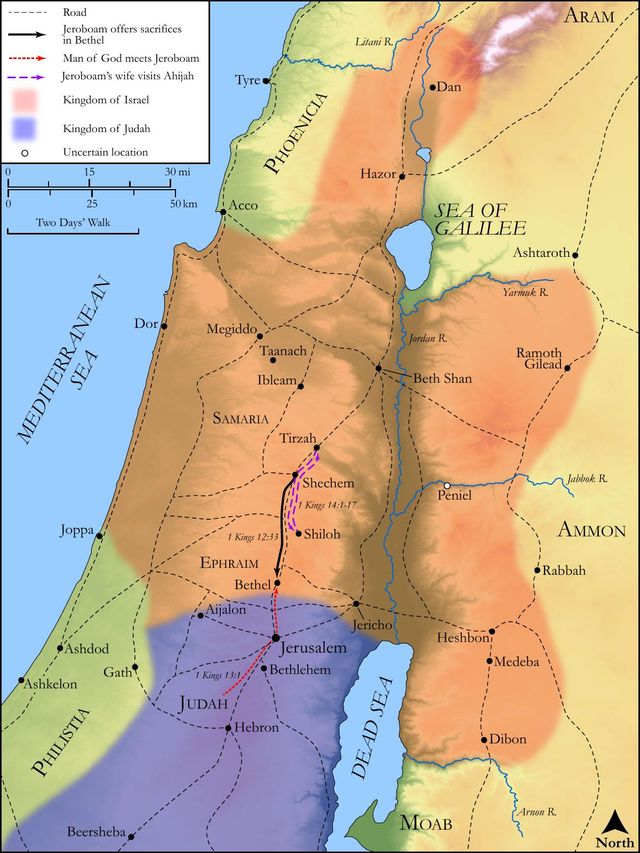
Study this verse
Public-domain commentary
Matthew Henry
From his Commentary on the Whole Bible. Henry comments on passages, not single verses — this entry covers 1 Kings 14:21–31. His three-level outline is real structure in the source text, so it is rendered as structure.
Judah's story and Israel's are intermixed in this book. Jeroboam out-lived Rehoboam, four or five years, yet his history is despatched first, that the account of Rehoboam's reign may be laid together; and a sad account it is.
I.Here is no good said of the king. All the account we have of him here is,
1.That he was forty-one years old when he began to reign, by which reckoning he was born in the last year of David, and had his education, and the forming of his mind, in the best days of Solomon; yet he lived not up to these advantages. Solomon's defection at last did more to corrupt him than his wisdom and devotion had done to give him good principles.
2.That he reigned seventeen years in Jerusalem, the city where God put his name, where he had opportunity enough to know his duty, if he had but had a heart to do it.
3.That his mother was Naamah, an Ammonitess; this is twice mentioned, Kg1 14:21, Kg1 14:31. It was strange that David would marry his son Solomon to an Ammonitess (for it was done while he lived), but it is probable that Solomon was in love with her, because she was Naamah, a beauty (so it signifies), and his father was loth to cross him, but it proved to have a very bad influence upon posterity. Probably she was daughter to Shobi the Ammonite, who was kind to David (Sa2 17:27), and David was too willing to requite him by matching his son into his family. None can imagine how lasting and how fatal the consequences may be of being unequally yoked with unbelievers.
4.That he had continual war with Jeroboam (Kg1 14:30), which could not but be a perpetual uneasiness to him.
5.That when he had reigned but seventeen years he died, and left his throne to his son. His father, and grandfather, and grandson, that reigned well, reigned long, forty years apiece. But sin often shortens men's lives and comforts.
II.Here is much evil said of the subjects, both as to their character and their condition.
1.See here how wicked and profane they were. It is a most sad account that is here given of their apostasy from God, Kg1 14:22-24. Judah, the only professing people God had in the world, did evil in his sight, in contempt and defiance of him and the tokens of his special presence with them; they provoked him to jealousy, as the adulterous wife provokes her husband by breaking the marriage-covenant. Their fathers had been bad enough, especially in the times of the judges, but they did abominable things, above all that their fathers had done. The magnificence of their temple, the pomp of their priesthood, and all the secular advantages with which their religion was attended, could not prevail to keep them to it. Nothing less than the pouring out of the Spirit from on high will keep God's Israel in their allegiance to him. The account here given of the wickedness of the Jews agrees with that which the apostle gives of the wickedness of the Gentile world (Rom 1:21, Rom 1:24), so that both Jew and Gentile are alike under sin, Rom 3:9.
(1.)They became vain in their imaginations concerning God, and changed his glory into an image, for they built themselves high places, images, and groves (Kg1 14:23), profaning God's name by affixing to it their images, and God's ordinances by serving their idols with them. They foolishly fancies that they exalted God when they worshipped him on high hills and pleased him when they worshipped him under the pleasant shadow of green trees.
(2.)They were given up to vile affections (as those idolaters Rom 1:26, Rom 1:27), for there were sodomites in the land (Kg1 14:24), men with men working that which is unseemly, and not to be thought of, much less mentioned, without abhorrence and indignation. They dishonoured God by one sin and then God left them to dishonour themselves by another. They profaned the privileges of a holy nation, therefore God gave them up to their own hearts' lusts, to imitate the abominations of the accursed Canaanites; and herein the Lord was righteous. And, when they did like those that were cast out, how could they expect any other than to be cast out like them?
2.See here how weak and poor they were; and this was the consequence of the former. Sin exposes, impoverishes, and weakens any people. Shishak, king of Egypt, came against them, and so far, either by force or surrender, made himself master of Jerusalem itself that he took away the treasures both of the temple and of the exchequer, of the house of the Lord and of the king's house, which David and Solomon had amassed, Kg1 14:25, Kg1 14:26. These, it is likely, tempted him to make his descent; and, to save the rest, Rehoboam perhaps tamely surrendered them, as Ahab, Kg1 20:4. He also took away the golden shields that were made but in his father's time, Kg1 14:26. These the king of Egypt carried off as trophies of his victory; and, instead of them, Rehoboam made brazen shields, which the life-guard carried before him when he went to church in state, Kg1 14:27, Kg1 14:28. This was an emblem of the diminution of his glory. Sin makes the gold become dim, changes the most fine gold, and turns it into brass. We commend Rehoboam for going to the house of the Lord, perhaps the oftener for the rebuke he had been under, and do not condemn him for going in pomp. Great men should honour God with their honour, and then they are themselves most honoured by it.
Continue studying 1 Kings 14:26 across the web’s major study libraries — every link below opens this exact verse, chapter, or book on the destination site.
Read & Compare
 BibleGatewayThis verse in more than 200 translations and 70 languages.
 Bible.comThe YouVersion reader — hundreds of translations, reading plans, and highlights.
 ESV.orgCrossway's official English Standard Version reader.
 NET BibleThe NET translation with 60,000+ translators' notes on every rendering decision.
 STEP BibleTyndale House's free study tool — original text, vocabulary, and scholarly resources.
 BibliaLogos Bible Software's free web reader.
 USCCBThe New American Bible (Revised Edition) with the U.S. bishops' study notes.
Commentaries
 BibleHub CommentariesDozens of classic commentaries on this verse, gathered on one page.
 StudyLightMore than 100 commentary sets — the largest collection on the web.
 BibleRefPlain-English commentary on what this verse means, verse by verse.
 Enduring WordDavid Guzik's free commentary on this chapter, widely used by Bible teachers.
 Bible Study ToolsVerse commentary alongside Greek and Hebrew study aids.
Original Language & Research
- BibleHub InterlinearThe verse word by word — original language, transliteration, and English.
- BibleHub LexiconEvery word's original-language definition and Strong's entry.
 Blue Letter BibleDeep-study tools — Strong's numbers, concordance, and word studies.
 SefariaThe Hebrew text with Rashi and centuries of Jewish commentary.
Sermons, Hymns & Audio


TrulyRandomVerse is not affiliated with these sites and doesn’t control their content. They’re linked because they’re genuinely useful.
Summary
1 Kings 14:26 powerfully narrates the devastating plunder of Jerusalem by Pharaoh Shishak of Egypt during the reign of King Rehoboam of Judah. This verse meticulously details the comprehensive seizure of both the sacred treasures housed within the Temple of the LORD and the immense wealth stored in the royal palace, culminating in the confiscation of the iconic golden shields that King Solomon had commissioned. This act of despoilment serves as a stark physical manifestation of divine judgment, directly correlating with Judah's widespread apostasy and abandonment of God's covenant, marking a significant downturn in the kingdom's fortunes.
Context
ShowHideLiterary Context
This verse is strategically placed within the latter half of 1 Kings chapter 14, which meticulously chronicles the tumultuous reign of King Rehoboam over the newly divided southern kingdom of Judah. Immediately preceding this account, the narrative vividly portrays Judah's rapid descent into idolatry and moral depravity under Rehoboam's leadership, characterized by the construction of high places, sacred pillars, and Asherim, alongside the proliferation of male cult prostitutes (1 Kings 14:22-24). The invasion by Pharaoh Shishak, introduced in 1 Kings 14:25, is presented not merely as a geopolitical conflict but as a direct, divinely ordained consequence and judgment for Judah's profound unfaithfulness. Thus, 1 Kings 14:26 serves as the climactic, tangible outcome of the nation's spiritual rebellion, illustrating the immediate and severe loss of national security, sacred wealth, and royal prestige.
Historical & Cultural Context
Pharaoh Shishak, unequivocally identified with Sheshonk I, was the formidable founder of the 22nd Dynasty of Egypt and a powerful military leader of his era. His extensive campaign against Judah and Israel, dated to approximately 925 BCE, is not solely confined to the biblical record (2 Chronicles 12:2-9) but is also historically corroborated by an inscription on the walls of the Karnak Temple in Egypt, which lists numerous conquered cities, including several from Judah. Among the nations, the systematic plundering of a defeated people's temple and royal treasury was a pervasive and highly symbolic practice, as when the Philistines brought the captured ark of God into the house of Dagon. It signified not only complete military subjugation but also the perceived weakness or defeat of the conquered nation's deity by the victorious power. The "shields of gold" specifically mentioned in the verse refer to the 200 large shields and 300 smaller bucklers crafted by King Solomon (1 Kings 10:16-17). These were not primarily functional military equipment but rather magnificent ceremonial items, symbolizing the kingdom's unparalleled wealth, prestige, and implied divine favor. Their loss was an immense blow to Judah's national pride, a visible sign of its drastically diminished status, and a stark reminder of its departure from its former glory.
Key Themes
ShowHideThis verse profoundly illustrates several overarching themes central to the book of Kings and the broader Old Testament narrative. Foremost is the consequences of disobedience to God's covenant; national apostasy directly invites divine judgment in the form of foreign invasion and significant material loss, echoing the severe warnings articulated in Deuteronomy 28. The plundering also highlights the loss of divine protection; where God's favor once secured the kingdom's prosperity and safety, unfaithfulness unequivocally removes that divine hedge, leaving the nation vulnerable. Furthermore, the swift and dramatic disappearance of Solomon's opulent golden shields and the Temple's riches powerfully underscores the transience of earthly glory and material wealth when such possessions are severed from a right and faithful relationship with God. This pivotal event marks a significant and tragic downturn for the Davidic kingdom, serving as a poignant and enduring reminder that true security, lasting value, and enduring prosperity are found not in physical possessions or human might, but solely in covenant fidelity to the Lord.
Exposition and Analysis
ShowHideKey Word Analysis
ShowHideThis primitive root verb (H3947), appearing four times in this single verse, signifies a forceful and complete seizure. While lâqaḥ can denote a simple act of "taking" or "receiving," its emphatic repetition here within the context of an invading army underscores a violent, comprehensive appropriation—a systematic stripping away of possessions. It conveys the thoroughness and ruthlessness of Shishak's plunder, leaving no ambiguity that the treasures were not merely relocated but definitively and irrevocably lost to Judah.
Derived from a root meaning "to store" (H214), this term refers to stored valuables, accumulated wealth, or provisions. In this verse, ʾôwtsâr encompasses both the sacred dedications and accumulated riches within the Temple of the LORD and the vast stores of wealth in the royal palace. These were not common goods but highly prized assets, often comprising precious metals, rare jewels, and unique artifacts, representing the pinnacle of the accumulated wealth and glory of the Solomonic era. Their removal signifies a deep and multifaceted loss—economic, symbolic, and spiritual.
This term (H4043) specifically denotes a shield, particularly the large, ceremonial type, as distinct from smaller bucklers. As detailed in 1 Kings 10:16-17, Solomon had commissioned 200 large shields and 300 smaller bucklers, all crafted from pure gold. These were not primarily intended for combat but for magnificent display, likely adorning the "House of the Forest of Lebanon" or the Temple precincts. Their composition of pure gold rendered them immensely valuable, and their very presence symbolized the kingdom's immense wealth, prestige, and perceived military might. Their removal represents the stripping away of Judah's outward glory and the visible evidence of its former, divinely-blessed invincibility.
Verse Breakdown
ShowHide"And he took away the treasures of the house of the LORD"
This opening clause immediately highlights the sacrilegious and profound nature of the plunder. The "house of the LORD" refers to Solomon's magnificent Temple in Jerusalem, which served as the spiritual heart of the nation and the designated dwelling place of God's presence among His people. The treasures within it were often dedicated gifts, sacred vessels used in worship, or accumulated wealth intended for its upkeep and the support of priestly service. Their seizure was not merely a financial loss but a profound spiritual affront, demonstrating the vulnerability of even sacred spaces when divine protection is withdrawn due to national sin and covenant infidelity.
"and the treasures of the king's house; he even took away all"
This expands the scope of the plunder beyond the sacred to include the royal palace and its vast treasury, emphasizing the comprehensive and devastating nature of Shishak's attack. The king's house represented the political, administrative, and economic power of the Davidic monarchy. The subsequent emphatic phrase, "he even took away all," serves as a stark summary, underscoring the absolute thoroughness of Shishak's raid. It implies that virtually nothing of significant value was spared, leaving Judah severely impoverished, deeply humiliated, and stripped of its material foundations.
"and he took away all the shields of gold which Solomon had made"
This specific mention of the golden shields, previously described in detail as a hallmark of Solomon's reign (1 Kings 10:16-17), underscores the loss of a key, visible symbol of Judah's former glory and security. These shields, crafted from pure gold, were not just valuable assets but represented the zenith of Solomon's unparalleled wealth and the kingdom's prestige during its golden age. Their removal signifies the stripping away of Judah's outward splendor, its perceived invincibility, and the tangible evidence of its past, divinely-blessed prosperity, leaving Rehoboam's kingdom visibly and profoundly diminished.
Literary Devices
ShowHideThe primary literary device powerfully employed in 1 Kings 14:26 is Repetition, specifically of the Hebrew verb "took away" (וַיִּקַּח, vayyiqqaḥ). This verb appears four times within the single verse, serving to underscore the thoroughness, finality, and devastating impact of Shishak's plunder. The relentless repetition creates a sense of systematic and comprehensive action, emphasizing that the treasures were methodically and completely stripped from both the sacred Temple and the royal palace. This rhetorical emphasis highlights the immense magnitude of the loss and the comprehensive nature of the divine judgment. Additionally, the "shields of gold" function as potent Symbolism. Originally, these magnificent items symbolized Solomon's unparalleled wealth, the kingdom's prestige, and its divinely-granted security and prosperity. Their removal, therefore, symbolizes the complete loss of that former glory, the kingdom's vulnerability, and the tangible consequences of Judah's unfaithfulness. The event also carries a degree of Foreshadowing, as this significant decline for the Davidic dynasty and the southern kingdom sets a precedent for future instances of foreign subjugation and the eventual, more complete destruction of Jerusalem and its Temple, all consistently linked to the nation's spiritual infidelity.
Theological and Thematic Connections
ShowHideThe plundering described in 1 Kings 14:26 stands as a stark theological declaration of God's unwavering covenant faithfulness, even when expressed through judgment. It powerfully demonstrates that divine blessings, including national prosperity, security, and the preservation of sacred spaces, are profoundly conditional upon obedience to the covenant. When Judah collectively turned to idolatry and abandoned its covenant relationship with the Lord, the protective hand of God was intentionally withdrawn, allowing foreign powers to exact a heavy and humiliating toll. This event serves as a tangible and direct fulfillment of the curses outlined in the Mosaic Law, particularly those warnings against the dire consequences of disobedience, such as invasion, subjugation, and the loss of treasured possessions. It profoundly underscores the enduring biblical principle that true security, lasting wealth, and national flourishing are not found in material accumulation, military might, or human ingenuity, but solely in a right, faithful, and obedient relationship with the sovereign God.
Reflection and Application
ShowHideFor believers today, the sobering account of Jerusalem's plundering in 1 Kings 14:26 serves as both a timeless warning and a profound call to unwavering spiritual vigilance. Just as Judah's devastating material losses were a direct and undeniable consequence of their spiritual apostasy and idolatry, so too can our lives experience a metaphorical 'plundering' when we prioritize earthly treasures or succumb to modern forms of idolatry—be it the relentless pursuit of wealth, comfort, power, reputation, or even self-reliance—over our singular devotion to God. This passage challenges us to deeply examine where our true security and ultimate value truly lie. It powerfully reminds us that external displays of prosperity, strength, or success are inherently fleeting and vulnerable if the foundational integrity of our faith and our relationship with God is compromised. The ultimate application is a call to radical faithfulness and wholehearted commitment, recognizing that our greatest and most enduring treasure is our relationship with Christ, a treasure that no earthly power or circumstance can ever take away, and that true spiritual wealth is built upon obedience, trust, and intimacy with God rather than on perishable possessions or fleeting accolades.
Questions for Reflection
ShowHideFAQ
ShowHideWhat was the significance of the "shields of gold" mentioned in this verse?
ShowHideThe "shields of gold" were not primarily for military use in battle but were magnificent ceremonial items, specifically 200 large shields and 300 smaller bucklers made of pure gold by King Solomon, as meticulously described in 1 Kings 10:16-17. They were likely displayed prominently in the "House of the Forest of Lebanon" or within the Temple complex itself. Their significance was immense: they symbolized Solomon's unparalleled wealth, the kingdom's prosperity, its prestige among nations, and its perceived invincibility under divine favor. Their seizure by Shishak was therefore a profound and humiliating blow to Judah's national pride, a highly visible sign of its drastically diminished glory, and a tangible representation of the loss of God's protective hand due to the nation's profound sin and covenant infidelity.
Why did Shishak specifically target the Temple and the king's house?
ShowHideAmong the nations, the temple and the royal palace were universally recognized as the primary repositories of a nation's greatest wealth. These locations housed not only vast quantities of precious metals and valuable artifacts but also cultic objects, royal regalia, and strategic provisions. Plundering these specific locations served multiple critical purposes for an invading force like Shishak's. Economically, it provided immense and immediate spoils of war, enriching the conquering empire. Symbolically, seizing the treasures of the temple demonstrated the perceived superiority of the invading deity (or the invader's god) over the local deity, thereby undermining the conquered nation's spiritual foundation. Similarly, the capture of the royal treasury signified the complete subjugation and profound humiliation of the defeated king and his entire kingdom. For the biblical narrative, this dual targeting was presented as a clear and direct act of divine judgment, allowing the enemy to strike at the very places that symbolized Judah's material wealth, national power, and spiritual center, confirming the consequences of their apostasy. The parallel account in 2 Chronicles 12:9 explicitly confirms this dual target.
Christ-Centered Fulfillment
ShowHideThe narrative of Jerusalem's plundering in 1 Kings 14:26 finds its ultimate Christ-centered fulfillment not in the preservation of perishable earthly treasures, but in the establishment of an eternal kingdom whose riches are imperishable and whose security is absolute. While Solomon's magnificent Temple and its golden shields typologically symbolized God's presence and blessing under the Old Covenant, their vulnerability to plunder profoundly highlights the temporary and typological nature of these earthly institutions. Christ, however, is the true and eternal Temple, whose physical body was destroyed and miraculously raised on the third day (John 2:19-21), thereby making Him the ultimate and permanent dwelling place of God among humanity. He is the one who secures for His followers treasures that "neither moth nor rust destroys, and where thieves do not break in and steal" (Matthew 6:19-21), inviting us to invest in eternal realities. The loss of Judah's golden shields, powerful symbols of human-made security and fleeting glory, powerfully points to Christ as our ultimate shield and protector (Psalm 18:30), whose divine power and sovereignty are never diminished, and whose everlasting kingdom "will never be destroyed, nor will it be left to another people" (Daniel 2:44). In Christ, believers are granted an inheritance that is "imperishable, undefiled, and unfading, kept in heaven" (1 Peter 1:3-5), demonstrating that true and lasting security, glory, and wealth are found not in earthly possessions or human accomplishments, but solely in the finished work, eternal reign, and unfailing faithfulness of our Savior.