


1 Kings 18:46
Bible text: King James Version (1769 Blayney text) · Public domain
Bible text: Berean Standard Bible · Public domain
Bible text: American Standard Version (1901) · Public domain
Bible text: World English Bible, Messianic edition · Public domain
Bible text: Geneva Bible (1599) · Public domain
Bible text: Young's Literal Translation · Public domain
- וְיַדve·yadand [the] hand ofH3027Conj-w ¦ N-cscNoun Singular common gender Constructוְandיַד[the] hand of
- יְהוָהYah·wehYahwehH3068N-properNoun Proper Title
- הָיְתָהha·ye·Tahit wasH1961V-Qal-Perf-3fsVerb Qal Perfect 3rd Singular Feminine
- אֶל'eltoH413PrepPreposition
- אֵלִיָּהוּ'e·li·Ya·huElijahH452N-proper-mNoun Proper Masculine
- וַיְשַׁנֵּסvay·sha·Nesand he girded upH8151Conj-w ¦ V-Piel-ConsecImperf-3msVerb Piel Consecutive Imperfect 3rd Singular Masculineוַandיְשַׁנֵּסhe girded up
- מָתְנָיוma·te·Navhis loinsH4975N-mdc ¦ 3msNoun Dual Masculine Constructמָתְנָיloinsוhis
- וַיָּרָץvai·Ya·rotzand he ranH7323Conj-w ¦ V-Qal-ConsecImperf-3msVerb Qal Consecutive Imperfect 3rd Singular Masculineוַandיָּרָץhe ran
- לִפְנֵיlif·Nei<to> beforeH6440Prep-l ¦ N-mpcNoun Plural Masculine Constructלִ<to>פְנֵיbefore
- אַחְאָב'ach·'AvAhabH256N-proper-mNoun Proper Masculine
- עַד'aduntilH5704PrepPreposition
- בֹּאֲכָהbo·'a·Khahcoming youH935V-Qal-Inf ¦ 2msVerb Qal Infinitive Constructבֹּאֲcomingכָהyou
- יִזְרְעֶאלָהyiz·re·'E·lahJezreel towardsH3157N-proper ¦ SfxNoun Proper LocationיִזְרְעֶאלָJezreelהtowards
English is a literal word-by-word gloss of the Hebrew, not the KJV's wording. Why?
This is the original text the KJV's translators worked from — each Hebrew word with its own literal English meaning in this verse, prepared by scholars at Tyndale House, Cambridge. The KJV translates whole sentences, not word by word, so its wording differs: one Hebrew word can become several English words, and the KJV may choose “the LORD” where the gloss reads “Yahweh”. Both are faithful — they answer different questions. For the KJV's own rendering, switch to the KJV text.
Details
See on the biblical-era maps

Study this verse
Public-domain commentary
Matthew Henry
From his Commentary on the Whole Bible. Henry comments on passages, not single verses — this entry covers 1 Kings 18:41–46. His two-level outline is real structure in the source text, so it is rendered as structure.
Israel being thus far reformed that they had acknowledged the Lord to be God, and had consented to the execution of Baal's prophets, that they might not seduce them any more, though this was far short of a thorough reformation, yet it was so far accepted that God thereupon opened the bottles of heaven, and poured out blessings upon his land, that very evening (as it should seem) on which they did this good work, which should have confirmed them in their reformation; see Hag 2:18, Hag 2:19.
I.Elijah sent Ahab to eat and drink, for joy that God had now accepted his works, and that rain was coming; see Ecc 9:7.
Ahab had continued fasting all day, either religiously, it being a day of prayer, or for want of leisure, it being a day of great expectation; but now let him eat and rink for, though others perceive no sign of it, Elijah, by faith, hears the sound of abundance of rain, Kg1 18:41. God reveals his secrets to his servants the prophets; and yet, without a revelation, we may foresee that when man's judgments run down like a river God's mercy will. Rain is the river of God, Psa 65:9.
II.He himself retired to pray (for though God had promised rain, he must ask it, Zac 10:1), and to give thanks for God's answer by fire, now hoping for an answer by water. What he said we are not told; but,
1.He withdrew to a strange place, to the top of Carmel, which was very high and very private. Hence we read of those that hide themselves in the top of Carmel, Amo 9:3. There he would be alone. Those who are called to appear and act in public for God must yet find time to be private with him and keep up their converse with him in solitude. There he set himself, as it were, upon his watch-tower, like the prophet, Hab 2:1.
2.He put himself into a strange posture. He cast himself down on his knees upon the earth, in token of humility, reverence, and importunity, and put his face between his knees (that is, bowed his head so low that it touched his knees), thus abasing himself in the sense of his own meanness now that God had thus honoured him.
III.He ordered his servant to bring him notice as soon as he discerned a cloud arising out of the sea, the Mediterranean Sea, which he had a large prospect of from the top of Carmel. The sailors at this day call it Cape Carmel. Six times his servant goes to the point of the hill and sees nothing, brings no good news to his master; yet Elijah continues praying, will not be diverted so far as to go and see with his own eyes, but still sends his servant to see if he can discover any hopeful cloud, while he keeps his mind close and intent in prayer, and abides by it, as one that has taken up his father Jacob's resolution, I will not let thee go except thou bless me. Note, Though the answer of our fervent and believing supplications may not come quickly, yet we must continue instant in prayer, and not faint nor desist; for at the end it shall speak and not lie.
IV.A little cloud at length appeared, no bigger than a man's hand, which presently overspread the heavens and watered the earth, Kg1 18:44, Kg1 18:45. Great blessings often arise from small beginnings, and showers of plenty from a cloud of a span long. Let us therefore never despise the day of small things, but hope and wait for great things from it. This was not as a morning cloud, which passes away (though Israel's goodness was so), but one that produced a plentiful rain (Psa 68:9), and an earnest of more.
V.Elijah hereupon hastened Ahab home, and attended him himself.
Ahab rode in his chariot, at ease and in state, Kg1 18:45. Elijah ran on foot before him. If Ahab had paid the respect to Elijah that he deserved he would have taken him into his chariot, as the eunuch did Philip, that he might honour him before the elders of Israel, and confer with him further about the reformation of the kingdom. But his corruptions got the better of his convictions, and he was glad to get clear of him, as Felix of Paul, when he dismissed him, and adjourned his conference with him to a more convenient season. But, since Ahab invites him not to ride with him, he will run before him (Kg1 18:46) as one of his footmen, that he may not seem to be lifted up with the great honour God had put upon him or to abate in his civil respect to his prince, though he reproved him faithfully. God's ministers should make it appear that, how great soever they look when they deliver God's message, yet they are far from affecting worldly grandeur: let them leave that to the kings of the earth.
Historical interpretation
Historical reception
1 surviving comment on this verse from the historical church.
In my opinion Elijah accorded a great honor to Ahab, of which he was unworthy, when he ran in front of him like a servant. And there are two reasons for this. In the first place, [the prophet intended] to comfort with his company the terrified and trembling king who was troubled in his spirit by the sudden weather changes that had occurred. It seems that he was taken by a great fear when, in a second, the sun had veiled its light and a heavy darkness had spread over all the land. And in that obscure and thick darkness he saw lightning and heard terrifying peals of thunder and a storm of violent winds and the rain falling like a cataract. Indeed, it was necessary that the atmosphere was clothed with such a dress in order to show the greatness of the sign that God had accomplished before his prophet. But the main reason for this action was that the king, who saw the honor that the prophets, messengers of the Highest, accorded to him, might learn that he had to honor God, his Creator, over all things, might be converted, might fulfill his commandments, observe his laws and obey the prophets sent to him.See the humility of Elijah, and admire his wisdom before the pride, insanity and foolishness of Ahab. I certainly call mad and senseless one who, after seeing the wind, the water, the fire and the weather subjected to the power of Elijah, and hearing the entire people proclaim his power similar to that of God, did not recognize the excellence of his dignity, did not admire his action or honor his person, but in the excess of his pride, let him march before him, as a servant precedes one who is superior to him many times over. Indeed, the king should have let the prophet climb up and sit with him on his chariot.
Continue studying 1 Kings 18:46 across the web’s major study libraries — every link below opens this exact verse, chapter, or book on the destination site.
Read & Compare
 BibleGatewayThis verse in more than 200 translations and 70 languages.
 Bible.comThe YouVersion reader — hundreds of translations, reading plans, and highlights.
 ESV.orgCrossway's official English Standard Version reader.
 NET BibleThe NET translation with 60,000+ translators' notes on every rendering decision.
 STEP BibleTyndale House's free study tool — original text, vocabulary, and scholarly resources.
 BibliaLogos Bible Software's free web reader.
 USCCBThe New American Bible (Revised Edition) with the U.S. bishops' study notes.
Commentaries
 BibleHub CommentariesDozens of classic commentaries on this verse, gathered on one page.
 StudyLightMore than 100 commentary sets — the largest collection on the web.
 BibleRefPlain-English commentary on what this verse means, verse by verse.
 Enduring WordDavid Guzik's free commentary on this chapter, widely used by Bible teachers.
 Bible Study ToolsVerse commentary alongside Greek and Hebrew study aids.
Original Language & Research
- BibleHub InterlinearThe verse word by word — original language, transliteration, and English.
- BibleHub LexiconEvery word's original-language definition and Strong's entry.
 Blue Letter BibleDeep-study tools — Strong's numbers, concordance, and word studies.
 SefariaThe Hebrew text with Rashi and centuries of Jewish commentary.
Sermons, Hymns & Audio


TrulyRandomVerse is not affiliated with these sites and doesn’t control their content. They’re linked because they’re genuinely useful.
Summary
This verse marks the triumphant culmination of the Mount Carmel encounter, portraying the prophet Elijah's supernatural empowerment by God. Following the dramatic demonstration of Yahweh's supremacy over Baal and the subsequent return of rain, Elijah, by divine enablement, performs an extraordinary feat of physical endurance and speed. He prepares himself by "girding up his loins" and then outruns King Ahab's chariot all the way to Jezreel, serving as a powerful visual testament to the Lord's active presence, vindication of His prophet, and sovereign control over all creation and human affairs.
Context
ShowHideLiterary Context
This verse immediately follows the climactic events of 1 Kings 18. The chapter opens with a severe three-and-a-half-year drought, a divine judgment on Israel's idolatry under King Ahab and Queen Jezebel. Elijah challenges the prophets of Baal and Asherah to a contest on Mount Carmel, where Yahweh dramatically consumes the sacrifice with fire, demonstrating His sole deity and power. This is followed by Elijah's command to slaughter the false prophets and his fervent prayer for rain, which miraculously returns, breaking the long drought (1 Kings 18:41-45). Verse 46 thus serves as a powerful epilogue, showcasing the continued divine power upon Elijah and setting the stage for the subsequent narrative of Jezebel's threat and Elijah's flight in 1 Kings 19.
Historical & Cultural Context
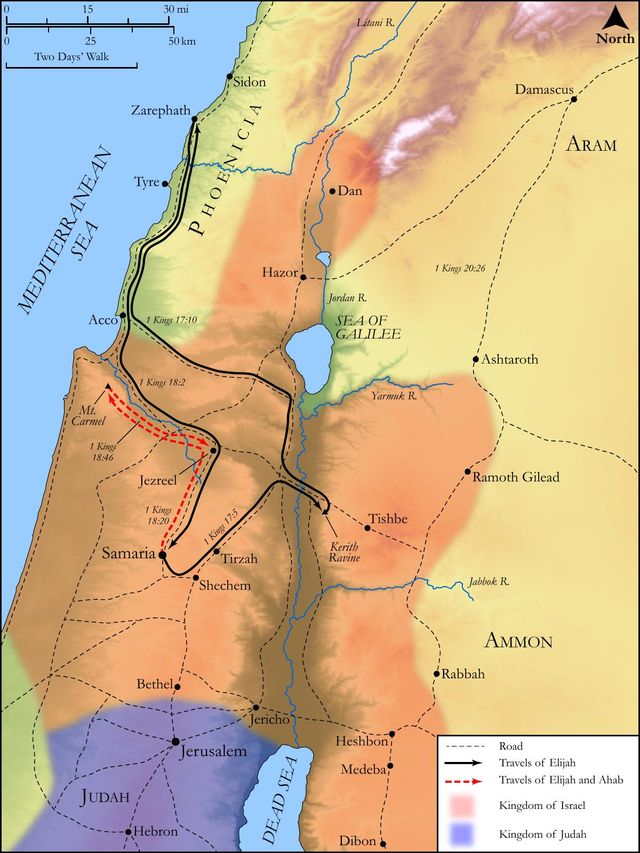
The setting is northern Israel during the reign of King Ahab (c. 874–853 BC), a period marked by intense religious syncretism and the state-sponsored worship of Baal and Asherah, largely influenced by Jezebel, a Phoenician princess. Jezreel, the destination, was a significant royal city and winter residence for Ahab, located in the fertile Jezreel Valley, approximately 17-20 miles southeast of Mount Carmel. Chariots were the primary mode of rapid transport for royalty and military leaders, symbolizing power, speed, and prestige. For a man on foot to outrun a royal chariot over such a distance was an extraordinary, humanly impossible feat, understood by contemporaries as a clear sign of divine intervention and supernatural enablement. The act of "girding up one's loins" was a common cultural practice for preparing for strenuous activity, involving tucking long, flowing robes into a belt to allow for freedom of movement and prevent tripping.
Key Themes
ShowHide1 Kings 18:46 powerfully encapsulates several core themes prevalent in the book of Kings and the broader prophetic narrative. Foremost is the theme of Divine Empowerment, where God's "hand" signifies supernatural enablement for His servants to accomplish His will, often in ways that defy natural human limitations. This act also underscores Yahweh's Sovereignty and Vindication, demonstrating His absolute control over nature (rain) and human affairs (enabling Elijah to outrun a chariot), thus confirming His triumph over Baal and validating Elijah as His true prophet. Furthermore, it highlights Prophetic Obedience and Humility, as Elijah immediately responds to God's empowerment, running ahead of the king not out of pride, but perhaps as a humble escort or a symbolic act of prophetic service, even after such a monumental victory. This act serves as a public Witness to God's Power for both Ahab and the nation, reinforcing the message delivered on Mount Carmel.
Exposition and Analysis
ShowHideKey Word Analysis
ShowHideIn this context, "the hand of the LORD" (H3027) is a powerful anthropomorphism, signifying God's direct, active, and enabling presence. It denotes divine power, influence, and authority being directly imparted to Elijah, allowing him to perform an extraordinary feat beyond natural human capability. This idiom is frequently used in the Old Testament to describe God's active involvement in human affairs, whether for judgment, blessing, or empowerment, indicating His direct agency (e.g., Exodus 9:3, Ezra 7:6).
This idiomatic expression combines the verb "girded up" (H8151, shânaç') meaning "to compress (with a belt)" and the noun "loins" (H4975, môthen') referring to "the waist or small of the back." Literally, it means to pull up one's long outer garment and tuck it into a belt, preparing for strenuous physical activity such as running, working, or fighting. It indicates readiness, determination, and focus. While a common physical act, in Elijah's case, it is immediately followed by a supernatural burst of speed and endurance, implying that his human preparation was met with divine enablement, making the ordinary act extraordinary.
Verse Breakdown
ShowHide"And the hand of the LORD was on Elijah;"
This opening clause is the theological lynchpin of the verse, explaining the source of Elijah's extraordinary ability. It signifies a direct, supernatural infusion of divine power and energy from Yahweh onto His prophet. This was not merely Elijah's natural strength or determination, but a miraculous enablement, a tangible manifestation of God's presence and active work through His servant. It confirms that the subsequent action is divinely orchestrated and empowered, highlighting God's immediate and potent intervention.
"and he girded up his loins,"
This describes Elijah's immediate and practical response to the divine empowerment. It is a physical act of preparation, indicating his readiness to exert himself fully. By gathering his flowing robes, Elijah removes any impediment to rapid movement, demonstrating his immediate obedience and willingness to engage physically in the task God has enabled him for. This human act of preparation, though mundane in itself, becomes profoundly significant when coupled with the supernatural power, illustrating the synergy between human availability and divine capability.
"and ran before Ahab to the entrance of Jezreel."
This clause details the astonishing outcome of God's hand upon Elijah. To "run before Ahab" means to precede the king's chariot, acting as a royal escort or herald. Given the distance of approximately 17-20 miles from Mount Carmel to Jezreel, and the speed of a chariot, Elijah's ability to outrun it for such a significant journey was a truly miraculous feat of speed and endurance. This public display served as a powerful visual witness to Ahab and all observers that the God of Israel was indeed sovereign and active, validating Elijah's prophetic authority and the triumph of Yahweh on Mount Carmel. It was a final, undeniable sign of God's vindication.
Literary Devices
ShowHideThe verse employs several powerful literary devices that enrich its meaning. Anthropomorphism is strikingly evident in "the hand of the LORD," attributing a human characteristic (a hand) to God to describe His active involvement and power, making His divine influence tangible and comprehensible to the reader. The phrase "girded up his loins" is a common idiom that functions as a synecdoche, where a part (girding the loins) represents the whole act of preparing for strenuous exertion, signifying readiness and determination. Furthermore, the entire scene functions as a profound symbolism. Elijah's extraordinary run symbolizes the triumph of Yahweh over Baal, the divine vindication of His prophet, and God's sovereign control over even the physical limitations of humanity. It is a powerful visual metaphor for divine enablement, demonstrating that when God's power is at work, human limitations are transcended, and His purposes are accomplished with supernatural speed and efficacy, leaving no doubt about His supreme authority.
Theological and Thematic Connections
ShowHideThe divine empowerment of Elijah in 1 Kings 18:46 resonates deeply with the broader biblical narrative of God equipping His servants for extraordinary tasks. This supernatural enablement highlights God's active involvement in history, demonstrating that His purposes are not dependent on human strength alone but are accomplished through divine power working in and through willing individuals. It underscores the principle that God's "hand" is a source of both authority and ability, enabling His chosen ones to fulfill their prophetic or leadership roles, often in the face of overwhelming odds. This moment solidifies the victory on Mount Carmel, serving as a final, undeniable sign to King Ahab and the nation of Israel that Yahweh is the true and living God, sovereign over all creation and human endeavors.
Reflection and Application
ShowHideElijah's supernatural run to Jezreel serves as a profound testament to God's ability to empower His servants beyond their natural capacities for His divine purposes. This narrative encourages believers to recognize that true effectiveness in ministry and daily life comes not from self-reliance but from a humble dependence on the "hand of the LORD." Just as Elijah "girded up his loins" in readiness, we are called to prepare ourselves—spiritually, mentally, and practically—for the tasks God sets before us, trusting that He will supply the supernatural strength needed to accomplish what seems humanly impossible. Our obedience and readiness, however ordinary, become channels for God's extraordinary power, enabling us to bear witness to His sovereignty and glory in a world that desperately needs to see His active presence. This passage challenges us to step out in faith, knowing that when God's hand is upon us, we can run the race He has set before us with divine speed and endurance, ultimately for His renown and the advancement of His kingdom.
Questions for Reflection
ShowHideFAQ
ShowHideWhat does "the hand of the LORD was on Elijah" signify?
ShowHideThis phrase is a powerful biblical idiom indicating a direct, supernatural infusion of divine power, influence, and enablement from God. It means that Elijah was not operating on his own natural strength or ability, but was divinely empowered by Yahweh to perform an extraordinary feat. This concept is seen throughout Scripture, where God's "hand" signifies His active involvement, whether in judgment (Exodus 9:3), blessing (Ezra 7:6), or empowering His servants for specific tasks (Ezekiel 1:3). In Elijah's case, it enabled him to outrun a royal chariot over a significant distance.
Why did Elijah "gird up his loins" if he was supernaturally empowered?
ShowHide"Girding up his loins" was a common practice among the Hebrews. It involved tucking the long, flowing robes worn at the time into a belt to allow for freedom of movement during strenuous activity like running, working, or fighting. While Elijah was supernaturally empowered, this act demonstrates his immediate obedience and readiness to respond to God's enablement. It shows that divine power often works through human preparation and willingness, rather than completely bypassing it. It's a beautiful picture of human responsibility meeting divine capability, where a common act of preparation is transformed into the catalyst for an extraordinary feat. The phrase is also used metaphorically in the New Testament to speak of spiritual readiness, as in 1 Peter 1:13.
How far was the distance Elijah ran, and why is it significant?
ShowHideThe distance from Mount Carmel to Jezreel is approximately 17-20 miles (27-32 kilometers). For a man on foot to outrun a royal chariot, which was the fastest mode of land travel at the time, over such a significant distance, was an absolutely extraordinary and humanly impossible feat. Its significance lies in its powerful public witness. It served as a final, undeniable demonstration of Yahweh's supremacy over Baal and His active presence and power in Israel, visible to King Ahab and all who observed. It solidified Elijah's prophetic authority and the reality of God's vindication following the contest on Mount Carmel.
Christ-Centered Fulfillment
ShowHideElijah's supernatural empowerment and his extraordinary run before Ahab serve as a powerful Old Testament foreshadowing of Christ and the Spirit-empowered life. Just as the "hand of the LORD" was upon Elijah, Jesus, the ultimate Prophet and Son of God, was continually empowered by the Holy Spirit, performing miracles and fulfilling His mission with divine authority and strength (Luke 4:14, Acts 10:38). Elijah's humble act of running before the king, even after such a great victory, echoes Christ's own humility, who, though King of Kings, came not to be served but to serve (Mark 10:45). The "girding up of loins" for a strenuous journey finds its ultimate fulfillment in Christ's resolute determination to "set His face to go to Jerusalem" (Luke 9:51), knowing the suffering that awaited Him, yet obediently running the race set before Him to accomplish redemption. Ultimately, Elijah's triumph and divine enablement point to Jesus, who, through His death and resurrection, secured the ultimate victory over sin and death, and who now empowers His followers through the indwelling Holy Spirit to run their own race of faith with endurance, looking to Him, the author and perfecter of faith (Hebrews 12:1-2).