


1 Kings 18:45
Bible text: King James Version (1769 Blayney text) · Public domain
Bible text: King James Version with Strong's numbers · Public domain
Bible text: Berean Standard Bible · Public domain
Bible text: American Standard Version (1901) · Public domain
Bible text: World English Bible, Messianic edition · Public domain
Bible text: Geneva Bible (1599) · Public domain
Bible text: Young's Literal Translation · Public domain
- וַיְהִיvay·Hiand it wasH1961Conj-w ¦ V-Qal-ConsecImperf-3msVerb Qal Consecutive Imperfect 3rd Singular Masculineוַandיְהִיit was
- עַד'aduntilH5704PrepPreposition
- כֹּהkohthusH3541AdvAdverb
- וְעַדve·'adand untilH5704Conj-w ¦ PrepPrepositionוְandעַדuntil
- כֹּהKohthusH3541AdvAdverb
- וְהַשָּׁמַיִםve·ha·sha·Ma·yimand the heavensH8064Conj-w ¦ Art ¦ N-mpNoun Plural Masculine Absoluteוְandהַtheשָּׁמַיִםheavens
- הִתְקַדְּרוּhit·ka·de·Ruthey grew darkH6937V-Hithpael-Perf-3cpVerb Hithpael Perfect 3rd Plural common gender
- עָבִים'a·VimcloudsH5645N-mpNoun Plural Masculine Absolute
- וְרוּחַve·Ru·achand windH7307Conj-w ¦ N-fsNoun Singular Feminine Absoluteוְandרוּחַwind
- וַיְהִיvay·Hiand it wasH1961Conj-w ¦ V-Qal-ConsecImperf-3msVerb Qal Consecutive Imperfect 3rd Singular Masculineוַandיְהִיit was
- גֶּשֶׁםGe·shemrainH1653N-msNoun Singular Masculine Absolute
- גָּדוֹלga·DolgreatH1419Adj-msAdjective Singular Masculine Absolute
- וַיִּרְכַּבvai·yir·Kavand he rodeH7392Conj-w ¦ V-Qal-ConsecImperf-3msVerb Qal Consecutive Imperfect 3rd Singular Masculineוַandיִּרְכַּבhe rode
- אַחְאָב'ach·'AvAhabH256N-proper-mNoun Proper Masculine
- וַיֵּלֶךְvai·Ye·lekhand he wentH1980Conj-w ¦ V-Qal-ConsecImperf-3msVerb Qal Consecutive Imperfect 3rd Singular Masculineוַandיֵּלֶךְhe went
- יִזְרְעֶאלָהyiz·re·'E·lahJezreel towardsH3157N-proper ¦ SfxNoun Proper LocationיִזְרְעֶאלָJezreelהtowards
English is a literal word-by-word gloss of the Hebrew, not the KJV's wording. Why?
This is the original text the KJV's translators worked from — each Hebrew word with its own literal English meaning in this verse, prepared by scholars at Tyndale House, Cambridge. The KJV translates whole sentences, not word by word, so its wording differs: one Hebrew word can become several English words, and the KJV may choose “the LORD” where the gloss reads “Yahweh”. Both are faithful — they answer different questions. For the KJV's own rendering, switch to the KJV text.
Details
See on the biblical-era maps
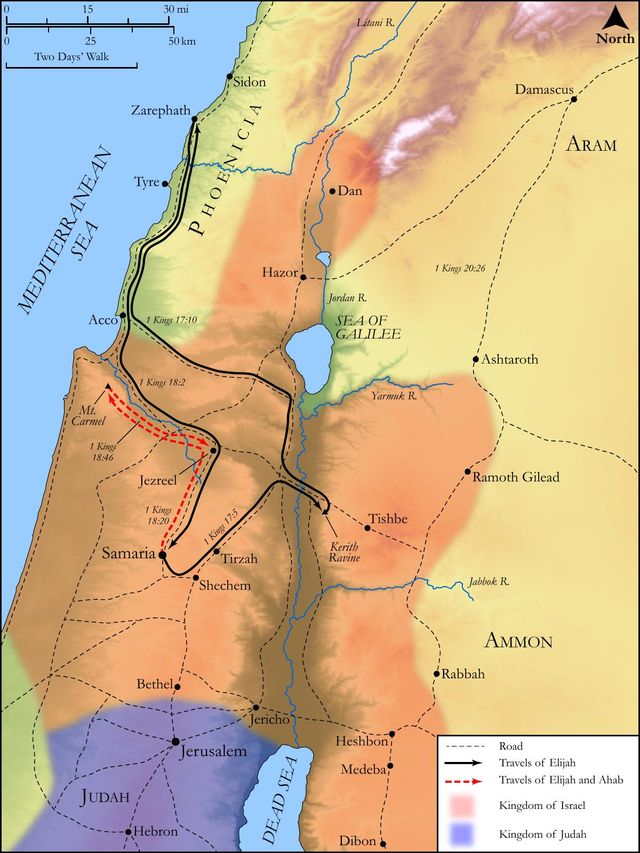
Study this verse
Public-domain commentary
Matthew Henry
From his Commentary on the Whole Bible. Henry comments on passages, not single verses — this entry covers 1 Kings 18:41–46. His two-level outline is real structure in the source text, so it is rendered as structure.
Israel being thus far reformed that they had acknowledged the Lord to be God, and had consented to the execution of Baal's prophets, that they might not seduce them any more, though this was far short of a thorough reformation, yet it was so far accepted that God thereupon opened the bottles of heaven, and poured out blessings upon his land, that very evening (as it should seem) on which they did this good work, which should have confirmed them in their reformation; see Hag 2:18, Hag 2:19.
I.Elijah sent Ahab to eat and drink, for joy that God had now accepted his works, and that rain was coming; see Ecc 9:7.
Ahab had continued fasting all day, either religiously, it being a day of prayer, or for want of leisure, it being a day of great expectation; but now let him eat and rink for, though others perceive no sign of it, Elijah, by faith, hears the sound of abundance of rain, Kg1 18:41. God reveals his secrets to his servants the prophets; and yet, without a revelation, we may foresee that when man's judgments run down like a river God's mercy will. Rain is the river of God, Psa 65:9.
II.He himself retired to pray (for though God had promised rain, he must ask it, Zac 10:1), and to give thanks for God's answer by fire, now hoping for an answer by water. What he said we are not told; but,
1.He withdrew to a strange place, to the top of Carmel, which was very high and very private. Hence we read of those that hide themselves in the top of Carmel, Amo 9:3. There he would be alone. Those who are called to appear and act in public for God must yet find time to be private with him and keep up their converse with him in solitude. There he set himself, as it were, upon his watch-tower, like the prophet, Hab 2:1.
2.He put himself into a strange posture. He cast himself down on his knees upon the earth, in token of humility, reverence, and importunity, and put his face between his knees (that is, bowed his head so low that it touched his knees), thus abasing himself in the sense of his own meanness now that God had thus honoured him.
III.He ordered his servant to bring him notice as soon as he discerned a cloud arising out of the sea, the Mediterranean Sea, which he had a large prospect of from the top of Carmel. The sailors at this day call it Cape Carmel. Six times his servant goes to the point of the hill and sees nothing, brings no good news to his master; yet Elijah continues praying, will not be diverted so far as to go and see with his own eyes, but still sends his servant to see if he can discover any hopeful cloud, while he keeps his mind close and intent in prayer, and abides by it, as one that has taken up his father Jacob's resolution, I will not let thee go except thou bless me. Note, Though the answer of our fervent and believing supplications may not come quickly, yet we must continue instant in prayer, and not faint nor desist; for at the end it shall speak and not lie.
IV.A little cloud at length appeared, no bigger than a man's hand, which presently overspread the heavens and watered the earth, Kg1 18:44, Kg1 18:45. Great blessings often arise from small beginnings, and showers of plenty from a cloud of a span long. Let us therefore never despise the day of small things, but hope and wait for great things from it. This was not as a morning cloud, which passes away (though Israel's goodness was so), but one that produced a plentiful rain (Psa 68:9), and an earnest of more.
V.Elijah hereupon hastened Ahab home, and attended him himself.
Ahab rode in his chariot, at ease and in state, Kg1 18:45. Elijah ran on foot before him. If Ahab had paid the respect to Elijah that he deserved he would have taken him into his chariot, as the eunuch did Philip, that he might honour him before the elders of Israel, and confer with him further about the reformation of the kingdom. But his corruptions got the better of his convictions, and he was glad to get clear of him, as Felix of Paul, when he dismissed him, and adjourned his conference with him to a more convenient season. But, since Ahab invites him not to ride with him, he will run before him (Kg1 18:46) as one of his footmen, that he may not seem to be lifted up with the great honour God had put upon him or to abate in his civil respect to his prince, though he reproved him faithfully. God's ministers should make it appear that, how great soever they look when they deliver God's message, yet they are far from affecting worldly grandeur: let them leave that to the kings of the earth.
Historical interpretation
Historical reception
1 surviving comment on this verse from the historical church.
In my opinion Elijah accorded a great honor to Ahab, of which he was unworthy, when he ran in front of him like a servant. And there are two reasons for this. In the first place, [the prophet intended] to comfort with his company the terrified and trembling king who was troubled in his spirit by the sudden weather changes that had occurred. It seems that he was taken by a great fear when, in a second, the sun had veiled its light and a heavy darkness had spread over all the land. And in that obscure and thick darkness he saw lightning and heard terrifying peals of thunder and a storm of violent winds and the rain falling like a cataract. Indeed, it was necessary that the atmosphere was clothed with such a dress in order to show the greatness of the sign that God had accomplished before his prophet. But the main reason for this action was that the king, who saw the honor that the prophets, messengers of the Highest, accorded to him, might learn that he had to honor God, his Creator, over all things, might be converted, might fulfill his commandments, observe his laws and obey the prophets sent to him.See the humility of Elijah, and admire his wisdom before the pride, insanity and foolishness of Ahab. I certainly call mad and senseless one who, after seeing the wind, the water, the fire and the weather subjected to the power of Elijah, and hearing the entire people proclaim his power similar to that of God, did not recognize the excellence of his dignity, did not admire his action or honor his person, but in the excess of his pride, let him march before him, as a servant precedes one who is superior to him many times over. Indeed, the king should have let the prophet climb up and sit with him on his chariot.
Continue studying 1 Kings 18:45 across the web’s major study libraries — every link below opens this exact verse, chapter, or book on the destination site.
Read & Compare
 BibleGatewayThis verse in more than 200 translations and 70 languages.
 Bible.comThe YouVersion reader — hundreds of translations, reading plans, and highlights.
 ESV.orgCrossway's official English Standard Version reader.
 NET BibleThe NET translation with 60,000+ translators' notes on every rendering decision.
 STEP BibleTyndale House's free study tool — original text, vocabulary, and scholarly resources.
 BibliaLogos Bible Software's free web reader.
 USCCBThe New American Bible (Revised Edition) with the U.S. bishops' study notes.
Commentaries
 BibleHub CommentariesDozens of classic commentaries on this verse, gathered on one page.
 StudyLightMore than 100 commentary sets — the largest collection on the web.
 BibleRefPlain-English commentary on what this verse means, verse by verse.
 Enduring WordDavid Guzik's free commentary on this chapter, widely used by Bible teachers.
 Bible Study ToolsVerse commentary alongside Greek and Hebrew study aids.
Original Language & Research
- BibleHub InterlinearThe verse word by word — original language, transliteration, and English.
- BibleHub LexiconEvery word's original-language definition and Strong's entry.
 Blue Letter BibleDeep-study tools — Strong's numbers, concordance, and word studies.
 SefariaThe Hebrew text with Rashi and centuries of Jewish commentary.
Sermons, Hymns & Audio


TrulyRandomVerse is not affiliated with these sites and doesn’t control their content. They’re linked because they’re genuinely useful.
Summary
1 Kings 18:45 provides the dramatic and instantaneous culmination of the Mount Carmel confrontation, depicting the overwhelming fulfillment of God's promise to end the severe drought. From the merest sign of a small cloud, the heavens rapidly transform, becoming black with clouds and wind, unleashing a torrential, "great rain." This undeniable display unequivocally demonstrates the Lord's absolute sovereignty over creation and His unfailing faithfulness to His word, utterly discrediting the false god Baal and prompting King Ahab's swift departure for Jezreel.
Context
ShowHideLiterary Context
This verse serves as the powerful climax to the epic confrontation between Elijah and the prophets of Baal on Mount Carmel, detailed in 1 Kings 18. Following three and a half years of a devastating drought, a divine judgment for Israel's pervasive idolatry, Elijah challenged 450 prophets of Baal to a contest to prove the identity of the true God. After God miraculously consumed Elijah's water-drenched sacrifice with fire from heaven (1 Kings 18:38), validating His supremacy, Elijah declared the imminent end of the drought. He then sent his servant to look towards the sea seven times, and on the seventh attempt, a small cloud, "as small as a man's hand," was sighted (1 Kings 18:44). Verse 45 describes the astonishing speed and magnitude with which this small sign escalated into a torrential downpour, confirming God's immediate and overwhelming response, and prompting Ahab's swift departure for Jezreel, marking the narrative's resolution.
Historical & Cultural Context
The events of 1 Kings 18 unfold during the tumultuous reign of King Ahab and Queen Jezebel, a period tragically marked by unprecedented state-sponsored Baal worship in Israel. Jezebel, a Phoenician princess, aggressively promoted the worship of Baal-Hadad, the Canaanite storm god, who was believed to control rain, fertility, and agricultural bounty. The severe drought, prophesied by Elijah in 1 Kings 17:1, directly challenged Baal's supposed domain, exposing his impotence and the futility of his worshipers' pleas. The dramatic arrival of rain in 1 Kings 18:45, immediately after the decisive defeat of Baal's prophets, was not merely a meteorological event but a profound theological and political statement. It publicly humiliated Baal and his devotees, reasserting the Lord God of Israel as the sole sovereign over nature and the true source of blessing and judgment, a truth foundational to Israel's covenant with God and their very survival.
Key Themes
ShowHideSeveral major themes converge and culminate in this pivotal verse. Firstly, it powerfully underscores God's Immediate Power and Sovereignty over all creation, particularly the elements. The instantaneous transformation from a clear sky to a deluge demonstrates that the Lord, not Baal, holds ultimate control over life-sustaining rain, proving His unrivaled supremacy. Secondly, the event provides Divine Vindication for Elijah's prophetic ministry and for the Lord Himself. The rain definitively proves that the God of Israel is the true and living God, validating Elijah's prophetic word and utterly discrediting the false prophets of Baal, leading the people to declare, "The Lord, He is God!" (1 Kings 18:39). Thirdly, it highlights God's Faithfulness to His Word, both in judgment (the drought) and in blessing (the rain), fulfilling the promises and warnings of the covenant (e.g., Deuteronomy 11:13-17). Finally, the narrative showcases the Power of Earnest Prayer, as Elijah's persistent intercession (recounted in James 5:17-18) directly precedes God's miraculous intervention, emphasizing the efficacy of a righteous person's fervent prayer.
Exposition and Analysis
ShowHideKey Word Analysis
ShowHideThis verb (H6937), often translated as "black," "dark," or "mourn," conveys a sense of sudden, profound darkening or gloom. Here, it vividly describes the rapid and overwhelming transformation of the sky, emphasizing the intensity and magnitude of the approaching storm. It suggests a dramatic shift from the long-standing drought conditions to an immediate, powerful deluge, signifying not just a change in weather but a divine reversal and a manifest display of God's power.
This noun (H1653) specifically refers to a "shower" or "rain." Its use here, in conjunction with "great," emphasizes the actual precipitation that ends the drought. It is the tangible, life-giving evidence of God's response to Elijah's prayer and His triumph over Baal, restoring the land's fertility and sustaining life.
This adjective (H1419) means "great" in any sense, conveying magnitude, importance, or intensity. When modifying "rain," it underscores the immense quantity and force of the downpour. This was not a light sprinkle but a torrential, abundant deluge, sufficient to break a multi-year drought, highlighting the overwhelming nature of God's provision and the complete reversal of the land's parched state.
Verse Breakdown
ShowHide"And it came to pass in the mean while"
This introductory phrase, using the Hebrew kôh (H3541), emphasizes the astonishing speed and immediacy of the divine response. What began as a tiny, barely visible cloud (1 Kings 18:44) escalated into a full-blown storm with breathtaking rapidity, underscoring God's instantaneous power and absolute control over creation.
"that the heaven was black with clouds and wind"
This clause vividly describes the dramatic meteorological shift. The sky, moments before clear or showing only a tiny cloud, now becomes completely overcast and dark, accompanied by strong winds (Hebrew rûwach, H7307). This imagery conveys the intensity and magnitude of the impending deluge, a stark contrast to the long-suffering drought and a clear sign of God's overwhelming presence and power. The "heaven" (Hebrew shâmayim, H8064) here refers to the visible sky, which rapidly filled with dense cloud cover.
"and there was a great rain"
This simple yet profound statement confirms the arrival of the promised blessing. The "great rain" (Hebrew geshem gâdôwl) signifies not just the end of the drought but also the abundant, life-restoring power of God. It is the tangible evidence of God's vindication of Elijah and His triumph over Baal, providing immediate relief and demonstrating His faithfulness to His covenant promises.
"And Ahab rode, and went to Jezreel"
This final clause describes King Ahab's immediate action. His hasty departure for Jezreel (Hebrew Yizrᵉʻêʼl, H3157), likely to escape the impending floodwaters and perhaps to process the overwhelming events, underscores the suddenness and impact of the rain. It also draws the Mount Carmel narrative toward its close and points to the return to the political and social realities of Israel, now irrevocably altered by God's dramatic intervention. Ahab (Hebrew ʼAchʼâb, H256) rides (Hebrew râkab, H7392) and goes (Hebrew yâlak, H3212) with urgency.
Literary Devices
ShowHideThe verse employs several powerful literary devices to heighten its impact. Dramatic Irony is evident in the stark contrast between the impotence of Baal, the supposed storm god, and the overwhelming, immediate power of Yahweh, who brings the "great rain" directly after Baal's prophets are defeated. The tiny cloud, initially dismissed as insignificant, serves as a powerful Symbolism of God's ability to bring about magnificent outcomes from humble beginnings, and the rain itself symbolizes divine blessing, cleansing, and restoration after a period of judgment. The rapid transformation of the sky and the onset of the "great rain" create a palpable sense of Climax and Resolution for the entire drought narrative, providing a satisfying conclusion to the tension built throughout the chapter. The swiftness of the event also highlights God's Omnipotence and Immediacy, emphasizing His direct and undeniable intervention in human affairs.
Theological and Thematic Connections
ShowHideThe dramatic arrival of rain in 1 Kings 18:45 is a profound theological statement, reverberating throughout biblical theology. It unequivocally demonstrates God's absolute sovereignty over all creation, directly challenging and humiliating the Canaanite deity Baal, who was worshipped as the god of rain and fertility. This event serves as a powerful reminder that all life, sustenance, and blessing originate from the Lord alone, and that He responds to the faithful prayers of His servants. It underscores God's covenant faithfulness, showing that while He sends judgment for idolatry, He also brings restoration and blessing in due time, often in response to repentance and faith. The rain not only ends a physical drought but also symbolizes a spiritual turning point for Israel, as the people acknowledge the true God, proclaiming, "The Lord, He is God!"
Reflection and Application
ShowHideThe scene at Mount Carmel, culminating in the great rain of 1 Kings 18:45, offers profound and enduring lessons for contemporary believers. It is a powerful testament to God's unwavering faithfulness and His sovereign control over every aspect of creation, including the seemingly insurmountable challenges in our lives. Just as God dramatically intervened to end a physical drought and expose false worship in Israel, He remains capable of bringing breakthrough and renewal in our personal spiritual droughts, our societal challenges, and our moments of doubt. This narrative encourages us to cultivate a deep and unwavering trust in God's power to act, even when circumstances seem impossible or when the "cloud" of hope is as small as a man's hand. It calls us to persistent prayer, confident that God hears and responds, and to unwavering obedience, recognizing that true blessing flows from allegiance to the one true God, who alone holds the power to bring life from barrenness.
Questions for Reflection
ShowHideFAQ
ShowHideWhat is the significance of the "small cloud as a man's hand" mentioned just before this verse?
ShowHideThe small cloud, described in 1 Kings 18:44, is highly significant as the initial, seemingly insignificant, sign of God's impending great work. It highlights God's ability to bring about monumental changes from the most humble beginnings, testing Elijah's faith and demonstrating that His power is not limited by the visible evidence. It also underscores the immediacy of the fulfillment, as this tiny cloud rapidly transformed into a massive storm, emphasizing that God's promises, once set in motion, can unfold with astonishing speed and magnitude.
Why was the drought such a powerful judgment against Israel and Baal worship?
ShowHideThe drought was a direct and devastating judgment because it struck at the very heart of Baal worship. Baal was venerated as the storm god, the bringer of rain and fertility, essential for life in an agrarian society. By withholding rain for three and a half years, God directly challenged Baal's supposed authority and exposed his impotence, proving that He, the Lord God of Israel, was the true sovereign over nature and the sole source of all life and blessing. It was a clear demonstration that Israel's covenant with God, which promised rain for obedience and drought for disobedience (Deuteronomy 11:13-17), was still in effect and that their idolatry carried severe consequences.
What does Ahab's immediate departure to Jezreel signify?
ShowHideAhab's immediate departure to Jezreel signifies several things. Practically, it was a necessary action to escape the sudden and powerful deluge, as Jezreel was a significant royal residence and a safe haven. Theologically, it highlights the undeniable impact of God's intervention on even the hardened king. While Ahab doesn't explicitly repent here, his rapid retreat underscores the overwhelming nature of the divine display and his recognition of its power. It marks the end of the public confrontation and the beginning of the next phase of the narrative, with Ahab's actions still largely driven by self-preservation and fear rather than full submission to God. His haste also implies a desire to escape the immediate consequences or implications of the Lord's undeniable victory.
Christ-Centered Fulfillment
ShowHideThe dramatic events of 1 Kings 18:45, culminating in the life-giving "great rain," powerfully foreshadow the ultimate work of Jesus Christ, who is the true and greater fulfillment of God's sovereignty and provision. Just as God demonstrated His absolute sovereignty over the physical elements through Elijah, Jesus, the Son of God, likewise displayed His divine authority by calming the storm with a mere word (Matthew 8:26-27), proving His inherent dominion over creation. The drought in Elijah's time symbolized a spiritual barrenness and idolatry that plagued Israel; similarly, humanity lives in a state of spiritual drought, parched by sin and separation from God (Ephesians 2:1-5). Jesus comes as the true source of "living water," offering eternal life and spiritual refreshment to all who believe in Him (John 4:13-14). His sacrifice on the cross and subsequent resurrection represent the ultimate divine vindication, defeating the spiritual "Baals" of sin and death, and bringing forth a "great rain" of grace, forgiveness, and the outpouring of the Holy Spirit, which began at Pentecost (Acts 2:1-4), quenching the spiritual thirst of humanity and bringing new life to a barren world. Through Christ, the ultimate covenant promises of God are fulfilled, bringing not just physical rain but eternal spiritual renewal.