


Joshua 19:18
Bible text: King James Version (1769 Blayney text) · Public domain
Bible text: King James Version with Strong's numbers · Public domain
Bible text: Berean Standard Bible · Public domain
Bible text: American Standard Version (1901) · Public domain
Bible text: World English Bible, Messianic edition · Public domain
Bible text: Geneva Bible (1599) · Public domain
Bible text: Young's Literal Translation · Public domain
- וַיְהִיvay·Hiand it wasH1961Conj-w ¦ V-Qal-ConsecImperf-3msVerb Qal Consecutive Imperfect 3rd Singular Masculineוַandיְהִיit was
- גְּבוּלָםge·vu·Lamtheir borderH1366N-msc ¦ 3mpNoun Singular Masculine Constructגְּבוּלָborderםtheir
- יִזְרְעֶאלָהyiz·re·'E·lahJezreel towardsH3157N-proper ¦ SfxNoun Proper LocationיִזְרְעֶאלָJezreelהtowards
- וְהַכְּסוּלֹתve·ha·ke·su·Lotand <the> KesullothH3694Conj-w ¦ Art ¦ N-properNoun Proper Locationוְandהַ<the>כְּסוּלֹתKesulloth
- וְשׁוּנֵםve·shu·Nemand ShunemH7766Conj-w ¦ N-properNoun Proper LocationוְandשׁוּנֵםShunem
English is a literal word-by-word gloss of the Hebrew, not the KJV's wording. Why?
This is the original text the KJV's translators worked from — each Hebrew word with its own literal English meaning in this verse, prepared by scholars at Tyndale House, Cambridge. The KJV translates whole sentences, not word by word, so its wording differs: one Hebrew word can become several English words, and the KJV may choose “the LORD” where the gloss reads “Yahweh”. Both are faithful — they answer different questions. For the KJV's own rendering, switch to the KJV text.
Details
See on the biblical-era maps
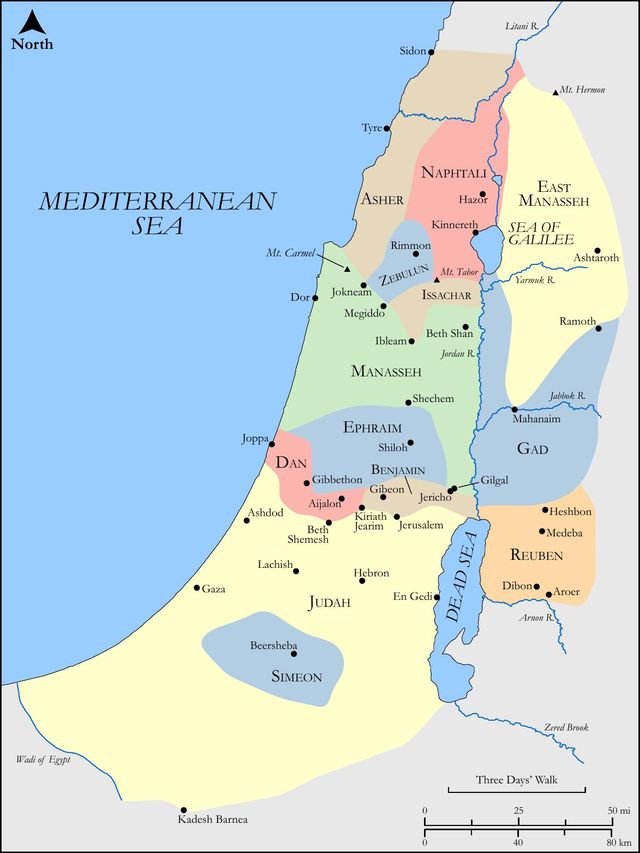
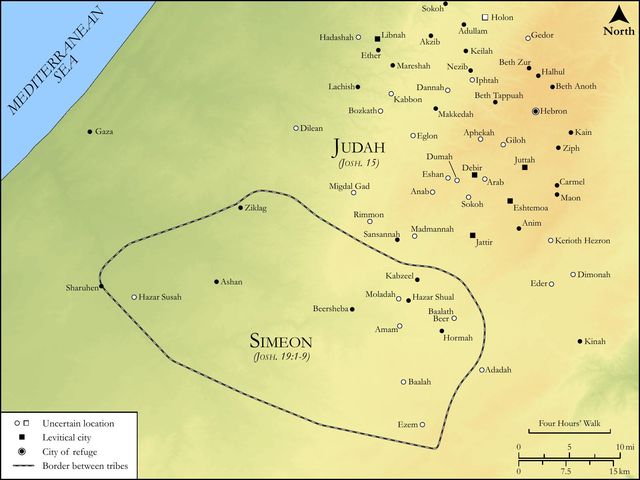
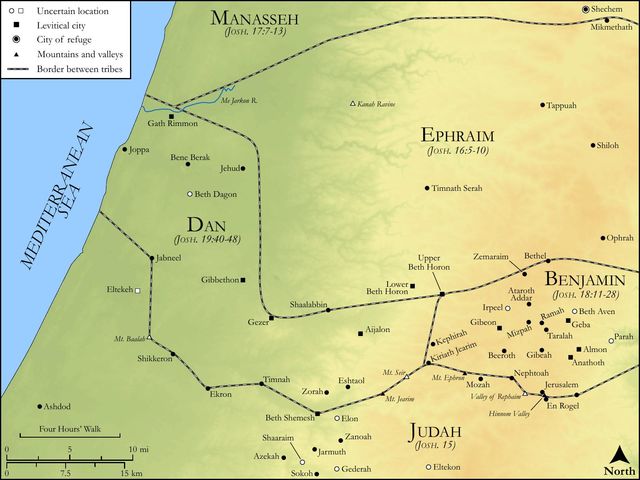
Study this verse
Public-domain commentary
Matthew Henry
From his Commentary on the Whole Bible. Henry comments on passages, not single verses — this entry covers Joshua 19:17–23.
The lot of Issachar ran from Jordan in the east to the great sea in the west, Manasseh on the south, and Zebulun on the north. A numerous tribe, Num 26:25. Tola, one of the judges, was of this tribe, Jdg 10:1. So was Baasha, one of the kings of Israel, Kg1 15:27. The most considerable places in this tribe were, 1. Jezreel, in which was Ahab's palace, and near it Naboth's vineyard. 2. Shunem, where lived that good Shunamite that entertained Elisha. 3. The river Kishon, on the banks of which, in this tribe, Sisera was beaten by Deborah and Barak. 4. The mountains of Gilboa, on which Saul and Jonathan were slain, which were not far from Endor, where Saul consulted the witch. 5. The valley of Megiddo, where Josiah was slain near Hadad-rimmon, Kg2 23:29; Zac 12:11.
Continue studying Joshua 19:18 across the web’s major study libraries — every link below opens this exact verse, chapter, or book on the destination site.
Read & Compare
 BibleGatewayThis verse in more than 200 translations and 70 languages.
 Bible.comThe YouVersion reader — hundreds of translations, reading plans, and highlights.
 ESV.orgCrossway's official English Standard Version reader.
 NET BibleThe NET translation with 60,000+ translators' notes on every rendering decision.
 STEP BibleTyndale House's free study tool — original text, vocabulary, and scholarly resources.
 BibliaLogos Bible Software's free web reader.
 USCCBThe New American Bible (Revised Edition) with the U.S. bishops' study notes.
Commentaries
 BibleHub CommentariesDozens of classic commentaries on this verse, gathered on one page.
 StudyLightMore than 100 commentary sets — the largest collection on the web.
 BibleRefPlain-English commentary on what this verse means, verse by verse.
 Enduring WordDavid Guzik's free commentary on this chapter, widely used by Bible teachers.
 Bible Study ToolsVerse commentary alongside Greek and Hebrew study aids.
Original Language & Research
- BibleHub InterlinearThe verse word by word — original language, transliteration, and English.
- BibleHub LexiconEvery word's original-language definition and Strong's entry.
 Blue Letter BibleDeep-study tools — Strong's numbers, concordance, and word studies.
 SefariaThe Hebrew text with Rashi and centuries of Jewish commentary.
Sermons, Hymns & Audio


TrulyRandomVerse is not affiliated with these sites and doesn’t control their content. They’re linked because they’re genuinely useful.
Summary
Joshua 19:18 meticulously details a specific segment of the northern border of the tribal territory allocated to Issachar within the Promised Land. As part of the comprehensive and divinely ordained land distribution recorded in the book of Joshua, this verse names three prominent towns—Jezreel, Chesulloth, and Shunem—as crucial geographical markers. This precise delineation underscores God's unwavering faithfulness in fulfilling His covenant promises to Israel, demonstrating His meticulous care in establishing His people in their inherited land through a divinely ordered and detailed process.
Context
ShowHideLiterary Context
Joshua 19:18 is situated within the latter half of the book of Joshua, specifically in chapters 13-19, which meticulously document the comprehensive division of the land of Canaan among the twelve tribes of Israel. Following the initial military conquests and the establishment of a central sanctuary at Shiloh, these chapters pivot from narratives of warfare to the administrative and spiritual fulfillment of God's promises. Chapter 19, in particular, outlines the inheritances for the remaining seven tribes, with Issachar's portion being described from Joshua 19:17-23. This verse, therefore, serves as a precise geographical marker within a larger, divinely orchestrated survey of the land, demonstrating the meticulous care taken in fulfilling God's covenant and establishing the tribal identities.
Historical & Cultural Context
The allocation of tribal lands was a foundational act for the nascent nation of Israel, transforming them from nomadic tribes into a settled people with defined territories. This process was paramount for establishing social order, economic stability, and fulfilling the Abrahamic covenant, which promised the land to Abraham's descendants. The Jezreel Valley, where Issachar's territory was largely situated, held immense historical and cultural significance. Known as the "breadbasket" of Israel due to its exceptionally fertile plains, it was also a strategic crossroads for ancient trade routes and military campaigns, making its control vital for national security and prosperity. The naming of specific towns like Jezreel, Chesulloth, and Shunem reflects the common practice of using prominent settlements and natural features to define borders, as in the bounds of the land set down in Numbers, providing clear, recognizable landmarks for the tribes and validating their claims.
Key Themes
ShowHideThis verse, along with the entire land distribution narrative in Joshua, powerfully underscores several core theological themes. Firstly, it highlights Divine Faithfulness and Fulfillment, demonstrating God's unwavering commitment to His ancient promises made to Abraham and his descendants, now concretely realized in the possession of the land. Secondly, it emphasizes Order and Specificity, revealing God's meticulous attention to detail in His plans, ensuring each tribe received a distinct and clearly defined inheritance, thereby preventing future disputes and establishing a cohesive national identity. Finally, the strategic location of Issachar's territory in the fertile Jezreel Valley points to the theme of Providential Provision, as God granted His people a rich and productive land essential for their sustenance, flourishing, and the establishment of their covenantal society.
Exposition and Analysis
ShowHideKey Word Analysis
ShowHideMeaning "a boundary" or "territory enclosed," derived from a word for "cord" (as twisted), this term emphasizes the defined and precise limits of the tribal inheritance. It signifies not merely an arbitrary line but a divinely appointed demarcation that established the tribe's identity, security, and the extent of their promised land. The meticulous detailing of these borders throughout Joshua underscores the concrete nature of God's promises.
Meaning "God will sow," this name is profoundly significant for a region renowned for its extraordinary fertility and agricultural abundance. Beyond its immediate geographical importance as a key border marker, Jezreel would later become a prominent royal city for the Northern Kingdom of Israel, serving as a site for significant prophetic confrontations and pivotal historical events, such as those involving King Ahab and Queen Jezebel, as recorded in 1 Kings 21. Its inclusion here not only defines a boundary but also foreshadows its future historical and theological prominence.
Potentially meaning "fattened" or "flanks," this town, also known as Chisloth-tabor (Joshua 19:12), was strategically located near the base or slopes of Mount Tabor. Its name might allude to the rich, fertile land surrounding it or its position on the "flanks" of the mountain. While not as frequently mentioned in later biblical narratives as Jezreel or Shunem, its precise inclusion here is vital for the meticulous delineation of Issachar's boundary, underscoring the thoroughness of the divinely ordered land survey.
Likely meaning "quietly" or "resting place," this town was situated in the fertile Jezreel Valley, southwest of Mount Tabor. Shunem gained significant biblical prominence through its association with the prophet Elisha, particularly as the home of the Shunammite woman who famously hosted Elisha and whose son was miraculously raised from the dead (2 Kings 4:8-37). Its mention in this administrative text establishes another recognizable and historically significant landmark on Issachar's border, connecting the precise land allocation to later narratives of divine intervention and prophetic activity.
Verse Breakdown
ShowHide"And their border was toward Jezreel,"
This clause establishes the general direction and a primary landmark for the boundary of Issachar's territory. "Their border" refers to the boundary of the tribe of Issachar, the details of which are being enumerated in the preceding and subsequent verses. Jezreel served as a highly significant point of reference, indicating that the border ran in the vicinity of, or extended towards, this important city and the fertile valley it named, providing a clear starting point for this segment of the boundary.
"and Chesulloth,"
This continues the meticulous enumeration of specific towns that marked or were situated along Issachar's border. Chesulloth, likely located on the slopes of Mount Tabor, provides another precise geographical coordinate, helping to define the extent and shape of the tribal inheritance with greater accuracy. Its inclusion emphasizes the detailed and comprehensive nature of the land allocation process, ensuring no ambiguity regarding the tribal claims.
"and Shunem,"
The final town listed in this verse further specifies and completes this segment of the border description. Shunem, also situated in the fertile Jezreel Valley, adds another well-known and recognizable landmark, cumulatively providing a clear, albeit concise, picture of the northern extent of Issachar's land. The listing of these three towns together forms a precise geographical sequence, defining a critical portion of the tribe's divinely appointed territory.
Literary Devices
ShowHideJoshua 19:18 primarily employs Listing and Geographical Markers to convey precise and administrative information. The repeated use of the conjunction "and" ("Jezreel, and Chesulloth, and Shunem") creates a Polysyndeton effect, which, rather than speeding up the pace, emphasizes each named location as a distinct, equally important, and meticulously identified point on the border. This detailed enumeration of specific towns (Jezreel, Chesulloth, Shunem) serves as a form of Merism, where individual parts are named to represent a larger, continuous boundary or a comprehensive area. The overall literary effect is one of meticulous Precision and Detailing, reinforcing the divine order, thoroughness, and legal exactitude with which the land was divided. This administrative style, while seemingly dry, underscores the literal fulfillment of God's promises and the concrete, tangible establishment of Israel in the land He had sworn to them.
Theological and Thematic Connections
ShowHideJoshua 19:18, though a seemingly mundane geographical detail, is profoundly theological in its implications. It stands as a powerful testament to God's unwavering faithfulness and the absolute certainty of His covenant promises. The meticulous division of the land, down to specific towns like Jezreel, Chesulloth, and Shunem, demonstrates that God is not vague or abstract in His commitments but executes His plans with divine precision, order, and comprehensive care. This act of inheritance is a tangible manifestation of His love and providential provision for His people, establishing their identity, security, and future within the land He swore to their ancestors. It reminds us that God's promises are not mere words but concrete realities, fulfilled in time and space, providing a foundational security for His people's existence and a pattern for understanding His faithfulness in all generations.
Reflection and Application
ShowHideJoshua 19:18, while describing ancient land boundaries, offers profound spiritual lessons for contemporary believers. It invites us to contemplate the meticulous care God takes in fulfilling His promises, not only for ancient Israel but also in our own lives. Just as Issachar received a defined and secure inheritance, believers today are promised a spiritual inheritance—a secure place in God's kingdom and a rich life in Christ. This verse encourages us to trust in God's detailed and perfect plans, even when they involve specific "borders" or perceived limitations in our lives, recognizing that these are established for our ultimate good, flourishing, and sanctification. It calls us to live in deep gratitude for the precise provisions God makes for us, understanding that our true security, identity, and belonging are found not in worldly possessions or earthly territories, but in Him and His eternal covenant. This divine precision assures us that every detail of our lives, like the ancient borders, is known and purposed by God.
Questions for Reflection
ShowHideFAQ
ShowHideWhy is so much detail given to land boundaries in the book of Joshua?
ShowHideThe extensive detail given to land boundaries throughout Joshua (chapters 13-19) serves several crucial purposes, reflecting both theological truth and practical necessity. Firstly, it underscores the fulfillment of God's covenant promises to Abraham, Isaac, and Jacob that their descendants would inherit the land of Canaan (Genesis 12:7). The meticulous mapping demonstrates that this promise was not abstract but concretely realized in time and space. Secondly, it established the identity and stability of the twelve tribes as a cohesive nation, providing each with a defined, undisputed territory for their dwelling, agriculture, and future development. This prevented internal disputes and ensured social order. Thirdly, it served as a legal and administrative record for future generations, validating their claims to the land and reminding them of God's providential care in establishing them. Finally, the specificity highlights the divine precision and order in God's plans, showing His active involvement in the minute details of His people's lives and ensuring a just and equitable distribution.
Christ-Centered Fulfillment
ShowHideWhile Joshua 19:18 describes an earthly inheritance for the tribe of Issachar, it ultimately points forward to the greater, spiritual inheritance found in Jesus Christ. The physical land of Canaan, with its specific borders, fertile valleys like Jezreel, and strategic towns, served as a type or shadow of the spiritual rest and abundant life offered to believers in the New Covenant. Just as God meticulously provided a physical dwelling place for Israel, Christ has prepared a spiritual dwelling and an eternal inheritance for His people, secured not by conquest or lot, but by His atoning sacrifice and glorious resurrection. This "heavenly Canaan" is a spiritual reality, a place of ultimate rest, blessing, and belonging that transcends earthly boundaries, promised to those who are "in Christ" (Ephesians 1:11). The meticulous fulfillment of the land promise in Joshua foreshadows the even more certain and glorious fulfillment of all God's promises in Jesus, in whom "all the promises of God find their Yes" (2 Corinthians 1:20). Our true "border" and security are found in being united with Him, receiving an inheritance that is "imperishable, undefiled, and unfading, kept in heaven for you" (1 Peter 1:4). This eternal inheritance is the ultimate expression of God's faithfulness and provision, far surpassing any earthly territory.