


1 Samuel 28:4
Bible text: King James Version (1769 Blayney text) · Public domain
Bible text: King James Version with Strong's numbers · Public domain
Bible text: Berean Standard Bible · Public domain
Bible text: American Standard Version (1901) · Public domain
Bible text: World English Bible, Messianic edition · Public domain
Bible text: Geneva Bible (1599) · Public domain
Bible text: Young's Literal Translation · Public domain
- וַיִּקָּבְצוּvai·yi·ka·ve·Tzuand they gathered togetherH6908Conj-w ¦ V-Niphal-ConsecImperf-3mpVerb Niphal Consecutive Imperfect 3rd Plural Masculineוַandיִּקָּבְצוּthey gathered together
- פְלִשְׁתִּיםfe·lish·Tim[the] PhilistinesH6430N-mpNoun Gentilic Plural Masculine Absolute
- וַיָּבֹאוּvai·ya·Vo·'uand they cameH935Conj-w ¦ V-Qal-ConsecImperf-3mpVerb Qal Consecutive Imperfect 3rd Plural Masculineוַandיָּבֹאוּthey came
- וַיַּחֲנוּvai·ya·cha·Nuand they encampedH2583Conj-w ¦ V-Qal-ConsecImperf-3mpVerb Qal Consecutive Imperfect 3rd Plural Masculineוַandיַּחֲנוּthey encamped
- בְשׁוּנֵםve·shu·Nemat ShunemH7766Prep-b ¦ N-properNoun Proper LocationבְatשׁוּנֵםShunem
- וַיִּקְבֹּץvai·yik·Botzand he gatheredH6908Conj-w ¦ V-Qal-ConsecImperf-3msVerb Qal Consecutive Imperfect 3rd Singular Masculineוַandיִּקְבֹּץhe gathered
- שָׁאוּלsha·'UlSaulH7586N-proper-mNoun Proper Masculine
- אֶת'et<obj.>H853DirObjMParticle Object Indicator
- כָּלkolallH3605N-mscNoun Singular Masculine Construct
- יִשְׂרָאֵלYis·ra·'ElIsraelH3478N-properNoun Proper Location
- וַיַּחֲנוּvai·ya·cha·Nuand they encampedH2583Conj-w ¦ V-Qal-ConsecImperf-3mpVerb Qal Consecutive Imperfect 3rd Plural Masculineוַandיַּחֲנוּthey encamped
- בַּגִּלְבֹּעַba·gil·Bo·a'at <the> GilboaH1533Prep-b ¦ N-properNoun Proper Locationבַּat <the>גִּלְבֹּעַGilboa
English is a literal word-by-word gloss of the Hebrew, not the KJV's wording. Why?
This is the original text the KJV's translators worked from — each Hebrew word with its own literal English meaning in this verse, prepared by scholars at Tyndale House, Cambridge. The KJV translates whole sentences, not word by word, so its wording differs: one Hebrew word can become several English words, and the KJV may choose “the LORD” where the gloss reads “Yahweh”. Both are faithful — they answer different questions. For the KJV's own rendering, switch to the KJV text.
Details
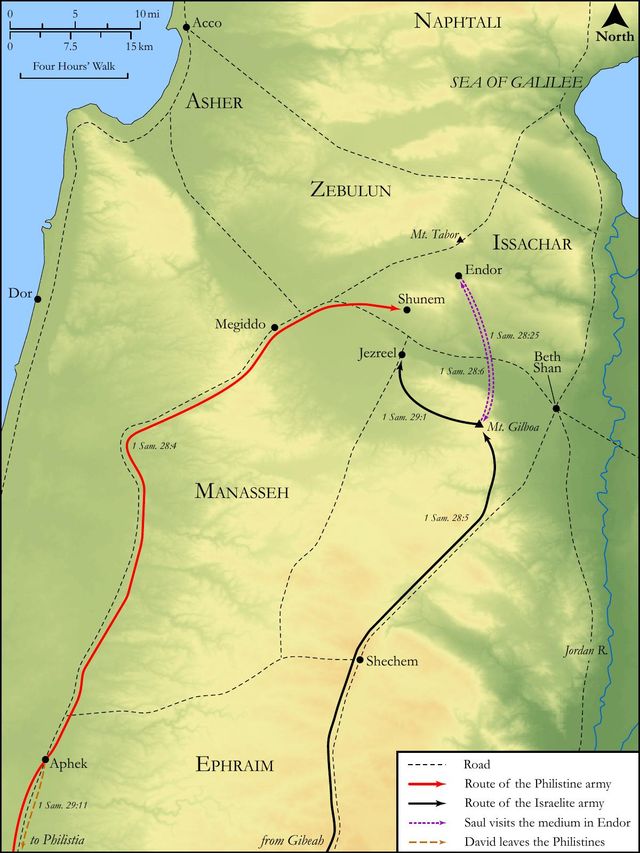
See on the biblical-era map
Study this verse
Public-domain commentary
Matthew Henry
From his Commentary on the Whole Bible. Henry comments on passages, not single verses — this entry covers 1 Samuel 28:1–6. His two-level outline is real structure in the source text, so it is rendered as structure.
Here is, I. The design of the Philistines against Israel. They resolved to fight them, Sa1 28:1. If the Israelites had not forsaken God, there would have been no Philistines remaining to molest them; if Saul had not forsaken him, they would by this time have been put out of all danger by them. The Philistines took an opportunity to make this attempt when they had David among them, whom they feared more than Saul and all his forces.
II.The expectation Achish had of assistance from David in this war, and the encouragement David gave him to expect it:
"Thou shalt go with me to battle," says Achish. "If I protect thee, I may demand service from thee;" and he will think himself happy if he may have such a man as David on his side, who prospered whithersoever he went. David gave him an ambiguous answer: "We will see what will be done; it will be time enough to talk of that hereafter; but surely thou shalt know what thy servant can do" (Sa1 28:2), that is, "I will consider in what post I may be best able to serve thee, if thou wilt but give me leave to choose it." Thus he keeps himself free from a promise to serve him and yet keeps up his expectation of it; for Achish took it in no other sense than as an engagement to assist him, and promised him, thereupon, that he would make him captain of the guards, protector, or prime-minister of state.
III.The drawing of the armies, on both sides, into the field (Sa1 28:4):
The Philistines pitched in Shunem, which was in the tribe of Issachar, a great way north from their country. The land of Israel, it seems, was ill-guarded, when the Philistines could march their army into the very heart of the country. Saul, while he pursued David, left his people naked and exposed. On some of the adjacent mountains of Gilboa Saul mustered his forces, and prepared to engage the Philistines, which he had little heart to do now that the Spirit of the Lord had departed from him.
IV.The terror Saul was in, and the loss he was at, upon this occasion:
He saw the host of the Philistines, and by his own view of them, and the intelligence his spies brought him, he perceived they were more numerous, better armed, and in better heart, than his own were, which made him afraid, so that his heart greatly trembled, Sa1 28:5. Had he kept close to God, he needed not have been afraid at the sight of an army of Philistines; but now that he had provoked God to forsake him his interest failed, his armies dwindled and looked mean, and, which was worse, his spirits failed him, his heart sunk within him, a guilty conscience made him tremble at the shaking of a leaf. Now he remembered the guilty blood of the Amalekites which he had spared, and the innocent blood of the priests which he had spilt. His sins were set in order before his eyes, which put him into confusion, embarrassed all his counsels, robbed him of all his courage, and produced in him a certain fearful looking for of judgment and fiery indignation. Note, Troubles are terrors to the children of disobedience. In this distress Saul enquired of the Lord, Sa1 28:6. Need drives those to God who in the day of their prosperity slighted his oracles and altars. Lord, in trouble have they visited thee, Isa 26:16. Did ever any seek the Lord and not find him? Yes, Saul did; the Lord answered him not, took no notice either of his petitions or of his enquiries; gave him no directions what to do, nor any encouragement to hope that he would be with him. Should he be enquired of at all by such a one as Saul? Eze 14:3. No, he could not expect an answer of peace, for,
1.He enquired in such a manner that it was as if he had not enquired at all. Therefore it is said (Ch1 10:14), He enquired not of the Lord; for he did it faintly and coldly, and with a secret design, if God did not answer him, to consult the devil. He did not enquire in faith, but with a double unstable mind.
2.He enquired of the Lord when it was too late, when the days of his probation were over and he was finally rejected. Seek the Lord while he may be found, for there is a time when he will not be found.
3.He had forfeited the benefit of all the methods of enquiry. Could he that hated and persecuted Samuel and David, who were both prophets, expect to be answered by prophets? Could he that had slain the high priest, expect to be answered by Urim? Or could he that had sinned away the Spirit of grace, expect to be answered by dreams? No. Be not deceived, God is not mocked.
V.The mention of some things that had happened a good while ago, to introduce the following story, Sa1 28:3.
1.The death of Samuel. Samuel was dead, which made the Philistines the more bold and Saul the more afraid; for, had Samuel been alive, Saul probably thought that his presence and countenance, his good advice and good prayers, would have availed him in his distress.
2.Saul's edict against witchcraft. He had put the laws in execution against those that had familiar spirits, who must not be suffered to live, Exo 22:18. Some think that he did this in the beginning of his reign, while he was under Samuel's influence; others think that it was lately done, for it is spoken of here (Sa1 28:9) as a late edict. Perhaps when Saul was himself troubled with an evil spirit he suspected that he was bewitched, and, for that reason, cut off all that had familiar spirits. Many seem zealous against sin, when they themselves are any way hurt by it (they will inform against swearers if they swear at them, or against drunkards if in their drink they abuse them), who otherwise have no concern for the glory of God, nor any dislike of sin as sin. However it was commendable in Saul thus to use his power for the terror and restraint of these evil-doers. Note, Many seem enemies to sin in others, while they indulge it in themselves. Saul will drive the devil out of his kingdom, and yet harbour him in his heart, by envy and malice.
Historical interpretation
Historical reception
1 surviving comment on this verse from the historical church.
And the Philistines gathered together, etc. The Philistines in this place, inasmuch as they seek the aid of David and his men, represent the faithful from the Gentiles; but inasmuch as they scorn and reject him, they represent the unfaithful who oppose Christ. For they oppose both the unfaithful Jews and the heretically unfaithful, and the Catholics, Christians and pagans alike. Therefore it is fitting that the Philistines are said to have been encamped in Sunam, which is interpreted as 'crimson'. For crimson holds the appearance of fire. Indeed, the faithful, fervent with the love of Christ, and the pagans, raging with the fire of persecution, do not hesitate to fight against their adversaries. For the good fight against the evil; the evil fight among themselves; but the good cannot fight among themselves at all. Moreover, Israel, because it gathered under Saul who was dying and impious, not under David who was just and destined to rule, either signifies the present blindness of its own people, as we said above, or the heretical depravity; and thus rightly it is described to have gathered on the mountain of downfall, which the name Gelboe signifies, and to have fallen there.
Continue studying 1 Samuel 28:4 across the web’s major study libraries — every link below opens this exact verse, chapter, or book on the destination site.
Read & Compare
 BibleGatewayThis verse in more than 200 translations and 70 languages.
 Bible.comThe YouVersion reader — hundreds of translations, reading plans, and highlights.
 ESV.orgCrossway's official English Standard Version reader.
 NET BibleThe NET translation with 60,000+ translators' notes on every rendering decision.
 STEP BibleTyndale House's free study tool — original text, vocabulary, and scholarly resources.
 BibliaLogos Bible Software's free web reader.
 USCCBThe New American Bible (Revised Edition) with the U.S. bishops' study notes.
Commentaries
 BibleHub CommentariesDozens of classic commentaries on this verse, gathered on one page.
 StudyLightMore than 100 commentary sets — the largest collection on the web.
 BibleRefPlain-English commentary on what this verse means, verse by verse.
 Enduring WordDavid Guzik's free commentary on this chapter, widely used by Bible teachers.
 Bible Study ToolsVerse commentary alongside Greek and Hebrew study aids.
Original Language & Research
- BibleHub InterlinearThe verse word by word — original language, transliteration, and English.
- BibleHub LexiconEvery word's original-language definition and Strong's entry.
 Blue Letter BibleDeep-study tools — Strong's numbers, concordance, and word studies.
 SefariaThe Hebrew text with Rashi and centuries of Jewish commentary.
Sermons, Hymns & Audio


TrulyRandomVerse is not affiliated with these sites and doesn’t control their content. They’re linked because they’re genuinely useful.
Summary
1 Samuel 28:4 meticulously chronicles the strategic military movements of two formidable forces: the Philistines, Israel's persistent adversaries, gathering at Shunem, and King Saul, rallying all of Israel, encamping on Mount Gilboa. This verse serves as a tense prelude, setting the geographical and tactical stage for the climactic and ultimately tragic final confrontation between Saul and the Philistines, encapsulating the profound crisis facing a divinely abandoned king and his nation.
Context
ShowHideLiterary Context
This verse immediately follows a poignant depiction of King Saul's spiritual desolation. The preceding verses 1 Samuel 28:1-3 establish the death of Samuel, God's primary prophetic voice to Saul, and highlight Saul's earlier, albeit inconsistent, purge of mediums and spiritists from the land. Crucially, 1 Samuel 28:6 reveals God's complete silence to Saul, refusing to answer him by dreams, Urim, or prophets. The military mobilization described in verse 4 thus functions as the direct catalyst for Saul's subsequent, desperate, and ultimately fatal decision to seek guidance from the very illicit source he had previously outlawed—a medium at Endor, an event detailed in 1 Samuel 28:7-19. This strategic setup is not merely a logistical detail but the immediate precipice that drives Saul to his final, profound act of disobedience, sealing his tragic fate and the downfall of his kingdom.
Historical & Cultural Context
The Philistines were a formidable and recurring enemy of Israel throughout the periods of the Judges and early monarchy, often possessing superior military organization and iron technology. The Jezreel Valley, where Shunem and Gilboa are situated, was a strategically vital corridor, controlling access between the fertile coastal plain and the Jordan Valley, making it a frequent battleground and central to Israel's security. Shunem, located on the northern slope of the Hill of Moreh, provided the Philistines with a strong base from which to dominate the valley, while Mount Gilboa, a prominent mountain range to the southeast, offered Saul a defensible high ground with a commanding view. The acts of "gathering" and "pitching" (encamping) were standard military procedures, signifying the mustering of forces and the establishment of a temporary operational base in preparation for a decisive engagement. Culturally, kings were expected to seek divine counsel before battle, a practice Saul was no longer afforded due to his prior disobedience and rejection by God, as seen in 1 Samuel 15:23.
Key Themes
ShowHideThis verse powerfully contributes to several overarching themes in the book of 1 Samuel. Firstly, it underscores the Imminent Conflict between Israel and the Philistines, a persistent struggle that highlights Israel's precarious existence and the ongoing need for strong, divinely-guided leadership. Secondly, it emphasizes Strategic Positioning, as the choice of Shunem and Gilboa sets the stage for a tense standoff in a critical geographical location, foreshadowing the decisive and tragic nature of the battle to come. Most profoundly, the military crisis depicted here is a direct manifestation of Saul's Desperation and Divine Abandonment. While the verse itself only describes the armies, the broader narrative context reveals that Saul's assembly of forces on Gilboa is a desperate act by a king who has lost God's favor and guidance. His inability to receive divine counsel, explicitly stated in 1 Samuel 28:6, drives him to seek illicit spiritual means, leading directly to his downfall and the ultimate defeat on Mount Gilboa.
Exposition and Analysis
ShowHideKey Word Analysis
ShowHideThis primitive root means "to grasp, i.e. collect." In this context, it signifies a deliberate, organized assembly or mustering of troops. For both the Philistines and Saul, it implies a purposeful mobilization of forces for a specific objective—a major battle. The repetition of this verb underscores the parallel and opposing actions of the two armies, each intentionally consolidating their power.
This primitive root means "to incline; by implication, to decline (of the slanting rays of evening); specifically, to pitch a tent; gen. to encamp." This term refers to the act of establishing a military camp, including tents, supplies, and defensive arrangements. When armies "pitch," they are settling in for a period, signifying readiness for confrontation and often a strategic waiting game before engagement. The use of this word highlights the establishment of battle lines and the imminence of conflict.
Verse Breakdown
ShowHide"And the Philistines gathered themselves together, and came and pitched in Shunem"
This opening clause establishes the aggressor's initiative and their strategic choice of location. The Philistines, Israel's perennial adversaries, are depicted as a unified, organized, and formidable force. Their encampment at Shunem, a town in the Jezreel Valley, was militarily astute, providing them with a strong base from which to threaten central and northern Israel, and potentially cut off Saul's forces from other parts of the kingdom. This sets a tone of impending threat and foreign aggression.
"and Saul gathered all Israel together, and they pitched in Gilboa."
This second clause presents Israel's defensive response under King Saul. The phrase "all Israel" suggests a comprehensive mobilization, indicating the extreme gravity of the threat and the desperate nature of the situation. Saul's decision to "pitch in Gilboa" signifies his attempt to establish a strong defensive position on the high ground overlooking the valley. This positioning creates a direct geographical and military confrontation with the Philistines, highlighting the tension and the high stakes of the impending battle. It also subtly underscores Saul's reliance on human strength and strategic positioning in the absence of divine guidance.
Literary Devices
ShowHideThe verse employs several powerful literary devices to convey its message. Juxtaposition is central, as the Philistines and Saul's forces are presented in direct opposition, each "gathering" and "pitching" in distinct yet proximate locations (Shunem vs. Gilboa). This creates a vivid image of two formidable armies poised for a decisive clash. The specific naming of the locations serves as Setting, grounding the narrative in a historically and geographically significant region, the Jezreel Valley, known for its strategic importance in ancient warfare. This precise setting also contributes to Foreshadowing, as the mention of Gilboa immediately brings to mind the tragic events of 1 Samuel 31, where Saul and his sons meet their demise. The structural Parallelism in the phrasing ("Philistines gathered...pitched in Shunem; Saul gathered...pitched in Gilboa") emphasizes the symmetrical nature of the military preparations, yet it also subtly highlights the contrasting spiritual states of the two leaders, one acting with perceived strength, the other in profound desperation.
Theological and Thematic Connections
ShowHide1 Samuel 28:4 serves as a grim prelude to the final act of King Saul's tragic reign, underscoring the severe consequences of spiritual disobedience and divine abandonment. The gathering of these armies, particularly Saul's, is a desperate measure by a king who has lost God's favor and, consequently, His counsel. This military crisis is not merely a physical threat but a spiritual one, revealing the depth of Saul's isolation and his ultimate reliance on human strength rather than divine guidance. The impending battle on Gilboa, set in motion by this verse, is the culmination of Saul's rebellion against God's commands, his persistent pride, and his failure to genuinely repent. It highlights a profound theological truth: when a leader, or any individual, consistently rejects God's authority, they inevitably face the consequences of their own choices, often leading to desperation and ultimately, ruin. The scene is a stark reminder that true security and victory come from faithful obedience and reliance on the Lord, not from military might alone or illicit spiritual endeavors.
Reflection and Application
ShowHideThe scene in 1 Samuel 28:4, while ancient, resonates deeply with contemporary spiritual realities. It portrays a leader facing an overwhelming external threat, but whose true crisis is internal—a profound spiritual disconnect from God. When we face our own "Philistine" battles—whether they be personal struggles, professional challenges, or societal pressures—it is tempting to rely solely on our own strength, strategies, or even to seek guidance from sources outside of God's revealed will. Saul's desperate situation, exacerbated by God's silence, serves as a powerful warning against the dangers of spiritual drift and unconfessed sin. It compels us to examine our own hearts: Are we diligently seeking God's counsel through His Word and prayer? Are we living in obedience, or are we, like Saul, creating a chasm between ourselves and the divine source of wisdom and strength? The ultimate tragedy of Saul's reign, initiated by the events of this chapter, is a stark reminder that true victory and peace are found not in human ingenuity or illicit shortcuts, but in humble, persistent reliance on the Lord, even when His voice seems distant.
Questions for Reflection
ShowHideFAQ
ShowHideWhy did the Philistines choose Shunem as their encampment?
ShowHideShunem was a strategically advantageous location for the Philistines. Situated on the northern slope of the Hill of Moreh (also known as Little Hermon), it provided a commanding view of the eastern Jezreel Valley. This position allowed them to control a vital east-west trade route and posed a direct threat to Israel's northern territories. It also offered a strong base from which to launch an attack towards Mount Gilboa, where Saul's forces were gathered, and to potentially cut off communication and supply lines between northern and central Israel.
Why did Saul choose Mount Gilboa for his encampment?
ShowHideMount Gilboa offered Saul a strong defensive position. As a prominent mountain range overlooking the Jezreel Valley, it provided a natural fortress and a significant tactical advantage. From Gilboa, Saul's army could observe the movements of the Philistines in the valley below and potentially defend against an uphill assault. It was a logical choice for a king attempting to rally his forces against a superior enemy, seeking to use the terrain to his advantage in a desperate situation, especially given God's silence to him as noted in 1 Samuel 28:6.
What was the broader significance of this specific military confrontation for Israel's history?
ShowHideThis military confrontation, set up in 1 Samuel 28:4, was profoundly significant as it marked the tragic end of King Saul's reign and the beginning of a new era for Israel. The subsequent battle on Mount Gilboa resulted in the devastating defeat of Israel's army and the deaths of Saul and his three sons, including Jonathan (1 Samuel 31:1-6). This pivotal event cleared the way for David, God's chosen king, to fully ascend to the throne, ushering in a period of unprecedented national strength and divine favor under a leader "after God's own heart" (Acts 13:22). It was a turning point, demonstrating God's sovereign hand in establishing His chosen king and judging the disobedient.
Christ-Centered Fulfillment
ShowHideThe desperate scene of 1 Samuel 28:4, with a divinely abandoned king facing an overwhelming enemy, powerfully foreshadows the ultimate need for a perfect King who would never be forsaken by God. Saul's reliance on human strategy and his eventual resort to illicit spiritual means highlight the profound limitations of human kingship and the devastating consequences of spiritual rebellion. In stark contrast, Jesus Christ is the true King, the Son of God, who always walked in perfect obedience to His Father (Philippians 2:8). Unlike Saul, who experienced God's silence, Jesus consistently communed with the Father, even in His deepest agony (Luke 22:42). Where Saul faced defeat and death on Gilboa, Jesus, through His death on the cross, achieved ultimate victory over sin, death, and all spiritual enemies (Colossians 2:15). He is the King who never fails, whose kingdom is eternal (Daniel 7:14), and who offers true security and guidance to all who trust in Him. The tragedy of Saul's reign underscores the necessity of Christ's perfect reign, where His people are never abandoned but are eternally guided and protected by the Good Shepherd (John 10:11).