


1 Samuel 28:9
Bible text: King James Version (1769 Blayney text) · Public domain
Bible text: King James Version with Strong's numbers · Public domain
Bible text: Berean Standard Bible · Public domain
Bible text: American Standard Version (1901) · Public domain
Bible text: World English Bible, Messianic edition · Public domain
Bible text: Geneva Bible (1599) · Public domain
Bible text: Young's Literal Translation · Public domain
- וַתֹּאמֶרva·To·merand she saidH559Conj-w ¦ V-Qal-ConsecImperf-3fsVerb Qal Consecutive Imperfect 3rd Singular Feminineוַandתֹּאמֶרshe said
- הָאִשָּׁהha·'i·Shahthe womanH802Art ¦ N-fsNoun Singular Feminine Absoluteהָtheאִשָּׁהwoman
- אֵלָיו'e·Lavto himH413Prep ¦ 3msPreposition Definiteאֵלָיtoוhim
- הִנֵּהhi·Nehhere!H2009PrtParticle Interjection
- אַתָּה'a·TahyouH859Pro-2msPronoun Personal 2nd Singular Masculine
- יָדַעְתָּya·Da'·tayou knowH3045V-Qal-Perf-2msVerb Qal Perfect 2nd Singular Masculine
- אֵת'et<obj.>H853DirObjMParticle Object Indicator
- אֲשֶׁר'a·Sher[that] whichH834RelParticle Relative
- עָשָׂה'a·Sahhe has doneH6213V-Qal-Perf-3msVerb Qal Perfect 3rd Singular Masculine
- שָׁאוּלsha·'UlSaulH7586N-proper-mNoun Proper Masculine
- אֲשֶׁר'a·SherthatH834RelParticle Relative
- הִכְרִיתhikh·Rithe has cut offH3772V-Hiphil-Perf-3msVerb Hiphil Perfect 3rd Singular Masculine
- אֶת'et<obj.>H853DirObjMParticle Object Indicator
- הָאֹבוֹתha·'o·Votthe necromancersH178Art ¦ N-fpNoun Plural Feminine Absoluteהָtheאֹבוֹתnecromancers
- וְאֶתve·'Etand <obj.>H853Conj-w ¦ DirObjMParticle Object Indicatorוְandאֶת<obj.>
- הַיִּדְּעֹנִיhai·yi·de·'o·Nithe soothsayerH3049Art ¦ N-msNoun Singular Masculine Absoluteהַtheיִּדְּעֹנִיsoothsayer
- מִןminfromH4480PrepPreposition
- הָאָרֶץha·'A·retzthe landH776Art ¦ N-fsNoun Singular Feminine Absoluteהָtheאָרֶץland
- וְלָמָהve·la·Mahand <to> why?H4100Conj-w ¦ Prep-l ¦ InterrogPronoun Interrogativeוְandלָ<to>מָהwhy?
- אַתָּה'a·Tah[are] youH859Pro-2msPronoun Personal 2nd Singular Masculine
- מִתְנַקֵּשׁmit·na·Keshsetting trapsH5367V-Hithpael-Prtcpl-msVerb Hithpael Participle Singular Masculine Absolute
- בְּנַפְשִׁיbe·naf·Shion my lifeH5315Prep-b ¦ N-fsc ¦ 1csNoun Singular Feminine Constructבְּonנַפְשִׁlifeיmy
- לַהֲמִיתֵנִיla·ha·mi·Te·nito cause to die meH4191Prep-l ¦ V-Hiphil-Inf ¦ 1csVerb Hiphil Infinitive Constructלַtoהֲמִיתֵcause to dieנִיme
English is a literal word-by-word gloss of the Hebrew, not the KJV's wording. Why?
This is the original text the KJV's translators worked from — each Hebrew word with its own literal English meaning in this verse, prepared by scholars at Tyndale House, Cambridge. The KJV translates whole sentences, not word by word, so its wording differs: one Hebrew word can become several English words, and the KJV may choose “the LORD” where the gloss reads “Yahweh”. Both are faithful — they answer different questions. For the KJV's own rendering, switch to the KJV text.
Details
See on the biblical-era map
Study this verse
Public-domain commentary
Matthew Henry
From his Commentary on the Whole Bible. Henry comments on passages, not single verses — this entry covers 1 Samuel 28:7–14. His two-level outline is real structure in the source text, so it is rendered as structure.
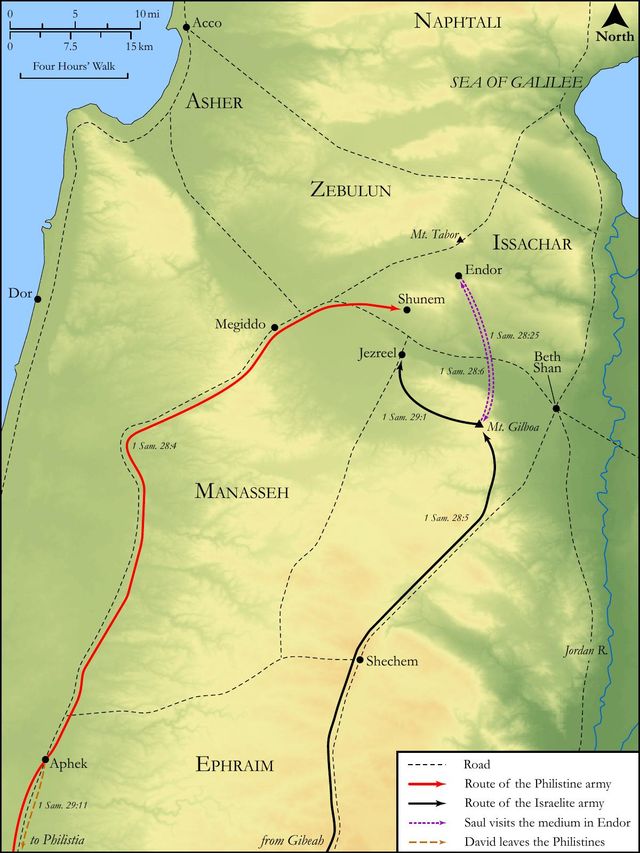
Here, I. Saul seeks for a witch, Sa1 28:7. When God answered him not, if he had humbled himself by repentance and persevered in seeking God, who knows but that at length he might have been entreated for him? but, since he can discern no comfort either from heaven or earth (Isa 8:21, Isa 8:22), he resolves to knock at the gates of hell, and to see if any there will befriend him and give him advice: Seek me a woman that has a familiar spirit, Sa1 28:7. And his servants were too officious to serve him in this evil affair; they presently recommended one to him at Endor (a city not far off) who had escaped the execution of Saul's edict. To her he resolves to apply. Herein he is chargeable, 1. With contempt of the God of Israel; as if any creature could do him a kindness when God had left him and frowned upon him. 2. With contradiction to himself. He knew the heinousness of the sin of witchcraft, else he would not have cut off those that had familiar spirits; yet now he had recourse to that as an oracle which he had before condemned as an abomination. It is common for men to inveigh severely against those sins which they are in no temptation to, but afterwards to be themselves overcome by them. Had one told Saul, when he was destroying the witches, that he himself would, ere long, consult with one, he would have said, as Hazael did, What? Is thy servant a dog? But who knows what mischiefs those will run into that forsake God and are forsaken of him?
II.Hearing of one he hastens to her, but goes by night, and in disguise, only with two servants, and probably on foot, Sa1 28:8. See how those that are led captive by Satan are forced,
1.To disparage themselves. Never did Saul look so mean as when he went sneaking to a sorry witch to know his fortune.
2.To dissemble. Evil works are works of darkness, and they hate the light, neither care for coming to it. Saul went to the witch, not in his robes, but in the habit of a common soldier, not only lest the witch herself, if she had known him, should decline to serve him, either fearing he came to trepan her or resolving to be avenged on him for his edict against those of her profession, but lest his own people should know it and abhor him for it. Such is the power of natural conscience that even those who do evil blush and are ashamed to do it.
III.He tells her his errand and promises her impunity.
1.All he desires of her is to bring up one from the dead, whom he had a mind to discourse with. It was necromancy or divination by the dead, that he hoped to serve his purpose by. This was expressly forbidden by the law (Deu 18:11), seeking for the living to the dead, Isa 8:19. Bring me up him whom I shall name, Sa1 28:8. This supposes that it was generally taken for granted that souls exist after death, and that when men die there is not an end of them: it supposes too that great knowledge was attributed to separate souls. But to think that any good souls would come up at the beck of an evil spirit, or that God, who had denied a man the benefit of his own institutions, would suffer him to reap any real advantage by a cursed diabolical invention, was very absurd.
2.She signifies her fear of the law, and her suspicion that this stranger came to draw her into a snare (Sa1 28:9): Thou knowest what Saul has done. Providence ordered it so that Saul should be told to his face of his edict against witches, at this very time when he was consulting one, for the greater aggravation of his sin. She insists upon the peril of the law, perhaps to raise her price; for, though no mention is made of her fee, no doubt she demanded and had a large one. Observe how sensible she is of danger from the edict of Saul, and what care she is in to guard against it; but not at all apprehensive of the obligations off God's law and the terrors of his wrath. She considered what Saul had done, not what God had done, against such practices, and feared a snare laid for her life more than a snare laid for her soul. It is common for sinners to be more afraid of punishment from men than of God's righteous judgment. But,
3.Saul promises with an oath not to betray her, Sa1 28:10. It was his duty as a king to punish her and he knew it, yet he swears no to do it; as if he could by his own oath bind himself from doing that which, by the divine command, he was bound to do. But he promised more than he could perform when he said, There shall no punishment happen to thee; for he that could not secure himself could much less secure her from divine vengeance.
IV.Samuel, who was lately dead, is the person whom Saul desired to have some talk with; and the witch, with her enchantments, gratifies his desire, and brings them together.
1.As soon as Saul had given the witch the assurance she desired (that he would not discover her) she applied to her witchcrafts, and asked very confidently, Whom shall I bring up to thee? Sa1 28:11. Note, Hopes of impunity embolden sinners in their evil ways and harden their hearts.
2.Saul desires to speak with Samuel: Bring me up Samuel. Samuel had anointed him to the kingdom and had formerly been his faithful friend and counsellor, and therefore with him he wished to advise. While Samuel was living at Ramah, not far from Gibeah of Saul, and presided there in the school of the prophets, we never read of Saul's going to him to consult him in any of the difficulties he was in (it would have been well for him if he had); then he slighted him, and perhaps hated him, looking upon him to be in David's interest. But now that he is dead, "O for Samuel again! By all means, bring me up Samuel." Note, Many that despise and persecute God's saints and ministers when they are living would be glad to have them again when they are gone. Send Lazarus to me, and send Lazarus to my father's house, Luk 16:24-27. The sepulchres of the righteous are garnished.
3.Here is a seeming defector chasm in the story. Saul said, Bring me up Samuel, and the very next words are, When the woman saw Samuel, (Sa1 28:12), whereas one would have expected to be told how she performed the operation, what spells and charms she used, or that some little intimation would be given of what she said or did; but the profound silence of the scripture concerning it forbids our coveting to know the depths of Satan (Rev 2:24) or to have our curiosity gratified with an account of the mysteries of iniquity. It has been said of the books of some of the popish confessors that, by their descriptions of sin, they have taught men to commit it; but the scripture conceals sinful art, that we may be simple concerning evil, Rom 16:19.
4.The witch, upon sight of the apparition, was aware that her client was Saul, her familiar spirit, it is likely, informing her of it (Sa1 28:12): "Why hast thou deceived me with a disguise; for thou art Saul, the very man that I am afraid of above any man?" Thus she gave Saul to understand the power of her art, in that she could discover him through his disguise; and yet she feared lest, hereafter, at least, he should take advantage against her for what she was now doing. Had she believed that it was really Samuel whom she saw, she would have had more reason to be afraid of him, who was a good prophet, than of Saul, who was a wicked king. But the wrath of earthly princes is feared by most more than the wrath of the King of kings.
5.Saul (who, we may suppose, was kept at a distance in the next room) bade her not to be afraid of him, but go on with the operation, and enquired what she saw? Sa1 28:13. O, says the woman, I saw gods (that is, a spirit) ascending out of the earth; they called angels gods, because spiritual beings. Poor gods that ascend out of the earth! But she speaks the language of the heathen, who had their infernal deities and had them in veneration. If Saul had thought it necessary to his conversation with Samuel that the body of Samuel should be called out of the grave, he would have taken the witch with him to Ramah, where his sepulchre was; but the design was wholly upon his soul, which yet, if it became visible, was expected to appear in the usual resemblance of the body; and God permitted the devil, to answer the design, to put on Samuel's shape, that those who would not receive the love of the truth might be given up to strong delusions and believe a lie. That it could not be the soul of Samuel himself they might easily apprehend when it ascended out of the earth, for the spirit of a man, much more of a good man, goes upward, Ecc 3:21. But, if people will be deceived, it is just with God to say, "Let them be deceived." That the devil, by the divine permission, should be able to personate Samuel is not strange, since he can transform himself into an angel of light! nor is it strange that he should be permitted to do it upon this occasion, that Saul might be driven to despair, by enquiring of the devil, since he would not, in a right manner, enquire of the Lord, by which he might have had comfort. Saul, being told of gods ascending, was eager to know what was the form of this deity, and in what shape he appeared, so far was he from conceiving any horror at it, his heart being wretchedly hardened by the deceitfulness of sin. Saul, it seems, was not permitted to see any manner of similitude himself, but he must take the woman's word for it, that she saw an old man covered with a mantle, or robe, the habit of a judge, which Samuel had sometimes worn, and some think it was for the sake of that, and the majesty of its aspect, that she called this apparition Elohim, a god or gods; for so magistrates are styled, Psa 82:1.
6.Saul, perceiving, by the woman's description, that it was Samuel, stooped with his face to the ground, either, as it is generally taken, in reverence to Samuel, though he saw him not, or perhaps to listen to that soft and muttering voice which he now expected to hear (for those that had familiar spirits peeped and muttered, Isa 8:19); and it should seem Saul bowed himself (probably by the witch's direction) that he might hear what was whispered and listen carefully to it; for the voice of one that has a familiar spirit is said to come out of the ground, and whisper out of the dust, Isa 29:4. He would stoop to that who would not stoop to the word of God.
Continue studying 1 Samuel 28:9 across the web’s major study libraries — every link below opens this exact verse, chapter, or book on the destination site.
Read & Compare
 BibleGatewayThis verse in more than 200 translations and 70 languages.
 Bible.comThe YouVersion reader — hundreds of translations, reading plans, and highlights.
 ESV.orgCrossway's official English Standard Version reader.
 NET BibleThe NET translation with 60,000+ translators' notes on every rendering decision.
 STEP BibleTyndale House's free study tool — original text, vocabulary, and scholarly resources.
 BibliaLogos Bible Software's free web reader.
 USCCBThe New American Bible (Revised Edition) with the U.S. bishops' study notes.
Commentaries
 BibleHub CommentariesDozens of classic commentaries on this verse, gathered on one page.
 StudyLightMore than 100 commentary sets — the largest collection on the web.
 BibleRefPlain-English commentary on what this verse means, verse by verse.
 Enduring WordDavid Guzik's free commentary on this chapter, widely used by Bible teachers.
 Bible Study ToolsVerse commentary alongside Greek and Hebrew study aids.
Original Language & Research
- BibleHub InterlinearThe verse word by word — original language, transliteration, and English.
- BibleHub LexiconEvery word's original-language definition and Strong's entry.
 Blue Letter BibleDeep-study tools — Strong's numbers, concordance, and word studies.
 SefariaThe Hebrew text with Rashi and centuries of Jewish commentary.
Sermons, Hymns & Audio


TrulyRandomVerse is not affiliated with these sites and doesn’t control their content. They’re linked because they’re genuinely useful.
Summary
In 1 Samuel 28:9, the woman of Endor, a medium, confronts King Saul, who is disguised, with a sharp, fearful question. She reminds him of his own decree to eradicate all practitioners of divination and sorcery from Israel, expressing her profound suspicion that his request to conjure a spirit is a deadly trap designed to expose and execute her. Her words underscore the king's desperate hypocrisy and the immense danger inherent in her forbidden practice, highlighting the tragic depths of Saul's spiritual decline.
Context
ShowHideLiterary Context
This verse is a pivotal moment in the dramatic account of King Saul's final days, immediately preceding his encounter with the spirit of Samuel. The narrative of 1 Samuel 28 opens with the Philistines gathering for war against Israel. Saul, abandoned by God due to his persistent disobedience and rebellion (1 Samuel 15:23), seeks divine guidance through traditional means—dreams, Urim, and prophets—but receives no answer (1 Samuel 28:6). In a desperate and profoundly hypocritical act, Saul, who had previously purged the land of mediums and wizards (1 Samuel 28:3), now commands his servants to find one for him. The woman's fearful response in verse 9 directly sets the stage for the shocking appearance of Samuel and the dire prophecy of Saul's impending death.
Historical & Cultural Context
The nations round about Israel frequently engaged in various forms of divination, necromancy, and magic to gain insight into the future or communicate with the spiritual realm. These practices were deeply embedded in pagan religious systems. However, the Mosaic Law explicitly and repeatedly condemned such activities as detestable to Yahweh, viewing them as an affront to His sovereignty and a direct violation of the covenant (Deuteronomy 18:9-12). Israel was commanded to be distinct from the nations around them, relying solely on God for guidance. Saul's earlier purge of mediums and wizards, mentioned by the woman, aligns with this divine mandate and demonstrates an initial, albeit ultimately inconsistent, adherence to God's law. His later desperate act reveals the profound spiritual decay that had gripped him, leading him to violate the very laws he had enforced.
Key Themes
ShowHideThe exchange in 1 Samuel 28:9 powerfully highlights several major themes within the book of Samuel and the broader Old Testament narrative. Foremost is the theme of Divine Abandonment and Consequences of Disobedience. Saul's inability to receive guidance from God directly stems from his persistent rebellion, particularly his rejection of God's word (1 Samuel 15:23). This leads to Desperation and Hypocrisy, as Saul, once a champion against idolatry, now resorts to forbidden practices, demonstrating the extent of his spiritual decline. The verse also underscores the Strictness of God's Prohibition against Occult Practices, emphasizing that seeking guidance outside of God's revealed will is an abomination. Finally, the woman's fear highlights the Vulnerability of those who Practice Forbidden Arts under a regime that, at least publicly, enforces God's law, even if the enforcer is himself compromised.
Exposition and Analysis
ShowHideKey Word Analysis
ShowHideThis term (H178, 'ôwb) properly refers to a 'mumble' or 'hollow sound,' leading to its association with a necromancer or ventriloquist, as one might speak from a jar. It denotes a person who consults the dead, believed to evoke a spirit to provide information. The Mosaic Law strictly forbade consulting an 'ôwb (Leviticus 19:31).
Derived from the root 'to know,' this term (H3049, yiddᵉʻônîy) properly designates a 'knowing one' or a conjurer. It refers to a wizard or one who claims special knowledge or insight obtained through occult practices, such as divination or sorcery. Like 'ôwb, the yiddᵉʻônî was explicitly condemned by God's law (Deuteronomy 18:10-11).
This primitive root (H3772, kârath') means 'to cut (off, down or asunder),' and by implication, 'to destroy or consume.' In this context, it refers to Saul's decisive act of eradicating or removing those who practiced forbidden arts from the land, demonstrating a forceful and complete purge as if by cutting them off from the community.
Verse Breakdown
ShowHide"And the woman said unto him, Behold, thou knowest what Saul hath done,"
The medium immediately recognizes the gravity of the situation, even without knowing Saul's identity. Her opening words are a direct, almost accusatory, challenge, indicating her awareness of the king's public policy and the severe risks involved in her profession. The phrase "thou knowest" implies a shared understanding of the king's decree and its lethal implications.
"how he hath cut off those that have familiar spirits, and the wizards, out of the land:"
This clause explicitly states the reason for her fear. Saul, in an earlier period of his reign, had taken decisive action to purge Israel of all practitioners of necromancy and divination, in accordance with God's law. This act, while righteous in itself, now becomes the very source of the medium's terror, as she fears being caught in a trap set by the king himself. The thoroughness of Saul's purge ("cut off... out of the land") highlights the extreme danger she perceives.
"wherefore then layest thou a snare for my life, to cause me to die?"
This is the culmination of her suspicion and fear. She directly accuses the disguised Saul of attempting to entrap her, believing his request to be a ruse to identify and execute her for violating the very law he had enforced. Her question reveals a profound instinct for self-preservation and a deep distrust, born of the deadly consequences associated with her forbidden craft under Saul's regime.
Literary Devices
ShowHideThe passage is rich in Irony, as King Saul, the very one who "cut off" mediums and wizards, now desperately seeks one out. This dramatic irony underscores his profound spiritual decline and hypocrisy. There is also significant Dramatic Tension, built by the woman's fearful accusation and Saul's desperate need, leading to the climactic appearance of Samuel. The woman's words also serve as a form of Foreshadowing, as Saul's illicit act of seeking forbidden counsel ultimately contributes to his downfall, which Samuel's spirit will soon confirm. The dialogue is a concise Anaphora of "thou knowest what Saul hath done," emphasizing the king's well-known policy and the woman's immediate apprehension.
Theological and Thematic Connections
ShowHideThe encounter between Saul and the medium of Endor powerfully illustrates the destructive consequences of persistent disobedience and the futility of seeking guidance outside of God's revealed will. Saul's desperation leads him to violate the very laws he once upheld, demonstrating a complete spiritual bankruptcy. This narrative serves as a stark warning against spiritual syncretism and the allure of forbidden knowledge. God's prohibition against divination and necromancy is not arbitrary; it is rooted in His desire for His people to rely solely on Him, the true source of all wisdom and power, and to avoid the deceptive and destructive influence of demonic forces. Saul's actions reveal the dangerous spiral of a heart hardened against God, where even good deeds (like purging mediums) can be overshadowed by a deeper rebellion.
Reflection and Application
ShowHideThe story of Saul and the medium of Endor is a profound cautionary tale for all believers. It reveals the perilous path of a heart that has turned away from the Lord, demonstrating how desperation can drive individuals to violate their own principles and God's clear commands. When faced with overwhelming challenges or a perceived silence from God, the temptation to seek "quick fixes" or unconventional, unbiblical solutions can be strong. This passage reminds us that true peace, wisdom, and guidance are found only in unwavering trust and obedience to God, seeking His will through His Word, prayer, and the counsel of godly believers. Saul's tragic end underscores that even when God seems silent, the answer is never to turn to forbidden practices, but to humble ourselves, repent, and wait on the Lord, knowing that His ways are always perfect, even when they are mysterious.
Questions for Reflection
ShowHideFAQ
ShowHideWhy did Saul, who had previously purged mediums, seek one out?
ShowHideSaul's actions in 1 Samuel 28 are a tragic demonstration of his spiritual decline and desperation. Having been rejected by God for his disobedience (1 Samuel 15:23), and facing a formidable Philistine army, Saul sought guidance from God through traditional, legitimate means—dreams, Urim, and prophets—but received no answer (1 Samuel 28:6). In his profound distress and spiritual isolation, he resorted to the very practices he had previously outlawed and punished, revealing the depth of his hypocrisy and the extent to which he had abandoned God's ways. His desperation overrode his former, albeit inconsistent, obedience to the Mosaic Law.
Christ-Centered Fulfillment
ShowHideThe desperate and forbidden act of Saul in seeking a medium stands in stark contrast to the perfect and complete revelation of God found in Jesus Christ. Saul's attempt to conjure the dead highlights humanity's inherent longing for connection with the spiritual realm and knowledge of the future, a longing that, when pursued outside of God's will, leads to deception and destruction. In Christ, this longing is fully and righteously satisfied. Jesus is the ultimate Prophet, through whom God speaks directly and clearly to humanity (Hebrews 1:1-2). He is the one who perfectly fulfills the Law, including its prohibitions against occult practices, by providing direct access to God the Father through His atoning sacrifice (Ephesians 2:18). Unlike Saul, who was cut off from divine counsel due to his sin, believers in Christ have the Holy Spirit as their Counselor and Guide (John 14:26), who leads them into all truth and reveals God's will through His living Word (John 16:13). Saul's tragic reliance on a "familiar spirit" underscores the need for the true Lamb of God, who takes away the sin of the world, offering not a fleeting, illicit glimpse into the future, but eternal life and a secure, open relationship with the living God (John 1:29).