


1 Samuel 28:11
Bible text: King James Version (1769 Blayney text) · Public domain
Bible text: Berean Standard Bible · Public domain
Bible text: American Standard Version (1901) · Public domain
Bible text: World English Bible, Messianic edition · Public domain
Bible text: Geneva Bible (1599) · Public domain
Bible text: Young's Literal Translation · Public domain
- וַתֹּאמֶרva·To·merand she saidH559Conj-w ¦ V-Qal-ConsecImperf-3fsVerb Qal Consecutive Imperfect 3rd Singular Feminineוַandתֹּאמֶרshe said
- הָאִשָּׁהha·'i·Shahthe womanH802Art ¦ N-fsNoun Singular Feminine Absoluteהָtheאִשָּׁהwoman
- אֶת'et<obj.>H853DirObjMParticle Object Indicator
- מִיmiwhom?H4310InterrogPronoun Interrogative
- אַעֲלֶה'a·'a·lehwill I bring upH5927V-Hiphil-Imperf-1csVerb Hiphil Imperfect 1st Singular common gender
- לָּךְLakhfor <the> youPrep-l ¦ 2msSuffix Personal 2nd Singular Masculineלָּfor <the>ךְyou
- וַיֹּאמֶרvai·Yo·merand he saidH559Conj-w ¦ V-Qal-ConsecImperf-3msVerb Qal Consecutive Imperfect 3rd Singular Masculineוַandיֹּאמֶרhe said
- אֶת'et<obj.>H853DirObjMParticle Object Indicator
- שְׁמוּאֵלshe·mu·'ElSamuelH8050N-proper-mNoun Proper Masculine
- הַעֲלִיha·'a·libring upH5927V-Hiphil-Imp-2fsVerb Hiphil Imperative 2nd Singular Feminine
- לִיLifor <the> mePrep-l ¦ 1csSuffix Personal 1st Singular common genderלִfor <the>יme
English is a literal word-by-word gloss of the Hebrew, not the KJV's wording. Why?
This is the original text the KJV's translators worked from — each Hebrew word with its own literal English meaning in this verse, prepared by scholars at Tyndale House, Cambridge. The KJV translates whole sentences, not word by word, so its wording differs: one Hebrew word can become several English words, and the KJV may choose “the LORD” where the gloss reads “Yahweh”. Both are faithful — they answer different questions. For the KJV's own rendering, switch to the KJV text.
Details
See on the biblical-era map
Study this verse
Public-domain commentary
Matthew Henry
From his Commentary on the Whole Bible. Henry comments on passages, not single verses — this entry covers 1 Samuel 28:7–14. His two-level outline is real structure in the source text, so it is rendered as structure.
Here, I. Saul seeks for a witch, Sa1 28:7. When God answered him not, if he had humbled himself by repentance and persevered in seeking God, who knows but that at length he might have been entreated for him? but, since he can discern no comfort either from heaven or earth (Isa 8:21, Isa 8:22), he resolves to knock at the gates of hell, and to see if any there will befriend him and give him advice: Seek me a woman that has a familiar spirit, Sa1 28:7. And his servants were too officious to serve him in this evil affair; they presently recommended one to him at Endor (a city not far off) who had escaped the execution of Saul's edict. To her he resolves to apply. Herein he is chargeable, 1. With contempt of the God of Israel; as if any creature could do him a kindness when God had left him and frowned upon him. 2. With contradiction to himself. He knew the heinousness of the sin of witchcraft, else he would not have cut off those that had familiar spirits; yet now he had recourse to that as an oracle which he had before condemned as an abomination. It is common for men to inveigh severely against those sins which they are in no temptation to, but afterwards to be themselves overcome by them. Had one told Saul, when he was destroying the witches, that he himself would, ere long, consult with one, he would have said, as Hazael did, What? Is thy servant a dog? But who knows what mischiefs those will run into that forsake God and are forsaken of him?
II.Hearing of one he hastens to her, but goes by night, and in disguise, only with two servants, and probably on foot, Sa1 28:8. See how those that are led captive by Satan are forced,
1.To disparage themselves. Never did Saul look so mean as when he went sneaking to a sorry witch to know his fortune.
2.To dissemble. Evil works are works of darkness, and they hate the light, neither care for coming to it. Saul went to the witch, not in his robes, but in the habit of a common soldier, not only lest the witch herself, if she had known him, should decline to serve him, either fearing he came to trepan her or resolving to be avenged on him for his edict against those of her profession, but lest his own people should know it and abhor him for it. Such is the power of natural conscience that even those who do evil blush and are ashamed to do it.
III.He tells her his errand and promises her impunity.
1.All he desires of her is to bring up one from the dead, whom he had a mind to discourse with. It was necromancy or divination by the dead, that he hoped to serve his purpose by. This was expressly forbidden by the law (Deu 18:11), seeking for the living to the dead, Isa 8:19. Bring me up him whom I shall name, Sa1 28:8. This supposes that it was generally taken for granted that souls exist after death, and that when men die there is not an end of them: it supposes too that great knowledge was attributed to separate souls. But to think that any good souls would come up at the beck of an evil spirit, or that God, who had denied a man the benefit of his own institutions, would suffer him to reap any real advantage by a cursed diabolical invention, was very absurd.
2.She signifies her fear of the law, and her suspicion that this stranger came to draw her into a snare (Sa1 28:9): Thou knowest what Saul has done. Providence ordered it so that Saul should be told to his face of his edict against witches, at this very time when he was consulting one, for the greater aggravation of his sin. She insists upon the peril of the law, perhaps to raise her price; for, though no mention is made of her fee, no doubt she demanded and had a large one. Observe how sensible she is of danger from the edict of Saul, and what care she is in to guard against it; but not at all apprehensive of the obligations off God's law and the terrors of his wrath. She considered what Saul had done, not what God had done, against such practices, and feared a snare laid for her life more than a snare laid for her soul. It is common for sinners to be more afraid of punishment from men than of God's righteous judgment. But,
3.Saul promises with an oath not to betray her, Sa1 28:10. It was his duty as a king to punish her and he knew it, yet he swears no to do it; as if he could by his own oath bind himself from doing that which, by the divine command, he was bound to do. But he promised more than he could perform when he said, There shall no punishment happen to thee; for he that could not secure himself could much less secure her from divine vengeance.
IV.Samuel, who was lately dead, is the person whom Saul desired to have some talk with; and the witch, with her enchantments, gratifies his desire, and brings them together.
1.As soon as Saul had given the witch the assurance she desired (that he would not discover her) she applied to her witchcrafts, and asked very confidently, Whom shall I bring up to thee? Sa1 28:11. Note, Hopes of impunity embolden sinners in their evil ways and harden their hearts.
2.Saul desires to speak with Samuel: Bring me up Samuel. Samuel had anointed him to the kingdom and had formerly been his faithful friend and counsellor, and therefore with him he wished to advise. While Samuel was living at Ramah, not far from Gibeah of Saul, and presided there in the school of the prophets, we never read of Saul's going to him to consult him in any of the difficulties he was in (it would have been well for him if he had); then he slighted him, and perhaps hated him, looking upon him to be in David's interest. But now that he is dead, "O for Samuel again! By all means, bring me up Samuel." Note, Many that despise and persecute God's saints and ministers when they are living would be glad to have them again when they are gone. Send Lazarus to me, and send Lazarus to my father's house, Luk 16:24-27. The sepulchres of the righteous are garnished.
3.Here is a seeming defector chasm in the story. Saul said, Bring me up Samuel, and the very next words are, When the woman saw Samuel, (Sa1 28:12), whereas one would have expected to be told how she performed the operation, what spells and charms she used, or that some little intimation would be given of what she said or did; but the profound silence of the scripture concerning it forbids our coveting to know the depths of Satan (Rev 2:24) or to have our curiosity gratified with an account of the mysteries of iniquity. It has been said of the books of some of the popish confessors that, by their descriptions of sin, they have taught men to commit it; but the scripture conceals sinful art, that we may be simple concerning evil, Rom 16:19.
4.The witch, upon sight of the apparition, was aware that her client was Saul, her familiar spirit, it is likely, informing her of it (Sa1 28:12): "Why hast thou deceived me with a disguise; for thou art Saul, the very man that I am afraid of above any man?" Thus she gave Saul to understand the power of her art, in that she could discover him through his disguise; and yet she feared lest, hereafter, at least, he should take advantage against her for what she was now doing. Had she believed that it was really Samuel whom she saw, she would have had more reason to be afraid of him, who was a good prophet, than of Saul, who was a wicked king. But the wrath of earthly princes is feared by most more than the wrath of the King of kings.
5.Saul (who, we may suppose, was kept at a distance in the next room) bade her not to be afraid of him, but go on with the operation, and enquired what she saw? Sa1 28:13. O, says the woman, I saw gods (that is, a spirit) ascending out of the earth; they called angels gods, because spiritual beings. Poor gods that ascend out of the earth! But she speaks the language of the heathen, who had their infernal deities and had them in veneration. If Saul had thought it necessary to his conversation with Samuel that the body of Samuel should be called out of the grave, he would have taken the witch with him to Ramah, where his sepulchre was; but the design was wholly upon his soul, which yet, if it became visible, was expected to appear in the usual resemblance of the body; and God permitted the devil, to answer the design, to put on Samuel's shape, that those who would not receive the love of the truth might be given up to strong delusions and believe a lie. That it could not be the soul of Samuel himself they might easily apprehend when it ascended out of the earth, for the spirit of a man, much more of a good man, goes upward, Ecc 3:21. But, if people will be deceived, it is just with God to say, "Let them be deceived." That the devil, by the divine permission, should be able to personate Samuel is not strange, since he can transform himself into an angel of light! nor is it strange that he should be permitted to do it upon this occasion, that Saul might be driven to despair, by enquiring of the devil, since he would not, in a right manner, enquire of the Lord, by which he might have had comfort. Saul, being told of gods ascending, was eager to know what was the form of this deity, and in what shape he appeared, so far was he from conceiving any horror at it, his heart being wretchedly hardened by the deceitfulness of sin. Saul, it seems, was not permitted to see any manner of similitude himself, but he must take the woman's word for it, that she saw an old man covered with a mantle, or robe, the habit of a judge, which Samuel had sometimes worn, and some think it was for the sake of that, and the majesty of its aspect, that she called this apparition Elohim, a god or gods; for so magistrates are styled, Psa 82:1.
6.Saul, perceiving, by the woman's description, that it was Samuel, stooped with his face to the ground, either, as it is generally taken, in reverence to Samuel, though he saw him not, or perhaps to listen to that soft and muttering voice which he now expected to hear (for those that had familiar spirits peeped and muttered, Isa 8:19); and it should seem Saul bowed himself (probably by the witch's direction) that he might hear what was whispered and listen carefully to it; for the voice of one that has a familiar spirit is said to come out of the ground, and whisper out of the dust, Isa 29:4. He would stoop to that who would not stoop to the word of God.
Historical interpretation
Five Centuries of Reception
4 surviving comments on this verse. Each one is dated, so this reads as a timeline rather than a list.
Select a marker to jump to its quote. Markers stagger vertically where authors wrote within a few decades of each other.
For what is it which has been written? “And the woman said, Whom shall I bring up for you?” Whose expression is the one which says, “The woman said”? Is it the expression of the Holy Spirit, from whom the Scripture is believed to be recorded, or is it the expression of someone else? For the narrative expression, as those involved with all sorts of words also know, is above all the expression of the author. And the author for all of these words has not been believed to be a human, but the author is the Holy Spirit who moves humans.
Is it not the case then, if such a great man was under the earth and the medium did bring him up, that a little demon has sway over the soul of the prophet? What can I say? These things are recorded. Is it true or is it not true? To say that it is not true drives us to unbelief. It comes down on the heads of those who speak it. But to say it is true presents for us an enquiry and quandary.And we well know that some among our brothers look askance at the Scripture and say, I do not believe in the medium. The medium says that she saw Samuel. She is lying! Samuel was not brought up. Samuel does not speak. Just as there are false prophets who say, “Thus says the Lord,” and “The Lord did not speak,” so too this little demon lies when it proclaims that it brings up the one pointed out by Saul. For, “whom shall I bring up?” He says, “Bring up Samuel for me.” These things are said by those who state that this history is not true.
And the woman said to Saul, etc. She calls one seen in the plural, as is very customary in Scripture, where often many are designated by the singular, and singular individuals by the plural number. Finally, when one calf was made, the people said: These are your gods, O Israel (Exodus 32). And not one frog or fly was sent against the wicked, but it is said: He sent among them the dog-fly, and it devoured them; the frog, and it destroyed them (Psalm 77); and countless others of this kind.
And the woman said to him: Whom shall I raise up for you? etc. And the people of the Jews, entering their synagogue, through the prophecies once summarized and completed in Christ, desire as if to be raised up from the dead for themselves, namely practicing so as to serve anew the shadows of sacrifices, the Sabbath, new moons, leprosy of houses and clothes, and the other literal observances.
Continue studying 1 Samuel 28:11 across the web’s major study libraries — every link below opens this exact verse, chapter, or book on the destination site.
Read & Compare
 BibleGatewayThis verse in more than 200 translations and 70 languages.
 Bible.comThe YouVersion reader — hundreds of translations, reading plans, and highlights.
 ESV.orgCrossway's official English Standard Version reader.
 NET BibleThe NET translation with 60,000+ translators' notes on every rendering decision.
 STEP BibleTyndale House's free study tool — original text, vocabulary, and scholarly resources.
 BibliaLogos Bible Software's free web reader.
 USCCBThe New American Bible (Revised Edition) with the U.S. bishops' study notes.
Commentaries
 BibleHub CommentariesDozens of classic commentaries on this verse, gathered on one page.
 StudyLightMore than 100 commentary sets — the largest collection on the web.
 BibleRefPlain-English commentary on what this verse means, verse by verse.
 Enduring WordDavid Guzik's free commentary on this chapter, widely used by Bible teachers.
 Bible Study ToolsVerse commentary alongside Greek and Hebrew study aids.
Original Language & Research
- BibleHub InterlinearThe verse word by word — original language, transliteration, and English.
- BibleHub LexiconEvery word's original-language definition and Strong's entry.
 Blue Letter BibleDeep-study tools — Strong's numbers, concordance, and word studies.
 SefariaThe Hebrew text with Rashi and centuries of Jewish commentary.
Sermons, Hymns & Audio


TrulyRandomVerse is not affiliated with these sites and doesn’t control their content. They’re linked because they’re genuinely useful.
Summary
1 Samuel 28:11 captures a pivotal and tragic moment in King Saul's reign, revealing the profound depth of his spiritual decline and desperation. Abandoned by divine counsel and facing an overwhelming Philistine threat, Saul, in direct violation of God's law and his own prior decrees, seeks out a medium in Endor. This verse records the medium's critical inquiry regarding whom she should summon from the realm of the dead, immediately followed by Saul's specific and urgent request for the deceased prophet Samuel, whose guidance he now craved with a desperate and forbidden intensity.
Context
ShowHideLiterary Context
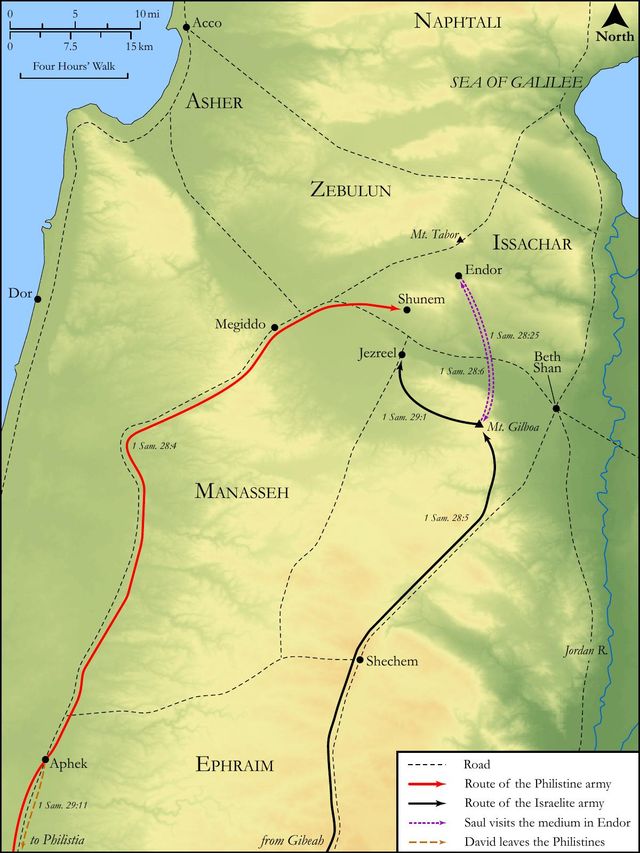
This verse is situated within the somber final chapters of King Saul's reign, immediately following the narrative of God's definitive silence to Saul (1 Samuel 28:6). Having been rejected by God due to his disobedience, Saul could no longer receive divine guidance through legitimate means such as dreams, the Urim, or prophets. The preceding verses establish the dire military situation, with the Philistines gathered for battle at Shunem and Israel encamped at Gilboa (1 Samuel 28:4-5), filling Saul with overwhelming fear. Crucially, the narrative also reminds the reader that Saul himself had previously undertaken a zealous purge of mediums and spiritualists from the land (1 Samuel 28:3, 1 Samuel 28:9), making his current action a stark and hypocritical reversal of his own policy and God's law. The earlier mention of Samuel's death (1 Samuel 25:1) sets the stage for this illicit summoning, as Saul desperately seeks counsel from the very prophet who had both anointed him and pronounced God's judgment upon him. The subsequent verses detail the shocking appearance of Samuel and his dire prophecy of Saul's impending defeat and death, underscoring the gravity and futility of this forbidden encounter.
Historical & Cultural Context
The practice of necromancy—attempting to communicate with the dead—was practiced among the nations whom the LORD drove out before Israel, by rulers and commoners alike, to gain insight into the future, seek counsel, or manipulate events. However, such practices were unequivocally forbidden in Israelite law, forming a core tenet of the Mosaic covenant. Explicit prohibitions against mediums, spiritists, and those who consult the dead are found in passages like Deuteronomy 18:10-12, Leviticus 19:31, and Leviticus 20:27. Saul's act was not merely a lapse in judgment but a direct and egregious transgression of God's commands, which he, as the anointed king, was sworn to uphold. This historical and legal backdrop highlights the profound spiritual crisis Saul faced, where his fear of the Philistines and God's silence drove him to violate fundamental divine prohibitions, revealing the depths of his spiritual rebellion, desperation, and ultimate rejection.
Key Themes
ShowHideThe events surrounding 1 Samuel 28:11 powerfully illustrate several major theological and narrative themes central to the book of 1 Samuel and the broader biblical narrative. Foremost among these is desperation leading to disobedience, as Saul's overwhelming fear and the absence of legitimate divine guidance drive him to forbidden means, demonstrating the perils of seeking shortcuts outside God's will. This episode also vividly portrays the consequences of rejecting God's word, showing how a life marked by repeated disobedience ultimately leads to spiritual abandonment and a tragic end, as seen in God's silence to Saul (1 Samuel 28:6). The narrative underscores the dangers of seeking spiritual insight from ungodly sources, serving as a potent cautionary tale against turning away from God's revealed will, especially when faced with fear or uncertainty, reminding us that God condemns such practices (as in Isaiah 8:19-20). Furthermore, it highlights the finality of divine judgment, as God's silence to Saul signifies a definitive withdrawal of favor and guidance, leaving the king to his own devices and the inevitable consequences of his choices, culminating in the dire prophecy of 1 Samuel 28:19.
Exposition and Analysis
ShowHideKey Word Analysis
ShowHideThis term refers to the female medium of Endor. In this context, it signifies a person who practices forbidden arts, specifically necromancy. The biblical text often uses this term to denote the inherent nature or role of an individual. Here, it highlights her identity as a practitioner of a divinely prohibited craft, making her the active agent in Saul's transgression.
A versatile primitive root meaning "to ascend," "to go up," or "to cause to come up." In this specific context, it carries the chilling connotation of summoning a spirit or a deceased person from the realm of the dead (Sheol). Saul's use of this term confirms his explicit intent to engage in necromancy, a practice explicitly forbidden by God, and defines the medium's role as one who attempts to bridge the gap between the living and the dead.
Meaning "Heard of God" or "Name of God," Samuel was the revered prophet who had anointed Saul as Israel's first king and later delivered God's message of rejection to him. Saul's specific request for Samuel underscores his desperate need for the counsel of this particular prophet, whom he had once scorned but whose authority and connection to God he still recognized, even in death. The name itself carries profound prophetic weight, emphasizing the bitter irony of Saul seeking wisdom from the very source he had alienated through his disobedience.
Verse Breakdown
ShowHide"Then said the woman, Whom shall I bring up unto thee?"
This clause establishes the medium's active role in the forbidden act and confirms her understanding of Saul's purpose. Her question is an invitation for Saul to name the specific deceased individual he wishes to consult, highlighting his full complicity and direct involvement in the act of necromancy. It also subtly emphasizes the power dynamic, as she controls the "bringing up," but Saul dictates the "whom," revealing his desperate reliance on her illicit power.
"And he said, Bring me up Samuel."
Saul's immediate and unequivocal response reveals the depth of his desperation and his single-minded focus. His choice of Samuel, the prophet who had been the instrument of his anointing and subsequent rejection by God, indicates his belief that only Samuel could provide the guidance or insight he so desperately sought. This request is made even at the cost of violating God's explicit commands and his own past actions, underscoring his profound spiritual bankruptcy and his reliance on a human figure—even a dead one—rather than renewed repentance and seeking God through legitimate means.
Literary Devices
ShowHideThe passage in 1 Samuel 28:11 is rich with literary devices that amplify its dramatic and theological impact. Irony is profoundly evident, as Saul, the very king who had previously purged mediums and spiritualists from Israel (11 Samuel 28:3), now disguises himself to seek out such a person. This highlights his hypocrisy, the tragic reversal of his own policies, and the depths of his spiritual decline. There is significant foreshadowing, as the illicit summoning of Samuel immediately precedes the prophet's grim prophecy of Saul's defeat and death, building intense suspense for the reader and confirming the king's impending doom. Dramatic Irony is powerfully at play, as the audience is acutely aware of Saul's impending destruction and God's definitive rejection, making his desperate and forbidden act even more poignant, futile, and self-destructive. The scene also employs pathos, evoking a sense of pity for Saul's profound desperation and the spiritual agony that drives him to such an extreme measure, cut off from divine guidance and facing certain destruction. Ultimately, the narrative's stark portrayal of Saul's spiritual decline and his tragic end serves as a powerful cautionary tale for all who would turn away from God's revealed will.
Theological and Thematic Connections
ShowHide1 Samuel 28:11 stands as a stark testament to the tragic consequences of spiritual rebellion and the profound dangers of seeking counsel outside of God's revealed will. Saul's actions represent the culmination of a life marked by persistent disobedience, culminating in God's silence—a severe form of divine judgment and abandonment. This episode underscores the theological truth that when humanity turns away from God, even in moments of overwhelming desperation, resorting to forbidden means only deepens the chasm between creator and creature, leading to further spiritual darkness and condemnation. It highlights God's absolute sovereignty, demonstrating His ability to use even illicit acts to deliver a final, damning word to a king who had repeatedly spurned His grace and authority. The narrative serves as a powerful warning against the allure of forbidden practices and the paramount importance of steadfast faith, patience, and unwavering obedience to God's timing and commands, rather than succumbing to fear and seeking answers from sources God has explicitly prohibited.
Reflection and Application
ShowHideSaul's desperate plea in 1 Samuel 28:11 offers a profound opportunity for self-reflection for believers today. When faced with overwhelming fear, deep uncertainty, or a perceived silence from God, where do we instinctively turn for guidance and comfort? Saul's tragic example reminds us that true security, profound wisdom, and lasting peace are found not in forbidden shortcuts, human ingenuity, or illicit spiritual practices, but in steadfast trust in God's unfailing sovereignty and faithful adherence to His revealed Word. This passage challenges us to examine our own hearts: are we willing to wait patiently on the Lord, even when answers are slow in coming, or do we, like Saul, resort to means outside of God's will, seeking control or immediate relief through ungodly avenues? It underscores the critical importance of cultivating a relationship with God rooted in genuine obedience, unwavering faith, and humble dependence, ensuring that our ultimate source of counsel and hope is always divine, righteous, and consistent with His character.
Questions for Reflection
ShowHideFAQ
ShowHideWas it really Samuel who appeared to Saul, or was it a demonic impersonation?
ShowHideThe biblical text strongly implies that it was indeed the genuine prophet Samuel who appeared. Several key elements within the narrative support this view: the medium's immediate and extreme fear upon seeing the apparition (1 Samuel 28:12), Saul's recognition of Samuel, and critically, the accurate, detailed, and divinely authoritative prophecy delivered by Samuel concerning Saul's impending death and the defeat of Israel (1 Samuel 28:19). While some theological interpretations suggest a demonic impersonation to avoid the idea of God allowing such a forbidden act, the narrative itself presents it as Samuel, underscoring God's ultimate sovereignty even over illicit acts to deliver His judgment. It was not an act of divine approval for necromancy, but a demonstration of God's control, even in an illicit context, to pronounce a final, damning word to a disobedient king.
Why did God allow Samuel to appear if He had forbidden necromancy and was silent to Saul?
ShowHideGod's allowance of Samuel's appearance was not an endorsement of necromancy, nor did it signify a reversal of His silence to Saul. Rather, it served as a powerful and terrifying demonstration of God's absolute sovereignty and control, even over the realm of the dead and over human sin. Having cut off all legitimate channels of communication due to Saul's persistent disobedience and rebellion, God used this illicit means to deliver a final, unalterable word of judgment. It was a dramatic, divine intervention to confirm Saul's doom, leaving him without hope or excuse. This event highlights that even when humans defy God's commands, God remains sovereign, capable of using any means to accomplish His righteous purposes, particularly in delivering judgment. It underscores that God's silence to Saul was itself a form of judgment, and this appearance was the final, devastating pronouncement of that judgment, not a new avenue for divine guidance or a renewed relationship.
Christ-Centered Fulfillment
ShowHideThe tragic account of Saul's desperate search for a word from the dead in 1 Samuel 28:11 powerfully contrasts with the ultimate and perfect reality found in Jesus Christ, who is the living Word and the fulfillment of all true prophecy. Saul, cut off from the living God due to his disobedience, sought counsel from a deceased prophet through forbidden means, highlighting humanity's profound need for a mediator and a reliable, divine source of truth. In stark contrast, Christ is the living Word made flesh (as profoundly declared in John 1:1 and Revelation 19:13), who not only speaks for God but is God, embodying all divine revelation. Saul's inability to hear from God directly underscores the chasm between a sinful humanity and a holy God, a gap that only Christ could bridge. Through His perfect life, atoning sacrifice, and glorious resurrection, Jesus became the one mediator between God and mankind (1 Timothy 2:5), providing direct, unhindered access to the Father. Furthermore, unlike Samuel, who was momentarily summoned from the realm of the dead, Christ conquered death definitively through His resurrection (Romans 1:4, Hebrews 2:14-15), liberating humanity from its bondage to fear and sin. Believers no longer need to fear death or resort to illicit means for guidance; instead, we have bold access to the throne of grace through Christ (Hebrews 4:16) and all the boundless treasures of wisdom and knowledge hidden in Him (Colossians 2:3). He is the ultimate, perfect, and eternally accessible source of divine counsel, life, and hope for all who believe.