


1 Samuel 28:19
Bible text: King James Version (1769 Blayney text) · Public domain
Bible text: King James Version with Strong's numbers · Public domain
Bible text: Berean Standard Bible · Public domain
Bible text: American Standard Version (1901) · Public domain
Bible text: World English Bible, Messianic edition · Public domain
Bible text: Geneva Bible (1599) · Public domain
Bible text: Young's Literal Translation · Public domain
- וְיִתֵּןve·yi·Tenso he may giveH5414Conj-w ¦ V-Qal-ConjImperf-3msVerb Qal Conjunction+Imperfect 3rd Singular Masculineוְsoיִתֵּןhe may give
- יְהוָהYah·wehYahwehH3068N-properNoun Proper Title
- גַּםgamalsoH1571AdvAdverb
- אֶת'et<obj.>H853DirObjMParticle Object Indicator
- יִשְׂרָאֵלYis·ra·'ElIsraelH3478N-properNoun Proper Location
- עִמְּךָ'i·me·Khawith youH5973Prep ¦ 2msPreposition Definiteעִמְּwithךָyou
- בְּיַדbe·yadin [the] hand ofH3027Prep-b ¦ N-cscNoun Singular common gender Constructבְּinיַד[the] hand of
- פְּלִשְׁתִּיםpe·lish·Tim[the] PhilistinesH6430N-mpNoun Gentilic Plural Masculine Absolute
- וּמָחָרu·ma·Charand tomorrowH4279Conj-w ¦ N-msNoun Singular Masculine Absoluteוּandמָחָרtomorrow
- אַתָּה'a·TahyouH859Pro-2msPronoun Personal 2nd Singular Masculine
- וּבָנֶיךָu·va·Nei·khaand your sonsH1121Conj-w ¦ N-mpc ¦ 2msNoun Plural Masculine Constructוּandבָנֶיsonsךָyour
- עִמִּי'i·Mi[will be] with meH5973Prep ¦ 1csPreposition Definiteעִמִּ[will be] withיme
- גַּםgamalsoH1571AdvAdverb
- אֶת'et<obj.>H853DirObjMParticle Object Indicator
- מַחֲנֵהma·cha·Neh[the] camp ofH4264N-fscNoun Singular Feminine Construct
- יִשְׂרָאֵלYis·ra·'ElIsraelH3478N-properNoun Proper Location
- יִתֵּןyi·Tenhe will giveH5414V-Qal-Imperf-3msVerb Qal Imperfect 3rd Singular Masculine
- יְהוָהYah·wehYahwehH3068N-properNoun Proper Title
- בְּיַדbe·yadin [the] hand ofH3027Prep-b ¦ N-cscNoun Singular common gender Constructבְּinיַד[the] hand of
- פְּלִשְׁתִּיםpe·lish·Tim[the] PhilistinesH6430N-mpNoun Gentilic Plural Masculine Absolute
English is a literal word-by-word gloss of the Hebrew, not the KJV's wording. Why?
This is the original text the KJV's translators worked from — each Hebrew word with its own literal English meaning in this verse, prepared by scholars at Tyndale House, Cambridge. The KJV translates whole sentences, not word by word, so its wording differs: one Hebrew word can become several English words, and the KJV may choose “the LORD” where the gloss reads “Yahweh”. Both are faithful — they answer different questions. For the KJV's own rendering, switch to the KJV text.
Details
See on the biblical-era map
Study this verse
Public-domain commentary
Matthew Henry
From his Commentary on the Whole Bible. Henry comments on passages, not single verses — this entry covers 1 Samuel 28:15–19.
We have here the conference between Saul and Satan. Saul came in disguise (Sa1 28:8), but Satan soon discovered him, Sa1 28:12. Satan comes in disguise, in the disguise of Samuel's mantle, and Saul cannot discover him. Such is the disadvantage we labour under, in wrestling with the rulers of the darkness of this world, that they know us, while we are ignorant of their wiles and devices.
I.The spectre, or apparition, personating Samuel, asks why he is sent for (Sa1 28:15):
Why hast thou disquieted me to bring me up? To us this discovers that it was an evil spirit that personated Samuel; for (as bishop Patrick observes) it is not in the power of witches to disturb the rest of good men and to bring them back into the world when they please; nor would the true Samuel have acknowledged such a power in magical arts: but to Saul this was a proper device of Satan's, to draw veneration from him, to possess him with an opinion of the power of divination, and so to rivet him in the devil's interests.
II.Saul makes his complaint to this counterfeit Samuel, mistaking him for the true; and a most doleful complaint it is:
"I am sorely distressed, and know not what to do, for the Philistines make war against me; yet I should do well enough with them if I had but the tokens of God's presence with me; but, alas! God has departed from me." He complained not of God's withdrawings till he fell into trouble, till the Philistines made war against him, and then he began to lament God's departure. He that in his prosperity enquired not after God in his adversity thought it hard that God answered him not, nor took any notice of his enquiries, either by dreams or prophets, neither gave answers immediately himself nor sent them by any of his messengers. He does not, like a penitent, own the righteousness of God in this; but, like a man enraged, flies out against God as unkind and flies off from him: Therefore I have called thee; as if Samuel, a servant of God, would favour those whom God frowned upon, or as if a dead prophet could do him more service than the living ones. One would think, from this, that he really desired to meet with the devil, and expected no other (though under the covert of Samuel's name), for he desires advice otherwise than from God, therefore from the devil, who is a rival with God. "God denies me, therefore I come to thee. Flectere si nequeo superos, Acheronta movebo." - If I fail with heaven, I will move hell.
III.It is cold comfort which this evil spirit in Samuel's mantle gives to Saul, and is manifestly intended to drive him to despair and self-murder. Had it been the true Samuel, when Saul desired to be told what he should do he would have told him to repent and make his peace with God, and recall David from his banishment, and would then have told him that he might hope in this way to find mercy with God; but, instead of that, he represents his case as helpless and hopeless, serving him as he did Judas, to whom he was first a tempter and then a tormentor, persuading him first to sell his master and then to hang himself. 1. He upbraids him with his present distress (Sa1 28:16), tells him, not only that God had departed from him, but that he had become his enemy, and therefore he must expect no comfortable answer from him: "Wherefore dost thou ask me? How can I be thy friend when God is thy enemy, or thy counsellor when he has left thee?" 2. He upbraids him with the anointing of David to the kingdom, Sa1 28:17. He could not have touched upon a string that sounded more unpleasant in the ear of Saul than this. Nothing is said to reconcile him to David, but all tends rather to exasperate him against David and widen the breach. Yet, to make him believe that he was Samuel, the apparition affirmed that it was God who spoke by him. The devil knows how to speak with an air of religion, and can teach false apostles to transform themselves into the apostles of Christ and imitate their language. Those who use spells and charms, and plead, in defence of them, that they find nothing in them but what is good, may remember what good words the devil here spoke, and yet with what a malicious design. 3. He upbraids him with his disobedience to the command of God in not destroying the Amalekites, Sa1 28:18. Satan had helped him to palliate and excuse that sin when Samuel was dealing with him to bring him to repentance, but now he aggravates it, to make him despair of God's mercy. See what those get that hearken to Satan's temptations. He himself will be their accuser, and insult over them. And see whom those resemble that allure others to that which is evil and reproach them for it when they have done. 4. He foretels his approaching ruin, Sa1 28:19. (1.) That his army should be routed by the Philistines. This is twice mentioned: The Lord shall deliver Israel into the hand of the Philistines. This he might foresee, by considering the superior strength and number of the Philistines, the weakness of the armies of Israel, Saul's terror, and especially God's departure from them. Yet, to personate a prophet, he very gravely ascribes it once and again to God: The Lord shall do it. (2.) That he and his sons should be slain in the battle: Tomorrow, that is, in a little time (and, supposing that it was now after midnight, I see not but it may be taken strictly for the very next day after that which had now begun), thou and thy sons shall be with me, that is, in the state of the dead, separate from the body. Had this been the true Samuel, he could not have foretold the event unless God had revealed it to him; and, though it were an evil spirit, God might by him foretel it; as we read of an evil spirit that foresaw Ahab's fall at Ramoth-Gilead and was instrumental in it (Kg1 22:20, etc.), as perhaps this evil spirit was, by the divine permission, in Saul's destruction. That evil spirit flattered Ahab, this frightened Saul, and both that they might fall; so miserable are those that are under the power of Satan; for, whether he rage or laugh, there is no rest, Pro 29:9.
Historical interpretation
Fifteen Centuries of Reception
3 surviving comments on this verse. Each one is dated, so this reads as a timeline rather than a list.
Select a marker to jump to its quote. Markers stagger vertically where authors wrote within a few decades of each other.
Is a little demon capable of prophesying concerning the entire people of God that the Lord is about to deliver Israel?…Can also a little demon know this, that after a king has been appointed with the anointing oil of a prophet, that tomorrow Saul and his sons with him will forfeit their lives?…
But I cannot give to a little demon such a great power that he can prophesy concerning Saul and the people of God and he can prophesy concerning David that he will become king.
Tomorrow you and your sons will be with me, whether Samuel said it, or an evil spirit, it is understood no otherwise than without a body, that is, in another life. For by no means could wicked Saul be there after death, where good Jonathan could be received, indeed a great chasm is established between them, where one is received into the bosom of Abraham with Samuel, the other buried in the flame of hell with the devil. However, both are taken from the conversation of this life, which the devil always lacked. Nor does anything hinder the understanding, if we believe these things fantastically said and shown by the devil, that the evil one wanted to mix falsehoods among the truths he would speak; and saying under the person of Samuel to the wicked one, You and your sons will be with me. To secretly persuade sinners that after death, even the worst sins being put to sleep and dismissed, they can then live blessedly with those who lived well before death.
With me: That is, in the state of the dead, and in another world, though not in the same place.
Continue studying 1 Samuel 28:19 across the web’s major study libraries — every link below opens this exact verse, chapter, or book on the destination site.
Read & Compare
 BibleGatewayThis verse in more than 200 translations and 70 languages.
 Bible.comThe YouVersion reader — hundreds of translations, reading plans, and highlights.
 ESV.orgCrossway's official English Standard Version reader.
 NET BibleThe NET translation with 60,000+ translators' notes on every rendering decision.
 STEP BibleTyndale House's free study tool — original text, vocabulary, and scholarly resources.
 BibliaLogos Bible Software's free web reader.
 USCCBThe New American Bible (Revised Edition) with the U.S. bishops' study notes.
Commentaries
 BibleHub CommentariesDozens of classic commentaries on this verse, gathered on one page.
 StudyLightMore than 100 commentary sets — the largest collection on the web.
 BibleRefPlain-English commentary on what this verse means, verse by verse.
 Enduring WordDavid Guzik's free commentary on this chapter, widely used by Bible teachers.
 Bible Study ToolsVerse commentary alongside Greek and Hebrew study aids.
Original Language & Research
- BibleHub InterlinearThe verse word by word — original language, transliteration, and English.
- BibleHub LexiconEvery word's original-language definition and Strong's entry.
 Blue Letter BibleDeep-study tools — Strong's numbers, concordance, and word studies.
 SefariaThe Hebrew text with Rashi and centuries of Jewish commentary.
Sermons, Hymns & Audio


TrulyRandomVerse is not affiliated with these sites and doesn’t control their content. They’re linked because they’re genuinely useful.
Summary
1 Samuel 28:19 presents a chilling and definitive prophecy delivered by the spirit of Samuel to King Saul, foretelling the immediate and devastating defeat of Israel at the hands of the Philistines, and the certain death of Saul and his sons on the following day. This verse encapsulates the culmination of divine judgment against Saul's persistent disobedience and highlights God's sovereign control over the destiny of nations and individuals, even through unconventional and forbidden means.
Context
ShowHideLiterary Context
This verse serves as the climactic and most devastating pronouncement within the dramatic and unsettling narrative of 1 Samuel 28. Saul, having been rejected by the LORD and abandoned by legitimate divine communication through dreams, Urim, or prophets (as noted in 1 Samuel 28:6), desperately seeks guidance before an impending battle with the Philistines. In direct defiance of God's law prohibiting divination (Deuteronomy 18:10-12), Saul disguises himself and consults a medium at Endor (1 Samuel 28:7). The medium, to her own astonishment, witnesses the appearance of Samuel's spirit, who then delivers this grim prophecy. The immediate and precise fulfillment of this prophecy is recounted in 1 Samuel 31, where Saul and his sons indeed die in the Battle of Gilboa, exactly as foretold.
Historical & Cultural Context
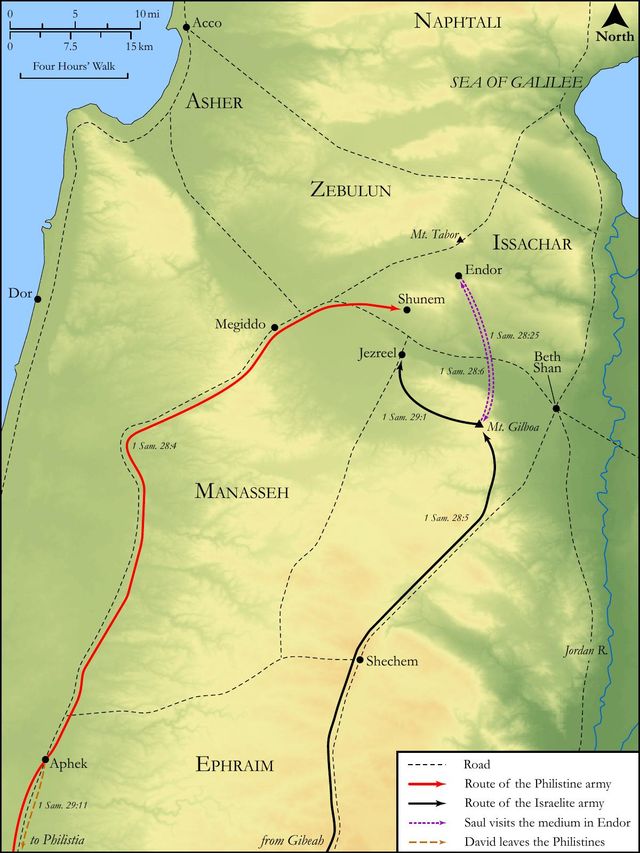
The period leading up to this event is characterized by intense and ongoing conflict between Israel and the Philistines, a dominant military power that frequently oppressed Israel. Saul's reign, though initially promising, was plagued by his persistent disobedience and spiritual decline, culminating in his definitive rejection by God as king (1 Samuel 15:23). The Philistine army had gathered at Shunem, while Israel camped at Gilboa (1 Samuel 28:4). Saul's consultation with a medium was a grave offense, explicitly punishable by death under Mosaic Law, reflecting the LORD's absolute prohibition against practices that sought to bypass or manipulate divine revelation. The concept of "being with me" refers to the common Old Testament understanding of Sheol, the realm of the dead, where all departed souls were believed to go, regardless of their moral standing, a shadowy existence rather than a place of conscious reward or punishment.
Key Themes
ShowHide1 Samuel 28:19 powerfully underscores several profound themes. First, it highlights the Divine Judgment and Consequences of Disobedience, demonstrating that God's rejection of Saul was not merely a withdrawal of favor but an active, culminating judgment that would result in his demise and Israel's defeat. Second, it emphasizes the Sovereignty of God over all events, including military outcomes, reinforcing that ultimate victory or defeat rests in His hands, not solely on human strength or strategy, as seen in Proverbs 21:31. Third, the verse demonstrates the Certainty of Prophecy, as Samuel's words are fulfilled precisely and swiftly, confirming the veracity and immutability of divine pronouncements, regardless of the means of their delivery. Finally, it marks the End of an Era, signaling the definitive close of Saul's kingship and paving the way for the establishment of David's dynasty, a pivotal transition in Israel's history that would bring a king after God's own heart, unlike Saul (1 Samuel 13:14).
Exposition and Analysis
ShowHideKey Word Analysis
ShowHideThis verb (H5414), meaning "to give," "to place," or "to deliver," is crucial here. Its repeated use emphasizes that the Philistine victory is not merely a military outcome but a direct act of divine judgment and agency. It signifies that God Himself is actively handing over Saul and Israel to their enemies, underscoring His sovereignty and the severity of Saul's sin. It is a deliberate act of divine surrender.
The inclusion of "tomorrow" (H4279) provides an immediate and terrifying temporal specificity to the prophecy. It removes any doubt about the timing of the impending doom, highlighting the swift and inescapable nature of the judgment. This word intensifies the sense of urgency and hopelessness for Saul, leaving him no time to escape or repent.
The word "sons" (H1121) refers to Saul's male offspring. Their inclusion in the prophecy of death signifies the complete and utter end of Saul's dynastic aspirations. It underscores that God's judgment extends beyond Saul himself to his lineage, ensuring that his kingship will not be passed down, thereby fulfilling earlier pronouncements of his rejection and the transfer of the kingdom to another.
Verse Breakdown
ShowHide"Moreover the LORD will also deliver Israel with thee into the hand of the Philistines:"
This opening clause establishes the divine agency behind the impending catastrophe. It is not simply a military defeat but a judgment orchestrated by the LORD (H3068). The phrase "with thee" links Saul's personal fate directly to the national calamity, indicating that his sin and disobedience have brought judgment not only upon himself but also upon the entire nation of Israel (H3478), who will be delivered (H5414) into the "hand" (H3027), signifying the power and control, of the Philistines (H6430).
"and to morrow [shalt] thou and thy sons [be] with me:"
This is the most personal and chilling part of the prophecy. "Tomorrow" (H4279) underscores the immediacy of the judgment. The inclusion of "thy sons" (H1121) highlights the dynastic consequences of Saul's rebellion—his lineage will not continue on the throne. "Be with me" is a stark euphemism for death, meaning Saul and his sons will join Samuel in Sheol, the realm of the dead, confirming their imminent demise and the finality of their earthly existence.
"the LORD also shall deliver the host of Israel into the hand of the Philistines."
This final clause reiterates and reinforces the first, emphasizing the totality of the defeat. The "host" (H4264) of Israel refers to the entire army, confirming that the national military power will be utterly broken. The repetition of "the LORD (H3068) also shall deliver (H5414)" underscores God's absolute sovereignty and active role in bringing about this judgment, leaving no room for doubt about the source of the impending disaster and the complete triumph of the Philistines (H6430).
Literary Devices
ShowHideThe passage employs several potent literary devices that amplify its dramatic and theological impact. Foreshadowing is paramount, as Samuel's prophecy explicitly details the grim outcome of the battle, creating a sense of inevitability and dread that hangs over the subsequent narrative of Saul's final days. There is profound Irony in Saul's desperate attempt to seek divine guidance through forbidden means, only to receive a message of utter condemnation and doom from the very prophet he had previously disobeyed. The phrase "be with me" functions as a clear Euphemism for death, softening the direct mention of demise while still conveying its absolute certainty and the shared fate of the departed. Finally, the Repetition of "the LORD will also deliver... into the hand of the Philistines" serves to emphasize the divine origin and certainty of the judgment, hammering home the message of God's sovereign control over the events and the inescapable nature of His decree.
Theological and Thematic Connections
ShowHide1 Samuel 28:19 serves as a stark theological commentary on the dire consequences of rebellion against God's revealed will and the unyielding nature of divine judgment. It demonstrates God's absolute sovereignty, not only in granting kingship but also in removing it, and in determining the outcome of battles and the fate of nations. Even when humans resort to forbidden practices, God remains in control, capable of using any means, even a medium, to declare His immutable decrees. This passage underscores that true security and guidance come only from faithful obedience to God and seeking Him through His appointed means, rather than through desperate and illicit measures born of fear and unbelief. It is a powerful reminder that God's word, once spoken, will not return void, and His justice will ultimately prevail.
Reflection and Application
ShowHideThe chilling prophecy of 1 Samuel 28:19 offers timeless lessons for believers today. Saul's tragic end is a powerful cautionary tale, reminding us that persistent disobedience to God's commands carries severe consequences, not only for individuals but potentially for those connected to them. It highlights the critical importance of seeking God's will through His legitimate and righteous channels—prayer, His Word, and the counsel of godly leaders—rather than resorting to desperate or forbidden means when faced with overwhelming challenges or spiritual silence. This passage calls us to cultivate a deep and abiding trust in God's sovereignty, even when circumstances seem dire or when His answers are not what we desire. Our ultimate hope and safety lie in faithful submission to His perfect will, understanding that His ways are always just, even when they involve difficult truths or judgments. It challenges us to examine our own lives: are we truly seeking God's face in His prescribed ways, or are we tempted to bypass His authority when fear or impatience takes hold?
Questions for Reflection
ShowHideFAQ
ShowHideWas it truly Samuel who appeared to Saul, or was it a demonic entity or an impostor?
ShowHideThis question has been debated among scholars for centuries. The text itself states, "Then said Samuel, Why hast thou disquieted me, to bring me up?" (1 Samuel 28:15). The medium also "saw Samuel" (1 Samuel 28:12). The most compelling argument for it being Samuel is that the prophecy delivered was entirely accurate and came to pass precisely as foretold, including the specific timing ("tomorrow") and the details of Saul's and his sons' deaths and Israel's defeat, which aligns with God's character as the source of truth. While God had forbidden consulting mediums, He is sovereign and can choose to override human prohibitions or use unexpected means to communicate His will, especially in judgment. Some argue it was a demonic deception, but such an entity would not be expected to deliver a divine judgment so accurately and in line with God's previous pronouncements through Samuel. Therefore, many conservative scholars conclude that, by God's sovereign allowance, the spirit of Samuel was indeed permitted to appear and deliver this final, devastating word to Saul.
Why would God allow Samuel to appear through a forbidden act of divination?
ShowHideWhile God strictly prohibited divination and consulting mediums (Deuteronomy 18:10-12), this incident demonstrates God's absolute sovereignty and His ability to achieve His purposes even through human sin and rebellion. God had already rejected Saul and ceased to communicate with him through legitimate means (1 Samuel 28:6). The appearance of Samuel, whether by God's direct command or sovereign permission, served as a final, undeniable confirmation of God's judgment upon Saul. It underscores that God's will cannot be thwarted, and His word will be fulfilled. It was not an endorsement of Saul's sin, but rather a powerful demonstration of God's justice and control over all events, even those that violate His commands.
What is the significance of the phrase "to morrow shalt thou and thy sons be with me"?
ShowHideThis phrase is a euphemism for death and a reference to Sheol, the common Old Testament understanding of the realm of the dead. It signifies that Saul and his sons would die the very next day and join Samuel in the afterlife. In the Old Testament, Sheol was not typically understood as a place of conscious torment or blessing, but rather a shadowy existence where all departed souls went. The significance here is twofold: first, it confirms the absolute certainty and immediacy of their deaths; and second, it highlights the personal and familial nature of the judgment against Saul, extending to his sons and ensuring the end of his dynastic line.
Christ-Centered Fulfillment
ShowHideThe grim prophecy of 1 Samuel 28:19, sealing Saul's fate and the defeat of Israel due to his disobedience, finds profound Christ-centered fulfillment in the New Testament. Saul's kingship, marked by rebellion and ending in judgment and death, stands in stark contrast to the perfect obedience and eternal reign of Jesus Christ. While Saul was "delivered... into the hand of the Philistines" as a consequence of his sin, Jesus, the true King, willingly "delivered himself up for us all" (Romans 8:32) as the ultimate sacrifice for sin. Saul's death meant the end of his earthly reign and a descent into Sheol, but Christ's death was a triumphant victory over sin and death itself, leading to His glorious resurrection and ascension, where He now reigns eternally at the right hand of God (Ephesians 1:20-21). The promise of Saul and his sons "being with me" (in death) is transformed for believers in Christ into the glorious hope of "being with Him" (in eternal life), as Jesus promised, "where I am, there you may be also" (John 14:3). Thus, the judgment and death pronounced upon Saul foreshadow the wages of sin (Romans 6:23), while Christ's perfect obedience and sacrificial death offer the free gift of eternal life to all who believe, conquering the power of death and ushering in a new, everlasting kingdom founded on grace and truth (Hebrews 5:8-9).