


1 Samuel 28:17
Bible text: King James Version (1769 Blayney text) · Public domain
Bible text: King James Version with Strong's numbers · Public domain
Bible text: Berean Standard Bible · Public domain
Bible text: American Standard Version (1901) · Public domain
Bible text: World English Bible, Messianic edition · Public domain
Bible text: Geneva Bible (1599) · Public domain
Bible text: Young's Literal Translation · Public domain
- וַיַּעַשׂvai·Ya·'asand he has doneH6213Conj-w ¦ V-Qal-ConsecImperf-3msVerb Qal Consecutive Imperfect 3rd Singular Masculineוַandיַּעַשׂhe has done
- יְהוָהYah·wehYahwehH3068N-properNoun Proper Title
- לוֹloto <the> himPrep-l ¦ 3msSuffix Personal 3rd Singular Masculineלto <the>וֹhim
- כַּאֲשֶׁרka·'a·Sherjust asH834Prep-k ¦ RelParticle Relativeכַּjustאֲשֶׁרas
- דִּבֶּרdi·Berhe spokeH1696V-Piel-Perf-3msVerb Piel Perfect 3rd Singular Masculine
- בְּיָדִיbe·ya·Diby my handH3027Prep-b ¦ N-csc ¦ 1csNoun Singular common gender Constructבְּbyיָדִhandיmy
- וַיִּקְרַעvai·yik·Ra'and he has tornH7167Conj-w ¦ V-Qal-ConsecImperf-3msVerb Qal Consecutive Imperfect 3rd Singular Masculineוַandיִּקְרַעhe has torn
- יְהוָהYah·wehYahwehH3068N-properNoun Proper Title
- אֶת'et<obj.>H853DirObjMParticle Object Indicator
- הַמַּמְלָכָהha·mam·la·Khahthe kingdomH4467Art ¦ N-fsNoun Singular Feminine Absoluteהַtheמַּמְלָכָהkingdom
- מִיָּדֶךָmi·ya·De·khafrom your handH3027Prep-m ¦ N-csc ¦ 2msNoun Singular common gender Constructמִfromיָּדֶhandךָyour
- וַיִּתְּנָהּvai·yi·te·Nahand he has given itH5414Conj-w ¦ V-Qal-ConsecImperf-3ms ¦ 3fsVerb Qal Consecutive Imperfect 3rd Singular Masculineוַandיִּתְּנָhe has givenהּit
- לְרֵעֲךָle·re·'a·Khato your neighborH7453Prep-l ¦ N-msc ¦ 2msNoun Singular Masculine Constructלְtoרֵעֲneighborךָyour
- לְדָוִדle·da·Vidto DavidH1732Prep-l ¦ N-proper-mNoun Proper MasculineלְtoדָוִדDavid
English is a literal word-by-word gloss of the Hebrew, not the KJV's wording. Why?
This is the original text the KJV's translators worked from — each Hebrew word with its own literal English meaning in this verse, prepared by scholars at Tyndale House, Cambridge. The KJV translates whole sentences, not word by word, so its wording differs: one Hebrew word can become several English words, and the KJV may choose “the LORD” where the gloss reads “Yahweh”. Both are faithful — they answer different questions. For the KJV's own rendering, switch to the KJV text.
Details
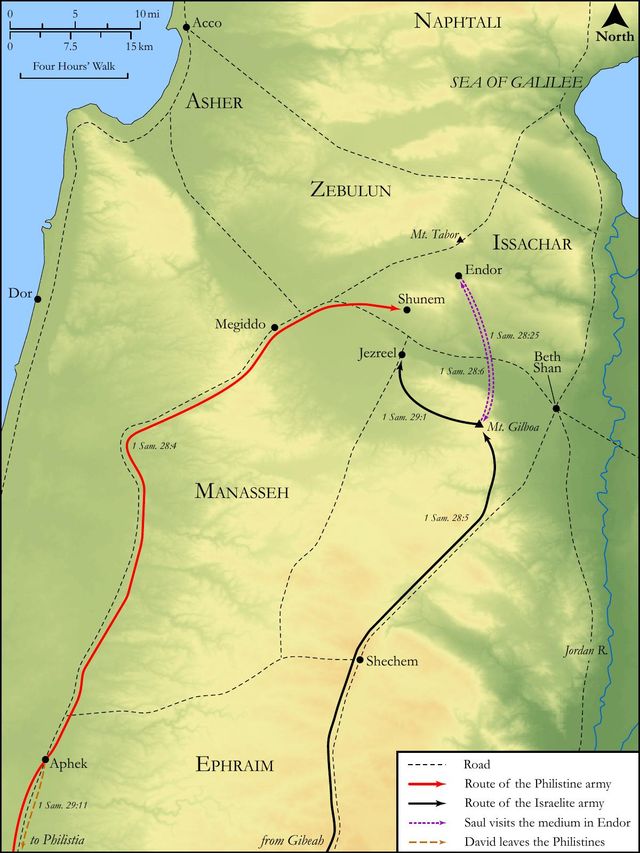
See on the biblical-era map
Study this verse
Public-domain commentary
Matthew Henry
From his Commentary on the Whole Bible. Henry comments on passages, not single verses — this entry covers 1 Samuel 28:15–19.
We have here the conference between Saul and Satan. Saul came in disguise (Sa1 28:8), but Satan soon discovered him, Sa1 28:12. Satan comes in disguise, in the disguise of Samuel's mantle, and Saul cannot discover him. Such is the disadvantage we labour under, in wrestling with the rulers of the darkness of this world, that they know us, while we are ignorant of their wiles and devices.
I.The spectre, or apparition, personating Samuel, asks why he is sent for (Sa1 28:15):
Why hast thou disquieted me to bring me up? To us this discovers that it was an evil spirit that personated Samuel; for (as bishop Patrick observes) it is not in the power of witches to disturb the rest of good men and to bring them back into the world when they please; nor would the true Samuel have acknowledged such a power in magical arts: but to Saul this was a proper device of Satan's, to draw veneration from him, to possess him with an opinion of the power of divination, and so to rivet him in the devil's interests.
II.Saul makes his complaint to this counterfeit Samuel, mistaking him for the true; and a most doleful complaint it is:
"I am sorely distressed, and know not what to do, for the Philistines make war against me; yet I should do well enough with them if I had but the tokens of God's presence with me; but, alas! God has departed from me." He complained not of God's withdrawings till he fell into trouble, till the Philistines made war against him, and then he began to lament God's departure. He that in his prosperity enquired not after God in his adversity thought it hard that God answered him not, nor took any notice of his enquiries, either by dreams or prophets, neither gave answers immediately himself nor sent them by any of his messengers. He does not, like a penitent, own the righteousness of God in this; but, like a man enraged, flies out against God as unkind and flies off from him: Therefore I have called thee; as if Samuel, a servant of God, would favour those whom God frowned upon, or as if a dead prophet could do him more service than the living ones. One would think, from this, that he really desired to meet with the devil, and expected no other (though under the covert of Samuel's name), for he desires advice otherwise than from God, therefore from the devil, who is a rival with God. "God denies me, therefore I come to thee. Flectere si nequeo superos, Acheronta movebo." - If I fail with heaven, I will move hell.
III.It is cold comfort which this evil spirit in Samuel's mantle gives to Saul, and is manifestly intended to drive him to despair and self-murder. Had it been the true Samuel, when Saul desired to be told what he should do he would have told him to repent and make his peace with God, and recall David from his banishment, and would then have told him that he might hope in this way to find mercy with God; but, instead of that, he represents his case as helpless and hopeless, serving him as he did Judas, to whom he was first a tempter and then a tormentor, persuading him first to sell his master and then to hang himself. 1. He upbraids him with his present distress (Sa1 28:16), tells him, not only that God had departed from him, but that he had become his enemy, and therefore he must expect no comfortable answer from him: "Wherefore dost thou ask me? How can I be thy friend when God is thy enemy, or thy counsellor when he has left thee?" 2. He upbraids him with the anointing of David to the kingdom, Sa1 28:17. He could not have touched upon a string that sounded more unpleasant in the ear of Saul than this. Nothing is said to reconcile him to David, but all tends rather to exasperate him against David and widen the breach. Yet, to make him believe that he was Samuel, the apparition affirmed that it was God who spoke by him. The devil knows how to speak with an air of religion, and can teach false apostles to transform themselves into the apostles of Christ and imitate their language. Those who use spells and charms, and plead, in defence of them, that they find nothing in them but what is good, may remember what good words the devil here spoke, and yet with what a malicious design. 3. He upbraids him with his disobedience to the command of God in not destroying the Amalekites, Sa1 28:18. Satan had helped him to palliate and excuse that sin when Samuel was dealing with him to bring him to repentance, but now he aggravates it, to make him despair of God's mercy. See what those get that hearken to Satan's temptations. He himself will be their accuser, and insult over them. And see whom those resemble that allure others to that which is evil and reproach them for it when they have done. 4. He foretels his approaching ruin, Sa1 28:19. (1.) That his army should be routed by the Philistines. This is twice mentioned: The Lord shall deliver Israel into the hand of the Philistines. This he might foresee, by considering the superior strength and number of the Philistines, the weakness of the armies of Israel, Saul's terror, and especially God's departure from them. Yet, to personate a prophet, he very gravely ascribes it once and again to God: The Lord shall do it. (2.) That he and his sons should be slain in the battle: Tomorrow, that is, in a little time (and, supposing that it was now after midnight, I see not but it may be taken strictly for the very next day after that which had now begun), thou and thy sons shall be with me, that is, in the state of the dead, separate from the body. Had this been the true Samuel, he could not have foretold the event unless God had revealed it to him; and, though it were an evil spirit, God might by him foretel it; as we read of an evil spirit that foresaw Ahab's fall at Ramoth-Gilead and was instrumental in it (Kg1 22:20, etc.), as perhaps this evil spirit was, by the divine permission, in Saul's destruction. That evil spirit flattered Ahab, this frightened Saul, and both that they might fall; so miserable are those that are under the power of Satan; for, whether he rage or laugh, there is no rest, Pro 29:9.
Historical interpretation
Two Centuries of Reception
2 surviving comments on this verse. Each one is dated, so this reads as a timeline rather than a list.
Select a marker to jump to its quote. Markers stagger vertically where authors wrote within a few decades of each other.
Is a little demon capable of prophesying concerning the entire people of God that the Lord is about to deliver Israel?…Can also a little demon know this, that after a king has been appointed with the anointing oil of a prophet, that tomorrow Saul and his sons with him will forfeit their lives?…
But I cannot give to a little demon such a great power that he can prophesy concerning Saul and the people of God and he can prophesy concerning David that he will become king.
Also, some can be sent to the living from the dead, just as in the opposite direction divine Scripture testifies that Paul was snatched from the living into paradise. Samuel the prophet, although dead, predicted future events to King Saul, who was alive, although some think that it was not Samuel himself who was able to be called forth by some magic, but that some spirit so allied with evil works had feigned a likeness to him—yet the book of Ecclesiasticus, which Jesus the son of Sirach is said to have written, but because of some similarity of style is thought to be the work of Solomon, contains in praise of the fathers the fact that Samuel prophesied even though dead. If there is objection to this book on the ground that it is not in the canon of ancient Hebrew Scripture, what are we going to say of Moses, who in Deuteronomy is certainly recorded as dead and again in the Gospel of Matthew is reported to have appeared to the living along with Elijah who did not die.
Continue studying 1 Samuel 28:17 across the web’s major study libraries — every link below opens this exact verse, chapter, or book on the destination site.
Read & Compare
 BibleGatewayThis verse in more than 200 translations and 70 languages.
 Bible.comThe YouVersion reader — hundreds of translations, reading plans, and highlights.
 ESV.orgCrossway's official English Standard Version reader.
 NET BibleThe NET translation with 60,000+ translators' notes on every rendering decision.
 STEP BibleTyndale House's free study tool — original text, vocabulary, and scholarly resources.
 BibliaLogos Bible Software's free web reader.
 USCCBThe New American Bible (Revised Edition) with the U.S. bishops' study notes.
Commentaries
 BibleHub CommentariesDozens of classic commentaries on this verse, gathered on one page.
 StudyLightMore than 100 commentary sets — the largest collection on the web.
 BibleRefPlain-English commentary on what this verse means, verse by verse.
 Enduring WordDavid Guzik's free commentary on this chapter, widely used by Bible teachers.
 Bible Study ToolsVerse commentary alongside Greek and Hebrew study aids.
Original Language & Research
- BibleHub InterlinearThe verse word by word — original language, transliteration, and English.
- BibleHub LexiconEvery word's original-language definition and Strong's entry.
 Blue Letter BibleDeep-study tools — Strong's numbers, concordance, and word studies.
 SefariaThe Hebrew text with Rashi and centuries of Jewish commentary.
Sermons, Hymns & Audio


TrulyRandomVerse is not affiliated with these sites and doesn’t control their content. They’re linked because they’re genuinely useful.
Summary
1 Samuel 28:17 delivers Samuel's final, devastating pronouncement to King Saul, confirming the irreversible divine judgment against him. Through the prophet's spirit, God declares that He has decisively torn the kingdom from Saul's grasp due to his persistent disobedience and has irrevocably transferred it to his "neighbour," David. This verse underscores God's absolute sovereignty over human affairs, the certainty of His prophetic word, and the severe consequences of rebellion against His will, culminating in the complete rejection of Saul's dynasty and the establishment of David's.
Context
ShowHideLiterary Context
This verse represents the climactic and most painful part of Samuel's posthumous appearance to King Saul at Endor. The narrative of 1 Samuel 28 opens with Saul in a desperate predicament: the Philistines are arrayed for battle, and God has refused to answer him through legitimate means—dreams, Urim, or prophets, as stated in 1 Samuel 28:6. In his profound desperation, Saul resorts to a forbidden act, consulting a medium and violating God's explicit command against necromancy, found in passages like Deuteronomy 18:10-12. The unexpected manifestation of Samuel's spirit, which even surprises the medium, serves not to offer counsel or comfort to Saul but to powerfully reiterate and confirm God's earlier judgment. This pronouncement in 1 Samuel 28:17 directly echoes Samuel's previous declarations of God's rejection of Saul's kingship, particularly the prophecy in 1 Samuel 15:28, where Samuel foretold that the Lord had torn the kingdom from Saul and given it to a neighbor. The verses immediately following 1 Samuel 28:17 detail the full extent of God's judgment, including Saul's impending death and the defeat of Israel.
Historical & Cultural Context
Saul's reign (c. 1050-1010 BC) marked Israel's critical transition from a tribal confederacy under judges to a centralized monarchy. However, his kingship was marred by repeated acts of disobedience to God's commands, most notably concerning the Amalekites, as detailed in 1 Samuel 15. During this period, the Philistines were Israel's formidable and persistent enemies, constantly threatening their borders and sovereignty. The impending battle at Gilboa, for which Saul is preparing, was a pivotal moment that would result in his death and a significant Philistine victory, plunging Israel into a period of vulnerability. In Israel, kingship was divinely ordained, for Samuel anointed Saul at the LORD's word, and a king's success was inextricably linked to his favor with God. This meant strict adherence to the covenant with Yahweh. Consulting mediums or engaging in necromancy was a grave offense, explicitly forbidden by the Mosaic Law, as it sought guidance from sources other than God and encroached upon His exclusive authority. Samuel's appearance, therefore, is not a legitimate prophetic act initiated by Saul but a sovereign divine intervention to confirm judgment through a forbidden channel, highlighting the profound depth of Saul's spiritual rebellion and God's unwavering control even over the means of His revelation.
Key Themes
ShowHideThis verse powerfully encapsulates several overarching themes within 1 Samuel and the broader Old Testament narrative. It vividly illustrates Divine Judgment and Consequences, demonstrating that persistent disobedience to God's explicit commands, especially from those in leadership, inevitably leads to severe and irreversible consequences. Saul's rejection is directly linked to his rebellion against the Lord's word, as articulated in 1 Samuel 15:23. The theme of God's Sovereignty is paramount, as the verse unequivocally states, "the LORD hath done to him," emphasizing that the transfer of the kingdom is not a random political upheaval but a deliberate, sovereign act of God's will. This highlights God's ultimate control over history and the destiny of nations and individuals. Furthermore, it underscores Prophetic Fulfillment, as Samuel's words serve as a painful and undeniable confirmation of earlier prophecies, reinforcing the reliability and certainty of God's declarations. What God speaks, He brings to pass, a truth echoed in Isaiah 55:11. Finally, the verse explicitly points to The Rise of David, naming him as the chosen successor and God's instrument for the new dynasty, fulfilling God's earlier anointing of David in 1 Samuel 16:13.
Exposition and Analysis
ShowHideKey Word Analysis
ShowHideThis primitive root signifies a violent tearing, ripping, or rending. It is not a gentle separation or a gradual transition but a forceful, decisive, and irreversible act. In the context of the kingdom, it emphasizes the abrupt and complete removal of Saul's authority and dynasty, reflecting the severity of his spiritual breach with the LORD and the finality of his rejection as king. This same word was used by Samuel in 1 Samuel 15:28, when he tore Samuel's robe, symbolizing God tearing the kingdom from Saul.
This word denotes an associate, companion, or friend. While literally meaning "friend" or "fellow," in this context, it refers to someone in close proximity or relation within the community, but crucially, it is not Saul's son or direct dynastic heir. The term here highlights the deliberate bypassing of Saul's lineage and the selection of someone outside his immediate family, yet close enough in the community of Israel to be considered a "neighbour." This emphasizes the divine choice of David, who was from the same nation but a different tribe and family, as the divinely appointed successor, rather than an expected dynastic transfer.
The verb dâbar (to speak) combined with the idiom "by my hand" (yâd) signifies that Samuel was God's instrument or agent through whom the divine message was delivered. It underscores Samuel's role as a true prophet, whose words were not his own but direct utterances from the LORD (Yᵉhôvâh). Even in death, Samuel's prophetic authority and the veracity of his prior pronouncements are reaffirmed, demonstrating that God's word, once spoken, is immutable and will come to pass. The phrase emphasizes the divine origin and authoritative nature of the message.
Verse Breakdown
ShowHide"And the LORD hath done to him, as he spake by me:"
This opening clause immediately establishes God's absolute sovereignty and the certainty of His prophetic word. "To him" refers to Saul. The phrase "as he spake by me" directly links this present judgment to Samuel's earlier prophecies, particularly those in 1 Samuel 13:14 and 1 Samuel 15:28. It confirms that the unfolding events are not random misfortune or political happenstance but the deliberate execution of God's foretold judgment, mediated through His prophet. The use of the past perfect tense ("hath done," "hath spake") underscores the accomplished nature of God's decree from His perspective.
"for the LORD hath rent the kingdom out of thine hand,"
This is the core of the judgment and the explanation ("for") for God's action. The verb "rent" (H7167, qâra') conveys a violent, decisive, and irreversible tearing away. "The kingdom" (H4467, mamlâkâh) refers to the royal dominion and authority. "Out of thine hand" (H3027, yâd) signifies the complete removal of authority, power, and legitimacy from Saul. This clause emphasizes that the loss of kingship is not a political coup or a natural succession but a direct, forceful act of divine intervention, a consequence of Saul's repeated disobedience and rejection of God's commands.
"and given it to thy neighbour, [even] to David:"
This final clause identifies the recipient of the kingdom, confirming God's chosen successor. The passive voice "given it" (H5414, nâthan) again highlights God (H3068, Yᵉhôvâh) as the active agent in this transfer, not human machinations. The term "thy neighbour" (H7453, rêa') is significant; it indicates someone not from Saul's immediate family or tribe, emphasizing that God bypasses Saul's lineage entirely. The explicit naming of David (H1732, Dâvid) removes all ambiguity, pointing to the shepherd boy from Bethlehem whom God had already anointed through Samuel (1 Samuel 16:13). This establishes the divine legitimacy of David's future reign and the ultimate fulfillment of God's covenant purposes.
Literary Devices
ShowHide1 Samuel 28:17 employs several potent literary devices to convey its message with dramatic force. Prophetic Utterance is central, as the entire verse functions as a divine declaration delivered through the spirit of Samuel. This form lends immense authority and finality to the words, underscoring their origin in God's immutable will. The consistent use of the past perfect tense ("hath done," "hath spake," "hath rent," "given") creates a powerful sense of Foregone Conclusion or Accomplished Fact, emphasizing that in God's eyes, the decision is already made and executed, leaving no room for reversal, even though the full physical transfer of power has not yet occurred. There is a profound Irony in Saul seeking guidance from a forbidden source only to receive a confirmation of his doom from the very prophet he had previously disobeyed and whose words he had rejected. The word "rent" serves as a powerful Metaphor for the violent and irreversible tearing away of the kingdom from Saul, vividly portraying the decisive nature of God's judgment. This metaphor is reinforced by the earlier instance in 1 Samuel 15:27-28, where Samuel's tearing of Saul's robe symbolizes the tearing of the kingdom.
Theological and Thematic Connections
ShowHide1 Samuel 28:17 stands as a stark theological declaration of God's absolute sovereignty and moral governance over His creation, particularly concerning leadership within His covenant people. It underscores that God is not merely an observer of human history but its ultimate orchestrator, capable of raising up and casting down kings according to His righteous will. The verse powerfully illustrates the principle that divine favor is conditional upon obedience and faithfulness, and persistent rebellion, even from an anointed leader, incurs severe and irreversible judgment. This passage also highlights the unwavering reliability of God's prophetic word; what He declares, He brings to pass, demonstrating His faithfulness to His promises and His threats. The transfer of the kingdom from Saul to David is not just a political transition but a divinely ordained shift, establishing the lineage through which God's ultimate redemptive purposes would unfold, setting the stage for the Davidic covenant and the coming Messiah.
Reflection and Application
ShowHideThe tragic narrative of Saul, culminating in this devastating pronouncement, serves as a timeless and sobering warning for all believers. It reminds us that God's standards are immutable, and His call to obedience is absolute, regardless of one's position or past achievements. Saul's downfall was not a sudden event but the painful consequence of a pattern of self-will, disobedience, and a gradual turning away from dependence on God. This verse challenges us to examine our own hearts: are we truly submitted to God's word, or do we, like Saul, prioritize our own desires, fears, or perceived necessities over His clear commands? It also offers profound comfort in the midst of life's uncertainties, affirming God's unwavering sovereignty. Even when human leaders fail or circumstances seem chaotic, God remains on His throne, working out His purposes, often through unexpected means and individuals. Our ultimate hope and security rest not in human power or political stability but in the unchanging character and sovereign plan of God, who raises up and brings down according to His perfect will.
Questions for Reflection
ShowHideFAQ
ShowHideWhy did God allow Samuel to appear through a medium, which He explicitly forbade?
ShowHideGod did not "allow" Samuel to appear in the sense of sanctioning or blessing Saul's forbidden act. Rather, God sovereignly intervened in a situation initiated by Saul's sin to deliver a final, undeniable judgment. The text emphasizes that Samuel's appearance was unexpected even by the medium, suggesting it was a divine override of the dark arts, not a result of them. God used this extraordinary and terrifying event to confirm His irreversible decree against Saul, demonstrating His power to use even unholy contexts to achieve His righteous purposes and to highlight the depth of Saul's desperation and the finality of his rejection. It was a terrifying manifestation of divine judgment, not a legitimate prophetic consultation.
What does it mean that David was Saul's "neighbour"?
ShowHideThe term "neighbour" (Hebrew: rea') implies someone close within the community but not necessarily a direct familial heir. In this context, it highlights that God bypassed Saul's own sons and direct lineage, choosing someone from outside his immediate family (David from the tribe of Judah, while Saul was from Benjamin) to inherit the kingdom. This emphasizes that the transfer of kingship was not a natural dynastic succession but a divine appointment based on God's sovereign choice and David's faithfulness, in contrast to Saul's disobedience. It underscores that God's choice is not limited by human expectations or traditions, and He can raise up a leader from an unexpected place, as seen in 1 Samuel 16:7.
Was there any hope for Saul to reverse God's judgment at this point?
ShowHideNo, the language of 1 Samuel 28:17 and the preceding chapters indicates that God's judgment against Saul was final and irreversible concerning his kingship and dynasty. Samuel's earlier pronouncements in 1 Samuel 13:14 and especially 1 Samuel 15:28-29 had already declared the kingdom torn from him. This final appearance of Samuel simply confirms the execution of that judgment. Saul's repeated and unrepentant disobedience had led to a point of no return regarding his kingship and dynasty. While God is merciful and long-suffering, there are consequences for persistent rebellion that can lead to irreversible outcomes in specific contexts, particularly concerning covenantal leadership and the fulfillment of divine purposes.
Christ-Centered Fulfillment
ShowHide1 Samuel 28:17, though a narrative of judgment and dynastic transition, profoundly foreshadows the ultimate King and His eternal kingdom. The tearing of the kingdom from Saul's hand and its transfer to David prefigures a greater divine transfer: the shift from a failed human kingship to the perfect, everlasting reign of Jesus Christ. Saul's rejection highlights the inadequacy of human leaders, even anointed ones, to perfectly fulfill God's will and maintain His covenant, pointing to the need for a King who is truly righteous and without blemish. In contrast, David, though flawed, was a "man after God's own heart" (Acts 13:22), chosen by God to establish a lineage that would culminate in the Messiah. Jesus, the true Son of David (Matthew 1:1), is the ultimate "neighbour" to whom the kingdom is given, not through human succession or political maneuvering, but by divine right and eternal decree. He is the King whose kingdom "shall have no end" (Luke 1:33), unlike Saul's temporary reign. The "rent" kingdom of Saul points to the brokenness of humanity's attempts at self-governance and the consequences of sin, while Christ's perfect obedience and sacrificial atonement establish a new, spiritual kingdom that cannot be shaken (Hebrews 12:28). Ultimately, 1 Samuel 28:17, in its declaration of God's sovereign removal of an unfaithful king and the establishment of His chosen successor, points forward to the glorious reign of Christ, who perfectly fulfills all prophetic promises and reigns eternally as the King of kings and Lord of lords (Revelation 19:16).