


1 Samuel 28:8
Bible text: King James Version (1769 Blayney text) · Public domain
Bible text: King James Version with Strong's numbers · Public domain
Bible text: Berean Standard Bible · Public domain
Bible text: American Standard Version (1901) · Public domain
Bible text: World English Bible, Messianic edition · Public domain
Bible text: Geneva Bible (1599) · Public domain
Bible text: Young's Literal Translation · Public domain
- וַיִּתְחַפֵּשׂvai·yit·cha·Pesand he disguised himselfH2664Conj-w ¦ V-Hithpael-ConsecImperf-3msVerb Hithpael Consecutive Imperfect 3rd Singular Masculineוַandיִּתְחַפֵּשׂhe disguised himself
- שָׁאוּלsha·'UlSaulH7586N-proper-mNoun Proper Masculine
- וַיִּלְבַּשׁvai·yil·Bashand he was clothedH3847Conj-w ¦ V-Qal-ConsecImperf-3msVerb Qal Consecutive Imperfect 3rd Singular Masculineוַandיִּלְבַּשׁhe was clothed
- בְּגָדִיםbe·ga·DimgarmentsH899N-mpNoun Plural Masculine Absolute
- אֲחֵרִים'a·che·RimotherH312Adj-mpAdjective Plural Masculine Absolute
- וַיֵּלֶךְvai·Ye·lekhand he wentH1980Conj-w ¦ V-Qal-ConsecImperf-3msVerb Qal Consecutive Imperfect 3rd Singular Masculineוַandיֵּלֶךְhe went
- הוּאHu'heH1931Pro-3msPronoun Personal 3rd Singular Masculine
- וּשְׁנֵיu·she·Neiand twoH8147Conj-w ¦ N-cdcNoun Dual common gender Constructוּandשְׁנֵיtwo
- אֲנָשִׁים'a·na·ShimmenH582N-mpNoun Plural Masculine Absolute
- עִמּוֹi·Mowith himH5973Prep ¦ 3msPreposition Definiteעִמּwithוֹhim
- וַיָּבֹאוּvai·ya·Vo·'uand they cameH935Conj-w ¦ V-Qal-ConsecImperf-3mpVerb Qal Consecutive Imperfect 3rd Plural Masculineוַandיָּבֹאוּthey came
- אֶל'eltoH413PrepPreposition
- הָאִשָּׁהha·'i·Shahthe womanH802Art ¦ N-fsNoun Singular Feminine Absoluteהָtheאִשָּׁהwoman
- לָיְלָהLa·ye·lahnightH3915N-msNoun Singular Masculine Absolute
- וַיֹּאמֶרvai·Yo·merand he saidH559Conj-w ¦ V-Qal-ConsecImperf-3msVerb Qal Consecutive Imperfect 3rd Singular Masculineוַandיֹּאמֶרhe said
- קָסֳמִיka·so·midivineH7080V-Qal-Imp-2fsVerb Qal Imperative 2nd Singular Feminine
- נָאna'pleaseH4994PrtParticle Interjection
- לִיlifor <the> mePrep-l ¦ 1csSuffix Personal 1st Singular common genderלִfor <the>יme
- בָּאוֹבba·'ovby <the> necromancyH178Prep-b ¦ N-msNoun Singular Masculine Absoluteבָּby <the>אוֹבnecromancy
- וְהַעֲלִיve·Ha·'a·liand bring upH5927Conj-w ¦ V-Hiphil-Imp-2fsVerb Hiphil Imperative 2nd Singular Feminineוְandהַעֲלִיbring up
- לִיLifor <the> mePrep-l ¦ 1csSuffix Personal 1st Singular common genderלִfor <the>יme
- אֵת'et<obj.>H853DirObjMParticle Object Indicator
- אֲשֶׁר'a·Sher[the one] whomH834RelParticle Relative
- אֹמַר'o·MarI will sayH559V-Qal-Imperf-1csVerb Qal Imperfect 1st Singular common gender
- אֵלָיִךְ'e·La·yikhto youH413Prep ¦ 2fsPreposition Definiteאֵלָיִtoךְyou
English is a literal word-by-word gloss of the Hebrew, not the KJV's wording. Why?
This is the original text the KJV's translators worked from — each Hebrew word with its own literal English meaning in this verse, prepared by scholars at Tyndale House, Cambridge. The KJV translates whole sentences, not word by word, so its wording differs: one Hebrew word can become several English words, and the KJV may choose “the LORD” where the gloss reads “Yahweh”. Both are faithful — they answer different questions. For the KJV's own rendering, switch to the KJV text.
Details
See on the biblical-era map
Study this verse
Public-domain commentary
Matthew Henry
From his Commentary on the Whole Bible. Henry comments on passages, not single verses — this entry covers 1 Samuel 28:7–14. His two-level outline is real structure in the source text, so it is rendered as structure.
Here, I. Saul seeks for a witch, Sa1 28:7. When God answered him not, if he had humbled himself by repentance and persevered in seeking God, who knows but that at length he might have been entreated for him? but, since he can discern no comfort either from heaven or earth (Isa 8:21, Isa 8:22), he resolves to knock at the gates of hell, and to see if any there will befriend him and give him advice: Seek me a woman that has a familiar spirit, Sa1 28:7. And his servants were too officious to serve him in this evil affair; they presently recommended one to him at Endor (a city not far off) who had escaped the execution of Saul's edict. To her he resolves to apply. Herein he is chargeable, 1. With contempt of the God of Israel; as if any creature could do him a kindness when God had left him and frowned upon him. 2. With contradiction to himself. He knew the heinousness of the sin of witchcraft, else he would not have cut off those that had familiar spirits; yet now he had recourse to that as an oracle which he had before condemned as an abomination. It is common for men to inveigh severely against those sins which they are in no temptation to, but afterwards to be themselves overcome by them. Had one told Saul, when he was destroying the witches, that he himself would, ere long, consult with one, he would have said, as Hazael did, What? Is thy servant a dog? But who knows what mischiefs those will run into that forsake God and are forsaken of him?
II.Hearing of one he hastens to her, but goes by night, and in disguise, only with two servants, and probably on foot, Sa1 28:8. See how those that are led captive by Satan are forced,
1.To disparage themselves. Never did Saul look so mean as when he went sneaking to a sorry witch to know his fortune.
2.To dissemble. Evil works are works of darkness, and they hate the light, neither care for coming to it. Saul went to the witch, not in his robes, but in the habit of a common soldier, not only lest the witch herself, if she had known him, should decline to serve him, either fearing he came to trepan her or resolving to be avenged on him for his edict against those of her profession, but lest his own people should know it and abhor him for it. Such is the power of natural conscience that even those who do evil blush and are ashamed to do it.
III.He tells her his errand and promises her impunity.
1.All he desires of her is to bring up one from the dead, whom he had a mind to discourse with. It was necromancy or divination by the dead, that he hoped to serve his purpose by. This was expressly forbidden by the law (Deu 18:11), seeking for the living to the dead, Isa 8:19. Bring me up him whom I shall name, Sa1 28:8. This supposes that it was generally taken for granted that souls exist after death, and that when men die there is not an end of them: it supposes too that great knowledge was attributed to separate souls. But to think that any good souls would come up at the beck of an evil spirit, or that God, who had denied a man the benefit of his own institutions, would suffer him to reap any real advantage by a cursed diabolical invention, was very absurd.
2.She signifies her fear of the law, and her suspicion that this stranger came to draw her into a snare (Sa1 28:9): Thou knowest what Saul has done. Providence ordered it so that Saul should be told to his face of his edict against witches, at this very time when he was consulting one, for the greater aggravation of his sin. She insists upon the peril of the law, perhaps to raise her price; for, though no mention is made of her fee, no doubt she demanded and had a large one. Observe how sensible she is of danger from the edict of Saul, and what care she is in to guard against it; but not at all apprehensive of the obligations off God's law and the terrors of his wrath. She considered what Saul had done, not what God had done, against such practices, and feared a snare laid for her life more than a snare laid for her soul. It is common for sinners to be more afraid of punishment from men than of God's righteous judgment. But,
3.Saul promises with an oath not to betray her, Sa1 28:10. It was his duty as a king to punish her and he knew it, yet he swears no to do it; as if he could by his own oath bind himself from doing that which, by the divine command, he was bound to do. But he promised more than he could perform when he said, There shall no punishment happen to thee; for he that could not secure himself could much less secure her from divine vengeance.
IV.Samuel, who was lately dead, is the person whom Saul desired to have some talk with; and the witch, with her enchantments, gratifies his desire, and brings them together.
1.As soon as Saul had given the witch the assurance she desired (that he would not discover her) she applied to her witchcrafts, and asked very confidently, Whom shall I bring up to thee? Sa1 28:11. Note, Hopes of impunity embolden sinners in their evil ways and harden their hearts.
2.Saul desires to speak with Samuel: Bring me up Samuel. Samuel had anointed him to the kingdom and had formerly been his faithful friend and counsellor, and therefore with him he wished to advise. While Samuel was living at Ramah, not far from Gibeah of Saul, and presided there in the school of the prophets, we never read of Saul's going to him to consult him in any of the difficulties he was in (it would have been well for him if he had); then he slighted him, and perhaps hated him, looking upon him to be in David's interest. But now that he is dead, "O for Samuel again! By all means, bring me up Samuel." Note, Many that despise and persecute God's saints and ministers when they are living would be glad to have them again when they are gone. Send Lazarus to me, and send Lazarus to my father's house, Luk 16:24-27. The sepulchres of the righteous are garnished.
3.Here is a seeming defector chasm in the story. Saul said, Bring me up Samuel, and the very next words are, When the woman saw Samuel, (Sa1 28:12), whereas one would have expected to be told how she performed the operation, what spells and charms she used, or that some little intimation would be given of what she said or did; but the profound silence of the scripture concerning it forbids our coveting to know the depths of Satan (Rev 2:24) or to have our curiosity gratified with an account of the mysteries of iniquity. It has been said of the books of some of the popish confessors that, by their descriptions of sin, they have taught men to commit it; but the scripture conceals sinful art, that we may be simple concerning evil, Rom 16:19.
4.The witch, upon sight of the apparition, was aware that her client was Saul, her familiar spirit, it is likely, informing her of it (Sa1 28:12): "Why hast thou deceived me with a disguise; for thou art Saul, the very man that I am afraid of above any man?" Thus she gave Saul to understand the power of her art, in that she could discover him through his disguise; and yet she feared lest, hereafter, at least, he should take advantage against her for what she was now doing. Had she believed that it was really Samuel whom she saw, she would have had more reason to be afraid of him, who was a good prophet, than of Saul, who was a wicked king. But the wrath of earthly princes is feared by most more than the wrath of the King of kings.
5.Saul (who, we may suppose, was kept at a distance in the next room) bade her not to be afraid of him, but go on with the operation, and enquired what she saw? Sa1 28:13. O, says the woman, I saw gods (that is, a spirit) ascending out of the earth; they called angels gods, because spiritual beings. Poor gods that ascend out of the earth! But she speaks the language of the heathen, who had their infernal deities and had them in veneration. If Saul had thought it necessary to his conversation with Samuel that the body of Samuel should be called out of the grave, he would have taken the witch with him to Ramah, where his sepulchre was; but the design was wholly upon his soul, which yet, if it became visible, was expected to appear in the usual resemblance of the body; and God permitted the devil, to answer the design, to put on Samuel's shape, that those who would not receive the love of the truth might be given up to strong delusions and believe a lie. That it could not be the soul of Samuel himself they might easily apprehend when it ascended out of the earth, for the spirit of a man, much more of a good man, goes upward, Ecc 3:21. But, if people will be deceived, it is just with God to say, "Let them be deceived." That the devil, by the divine permission, should be able to personate Samuel is not strange, since he can transform himself into an angel of light! nor is it strange that he should be permitted to do it upon this occasion, that Saul might be driven to despair, by enquiring of the devil, since he would not, in a right manner, enquire of the Lord, by which he might have had comfort. Saul, being told of gods ascending, was eager to know what was the form of this deity, and in what shape he appeared, so far was he from conceiving any horror at it, his heart being wretchedly hardened by the deceitfulness of sin. Saul, it seems, was not permitted to see any manner of similitude himself, but he must take the woman's word for it, that she saw an old man covered with a mantle, or robe, the habit of a judge, which Samuel had sometimes worn, and some think it was for the sake of that, and the majesty of its aspect, that she called this apparition Elohim, a god or gods; for so magistrates are styled, Psa 82:1.
6.Saul, perceiving, by the woman's description, that it was Samuel, stooped with his face to the ground, either, as it is generally taken, in reverence to Samuel, though he saw him not, or perhaps to listen to that soft and muttering voice which he now expected to hear (for those that had familiar spirits peeped and muttered, Isa 8:19); and it should seem Saul bowed himself (probably by the witch's direction) that he might hear what was whispered and listen carefully to it; for the voice of one that has a familiar spirit is said to come out of the ground, and whisper out of the dust, Isa 29:4. He would stoop to that who would not stoop to the word of God.
Historical interpretation
Historical reception
1 surviving comment on this verse from the historical church.
He therefore changed his appearance, etc. The people of the Jews, having changed their habit in worst either of their earthly kingdom or of faith and works, by which they ought to have been spiritually adorned and loved, came to the hearing of such a Synagogue, which the woman with a familiar spirit signifies, in the blindness of a darkened heart; with those who, transgressing the unity of the true faith or charity, have by no means come to the knowledge of the holy Trinity. For he knows that the number two is sometimes placed in evil, who knows on what account the work of the second day alone in the creation of the world did not deserve the blessing of divine vision, and that unclean animals entered the ark under this number, and he rightly understands innumerable other things of this kind in the Scriptures.
Continue studying 1 Samuel 28:8 across the web’s major study libraries — every link below opens this exact verse, chapter, or book on the destination site.
Read & Compare
 BibleGatewayThis verse in more than 200 translations and 70 languages.
 Bible.comThe YouVersion reader — hundreds of translations, reading plans, and highlights.
 ESV.orgCrossway's official English Standard Version reader.
 NET BibleThe NET translation with 60,000+ translators' notes on every rendering decision.
 STEP BibleTyndale House's free study tool — original text, vocabulary, and scholarly resources.
 BibliaLogos Bible Software's free web reader.
 USCCBThe New American Bible (Revised Edition) with the U.S. bishops' study notes.
Commentaries
 BibleHub CommentariesDozens of classic commentaries on this verse, gathered on one page.
 StudyLightMore than 100 commentary sets — the largest collection on the web.
 BibleRefPlain-English commentary on what this verse means, verse by verse.
 Enduring WordDavid Guzik's free commentary on this chapter, widely used by Bible teachers.
 Bible Study ToolsVerse commentary alongside Greek and Hebrew study aids.
Original Language & Research
- BibleHub InterlinearThe verse word by word — original language, transliteration, and English.
- BibleHub LexiconEvery word's original-language definition and Strong's entry.
 Blue Letter BibleDeep-study tools — Strong's numbers, concordance, and word studies.
 SefariaThe Hebrew text with Rashi and centuries of Jewish commentary.
Sermons, Hymns & Audio


TrulyRandomVerse is not affiliated with these sites and doesn’t control their content. They’re linked because they’re genuinely useful.
Summary
1 Samuel 28:8 chronicles King Saul's desperate and disobedient act of seeking guidance from a medium at Endor. Overwhelmed by the formidable Philistine threat and experiencing profound divine silence, Saul, in a profound act of hypocrisy and spiritual decline, disguises himself and, accompanied by two trusted men, approaches the woman by night. He implores her to conjure a specific individual's spirit through her familiar spirit, a practice explicitly forbidden by God, thereby revealing the tragic depths of his spiritual abandonment and his willingness to defy divine commands for perceived strategic advantage.
Context
ShowHideLiterary Context
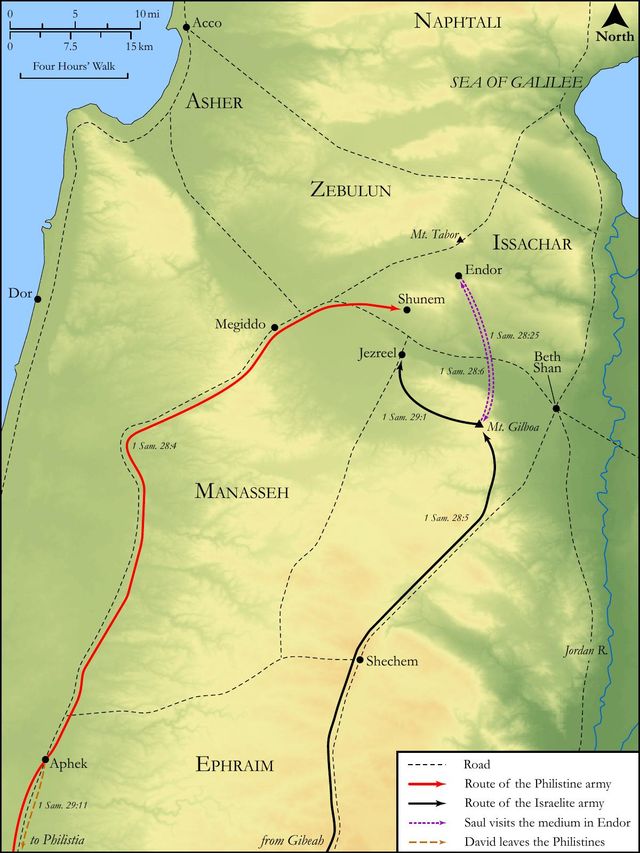
This verse marks a critical turning point in the tragic decline of King Saul's reign, immediately following a period of intense despair and God's absolute silence. The preceding verses vividly portray the overwhelming Philistine military might gathered at Shunem and Saul's profound fear, which caused his heart to tremble greatly, as described in 1 Samuel 28:5. Crucially, God had ceased to answer Saul through any legitimate means: neither by dreams, nor by Urim (the priestly oracle), nor by prophets, as explicitly stated in 1 Samuel 28:6. This divine abandonment, a direct consequence of Saul's persistent disobedience and God's earlier rejection of him as king, drives him to seek a forbidden, illicit alternative. The irony is particularly stark, given that Saul himself had previously demonstrated zeal by outlawing and purging mediums and familiar spirits from the land, as noted in 1 Samuel 28:3. His nocturnal visit and elaborate disguise underscore the shame, secrecy, and profound hypocrisy inherent in his actions, setting the ominous stage for the dramatic and ultimately disastrous encounter that unfolds.
Historical & Cultural Context
Among the nations whom the LORD drove out before Israel, various forms of divination, including necromancy (consulting the dead) and spiritism, were common and widely practiced. However, the Mosaic Law, which formed the bedrock of Israel's covenant relationship with Yahweh, unequivocally condemned such practices as detestable abominations. Passages like Deuteronomy 18:10-12 and Leviticus 19:31 explicitly forbid consulting mediums, familiar spirits, or the dead, associating these acts with idolatry, paganism, and a turning away from the one true God. The theological rationale was clear: God alone is the sovereign source of all revelation, wisdom, and guidance. Seeking counsel from any other source, especially those associated with the demonic realm or pagan deities, was considered a profound affront to His unique sovereignty, holiness, and covenant faithfulness. Saul's desperate act, therefore, was not merely a personal moral failing but a grave violation of the covenant, a public rejection of God's prescribed means of communication, and a descent into the very practices he was divinely commanded to eradicate.
Key Themes
ShowHideThis pivotal passage powerfully illustrates several profound theological and narrative themes. Firstly, desperation leading to disobedience is central, demonstrating how intense fear and a perceived lack of divine guidance can tragically compel even a king to defy God's explicit commands. Saul's actions serve as a chilling example of what transpires when human panic and self-reliance override faith and obedience to divine law. Secondly, the theme of hypocrisy and profound spiritual decline is vividly portrayed, as Saul, who once enforced God's law against mediums, now secretly seeks one out, revealing the extent of his moral and spiritual decay. His willingness to abandon fundamental principles for a semblance of control or information highlights a catastrophic loss of his moral and spiritual compass. Thirdly, the theme of forbidden practices is underscored, serving as a stark biblical warning against necromancy and any form of divination, emphasizing their detestable nature to the Lord and their inherent danger to spiritual well-being. Finally, and perhaps most significantly, the verse contributes to the overarching theme of the consequences of rejecting God's authority, as Saul's persistent rebellion, particularly his earlier disobedience regarding the Amalekites as detailed in 1 Samuel 15:23, culminates in this desperate, illicit act, foreshadowing his impending doom and demonstrating the severe and irreversible repercussions of turning away from the Lord's will.
Exposition and Analysis
ShowHideKey Word Analysis
ShowHideFrom the primitive root H2664, meaning "to seek; causatively, to conceal oneself (i.e. let be sought), or mask; change, (make) diligent (search), disquise self, hide, search (for, out)." In this context, it emphasizes Saul's deliberate and active effort to hide his royal identity. This act of concealment is not merely practical but deeply symbolic, reflecting his shame, fear of discovery, and the profound hypocrisy of seeking a practice he had himself outlawed. It underscores his fallen state, a king reduced to secrecy and deception.
Meaning "from the same as אָב (apparently through the idea of prattling a father's name); properly, a mumble, i.e. a water skin (from its hollow sound); hence a necromancer (ventriloquist, as from a jar); bottle, familiar spirit." This term refers to a medium or necromancer who was believed to be possessed by a spirit or to conjure the spirits of the dead. The Hebrew word itself can refer to a leather bottle, possibly indicating the ventriloquial sound associated with such spirits, as if speaking from the ground or from within the medium. It denotes a spirit of divination or sorcery and is consistently condemned throughout the Old Testament as an abomination to God, representing a direct channel to demonic forces rather than divine revelation.
Verse Breakdown
ShowHide"And Saul disguised himself, and put on other raiment"
This opening clause immediately establishes the clandestine and illicit nature of Saul's mission. His disguise signifies his desperate attempt to evade recognition and the legal consequences of his actions, as well as the profound shame associated with his desperate act. It underscores his fallen state, a once-anointed king now resorting to deception. The "other raiment" (H312, H899) suggests a deliberate change from royal attire to common clothing, further emphasizing his desire for anonymity.
"and he went, and two men with him"
Saul's decision to bring two men (H582) suggests a need for security, witnesses, or perhaps moral support, though their presence also means his forbidden act is not entirely private. Their journey ("went," H3212) implies a deliberate and purposeful undertaking, despite its illicit nature.
"and they came to the woman by night"
The arrival ("came," H935) at night (H3915) powerfully reinforces the clandestine nature of the visit. The "woman" (H802) is specifically identified as a medium (implied by the subsequent request), located in Endor, a place likely chosen for its remoteness and the medium's reputation for operating outside the king's previous purge. The darkness of night symbolizes the moral and spiritual darkness of Saul's actions.
"and he said, I pray thee, divine unto me by the familiar spirit"
This is Saul's direct and desperate request, revealing his intent. "Divine unto me" (H7080, qâçam) means to practice divination or enchantment. He explicitly asks the woman to use her "familiar spirit" (H178, ʼôwb), acknowledging her forbidden power and his desperate reliance on it. This is a direct and egregious violation of God's commands against such practices.
"and bring me [him] up, whom I shall name unto thee."
This final clause specifies Saul's precise objective: to conjure a particular individual (H5927, ʻâlâh - to ascend, bring up) from the dead. The bracketed "him" in the KJV text clarifies that Saul intends to name a specific person, which, as the narrative unfolds, is the prophet Samuel. This demonstrates Saul's desperate desire for guidance from a source he once respected and trusted, even if it means resorting to necromancy, a practice anathema to Yahweh.
Literary Devices
ShowHideThe passage is rich in Irony, as Saul, who had previously purged the land of mediums and familiar spirits (1 Samuel 28:3), now seeks one out in his utter desperation. This highlights his profound spiritual decline, hypocrisy, and the tragic reversal of his earlier, more obedient stance. The setting of "by night" serves as potent Symbolism, representing not only the secrecy and illicit nature of the encounter but also the moral and spiritual darkness into which Saul has descended. This nocturnal setting also creates palpable Dramatic Tension, as the reader anticipates the forbidden encounter and its ominous, divinely condemned implications. The entire scene functions as powerful Foreshadowing, as Saul's desperate act of defiance against God's explicit law directly precedes and sets the stage for his ultimate defeat and death in the subsequent chapter, underscoring the severe and inevitable consequences of rejecting divine authority and seeking counsel from forbidden sources.
Theological and Thematic Connections
ShowHideSaul's desperate turn to a familiar spirit is a profound theological statement on the dangers of seeking guidance outside of God's prescribed will. When God's legitimate channels of communication (prophets, dreams, Urim) are closed due to persistent disobedience and unrepentant sin, human beings are often tempted to resort to illicit and forbidden means. This can manifest not only as overt occult practices but also through more subtle forms of ungodly counsel, manipulative spiritual practices, or a desperate pursuit of signs and wonders that bypass the steady work of prayer, Scripture study, and faithful community. This passage underscores God's absolute sovereignty and the futility of human attempts to force or manipulate spiritual revelation. It highlights that true wisdom and guidance come only from humble submission to God's word and patient waiting upon Him, even in times of perceived silence or overwhelming difficulty. Saul's actions serve as a stark warning against spiritual shortcuts and the profound spiritual dangers of seeking power or knowledge from sources other than the Lord, emphasizing that such actions constitute a profound betrayal of covenant loyalty.
Reflection and Application
ShowHideSaul's tragic story in 1 Samuel 28:8 offers a sobering and timeless mirror for believers today. In moments of intense fear, confusion, or perceived divine silence, the temptation to seek guidance from sources outside God's revealed will can be incredibly strong. This might not manifest as literal necromancy but could appear as an over-reliance on worldly wisdom, ungodly counsel from friends or media, manipulative spiritual practices, or even a desperate pursuit of signs and wonders that bypass the steady, patient work of prayer, diligent Scripture study, and faithful community. Saul's ultimate demise reminds us that true peace, genuine guidance, and lasting security come only from abiding in God's will and trusting His sovereign control, even when circumstances are bleak and immediate answers are not apparent. It calls us to cultivate a deep, unwavering dependence on God, to patiently wait on Him, and to consistently seek His face through His infallible Word and persistent prayer, rather than resorting to any "familiar spirit" that promises quick fixes, illicit knowledge, or a sense of control apart from Him. Our desperation should drive us to God, not away from Him.
Questions for Reflection
ShowHideFAQ
ShowHideWhy was consulting a familiar spirit so strictly forbidden in ancient Israel?
ShowHideConsulting a familiar spirit, or any form of necromancy or divination, was strictly forbidden in ancient Israel for several profound theological reasons, rooted in God's unique nature and His covenant with His people. Firstly, it represented a direct act of idolatry, a turning away from Yahweh, the one true God, to seek guidance or power from other sources, which were often associated with demonic entities or false gods (Deuteronomy 18:10-12). God alone is the source of all true revelation and wisdom, and seeking counsel elsewhere was a profound affront to His sovereignty and exclusivity. Secondly, it was seen as an attempt to manipulate the spiritual realm or gain knowledge through illicit means, bypassing God's sovereign control and His established ways of communication (prophets, dreams, Urim). This demonstrated a lack of trust in God's provision and timing. Thirdly, such practices often involved deception and led people astray, drawing them into spiritual darkness and away from the light of God's truth. Finally, it dishonored the dead and violated the sacred boundary between life and death, a boundary established and maintained by God. The Old Testament consistently portrays these practices as detestable to the Lord, warning of severe consequences for those who engaged in them, even death (Leviticus 20:6).
Christ-Centered Fulfillment
ShowHideSaul's desperate and disobedient act of seeking a familiar spirit stands in stark, illuminating contrast to the perfect obedience and divine authority of Jesus Christ. Saul, the failed king, sought to conjure a dead prophet for guidance, revealing his spiritual bankruptcy and the futility of human efforts to manipulate spiritual realities. In Christ, however, we find the ultimate Prophet, Priest, and King, who truly speaks the words of God and needs no familiar spirit to reveal truth. Unlike Saul, who was abandoned by God due to his rebellion and persistent sin, Jesus perfectly fulfilled the Father's will, even to the point of death on the cross, thereby securing for us true access to God and His boundless wisdom. Where Saul's act was a descent into darkness and a profound violation of God's law, Christ is the Light of the World, who dispels the shadows of sin, deception, and spiritual ignorance. He is the Good Shepherd who leads His sheep, providing clear, life-giving guidance and protection, unlike the deceptive whispers of familiar spirits. Through His atoning sacrifice and victorious resurrection, Christ has broken the power of darkness, sin, and evil spirits, offering us freedom from their influence and establishing a direct, unhindered relationship with God. He sends the Holy Spirit, who guides us into all truth and reveals the deep things of God, making the forbidden practices of Saul's era utterly obsolete for the believer. Thus, Saul's tragic search for a false oracle ultimately points to Christ as the only true source of life, wisdom, and peace, the one who gives us access to the Father and the Spirit of truth to navigate life's darkest moments.