


2 Chronicles 18:29
- וַיֹּאמֶרvai·yo·Merand he saidH559Conj-w ¦ V-Qal-ConsecImperf-3msVerb Qal Consecutive Imperfect 3rd Singular Masculineוַandיֹּאמֶרhe said
- מֶלֶךְMe·lekh[the] king ofH4428N-mscNoun Singular Masculine Construct
- יִשְׂרָאֵלYis·ra·'ElIsraelH3478N-properNoun Proper Location
- אֶל'eltoH413PrepPreposition
- יְהוֹשָׁפָטye·ho·sha·FatJehoshaphatH3092N-proper-mNoun Proper Masculine
- הִתְחַפֵּשׂhit·cha·PesI will disguise myselfH2664V-Hithpael-InfVerb Hithpael Infinitive Construct
- וָבוֹאva·Vo'and I will goH935Conj-w ¦ V-Qal-InfVerb Qal Infinitive ConstructוָandבוֹאI will go
- בַמִּלְחָמָהva·mil·cha·Mahin <the> battleH4421Prep-b ¦ N-fsNoun Singular Feminine Absoluteבַin <the>מִּלְחָמָהbattle
- וְאַתָּהve·'a·Tahand youH859Conj-w ¦ Pro-2msPronoun Personal 2nd Singular Masculineוְandאַתָּהyou
- לְבַשׁle·VashwearH3847V-Qal-Imp-2msVerb Qal Imperative 2nd Singular Masculine
- בְּגָדֶיךָbe·ga·Dei·khayour own clothesH899N-mpc ¦ 2msNoun Plural Masculine Constructבְּגָדֶיown clothesךָyour
- וַיִּתְחַפֵּשׂvai·yit·cha·Pesand he disguised himselfH2664Conj-w ¦ V-Hithpael-ConsecImperf-3msVerb Hithpael Consecutive Imperfect 3rd Singular Masculineוַandיִּתְחַפֵּשׂhe disguised himself
- מֶלֶךְMe·lekh[the] king ofH4428N-mscNoun Singular Masculine Construct
- יִשְׂרָאֵלYis·ra·'ElIsraelH3478N-properNoun Proper Location
- וַיָּבֹאוּvai·ya·Vo·'uand they wentH935Conj-w ¦ V-Qal-ConsecImperf-3mpVerb Qal Consecutive Imperfect 3rd Plural Masculineוַandיָּבֹאוּthey went
- בַּמִּלְחָמָהba·mil·cha·Mahin <the> battleH4421Prep-b ¦ N-fsNoun Singular Feminine Absoluteבַּin <the>מִּלְחָמָהbattle
English is a literal word-by-word gloss of the Hebrew, not the KJV's wording. Why?
This is the original text the KJV's translators worked from — each Hebrew word with its own literal English meaning in this verse, prepared by scholars at Tyndale House, Cambridge. The KJV translates whole sentences, not word by word, so its wording differs: one Hebrew word can become several English words, and the KJV may choose “the LORD” where the gloss reads “Yahweh”. Both are faithful — they answer different questions. For the KJV's own rendering, switch to the KJV text.
Details
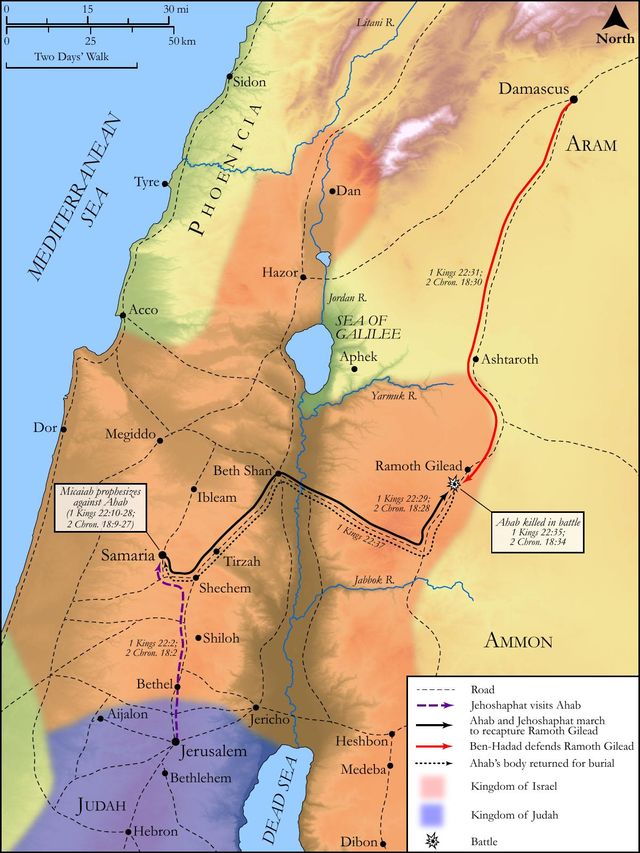
See on the biblical-era map
Study this verse
Public-domain commentary
Matthew Henry
From his Commentary on the Whole Bible. Henry comments on passages, not single verses — this entry covers 2 Chronicles 18:28–34.
We have here, 1. Good Jehoshaphat exposing himself in his robes, thereby endangered, and yet delivered. We have reason to think that Ahab, while he pretended friendship, really aimed at Jehoshaphat's life, to take him off, that he might have the management of his successor, who was his son-in-law, else he would never have advised him to enter into the battle with his robes on, which was but to make himself an easy mark to the enemy: and, if really he intended that, it was as unprincipled a piece of treachery as ever man was guilty of, and justly was he himself taken in the pit he digged for his friend. The enemy had soon an eye upon the robes, and vigorously attacked the unwary prince who now, when it was too late, wished himself in the habit of the poorest soldier, rather than in his princely raiment. he cried out, either to his friends to relieve him (but Ahab took no care of that), or to his enemies, to rectify their mistake, and let them know that he was not the king of Israel. Or perhaps he cried to God for succour and deliverance (to whom else should he cry?) and he found it was not in vain: The Lord helped him out of his distress, by moving the captains to depart from him, Ch2 18:31. God has all men's hearts in his hand, and turns them as he pleases, contrary to their own first intentions, to serve his purposes. Many are moved unaccountably both to themselves and others, but an invisible power moves them. 2. Wicked Ahab disguising himself, arming himself thereby as he thought securing himself, and yet slain, Ch2 18:33. No art, no arms, can save those whom God has appointed to ruin. What can hurt those whom God will protect? And what can shelter those whom God will destroy? Jehoshaphat is safe in his robes, Ahab killed in his armour; for the race is not to the swift nor the battle to the strong.
Continue studying 2 Chronicles 18:29 across the web’s major study libraries — every link below opens this exact verse, chapter, or book on the destination site.
Read & Compare
 BibleGatewayThis verse in more than 200 translations and 70 languages.
 Bible.comThe YouVersion reader — hundreds of translations, reading plans, and highlights.
 ESV.orgCrossway's official English Standard Version reader.
 NET BibleThe NET translation with 60,000+ translators' notes on every rendering decision.
 STEP BibleTyndale House's free study tool — original text, vocabulary, and scholarly resources.
 BibliaLogos Bible Software's free web reader.
 USCCBThe New American Bible (Revised Edition) with the U.S. bishops' study notes.
Commentaries
 BibleHub CommentariesDozens of classic commentaries on this verse, gathered on one page.
 StudyLightMore than 100 commentary sets — the largest collection on the web.
 BibleRefPlain-English commentary on what this verse means, verse by verse.
 Enduring WordDavid Guzik's free commentary on this chapter, widely used by Bible teachers.
 Bible Study ToolsVerse commentary alongside Greek and Hebrew study aids.
Original Language & Research
- BibleHub InterlinearThe verse word by word — original language, transliteration, and English.
- BibleHub LexiconEvery word's original-language definition and Strong's entry.
 Blue Letter BibleDeep-study tools — Strong's numbers, concordance, and word studies.
 SefariaThe Hebrew text with Rashi and centuries of Jewish commentary.
Sermons, Hymns & Audio


TrulyRandomVerse is not affiliated with these sites and doesn’t control their content. They’re linked because they’re genuinely useful.
Summary
Second Chronicles 18:29 captures a pivotal moment preceding the fateful battle of Ramoth-gilead, where King Ahab of Israel, in a desperate and ultimately vain attempt to circumvent divine prophecy, declares his intention to disguise himself while instructing King Jehoshaphat of Judah to wear his royal robes. This verse vividly illustrates Ahab's defiance and reliance on human cunning against the sovereign will of God, simultaneously highlighting the perilous consequences of Jehoshaphat's unwise alliance, which places him in immediate danger and underscores the futility of human schemes when they oppose divine decree.
Context
ShowHideLiterary Context
This verse is strategically placed at the dramatic culmination of the confrontation between King Ahab and the prophet Micaiah. Earlier in the chapter, King Jehoshaphat of Judah, despite his general righteousness, had unwisely allied himself with Ahab, King of Israel, for a military campaign to reclaim Ramoth-gilead. Following the unanimous, yet false, prophecies of four hundred royal prophets assuring victory, Jehoshaphat's insistence led to the consultation of Micaiah, a true prophet of the Lord. Micaiah initially offered a sarcastic affirmation of the false prophecies but then delivered a chilling vision of Israel scattered like sheep without a shepherd, explicitly foretelling Ahab's demise in battle (2 Chronicles 18:16). Instead of repenting or abandoning the ill-fated campaign, Ahab, consumed by pride and defiance, concocted a deceptive scheme to evade the prophesied judgment. His instruction to Jehoshaphat to remain in his distinctive royal attire while he himself adopted a disguise was a calculated maneuver designed to deflect the enemy's attention and wrath, hoping to outwit the divine decree and escape his fate.
Historical & Cultural Context
The historical backdrop for this event is the mid-9th century BCE, a period marked by significant geopolitical tensions between the Northern Kingdom of Israel, under the notorious King Ahab, and the Aramean kingdom (Syria). Ramoth-gilead was a highly strategic city located on the eastern frontier, controlling crucial trade routes and access to fertile lands, making its recapture a paramount military objective for Ahab. In ancient Near Eastern warfare, kings traditionally led their armies from the front, often adorned in distinctive royal vestments that served to inspire their troops, signify their authority, and identify them as primary targets for the enemy. Ahab's decision to disguise himself, while not entirely unprecedented in ancient military tactics, was particularly telling in this context, revealing his superstitious belief that he could manipulate circumstances to escape a divinely ordained fate. The alliance between Ahab and Jehoshaphat, cemented through the marriage of Ahab's daughter Athaliah to Jehoshaphat's son Jehoram, represented a relatively recent and significant shift from previous hostilities between the two Israelite kingdoms. However, this alliance frequently led Jehoshaphat, a king generally committed to the Lord, into compromising situations and ultimately drew divine disapproval (2 Chronicles 19:2).
Key Themes
ShowHideThis verse powerfully encapsulates several profound themes woven throughout 2 Chronicles and the broader biblical narrative. Firstly, it starkly illustrates the futility of human deception and cunning when pitted against divine sovereignty. Ahab's elaborate plan to evade his prophesied death ultimately proved powerless against the Lord's decree, forcefully underscoring the truth that no human scheme or strategy can thwart God's immutable will (Proverbs 21:30). Secondly, the passage highlights the destructive nature of pride and a stubborn disregard for divine truth. Ahab consistently rejected the uncomfortable, yet truthful, word delivered by God's prophet, Micaiah, preferring the flattering lies of his sycophantic advisors. This pattern of willful spiritual blindness and defiance ultimately led to his downfall, a recurring motif in the narratives of wicked kings (1 Kings 22:8). Finally, the verse serves as a potent cautionary tale regarding the dangers of unwise alliances. Jehoshaphat's presence in the battle, wearing his royal robes at Ahab's manipulative behest, placed him in extreme peril, demonstrating how even a righteous individual can be led astray and endangered through association with those who actively defy God's will and truth (2 Corinthians 6:14).
Exposition and Analysis
ShowHideKey Word Analysis
ShowHideThe Hebrew verb חָפַשׂ (châphas) is a primitive root meaning "to seek; causatively, to conceal oneself (i.e. let be sought), or mask." In this context, it specifically denotes a deliberate and calculated act of concealing one's true identity or nature. Ahab's use of this word signifies his intentional effort to become unrecognizable to the enemy, thereby attempting to evade the specific targeting that a king would face in battle. This word emphasizes the cunning, deceptive, and manipulative nature of Ahab's plan, highlighting his desperate attempt to outwit divine judgment and manipulate circumstances to escape the prophetic word.
The Hebrew word בֶּגֶד (beged) refers to "a covering, i.e., clothing; also treachery or pillage." Here, it specifically denotes the distinctive royal garments or official vestments that Jehoshaphat would wear. The stark contrast between Ahab's "disguise" and Jehoshaphat's prominent "robes" is intentional and serves a strategic purpose for Ahab. Ahab seeks to shed his identity, while Jehoshaphat is commanded to display his, making him a conspicuous target. The robes thus symbolize royal authority and, in this specific context, function as a deceptive decoy, drawing attention away from Ahab.
Verse Breakdown
ShowHide"And the king of Israel said unto Jehoshaphat, I will disguise myself, and will go to the battle;"
This initial clause reveals King Ahab's defiant and desperate strategy in the face of Micaiah's dire prophecy. Having been forewarned of his impending death, Ahab's immediate response is not one of repentance or withdrawal, but rather a cunning scheme to outmaneuver fate. His decision to "disguise myself" is an act of profound human presumption, rooted in the belief that he can manipulate circumstances and evade God's judgment through his own cleverness. It underscores his stubborn refusal to heed divine warning and his reliance on self-preservation tactics rather than submission to the Lord's will.
"but put thou on thy robes."
This instruction to Jehoshaphat exposes Ahab's self-serving and manipulative character. Ahab's intention is clear: he wants Jehoshaphat, a fellow king, to remain conspicuous and thereby draw the enemy's primary attention and attacks, effectively making him a decoy. This highlights the perilous and morally compromising nature of Jehoshaphat's alliance with Ahab, demonstrating how such associations can lead even a righteous individual into grave danger. It also sets the stage for Jehoshaphat's near-fatal encounter later in the battle, where he is indeed mistaken for Ahab (2 Chronicles 18:31).
"So the king of Israel disguised himself; and they went to the battle."
This concluding clause succinctly describes the immediate execution of Ahab's deceptive plan and the fateful march towards Ramoth-gilead. The brevity of the statement belies the profound theological implications: despite Ahab's elaborate human scheme to circumvent his destiny, the divine decree remains unalterable. The kings proceed to battle, seemingly in control, yet unaware that Ahab's disguise will ultimately prove futile, and Micaiah's prophecy will be fulfilled in an unexpected, yet precise, manner (2 Chronicles 18:33-34).
Literary Devices
ShowHideThe narrative in 2 Chronicles 18:29 masterfully employs several literary devices to deepen its theological and dramatic impact. Irony is paramount, as Ahab's elaborate attempt to evade his prophesied death through disguise ultimately leads directly to its fulfillment; his cunning, intended to save him, serves only to highlight the utter futility of human schemes against divine will. There is also strong Foreshadowing, as Micaiah's earlier, unambiguous prophecy of Ahab's demise looms over this verse, creating a palpable sense of impending doom for the king and heightening the dramatic tension. The vivid Contrast between Ahab's disguised, concealed identity and Jehoshaphat's conspicuous royal robes serves as both a visual and thematic device, emphasizing Ahab's deceptive nature and Jehoshaphat's unwitting vulnerability. Furthermore, the Symbolism of the "robes" is significant, representing identity, authority, and destiny. Ahab attempts to shed his regal identity to escape his prophesied destiny, while Jehoshaphat's robes ironically make him a prime target, underscoring the dangers of misplaced trust and the inescapable nature of divine judgment.
Theological and Thematic Connections
ShowHideThis verse serves as a powerful theological statement on the absolute sovereignty of God versus the inherent futility of human attempts to thwart His will. Ahab's disguise is not merely a military tactic but a desperate act of rebellion against a divine decree, a stark reminder that human cunning, self-preservation strategies, and manipulative schemes are utterly powerless when they stand in opposition to the Lord's purposes. It underscores the profound biblical principle that God's word, once spoken, will inevitably come to pass, regardless of human machinations or defiance. The narrative also highlights the destructive nature of spiritual blindness and pride, as Ahab repeatedly chose to believe flattering lies over uncomfortable truth, leading him down an inescapable path of destruction. For Jehoshaphat, his participation, though perhaps motivated by political obligation or naive good intentions, powerfully illustrates the perils of compromising alliances, even for a righteous king, as such associations can lead to grave danger, moral compromise, and divine displeasure.
Reflection and Application
ShowHideThe account of Ahab's futile disguise and Jehoshaphat's perilous alliance offers timeless and profound lessons for believers today. We are often tempted, much like Ahab, to employ our own "disguises" or clever schemes to avoid the natural consequences of our choices, to escape uncomfortable truths about ourselves, or to circumvent God's revealed will and moral standards in our lives. This verse stands as a sobering reminder that such attempts are ultimately futile and self-defeating. God's sovereignty is absolute, and His purposes will prevail, often in ways we least expect. True wisdom and spiritual maturity lie not in trying to outwit God or manipulate circumstances to our advantage, but in humbly submitting to His word, even when it challenges our desires, exposes our sin, or demands uncomfortable obedience. Furthermore, Jehoshaphat's experience serves as a potent cautionary tale about the company we keep and the alliances we form. Aligning ourselves with those who consistently disregard God's truth, mock His warnings, or live in open defiance of His principles, even for seemingly pragmatic or benevolent reasons, can lead us into spiritual and practical danger. We are called to exercise profound discernment in our relationships, partnerships, and commitments, ensuring that our associations do not compromise our faith, undermine our convictions, or lead us into situations where we are vulnerable to the enemy's schemes or God's displeasure.
Questions for Reflection
ShowHideFAQ
ShowHideWhy did King Ahab try to disguise himself if he knew he was going to die?
ShowHideKing Ahab's attempt to disguise himself was a desperate act born out of a complex mixture of defiance, pride, and perhaps a superstitious belief that he could outwit or circumvent the specific divine prophecy delivered by Micaiah (2 Chronicles 18:16). He had heard the clear word of the Lord regarding his demise but stubbornly refused to repent or alter his course. Instead, he chose to rely on human cunning, hoping that by not appearing as the king in battle, he could evade the particular fate foretold for him. This highlights a common human tendency to try and control outcomes and escape consequences even when faced with clear divine warnings, rather than submitting to God's sovereign will. Ultimately, his disguise proved futile, as he was struck by a randomly shot arrow and died, precisely fulfilling the prophecy (2 Chronicles 18:33-34).
Why did Jehoshaphat agree to wear his robes and go into battle with Ahab?
ShowHideJehoshaphat's decision to wear his royal robes and participate in the battle alongside Ahab is indeed perplexing, especially given his own generally righteous character and his insistence on hearing from a true prophet of the Lord. His agreement likely stemmed from a combination of factors: the existing political alliance forged through the marriage between their royal families, a sense of obligation or loyalty to a fellow king, and perhaps a naive belief that his presence could somehow mitigate the danger or that God would protect him despite the ill-advised association. However, the biblical narrative clearly indicates that this alliance was displeasing to the Lord, and Jehoshaphat was later rebuked for it by the prophet Jehu (2 Chronicles 19:2). His near-death experience in the battle, where he was mistaken for Ahab and narrowly escaped (2 Chronicles 18:31), served as a stark and immediate consequence of his unwise association.
Christ-Centered Fulfillment
ShowHideThe futile attempt of King Ahab to escape his divinely appointed death through disguise in 2 Chronicles 18:29 stands in profound and illuminating contrast to the willing and purposeful embrace of death by Jesus Christ. Ahab sought to preserve his earthly life through deception and evasion, but his cunning efforts were ultimately in vain, demonstrating the absolute powerlessness of human schemes against God's sovereign and immutable plan. In stark opposition, Jesus, the true King of kings, did not disguise Himself or seek to evade His destiny. Instead, He knowingly and willingly walked towards the cross, the very purpose for which He came into the world (Mark 10:45). He was the Lamb of God who takes away the sin of the world, not a king attempting to escape judgment, but one who fully absorbed the righteous wrath of God on behalf of humanity (Isaiah 53:5-6). While Ahab's disguise led directly to his demise and the scattering of his people, Christ's sacrificial death brought about reconciliation between God and humanity and the gathering of all who believe into His eternal kingdom (Ephesians 1:10). The futility of human efforts to outwit God's judgment, so clearly demonstrated in Ahab's story, finds its perfect counterpoint in the divine wisdom, power, and boundless love displayed in Christ's voluntary submission to the Father's will, thereby securing eternal life and true freedom for all who trust in Him (John 3:16).