


2 Chronicles 18:31
- וַיְהִיvay·Hiand it wasH1961Conj-w ¦ V-Qal-ConsecImperf-3msVerb Qal Consecutive Imperfect 3rd Singular Masculineוַandיְהִיit was
- כִּרְאוֹתkir·'Otwhen sawH7200Prep-k ¦ V-Qal-InfVerb Qal Infinitive Constructכִּwhenרְאוֹתsaw
- שָׂרֵיsa·Rei[the] commanders ofH8269N-mpcNoun Plural Masculine Construct
- הָרֶכֶבha·Re·khevthe chariotryH7393Art ¦ N-msNoun Singular Masculine Absoluteהָtheרֶכֶבchariotry
- אֶת'et<obj.>H853DirObjMParticle Object Indicator
- יְהוֹשָׁפָטye·ho·sha·FatJehoshaphatH3092N-proper-mNoun Proper Masculine
- וְהֵמָּהve·He·mahand theyH1992Conj-w ¦ Pro-3mpPronoun Personal 3rd Plural Masculineוְandהֵמָּהthey
- אָמְרוּ'a·me·Ruthey saidH559V-Qal-Perf-3cpVerb Qal Perfect 3rd Plural common gender
- מֶלֶךְMe·lekh[is] [the] king ofH4428N-mscNoun Singular Masculine Construct
- יִשְׂרָאֵלYis·ra·'ElIsraelH3478N-properNoun Proper Location
- הוּאHu'heH1931Pro-3msPronoun Personal 3rd Singular Masculine
- וַיָּסֹבּוּvai·ya·So·buand they surroundedH5437Conj-w ¦ V-Qal-ConsecImperf-3mpVerb Qal Consecutive Imperfect 3rd Plural Masculineוַandיָּסֹבּוּthey surrounded
- עָלָיו'a·Lav<on> himH5921Prep ¦ 3msPrepositionעָלָי<on>וhim
- לְהִלָּחֵםle·hi·la·Chemto fightH3898Prep-l ¦ V-Niphal-InfVerb Niphal Infinitive Constructלְtoהִלָּחֵםfight
- וַיִּזְעַקvai·yiz·'Akand he cried outH2199Conj-w ¦ V-Qal-ConsecImperf-3msVerb Qal Consecutive Imperfect 3rd Singular Masculineוַandיִּזְעַקhe cried out
- יְהוֹשָׁפָטye·ho·sha·FatJehoshaphatH3092N-proper-mNoun Proper Masculine
- וַיהוָהva·Yah·wehand YahwehH3068Conj-w ¦ N-properNoun Proper TitleוַandיהוָהYahweh
- עֲזָרוֹa·za·Rohe helped himH5826V-Qal-Perf-3ms ¦ 3msVerb Qal Perfect 3rd Singular Masculineעֲזָרhe helpedוֹhim
- וַיְסִיתֵםvay·si·Temand he lured themH5496Conj-w ¦ V-Hiphil-ConsecImperf-3ms ¦ 3mpVerb Hiphil Consecutive Imperfect 3rd Singular Masculineוַandיְסִיתֵhe luredםthem
- אֱלֹהִים'E·lo·HimGodH430N-mpNoun Plural Masculine Absolute
- מִמֶּנּוּmi·Me·nuaway from himH4480Prep ¦ 3msPrepositionמִמֶּaway fromנּוּhim
English is a literal word-by-word gloss of the Hebrew, not the KJV's wording. Why?
This is the original text the KJV's translators worked from — each Hebrew word with its own literal English meaning in this verse, prepared by scholars at Tyndale House, Cambridge. The KJV translates whole sentences, not word by word, so its wording differs: one Hebrew word can become several English words, and the KJV may choose “the LORD” where the gloss reads “Yahweh”. Both are faithful — they answer different questions. For the KJV's own rendering, switch to the KJV text.
Details
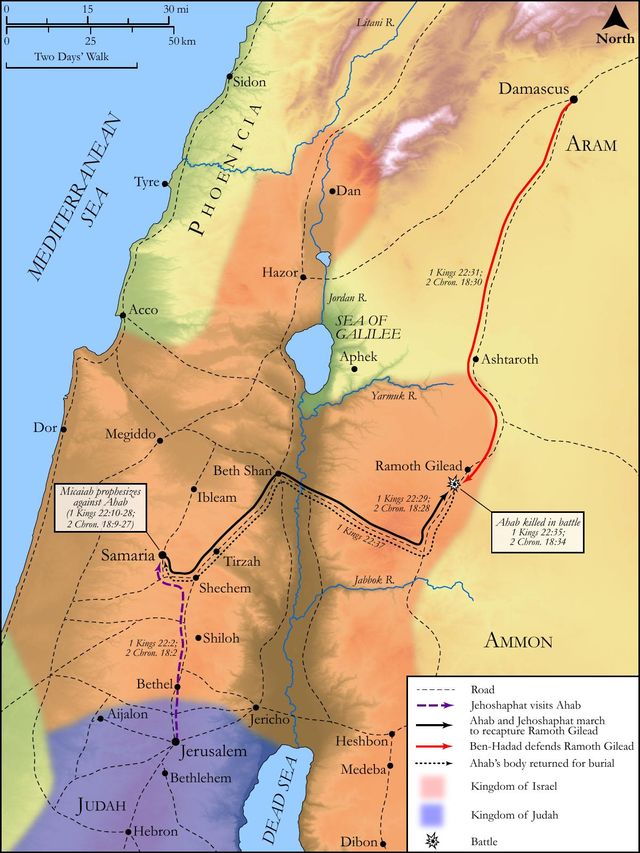
See on the biblical-era map
Study this verse
Public-domain commentary
Matthew Henry
From his Commentary on the Whole Bible. Henry comments on passages, not single verses — this entry covers 2 Chronicles 18:28–34.
We have here, 1. Good Jehoshaphat exposing himself in his robes, thereby endangered, and yet delivered. We have reason to think that Ahab, while he pretended friendship, really aimed at Jehoshaphat's life, to take him off, that he might have the management of his successor, who was his son-in-law, else he would never have advised him to enter into the battle with his robes on, which was but to make himself an easy mark to the enemy: and, if really he intended that, it was as unprincipled a piece of treachery as ever man was guilty of, and justly was he himself taken in the pit he digged for his friend. The enemy had soon an eye upon the robes, and vigorously attacked the unwary prince who now, when it was too late, wished himself in the habit of the poorest soldier, rather than in his princely raiment. he cried out, either to his friends to relieve him (but Ahab took no care of that), or to his enemies, to rectify their mistake, and let them know that he was not the king of Israel. Or perhaps he cried to God for succour and deliverance (to whom else should he cry?) and he found it was not in vain: The Lord helped him out of his distress, by moving the captains to depart from him, Ch2 18:31. God has all men's hearts in his hand, and turns them as he pleases, contrary to their own first intentions, to serve his purposes. Many are moved unaccountably both to themselves and others, but an invisible power moves them. 2. Wicked Ahab disguising himself, arming himself thereby as he thought securing himself, and yet slain, Ch2 18:33. No art, no arms, can save those whom God has appointed to ruin. What can hurt those whom God will protect? And what can shelter those whom God will destroy? Jehoshaphat is safe in his robes, Ahab killed in his armour; for the race is not to the swift nor the battle to the strong.
Continue studying 2 Chronicles 18:31 across the web’s major study libraries — every link below opens this exact verse, chapter, or book on the destination site.
Read & Compare
 BibleGatewayThis verse in more than 200 translations and 70 languages.
 Bible.comThe YouVersion reader — hundreds of translations, reading plans, and highlights.
 ESV.orgCrossway's official English Standard Version reader.
 NET BibleThe NET translation with 60,000+ translators' notes on every rendering decision.
 STEP BibleTyndale House's free study tool — original text, vocabulary, and scholarly resources.
 BibliaLogos Bible Software's free web reader.
 USCCBThe New American Bible (Revised Edition) with the U.S. bishops' study notes.
Commentaries
 BibleHub CommentariesDozens of classic commentaries on this verse, gathered on one page.
 StudyLightMore than 100 commentary sets — the largest collection on the web.
 BibleRefPlain-English commentary on what this verse means, verse by verse.
 Enduring WordDavid Guzik's free commentary on this chapter, widely used by Bible teachers.
 Bible Study ToolsVerse commentary alongside Greek and Hebrew study aids.
Original Language & Research
- BibleHub InterlinearThe verse word by word — original language, transliteration, and English.
- BibleHub LexiconEvery word's original-language definition and Strong's entry.
 Blue Letter BibleDeep-study tools — Strong's numbers, concordance, and word studies.
 SefariaThe Hebrew text with Rashi and centuries of Jewish commentary.
Sermons, Hymns & Audio


TrulyRandomVerse is not affiliated with these sites and doesn’t control their content. They’re linked because they’re genuinely useful.
Summary
2 Chronicles 18:31 powerfully narrates a moment of extreme peril for King Jehoshaphat of Judah during the battle of Ramoth-Gilead, where Syrian chariot captains, mistaking him for King Ahab of Israel due to his royal attire, surrounded him with intent to kill. In this desperate situation, Jehoshaphat cried out to the Lord, and in a remarkable act of divine intervention, God not only heard his fervent plea but supernaturally caused the enemy forces to abandon their pursuit, miraculously preserving his life despite his ill-advised alliance with the wicked King Ahab.
Context
ShowHideLiterary Context
This pivotal verse is situated within the broader narrative of 2 Chronicles 18, which details the ill-fated alliance between King Jehoshaphat of Judah and King Ahab of Israel for a military campaign against Aram (Syria) to reclaim Ramoth-Gilead. The chapter opens with Jehoshaphat's visit to Ahab, leading to the proposed battle, a decision that is immediately questioned by Jehoshaphat's insistence on inquiring of the Lord. Despite the unanimous, but false, assurances of Ahab's 400 prophets, the true prophet Micaiah foretells disaster and Ahab's death (2 Chronicles 18:18-27). Ahab, attempting to circumvent the prophecy, cunningly disguises himself, while Jehoshaphat, perhaps adhering to royal protocol or out of misplaced confidence, wears his kingly robes. This strategic difference directly precipitates the life-threatening encounter described in 2 Chronicles 18:31, as the Syrian captains, under specific orders to target the king of Israel (2 Chronicles 18:30), naturally focus their attack on the visibly royal figure. The immediate aftermath sees Ahab mortally wounded, fulfilling Micaiah's prophecy, while Jehoshaphat's miraculous escape underscores the protective hand of God.
Historical & Cultural Context
The battle for Ramoth-Gilead was a significant military engagement in the 9th century BCE, reflecting the ongoing struggle for regional dominance between the northern kingdom of Israel (often allied with Judah) and the Aramean kingdom of Damascus. Ramoth-Gilead was a strategically vital city in Transjordan, controlling key trade routes and access points. Militarily, chariot warfare was a formidable and often decisive element of ancient Near Eastern combat, with chariot captains forming an elite and highly effective fighting force. Their primary objective in battle was often to neutralize enemy leadership, as the death or capture of a monarch could demoralize an army and lead to swift victory. The Syrian king's explicit command to "fight with neither small nor great, save only with the king of Israel" (2 Chronicles 18:30) highlights the strategic importance of targeting the opposing monarch. Culturally, kings frequently led their armies into battle, making them conspicuous targets. Jehoshaphat's decision to wear his royal garments, while perhaps intended to project authority and leadership, inadvertently made him the prime target for the Syrian chariots, leading to his near-fatal predicament.
Key Themes
ShowHide2 Chronicles 18:31 powerfully illustrates several profound themes central to the Books of Chronicles. Firstly, it emphasizes the consequences of unholy alliances. Despite Jehoshaphat's generally righteous reign and his commitment to the Lord, his decision to align with the idolatrous Ahab brought him into direct and mortal danger, a misstep later rebuked by the prophet Jehu (2 Chronicles 19:2). Secondly, the verse dramatically showcases divine protection and intervention, even when human choices are deeply flawed. God's unwavering faithfulness to His covenant people, particularly to a king who, despite his error, generally sought the Lord, is powerfully demonstrated. Thirdly, it underscores the power of desperate prayer. Jehoshaphat's "cried out" signifies a fervent, urgent, and unreserved appeal to God in a moment of extreme distress, which immediately elicits a divine response. This highlights God's attentiveness and responsiveness to the cries of His people, a recurring motif throughout Scripture, echoing sentiments found in passages like Psalm 18:6. Finally, the narrative reinforces the sovereignty of God over human affairs and even the intentions of enemies, as "God moved them to depart from him," demonstrating His ultimate control over outcomes and His ability to orchestrate events for the preservation of His purposes.
Exposition and Analysis
ShowHideKey Word Analysis
ShowHideThis verb (H2199) signifies a loud, urgent, and often desperate cry for help, typically uttered in a situation of distress, oppression, or imminent danger. It is not a casual call but an impassioned plea, reflecting a deep sense of need and reliance on a higher power. In this context, it underscores Jehoshaphat's immediate and fervent appeal to the Lord in the face of imminent death, highlighting his faith even amidst his perilous circumstances and the efficacy of a desperate prayer.
The Hebrew verb (H5826) means "to surround," "to protect," or "to aid." When used in relation to God, it often implies a powerful, miraculous, and decisive act of salvation from danger or oppression. Here, "the LORD helped him" indicates a direct, active, and effective intervention by God to rescue Jehoshaphat from the overwhelming Syrian forces, demonstrating divine power, faithfulness, and the immediate response to his cry.
The verb (H5496) means "to prick," "to stimulate," or "to turn aside" (figuratively, "to seduce" or "incite"). In this context, "God moved them to depart from him" indicates that God supernaturally influenced or redirected the Syrian captains' intentions or actions. It implies a divine manipulation of circumstances or even the hearts and minds of the enemies, causing them to abandon their pursuit of Jehoshaphat, thus ensuring his miraculous escape and demonstrating God's sovereign control.
Verse Breakdown
ShowHide"And it came to pass, when the captains of the chariots saw Jehoshaphat, that they said, It [is] the king of Israel."
This opening clause establishes the critical moment of mistaken identity. The elite Syrian chariot commanders, under explicit orders to target King Ahab, visually identified Jehoshaphat, who was clothed in his royal attire, and erroneously concluded that he was their primary objective, the king of Israel. This misidentification immediately placed Jehoshaphat in extreme and unexpected danger, setting the stage for the dramatic rescue.
"Therefore they compassed about him to fight:"
As a direct and logical consequence of their mistaken identification, the formidable Syrian chariot forces immediately encircled Jehoshaphat. The verb "compassed about" (H5437, çâbab') conveys the sense of being surrounded on all sides, indicating a concentrated and overwhelming attack. This highlights the dire nature of his predicament—he was cornered and facing certain death from a superior and determined enemy.
"but Jehoshaphat cried out, and the LORD helped him;"
In this moment of ultimate peril, Jehoshaphat's response was not to fight or flee by his own strength, but to desperately appeal to the Lord. His "cried out" (H2199, zâʻaq') signifies a fervent, urgent, and unreserved prayer. The immediate divine response, "the LORD helped him" (H5826, ʻâzar'), demonstrates God's attentiveness and miraculous intervention for His faithful, even when they are in self-inflicted trouble. This help was a direct, supernatural act of deliverance.
"and God moved them [to depart] from him."
This final clause reveals the specific and miraculous nature of God's help. It was not merely a general assistance but a direct, sovereign act where God supernaturally influenced the Syrian captains. He "moved" (H5496, çûwth') or diverted their attention and intent, causing them to abandon their pursuit of Jehoshaphat. This highlights God's absolute control over human will and circumstances, turning the hearts of enemies to deliver His servant and fulfill His purposes.
Literary Devices
ShowHideThe narrative in 2 Chronicles 18:31 masterfully employs several literary devices to heighten its dramatic impact and theological message. Irony is profoundly present, as Jehoshaphat, who wore his royal robes, was mistaken for Ahab, who disguised himself, leading to the very danger Ahab sought to avoid. This reversal of expectations underscores the unpredictability of battle and the hand of divine providence. Suspense is meticulously built through the rapid sequence of events: the captains' recognition, the immediate encirclement, and the imminent threat of death, culminating in Jehoshaphat's desperate cry. The phrase "cried out" functions as a powerful climax, representing the turning point from human despair to divine intervention. The explicit mention of "the LORD helped him; and God moved them" is a clear example of divine intervention or deus ex machina, where God directly and supernaturally alters the course of events. This emphasizes God's active role in human history and His unwavering faithfulness to those who call upon Him. Furthermore, the entire episode serves as a powerful illustration of the consequences of unholy alliances and, more importantly, the redemptive power of God's grace and His sovereign control over all circumstances.
Theological and Thematic Connections
ShowHideThe divine deliverance of Jehoshaphat in 2 Chronicles 18:31, despite his perilous alliance with the wicked King Ahab, serves as a powerful testament to God's unwavering faithfulness and sovereign protection over His people. It illustrates that while human sin and folly—such as Jehoshaphat's ill-advised political and military entanglement—can lead to grave consequences, God's mercy and grace can still prevail when His children turn to Him in desperate prayer. This event underscores the profound theological principle that God's covenant promises are often upheld not because of human perfection or flawless obedience, but because of His own immutable character, His steadfast love, and His commitment to His chosen ones. It also highlights the profound efficacy of prayer, demonstrating that a sincere, urgent cry for help, even in the face of seemingly insurmountable odds and self-inflicted trouble, can activate divine intervention, turning certain defeat into miraculous deliverance. The narrative thus reinforces God's ultimate control over all circumstances, including the intentions and actions of enemies, showcasing His ability to orchestrate events for the preservation of His purposes and His people.
Reflection and Application
ShowHideThe gripping account of Jehoshaphat's near-death experience and miraculous deliverance offers profound and timeless lessons for believers today. It serves as a stark reminder that even those who generally walk faithfully with God can make grave errors in judgment, leading them into dangerous and potentially self-inflicted predicaments. Jehoshaphat's alliance with Ahab was a direct disobedience to God's principles and a compromise of his spiritual integrity, yet in his moment of ultimate despair, his desperate cry to the Lord was met with immediate and supernatural divine intervention. This teaches us that God's grace is vast enough to encompass our failures, and His mercy is profoundly available even when we find ourselves in trouble due to our own poor choices, provided we turn to Him in humility, repentance, and genuine dependence. The narrative powerfully underscores the vital importance of prayer, particularly in moments of crisis. When all human options are exhausted, and we face overwhelming opposition or seemingly insurmountable challenges, a sincere, heartfelt cry to God can unleash His supernatural power to deliver, protect, and redirect circumstances beyond our comprehension. This account calls us to cultivate a deep and abiding reliance on God, to diligently seek His wisdom in all our decisions, especially regarding our associations and alliances, and to never underestimate the transformative power of a desperate prayer offered from a humble heart.
Questions for Reflection
ShowHideFAQ
ShowHideQuestion? Was Jehoshaphat's cry to God an act of genuine faith, or merely a desperate reaction to fear?
ShowHideWhile the immediate context is undeniably one of extreme fear and desperation in the face of imminent death, Jehoshaphat's cry was undoubtedly an act rooted in genuine faith. Throughout the Books of Chronicles, Jehoshaphat is consistently portrayed as a king who "sought the LORD with all his heart" (2 Chronicles 22:9) and whose heart was "devoted to the ways of the LORD" (2 Chronicles 17:6). His previous actions, such as sending Levites and priests to teach the Law throughout Judah (2 Chronicles 17:7-9) and leading the people in fervent prayer during a national crisis, acknowledging God's sovereignty and their utter dependence on Him (2 Chronicles 20:5-12), demonstrate a consistent pattern of seeking God in times of need. Therefore, his cry in 2 Chronicles 18:31 was not an isolated act of panic but a natural, ingrained outpouring of a heart accustomed to trusting and calling upon the Lord, even when his own judgment had led him into peril. It was a desperate cry, but one born of a life of established faith and reliance on God.
Christ-Centered Fulfillment
ShowHideThe miraculous deliverance of Jehoshaphat in 2 Chronicles 18:31 serves as a profound foreshadowing of the ultimate and perfect deliverance found in Jesus Christ. Jehoshaphat, despite his generally righteous character, found himself in a life-threatening situation due to his own flawed judgment and an unholy alliance with an idolatrous king. His desperate cry for help was met with a sovereign, supernatural intervention that saved him from physical death. This narrative points forward to Christ, who is our ultimate deliverer, not merely from physical enemies or temporary peril, but from the spiritual enemies of sin, death, and the devil. Unlike Jehoshaphat, whose deliverance was a temporary reprieve from a self-inflicted wound, Jesus's rescue is eternal, complete, and freely offered to all who believe. He is the true King, who, though not mistaken for another, willingly took on the form of a servant and bore the full wrath of God on the cross, becoming the ultimate target for our sins (Isaiah 53:5-6). Through His sacrificial death and glorious resurrection, Jesus decisively "moved" the power of sin and death to depart from us, securing our eternal salvation and freedom. When we, in our spiritual peril, "cry out" to Him in faith, acknowledging our desperate need for salvation, He hears us and delivers us from the spiritual bondage and condemnation that none of us can escape on our own (Romans 10:9-10). Thus, Jehoshaphat's rescue stands as a beautiful, albeit partial, picture of the greater salvation wrought by the Lamb of God who takes away the sin of the world, offering eternal life and true freedom to all who believe.