


2 Chronicles 18:32
- וַיְהִיvay·Hiand it wasH1961Conj-w ¦ V-Qal-ConsecImperf-3msVerb Qal Consecutive Imperfect 3rd Singular Masculineוַandיְהִיit was
- כִּרְאוֹתkir·'Otwhen sawH7200Prep-k ¦ V-Qal-InfVerb Qal Infinitive Constructכִּwhenרְאוֹתsaw
- שָׂרֵיsa·Rei[the] commanders ofH8269N-mpcNoun Plural Masculine Construct
- הָרֶכֶבha·Re·khevthe chariotryH7393Art ¦ N-msNoun Singular Masculine Absoluteהָtheרֶכֶבchariotry
- כִּיkithatH3588PrtParticle Conditional
- לֹאlo'notH3808NegParticle Negative
- הָיָהha·Yahit wasH1961V-Qal-Perf-3msVerb Qal Perfect 3rd Singular Masculine
- מֶלֶךְMe·lekh[the] king ofH4428N-mscNoun Singular Masculine Construct
- יִשְׂרָאֵלYis·ra·'ElIsraelH3478N-properNoun Proper Location
- וַיָּשֻׁבוּvai·ya·Shu·vuand they turned backH7725Conj-w ¦ V-Qal-ConsecImperf-3mpVerb Qal Consecutive Imperfect 3rd Plural Masculineוַandיָּשֻׁבוּthey turned back
- מֵאַחֲרָיוme·'a·cha·Ravfrom after himH310Prep-m ¦ Adj-mpc ¦ 3msAdjective Numerical Plural Masculine Constructמֵfromאַחֲרָיafterוhim
English is a literal word-by-word gloss of the Hebrew, not the KJV's wording. Why?
This is the original text the KJV's translators worked from — each Hebrew word with its own literal English meaning in this verse, prepared by scholars at Tyndale House, Cambridge. The KJV translates whole sentences, not word by word, so its wording differs: one Hebrew word can become several English words, and the KJV may choose “the LORD” where the gloss reads “Yahweh”. Both are faithful — they answer different questions. For the KJV's own rendering, switch to the KJV text.
Details
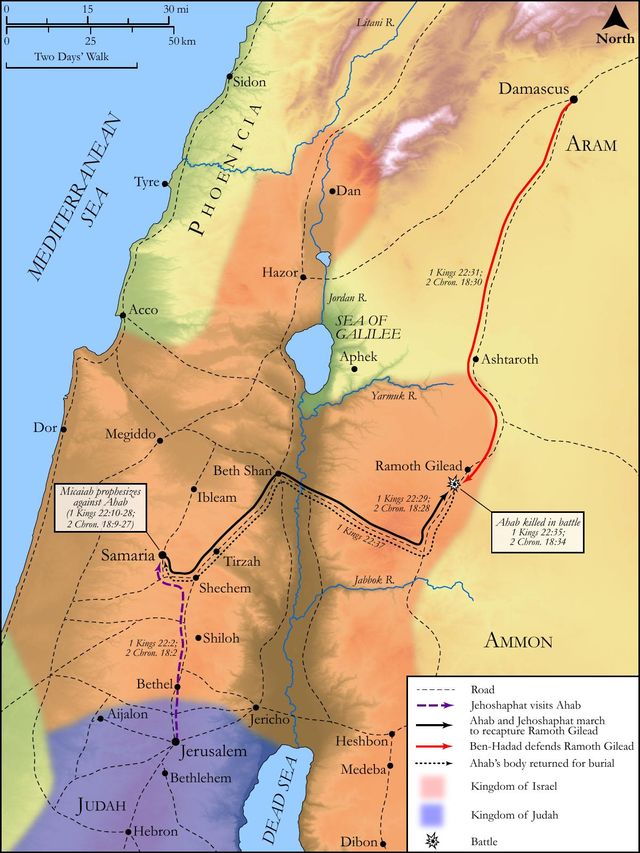
See on the biblical-era map
Study this verse
Public-domain commentary
Matthew Henry
From his Commentary on the Whole Bible. Henry comments on passages, not single verses — this entry covers 2 Chronicles 18:28–34.
We have here, 1. Good Jehoshaphat exposing himself in his robes, thereby endangered, and yet delivered. We have reason to think that Ahab, while he pretended friendship, really aimed at Jehoshaphat's life, to take him off, that he might have the management of his successor, who was his son-in-law, else he would never have advised him to enter into the battle with his robes on, which was but to make himself an easy mark to the enemy: and, if really he intended that, it was as unprincipled a piece of treachery as ever man was guilty of, and justly was he himself taken in the pit he digged for his friend. The enemy had soon an eye upon the robes, and vigorously attacked the unwary prince who now, when it was too late, wished himself in the habit of the poorest soldier, rather than in his princely raiment. he cried out, either to his friends to relieve him (but Ahab took no care of that), or to his enemies, to rectify their mistake, and let them know that he was not the king of Israel. Or perhaps he cried to God for succour and deliverance (to whom else should he cry?) and he found it was not in vain: The Lord helped him out of his distress, by moving the captains to depart from him, Ch2 18:31. God has all men's hearts in his hand, and turns them as he pleases, contrary to their own first intentions, to serve his purposes. Many are moved unaccountably both to themselves and others, but an invisible power moves them. 2. Wicked Ahab disguising himself, arming himself thereby as he thought securing himself, and yet slain, Ch2 18:33. No art, no arms, can save those whom God has appointed to ruin. What can hurt those whom God will protect? And what can shelter those whom God will destroy? Jehoshaphat is safe in his robes, Ahab killed in his armour; for the race is not to the swift nor the battle to the strong.
Continue studying 2 Chronicles 18:32 across the web’s major study libraries — every link below opens this exact verse, chapter, or book on the destination site.
Read & Compare
 BibleGatewayThis verse in more than 200 translations and 70 languages.
 Bible.comThe YouVersion reader — hundreds of translations, reading plans, and highlights.
 ESV.orgCrossway's official English Standard Version reader.
 NET BibleThe NET translation with 60,000+ translators' notes on every rendering decision.
 STEP BibleTyndale House's free study tool — original text, vocabulary, and scholarly resources.
 BibliaLogos Bible Software's free web reader.
 USCCBThe New American Bible (Revised Edition) with the U.S. bishops' study notes.
Commentaries
 BibleHub CommentariesDozens of classic commentaries on this verse, gathered on one page.
 StudyLightMore than 100 commentary sets — the largest collection on the web.
 BibleRefPlain-English commentary on what this verse means, verse by verse.
 Enduring WordDavid Guzik's free commentary on this chapter, widely used by Bible teachers.
 Bible Study ToolsVerse commentary alongside Greek and Hebrew study aids.
Original Language & Research
- BibleHub InterlinearThe verse word by word — original language, transliteration, and English.
- BibleHub LexiconEvery word's original-language definition and Strong's entry.
 Blue Letter BibleDeep-study tools — Strong's numbers, concordance, and word studies.
 SefariaThe Hebrew text with Rashi and centuries of Jewish commentary.
Sermons, Hymns & Audio


TrulyRandomVerse is not affiliated with these sites and doesn’t control their content. They’re linked because they’re genuinely useful.
Summary
Second Chronicles 18:32 recounts a pivotal moment in the battle of Ramoth-Gilead where King Jehoshaphat of Judah, initially mistaken for King Ahab of Israel by Aramean chariot captains, was miraculously spared. Upon discerning that he was not their intended target, the captains ceased their intense pursuit, highlighting a profound instance of divine intervention and protection over God's servant, despite Jehoshaphat's ill-advised alliance with the wicked King Ahab. This verse powerfully underscores God's sovereignty and His ability to deliver His people amidst human error and battlefield chaos.
Context
ShowHideLiterary Context
This verse is strategically placed within the dramatic narrative of the ill-fated alliance between King Jehoshaphat of Judah and King Ahab of Israel to reclaim Ramoth-Gilead from the Arameans. The preceding verses meticulously set the stage for this near-fatal encounter. Ahab, despite the dire prophetic warnings of Micaiah, attempts to circumvent his prophesied death by disguising himself, while Jehoshaphat, perhaps unwisely, enters the battle in his royal robes (2 Chronicles 18:29). The Aramean king, intent on eliminating the Israelite leadership, had issued a direct command to his elite chariot captains: "Fight with neither small nor great, save only with the king of Israel" (2 Chronicles 18:30). When Jehoshaphat, conspicuous in his royal attire, is mistaken for Ahab and fiercely pursued, his desperate cry for divine assistance (2 Chronicles 18:31) immediately precedes the captains' sudden realization and cessation of pursuit in verse 32. The narrative's swift progression then leads to Ahab's unexpected death by a seemingly random arrow (2 Chronicles 18:33-34), fulfilling Micaiah's prophecy and contrasting sharply with Jehoshaphat's miraculous deliverance.
Historical & Cultural Context
The battle for Ramoth-Gilead was a significant conflict in the protracted struggle between the Northern Kingdom of Israel (often allied with Judah) and Aram (Syria) for control over strategic territories east of the Jordan River. Chariot warfare represented the pinnacle of ancient Near Eastern military might, with chariot captains commanding highly skilled and lethal units designed for shock and pursuit. Kings typically led their armies from the front, making them prime targets for the enemy. The alliance between Jehoshaphat, a king largely characterized by his devotion to the Lord, and Ahab, a notoriously wicked monarch who aggressively promoted Baal worship, was a politically expedient but spiritually perilous decision. This historical backdrop highlights the immense danger Jehoshaphat faced due to his compromised position and underscores the extraordinary nature of his deliverance in a chaotic and brutal battlefield environment where kings were specifically hunted.
Key Themes
ShowHideThis verse powerfully illustrates Divine Protection, showcasing God's miraculous safeguarding of His faithful servant, Jehoshaphat, even when the king's own poor judgment had placed him in mortal danger. It serves as a profound demonstration of God's Sovereignty over human events and military outcomes; the Aramean captains' abrupt change of focus was not mere chance but a divinely orchestrated intervention, as the preceding verse explicitly states that the Lord "helped him" and "moved them to depart from him" (2 Chronicles 18:31). The narrative also implicitly highlights the Consequences of Unwise Alliances, as Jehoshaphat's compromise nearly cost him his life, even though God's grace preserved him. Furthermore, the passage underscores the Power of Prayer, as Jehoshaphat's desperate cry for help is immediately met with divine intervention. Ultimately, this event sets the stage for the unfolding of Divine Justice against Ahab, whose death is ensured even as Jehoshaphat is spared, demonstrating God's meticulous control over both judgment and deliverance.
Exposition and Analysis
ShowHideKey Word Analysis
ShowHideThis verb, H7200, signifies "to see," "to discern," or "to recognize." It implies an intentional and accurate identification, moving beyond a casual glance to a conscious understanding. In the context of 2 Chronicles 18:32, it means the Aramean captains did not merely guess or assume, but actively and correctly identified that the man in royal robes was not their designated target, King Ahab. This precise recognition is crucial, as it underscores the specificity of their orders and the sudden, intentional shift in their strategy, strongly pointing to a divine influence on their discernment in the chaos of battle.
This verb, H7725, is a primitive root meaning "to turn back," "to retreat," or "to return." It often carries the sense of reversing a course of action. Here, it describes the immediate and decisive action taken by the chariot captains. Their turning back signifies an abrupt cessation of their pursuit of Jehoshaphat, indicating a complete reversal of their aggressive engagement. This sudden change in direction, directly following their realization, is the tangible evidence of God's miraculous intervention, diverting them from His servant.
This term, H310, derived from a root meaning "hind part" or "after," is used here adverbially to describe the act of following closely, specifically with hostile intent, as in "persecuting." It emphasizes the intensity and relentless nature of the chariot captains' initial chase of Jehoshaphat. The fact that they "turned back again from pursuing him" highlights the immediate and complete cessation of this aggressive, life-threatening action, underscoring the completeness of Jehoshaphat's deliverance.
Verse Breakdown
ShowHide"For it came to pass, that, when the captains of the chariots perceived"
This opening clause sets the scene for a critical and divinely orchestrated turning point in the battle. The "captains of the chariots" were the elite, highly effective units specifically tasked by their king to hunt down and eliminate the enemy's leader. Their "perception" or recognition is presented as the catalyst for the events that follow, signaling a moment of profound discernment, which the preceding verse attributes to God's direct intervention.
"that it was not the king of Israel,"
This is the core of the captains' sudden realization and the pivotal moment of Jehoshaphat's deliverance. They had initially mistaken Jehoshaphat, conspicuous in his royal attire, for Ahab, the designated target. Their orders were precise: kill the king of Israel, not the king of Judah. This accurate and sudden discernment, especially amidst the chaos and urgency of battle, powerfully highlights God's sovereign hand in directing their attention and understanding away from His servant, preventing a fatal error on their part.
"they turned back again from pursuing him."
This clause describes the immediate, decisive, and life-saving action taken by the chariot captains upon their realization. Their pursuit of Jehoshaphat ceased instantly and completely, demonstrating their strict adherence to their king's orders and the direct impact of their newfound knowledge. This abrupt cessation of pursuit is the tangible and miraculous evidence of God's direct intervention, saving Jehoshaphat from certain death and allowing God's greater plan for Ahab's demise to unfold separately.
Literary Devices
ShowHideThe narrative of 2 Chronicles 18:32 is rich with literary devices that amplify its theological message. Irony is powerfully employed: King Ahab, attempting to evade a prophetic death, disguises himself, while King Jehoshaphat, perhaps to draw fire away from Ahab or simply out of royal custom, wears his royal robes. This ironic reversal leads to Jehoshaphat becoming the initial target, only to be miraculously spared, while Ahab, despite his disguise, meets his prophesied end by a "random" arrow. This highlights Divine Providence or Divine Intervention, where what appears to be a chaotic or coincidental event—the captains' sudden change of focus—is explicitly presented as God's deliberate hand at work, fulfilling His purpose and protecting His servant. The text also utilizes Contrast effectively, juxtaposing the perilous situation of Jehoshaphat, on the brink of death, with his unexpected and immediate salvation. This dramatic contrast not only underscores the depth of God's protective power but also sets the stage for the subsequent, divinely orchestrated death of Ahab, thereby emphasizing God's meticulous sovereignty over both judgment and deliverance.
Theological and Thematic Connections
ShowHideThis verse profoundly illustrates God's unwavering commitment to protect and preserve His people, even when their own flawed choices lead them into perilous circumstances. Despite Jehoshaphat's unwise and compromising alliance with the wicked King Ahab, God's sovereign hand intervened directly and miraculously to save him from certain death on the battlefield. This demonstrates that God's grace and protective care are not solely contingent upon our perfect obedience, but often extend to preserve us through situations that appear to be mere chance or coincidence, yet are, in fact, divinely orchestrated. The passage powerfully affirms God's ultimate control over all events, including the chaos and unpredictability of warfare, ensuring that His purposes for His chosen ones are fulfilled. It serves as a comforting reminder that while our actions do have consequences, God's faithfulness can transcend our failures, providing deliverance and showcasing His unfathomable love, power, and meticulous oversight in the affairs of humanity.
Reflection and Application
ShowHideThe account of Jehoshaphat's miraculous deliverance in 2 Chronicles 18:32 offers profound and enduring lessons for believers today. It serves as a powerful reminder that even when our own poor judgment, spiritual compromise, or worldly pursuits lead us into dangerous or compromising situations, God's protective hand can still be at work. Jehoshaphat's near-death experience is a stark cautionary tale against forming "unholy alliances" or compromising our faith and principles for the sake of worldly gain, political expediency, or personal convenience. While God graciously delivered him, the peril was real and directly attributable to his own choices. This narrative encourages us to exercise profound discernment in our relationships, business dealings, and all life choices, ensuring that they align unequivocally with God's revealed will and righteous standards. Furthermore, Jehoshaphat's desperate cry for help in the preceding verse highlights the indispensable power and necessity of fervent prayer in moments of crisis. God heard his cry and intervened miraculously, demonstrating His immediate responsiveness to the pleas of His people. This should inspire us to turn to God immediately and fervently when we face overwhelming challenges, trusting in His sovereign ability to deliver us from circumstances that seem insurmountable. Ultimately, this passage reinforces the comforting and empowering truth that God's overarching plan cannot be thwarted by human schemes, battlefield chaos, or even our own missteps; He remains always in control, meticulously working out His purposes for His glory and our ultimate good.
Questions for Reflection
ShowHideFAQ
ShowHideWhy was Jehoshaphat specifically targeted by the Aramean captains, and how did they realize their mistake?
ShowHideJehoshaphat was targeted because he was wearing his royal robes, making him appear to be the "king of Israel" (Ahab), whom the Aramean king had specifically commanded his captains to pursue and kill (2 Chronicles 18:30). They realized their mistake likely through a combination of factors: Jehoshaphat's distinct appearance or possibly his desperate cry to the Lord (2 Chronicles 18:31), which may have revealed his identity as the king of Judah, not Israel. More profoundly, the text implies divine intervention, as God "helped him" and "moved them to depart from him," suggesting a supernatural prompting that enabled the captains to discern their error and cease their pursuit, ensuring His servant's safety.
Does this account imply that God will always protect His people from the consequences of their bad decisions?
ShowHideWhile this passage clearly demonstrates God's miraculous protection of Jehoshaphat despite his unwise alliance, it does not guarantee that God will always shield us from the natural consequences of our poor choices. Jehoshaphat was in grave danger precisely because of his compromise. God's intervention here highlights His sovereign grace and faithfulness, but it is not an excuse for reckless living or deliberate disobedience. Instead, it underscores God's mercy and His ability to work even through our failures, often preserving us for His greater purposes, as seen in Jehoshaphat's later reforms in Judah, which included appointing judges and priests throughout the land (2 Chronicles 19:4-11).
Christ-Centered Fulfillment
ShowHideThe miraculous deliverance of King Jehoshaphat from the Aramean chariots, while a powerful testament to God's immediate and sovereign protection, ultimately points to the infinitely greater and decisive deliverance accomplished by Jesus Christ. Jehoshaphat, a king of Judah, was momentarily mistaken for another, putting him in mortal peril, but God intervened to turn back his pursuers. In profound contrast, Jesus, the true King of Israel and the eternal Son of God, willingly faced the ultimate enemies—sin and death—and was not "turned back" from His mission. He was the intended target, the Lamb of God who takes away the sin of the world, and through His crucifixion, He absorbed the full wrath of God, securing our eternal deliverance from spiritual death. Where Jehoshaphat was saved from physical death in battle, Christ's sacrifice provides salvation from spiritual death and eternal separation from God (Romans 5:8). He is our ultimate refuge and strength (Psalm 46:1), the One who conquered the powers of darkness, triumphing over them by the cross (Colossians 2:15). Jehoshaphat's desperate cry for help was answered by God's intervention; similarly, Christ's ceaseless intercession for us at the right hand of the Father (Hebrews 7:25) ensures our ultimate and complete salvation, a spiritual rescue that far surpasses any earthly or temporal deliverance.