


2 Chronicles 18:33
- וְאִישׁve·'Ishand someoneH376Conj-w ¦ N-msNoun Singular Masculine Absoluteוְandאִישׁsomeone
- מָשַׁךְma·Shakhhe drewH4900V-Qal-Perf-3msVerb Qal Perfect 3rd Singular Masculine
- בַּקֶּשֶׁתba·Ke·sheton the bowH7198Prep-b ¦ N-fsNoun Singular Feminine Absoluteבַּon theקֶּשֶׁתbow
- לְתֻמּוֹle·tu·Moto his innocenceH8537Prep-l ¦ N-msc ¦ 3msNoun Singular Masculine Constructלְtoתֻמּinnocenceוֹhis
- וַיַּךְvai·yaKhand he struckH5221Conj-w ¦ V-Hiphil-ConsecImperf-3msVerb Hiphil Consecutive Imperfect 3rd Singular Masculineוַandיַּךְhe struck
- אֶת'et<obj.>H853DirObjMParticle Object Indicator
- מֶלֶךְMe·lekh[the] king ofH4428N-mscNoun Singular Masculine Construct
- יִשְׂרָאֵלYis·ra·'ElIsraelH3478N-properNoun Proper Location
- בֵּיןbeinbetweenH996Adj-mscAdjective Numerical Singular Masculine Construct
- הַדְּבָקִיםha·de·va·Kimthe jointsH1694Art ¦ N-mpNoun Plural Masculine Absoluteהַtheדְּבָקִיםjoints
- וּבֵיןu·Veinand betweenH996Conj-w ¦ Adj-mscAdjective Numerical Singular Masculine Constructוּandבֵיןbetween
- הַשִּׁרְיָןha·shir·Yanthe body armorH8302Art ¦ N-msNoun Singular Masculine Absoluteהַtheשִּׁרְיָןbody armor
- וַיֹּאמֶרvai·Yo·merand he saidH559Conj-w ¦ V-Qal-ConsecImperf-3msVerb Qal Consecutive Imperfect 3rd Singular Masculineוַandיֹּאמֶרhe said
- לָרַכָּבla·ra·Kavto the charioteerH7395Prep-l ¦ N-msNoun Singular Masculine Absoluteלָto theרַכָּבcharioteer
- הֲפֹךְha·Fokhturn aroundH2015V-Qal-Imp-2msVerb Qal Imperative 2nd Singular Masculine
- יָדְךָya·dei·khayour handH3027N-csc ¦ 2msNoun Singular common gender Constructיָדְhandךָyour
- וְהוֹצֵאתַנִיve·ho·tze·Ta·niand you will take out meH3318Conj-w ¦ V-Hiphil-ConsecPerf-2ms ¦ 1csVerb Hiphil Consecutive Perfect 2nd Singular Masculineוְandהוֹצֵאתַyou will take outנִיme
- מִןminfromH4480PrepPreposition
- הַמַּחֲנֶהha·ma·cha·Nehthe campH4264Art ¦ N-fsNoun Singular Feminine Absoluteהַtheמַּחֲנֶהcamp
- כִּיkiforH3588PrtParticle Conditional
- הָחֳלֵיתִיho·cho·Lei·tiI have been woundedH2470V-Hophal-Perf-1csVerb Hophal Perfect 1st Singular common gender
English is a literal word-by-word gloss of the Hebrew, not the KJV's wording. Why?
This is the original text the KJV's translators worked from — each Hebrew word with its own literal English meaning in this verse, prepared by scholars at Tyndale House, Cambridge. The KJV translates whole sentences, not word by word, so its wording differs: one Hebrew word can become several English words, and the KJV may choose “the LORD” where the gloss reads “Yahweh”. Both are faithful — they answer different questions. For the KJV's own rendering, switch to the KJV text.
Details
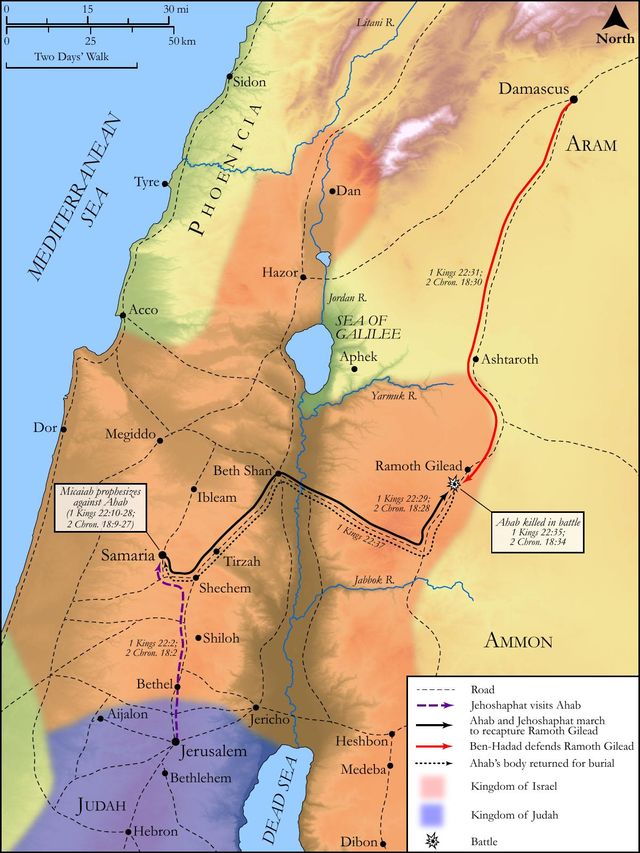
See on the biblical-era map
Study this verse
Public-domain commentary
Matthew Henry
From his Commentary on the Whole Bible. Henry comments on passages, not single verses — this entry covers 2 Chronicles 18:28–34.
We have here, 1. Good Jehoshaphat exposing himself in his robes, thereby endangered, and yet delivered. We have reason to think that Ahab, while he pretended friendship, really aimed at Jehoshaphat's life, to take him off, that he might have the management of his successor, who was his son-in-law, else he would never have advised him to enter into the battle with his robes on, which was but to make himself an easy mark to the enemy: and, if really he intended that, it was as unprincipled a piece of treachery as ever man was guilty of, and justly was he himself taken in the pit he digged for his friend. The enemy had soon an eye upon the robes, and vigorously attacked the unwary prince who now, when it was too late, wished himself in the habit of the poorest soldier, rather than in his princely raiment. he cried out, either to his friends to relieve him (but Ahab took no care of that), or to his enemies, to rectify their mistake, and let them know that he was not the king of Israel. Or perhaps he cried to God for succour and deliverance (to whom else should he cry?) and he found it was not in vain: The Lord helped him out of his distress, by moving the captains to depart from him, Ch2 18:31. God has all men's hearts in his hand, and turns them as he pleases, contrary to their own first intentions, to serve his purposes. Many are moved unaccountably both to themselves and others, but an invisible power moves them. 2. Wicked Ahab disguising himself, arming himself thereby as he thought securing himself, and yet slain, Ch2 18:33. No art, no arms, can save those whom God has appointed to ruin. What can hurt those whom God will protect? And what can shelter those whom God will destroy? Jehoshaphat is safe in his robes, Ahab killed in his armour; for the race is not to the swift nor the battle to the strong.
Continue studying 2 Chronicles 18:33 across the web’s major study libraries — every link below opens this exact verse, chapter, or book on the destination site.
Read & Compare
 BibleGatewayThis verse in more than 200 translations and 70 languages.
 Bible.comThe YouVersion reader — hundreds of translations, reading plans, and highlights.
 ESV.orgCrossway's official English Standard Version reader.
 NET BibleThe NET translation with 60,000+ translators' notes on every rendering decision.
 STEP BibleTyndale House's free study tool — original text, vocabulary, and scholarly resources.
 BibliaLogos Bible Software's free web reader.
 USCCBThe New American Bible (Revised Edition) with the U.S. bishops' study notes.
Commentaries
 BibleHub CommentariesDozens of classic commentaries on this verse, gathered on one page.
 StudyLightMore than 100 commentary sets — the largest collection on the web.
 BibleRefPlain-English commentary on what this verse means, verse by verse.
 Enduring WordDavid Guzik's free commentary on this chapter, widely used by Bible teachers.
 Bible Study ToolsVerse commentary alongside Greek and Hebrew study aids.
Original Language & Research
- BibleHub InterlinearThe verse word by word — original language, transliteration, and English.
- BibleHub LexiconEvery word's original-language definition and Strong's entry.
 Blue Letter BibleDeep-study tools — Strong's numbers, concordance, and word studies.
 SefariaThe Hebrew text with Rashi and centuries of Jewish commentary.
Sermons, Hymns & Audio


TrulyRandomVerse is not affiliated with these sites and doesn’t control their content. They’re linked because they’re genuinely useful.
Summary
Second Chronicles 18:33 vividly narrates the climactic and divinely orchestrated demise of King Ahab of Israel during the battle for Ramoth-gilead. Despite Ahab's desperate attempt to circumvent a dire prophecy by entering the fray in disguise, an anonymous archer, firing a seemingly random arrow, strikes him with lethal precision at a vulnerable seam in his armor. This fatal wound brings his wicked reign to an unequivocal end, serving as a powerful testament to the unyielding sovereignty of God and the certain fulfillment of His prophetic word, previously delivered through Micaiah.
Context
ShowHideLiterary Context
This verse serves as the dramatic and inevitable culmination of the narrative presented in 2 Chronicles chapter 18. The chapter details King Ahab's ill-fated alliance with King Jehoshaphat of Judah to reclaim Ramoth-gilead from the Arameans. Crucially, before battle, Jehoshaphat wisely insists on consulting the Lord. Ahab's 400 court prophets, eager to please, unanimously promise victory. However, Jehoshaphat, discerning their deceit, presses for a genuine prophet of the Lord, leading to the reluctant summoning of Micaiah, the son of Imlah. In stark contrast to the false prophets, Micaiah fearlessly pronounces a prophecy of disaster and Ahab's certain death, even revealing a vision of a deceiving spirit sent by God to mislead Ahab's false prophets (2 Chronicles 18:22). In a desperate and futile attempt to evade this grim prophecy, Ahab enters the battle disguised as a common soldier, while Jehoshaphat, ironically, wears his royal robes. This cunning human scheme, however, proves powerless against God's sovereign decree, setting the stage for the seemingly random yet divinely guided event detailed in this verse.
Historical & Cultural Context
The setting is the protracted conflict over Ramoth-gilead, a strategically vital city in Transjordan, frequently a flashpoint between the northern kingdom of Israel and Aram (Syria). In ancient Near Eastern warfare, kings typically led their armies from the front, making them prominent targets for enemy forces. Consequently, disguises, like the one employed by Ahab, were occasionally used by monarchs to avoid being singled out by archers or charioteers, or to observe the battle unrecognized and assess troop morale. Despite the protective nature of ancient armor, it inherently possessed vulnerable points, particularly at the joints, seams, or where plates overlapped. The concept of an "anonymous" or "random" shot was recognized, yet within the prevailing worldview, such seemingly chance occurrences were often attributed to divine intervention or fate. This narrative powerfully highlights the tension between human agency (Ahab's disguise, the archer's shot) and divine sovereignty, a recurring and profound theme throughout biblical historiography.
Key Themes
ShowHideThe narrative culminating in 2 Chronicles 18:33 profoundly underscores several major theological themes. Foremost is Divine Sovereignty, demonstrating that God's will is absolute and His purposes cannot be frustrated by human cunning, schemes, or apparent chance. What appears to be a random act by an unnamed archer is, in fact, a precise instrument of God's righteous judgment, echoing the truth found in Proverbs 16:33. Secondly, the verse highlights the Fulfillment of Prophecy. Despite King Ahab's desperate attempts to evade his prophesied fate, Micaiah's grim pronouncement (2 Chronicles 18:16) is undeniably and meticulously realized, underscoring the absolute reliability and authoritative nature of God's word. Finally, it serves as a stark reminder of the Consequences of Disobedience. King Ahab's persistent idolatry and profound wickedness, particularly under the malevolent influence of Jezebel, ultimately brought divine judgment upon him, illustrating the inevitable and just wages of rebellion against God, a truth powerfully articulated in Romans 6:23.
Exposition and Analysis
ShowHideKey Word Analysis
ShowHideThe KJV translation "at a venture" comes from the Hebrew phrase לְתֻמּוֹ (le-tummo), derived from the root H8537 (tôm). This word signifies "completeness," "innocence," or "without specific aim." In this context, it emphasizes the archer's lack of intentional targeting of King Ahab. The shot was not premeditated or aimed at a specific person, let alone the disguised king. This highlights the seemingly accidental nature of the event from a human perspective, yet it simultaneously underscores the profound divine precision behind it. God used an undirected arrow to achieve a perfectly directed, preordained outcome.
The Hebrew phrase בֵּין הַדְּבָקִים וּבֵין הַשִּׁרְיֹן (ben ha-debekim we-ben ha-shiryon) refers to the vulnerable gaps or seams in the king's armor. H1694 (debeq) denotes a "joint" or "solder," indicating the point where pieces connect. H8302 (shiryôwn) refers to the "harness" or "corslet," meaning the breastplate or coat of mail. Together, they describe the critical weak points in the protective gear, typically at the waist or between the breastplate and lower body armor, where plates overlapped or were fastened. The arrow striking precisely here, despite the archer's lack of aim and Ahab's disguise, is presented as a miraculous and unambiguous sign of divine intervention, ensuring the fatal blow and fulfilling prophecy.
Verse Breakdown
ShowHide"And a [certain] man drew a bow at a venture"
This opening clause immediately establishes the element of apparent randomness and anonymity. The archer is unnamed, emphasizing that his action is not driven by human design or specific intent towards a particular target. The phrase "at a venture" (Hebrew: le-tummo) underscores that the shot was fired haphazardly, without careful aim or knowledge of who might be struck. This sets the stage for the narrative to powerfully highlight God's absolute sovereignty over seemingly chance events.
"and smote the king of Israel between the joints of the harness"
This is the pivotal and miraculous moment of the passage. Despite the archer's lack of aim and King Ahab's disguise, the arrow finds its mark with deadly and impossible accuracy. The specific detail "between the joints of the harness" pinpoints the precise, vulnerable seam in Ahab's protective armor, indicating a wound that would prove fatal. This seemingly impossible shot, hitting a hidden king at an exact weak spot, is presented as the undeniable hand of divine intervention, meticulously executing prophecy.
"therefore he said to his chariot man, Turn thine hand, that thou mayest carry me out of the host; for I I am wounded."
Ahab's immediate reaction confirms the severity and mortal nature of the wound. His command to his chariot driver, "Turn thine hand, that thou mayest carry me out of the host," reveals his recognition that the wound is fatal and his desire to be removed from the main body of the army. This removal was likely intended to prevent his death from demoralizing his troops or to allow him to die away from public view. His desperate attempt to escape his fate, however, ultimately proves futile, as he dies later that day, fulfilling Micaiah's prophecy.
Literary Devices
ShowHideThe passage masterfully employs several potent literary devices to convey its profound theological message. Irony is strikingly evident, as Ahab's elaborate disguise, meticulously planned to thwart Micaiah's prophecy and escape death, ironically leads him into the very situation where a "random" arrow, precisely guided by divine will, finds him at his most vulnerable point. This highlights the utter futility of human attempts to circumvent God's decrees. Divine Intervention is the overarching and most significant theme, subtly yet powerfully presented through the "at a venture" shot. What appears to be pure chance or a mere accident from a human perspective is unequivocally portrayed as the precise, unyielding execution of God's judgment. The unnamed archer becomes an unwitting, anonymous instrument of God's sovereign plan, demonstrating God's ability to use any means, however ordinary or accidental they may seem, to accomplish His ultimate purposes. Finally, the narrative serves as a profound example of Poetic Justice, where King Ahab, who consistently defied God, persecuted His prophets, and led Israel into grievous idolatry, meets his end in a manner that underscores God's ultimate authority, His unwavering righteousness, and the inevitability of judgment for persistent wickedness.
Theological and Thematic Connections
ShowHideThe death of King Ahab in 2 Chronicles 18:33 stands as a profound theological statement on God's absolute sovereignty and the unwavering certainty of His prophetic word. It teaches us that no human cunning, no elaborate disguise, and no perceived randomness can ever thwart or frustrate the divine will. God's purposes, whether of judgment or salvation, will always prevail with perfect precision. This event serves as a powerful reminder that God is not a distant, passive observer but is actively and intimately involved in the affairs of humanity, meticulously guiding history and individual destinies according to His righteous and immutable plan, even through seemingly insignificant or accidental means. It underscores the profound truth that while humans exercise their choices, God ultimately holds the reins of destiny, ensuring that His prophecies are fulfilled and His justice is meted out.
Reflection and Application
ShowHideThe account of Ahab's death in 2 Chronicles 18:33 offers profound and multifaceted lessons for contemporary believers. It provides immense comfort and reassurance in the face of life's unpredictable circumstances, reminding us that even in what appears to be random, chaotic, or outside of our control, God's sovereign hand is meticulously at work. We can trust with unwavering confidence that His purposes for us, whether in trials or triumphs, are being perfectly unfolded, and no "chance" event can derail His ultimate, good plan. This profound truth should cultivate a deep sense of peace, reliance, and unshakeable faith in God's providence. Conversely, this passage serves as a solemn and urgent warning against persistent disobedience and deliberate rebellion against God's revealed will. Like Ahab, we cannot hide from God's omniscient gaze or ultimately escape the just consequences of our choices. His word, whether of promise or warning, will always be fulfilled. This dual truth should compel us to live in humble submission, sincere repentance, and unwavering obedience, knowing that our lives are lived before an omniscient, righteous, and sovereign God who holds all things, including every "random" arrow, in His powerful hands.
Questions for Reflection
ShowHideFAQ
ShowHideWas the archer aware he was shooting at King Ahab?
ShowHideNo, the text explicitly states that the man "drew a bow at a venture," meaning without specific aim or knowledge of his target. The Hebrew phrase לְתֻמּוֹ (le-tummo), translated as "at a venture," implies "in his simplicity," "randomly," or "without specific intent." This detail is crucial because it emphasizes that the shot was not a result of human intention, skill, or intelligence, but rather a divinely guided act that meticulously fulfilled God's prophecy against Ahab. It powerfully demonstrates God's absolute sovereignty over seemingly random events, orchestrating them to achieve His precise purposes.
Why did Ahab's disguise not protect him?
ShowHideKing Ahab's disguise was a deliberate and desperate attempt to evade the prophecy of his death, which had been delivered by the prophet Micaiah (2 Chronicles 18:16). He hoped that by not appearing as the king, he would avoid being targeted by enemy forces and thus escape his predicted fate. However, his disguise ultimately failed because God's sovereign will cannot be thwarted or circumvented by human cunning, evasion, or schemes. The "random" arrow, precisely guided by God's hand, found the one vulnerable spot in his armor, proving that no human effort can derail divine judgment or prevent the fulfillment of prophecy. This highlights the utter futility of fighting against God's declared purposes, a theme echoed in other biblical accounts where individuals attempt to escape their destiny, only to find God's plan fulfilled through unexpected and often ironic means (e.g., Jonah's flight from God's call).
Christ-Centered Fulfillment
ShowHideThe narrative of Ahab's divinely orchestrated death, where God uses a seemingly "random" arrow to fulfill His prophetic word, powerfully foreshadows the ultimate and supreme sovereignty of God revealed in the person and work of Jesus Christ. While Ahab's death was a just judgment for his persistent rebellion, Christ's death, though a willing sacrifice, was equally and profoundly under the precise control of God's eternal plan. The "random" nature of the archer's shot underscores that even seemingly chaotic or accidental events are meticulously within God's sovereign control, a truth supremely and redemptively demonstrated in the crucifixion. The death of Jesus, though appearing to be a defeat at the hands of human wickedness and Roman power, was in fact the predetermined counsel and foreknowledge of God for the salvation of humanity (Acts 2:23). Just as Ahab could not escape his divinely appointed fate, so too the powers of darkness could not ultimately prevent God's glorious victory through Christ's resurrection. The vulnerable "joints of the harness" in Ahab's armor find their profound spiritual parallel in Christ's humanity, through which He voluntarily entered into the ultimate vulnerability of death, not by chance, but as the Lamb of God who takes away the sin of the world. His death was not a random historical event but the very focal point of redemptive history, the fulfillment of all prophecy concerning Him (Luke 24:44), and the ultimate demonstration of God's perfect plan to establish His eternal kingdom through the One who conquered death itself and holds the keys of Hades and Death (Revelation 1:18).