


2 Chronicles 35:23
- וַיֹּרוּvai·yo·Ruand they shot arrowsH3384Conj-w ¦ V-Hiphil-ConsecImperf-3mpVerb Hiphil Consecutive Imperfect 3rd Plural Masculineוַandיֹּרוּthey shot arrows
- הַיֹּרִיםhai·yo·Rimthe archersH3384Art ¦ V-Qal-Prtcpl-mpVerb Qal Participle Plural Masculine Absoluteהַtheיֹּרִיםarchers
- לַמֶּלֶךְla·Me·lekhto the kingH4428Prep-l ¦ N-msNoun Singular Masculine Absoluteלַto theמֶּלֶךְking
- יֹאשִׁיָּהוּyo·shi·Ya·huJosiahH2977N-proper-mNoun Proper Masculine
- וַיֹּאמֶרvai·Yo·merand he saidH559Conj-w ¦ V-Qal-ConsecImperf-3msVerb Qal Consecutive Imperfect 3rd Singular Masculineוַandיֹּאמֶרhe said
- הַמֶּלֶךְha·Me·lekhthe kingH4428Art ¦ N-msNoun Singular Masculine Absoluteהַtheמֶּלֶךְking
- לַעֲבָדָיוla·'a·va·Davto his servantsH5650Prep-l ¦ N-mpc ¦ 3msNoun Plural Masculine Constructלַtoעֲבָדָיservantsוhis
- הַעֲבִירוּנִיha·'a·vi·Ru·nitake away meH5674V-Hiphil-Imp-2mp ¦ 1csVerb Hiphil Imperative 2nd Plural Masculineהַעֲבִירוּtake awayנִיme
- כִּיkiforH3588PrtParticle Conditional
- הָחֳלֵיתִיho·cho·Lei·tiI have been woundedH2470V-Hophal-Perf-1csVerb Hophal Perfect 1st Singular common gender
- מְאֹדme·'OdexceedinglyH3966Adj-msAdjective Numerical Singular Masculine Absolute
English is a literal word-by-word gloss of the Hebrew, not the KJV's wording. Why?
This is the original text the KJV's translators worked from — each Hebrew word with its own literal English meaning in this verse, prepared by scholars at Tyndale House, Cambridge. The KJV translates whole sentences, not word by word, so its wording differs: one Hebrew word can become several English words, and the KJV may choose “the LORD” where the gloss reads “Yahweh”. Both are faithful — they answer different questions. For the KJV's own rendering, switch to the KJV text.
Details
See on the biblical-era maps
Study this verse
Public-domain commentary
Matthew Henry
From his Commentary on the Whole Bible. Henry comments on passages, not single verses — this entry covers 2 Chronicles 35:20–27. His three-level outline is real structure in the source text, so it is rendered as structure.
It was thirteen years from Josiah's famous passover to his death. During this time, we may hope, thing went well in his kingdom, that he prospered, and religion flourished; yet we are not entertained with the pleasing account of those years, but they are passed over in silence, because the people, for all this, were not turned from the love of their sins nor God from the fierceness of his anger. The next news therefore we hear of Josiah is that he is cut off in the midst of his days and usefulness, before he is full forty years old. We had this sad story, Kg2 23:29, Kg2 23:30. Here it is somewhat more largely related. That appears here, more than did there, which reflects such blame on Josiah and such praise on the people as one would not have expected.
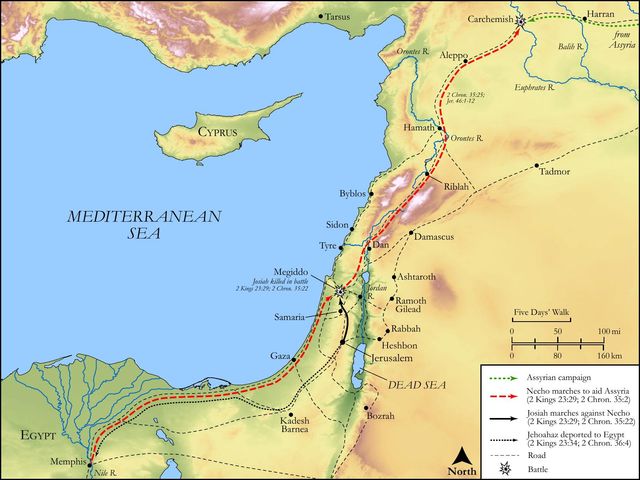
I.Josiah was a very good prince, yet he was much to be blamed for his rashness and presumption in going out to war against the king of Egypt without cause or call. It was bad enough, as it appeared in the Kings, that he meddled with strife which belonged not to him. But here it looks worse; for, it seems, the king of Egypt sent ambassadors to him, to warn him against this enterprise, Ch2 35:21.
1.The king of Egypt argued with Josiah,
(1.)From principles of justice. He professed that he had no desire to do him any hurt, and therefore it was unfair, against common equity and the law of nations, for Josiah to take up arms against him. If even a righteous man engage in an unrighteous cause, let him not expect to prosper. God is no respecter of persons. See Pro 3:30; Pro 25:8.
(2.)From principles of religion: "God is with me; nay, He commanded me to make haste, and therefore, if thou retard my motions, thou meddlest with God." It cannot be that the king of Egypt only pretended this (as Sennacherib did in a like case, Kg2 18:25), hoping thereby to make Josiah desist, because he knew he had a veneration for the word of God; for it is said here (Ch2 35:22) that the words of Necho were from the mouth of God. We must therefore suppose that either by a dream, or by a strong impulse upon his spirit which he had reason to think was from God, or by Jeremiah or some other prophet, he had ordered him to make war upon the king of Assyria.
(3.)From principles of policy: "That he destroy thee not; it is at thy peril if thou engage against one that has not only a better army and a better cause, but God on his side."
2.It was not in wrath to Josiah, whose heart was upright with the Lord his God, but in wrath to a hypocritical nation, who were unworthy of so good a king, that he was so far infatuated as not to hearken to these fair reasonings and desist from his enterprise. He would not turn his face from him, but went in person and fought the Egyptian army in the valley of Megiddo, Ch2 35:22. If perhaps he could not believe that the king of Egypt had a command from God to do what he did, yet, upon his pleading such a command, he ought to have consulted the oracles of God before he went out against him. His not doing that was his great fault, and of fatal consequence. In this matter he walked not in the ways of David his father; for, had it been his case, he would have enquired of the Lord, Shall I go up? Wilt thou deliver them into my hands? How can we think to prosper in our ways if we do not acknowledge God in them?
II.The people were a very wicked people, yet they were much to be commended for lamenting the death of Josiah as they did.
That Jeremiah lamented him I do not wonder; he was the weeping prophet, and plainly foresaw the utter ruin of his country following upon the death of this good king. But it is strange to find that all Judah and Jerusalem, that stupid senseless people, mourned for him (Ch2 35:24), contrived how to have their mourning excited by singing men and singing women, how to have it spread through the kingdom (they made an ordinance in Israel that the mournful ditties penned on this sad occasion should be learned and sung by all sorts of people), and also how to have the remembrance of it perpetuated: these elegies were inserted in the collections of state poems; they are written in the Lamentations. Hereby it appeared,
1.That they had some respect to their good prince, and that, though they did not cordially comply with him in all his good designs, they could not but greatly honour him. Pious useful men will be manifested in the consciences even of those that will not be influenced by their example; and many that will not submit to the rules of serious godliness themselves yet cannot but give it their good word and esteem it in others. Perhaps those lamented Josiah when he was dead that were not thankful to God for him while he lived. The Israelites murmured at Moses and Aaron while they were with them and spoke sometimes of stoning them, and yet, when they died, they mourned for them many days. We are often taught to value mercies by the loss of them which, when we enjoyed them, we did not prize as we ought.
2.That they had some sense of their own danger now that he was gone. Jeremiah told them, it is likely, of the evil they might now expect to come upon them, from which he was taken away; and so far they credited what he said that they lamented the death of him that was their defence. Note, Many will more easily be persuaded to lament the miseries that are coming upon them than to take the proper way by universal reformation to prevent them, will shed tears for their troubles, but will not be prevailed upon to part with their sins. But godly sorrow worketh repentance and that repentance will be to salvation.
Historical interpretation
Historical reception
2 surviving comments on this verse. Each one is dated, so this reads as a timeline rather than a list.
It is true that in the holy Scriptures many are called righteous, as Zachariah and Elizabeth, Job, Jehosaphat, Josiah, and many others who are mentioned in the sacred writings. Of this fact I shall, if God gives me grace, give a full explanation in the work that I have promised; in this letter it must suffice to say that they are called righteous, not because they are faultless but because their faults are eclipsed by their virtues. In fact Zachariah is punished with dumbness, Job is condemned out of his own mouth, and Jehoshaphat and Josiah who are beyond a doubt described as righteous are narrated to have done things displeasing to the Lord. The first aligned himself with the ungodly Ahab and brought on himself the rebuke of Micaiah; and the second, though forbidden by the word of the Lord spoken by Jeremiah, went against Pharaoh Neco, king of Egypt, and was killed by him.
Finally, Josiah is killed by Pharaoh, the king of Egypt, because he would not listen to the words of the Lord from the mouth of the prophet Jeremiah, or, as it is written in the Paralipomenon: “Josiah would not return but prepared to fight against him and did not listen to the words of Neco from the mouth of God.” And it is stated, “And he died and was buried in the monument of his ancestors. And all Judah and Jerusalem mourned for him, particularly Jeremiah, whose lamentations for Josiah all the singing men and singing women repeat to this day. And it became like a law in Israel: ‘Behold, it is found written in the Lamentations.’ ”
Continue studying 2 Chronicles 35:23 across the web’s major study libraries — every link below opens this exact verse, chapter, or book on the destination site.
Read & Compare
 BibleGatewayThis verse in more than 200 translations and 70 languages.
 Bible.comThe YouVersion reader — hundreds of translations, reading plans, and highlights.
 ESV.orgCrossway's official English Standard Version reader.
 NET BibleThe NET translation with 60,000+ translators' notes on every rendering decision.
 STEP BibleTyndale House's free study tool — original text, vocabulary, and scholarly resources.
 BibliaLogos Bible Software's free web reader.
 USCCBThe New American Bible (Revised Edition) with the U.S. bishops' study notes.
Commentaries
 BibleHub CommentariesDozens of classic commentaries on this verse, gathered on one page.
 StudyLightMore than 100 commentary sets — the largest collection on the web.
 BibleRefPlain-English commentary on what this verse means, verse by verse.
 Enduring WordDavid Guzik's free commentary on this chapter, widely used by Bible teachers.
 Bible Study ToolsVerse commentary alongside Greek and Hebrew study aids.
Original Language & Research
- BibleHub InterlinearThe verse word by word — original language, transliteration, and English.
- BibleHub LexiconEvery word's original-language definition and Strong's entry.
 Blue Letter BibleDeep-study tools — Strong's numbers, concordance, and word studies.
 SefariaThe Hebrew text with Rashi and centuries of Jewish commentary.
Sermons, Hymns & Audio


TrulyRandomVerse is not affiliated with these sites and doesn’t control their content. They’re linked because they’re genuinely useful.
Summary
Second Chronicles 35:23 tragically records the mortal wounding of King Josiah by archers during his ill-fated confrontation with Pharaoh Necho's forces at Megiddo. This pivotal moment marks a sorrowful turning point in Judah's history, as the reign of its last truly righteous king, despite his extensive reforms and profound devotion, concludes in death due to his decision to ignore a divinely-inspired warning and engage in a conflict that was not his to fight.
Context
ShowHideLiterary Context
This verse serves as the tragic climax of King Josiah's otherwise exemplary reign, immediately following his refusal to heed Pharaoh Necho's warning in 2 Chronicles 35:20-22. The Chronicler meticulously emphasizes that Necho's message was "from the mouth of God" (2 Chronicles 35:22), thereby underscoring Josiah's direct culpability and the theological weight of his subsequent actions. Verse 23 details the immediate and fatal consequence of this disobedience, leading directly into the account of the king's death and the widespread lamentations that follow in 2 Chronicles 35:24-25. This sorrowful end functions as a stark theological commentary by the Chronicler, illustrating that even a righteous king is not exempt from the severe repercussions of ignoring divine counsel, thus setting the stage for Judah's rapid spiritual and political decline towards the Babylonian exile, as further detailed in 2 Chronicles 36.
Historical & Cultural Context
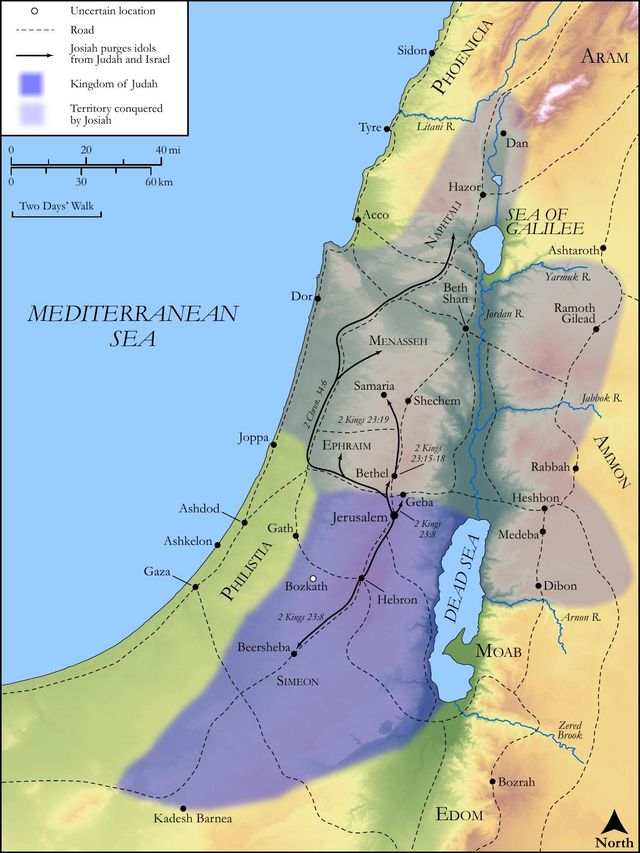
The events described in 2 Chronicles 35 unfold around 609 BC, a period of immense geopolitical upheaval in the ancient Near East. The once-dominant Assyrian Empire was in rapid decline, creating a power vacuum that new empires—Babylon to the east and Egypt to the west—were aggressively vying to fill. Pharaoh Necho II was leading his army northward through Judah to assist the remnants of the Assyrian forces against the burgeoning Babylonian power at Carchemish, located on the Euphrates River. Megiddo, the site of this fateful battle, was a highly strategic plain in northern Judah, historically renowned as a major battleground (e.g., Judges 5:19). King Josiah, a devout monarch who had spearheaded extensive religious reforms, purging idolatry and restoring the Passover celebration throughout Judah (as detailed in 2 Chronicles 34-35), likely saw Necho's passage as an opportunity to assert Judah's independence from foreign influence or to prevent Egyptian encroachment into his territory, aligning with his anti-Assyrian stance. However, his intervention against Necho, who explicitly claimed divine backing for his campaign, proved to be a fatal miscalculation.
Key Themes
ShowHideThe narrative surrounding Josiah's tragic death at Megiddo illuminates several profound theological and narrative themes within the Chronicler's work. Firstly, it powerfully underscores the consequences of disobedience, even for a king as devout and righteous as Josiah. His failure to discern or heed God's warning, delivered through the unexpected messenger of Pharaoh Necho, directly precipitates his demise, vividly illustrating that personal piety does not grant immunity from the repercussions of poor judgment or outright defiance of divine instruction. Secondly, the account delves into the complex interplay between divine sovereignty and human responsibility. While God's overarching plan for Judah's judgment was undeniably unfolding (a theme that becomes increasingly prominent in later chapters, such as 2 Chronicles 36), Josiah's specific decision to engage in this particular battle was his own, with devastating and immediate results. Finally, the Chronicler masterfully employs Josiah's death to emphasize the critical importance of heeding prophetic warnings and the inherent fragility of even a reformed nation when its leaders fail to walk in complete and discerning obedience to God's revealed will.
Exposition and Analysis
ShowHideKey Word Analysis
ShowHideThis primitive root (יָרָה) primarily means "to flow as water" or "to rain," but transitively, it signifies "to lay or throw," especially an arrow, hence "to shoot." In 2 Chronicles 35:23, its use precisely describes the action of the archers releasing arrows with intent, directly targeting or striking King Josiah. This word emphasizes the direct, deliberate, and lethal nature of the attack, indicating that Josiah was not merely caught in general combat but was specifically hit by an arrow, highlighting the immediate and decisive cause of his critical injury.
Derived from the same root as אוּד, this word (מְאֹד) properly conveys "vehemence" or "might." It functions as an intensifier, meaning "greatly," "very," "exceedingly," or "mightily." When paired with "wounded" (châlâh), it serves to dramatically emphasize the extreme severity of Josiah's injury. This is not a minor wound but one of overwhelming pain and critical gravity, underscoring the immediate and incapacitating nature of the blow that necessitates his urgent removal from the battlefield.
This primitive root (חָלָה) means "to be rubbed or worn," and figuratively, "to be weak, sick, or afflicted." It often implies a serious, critical, or even mortal condition. When Josiah declares, "I am sore wounded," the verb châlâh conveys that his injury has rendered him gravely ill or fatally afflicted. Combined with mᵉʼôd, it paints a vivid picture of a king in mortal distress, signaling that his wound is not merely painful but has reached a life-threatening, if not already terminal, stage.
Verse Breakdown
ShowHide"And the archers shot at king Josiah;"
This initial clause immediately establishes the agents of Josiah's injury—the archers—and the direct, hostile action taken against him. It conveys the suddenness and lethal efficiency of ancient warfare, where a volley of arrows could swiftly incapacitate or kill even a monarch. The focus is squarely on the direct cause of his critical state, emphasizing the specific manner of his undoing.
"and the king said to his servants, Have me away;"
This segment reveals Josiah's immediate and urgent response to being struck. His command, "Have me away" (literally, "take me out" or "carry me off"), indicates a clear and immediate recognition of the severity of his wound and the desperate necessity of being removed from the immediate danger and chaos of the battle. It portrays his awareness of his incapacitation and his desire to preserve his life, or at least to die away from the melee.
"for I am sore wounded."
This concluding clause provides the explicit and grave reason for Josiah's urgent command. It unequivocally confirms the critical, indeed mortal, nature of his injury, conveying the king's own assessment that his wound is not merely painful but profoundly debilitating and potentially fatal. This statement underscores the tragic reality of his situation and grimly foreshadows his impending death, marking the end of an era for Judah.
Literary Devices
ShowHideThe narrative of Josiah's death in 2 Chronicles 35:23 is profoundly shaped by several powerful literary devices. The most overarching is Tragedy, portraying the untimely and avoidable demise of a righteous king, beloved by God and his people, due to a singular, fatal error in judgment. This evokes a deep sense of Pathos, generating profound pity and sorrow for Josiah, whose commendable zeal for the Lord ultimately led him to a misguided and fatal battle. There is also striking Irony in his death: a king who meticulously purged idolatry, restored proper worship, and was renowned for his obedience to the Mosaic Law, dies precisely because he disobeys a warning that the Chronicler explicitly states came "from the mouth of God" (2 Chronicles 35:22). Furthermore, his death at Megiddo, a location steeped in historical significance as a site of decisive battles and later associated with eschatological conflicts, functions as potent Foreshadowing of the inevitable doom awaiting Judah. His removal from the scene, as the last truly righteous king, symbolically paves the way for the nation's rapid descent into apostasy and the eventual Babylonian exile, underscoring the fragility of a nation's spiritual well-being when its leadership falters.
Theological and Thematic Connections
ShowHideThe death of King Josiah, as depicted in 2 Chronicles 35:23, presents a profound theological paradox: a king who "did what was right in the eyes of the Lord" (2 Chronicles 34:2) and spearheaded a sweeping spiritual revival, nevertheless meets a tragic end due to a specific act of disobedience. This narrative powerfully underscores the Chronicler's consistent theological message: obedience brings blessing, and disobedience, regardless of one's past faithfulness or overall character, inevitably brings consequences. Josiah's zeal, while deeply commendable, was ultimately misguided when he failed to discern or heed a divine warning, even if delivered through an unexpected source like Pharaoh Necho. This highlights the critical importance of humility and discernment, reminding us that even the most devout individuals are not immune to the repercussions of acting outside of God's revealed will or wisdom. His death marks the abrupt end of an era of reform and ushers in a period of rapid decline for Judah, serving as a solemn warning about the cumulative impact of leadership decisions on a nation's spiritual trajectory and its ultimate destiny.
Reflection and Application
ShowHideThe tragic demise of King Josiah in 2 Chronicles 35:23 offers timeless and sobering lessons for believers today, particularly concerning the nature of discernment, the necessity of humility, and the inevitable consequences of our choices. Josiah's story serves as a poignant reminder that even admirable zeal and a history of profound faithfulness do not exempt us from the crucial need for careful and prayerful discernment of God's specific will in every situation. His failure to heed a warning, which the biblical text explicitly attributes to God's own voice, underscores the critical importance of listening to counsel, even when it comes from unexpected or seemingly unconventional sources, or through individuals we might not typically associate with divine revelation. We are called to cultivate a spirit of profound humility, recognizing that our own wisdom is inherently finite and that presumption, no matter how well-intentioned, can lead to devastating and irreversible outcomes. This passage profoundly challenges us to honestly consider whether our actions are truly aligned with divine leading or if they are primarily driven by our own plans, ambitions, or even a misguided sense of duty. It stands as a sobering reminder that even the most righteous among us are ultimately accountable for their individual decisions, and that ignoring wisdom or clear divine instruction can have profound and far-reaching impacts, not only on ourselves but also on those we lead, influence, or are responsible for.
Questions for Reflection
ShowHideFAQ
ShowHideWhy did Josiah, a seemingly righteous king, die in battle?
ShowHideJosiah's death, as described in 2 Chronicles 35:23, is presented by the Chronicler as a direct and tragic consequence of his disobedience to a divine warning. Pharaoh Necho, on his way to fight at Carchemish, sent messengers to Josiah, explicitly stating that his war was not against Judah and that God was with him in his endeavor (2 Chronicles 35:20-21). The text is remarkably clear that Necho's words were, in fact, "from the mouth of God" (2 Chronicles 35:22). Despite his overall righteousness and extensive religious reforms, Josiah stubbornly refused to listen, disguised himself, and went to battle at Megiddo, where he was mortally wounded by archers. His death serves as a stark theological lesson that even the most devout and well-intentioned individuals are accountable for their specific choices and can suffer severe consequences for ignoring divine counsel or acting presumptuously against God's revealed will.
What is the significance of Megiddo in this context?
ShowHideMegiddo, situated in the strategic Jezreel Valley, was a historically vital location and a frequent battleground throughout ancient Israel's history. Its significance in the context of Josiah's death is multi-layered and profound. Historically, it was a place of decisive conflicts, often associated with the very fate of Israel (e.g., Judges 5:19). For Josiah, it became the site of his tragic end, marking an undeniable turning point in Judah's history from a period of spiritual revival to one of rapid decline and eventual judgment. Prophetically, Megiddo (or "Armageddon," a transliteration of "Har Megiddo," meaning "Mount Megiddo") is famously mentioned in Revelation 16:16 as the symbolic gathering place for the final great battle in eschatological literature. While the battle in 2 Chronicles 35 is a specific historical event, its setting at Megiddo adds a profound layer of somber resonance, connecting Josiah's personal tragedy to a broader, enduring theme of conflict, divine judgment, and the ultimate triumph of God's purposes that echoes throughout the entire biblical narrative.
Christ-Centered Fulfillment
ShowHideThe tragic death of King Josiah in 2 Chronicles 35:23, though a direct consequence of his own act of disobedience, paradoxically serves to highlight the profound necessity and unique nature of Christ's perfect obedience and atoning sacrifice. Josiah, a king who "did what was right in the eyes of the Lord" (2 Chronicles 34:2) and led a sweeping spiritual revival, ultimately failed to heed clear divine counsel, leading to his fatal wounding and the subsequent unraveling of Judah's spiritual and political stability. His death, therefore, stands as a poignant testament to the inherent fallibility of even the best human leaders and the absolute inability of human righteousness, however zealous or well-intentioned, to fully secure salvation or avert divine judgment. In stark and glorious contrast, Jesus Christ, the ultimate and eternal King, perfectly obeyed the Father's will in every respect, even to the agonizing point of death on a cross (Philippians 2:8). Unlike Josiah, whose death was a consequence of a misguided battle and a failure to listen, Christ's death was a deliberate, preordained, and fully atoning sacrifice for the sins of humanity, the "Lamb of God, who takes away the sin of the world!" (John 1:29). Josiah's death brought widespread lamentation and marked the beginning of Judah's rapid decline towards exile (2 Chronicles 35:25); Christ's death, followed by His glorious resurrection, brought profound hope, eternal life, and the promise of complete salvation to all who believe (Romans 5:8 and 1 Corinthians 15:3-4). Josiah's story, therefore, serves as a poignant and necessary backdrop, magnifying the unparalleled perfection, redemptive power, and ultimate sufficiency of Christ's life, death, and resurrection, which alone can truly deliver humanity from the pervasive consequences of sin and disobedience.