


2 Chronicles 35:24
Bible text: King James Version (1769 Blayney text) · Public domain
Bible text: King James Version with Strong's numbers · Public domain
Bible text: Berean Standard Bible · Public domain
Bible text: American Standard Version (1901) · Public domain
Bible text: World English Bible, Messianic edition · Public domain
Bible text: Geneva Bible (1599) · Public domain
Bible text: Young's Literal Translation · Public domain
- וַיַּעֲבִירֻהוּvai·ya·'a·vi·Ru·huand they took away himH5674Conj-w ¦ V-Hiphil-ConsecImperf-3mp ¦ 3msVerb Hiphil Consecutive Imperfect 3rd Plural Masculineוַandיַּעֲבִירֻthey took awayהוּhim
- עֲבָדָיו'a·va·Davhis servantsH5650N-mpc ¦ 3msNoun Plural Masculine Constructעֲבָדָיservantsוhis
- מִןminfromH4480PrepPreposition
- הַמֶּרְכָּבָהha·mer·ka·Vahthe chariotH4818Art ¦ N-fsNoun Singular Feminine Absoluteהַtheמֶּרְכָּבָהchariot
- וַיַּרְכִּיבֻהוּvai·yar·ki·vu·Huand they made ride himH7392Conj-w ¦ V-Hiphil-ConsecImperf-3mp ¦ 3msVerb Hiphil Consecutive Imperfect 3rd Plural Masculineוַandיַּרְכִּיבֻthey made rideהוּhim
- עַל'alonH5921PrepPreposition
- רֶכֶבRe·khev[the] chariot ofH7393N-mscNoun Singular Masculine Construct
- הַמִּשְׁנֶהha·mish·Neh<the> secondH4932Art ¦ N-msNoun Singular Masculine Absoluteהַ<the>מִּשְׁנֶהsecond
- אֲשֶׁר'a·SherwhichH834RelParticle Relative
- לוֹlo[belonged] to himPrep-l ¦ 3msSuffix Personal 3rd Singular Masculineל[belonged] toוֹhim
- וַיּוֹלִיכֻהוּvai·yo·li·Khu·huand they brought himH1980Conj-w ¦ V-Hiphil-ConsecImperf-3mp ¦ 3msVerb Hiphil Consecutive Imperfect 3rd Plural Masculineוַandיּוֹלִיכֻthey broughtהוּhim
- יְרוּשָׁלִַםye·Ru·sha·LimJerusalemH3389N-properNoun Proper Location
- וַיָּמָתvai·Ya·motand he diedH4191Conj-w ¦ V-Qal-ConsecImperf-3msVerb Qal Consecutive Imperfect 3rd Singular Masculineוַandיָּמָתhe died
- וַיִּקָּבֵרvai·yi·ka·Verand he was buriedH6912Conj-w ¦ V-Niphal-ConsecImperf-3msVerb Niphal Consecutive Imperfect 3rd Singular Masculineוַandיִּקָּבֵרhe was buried
- בְּקִבְרוֹתbe·kiv·Rotin [the] graves ofH6913Prep-b ¦ N-fpcNoun Plural Feminine Constructבְּinקִבְרוֹת[the] graves of
- אֲבֹתָיו'a·vo·Tavhis ancestorsH1N-fpc ¦ 3msNoun Plural Feminine Constructאֲבֹתָיancestorsוhis
- וְכָלve·kholand allH3605Conj-w ¦ N-mscNoun Singular Masculine Constructוְandכָלall
- יְהוּדָהye·hu·DahJudahH3063N-properNoun Proper Location
- וִירוּשָׁלִַםvi·Ru·sha·Limand JerusalemH3389Conj-w ¦ N-properNoun Proper LocationוִandירוּשָׁלִַםJerusalem
- מִתְאַבְּלִיםmit·'a·be·Lim[were] mourningH56V-Hithpael-Prtcpl-mpVerb Hithpael Participle Plural Masculine Absolute
- עַל'alonH5921PrepPreposition
- יֹאשִׁיָּהוּyo·shi·Ya·huJosiahH2977N-proper-mNoun Proper Masculine
English is a literal word-by-word gloss of the Hebrew, not the KJV's wording. Why?
This is the original text the KJV's translators worked from — each Hebrew word with its own literal English meaning in this verse, prepared by scholars at Tyndale House, Cambridge. The KJV translates whole sentences, not word by word, so its wording differs: one Hebrew word can become several English words, and the KJV may choose “the LORD” where the gloss reads “Yahweh”. Both are faithful — they answer different questions. For the KJV's own rendering, switch to the KJV text.
Details
See on the biblical-era maps
Study this verse
Public-domain commentary
Matthew Henry
From his Commentary on the Whole Bible. Henry comments on passages, not single verses — this entry covers 2 Chronicles 35:20–27. His three-level outline is real structure in the source text, so it is rendered as structure.
It was thirteen years from Josiah's famous passover to his death. During this time, we may hope, thing went well in his kingdom, that he prospered, and religion flourished; yet we are not entertained with the pleasing account of those years, but they are passed over in silence, because the people, for all this, were not turned from the love of their sins nor God from the fierceness of his anger. The next news therefore we hear of Josiah is that he is cut off in the midst of his days and usefulness, before he is full forty years old. We had this sad story, Kg2 23:29, Kg2 23:30. Here it is somewhat more largely related. That appears here, more than did there, which reflects such blame on Josiah and such praise on the people as one would not have expected.
I.Josiah was a very good prince, yet he was much to be blamed for his rashness and presumption in going out to war against the king of Egypt without cause or call. It was bad enough, as it appeared in the Kings, that he meddled with strife which belonged not to him. But here it looks worse; for, it seems, the king of Egypt sent ambassadors to him, to warn him against this enterprise, Ch2 35:21.
1.The king of Egypt argued with Josiah,
(1.)From principles of justice. He professed that he had no desire to do him any hurt, and therefore it was unfair, against common equity and the law of nations, for Josiah to take up arms against him. If even a righteous man engage in an unrighteous cause, let him not expect to prosper. God is no respecter of persons. See Pro 3:30; Pro 25:8.
(2.)From principles of religion: "God is with me; nay, He commanded me to make haste, and therefore, if thou retard my motions, thou meddlest with God." It cannot be that the king of Egypt only pretended this (as Sennacherib did in a like case, Kg2 18:25), hoping thereby to make Josiah desist, because he knew he had a veneration for the word of God; for it is said here (Ch2 35:22) that the words of Necho were from the mouth of God. We must therefore suppose that either by a dream, or by a strong impulse upon his spirit which he had reason to think was from God, or by Jeremiah or some other prophet, he had ordered him to make war upon the king of Assyria.
(3.)From principles of policy: "That he destroy thee not; it is at thy peril if thou engage against one that has not only a better army and a better cause, but God on his side."
2.It was not in wrath to Josiah, whose heart was upright with the Lord his God, but in wrath to a hypocritical nation, who were unworthy of so good a king, that he was so far infatuated as not to hearken to these fair reasonings and desist from his enterprise. He would not turn his face from him, but went in person and fought the Egyptian army in the valley of Megiddo, Ch2 35:22. If perhaps he could not believe that the king of Egypt had a command from God to do what he did, yet, upon his pleading such a command, he ought to have consulted the oracles of God before he went out against him. His not doing that was his great fault, and of fatal consequence. In this matter he walked not in the ways of David his father; for, had it been his case, he would have enquired of the Lord, Shall I go up? Wilt thou deliver them into my hands? How can we think to prosper in our ways if we do not acknowledge God in them?
II.The people were a very wicked people, yet they were much to be commended for lamenting the death of Josiah as they did.
That Jeremiah lamented him I do not wonder; he was the weeping prophet, and plainly foresaw the utter ruin of his country following upon the death of this good king. But it is strange to find that all Judah and Jerusalem, that stupid senseless people, mourned for him (Ch2 35:24), contrived how to have their mourning excited by singing men and singing women, how to have it spread through the kingdom (they made an ordinance in Israel that the mournful ditties penned on this sad occasion should be learned and sung by all sorts of people), and also how to have the remembrance of it perpetuated: these elegies were inserted in the collections of state poems; they are written in the Lamentations. Hereby it appeared,
1.That they had some respect to their good prince, and that, though they did not cordially comply with him in all his good designs, they could not but greatly honour him. Pious useful men will be manifested in the consciences even of those that will not be influenced by their example; and many that will not submit to the rules of serious godliness themselves yet cannot but give it their good word and esteem it in others. Perhaps those lamented Josiah when he was dead that were not thankful to God for him while he lived. The Israelites murmured at Moses and Aaron while they were with them and spoke sometimes of stoning them, and yet, when they died, they mourned for them many days. We are often taught to value mercies by the loss of them which, when we enjoyed them, we did not prize as we ought.
2.That they had some sense of their own danger now that he was gone. Jeremiah told them, it is likely, of the evil they might now expect to come upon them, from which he was taken away; and so far they credited what he said that they lamented the death of him that was their defence. Note, Many will more easily be persuaded to lament the miseries that are coming upon them than to take the proper way by universal reformation to prevent them, will shed tears for their troubles, but will not be prevailed upon to part with their sins. But godly sorrow worketh repentance and that repentance will be to salvation.
Historical interpretation
Historical reception
2 surviving comments on this verse. Each one is dated, so this reads as a timeline rather than a list.
It is true that in the holy Scriptures many are called righteous, as Zachariah and Elizabeth, Job, Jehosaphat, Josiah, and many others who are mentioned in the sacred writings. Of this fact I shall, if God gives me grace, give a full explanation in the work that I have promised; in this letter it must suffice to say that they are called righteous, not because they are faultless but because their faults are eclipsed by their virtues. In fact Zachariah is punished with dumbness, Job is condemned out of his own mouth, and Jehoshaphat and Josiah who are beyond a doubt described as righteous are narrated to have done things displeasing to the Lord. The first aligned himself with the ungodly Ahab and brought on himself the rebuke of Micaiah; and the second, though forbidden by the word of the Lord spoken by Jeremiah, went against Pharaoh Neco, king of Egypt, and was killed by him.
Finally, Josiah is killed by Pharaoh, the king of Egypt, because he would not listen to the words of the Lord from the mouth of the prophet Jeremiah, or, as it is written in the Paralipomenon: “Josiah would not return but prepared to fight against him and did not listen to the words of Neco from the mouth of God.” And it is stated, “And he died and was buried in the monument of his ancestors. And all Judah and Jerusalem mourned for him, particularly Jeremiah, whose lamentations for Josiah all the singing men and singing women repeat to this day. And it became like a law in Israel: ‘Behold, it is found written in the Lamentations.’ ”
Continue studying 2 Chronicles 35:24 across the web’s major study libraries — every link below opens this exact verse, chapter, or book on the destination site.
Read & Compare
 BibleGatewayThis verse in more than 200 translations and 70 languages.
 Bible.comThe YouVersion reader — hundreds of translations, reading plans, and highlights.
 ESV.orgCrossway's official English Standard Version reader.
 NET BibleThe NET translation with 60,000+ translators' notes on every rendering decision.
 STEP BibleTyndale House's free study tool — original text, vocabulary, and scholarly resources.
 BibliaLogos Bible Software's free web reader.
 USCCBThe New American Bible (Revised Edition) with the U.S. bishops' study notes.
Commentaries
 BibleHub CommentariesDozens of classic commentaries on this verse, gathered on one page.
 StudyLightMore than 100 commentary sets — the largest collection on the web.
 BibleRefPlain-English commentary on what this verse means, verse by verse.
 Enduring WordDavid Guzik's free commentary on this chapter, widely used by Bible teachers.
 Bible Study ToolsVerse commentary alongside Greek and Hebrew study aids.
Original Language & Research
- BibleHub InterlinearThe verse word by word — original language, transliteration, and English.
- BibleHub LexiconEvery word's original-language definition and Strong's entry.
 Blue Letter BibleDeep-study tools — Strong's numbers, concordance, and word studies.
 SefariaThe Hebrew text with Rashi and centuries of Jewish commentary.
Sermons, Hymns & Audio


TrulyRandomVerse is not affiliated with these sites and doesn’t control their content. They’re linked because they’re genuinely useful.
Summary
Second Chronicles 35:24 vividly records the immediate aftermath of King Josiah's fatal injury at Megiddo, detailing his urgent transport to Jerusalem, his subsequent death, and his burial in the royal sepulchres. This verse encapsulates a moment of profound national tragedy, marking the abrupt end of a significant era of spiritual revival under Judah's most righteous king and initiating a period of widespread, heartfelt mourning across the entire kingdom.
Context
ShowHideLiterary Context
This verse serves as the climactic and tragic conclusion to the narrative of King Josiah's reign, particularly the events detailed in 2 Chronicles 35. Immediately preceding it, 2 Chronicles 35:23 describes Josiah being severely wounded by archers in the ill-fated battle against Pharaoh Necho at Megiddo. Following this verse, 2 Chronicles 35:25 recounts the profound lamentations for Josiah, including those composed by the prophet Jeremiah, solidifying the depth of national grief. The Chronicler presents Josiah's reign as the pinnacle of faithfulness since David, culminating in the grand Passover celebration in 2 Chronicles 35:1-19. His death, therefore, represents a devastating turning point, signaling the rapid decline of Judah towards exile, a narrative arc also paralleled in 2 Kings 23:29-30.
Historical & Cultural Context
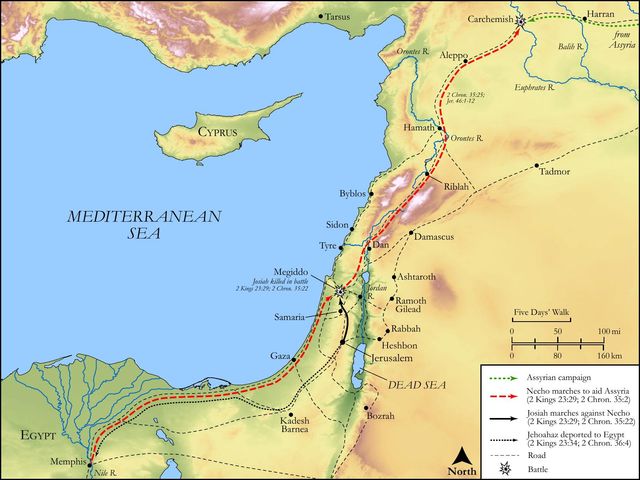
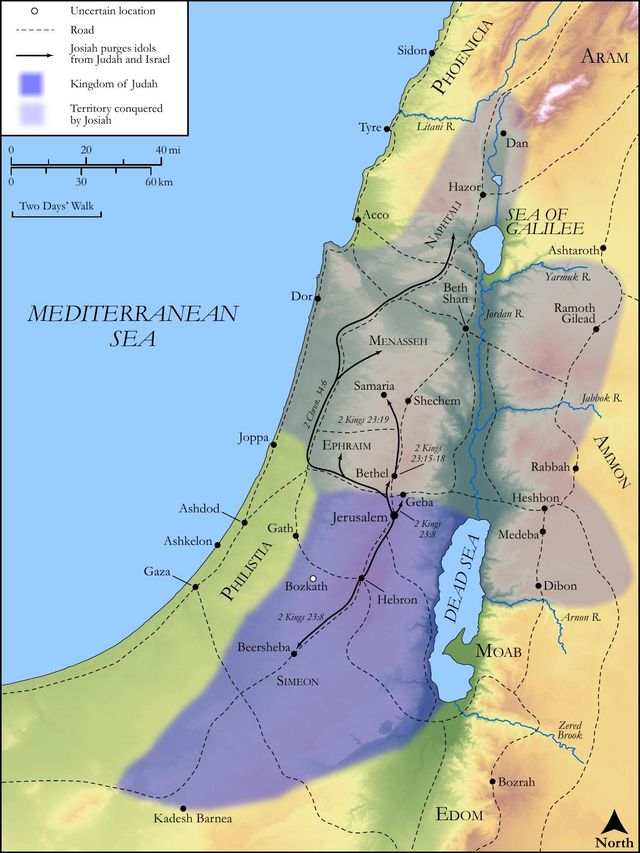
King Josiah reigned from 640-609 BC, a period marked by the decline of the Assyrian Empire and the rise of Babylon and Egypt. Josiah capitalized on Assyria's weakness to implement extensive religious reforms, cleansing Judah and Israel of idolatry and restoring the worship of Yahweh, as detailed in 2 Chronicles 34. His encounter with Pharaoh Necho II at Megiddo occurred as Necho was marching to aid the Assyrians against the Babylonians. Megiddo, located in the Jezreel Valley, was a historically significant battleground. Culturally, royal burials in ancestral tombs were crucial for legitimizing a king's reign and ensuring his place in the dynastic line. The widespread mourning described reflects the deep personal and national impact of a beloved and righteous king's death, often accompanied by professional mourners and public lamentations, as was customary in Israel.
Key Themes
ShowHideThis verse powerfully contributes to several key themes within the book of Chronicles and the broader biblical narrative. Firstly, it highlights the Tragedy of Righteousness, demonstrating that even the most devout and obedient kings are not immune to suffering or a premature end, raising complex questions about divine sovereignty and human responsibility. Secondly, it underscores the theme of National Loss and Grief, as Josiah's death precipitates a profound and widespread mourning across Judah and Jerusalem, signifying the abrupt end of an era of spiritual revival and relative peace. This national lament foreshadows the deeper sorrows to come. Lastly, it implicitly touches upon the Consequences of Disobedience or Misjudgment. While Josiah's intentions may have been patriotic, his decision to engage Pharaoh Necho, despite a warning that some interpret as divinely inspired (2 Chronicles 35:21), ultimately led to his downfall, serving as a sobering reminder of the need for discernment and wisdom in all actions, even those seemingly noble.
Exposition and Analysis
ShowHideKey Word Analysis
ShowHideThis term (H4818) refers to a war-chariot, a significant piece of military equipment and a symbol of royal status and power in ancient warfare. The mention of "the second chariot that he had" suggests either a backup vehicle, a more comfortable transport for a wounded king, or perhaps a less conspicuous one to avoid further attack. It emphasizes the urgency and severity of Josiah's condition, requiring immediate extraction from the battlefield.
This word (H6913) denotes a grave, tomb, or burial place. The phrase "sepulchres of his fathers" specifically refers to the royal burial grounds in Jerusalem, likely within or near the City of David, where the kings of Judah were traditionally interred. This detail confirms Josiah's legitimate lineage and ensures he received an honorable, royal burial despite his tragic death, affirming his place among the Davidic kings.
This verb (H56) describes a deep, public, and often ritualized lamentation or bewailing for the dead. It implies a profound expression of sorrow, often involving wailing, tearing of clothes, and other outward signs of grief. The declaration that "all Judah and Jerusalem mourned" indicates the widespread and intense nature of the national sorrow, underscoring Josiah's immense popularity and the devastating impact of his loss on the entire kingdom.
Verse Breakdown
ShowHide"His servants therefore took him out of that chariot, and put him in the second chariot that he had;"
This clause reveals the immediate action taken by Josiah's loyal attendants after he was mortally wounded. The transfer from one chariot to another highlights the critical nature of his injury and the urgency to remove him from the direct line of battle. The "second chariot" might have been a more secure or less damaged vehicle, or simply one designated for transporting a wounded king, indicating a desperate attempt to save his life or at least ensure his dignified removal.
"and they brought him to Jerusalem, and he died,"
This phrase details the journey from Megiddo to Jerusalem, a distance of approximately 60 miles. The fact that he died either en route or immediately upon arrival in Jerusalem underscores the severity of his wounds. Dying in Jerusalem, the capital and spiritual heart of Judah, was significant, allowing him to be buried in the royal necropolis and emphasizing the national impact of his death.
"and was buried in [one of] the sepulchres of his fathers."
This confirms Josiah received a proper royal burial in the established tombs of the Davidic kings in Jerusalem. This was a critical aspect of validating a king's reign and ensuring his place in the ancestral line. The Chronicler emphasizes this detail to show that despite the tragic circumstances, Josiah was afforded the full honor due to a legitimate king.
"And all Judah and Jerusalem mourned for Josiah."
This final clause emphasizes the profound and widespread grief that swept across the entire kingdom. "All Judah and Jerusalem" signifies a national outpouring of sorrow, reflecting the deep love and respect the people had for Josiah, who had led them in a significant spiritual revival. This collective lament underscores the magnitude of the loss and the end of a golden age for the nation.
Literary Devices
ShowHideThe Chronicler employs several powerful literary devices in 2 Chronicles 35:24 to convey the gravity of the moment. Pathos is profoundly evident, as the narrative evokes deep sorrow and pity for Josiah, a righteous king who meets a tragic, untimely end. The scene is designed to elicit an emotional response from the reader, emphasizing the unfairness of his demise and the profound loss for the nation. There is an element of Irony in Josiah's death; despite his unwavering devotion and extensive reforms, he falls in battle, possibly due to a misjudgment or a failure to discern divine will. This contrasts sharply with the expected divine protection for a righteous king, highlighting the complexities of God's ways and human responsibility. Furthermore, the widespread mourning described serves as a form of Foreshadowing, signaling the imminent decline and eventual destruction of Judah. Josiah's death marks the end of the last great period of revival and stability, setting the stage for the subsequent judgments and exile. The Chronicler's account also exhibits Parallelism with the narrative in 2 Kings 23:29-30, reinforcing the historical veracity and significance of Josiah's death as a pivotal moment in Judah's history.
Theological and Thematic Connections
ShowHideThe death of Josiah, as recounted in 2 Chronicles 35:24, presents a profound theological challenge: how could such a righteous and devoted king meet such a tragic end? This tension highlights the complexities of divine sovereignty and human responsibility. While God had promised Josiah that he would be gathered to his fathers in peace and not see the coming disaster (2 Kings 22:20), his death in battle at Megiddo seems to contradict this. Some interpretations suggest Josiah's decision to engage Pharaoh Necho was a misjudgment, perhaps even a direct disobedience to a divine warning delivered through Necho (2 Chronicles 35:21). Regardless, his death underscores that even the most faithful individuals are not immune to hardship, the consequences of human choices, or the broader sweep of God's judgment on a nation. It serves as a stark reminder that God's promises often operate within the framework of human actions and the unfolding of His larger redemptive plan, which sometimes involves the suffering of the righteous.
Reflection and Application
ShowHideThe tragic end of King Josiah, despite his exemplary righteousness, offers profound lessons for believers today. It challenges our often-simplistic assumptions that faithfulness guarantees an easy or prosperous life, reminding us that even those who walk closely with God may face unexpected suffering, loss, or untimely ends. Josiah's story calls us to trust in God's sovereignty even when circumstances are perplexing and to recognize that divine wisdom may not always align with our immediate understanding of justice or reward. His decision to engage in battle, despite a potential divine warning, underscores the critical importance of spiritual discernment and seeking God's will in all decisions, especially those with significant consequences. We are called to lead with integrity and devotion, as Josiah did, but also to exercise humility and wisdom, recognizing that even noble intentions require divine guidance. Ultimately, Josiah's legacy of reform and the profound national mourning for him highlight the lasting impact of a life lived wholeheartedly for God, inspiring us to pursue righteousness and leave a spiritual legacy that transcends our earthly lifespan.
Questions for Reflection
ShowHideFAQ
ShowHideWhy did Josiah, a good king, die so tragically?
ShowHideThe death of Josiah is one of the more perplexing events in the Old Testament, precisely because he is consistently portrayed as one of Judah's most righteous kings. While the text doesn't offer a single definitive reason for his death, several factors are considered. Some scholars interpret Pharaoh Necho's warning to Josiah in 2 Chronicles 35:21 as a divinely inspired message that Josiah failed to heed, making his death a consequence of disobedience or misjudgment. Others see it as a tragic outcome of war, highlighting that even righteous individuals are not immune to the dangers of conflict. It also serves a theological purpose within the Chronicler's narrative: Josiah's death marks the end of Judah's last great spiritual revival and signals the imminent divine judgment and exile, fulfilling prophecies of doom on a nation that had largely turned away from God despite Josiah's efforts. His death, therefore, underscores the gravity of Judah's sin and the inevitability of God's judgment.
What was the significance of being buried "in the sepulchres of his fathers"?
ShowHideBeing buried "in the sepulchres of his fathers" was highly significant for a king in ancient Judah. Firstly, it confirmed Josiah's legitimate kingship and his place in the unbroken Davidic lineage. This was the traditional burial ground for the kings of Judah, located within or near the City of David in Jerusalem. Secondly, it fulfilled the prophecy given to Josiah in 2 Kings 22:20, where God promised he would "be gathered to your fathers in peace, and your eyes shall not see all the disaster that I will bring upon this place." While he died in battle, his burial in Jerusalem before the Babylonian exile meant he did not witness the ultimate destruction and suffering that befell his people, thus fulfilling the spirit of the prophecy. It signified a peaceful rest from the coming national catastrophe.
How widespread was the mourning for Josiah?
ShowHideThe text states that "all Judah and Jerusalem mourned for Josiah," indicating a profound and national outpouring of grief. This was not merely a localized or royal family lament, but a widespread expression of sorrow across the entire kingdom. Josiah had led the most extensive spiritual revival since David, cleansing the land of idolatry and restoring the Passover celebration (2 Chronicles 34 and 2 Chronicles 35). His death was seen as a devastating loss, marking the end of an era of righteousness and stability. The depth of this national grief is further emphasized in 2 Chronicles 35:25, which notes that the prophet Jeremiah composed laments for Josiah, indicating the profound and lasting impact of his passing on the spiritual and political landscape of Judah.
Christ-Centered Fulfillment
ShowHideThe tragic death of King Josiah and the profound national mourning it evoked in 2 Chronicles 35:24 find a poignant and ultimately triumphant fulfillment in the person and work of Jesus Christ. Josiah, a righteous king, died prematurely, and his death marked the end of Judah's last great hope, ushering in a period of decline and judgment. This foreshadows, in a limited sense, the death of the truly righteous King, Jesus, who, though perfectly innocent, willingly laid down His life. However, the contrast is crucial: Josiah's death was a consequence of a battle and possibly misjudgment, leading to national despair, whereas Christ's death was a deliberate, atoning sacrifice for the sins of the world, leading to ultimate hope and salvation. The widespread mourning for Josiah, particularly the lamentations composed by Jeremiah, echoes the prophetic mourning for the Messiah, as foretold in Zechariah 12:10-11, where the mourning for the "one whom they have pierced" is compared to the mourning for Josiah at Megiddo. Unlike Josiah, whose burial in the "sepulchres of his fathers" signified a final resting place, Christ's burial in a borrowed tomb was temporary, leading to His glorious resurrection. His death transformed the deepest human sorrow into eternal joy, fulfilling His promise that though His disciples would mourn, their "sorrow will turn into joy" (John 16:20). Through Christ's death and resurrection, the ultimate "mourning" for sin and death is overcome, and His victory ushers in an everlasting kingdom of peace and righteousness, far surpassing the temporary revival under Josiah (Revelation 21:4).