


2 Chronicles 18:16
- וַיֹּאמֶרvai·Yo·merand he saidH559Conj-w ¦ V-Qal-ConsecImperf-3msVerb Qal Consecutive Imperfect 3rd Singular Masculineוַandיֹּאמֶרhe said
- רָאִיתִיra·'I·tiI sawH7200V-Qal-Perf-1csVerb Qal Perfect 1st Singular common gender
- אֶת'et<obj.>H853DirObjMParticle Object Indicator
- כָּלkolallH3605N-mscNoun Singular Masculine Construct
- יִשְׂרָאֵלYis·ra·'ElIsraelH3478N-properNoun Proper Location
- נְפוֹצִיםne·fo·TzimscatteredH6327V-Niphal-Prtcpl-mpVerb Niphal Participle Plural Masculine Absolute
- עַל'alonH5921PrepPreposition
- הֶהָרִיםhe·ha·Rimthe mountainsH2022Art ¦ N-mpNoun Plural Masculine Absoluteהֶtheהָרִיםmountains
- כַּצֹּאןka·Tzonlike <the> flockH6629Prep-k ¦ N-csNoun Singular common gender Absoluteכַּlike <the>צֹּאןflock
- אֲשֶׁר'a·SherwhichH834RelParticle Relative
- אֵין'einnotH369N-mscNoun Singular Masculine Construct
- לָהֶןla·Hen[belongs] to themPrep-l ¦ 3fpSuffix Personal 3rd Plural Feminineלָ[belongs] toהֶןthem
- רֹעֶהro·'Eha shepherdH7462V-Qal-Prtcpl-msVerb Qal Participle Singular Masculine Absolute
- וַיֹּאמֶרvai·Yo·merand he saidH559Conj-w ¦ V-Qal-ConsecImperf-3msVerb Qal Consecutive Imperfect 3rd Singular Masculineוַandיֹּאמֶרhe said
- יְהוָהYah·wehYahwehH3068N-properNoun Proper Title
- לֹאlo'notH3808NegParticle Negative
- אֲדֹנִים'a·do·NimmastersH113N-mpNoun Plural Masculine Absolute
- לָאֵלֶּהla·'E·leh[belong] to theseH428Prep-l ¦ PrtParticle Demonstrativeלָ[belong] toאֵלֶּהthese
- יָשׁוּבוּya·Shu·vulet them returnH7725V-Qal-Imperf-3mpVerb Qal Imperfect 3rd Plural Masculine
- אִישׁ'isheachH376N-msNoun Singular Masculine Absolute
- לְבֵיתוֹle·vei·Toto his own houseH1004Prep-l ¦ N-msc ¦ 3msNoun Singular Masculine Constructלְtoבֵיתown houseוֹhis
- בְּשָׁלוֹםbe·sha·Lomin peaceH7965Prep-b ¦ N-msNoun Singular Masculine Absoluteבְּinשָׁלוֹםpeace
English is a literal word-by-word gloss of the Hebrew, not the KJV's wording. Why?
This is the original text the KJV's translators worked from — each Hebrew word with its own literal English meaning in this verse, prepared by scholars at Tyndale House, Cambridge. The KJV translates whole sentences, not word by word, so its wording differs: one Hebrew word can become several English words, and the KJV may choose “the LORD” where the gloss reads “Yahweh”. Both are faithful — they answer different questions. For the KJV's own rendering, switch to the KJV text.
Details
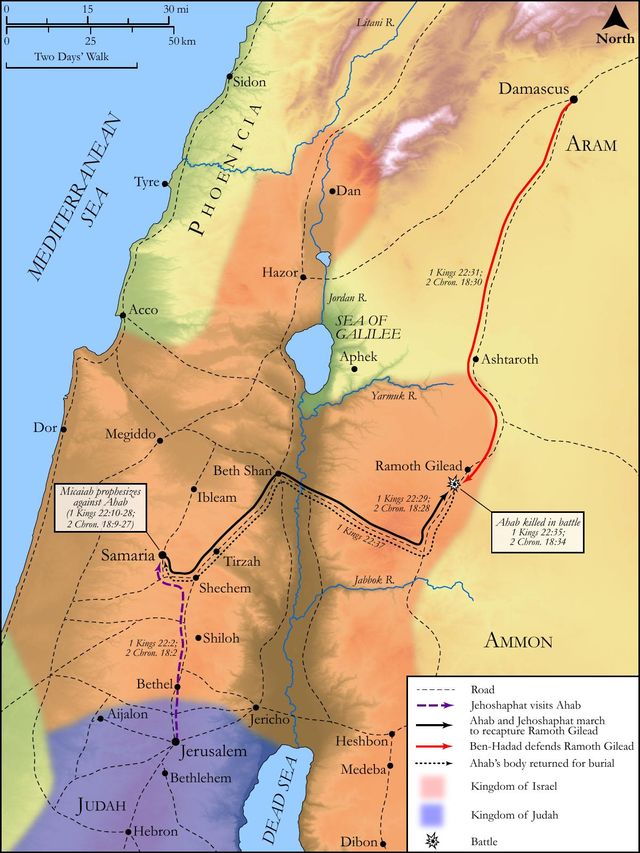
See on the biblical-era map
Study this verse
Public-domain commentary
Matthew Henry
From his Commentary on the Whole Bible. Henry comments on passages, not single verses — this entry covers 2 Chronicles 18:4–27.
This is almost word for word the same with what we had, 1 Kings 22. We will not repeat what was there said, nor have we much to add, but may take occasion to think, 1. Of the great duty of acknowledging God in all our ways and enquiring at his word, whatever we undertake. Jehoshaphat was not willing to proceed till he had done this, Ch2 18:4. By particular believing prayer, by an unbiased consultation of the scripture and our own consciences, and by an observant regard to the hints of providence, we may make such enquiries and very much to our satisfaction. 2. Of the great danger of bad company even to good men. Those that have more wisdom, grace, and resolution, cannot be sure that they can converse familiarly with wicked people and get no hurt by them. Jehoshaphat here, in complaisance to Ahab, sits in his robes, patiently hearing the false prophets speaking lies in the name of the Lord (Ch2 18:9), can scarcely find in his heart to give him a too mild and gentle reproof for hating a prophet of the Lord (Ch2 18:7), and dares not rebuke that false prophet who basely abused the faithful seer nor oppose Ahab who committed him to prison. Those who venture among the seats of the scornful cannot come off without a great deal of the guilt attaching to at least the omission of their duty, unless they have such measures of wisdom and courage as few can pretend to. 3. Of the unhappiness of those who are surrounded with flatterers, especially flattering prophets, who cry peace to them and prophesy nothing but smooth things. Thus was Ahab cheated into his ruin, and justly; for he hearkened to such, and preferred those that humoured him before a good prophet that gave him fair warning of his danger. Those do best for themselves that give their friends leave, and particularly their ministers, to deal plainly and faithfully with them, and take their reproofs not only patiently, but kindly. That counsel is not always best for us that is most pleasing to us. 4. Of the power of Satan, by the divine permission, in the children of disobedience. One lying spirit can make 400 lying prophets and make use of them to deceive Ahab, Ch2 18:21. The devil becomes a murderer by being a liar and destroys men by deceiving them. 5. Of the justice of God in giving those up to strong delusions, to believe a lie, who will not receive the love of the truth, but rebel against it, Ch2 18:21. Let the lying spirit prevail to entice those to their ruin that will not be persuaded to their duty and happiness. 6. Of the hard case of faithful ministers, whose lot it has often been to be hated, and persecuted, and ill-treated, for being true to their God and just and kind to the souls of men. Micaiah, for discharging a good conscience, was buffeted, imprisoned, and condemned to the bread and water of affliction. But he could with assurance appeal to the issue, as all those may do who are persecuted for their faithfulness, Ch2 18:27. The day will declare who is in the right and who in the wrong, when Christ will appear, to the unspeakable consolation of his persecuted people and the everlasting confusion of their persecutors, who will be made to see in that day (Ch2 18:24) what they will not now believe.
Continue studying 2 Chronicles 18:16 across the web’s major study libraries — every link below opens this exact verse, chapter, or book on the destination site.
Read & Compare
 BibleGatewayThis verse in more than 200 translations and 70 languages.
 Bible.comThe YouVersion reader — hundreds of translations, reading plans, and highlights.
 ESV.orgCrossway's official English Standard Version reader.
 NET BibleThe NET translation with 60,000+ translators' notes on every rendering decision.
 STEP BibleTyndale House's free study tool — original text, vocabulary, and scholarly resources.
 BibliaLogos Bible Software's free web reader.
 USCCBThe New American Bible (Revised Edition) with the U.S. bishops' study notes.
Commentaries
 BibleHub CommentariesDozens of classic commentaries on this verse, gathered on one page.
 StudyLightMore than 100 commentary sets — the largest collection on the web.
 BibleRefPlain-English commentary on what this verse means, verse by verse.
 Enduring WordDavid Guzik's free commentary on this chapter, widely used by Bible teachers.
 Bible Study ToolsVerse commentary alongside Greek and Hebrew study aids.
Original Language & Research
- BibleHub InterlinearThe verse word by word — original language, transliteration, and English.
- BibleHub LexiconEvery word's original-language definition and Strong's entry.
 Blue Letter BibleDeep-study tools — Strong's numbers, concordance, and word studies.
 SefariaThe Hebrew text with Rashi and centuries of Jewish commentary.
Sermons, Hymns & Audio


TrulyRandomVerse is not affiliated with these sites and doesn’t control their content. They’re linked because they’re genuinely useful.
Summary
Micaiah's divinely inspired prophecy delivers a stark and unvarnished counter-narrative to the flattering assurances given to King Ahab by his 400 court prophets. This pivotal verse reveals God's true assessment of the impending battle at Ramoth-Gilead, depicting the Israelite forces as a leaderless flock, scattered and vulnerable, thereby foreshadowing Ahab's demise and the subsequent disarray of his army, while also pronouncing a surprising divine permission for the defeated soldiers to return home in peace.
Context
ShowHideLiterary Context
This verse stands as the climactic and revelatory moment within the narrative of Micaiah's confrontation with King Ahab and King Jehoshaphat. The preceding verses establish Ahab's determination to reclaim Ramoth-Gilead from the Syrians, forming an ill-advised alliance with Jehoshaphat, the pious king of Judah, who, despite his spiritual integrity, is dangerously yoked with the wicked Ahab. While Ahab's 400 court prophets uniformly predict a resounding victory, Jehoshaphat's insistence on consulting a genuine prophet of the LORD leads to Micaiah's reluctant summons. Micaiah initially offers a sarcastic affirmation of the false prophets' message, mimicking their empty assurances (as seen in 2 Chronicles 18:15), but when pressed by Ahab, he unveils this devastating vision of Israel's defeat and the king's demise. This prophecy directly contradicts the prevailing narrative, setting the stage for the tragic events detailed later in the chapter, particularly Ahab's ignominious death in battle, as recorded in 2 Chronicles 18:34.
Historical & Cultural Context
The historical backdrop of this passage is the complex political landscape of the divided monarchy, with the northern kingdom of Israel (under Ahab) and the southern kingdom of Judah (under Jehoshaphat) forming a temporary and precarious alliance. Ramoth-Gilead was a strategically vital city on the eastern frontier, frequently contested between Israel and Aram (Syria). In this era, prophets held a crucial, albeit often challenging, role in advising kings. There was a stark distinction between true prophets, who spoke God's unvarnished truth regardless of personal risk, and court prophets, who typically offered flattering, politically expedient messages designed to please the monarch. Micaiah's unwavering willingness to defy the king and the overwhelming majority of his peers underscores the unique and often confrontational role of a genuine prophet of Yahweh, standing as a solitary voice against the prevailing idolatry and political machinations of the time.
Key Themes
ShowHideThe verse powerfully contributes to several overarching themes within 2 Chronicles and the broader biblical narrative. It highlights the nature of true prophecy versus false prophecy, demonstrating that God's word often challenges human desires and offers uncomfortable truths, as seen in Jeremiah's warnings against deceitful prophets in Jeremiah 14:14. The narrative also underscores the consequences of unwise alliances, particularly Jehoshaphat's dangerous partnership with Ahab, which nearly cost him his life, a theme echoed in warnings against being unequally yoked in the New Testament. Furthermore, it reveals divine judgment and sovereignty, as God actively orchestrates events to bring about judgment upon Ahab for his persistent wickedness and idolatry, demonstrating His ultimate control over the fate of nations and individuals. Finally, the vivid imagery of "sheep that have no shepherd" powerfully conveys the theme of leadership and its absence, signifying the disarray and vulnerability of a people or army without proper guidance. This concept is found throughout the Old and New Testaments, such as when Moses prayed for a successor to lead Israel in Numbers 27:17 or when Jesus saw the crowds as "sheep without a shepherd" in Matthew 9:36.
Exposition and Analysis
ShowHideKey Word Analysis
ShowHideThis verb (H6327) signifies being dispersed, spread out, or broken up, often implying disarray, defeat, or judgment. In this context, it vividly portrays the military defeat and the subsequent disorganization of the Israelite army. The imagery is not merely of retreat but of a complete loss of cohesion and direction, a direct consequence of the king's leadership failing.
The root (H7462) from which "shepherd" (specifically, the participle rō'eh) is derived, means "to tend a flock" or "to rule." In biblical literature, the shepherd is a common metaphor for a leader, king, or even God Himself, signifying care, provision, and governance. The absence of a shepherd ("no shepherd") thus denotes a state of vulnerability, helplessness, and lack of guidance, emphasizing the dire consequences of Ahab's impending death for his people and army.
This noun (H113) refers to a sovereign, controller, lord, or owner. In this context, it explicitly refers to King Ahab as the military and national leader. God's declaration that "These have no master" is a divine pronouncement of Ahab's imminent demise and the resulting leaderless state of his forces, underscoring the direct link between the king's fate and the army's disarray.
Verse Breakdown
ShowHide"Then he said, I did see all Israel scattered upon the mountains, as sheep that have no shepherd"
Micaiah begins his true prophecy by recounting a direct vision granted to him by the LORD. The imagery of "all Israel scattered upon the mountains" immediately conveys a scene of utter defeat and disarray for the army, not merely a tactical retreat but a complete breakdown of order and cohesion. The powerful simile "as sheep that have no shepherd" further amplifies this, highlighting their vulnerability, confusion, and desperate lack of direction, directly correlating to the impending death of King Ahab, their earthly leader, who would be struck down in the battle.
"and the LORD said, These have no master;"
This clause provides the divine interpretation and confirmation of Micaiah's vision. The "master" (Hebrew, 'ādôn) here refers specifically to the king (Ahab) as the ultimate ruler and commander. God's declaration that "These have no master" explicitly states the consequence of Ahab's death: his army will be left leaderless and without direction. This is a direct divine pronouncement of judgment and the inevitable outcome of Ahab's defiance and reliance on false prophecies.
"let them return [therefore] every man to his house in peace."
This final, surprising command from the LORD offers a measure of grace amidst the judgment. Despite the impending defeat and the loss of their king, God permits the scattered soldiers to return home "in peace." This implies that the judgment is primarily upon Ahab, the unrighteous king, and not necessarily upon all the individual soldiers. This divine allowance prevents further unnecessary bloodshed or pursuit of the leaderless army, underscoring God's sovereign control over the outcome of the battle, even down to the fate of individual combatants.
Literary Devices
ShowHideThe verse is rich in Simile, most notably "as sheep that have no shepherd," which vividly portrays the army's vulnerability, disorganization, and lack of direction. This simile also carries a strong Metaphorical weight, implicitly casting King Ahab as the failed shepherd whose demise leaves his flock (the army/nation) abandoned and without guidance. The entire verse functions as a Prophetic Vision, a divinely revealed insight into future events that stands in stark contrast to the false prophecies and highlights the true source of authority. There is also a subtle Irony in God's command for the soldiers to return "in peace" after a battle that will result in their king's death and their scattering; this "peace" is not victory but the cessation of hostilities for the leaderless, a stark contrast to the triumphant peace promised by the false prophets.
Theological and Thematic Connections
ShowHide2 Chronicles 18:16 is a profound theological statement on divine sovereignty, the nature of true leadership, and the consequences of disobedience. It reveals God's active involvement in human affairs, orchestrating events to fulfill His purposes and bring judgment upon wickedness. The imagery of "sheep without a shepherd" is a recurring motif throughout Scripture, consistently representing a people in desperate need of guidance, protection, and true leadership. This vision underscores the chaos and vulnerability that result when human leaders fail or are removed, pointing to a deeper spiritual reality where humanity, left to its own devices, is prone to scattering and destruction. The divine permission for the soldiers to return "in peace" also subtly highlights God's mercy, even in judgment, focusing the severity of the consequence primarily on the unrighteous king.
Reflection and Application
ShowHideMicaiah's bold and unpopular prophecy serves as a timeless reminder of the critical importance of discerning and heeding God's truth, even when it is challenging, counter-cultural, or directly contradicts popular opinion. In a world saturated with voices, we are called to cultivate a spiritual sensitivity that prioritizes divine revelation over human flattery or perceived expediency. This verse also compels us to reflect on the nature of leadership, both in our personal lives and in the broader community. The chaos and vulnerability of "sheep without a shepherd" underscore the profound need for godly, wise, and self-sacrificing leaders who genuinely care for those entrusted to their care. Conversely, it warns against aligning ourselves with ungodly purposes or compromising our faith for short-term gain, as Jehoshaphat nearly paid the ultimate price for his alliance with Ahab. Ultimately, the passage calls us to trust in God's sovereign plan, even when it involves difficult truths or unexpected outcomes, knowing that His word, though sometimes painful, always leads to ultimate peace and righteousness.
Questions for Reflection
ShowHideFAQ
ShowHideWhy did Micaiah initially give a sarcastic answer to Ahab?
ShowHideMicaiah's initial sarcastic affirmation ("Go, and prosper: for the LORD shall deliver it into the hand of the king") was a sharp, ironic echo of the false prophets' unanimous message. It was likely a rhetorical device designed to highlight the absurdity and falsehood of their predictions, forcing Ahab to acknowledge that Micaiah was not speaking sincerely and compelling him to demand the "truth in the name of the LORD." This tactic underscored Micaiah's integrity and his unwillingness to compromise God's true message with flattery, setting the stage for his genuine, devastating prophecy that followed, as seen in 2 Chronicles 18:15.
What does the imagery of "sheep that have no shepherd" signify in the Bible?
ShowHideThe imagery of "sheep that have no shepherd" is a powerful and recurring metaphor throughout the Bible, consistently symbolizing a people who are leaderless, vulnerable, disoriented, and prone to scattering. It signifies a state of chaos, lack of protection, and spiritual or physical destitution. This phrase is used in various contexts, from Moses' prayer for a successor to lead Israel (Numbers 27:17) to the Lord's indictment of corrupt leaders in Ezekiel (Ezekiel 34:5-6). Most notably, Jesus Himself used this imagery to describe the crowds He encountered, emphasizing their spiritual and physical need for guidance and compassion (Matthew 9:36).
What was the immediate outcome of the battle at Ramoth-Gilead for Ahab?
ShowHideDespite Micaiah's clear warning, King Ahab proceeded to battle at Ramoth-Gilead. In an attempt to evade the prophecy, he disguised himself, but divine judgment found him nonetheless. A seemingly random arrow struck him between the joints of his armor, mortally wounding him. He died later that day, and his blood was washed from his chariot in Samaria, where dogs licked it up, fulfilling earlier prophecies against him. His death led to the scattering of the Israelite army, just as Micaiah had prophesied, confirming the vision of "sheep that have no shepherd" and the declaration that "These have no master." The full account of his death is found in 2 Chronicles 18:33-34.
Christ-Centered Fulfillment
ShowHideThe imagery of "sheep without a shepherd" in 2 Chronicles 18:16 finds its ultimate and glorious fulfillment in Jesus Christ. While Micaiah's vision depicted the tragic consequences of a failed earthly king and the resulting disarray of his people, the New Testament presents Jesus as the Good Shepherd who perfectly leads, protects, and lays down His life for His flock. Unlike Ahab, who led his people to scattering and death, Jesus gathers His sheep, providing them with eternal life and true peace, declaring, "My sheep hear my voice, and I know them, and they follow me: And I give unto them eternal life; and they shall never perish". He is the Master whom His people will never be without, having conquered death and ascended to reign eternally. In Him, the vulnerability and disarray depicted in Micaiah's prophecy are overcome by divine provision and steadfast leadership. The "peace" offered to the scattered soldiers in 2 Chronicles 18:16 is a shadow of the profound spiritual peace that Christ offers to all who are scattered and lost, bringing them into His fold and granting them reconciliation with God through His atoning sacrifice on the cross, making Him the Prince of Peace. He is the one true King and Shepherd who ensures His flock will never be without a master, leading them to green pastures and still waters, even through the valley of the shadow of death, as promised in Psalm 23.