


2 Chronicles 18:21
Bible text: King James Version (1769 Blayney text) · Public domain
Bible text: King James Version with Strong's numbers · Public domain
Bible text: Berean Standard Bible · Public domain
Bible text: American Standard Version (1901) · Public domain
Bible text: World English Bible, Messianic edition · Public domain
Bible text: Geneva Bible (1599) · Public domain
Bible text: Young's Literal Translation · Public domain
- וַיֹּאמֶרvai·Yo·merand it saidH559Conj-w ¦ V-Qal-ConsecImperf-3msVerb Qal Consecutive Imperfect 3rd Singular Masculineוַandיֹּאמֶרit said
- אֵצֵא'e·Tze'I will go outH3318V-Qal-Imperf-1csVerb Qal Imperfect 1st Singular common gender
- וְהָיִיתִיve·ha·Yi·tiand I will becomeH1961Conj-w ¦ V-Qal-ConsecPerf-1csVerb Qal Consecutive Perfect 1st Singular common genderוְandהָיִיתִיI will become
- לְרוּחַle·Ru·ach<into> a spirit ofH7307Prep-l ¦ N-fscNoun Singular Feminine Constructלְ<into>רוּחַa spirit of
- שֶׁקֶרShe·kerfalsehoodH8267N-msNoun Singular Masculine Absolute
- בְּפִיbe·Fiin [the] mouth ofH6310Prep-b ¦ N-mscNoun Singular Masculine Constructבְּinפִי[the] mouth of
- כָּלkolallH3605N-mscNoun Singular Masculine Construct
- נְבִיאָיוne·vi·'Avhis prophetsH5030N-mpc ¦ 3msNoun Plural Masculine Constructנְבִיאָיprophetsוhis
- וַיֹּאמֶרvai·Yo·merand he saidH559Conj-w ¦ V-Qal-ConsecImperf-3msVerb Qal Consecutive Imperfect 3rd Singular Masculineוַandיֹּאמֶרhe said
- תְּפַתֶּהte·fa·Tehyou will deceiveH6601V-Piel-Imperf-2msVerb Piel Imperfect 2nd Singular Masculine
- וְגַםve·gamand alsoH1571Conj-w ¦ AdvAdverbוְandגַםalso
- תּוּכָלtu·Khalyou will prevailH3201V-Qal-Imperf-2msVerb Qal Imperfect 2nd Singular Masculine
- צֵאtze'go outH3318V-Qal-Imp-2msVerb Qal Imperative 2nd Singular Masculine
- וַעֲשֵׂהva·'a·sehand doH6213Conj-w ¦ V-Qal-Imp-2msVerb Qal Imperative 2nd Singular Masculineוַandעֲשֵׂהdo
- כֵןKhenthusH3651AdvAdverb
English is a literal word-by-word gloss of the Hebrew, not the KJV's wording. Why?
This is the original text the KJV's translators worked from — each Hebrew word with its own literal English meaning in this verse, prepared by scholars at Tyndale House, Cambridge. The KJV translates whole sentences, not word by word, so its wording differs: one Hebrew word can become several English words, and the KJV may choose “the LORD” where the gloss reads “Yahweh”. Both are faithful — they answer different questions. For the KJV's own rendering, switch to the KJV text.
Details
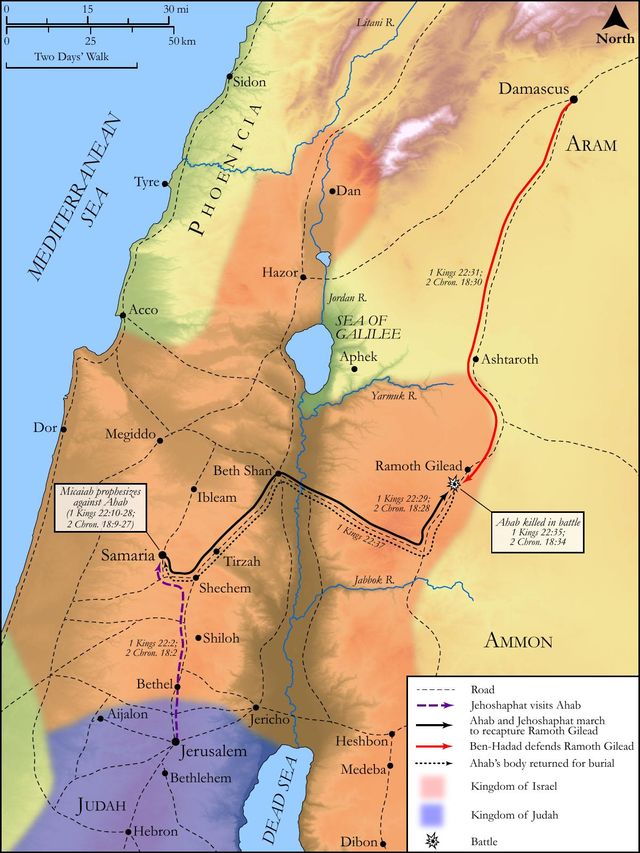
See on the biblical-era map
Study this verse
Public-domain commentary
Matthew Henry
From his Commentary on the Whole Bible. Henry comments on passages, not single verses — this entry covers 2 Chronicles 18:4–27.
This is almost word for word the same with what we had, 1 Kings 22. We will not repeat what was there said, nor have we much to add, but may take occasion to think, 1. Of the great duty of acknowledging God in all our ways and enquiring at his word, whatever we undertake. Jehoshaphat was not willing to proceed till he had done this, Ch2 18:4. By particular believing prayer, by an unbiased consultation of the scripture and our own consciences, and by an observant regard to the hints of providence, we may make such enquiries and very much to our satisfaction. 2. Of the great danger of bad company even to good men. Those that have more wisdom, grace, and resolution, cannot be sure that they can converse familiarly with wicked people and get no hurt by them. Jehoshaphat here, in complaisance to Ahab, sits in his robes, patiently hearing the false prophets speaking lies in the name of the Lord (Ch2 18:9), can scarcely find in his heart to give him a too mild and gentle reproof for hating a prophet of the Lord (Ch2 18:7), and dares not rebuke that false prophet who basely abused the faithful seer nor oppose Ahab who committed him to prison. Those who venture among the seats of the scornful cannot come off without a great deal of the guilt attaching to at least the omission of their duty, unless they have such measures of wisdom and courage as few can pretend to. 3. Of the unhappiness of those who are surrounded with flatterers, especially flattering prophets, who cry peace to them and prophesy nothing but smooth things. Thus was Ahab cheated into his ruin, and justly; for he hearkened to such, and preferred those that humoured him before a good prophet that gave him fair warning of his danger. Those do best for themselves that give their friends leave, and particularly their ministers, to deal plainly and faithfully with them, and take their reproofs not only patiently, but kindly. That counsel is not always best for us that is most pleasing to us. 4. Of the power of Satan, by the divine permission, in the children of disobedience. One lying spirit can make 400 lying prophets and make use of them to deceive Ahab, Ch2 18:21. The devil becomes a murderer by being a liar and destroys men by deceiving them. 5. Of the justice of God in giving those up to strong delusions, to believe a lie, who will not receive the love of the truth, but rebel against it, Ch2 18:21. Let the lying spirit prevail to entice those to their ruin that will not be persuaded to their duty and happiness. 6. Of the hard case of faithful ministers, whose lot it has often been to be hated, and persecuted, and ill-treated, for being true to their God and just and kind to the souls of men. Micaiah, for discharging a good conscience, was buffeted, imprisoned, and condemned to the bread and water of affliction. But he could with assurance appeal to the issue, as all those may do who are persecuted for their faithfulness, Ch2 18:27. The day will declare who is in the right and who in the wrong, when Christ will appear, to the unspeakable consolation of his persecuted people and the everlasting confusion of their persecutors, who will be made to see in that day (Ch2 18:24) what they will not now believe.
Historical interpretation
Historical reception
1 surviving comment on this verse from the historical church.
In the case of Ahab, God said, “Who shall deceive Ahab for me?” In addition, there is also the fact that he always made himself available for comparison with the pagan gods, and all this is below the dignity of God. However, viewed in another way, it becomes worthy of him. I say this for he is so merciful that for the sake of our salvation he foregoes being spoken of in terms befitting his dignity.
Continue studying 2 Chronicles 18:21 across the web’s major study libraries — every link below opens this exact verse, chapter, or book on the destination site.
Read & Compare
 BibleGatewayThis verse in more than 200 translations and 70 languages.
 Bible.comThe YouVersion reader — hundreds of translations, reading plans, and highlights.
 ESV.orgCrossway's official English Standard Version reader.
 NET BibleThe NET translation with 60,000+ translators' notes on every rendering decision.
 STEP BibleTyndale House's free study tool — original text, vocabulary, and scholarly resources.
 BibliaLogos Bible Software's free web reader.
 USCCBThe New American Bible (Revised Edition) with the U.S. bishops' study notes.
Commentaries
 BibleHub CommentariesDozens of classic commentaries on this verse, gathered on one page.
 StudyLightMore than 100 commentary sets — the largest collection on the web.
 BibleRefPlain-English commentary on what this verse means, verse by verse.
 Enduring WordDavid Guzik's free commentary on this chapter, widely used by Bible teachers.
 Bible Study ToolsVerse commentary alongside Greek and Hebrew study aids.
Original Language & Research
- BibleHub InterlinearThe verse word by word — original language, transliteration, and English.
- BibleHub LexiconEvery word's original-language definition and Strong's entry.
 Blue Letter BibleDeep-study tools — Strong's numbers, concordance, and word studies.
 SefariaThe Hebrew text with Rashi and centuries of Jewish commentary.
Sermons, Hymns & Audio


TrulyRandomVerse is not affiliated with these sites and doesn’t control their content. They’re linked because they’re genuinely useful.
Summary
Second Chronicles 18:21 captures a pivotal moment in the heavenly court, where a spirit volunteers to become a deceptive influence within the mouths of King Ahab's numerous prophets. This verse records the LORD's explicit authorization for this spiritual deception, thereby orchestrating events to entice Ahab towards his preordained demise in battle. It powerfully underscores God's absolute sovereignty over all forces, including malevolent ones, in the execution of His righteous judgment against persistent rebellion and profound wickedness.
Context
ShowHideLiterary Context
This verse is intricately woven into the dramatic climax of King Ahab's reign, as narrated in 2 Chronicles 18 and its parallel account in 1 Kings 22. Immediately preceding this verse, the prophet Micaiah has just delivered a startling vision to both King Jehoshaphat of Judah and King Ahab of Israel: a scene within the divine council where the LORD inquires who will entice Ahab to go up and fall at Ramoth-Gilead. A spirit then steps forward, offering to become a "lying spirit" in the mouths of Ahab's 400 court prophets. Verse 21 constitutes the LORD's direct and unequivocal approval of this plan, effectively sealing Ahab's fate. This divine decree stands in stark contrast to the uniformly positive, yet utterly false, prophecies offered by Ahab's own prophets, thereby highlighting the profound distinction between genuine and spurious prophetic messages.
Historical & Cultural Context
The historical backdrop for this narrative is the mid-9th century BCE, a period marked by complex political dynamics between the northern kingdom of Israel (under the notoriously wicked King Ahab) and the southern kingdom of Judah (under the more righteous King Jehoshaphat), as well as their ongoing conflicts with the Arameans (Syrians). Ramoth-Gilead, the strategic city at the heart of the conflict, was a vital frontier stronghold on Israel's eastern border, frequently contested between Israel and Aram. Among the nations round about, it was customary for monarchs to consult prophets, diviners, or omens before embarking on significant undertakings, especially military campaigns, believing they could ascertain the will of their deities. Scripture itself shows the LORD presiding over a heavenly assembly of spiritual beings, as in Micaiah's vision of the host of heaven standing on His right hand and on His left. This passage portrays Yahweh not merely as one deity among many, but as the supreme sovereign, orchestrating events even through the agency of spirits, thus demonstrating His absolute authority over all realms, both human and spiritual, and His ultimate control over the destiny of kings.
Key Themes
ShowHideThe passage powerfully articulates several profound theological themes. Firstly, Divine Sovereignty is paramount; God is not merely reacting to human events but actively orchestrating them, even permitting deception to achieve His righteous purposes. This sovereign decision is presented as a direct consequence of Ahab's persistent and egregious wickedness, as exemplified by descriptions of his unparalleled evil in passages like 1 Kings 21:25. Secondly, the theme of Divine Judgment is strikingly evident, as God's permission for the lying spirit is portrayed as a judicial act, leading Ahab to his deserved end. Thirdly, the nature of False Prophecy is illuminated; it is not merely human error or fabrication but can, in specific circumstances, be divinely permitted or even dispatched for punitive purposes. This stands in stark contrast to the true prophetic word, which, though often unpopular and challenging, always aligns with God's ultimate will and character, as powerfully demonstrated by Micaiah's unwavering message in 2 Chronicles 18:13-17. Finally, the narrative starkly showcases the Consequences of Persistent Disobedience, illustrating how God, in His justice, can harden hearts and allow individuals to be led astray by the very falsehoods they prefer over His truth.
Exposition and Analysis
ShowHideKey Word Analysis
ShowHideThis term (H7307) is highly versatile, referring to wind, breath, or a spiritual entity. In this context, it unequivocally denotes a non-corporeal being, an agent operating within the heavenly realm. The addition of "lying" (Hebrew, sheqer) specifies its inherent nature as one inclined to falsehood and deceit. This does not imply that God creates evil, but rather that He utilizes an existing malevolent inclination for His sovereign purposes, thereby highlighting His absolute authority over all spiritual forces, even those inherently deceptive.
This word (H8267) denotes an untruth, falsehood, or sham. When combined with "spirit," it precisely characterizes the nature of the entity volunteering for the task. It emphasizes that the spirit's intention and method are rooted in deception, designed to mislead and misrepresent the truth. This is crucial for understanding the ethical dimensions of the passage, as it clarifies that God is permitting an already deceptive entity to act in accordance with its nature, rather than commanding it to become evil.
This verb (H6601) means to open, persuade, deceive, or allure. In this context, it describes the precise method by which the lying spirit will influence Ahab's prophets and, consequently, Ahab himself. It suggests a subtle, persuasive deception that plays into Ahab's pre-existing desires for a favorable outcome, rather than an overt, coercive act. The spirit will offer a message that aligns with Ahab's preferences, leading him willingly into the trap of his own making.
Verse Breakdown
ShowHide"And he said, I will go out, and be a lying spirit in the mouth of all his prophets."
This clause presents the audacious and self-volunteering proposal of a specific spirit within the divine council. The spirit offers to be the direct agent of deception, operating through the very channels King Ahab trusts—his 400 court prophets. The phrase "in the mouth of all his prophets" indicates a pervasive, unanimous deception, ensuring that Ahab receives no dissenting voice from his preferred, human sources of counsel, thus confirming his chosen path.
"And [the LORD] said, Thou shalt entice [him], and thou shalt also prevail:"
This is the divine authorization and pronouncement of guaranteed success. The LORD directly addresses the spirit, confirming its proposed method ("entice") and unequivocally guaranteeing its success ("thou shalt also prevail"). This is a judicial pronouncement, not a moral endorsement of lying, but a sovereign permission for a pre-existing deceptive entity to execute a specific, preordained judgment. It powerfully underscores God's absolute control over the spiritual realm and His ability to use even evil for His righteous, punitive ends.
"go out, and do [even] so."
This is the final, unequivocal command from the LORD, commissioning the spirit to immediately execute its plan. It signifies the certain and imminent implementation of the divine decree. This short, decisive command highlights the finality of God's judgment upon Ahab, leaving no room for doubt about the inevitable and tragic outcome of his persistent rebellion.
Literary Devices
ShowHideThe passage employs several potent literary devices to convey its profound theological message. Dramatic Irony is central, as the audience is privy to the heavenly council's decision and the true nature of the prophets' words, while King Ahab remains tragically oblivious to the deception that will lead to his demise. The scene itself shows God presiding over a celestial assembly, as on the day in Job when "the sons of God came to present themselves before the LORD," making decisions and issuing decrees that impact earthly affairs. The portrayal of God directly commissioning a spirit, even a "lying spirit," is a form of Anthropomorphism, attributing human-like interaction (speaking, commanding) to God to convey His active and direct involvement in human history and judgment. Furthermore, the entire episode functions as Foreshadowing, clearly signaling Ahab's impending death and the futility of his military campaign, despite the positive reassurances from his false prophets, creating a sense of inescapable doom for the wicked king.
Theological and Thematic Connections
ShowHideThis passage profoundly illustrates God's absolute sovereignty, extending even over the forces of evil and deception. It does not imply that God creates evil or directly causes a spirit to lie; rather, in His righteous judgment, He can permit or even dispatch a spirit already inclined to deception to fulfill His purposes. This is a form of judicial hardening, where individuals who persistently reject God's truth are eventually given over to their own delusions. Ahab's long history of rebellion, exemplified by his promotion of Baal worship and persecution of true prophets, led to a point where God allowed him to be deceived by the very voices he chose to trust over the true prophets. This demonstrates that God's justice is not merely punitive but can also involve a withdrawal of grace, allowing individuals to reap the inevitable consequences of their chosen path of defiance.
Reflection and Application
ShowHideThe account of the lying spirit in 2 Chronicles 18:21 serves as a stark and sobering reminder of the critical importance of spiritual discernment in a world saturated with competing voices and deceptive messages. It challenges believers to not merely seek affirmation for their desires or preferences but to rigorously test all teachings, prophecies, and counsel against the unchanging, authoritative truth of God's Word. Ahab's tragic end underscores the perilous consequences of consistently rejecting divine truth and preferring flattering falsehoods that cater to one's own agenda. When we harden our hearts against God's warnings, whether spoken through Scripture, faithful preachers, or the quiet conviction of the Holy Spirit, we risk being given over to a spiritual blindness that can lead to our own undoing and separation from God's good purposes. This passage urgently calls us to cultivate a deep love for truth, to remain humble and teachable, and to constantly seek wisdom from God, recognizing that His ways, though sometimes mysterious and challenging to our human understanding, are always just, righteous, and ultimately for our eternal good.
Questions for Reflection
ShowHideFAQ
ShowHideDoes this passage imply that God directly causes evil or encourages lying?
ShowHideNo, the passage does not imply that God directly causes evil or encourages lying in a moral sense. Instead, it profoundly demonstrates God's absolute sovereignty over all creation, including spiritual forces, both good and evil. The "lying spirit" is presented as an entity already inclined to deception, and God, in His judicial capacity, permits or dispatches it to fulfill a specific, righteous purpose: to bring judgment upon King Ahab, who had persistently rebelled against Him and rejected His truth. This is a case of God using existing evil for His righteous ends, a theme seen elsewhere in Scripture where God "hardens" hearts (e.g., Pharaoh in Exodus 4:21), allowing individuals to be given over to the consequences of their own choices and desires. God remains holy, truthful, and just, but He orchestrates circumstances, even through the agency of wicked entities, to accomplish His divine will and execute His perfect justice.
Christ-Centered Fulfillment
ShowHideThe unsettling narrative of the lying spirit in 2 Chronicles 18:21, while revealing the severity of divine judgment against persistent rebellion, ultimately points to the supreme truth and salvation revealed in Jesus Christ. Ahab's fatal reliance on false prophets and his embrace of deception led directly to his demise, powerfully foreshadowing the ultimate consequence of sin and the rejection of divine truth for all humanity. In stark contrast, Jesus Christ is the very embodiment of truth, proclaiming Himself as "the way, the truth, and the life" (John 14:6). He is the true Prophet, who perfectly reveals the will and character of God, utterly unlike the deceptive spirits and false prophets who mislead humanity. His advent into the world exposed the "father of lies" (John 8:44) and broke the dominion of deception over those who believe. The righteous judgment visited upon Ahab for his persistent wickedness finds its ultimate and redemptive resolution in Christ, who bore the full weight of God's righteous judgment against sin on the cross, becoming sin for us so that we might become the righteousness of God in Him (2 Corinthians 5:21). Through His atoning sacrifice, believers are freed from the power of deception and are empowered by the Holy Spirit, the very Spirit of Truth, to discern God's will, understand His Word, and walk in righteousness (John 16:13). Thus, while 2 Chronicles 18:21 reveals God's sovereign judgment against those who reject Him, it also implicitly magnifies the saving work of Christ, who delivers us from the domain of darkness and ushers us into His marvelous light, where truth reigns supreme and eternal life is found.