


2 Chronicles 18:20
- וַיֵּצֵאvai·ye·Tze'and it came forthH3318Conj-w ¦ V-Qal-ConsecImperf-3msVerb Qal Consecutive Imperfect 3rd Singular Masculineוַandיֵּצֵאit came forth
- הָרוּחַha·Ru·achthe spiritH7307Art ¦ N-fsNoun Singular Feminine Absoluteהָtheרוּחַspirit
- וַיַּעֲמֹדvai·ya·'a·Modand it stoodH5975Conj-w ¦ V-Qal-ConsecImperf-3msVerb Qal Consecutive Imperfect 3rd Singular Masculineוַandיַּעֲמֹדit stood
- לִפְנֵיlif·Nei<to> beforeH6440Prep-l ¦ N-mpcNoun Plural Masculine Constructלִ<to>פְנֵיbefore
- יְהוָהYah·wehYahwehH3068N-properNoun Proper Title
- וַיֹּאמֶרvai·Yo·merand it saidH559Conj-w ¦ V-Qal-ConsecImperf-3msVerb Qal Consecutive Imperfect 3rd Singular Masculineוַandיֹּאמֶרit said
- אֲנִי'a·NiIH589Pro-1csPronoun Personal 1st Singular common gender
- אֲפַתֶּנּוּ'a·fat·Te·nuI will deceive himH6601V-Piel-Imperf-1cs ¦ 3msVerb Piel Imperfect 1st Singular common genderאֲפַתֶּI will deceiveנּוּhim
- וַיֹּאמֶרvai·Yo·merand he saidH559Conj-w ¦ V-Qal-ConsecImperf-3msVerb Qal Consecutive Imperfect 3rd Singular Masculineוַandיֹּאמֶרhe said
- יְהוָהYah·wehYahwehH3068N-properNoun Proper Title
- אֵלָיו'e·Lavto itH413Prep ¦ 3msPrepositionאֵלָיtoוit
- בַּמָּהba·Mah<in> how?H4100Prep-b ¦ InterrogPronoun Interrogativeבַּ<in>מָּהhow?
English is a literal word-by-word gloss of the Hebrew, not the KJV's wording. Why?
This is the original text the KJV's translators worked from — each Hebrew word with its own literal English meaning in this verse, prepared by scholars at Tyndale House, Cambridge. The KJV translates whole sentences, not word by word, so its wording differs: one Hebrew word can become several English words, and the KJV may choose “the LORD” where the gloss reads “Yahweh”. Both are faithful — they answer different questions. For the KJV's own rendering, switch to the KJV text.
Details
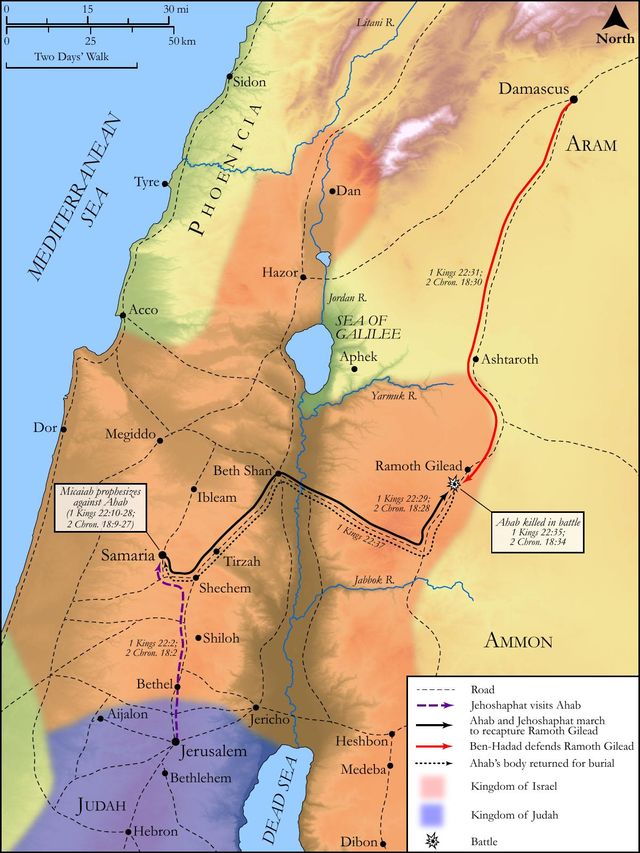
See on the biblical-era map
Study this verse
Public-domain commentary
Matthew Henry
From his Commentary on the Whole Bible. Henry comments on passages, not single verses — this entry covers 2 Chronicles 18:4–27.
This is almost word for word the same with what we had, 1 Kings 22. We will not repeat what was there said, nor have we much to add, but may take occasion to think, 1. Of the great duty of acknowledging God in all our ways and enquiring at his word, whatever we undertake. Jehoshaphat was not willing to proceed till he had done this, Ch2 18:4. By particular believing prayer, by an unbiased consultation of the scripture and our own consciences, and by an observant regard to the hints of providence, we may make such enquiries and very much to our satisfaction. 2. Of the great danger of bad company even to good men. Those that have more wisdom, grace, and resolution, cannot be sure that they can converse familiarly with wicked people and get no hurt by them. Jehoshaphat here, in complaisance to Ahab, sits in his robes, patiently hearing the false prophets speaking lies in the name of the Lord (Ch2 18:9), can scarcely find in his heart to give him a too mild and gentle reproof for hating a prophet of the Lord (Ch2 18:7), and dares not rebuke that false prophet who basely abused the faithful seer nor oppose Ahab who committed him to prison. Those who venture among the seats of the scornful cannot come off without a great deal of the guilt attaching to at least the omission of their duty, unless they have such measures of wisdom and courage as few can pretend to. 3. Of the unhappiness of those who are surrounded with flatterers, especially flattering prophets, who cry peace to them and prophesy nothing but smooth things. Thus was Ahab cheated into his ruin, and justly; for he hearkened to such, and preferred those that humoured him before a good prophet that gave him fair warning of his danger. Those do best for themselves that give their friends leave, and particularly their ministers, to deal plainly and faithfully with them, and take their reproofs not only patiently, but kindly. That counsel is not always best for us that is most pleasing to us. 4. Of the power of Satan, by the divine permission, in the children of disobedience. One lying spirit can make 400 lying prophets and make use of them to deceive Ahab, Ch2 18:21. The devil becomes a murderer by being a liar and destroys men by deceiving them. 5. Of the justice of God in giving those up to strong delusions, to believe a lie, who will not receive the love of the truth, but rebel against it, Ch2 18:21. Let the lying spirit prevail to entice those to their ruin that will not be persuaded to their duty and happiness. 6. Of the hard case of faithful ministers, whose lot it has often been to be hated, and persecuted, and ill-treated, for being true to their God and just and kind to the souls of men. Micaiah, for discharging a good conscience, was buffeted, imprisoned, and condemned to the bread and water of affliction. But he could with assurance appeal to the issue, as all those may do who are persecuted for their faithfulness, Ch2 18:27. The day will declare who is in the right and who in the wrong, when Christ will appear, to the unspeakable consolation of his persecuted people and the everlasting confusion of their persecutors, who will be made to see in that day (Ch2 18:24) what they will not now believe.
Historical interpretation
Historical reception
1 surviving comment on this verse from the historical church.
In the case of Ahab, God said, “Who shall deceive Ahab for me?” In addition, there is also the fact that he always made himself available for comparison with the pagan gods, and all this is below the dignity of God. However, viewed in another way, it becomes worthy of him. I say this for he is so merciful that for the sake of our salvation he foregoes being spoken of in terms befitting his dignity.
Continue studying 2 Chronicles 18:20 across the web’s major study libraries — every link below opens this exact verse, chapter, or book on the destination site.
Read & Compare
 BibleGatewayThis verse in more than 200 translations and 70 languages.
 Bible.comThe YouVersion reader — hundreds of translations, reading plans, and highlights.
 ESV.orgCrossway's official English Standard Version reader.
 NET BibleThe NET translation with 60,000+ translators' notes on every rendering decision.
 STEP BibleTyndale House's free study tool — original text, vocabulary, and scholarly resources.
 BibliaLogos Bible Software's free web reader.
 USCCBThe New American Bible (Revised Edition) with the U.S. bishops' study notes.
Commentaries
 BibleHub CommentariesDozens of classic commentaries on this verse, gathered on one page.
 StudyLightMore than 100 commentary sets — the largest collection on the web.
 BibleRefPlain-English commentary on what this verse means, verse by verse.
 Enduring WordDavid Guzik's free commentary on this chapter, widely used by Bible teachers.
 Bible Study ToolsVerse commentary alongside Greek and Hebrew study aids.
Original Language & Research
- BibleHub InterlinearThe verse word by word — original language, transliteration, and English.
- BibleHub LexiconEvery word's original-language definition and Strong's entry.
 Blue Letter BibleDeep-study tools — Strong's numbers, concordance, and word studies.
 SefariaThe Hebrew text with Rashi and centuries of Jewish commentary.
Sermons, Hymns & Audio


TrulyRandomVerse is not affiliated with these sites and doesn’t control their content. They’re linked because they’re genuinely useful.
Summary
This verse captures a dramatic moment in Micaiah's prophetic vision, revealing a heavenly court scene where a spirit volunteers to deceive King Ahab's 400 false prophets, thereby leading Ahab to his prophesied death at Ramoth-Gilead. The Lord's direct inquiry, "Wherewith?", underscores His absolute sovereignty and active permission, not mere passive allowance, in orchestrating events—even those involving deception—to bring about His righteous judgment against a rebellious king.
Context
ShowHideLiterary Context
2 Chronicles 18:20 is deeply embedded within the narrative of King Ahab's fatal campaign to reclaim Ramoth-Gilead. The preceding verses (2 Chronicles 18:1-19) establish the alliance between the wicked King Ahab of Israel and the righteous King Jehoshaphat of Judah. Ahab, seeking assurance for his military venture, consults his 400 court prophets, who, in unison, deliver a favorable prophecy of victory. However, Jehoshaphat, discerning the lack of true divine authority in their words, insists on consulting a genuine prophet of the Lord, leading to the reluctant summoning of Micaiah. Micaiah initially offers a sarcastic affirmation of the false prophecy before delivering the true, grim word from God, which begins with his vision of the heavenly court in 2 Chronicles 18:18. Our verse, 2 Chronicles 18:20, precisely details the mechanism of deception permitted by God, which directly precipitates Ahab's downfall as Micaiah further clarifies in 2 Chronicles 18:22. This entire episode powerfully demonstrates God's sovereign control over human affairs and starkly contrasts true prophecy with its false counterpart.
Historical & Cultural Context
The historical setting is the mid-9th century BCE, a period marked by shifting alliances and conflicts between the northern kingdom of Israel (under Ahab) and the southern kingdom of Judah (under Jehoshaphat). Ramoth-Gilead, a strategically vital city on Israel's eastern frontier, was a frequent flashpoint between Israel and Aram (Syria). Culturally, the concept of a "divine council" or heavenly court, where God presides over a host of spiritual beings, was a familiar motif in the ancient Near East. However, Israelite theology uniquely presented Yahweh as the sole, supreme sovereign within this council. Ahab's reliance on 400 court prophets reflects the common practice of kings maintaining official seers, yet in Israel, this often devolved into syncretism, blending Yahwism with Baal worship. Such prophets typically spoke what was politically expedient or what the king desired to hear, rather than God's unvarnished truth. This context vividly illustrates the spiritual apostasy prevalent in Ahab's Israel and the perilous consequences of seeking counsel that merely confirms one's own desires instead of divine revelation.
Key Themes
ShowHideThis verse profoundly contributes to several overarching themes within 2 Chronicles and the broader biblical narrative. Firstly, it powerfully underscores Divine Sovereignty and Control, demonstrating that even malevolent spiritual forces operate strictly under God's ultimate authority and permission. God is neither surprised nor thwarted by evil; rather, He can orchestrate events, including acts of deception, to fulfill His righteous purposes, often as a form of judgment upon those who persistently reject His truth, as echoed in Isaiah 46:10. Secondly, the passage vividly portrays the tangible reality of Spiritual Warfare and Deception. It depicts unseen spiritual entities actively influencing human affairs and delivering false messages, though always within the precise bounds of divine oversight. This highlights the critical need for spiritual discernment among God's people, urging them to "test the spirits" as exhorted in 1 John 4:1. Finally, the entire episode, culminating in this verse, starkly contrasts True vs. False Prophecy. Micaiah's unpopular, yet divinely accurate, prophecy stands in direct opposition to the unanimous, yet deceptive, predictions of Ahab's 400 prophets. This serves as a potent cautionary tale against seeking counsel that merely confirms one's own desires, rather than submitting to the often challenging truth of God's Word, a theme powerfully reiterated in Jeremiah 14:14.
Exposition and Analysis
ShowHideKey Word Analysis
ShowHideThe Hebrew word רוּחַ (rûwach) is polysemous, encompassing "wind," "breath," and "spirit." In this specific context, it unequivocally refers to an intelligent, active, non-corporeal entity. While it can denote God's Spirit or the human spirit, here it signifies a distinct spiritual being, often understood as a malevolent spirit or an agent dispatched for divine judgment, operating within the framework of the heavenly court. Its emergence "before the LORD" signifies its accountability and subservience to God's ultimate authority, even in its deceptive intent.
The verb פָּתָה (pâthâh) means "to open," "to persuade," "to deceive," or "to allure." It carries the critical nuance of subtle, alluring persuasion rather than overt force or coercion. The spirit's proposed plan is not to compel Ahab directly but to influence his prophets to speak lies that Ahab, due to his hardened heart and existing desires, will readily believe. This illuminates the insidious nature of deception, which often preys on pre-existing inclinations and biases.
The Hebrew word יְהֹוָה (Yᵉhôvâh), derived from a root meaning "to be," denotes "the self-Existent or Eternal One." It is the sacred, covenantal name of God, often translated as "Jehovah" or "the Lord." In this verse, the presence of Yᵉhôvâh emphasizes that the entire interaction in the heavenly court, including the spirit's proposal and its subsequent action, occurs under the direct oversight and ultimate authority of the sovereign God of Israel. His question, "Wherewith?", is a demonstration of His active control, not a sign of ignorance, affirming His supreme dominion over all spiritual forces and their activities.
Verse Breakdown
ShowHide"Then there came out a spirit, and stood before the LORD,"
This clause immediately follows Micaiah's vision of the Lord seated on His throne amidst the heavenly host. The "spirit" emerges from this divine assembly, signifying its place within the spiritual hierarchy and its direct access to God's presence. Its act of "standing before the LORD" implies a posture of readiness to serve or to present a proposal, highlighting the structured and ordered nature of the divine court. This is not an independent, rogue spiritual entity but one operating strictly within the parameters of divine permission and oversight.
"and said, I will entice him."
The spirit's declaration is a clear and direct statement of its malicious intent: to deceive King Ahab. The use of "entice" (pâthâh) suggests a subtle, persuasive form of deception, which, as the subsequent verses reveal, would be carried out through the false prophets. This reveals the spirit's malevolent nature and its willingness to participate in a scheme that will lead to Ahab's destruction, aligning with God's impending judgment upon the king for his persistent wickedness and idolatry.
"And the LORD said unto him, Wherewith?"
This is the pivotal and most profound part of the verse. God's direct question, "Wherewith?" (meaning "By what means?" or "How will you do it?"), is not a query born of ignorance or surprise but an active engagement with the spirit's proposal. It signifies divine permission and a controlled delegation of authority. God is not being manipulated or caught off guard; rather, He is orchestrating the events, allowing the spirit to act as an instrument of His righteous judgment. This demonstrates God's absolute and meticulous sovereignty, even over the actions of deceptive spiritual entities, ensuring they serve His ultimate, often judicial, purposes.
Literary Devices
ShowHideThe passage in 2 Chronicles 18 and specifically 2 Chronicles 18:20 employs several powerful literary devices that enhance its theological impact. Anthropomorphism is evident in the depiction of God "sitting on his throne" and engaging in a dialogue with a spirit, presenting divine activity in human-like terms to make the profound spiritual reality comprehensible to human understanding. The entire scene of the "heavenly court" serves as potent Symbolism, representing the ultimate divine authority and the unseen spiritual realm, emphasizing that all earthly events are ultimately subject to God's sovereign decree. The "spirit" itself functions as a Personification of a deceptive force, endowed with agency and speech, illustrating the active nature of spiritual evil. There is profound Dramatic Irony woven throughout the narrative: Ahab and his 400 false prophets are supremely confident in their impending victory, completely unaware that their very counsel is orchestrated by a deceptive spirit operating under divine permission, leading them directly to their doom. This irony heightens the sense of divine judgment and human folly. Furthermore, the spirit's proposal and God's subsequent question serve as clear Foreshadowing, unequivocally indicating Ahab's impending defeat and death, contrasting sharply with the false prophecies of success.
Theological and Thematic Connections
ShowHideThis verse offers a profound theological insight into the nature of divine sovereignty, the tangible reality of spiritual forces, and the intricate mechanisms of divine judgment. It challenges any simplistic view of good and evil, demonstrating unequivocally that even malevolent spirits operate strictly within the framework of God's ultimate control. God is not merely reacting to evil; He actively permits and directs it to achieve His righteous purposes, particularly in judging those who have persistently hardened their hearts against Him. This does not imply that God is the author of evil, but rather that He is utterly sovereign over it, able to use even the schemes of the wicked and the deceptive actions of spirits to bring about His perfect will. The passage underscores the immutable biblical truth that all spiritual powers, whether benevolent or malevolent, are subordinate to the Lord of Hosts. It also highlights the dangerous and ultimately destructive consequences of rejecting divine truth and embracing self-deception, as Ahab tragically did by preferring the comforting lies of his prophets over Micaiah's clear, albeit unwelcome, warning.
Reflection and Application
ShowHideThe dramatic scene in 2 Chronicles 18:20 serves as a sobering and enduring reminder that not all voices claiming divine authority are truthful, and even seemingly spiritual experiences can be profoundly deceptive. For believers today, this passage calls for profound and ongoing spiritual discernment, urging us to constantly evaluate messages, teachings, and even our own internal desires against the clear, unchanging, and authoritative truth of God's inspired Word. It delivers a potent warning against the insidious danger of seeking counsel that merely affirms our pre-existing biases or comforts our fleshly inclinations, rather than challenging us to align with God's righteous will, however uncomfortable or unpopular it may be. While we are assured of God's ultimate sovereignty and His eventual triumph over all evil, we are also called to be vigilant, recognizing that spiritual deception is a real and ever-present danger in our world. Our ultimate comfort lies not in the absence of spiritual warfare, but in the unwavering knowledge that God is ultimately in control, using even the schemes of darkness to fulfill His perfect purposes and to expose those who persistently reject His truth.
Questions for Reflection
ShowHideFAQ
ShowHideDoes God send evil spirits to deceive people?
ShowHideThis passage, along with others like 1 Samuel 16:14, indicates that God can indeed permit or even dispatch spirits to fulfill His sovereign purposes, often as a form of righteous judgment upon those who have persistently rejected His truth or rebelled against Him. It is crucial to understand that this does not make God the author of evil, nor does it imply that He delights in deception. Rather, it powerfully demonstrates His absolute authority and supreme control over all spiritual beings, including malevolent ones. He uses them as instruments to bring about His righteous will, particularly when individuals or nations have hardened their hearts and are ripe for divine judgment. In 2 Chronicles 18:20, the spirit volunteered, and God merely allowed and directed its method, fitting it precisely into His overarching plan for Ahab's just judgment.
What is the "heavenly court" or "divine council" depicted here?
ShowHideThe "heavenly court" or "divine council" is a recurring biblical motif (also seen in Job 1:6 and Psalm 82:1) that portrays God as a supreme King or Judge presiding over a council of heavenly beings (such as angels, spirits, or "sons of God"). This imagery serves to emphasize God's ultimate authority and absolute sovereignty over all creation, both visible and invisible. It is a profound way of depicting the spiritual realm where divine decisions are made and subsequently implemented through various agents. In this specific context, it vividly illustrates that even the actions of a deceptive spirit are not random or independent but are part of a divinely orchestrated plan, wholly subject to God's ultimate decree and purpose.
Christ-Centered Fulfillment
ShowHideThe narrative of the lying spirit in 2 Chronicles 18:20, while revealing God's profound sovereignty over evil and deception, finds its ultimate fulfillment and redemptive resolution in the person and work of Jesus Christ. Where a spirit was permitted to deceive King Ahab unto judgment, Jesus Christ is the very embodiment of divine truth, the Word made flesh, who came precisely to expose all deception and falsehood (John 1:14). He is the true and faithful Prophet, whose words are never deceptive but are always life-giving, eternally true, and lead to salvation (John 14:6). Christ's perfect life, atoning death, and glorious resurrection represent the definitive and ultimate triumph over all spiritual powers of darkness, including those that deceive humanity. He disarmed principalities and powers, triumphing over them decisively by the cross (Colossians 2:15). The spirit in Micaiah's vision operated under God's permission to bring judgment; Christ, however, came not to condemn the world but to save it through Himself (John 3:17). He grants His followers the spiritual authority and power to discern and overcome the schemes of the devil (Ephesians 6:11) and promises that the very gates of hell will not prevail against His Church (Matthew 16:18). Ultimately, the scene of the divine council in 2 Chronicles 18:20 foreshadows Christ's ultimate role as the King of kings and Lord of lords, who will return in glory to judge the living and the dead, bringing all hidden things into the light and definitively casting out all deception, evil, and spiritual darkness forever (Revelation 19:11-16).