


2 Chronicles 18:18
- וַיֹּאמֶרvai·Yo·merand he saidH559Conj-w ¦ V-Qal-ConsecImperf-3msVerb Qal Consecutive Imperfect 3rd Singular Masculineוַandיֹּאמֶרhe said
- לָכֵןla·Khen<to> thereforeH3651Prep-l ¦ AdvAdverbלָ<to>כֵןtherefore
- שִׁמְעוּshim·'UhearH8085V-Qal-Imp-2mpVerb Qal Imperative 2nd Plural Masculine
- דְבַרde·var[the] word ofH1697N-mscNoun Singular Masculine Construct
- יְהוָהYah·wehYahwehH3068N-properNoun Proper Title
- רָאִיתִיra·'I·tiI sawH7200V-Qal-Perf-1csVerb Qal Perfect 1st Singular common gender
- אֶת'et<obj.>H853DirObjMParticle Object Indicator
- יְהוָהYah·wehYahwehH3068N-properNoun Proper Title
- יוֹשֵׁבyo·ShevsittingH3427V-Qal-Prtcpl-msVerb Qal Participle Singular Masculine Absolute
- עַל'alonH5921PrepPreposition
- כִּסְאוֹkis·'Ohis throneH3678N-msc ¦ 3msNoun Singular Masculine Constructכִּסְאthroneוֹhis
- וְכָלve·kholand allH3605Conj-w ¦ N-mscNoun Singular Masculine Constructוְandכָלall
- צְבָאtze·Va'[the] host ofH6635N-mscNoun Singular Masculine Construct
- הַשָּׁמַיִםha·sha·Ma·yimthe heavensH8064Art ¦ N-mpNoun Plural Masculine Absoluteהַtheשָּׁמַיִםheavens
- עֹמְדִים'o·me·Dim[were] standingH5975V-Qal-Prtcpl-mpVerb Qal Participle Plural Masculine Absolute
- עַל'alonH5921PrepPreposition
- יְמִינוֹye·mi·Nohis right [hand]H3225N-fsc ¦ 3msNoun Singular Feminine Constructיְמִינright [hand]וֹhis
- וּשְׂמֹאלוֹu·se·mo·Loand his left [hand]H8040Conj-w ¦ N-msc ¦ 3msNoun Singular Masculine Constructוּandשְׂמֹאלleft [hand]וֹhis
English is a literal word-by-word gloss of the Hebrew, not the KJV's wording. Why?
This is the original text the KJV's translators worked from — each Hebrew word with its own literal English meaning in this verse, prepared by scholars at Tyndale House, Cambridge. The KJV translates whole sentences, not word by word, so its wording differs: one Hebrew word can become several English words, and the KJV may choose “the LORD” where the gloss reads “Yahweh”. Both are faithful — they answer different questions. For the KJV's own rendering, switch to the KJV text.
Details
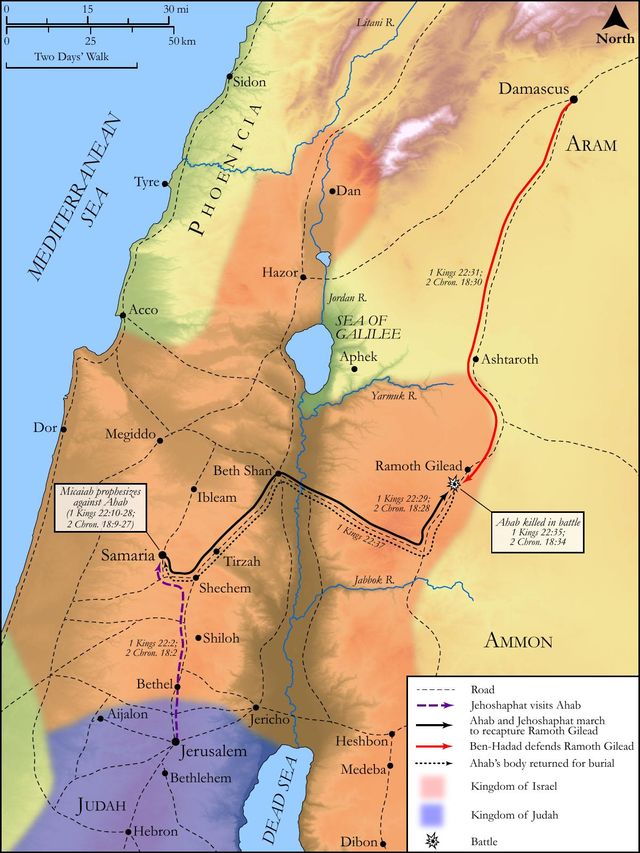
See on the biblical-era map
Study this verse
Public-domain commentary
Matthew Henry
From his Commentary on the Whole Bible. Henry comments on passages, not single verses — this entry covers 2 Chronicles 18:4–27.
This is almost word for word the same with what we had, 1 Kings 22. We will not repeat what was there said, nor have we much to add, but may take occasion to think, 1. Of the great duty of acknowledging God in all our ways and enquiring at his word, whatever we undertake. Jehoshaphat was not willing to proceed till he had done this, Ch2 18:4. By particular believing prayer, by an unbiased consultation of the scripture and our own consciences, and by an observant regard to the hints of providence, we may make such enquiries and very much to our satisfaction. 2. Of the great danger of bad company even to good men. Those that have more wisdom, grace, and resolution, cannot be sure that they can converse familiarly with wicked people and get no hurt by them. Jehoshaphat here, in complaisance to Ahab, sits in his robes, patiently hearing the false prophets speaking lies in the name of the Lord (Ch2 18:9), can scarcely find in his heart to give him a too mild and gentle reproof for hating a prophet of the Lord (Ch2 18:7), and dares not rebuke that false prophet who basely abused the faithful seer nor oppose Ahab who committed him to prison. Those who venture among the seats of the scornful cannot come off without a great deal of the guilt attaching to at least the omission of their duty, unless they have such measures of wisdom and courage as few can pretend to. 3. Of the unhappiness of those who are surrounded with flatterers, especially flattering prophets, who cry peace to them and prophesy nothing but smooth things. Thus was Ahab cheated into his ruin, and justly; for he hearkened to such, and preferred those that humoured him before a good prophet that gave him fair warning of his danger. Those do best for themselves that give their friends leave, and particularly their ministers, to deal plainly and faithfully with them, and take their reproofs not only patiently, but kindly. That counsel is not always best for us that is most pleasing to us. 4. Of the power of Satan, by the divine permission, in the children of disobedience. One lying spirit can make 400 lying prophets and make use of them to deceive Ahab, Ch2 18:21. The devil becomes a murderer by being a liar and destroys men by deceiving them. 5. Of the justice of God in giving those up to strong delusions, to believe a lie, who will not receive the love of the truth, but rebel against it, Ch2 18:21. Let the lying spirit prevail to entice those to their ruin that will not be persuaded to their duty and happiness. 6. Of the hard case of faithful ministers, whose lot it has often been to be hated, and persecuted, and ill-treated, for being true to their God and just and kind to the souls of men. Micaiah, for discharging a good conscience, was buffeted, imprisoned, and condemned to the bread and water of affliction. But he could with assurance appeal to the issue, as all those may do who are persecuted for their faithfulness, Ch2 18:27. The day will declare who is in the right and who in the wrong, when Christ will appear, to the unspeakable consolation of his persecuted people and the everlasting confusion of their persecutors, who will be made to see in that day (Ch2 18:24) what they will not now believe.
Historical interpretation
Historical reception
1 surviving comment on this verse from the historical church.
In the case of Ahab, God said, “Who shall deceive Ahab for me?” In addition, there is also the fact that he always made himself available for comparison with the pagan gods, and all this is below the dignity of God. However, viewed in another way, it becomes worthy of him. I say this for he is so merciful that for the sake of our salvation he foregoes being spoken of in terms befitting his dignity.
Continue studying 2 Chronicles 18:18 across the web’s major study libraries — every link below opens this exact verse, chapter, or book on the destination site.
Read & Compare
 BibleGatewayThis verse in more than 200 translations and 70 languages.
 Bible.comThe YouVersion reader — hundreds of translations, reading plans, and highlights.
 ESV.orgCrossway's official English Standard Version reader.
 NET BibleThe NET translation with 60,000+ translators' notes on every rendering decision.
 STEP BibleTyndale House's free study tool — original text, vocabulary, and scholarly resources.
 BibliaLogos Bible Software's free web reader.
 USCCBThe New American Bible (Revised Edition) with the U.S. bishops' study notes.
Commentaries
 BibleHub CommentariesDozens of classic commentaries on this verse, gathered on one page.
 StudyLightMore than 100 commentary sets — the largest collection on the web.
 BibleRefPlain-English commentary on what this verse means, verse by verse.
 Enduring WordDavid Guzik's free commentary on this chapter, widely used by Bible teachers.
 Bible Study ToolsVerse commentary alongside Greek and Hebrew study aids.
Original Language & Research
- BibleHub InterlinearThe verse word by word — original language, transliteration, and English.
- BibleHub LexiconEvery word's original-language definition and Strong's entry.
 Blue Letter BibleDeep-study tools — Strong's numbers, concordance, and word studies.
 SefariaThe Hebrew text with Rashi and centuries of Jewish commentary.
Sermons, Hymns & Audio


TrulyRandomVerse is not affiliated with these sites and doesn’t control their content. They’re linked because they’re genuinely useful.
Summary
Micaiah's prophetic declaration offers a profound and unparalleled glimpse into the divine council, revealing the absolute sovereignty of God and His active, meticulous involvement in human affairs. Confronting King Ahab's numerous false prophets, Micaiah boldly recounts a direct vision of the Lord enthroned in His heavenly court, surrounded by the celestial host, thereby establishing the undeniable divine origin and incontrovertible truth of his prophecy concerning Ahab's impending defeat and demise at Ramoth-gilead. This pivotal encounter starkly contrasts human deception with God's unyielding decree, powerfully setting the stage for the unfolding of His sovereign will and judgment.
Context
ShowHideLiterary Context
This verse serves as the climactic revelation in Micaiah's confrontation with King Ahab and his 400 court prophets. Following King Jehoshaphat's insistence on hearing from a true prophet of Yahweh, as recorded in 2 Chronicles 18:6, Micaiah is reluctantly summoned. Initially, he delivers a sarcastic prophecy of victory, mimicking the flattering words of the false prophets. However, when pressed by Ahab to speak "nothing but the truth in the name of the LORD," Micaiah shifts dramatically, delivering the true, unwelcome word of the Lord. He then explains the divine source of this truth through the vivid vision of the heavenly court presented in this verse. This vision directly precedes Micaiah's detailed prophecy of Israel scattered like sheep without a shepherd in 2 Chronicles 18:16 and his subsequent explanation of a deceiving spirit sent by God to mislead Ahab's prophets in 2 Chronicles 18:19-22. Thus, the vision in 2 Chronicles 18:18 functions as the ultimate validation of Micaiah's message as divinely authorized, setting the inexorable path for Ahab's tragic end.
Historical & Cultural Context
The narrative unfolds during a period marked by complex political alliances and pervasive religious syncretism in ancient Israel and Judah. King Ahab of Israel was infamous for actively promoting Baal worship and persecuting the true prophets of Yahweh, while King Jehoshaphat of Judah, though largely righteous in his reign, had formed an ill-advised military alliance with Ahab. The practice of kings consulting prophets was a common cultural norm across the ancient Near East. However, the presence of numerous "court prophets" who prioritized flattering the king over speaking God's unvarnished truth was a significant and dangerous problem, a dynamic also vividly illustrated in the confrontation between Jeremiah and Hananiah in Jeremiah 28. Micaiah's vision, therefore, serves as a radical challenge to the prevailing cultural expectation of politically convenient prophecies, asserting instead the ultimate and unchallengeable authority of Yahweh over all earthly rulers and their councils, regardless of their power or popularity.
Key Themes
ShowHideThe most prominent theme powerfully conveyed by Micaiah's vision is Divine Sovereignty. The imagery of the Lord "sitting upon his throne" unequivocally signifies His absolute control over all creation and human destiny, including the fates of kings and nations, echoing similar affirmations found in passages like Psalm 103:19. This verse also profoundly highlights the theme of Authentic Prophetic Revelation, drawing a stark contrast between Micaiah's direct, unvarnished, and divinely sourced vision and the deceptive, self-serving prophecies of Ahab's court. This theme is crucial for discerning true from false prophets, as outlined in Deuteronomy 18:20-22. Furthermore, the depiction of the "host of heaven" introduces the significant theme of the Heavenly Council, offering a rare and awe-inspiring glimpse into the divine realm where God's decrees are made and executed by celestial beings, a motif also found in the book of Job (Job 1:6) and Isaiah's prophetic call (Isaiah 6:1-2).
Exposition and Analysis
ShowHideKey Word Analysis
ShowHideThis is the Tetragrammaton, the personal, covenantal name of God, emphasizing His unique, self-existent, and unchanging nature. Its use here underscores that the vision and subsequent prophecy come directly from the sovereign God of Israel, Yahweh, not a lesser deity or a general divine force, thereby lending ultimate authority and veracity to Micaiah's words.
Refers to a seat of authority, especially for a king. God "sitting upon his throne" is a powerful anthropomorphism signifying His established reign, supreme authority, and judicial power. It conveys stability, control, and the execution of divine judgment, asserting that God is actively governing and directing the affairs of the universe and humanity from a position of unshakeable power.
This word, often translated as "army" or "multitude," refers in this context to the angelic beings or spiritual multitude that serve God in His heavenly court. When combined with "of heaven" (H8064, shâmayim), it forms the phrase "host of heaven," denoting not celestial bodies but the organized angelic forces. Their "standing on his right hand and on his left" denotes their readiness to serve, obey, and execute His commands, reinforcing God's omnipotence and the vast resources at His disposal to accomplish His will.
Verse Breakdown
ShowHide"Again he said, Therefore hear the word of the LORD;"
This serves as Micaiah's emphatic and solemn declaration, signaling a crucial shift from his initial sarcastic, false prophecy to the true, divinely revealed message. The phrase "hear the word of the LORD" is a classic and authoritative prophetic formula, demanding immediate and serious attention, and implicitly, submission to God's authoritative pronouncement, thereby setting the stage for the profound and awe-inspiring vision that follows.
"I saw the LORD sitting upon his throne, "
This is the core of Micaiah's vision, a direct, personal, and unmediated encounter with the divine. The imagery of God "sitting" conveys His settled authority, sovereign rule, and judicial posture, indicating a state of being firmly established in power. The "throne" itself symbolizes His ultimate power, royal dominion, and absolute control over all creation, unequivocally establishing that what Micaiah is about to say originates from the highest and most supreme authority in the cosmos.
"and all the host of heaven standing on his right hand and [on] his left."
This depicts the divine council, a significant biblical motif that illustrates God's governance. "All the host of heaven" refers to the innumerable angelic beings or celestial attendants who serve God in His throne room. Their position "standing on his right hand and on his left" signifies their readiness, unwavering obedience, and subservience to God's commands, implying that they are poised and prepared to execute His divine will, including the specific decree concerning King Ahab's fate.
Literary Devices
ShowHideThe passage employs several potent literary devices to convey its profound theological message. Vivid Imagery is central, as Micaiah paints a striking and memorable picture of the divine throne room, allowing the audience to visualize God's supreme authority and the celestial order. The Anthropomorphism of God "sitting upon his throne" makes the abstract concept of divine sovereignty more tangible and comprehensible to human minds, attributing a human-like posture to convey the theological truth of God's established reign and judicial power. The description of the "host of heaven" functions as Symbolism, representing the vast, organized, and obedient forces at God's command, ready to enact His decrees. Furthermore, the entire vision serves as a powerful Prophetic Oracle, a divinely inspired message delivered through a prophet, which in this case directly contrasts with and exposes the falsehood of the court prophets' predictions, highlighting the crucial biblical theme of true versus false prophecy.
Theological and Thematic Connections
ShowHideMicaiah's profound vision of God enthroned amidst His heavenly host profoundly underscores the biblical doctrine of divine sovereignty. It asserts that God is not merely a distant observer but an active, reigning monarch who orchestrates events, even allowing for deception to achieve His ultimate purposes, as further elaborated in the subsequent verses of this chapter (2 Chronicles 18:19-22). This vision serves as a stark reminder that all earthly powers, including kings and their advisors, operate under the supreme and unchallenged authority of the Almighty. It validates the authenticity of true prophecy, which derives its power and truth from a direct encounter with God's will, contrasting sharply with human-devised or politically motivated predictions. The concept of a heavenly council, where divine decrees are made and executed, reinforces God's meticulous and comprehensive governance over all creation, demonstrating His intentionality in all matters.
Reflection and Application
ShowHideMicaiah's unflinching declaration of God's sovereign reign, even when it meant delivering an unpopular and dangerous message to a powerful king, challenges believers today to prioritize divine truth over human comfort, political expediency, or personal safety. This vivid vision reminds us that despite the chaos, deception, or apparent randomness in the world, God remains firmly on His throne, actively directing all things according to His eternal purposes. This truth should instill in us both profound reverence for His majesty and an unshakeable trust in His unfailing plan. When we face difficult decisions, are surrounded by voices that contradict God's revealed will, or feel overwhelmed by the world's complexities, Micaiah's example calls us to diligently seek and courageously heed the authentic word of the Lord. True wisdom comes from acknowledging His supreme authority and aligning our lives with His perfect and righteous plan. It also offers immense comfort: if God is sovereign over the "host of heaven" and the fates of kings and nations, He is certainly sovereign over our individual lives, working all things for good for those who love Him and are called according to His purpose.
Questions for Reflection
ShowHideFAQ
ShowHideWhat is the significance of the "host of heaven" in this context?
ShowHideThe "host of heaven" (צְבָא הַשָּׁמַיִם, tzva hashshamayim) in 2 Chronicles 18:18 refers to the angelic beings or spiritual multitude that serve God in His heavenly court, rather than astronomical bodies. Their presence "standing on his right hand and on his left" signifies their unwavering readiness to obey and execute God's commands. This imagery powerfully emphasizes God's absolute authority and the vast, organized resources at His disposal to carry out His divine will. It portrays a divine council where God's decrees are made and then implemented by His celestial servants, reinforcing the idea that even the deception of Ahab's prophets and Ahab's ultimate demise are part of a divinely orchestrated plan, as further revealed in 2 Chronicles 18:19-22.
How does Micaiah's vision compare to other biblical accounts of God's throne room?
ShowHideThe "host of heaven" (צְבָא הַשָּׁמַיִם, tzva hashshamayim) in 2 Chronicles 18:18 refers to the angelic beings or spiritual multitude that serve God in His heavenly court, rather than astronomical bodies. Their presence "standing on his right hand and on his left" signifies their unwavering readiness to obey and execute God's commands. This imagery powerfully emphasizes God's absolute authority and the vast, organized resources at His disposal to carry out His divine will. It portrays a divine council where God's decrees are made and then implemented by His celestial servants, reinforcing the idea that even the deception of Ahab's prophets and Ahab's ultimate demise are part of a divinely orchestrated plan, as further revealed in 2 Chronicles 18:19-22.Micaiah's vision shares profound common elements with other biblical accounts of God's throne room, such as the emphasis on God's supreme authority, His enthroned position, and the presence of celestial beings. For instance, Isaiah 6:1-2 describes Isaiah seeing the Lord seated on a high and exalted throne, with seraphim attending Him. Similarly, Daniel 7:9-10 portrays the "Ancient of Days" on His throne, with thousands upon thousands ministering to Him. In the New Testament, Revelation 4:2-8 provides a detailed vision of God's throne surrounded by twenty-four elders and four living creatures, all engaged in worship and service. While each account possesses unique details and serves distinct prophetic purposes, they collectively affirm the reality of God's heavenly court, His sovereign rule, and the active participation of His angelic host in His divine administration, demonstrating a consistent biblical understanding of the divine realm.
Christ-Centered Fulfillment
ShowHideWhile 2 Chronicles 18:18 directly reveals the Old Testament understanding of God's sovereign rule through His heavenly council, it finds its ultimate fulfillment and clearest expression in the person and redemptive work of Jesus Christ. The Lord whom Micaiah saw "sitting upon his throne" is the same eternal God who, in the fullness of time, sent His Son, Jesus, who is the very embodiment of divine authority and the ultimate executor of God's will. As Colossians 1:16 profoundly declares, "For by him all things were created, in heaven and on earth, visible and invisible, whether thrones or dominions or rulers or authorities—all things were created through him and for him." Jesus, having accomplished perfect redemption on the cross and triumphed over sin and death, has been exalted to the right hand of God, where He now sits on the heavenly throne, exercising all authority in heaven and on earth (Matthew 28:18; Ephesians 1:20-22). The "host of heaven" that stood ready to execute God's commands in Micaiah's vision now serves the resurrected Christ, who is Lord over all angelic powers and authorities (1 Peter 3:22). Thus, the absolute sovereignty and divine administration glimpsed by Micaiah are fully realized and perfectly revealed in Christ, who is the King of kings and Lord of lords, through whom all divine decrees are perfectly fulfilled and through whom God's eternal kingdom ultimately triumphs.