


2 Chronicles 18:4
- וַיֹּאמֶרvai·Yo·merand he saidH559Conj-w ¦ V-Qal-ConsecImperf-3msVerb Qal Consecutive Imperfect 3rd Singular Masculineוַandיֹּאמֶרhe said
- יְהוֹשָׁפָטye·ho·sha·FatJehoshaphatH3092N-proper-mNoun Proper Masculine
- אֶל'eltoH413PrepPreposition
- מֶלֶךְMe·lekh[the] king ofH4428N-mscNoun Singular Masculine Construct
- יִשְׂרָאֵלYis·ra·'ElIsraelH3478N-properNoun Proper Location
- דְּרָשׁde·roshseekH1875V-Qal-Imp-2msVerb Qal Imperative 2nd Singular Masculine
- נָאna'pleaseH4994PrtParticle Interjection
- כַיּוֹםkhai·Yomas the dayH3117Prep-k ¦ N-msNoun Singular Masculine Absoluteכַas theיּוֹםday
- אֶת'et<obj.>H853DirObjMParticle Object Indicator
- דְּבַרde·Var[the] word ofH1697N-mscNoun Singular Masculine Construct
- יְהוָהYah·wehYahwehH3068N-properNoun Proper Title
English is a literal word-by-word gloss of the Hebrew, not the KJV's wording. Why?
This is the original text the KJV's translators worked from — each Hebrew word with its own literal English meaning in this verse, prepared by scholars at Tyndale House, Cambridge. The KJV translates whole sentences, not word by word, so its wording differs: one Hebrew word can become several English words, and the KJV may choose “the LORD” where the gloss reads “Yahweh”. Both are faithful — they answer different questions. For the KJV's own rendering, switch to the KJV text.
Details
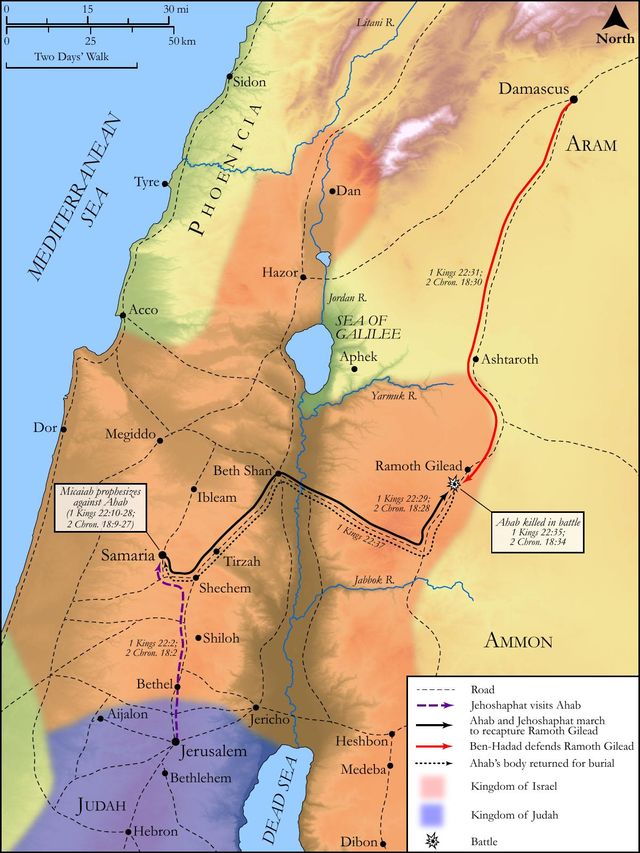
See on the biblical-era map
Study this verse
Public-domain commentary
Matthew Henry
From his Commentary on the Whole Bible. Henry comments on passages, not single verses — this entry covers 2 Chronicles 18:4–27.
This is almost word for word the same with what we had, 1 Kings 22. We will not repeat what was there said, nor have we much to add, but may take occasion to think, 1. Of the great duty of acknowledging God in all our ways and enquiring at his word, whatever we undertake. Jehoshaphat was not willing to proceed till he had done this, Ch2 18:4. By particular believing prayer, by an unbiased consultation of the scripture and our own consciences, and by an observant regard to the hints of providence, we may make such enquiries and very much to our satisfaction. 2. Of the great danger of bad company even to good men. Those that have more wisdom, grace, and resolution, cannot be sure that they can converse familiarly with wicked people and get no hurt by them. Jehoshaphat here, in complaisance to Ahab, sits in his robes, patiently hearing the false prophets speaking lies in the name of the Lord (Ch2 18:9), can scarcely find in his heart to give him a too mild and gentle reproof for hating a prophet of the Lord (Ch2 18:7), and dares not rebuke that false prophet who basely abused the faithful seer nor oppose Ahab who committed him to prison. Those who venture among the seats of the scornful cannot come off without a great deal of the guilt attaching to at least the omission of their duty, unless they have such measures of wisdom and courage as few can pretend to. 3. Of the unhappiness of those who are surrounded with flatterers, especially flattering prophets, who cry peace to them and prophesy nothing but smooth things. Thus was Ahab cheated into his ruin, and justly; for he hearkened to such, and preferred those that humoured him before a good prophet that gave him fair warning of his danger. Those do best for themselves that give their friends leave, and particularly their ministers, to deal plainly and faithfully with them, and take their reproofs not only patiently, but kindly. That counsel is not always best for us that is most pleasing to us. 4. Of the power of Satan, by the divine permission, in the children of disobedience. One lying spirit can make 400 lying prophets and make use of them to deceive Ahab, Ch2 18:21. The devil becomes a murderer by being a liar and destroys men by deceiving them. 5. Of the justice of God in giving those up to strong delusions, to believe a lie, who will not receive the love of the truth, but rebel against it, Ch2 18:21. Let the lying spirit prevail to entice those to their ruin that will not be persuaded to their duty and happiness. 6. Of the hard case of faithful ministers, whose lot it has often been to be hated, and persecuted, and ill-treated, for being true to their God and just and kind to the souls of men. Micaiah, for discharging a good conscience, was buffeted, imprisoned, and condemned to the bread and water of affliction. But he could with assurance appeal to the issue, as all those may do who are persecuted for their faithfulness, Ch2 18:27. The day will declare who is in the right and who in the wrong, when Christ will appear, to the unspeakable consolation of his persecuted people and the everlasting confusion of their persecutors, who will be made to see in that day (Ch2 18:24) what they will not now believe.
Continue studying 2 Chronicles 18:4 across the web’s major study libraries — every link below opens this exact verse, chapter, or book on the destination site.
Read & Compare
 BibleGatewayThis verse in more than 200 translations and 70 languages.
 Bible.comThe YouVersion reader — hundreds of translations, reading plans, and highlights.
 ESV.orgCrossway's official English Standard Version reader.
 NET BibleThe NET translation with 60,000+ translators' notes on every rendering decision.
 STEP BibleTyndale House's free study tool — original text, vocabulary, and scholarly resources.
 BibliaLogos Bible Software's free web reader.
 USCCBThe New American Bible (Revised Edition) with the U.S. bishops' study notes.
Commentaries
 BibleHub CommentariesDozens of classic commentaries on this verse, gathered on one page.
 StudyLightMore than 100 commentary sets — the largest collection on the web.
 BibleRefPlain-English commentary on what this verse means, verse by verse.
 Enduring WordDavid Guzik's free commentary on this chapter, widely used by Bible teachers.
 Bible Study ToolsVerse commentary alongside Greek and Hebrew study aids.
Original Language & Research
- BibleHub InterlinearThe verse word by word — original language, transliteration, and English.
- BibleHub LexiconEvery word's original-language definition and Strong's entry.
 Blue Letter BibleDeep-study tools — Strong's numbers, concordance, and word studies.
 SefariaThe Hebrew text with Rashi and centuries of Jewish commentary.
Sermons, Hymns & Audio


TrulyRandomVerse is not affiliated with these sites and doesn’t control their content. They’re linked because they’re genuinely useful.
Summary
In 2 Chronicles 18:4, King Jehoshaphat of Judah, despite having entered into a politically motivated and spiritually compromising alliance with the notoriously wicked King Ahab of Israel, demonstrates his unwavering piety and spiritual discernment by insisting that Ahab "enquire... at the word of the LORD to day" before engaging in a military campaign against Ramoth-gilead. This pivotal request highlights Jehoshaphat's deep conviction that divine counsel is paramount for all significant undertakings, setting the stage for a dramatic confrontation between true and false prophecy and underscoring the enduring necessity of seeking God's authoritative will.
Context
ShowHideLiterary Context
This verse immediately follows the establishment of a troubling alliance between Jehoshaphat and Ahab. 2 Chronicles 18:1 records Jehoshaphat's visit to Ahab in Samaria, a visit sealed by a marriage alliance between their families. Ahab, eager to reclaim the strategically vital city of Ramoth-gilead from the Syrians, proposes that Jehoshaphat join him in battle (2 Chronicles 18:3). Jehoshaphat's response in verse 4, "Enquire, I pray thee, at the word of the LORD to day," serves as a crucial narrative pivot. It introduces the overarching theme of divine guidance and sets the stage for the dramatic prophetic confrontation that dominates the remainder of 2 Chronicles 18, vividly contrasting Ahab's reliance on flattering false prophets with Jehoshaphat's genuine desire for authentic divine revelation. This request fundamentally shifts the narrative focus from political maneuvering to spiritual discernment and the authority of God's Word.
Historical & Cultural Context
The period of the divided monarchy (roughly 931-586 BC) was characterized by frequent conflicts and shifting alliances between the northern kingdom of Israel and the southern kingdom of Judah, as well as with surrounding nations like Aram (Syria). Ramoth-gilead, located in Transjordan, was a key border city often contested between Israel and Aram. Consulting prophets, diviners, or oracles before major undertakings, especially warfare, was a common practice across the ancient Near East, reflecting the widespread belief that success depended on divine favor. However, the nature of "the word of the LORD" in Israel was unique, emphasizing the authoritative, revealed will of Yahweh through His chosen prophets, distinct from pagan divination or manipulation. Jehoshaphat's request, therefore, underscores the expectation that a king, particularly one who feared Yahweh, would seek legitimate divine counsel, even if his ally, Ahab, was notoriously wicked and known for promoting Baal worship (see 1 Kings 16:30-33).
Key Themes
ShowHideThe primary theme introduced by this verse is the imperative of seeking authentic divine guidance before making critical decisions, particularly those with life-or-death implications like engaging in warfare. Jehoshaphat's insistence highlights his personal commitment to the Lord, even when his political alliances were problematic, showcasing spiritual discernment amidst compromise. This verse also subtly but powerfully introduces the theme of true versus false prophecy, as Ahab's immediate recourse is to his 400 court prophets, who predictably offer favorable but ultimately deceptive counsel, contrasting sharply with the lone, unpopular, but truthful word of Micaiah (2 Chronicles 18:7-27). Furthermore, it underscores the ultimate authority of God's word over human plans and desires, a principle that Jehoshaphat generally upheld despite his occasional missteps, and one that ultimately determines the fate of kings and nations, as seen in the broader narrative of 2 Chronicles.
Exposition and Analysis
ShowHideKey Word Analysis
ShowHideThis verb (H1875, דרש) signifies a diligent, earnest, and often spiritual seeking, consulting, or searching. It implies a thorough investigation or a serious request for divine revelation, not a casual inquiry. When applied to God's word, it suggests a profound desire to understand and align with His will, often through prophetic consultation, prayer, or studying the Law. Jehoshaphat's use of dārash here indicates his deep-seated conviction that the matter at hand—a military campaign—demanded nothing less than God's explicit approval and direction.
This noun (H1697, דבר) refers to a spoken word, a matter, a thing, or a decree. In the context of "the word of the LORD," it denotes the authoritative, revealed will or message of God. It is not merely human opinion or a general sense of divine presence, but a specific, communicated instruction or prophecy from Yahweh Himself. Jehoshaphat's insistence on "the word of the LORD" demonstrates his understanding that true guidance comes directly from God, as opposed to human wisdom, political expediency, or the pronouncements of false prophets. This word carries immense weight, signifying ultimate truth and authority.
This proper noun (H3068, יהוה) is the sacred covenant name of God, often translated as "Yahweh" or "Jehovah." It signifies God's self-existence, eternality, and His covenant faithfulness to Israel. By specifically requesting "the word of the LORD," Jehoshaphat is not asking for just any divine counsel, but for the authoritative word from the one true God of Israel, Yahweh, in stark contrast to the pagan deities or syncretistic practices prevalent in Ahab's kingdom. This highlights Jehoshaphat's singular devotion to the God of his fathers.
Verse Breakdown
ShowHide"And Jehoshaphat said unto the king of Israel"
This opening clause establishes the speaker, Jehoshaphat, and the recipient, Ahab. It immediately highlights Jehoshaphat's initiative and spiritual conviction even within the context of a potentially compromising alliance. Despite being the guest and the one seeking military aid, Jehoshaphat takes the lead in asserting a spiritual priority, demonstrating that he is not a passive participant but one who actively seeks to honor God even in challenging circumstances.
"Enquire, I pray thee, at the word of the LORD"
This is the core of Jehoshaphat's request, a polite but firm demand for Ahab to consult Yahweh, the God of Israel, for guidance. The phrase "I pray thee" (נָא, na') adds a sense of earnestness and urgency to the request, underscoring its profound importance to Jehoshaphat. He is not merely suggesting, but imploring Ahab to seek the divine will as the foundational and indispensable step before any military engagement, recognizing that human plans are futile without divine approval.
"to day"
This final phrase emphasizes the immediate necessity of seeking God's word. It signifies that the decision to go to war, or any significant undertaking, should not proceed without current and direct divine approval. It underscores Jehoshaphat's spiritual discipline and his recognition that God's counsel is not a mere formality or a future consideration, but an essential prerequisite for righteous action and true success, demanded in the present moment.
Literary Devices
ShowHideThe verse employs several potent literary devices that enhance its meaning and impact. Contrast is immediately evident between Jehoshaphat's piety and Ahab's typical disregard for divine counsel, immediately setting up a profound tension that will unfold throughout the chapter. Jehoshaphat, generally portrayed as a righteous king, is the one who insists on seeking God, while Ahab, the notoriously wicked king, is compelled to comply. This request also serves as a strong foreshadowing device. By demanding "the word of the LORD," Jehoshaphat unwittingly sets the stage for the dramatic confrontation between the 400 false prophets and the lone, true prophet Micaiah, whose unpopular but accurate prophecy will expose the deception and ultimately lead to Ahab's demise. There is also a subtle irony in the situation: Jehoshaphat, who has compromised his spiritual purity by allying with Ahab, is paradoxically the one who upholds the spiritual standard, revealing his underlying devotion to Yahweh despite his poor judgment in forming unholy alliances.
Theological and Thematic Connections
ShowHideThis verse powerfully underscores the biblical imperative to seek God's guidance in all major decisions, especially those with significant consequences. Jehoshaphat's insistence on hearing "the word of the LORD" before engaging in battle reflects a foundational principle of wisdom literature and prophetic teaching: true success, security, and blessing come from aligning human plans with divine will. It highlights that even in compromised situations, a genuine heart for God will instinctively turn to Him for direction. The narrative implicitly warns against the dangers of relying on human wisdom, political expediency, or popular opinion, especially when it contradicts God's revealed truth, foreshadowing the tragic outcome of Ahab's disregard for Micaiah's prophecy. This principle remains timeless, reminding believers that proactive and diligent inquiry into God's will is not optional but essential for navigating life's complexities, avoiding pitfalls, and ensuring that our endeavors are truly blessed by the Almighty.
Reflection and Application
ShowHideJehoshaphat's request in 2 Chronicles 18:4 serves as a profound model for believers today, urging us to prioritize divine counsel above all else. In a world that often pressures us to make swift decisions based on expediency, financial gain, social approval, or even perceived necessity, Jehoshaphat reminds us that the most crucial step before any significant undertaking—be it a career change, a major investment, a new relationship, a difficult ethical choice, or a significant ministry endeavor—is to diligently "enquire at the word of the LORD." This involves consistent prayer, deep engagement with Scripture to discern God's revealed principles and specific guidance, and seeking wise counsel from mature, godly individuals who are grounded in the Word and led by the Spirit. It challenges us to cultivate a posture of humility and dependence, recognizing that our wisdom is limited, but God's is infinite, unfailing, and perfectly good. Furthermore, while Jehoshaphat's piety is commendable, his initial alliance with Ahab serves as a sobering cautionary tale: even good intentions cannot sanctify unholy partnerships. We must carefully consider the company we keep and the alliances we form, ensuring they do not compromise our commitment to God or make it harder to hear and obey His voice clearly.
Questions for Reflection
ShowHideFAQ
ShowHideWhy did Jehoshaphat ally with Ahab in the first place, given Ahab's wickedness?
ShowHideThe text in 2 Chronicles 18:1 states that Jehoshaphat "had riches and honour in abundance; and joined affinity with Ahab." This alliance was likely a political maneuver, possibly aimed at strengthening Judah's position against common enemies like Aram, or securing trade routes and regional stability. Dynastic marriages, such as the one between Jehoshaphat's son Jehoram and Ahab's daughter Athaliah (2 Kings 8:18), were common ways to seal such treaties. While Jehoshaphat was generally a righteous king, this alliance with Ahab, a notoriously wicked and idolatrous king of Israel, was a significant spiritual compromise. The prophet Jehu later rebuked Jehoshaphat for this very reason, asking, "Shouldest thou help the ungodly, and love them that hate the LORD?" (2 Chronicles 19:2). Despite this compromise, Jehoshaphat's request in 2 Chronicles 18:4 demonstrates his underlying devotion to Yahweh and his desire to follow God's will.
What does "enquire at the word of the LORD" mean practically for us today?
ShowHideFor believers today, "enquiring at the word of the LORD" involves several interconnected practices. First, it means prayer, diligently seeking God's wisdom and guidance through direct communication with Him, casting all anxieties upon Him (Philippians 4:6-7). Second, it means immersing ourselves in Scripture, as the Bible is God's revealed Word, providing timeless principles, commands, and narratives that illuminate His will for all aspects of life (2 Timothy 3:16-17). Third, it involves seeking godly counsel from mature believers who are grounded in the Word and led by the Spirit, recognizing that "in the multitude of counselors there is safety" (Proverbs 11:14). Finally, it means listening to the Holy Spirit's leading, as He indwells believers, guides us into all truth, and applies God's Word to our specific situations, illuminating our path (John 16:13).
How did Ahab respond to Jehoshaphat's request to "enquire... at the word of the LORD"?
ShowHideAhab initially complied with Jehoshaphat's request, but his response immediately revealed his true spiritual state and his preference for flattery over truth. He gathered 400 of his own prophets, who were likely court prophets serving Baal or a syncretistic form of Yahwism, and they all prophesied favorably, encouraging the kings to go up to Ramoth-gilead with promises of victory (2 Chronicles 18:5). However, Jehoshaphat, discerning the lack of genuine divine authority in their pronouncements, pressed further, asking, "Is there not here a prophet of the LORD besides, that we might enquire of him?" (2 Chronicles 18:6). This led to the reluctant summoning of Micaiah, the true prophet of Yahweh, who delivered an unpopular but accurate prophecy of doom for Ahab, which ultimately came to pass (2 Chronicles 18:7-27).
Christ-Centered Fulfillment
ShowHideJehoshaphat's earnest plea to "enquire... at the word of the LORD" finds its ultimate and most profound fulfillment in the person and work of Jesus Christ. In the Old Testament, God spoke "at sundry times and in divers manners by the prophets" (Hebrews 1:1), providing glimpses and partial revelations of His will. However, in the New Testament, "He hath in these last days spoken unto us by His Son" (Hebrews 1:2). Jesus is the living Word of God, the full, complete, and final revelation of God's character, will, and redemptive plan (John 1:1-14). To "enquire at the word of the LORD" now means to turn to Christ, for "in Him are hid all the treasures of wisdom and knowledge" (Colossians 2:3). He is the truth, the way, and the life, and no one comes to the Father or truly understands God's will except through Him (John 14:6). The Holy Spirit, whom Christ sent, continues to guide believers into all truth, illuminating the Scriptures and applying Christ's wisdom to our lives, ensuring that we are always walking in the light of God's revealed will and experiencing the abundant life He offers (John 16:13). Thus, Jehoshaphat's deep desire for divine counsel is perfectly met and eternally surpassed in the person and work of Jesus Christ, who is our ultimate source of guidance, wisdom, and life itself.