


2 Chronicles 18:7
Bible text: King James Version (1769 Blayney text) · Public domain
Bible text: King James Version with Strong's numbers · Public domain
Bible text: Berean Standard Bible · Public domain
Bible text: American Standard Version (1901) · Public domain
Bible text: World English Bible, Messianic edition · Public domain
Bible text: Geneva Bible (1599) · Public domain
Bible text: Young's Literal Translation · Public domain
- וַיֹּאמֶרvai·Yo·merand he saidH559Conj-w ¦ V-Qal-ConsecImperf-3msVerb Qal Consecutive Imperfect 3rd Singular Masculineוַandיֹּאמֶרhe said
- מֶלֶךְMe·lekh[the] king ofH4428N-mscNoun Singular Masculine Construct
- יִשְׂרָאֵלYis·ra·'ElIsraelH3478N-properNoun Proper Location
- אֶל'eltoH413PrepPreposition
- יְהוֹשָׁפָטye·ho·sha·FatJehoshaphatH3092N-proper-mNoun Proper Masculine
- עוֹדodstillH5750Adj-msAdjective Numerical Singular Masculine Absolute
- אִישׁ'isha manH376N-msNoun Singular Masculine Absolute
- אֶחָד'e·ChadoneH259N-fsNoun Singular Feminine Absolute
- לִדְרוֹשׁlid·ro·Voshto consultH1875Prep-l ¦ V-Qal-InfVerb Qal Infinitive Constructלִtoדְרוֹשׁconsult
- אֶת'et<obj.>H853DirObjMParticle Object Indicator
- יְהוָהYah·wehYahwehH3068N-properNoun Proper Title
- מֵאֹתוֹme·'o·Tofrom <obj.> himH853Prep-m ¦ DirObjM ¦ 3msParticle Object Indicatorמֵfromאֹת<obj.>וֹhim
- וַאֲנִיva·'a·Niand IH589Conj-w ¦ Pro-1csPronoun Personal 1st Singular common genderוַandאֲנִיI
- שְׂנֵאתִיהוּse·ne·Ti·huI hate himH8130V-Qal-Perf-1cs ¦ 3msVerb Qal Perfect 1st Singular common genderשְׂנֵאתִיI hateהוּhim
- כִּיkiforH3588PrtParticle Conditional
- אֵינֶנּוּ'Ei·ne·nunot heH369N-msc ¦ 3msNoun Singular Masculine Constructאֵינֶnotנּוּhe
- מִתְנַבֵּאmit·na·Be'[is] prophesyingH5012V-Hithpael-Prtcpl-msVerb Hithpael Participle Singular Masculine Absolute
- עָלַי'a·Laion meH5921Prep ¦ 1csPrepositionעָלַonיme
- לְטוֹבָהle·to·Vah<to> goodH2896Prep-l ¦ N-fsNoun Singular Feminine Absoluteלְ<to>טוֹבָהgood
- כִּיkiforH3588PrtParticle Conditional
- כָלkholallH3605N-mscNoun Singular Masculine Construct
- יָמָיוya·Mavhis daysH3117N-mpc ¦ 3msNoun Plural Masculine Constructיָמָיdaysוhis
- לְרָעָהle·ra·'Ah<to> evilH7451Prep-l ¦ N-fsNoun Singular Feminine Absoluteלְ<to>רָעָהevil
- הוּאhu'heH1931Pro-3msPronoun Personal 3rd Singular Masculine
- מִיכָיְהוּmi·Kha·ye·hu[is] MicaiahH4321N-proper-mNoun Proper Masculine
- בֶןven[the] son ofH1121N-mscNoun Singular Masculine Construct
- יִמְלָאyim·La'ImlahH3229N-proper-mNoun Proper Masculine
- וַיֹּאמֶרvai·Yo·merand he saidH559Conj-w ¦ V-Qal-ConsecImperf-3msVerb Qal Consecutive Imperfect 3rd Singular Masculineוַandיֹּאמֶרhe said
- יְהוֹשָׁפָטye·Ho·o·sha·FatJehoshaphatH3092N-proper-mNoun Proper Masculine
- אַל'almay notH408NegParticle Negative
- יֹאמַרyo·Marhe sayH559V-Qal-Imperf-3msVerb Qal Imperfect 3rd Singular Masculine
- הַמֶּלֶךְha·Me·lekhthe kingH4428Art ¦ N-msNoun Singular Masculine Absoluteהַtheמֶּלֶךְking
- כֵּןKenthusH3651AdvAdverb
English is a literal word-by-word gloss of the Hebrew, not the KJV's wording. Why?
This is the original text the KJV's translators worked from — each Hebrew word with its own literal English meaning in this verse, prepared by scholars at Tyndale House, Cambridge. The KJV translates whole sentences, not word by word, so its wording differs: one Hebrew word can become several English words, and the KJV may choose “the LORD” where the gloss reads “Yahweh”. Both are faithful — they answer different questions. For the KJV's own rendering, switch to the KJV text.
Details
See on the biblical-era map
Study this verse
Public-domain commentary
Matthew Henry
From his Commentary on the Whole Bible. Henry comments on passages, not single verses — this entry covers 2 Chronicles 18:4–27.
This is almost word for word the same with what we had, 1 Kings 22. We will not repeat what was there said, nor have we much to add, but may take occasion to think, 1. Of the great duty of acknowledging God in all our ways and enquiring at his word, whatever we undertake. Jehoshaphat was not willing to proceed till he had done this, Ch2 18:4. By particular believing prayer, by an unbiased consultation of the scripture and our own consciences, and by an observant regard to the hints of providence, we may make such enquiries and very much to our satisfaction. 2. Of the great danger of bad company even to good men. Those that have more wisdom, grace, and resolution, cannot be sure that they can converse familiarly with wicked people and get no hurt by them. Jehoshaphat here, in complaisance to Ahab, sits in his robes, patiently hearing the false prophets speaking lies in the name of the Lord (Ch2 18:9), can scarcely find in his heart to give him a too mild and gentle reproof for hating a prophet of the Lord (Ch2 18:7), and dares not rebuke that false prophet who basely abused the faithful seer nor oppose Ahab who committed him to prison. Those who venture among the seats of the scornful cannot come off without a great deal of the guilt attaching to at least the omission of their duty, unless they have such measures of wisdom and courage as few can pretend to. 3. Of the unhappiness of those who are surrounded with flatterers, especially flattering prophets, who cry peace to them and prophesy nothing but smooth things. Thus was Ahab cheated into his ruin, and justly; for he hearkened to such, and preferred those that humoured him before a good prophet that gave him fair warning of his danger. Those do best for themselves that give their friends leave, and particularly their ministers, to deal plainly and faithfully with them, and take their reproofs not only patiently, but kindly. That counsel is not always best for us that is most pleasing to us. 4. Of the power of Satan, by the divine permission, in the children of disobedience. One lying spirit can make 400 lying prophets and make use of them to deceive Ahab, Ch2 18:21. The devil becomes a murderer by being a liar and destroys men by deceiving them. 5. Of the justice of God in giving those up to strong delusions, to believe a lie, who will not receive the love of the truth, but rebel against it, Ch2 18:21. Let the lying spirit prevail to entice those to their ruin that will not be persuaded to their duty and happiness. 6. Of the hard case of faithful ministers, whose lot it has often been to be hated, and persecuted, and ill-treated, for being true to their God and just and kind to the souls of men. Micaiah, for discharging a good conscience, was buffeted, imprisoned, and condemned to the bread and water of affliction. But he could with assurance appeal to the issue, as all those may do who are persecuted for their faithfulness, Ch2 18:27. The day will declare who is in the right and who in the wrong, when Christ will appear, to the unspeakable consolation of his persecuted people and the everlasting confusion of their persecutors, who will be made to see in that day (Ch2 18:24) what they will not now believe.
Continue studying 2 Chronicles 18:7 across the web’s major study libraries — every link below opens this exact verse, chapter, or book on the destination site.
Read & Compare
 BibleGatewayThis verse in more than 200 translations and 70 languages.
 Bible.comThe YouVersion reader — hundreds of translations, reading plans, and highlights.
 ESV.orgCrossway's official English Standard Version reader.
 NET BibleThe NET translation with 60,000+ translators' notes on every rendering decision.
 STEP BibleTyndale House's free study tool — original text, vocabulary, and scholarly resources.
 BibliaLogos Bible Software's free web reader.
 USCCBThe New American Bible (Revised Edition) with the U.S. bishops' study notes.
Commentaries
 BibleHub CommentariesDozens of classic commentaries on this verse, gathered on one page.
 StudyLightMore than 100 commentary sets — the largest collection on the web.
 BibleRefPlain-English commentary on what this verse means, verse by verse.
 Enduring WordDavid Guzik's free commentary on this chapter, widely used by Bible teachers.
 Bible Study ToolsVerse commentary alongside Greek and Hebrew study aids.
Original Language & Research
- BibleHub InterlinearThe verse word by word — original language, transliteration, and English.
- BibleHub LexiconEvery word's original-language definition and Strong's entry.
 Blue Letter BibleDeep-study tools — Strong's numbers, concordance, and word studies.
 SefariaThe Hebrew text with Rashi and centuries of Jewish commentary.
Sermons, Hymns & Audio


TrulyRandomVerse is not affiliated with these sites and doesn’t control their content. They’re linked because they’re genuinely useful.
Summary
2 Chronicles 18:7 captures a pivotal moment of spiritual discernment and royal obstinacy, as King Ahab of Israel reluctantly reveals the existence of Micaiah, a true prophet of the Lord. Ahab's transparent hatred for Micaiah stems from the prophet's consistent delivery of unfavorable prophecies, or "evil," rather than the "good" outcomes Ahab desires. In stark contrast, King Jehoshaphat of Judah immediately rebukes Ahab's bias, underscoring the crucial importance of prioritizing genuine divine truth over personal preference or political expediency, thereby setting the stage for Micaiah's courageous, yet unpopular, prophetic ministry.
Context
ShowHideLiterary Context
This verse is strategically placed within the narrative of King Ahab's ill-fated campaign to reclaim Ramoth-Gilead from the Syrians, a critical point that highlights the profound spiritual chasm between Ahab and Jehoshaphat. The preceding verses establish Jehoshaphat's commitment to seeking the Lord's counsel, even after Ahab presents 400 court prophets who unanimously promise victory (2 Chronicles 18:4-5). Ahab's grudging admission of Micaiah's existence in this verse, coupled with his explicit animosity, immediately signals a conflict between divine truth and human self-interest. The subsequent account, beginning with 2 Chronicles 18:8, details Micaiah's unvarnished prophecy of Ahab's defeat and the dramatic confrontation with the false prophets, culminating in Ahab's death in battle, precisely as Micaiah foretold (2 Chronicles 18:34).
Historical & Cultural Context
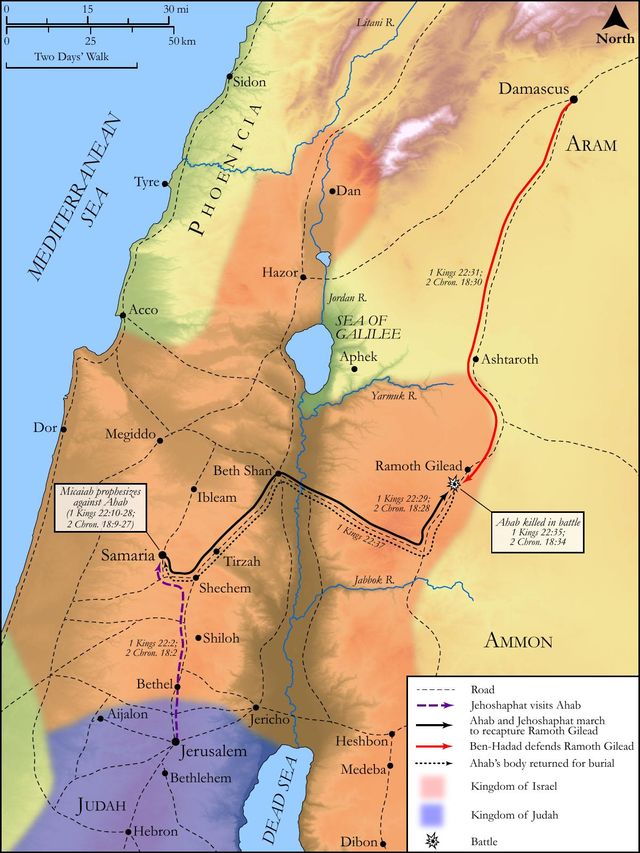
The historical backdrop involves the complex and often volatile relationship between the northern kingdom of Israel and the southern kingdom of Judah, occasionally punctuated by strategic alliances like the one seen here. Ramoth-Gilead was a highly contested city, crucial for controlling trade routes and borders in Transjordan. In Israel and among the nations round about, it was customary for kings to consult prophets for divine guidance, especially before military engagements. However, the period of Ahab's reign in Israel was marked by widespread apostasy, particularly the promotion of Baal worship and the persecution of Yahweh's prophets. This context makes Micaiah's unwavering faithfulness to the Lord's word, despite the personal danger, exceptionally significant. The distinction between true prophets, who spoke God's unadulterated message, and court prophets, who often flattered the king, was stark and often a matter of life and death.
Key Themes
ShowHideThis verse powerfully illuminates several enduring theological themes. Firstly, it underscores The Unpopular Nature of Divine Truth, demonstrating humanity's pervasive tendency to reject uncomfortable revelation in favor of self-serving falsehoods. Ahab's hatred for Micaiah is not rooted in the prophet's character but in the content of his messages, which consistently expose Ahab's sin and warn of impending judgment. This mirrors the broader biblical truth that "the light has come into the world, but people loved darkness instead of light because their deeds were evil" (John 3:19). Secondly, the passage highlights The Integrity of True Prophecy, contrasting Micaiah's unwavering commitment to God's word with the sycophancy of the 400 false prophets. True prophecy, as exemplified by Micaiah, is not about predicting desired outcomes but about faithfully delivering God's message, regardless of personal cost (Deuteronomy 18:20-22). Finally, Jehoshaphat's insistence on seeking genuine divine counsel emphasizes the theme of Spiritual Discernment, stressing the vital need to distinguish between popular opinion or human desire and the authentic voice of the Lord (Proverbs 3:5-6).
Exposition and Analysis
ShowHideKey Word Analysis
ShowHideThis primitive root (H8130) signifies a deep, personal aversion often manifesting as active hostility or rejection. Ahab's "hate" for Micaiah is not a mere dislike but a profound animosity rooted in the prophet's consistent delivery of messages that directly contradicted Ahab's desires and plans. This hatred reveals Ahab's spiritual rebellion against God's will, his preference for self-serving delusion over divine truth, and the profound spiritual conflict where the king's personal agenda clashes violently with God's sovereign purposes.
Derived from a root meaning "to be bad" (H7451), "evil" in this context primarily refers to misfortune, calamity, or disaster, rather than moral wickedness. Ahab's complaint is that Micaiah "never prophesied good unto me, but always evil," meaning Micaiah consistently foretold negative outcomes, judgment, or defeat for Ahab's endeavors. This is because Ahab's actions were indeed morally wicked, leading to divine judgment, which Micaiah faithfully announced. The word highlights the consequence of sin and disobedience, showing that God's "evil" (calamity) is a righteous response to human "evil" (wickedness).
Verse Breakdown
ShowHide"And the king of Israel said unto Jehoshaphat, [There is] yet one man, by whom we may enquire of the LORD:"
This clause reveals King Ahab's grudging concession to Jehoshaphat's spiritual insistence. Despite having 400 prophets of his own, Ahab acknowledges, under pressure, the existence of "yet one man," implying a prophet of a different caliber—one who truly represents the Lord. This admission, though reluctant, is a testament to Micaiah's recognized, albeit unwelcome, prophetic authority.
"but I hate him; for he never prophesied good unto me, but always evil: the same [is] Micaiah the son of Imla."
This is the core of Ahab's confession and the central conflict of the verse. Ahab's animosity towards Micaiah is explicitly stated and justified by the king's perception that Micaiah's prophecies are consistently negative ("evil") and never favorable ("good"). This exposes Ahab's self-centeredness and his desire for prophecies that align with his personal agenda, rather than God's truth. The naming of "Micaiah the son of Imla" identifies the specific individual who stands in stark contrast to the compliant court prophets.
"And Jehoshaphat said, Let not the king say so."
Jehoshaphat's immediate and firm response serves as a direct rebuke to Ahab's biased assessment. It signifies Jehoshaphat's understanding that a true prophet speaks God's unvarnished word, not merely what the king desires to hear. His words are a plea for spiritual integrity, urging Ahab to set aside his personal feelings and genuinely seek the Lord's counsel, regardless of its perceived "good" or "evil" nature.
Literary Devices
ShowHideThe passage employs several potent literary devices to convey its message. Characterization is immediately evident, portraying Ahab as a king who prioritizes flattery and self-interest over truth, revealed through his open hatred for Micaiah. Conversely, Jehoshaphat is characterized as discerning and spiritually sensitive, insisting on authentic divine counsel. Contrast is central, highlighting the stark difference between Ahab's 400 sycophantic prophets who prophesy "good" (what the king desires) and Micaiah, the lone true prophet, who consistently prophesies "evil" (divine judgment). This contrast underscores the fundamental nature of true versus false prophecy. There is also a strong element of Irony: Ahab, in his attempt to dismiss Micaiah as a purveyor of only "evil," inadvertently confirms Micaiah's authenticity as a true prophet of the Lord, as a genuine prophet's message often challenges and convicts. Finally, the verse serves as Foreshadowing, setting the stage for the dramatic confrontation between Micaiah and the false prophets, and ultimately, for Ahab's demise, which Micaiah's "evil" prophecies accurately foretell.
Theological and Thematic Connections
ShowHide2 Chronicles 18:7 profoundly illustrates the timeless conflict between divine truth and human desire, particularly within positions of power. It reveals that the rejection of God's word often stems not from a lack of clarity, but from a willful preference for self-serving delusion. Ahab's hatred for Micaiah is a microcosm of humanity's broader rebellion against a God whose truth exposes sin and calls for repentance. The passage underscores God's unwavering commitment to communicate His will, even through unpopular voices, and the critical importance of spiritual discernment to distinguish between genuine divine counsel and flattering falsehoods. It serves as a powerful reminder that faithfulness to God's word may incur human animosity, but it is ultimately vindicated by God's sovereign hand.
Reflection and Application
ShowHideThis ancient narrative speaks directly to contemporary challenges, urging us to cultivate a profound love for truth, even when it is uncomfortable or contradicts our personal preferences. Like Ahab, we can be tempted to surround ourselves with "yes-men" or information sources that only affirm our existing biases, leading us down paths of self-deception and ultimately, spiritual peril. The wisdom of Jehoshaphat, however, calls us to a higher standard: to earnestly seek God's unvarnished truth, to discern carefully between popular opinion and divine revelation, and to embrace the often-challenging voice of the Holy Spirit. For those called to speak truth, whether in personal relationships, professional settings, or public discourse, Micaiah's example reminds us that faithfulness to God's word is paramount, even if it means enduring unpopularity or opposition. Our ultimate allegiance must be to the truth of God, not to the fleeting approval of others.
Questions for Reflection
ShowHideFAQ
ShowHideWhy did Ahab "hate" Micaiah so much?
ShowHideAhab's hatred for Micaiah stemmed from the prophet's consistent delivery of messages that foretold negative outcomes or divine judgment for Ahab's actions, rather than the favorable prophecies Ahab desired. Micaiah faithfully spoke God's truth, which often exposed Ahab's sin and rebellion against the Lord. This made Micaiah an unwelcome voice in Ahab's court, as Ahab preferred the flattering words of his 400 false prophets who promised success and aligned with his own agenda. Ahab's hatred was a manifestation of his rejection of God's authority and his preference for self-deception over divine reality, as seen in his later disregard for Micaiah's specific warnings about the battle at Ramoth-Gilead.
What is the difference between "good" and "evil" prophecy in this context?
ShowHideIn this context, "good" (Hebrew: ṭôwb) refers to prophecies of favorable outcomes, success, prosperity, or peace, which is what Ahab wanted to hear. "Evil" (Hebrew: raʻ) refers to prophecies of misfortune, calamity, judgment, or defeat. Micaiah's prophecies were "evil" to Ahab because they consistently foretold disaster for Ahab's unrighteous reign and his military endeavors, reflecting God's righteous judgment. This distinction highlights that true prophecy is not about delivering pleasant news, but about accurately conveying God's will, whether it brings comfort or conviction, as exemplified by prophets like Jeremiah who often spoke words of judgment to a rebellious nation.
Why was Jehoshaphat so insistent on hearing from Micaiah?
ShowHideJehoshaphat, a righteous king of Judah, possessed spiritual discernment that allowed him to sense that the unanimous, positive prophecies of Ahab's 400 prophets were not genuinely from the Lord. He likely recognized the superficiality or self-serving nature of their messages. His insistence on hearing from "yet another prophet of the Lord" (as in 2 Chronicles 18:6) demonstrated his commitment to seeking authentic divine guidance, even if it meant challenging the king of Israel and potentially hearing an unpopular truth. His spiritual sensitivity led him to prioritize God's true will over political expediency or popular opinion.
Christ-Centered Fulfillment
ShowHideThe narrative of Micaiah, the prophet hated for speaking truth, finds profound Christ-centered fulfillment. Micaiah stands as a prophetic type of Jesus Christ, the ultimate Prophet who spoke God's unvarnished truth to a world that largely rejected Him. Just as Ahab hated Micaiah because he "never prophesied good unto me, but always evil," so too was Jesus despised by many religious and political leaders because His message exposed their hypocrisy, challenged their authority, and called them to a repentance they refused to embrace (John 7:7). Jesus declared, "The light has come into the world, but people loved darkness instead of light because their deeds were evil" (John 3:19), perfectly echoing Ahab's preference for flattering lies over convicting truth.
Micaiah's willingness to suffer imprisonment for God's word (2 Chronicles 18:26) foreshadows Christ's suffering and ultimate sacrifice for truth and righteousness. The world's rejection of Micaiah, the true messenger, culminates in Ahab's demise, illustrating the dire consequences of rejecting God's word. Similarly, the rejection of Christ, the very Word made flesh, leads to spiritual death. Yet, in Christ, the "evil" (judgment) that was due to humanity for its sin was prophesied and then absorbed by Him on the cross, allowing for the ultimate "good" (salvation and reconciliation) for those who believe (Romans 5:8). Jesus is the faithful Prophet, Priest, and King, who, unlike Micaiah, not only spoke the truth but embodied it, becoming the way, the truth, and the life (John 14:6), offering ultimate salvation where human kings and their false prophets could only lead to ruin.