


2 Chronicles 18:8
Bible text: King James Version (1769 Blayney text) · Public domain
Bible text: Berean Standard Bible · Public domain
Bible text: American Standard Version (1901) · Public domain
Bible text: World English Bible, Messianic edition · Public domain
Bible text: Geneva Bible (1599) · Public domain
Bible text: Young's Literal Translation · Public domain
- וַיִּקְרָאvai·yik·Ra'and he calledH7121Conj-w ¦ V-Qal-ConsecImperf-3msVerb Qal Consecutive Imperfect 3rd Singular Masculineוַandיִּקְרָאhe called
- מֶלֶךְMe·lekh[the] king ofH4428N-mscNoun Singular Masculine Construct
- יִשְׂרָאֵלYis·ra·'ElIsraelH3478N-properNoun Proper Location
- אֶל'eltoH413PrepPreposition
- סָרִיסsa·Risa court-officialH5631N-msNoun Singular Masculine Absolute
- אֶחָד'e·ChadoneH259N-fsNoun Singular Feminine Absolute
- וַיֹּאמֶרvai·Yo·merand he saidH559Conj-w ¦ V-Qal-ConsecImperf-3msVerb Qal Consecutive Imperfect 3rd Singular Masculineוַandיֹּאמֶרhe said
- מַהֵרma·Herbring quicklyH4116V-Piel-Imp-2msVerb Piel Imperative 2nd Singular Masculine
- מִיכָיְהוּmi·kha·huMicaiahH4321N-proper-mNoun Proper Masculine
- בֶןven[the] son ofH1121N-mscNoun Singular Masculine Construct
- יִמְלָאyim·La'ImlahH3229N-proper-mNoun Proper Masculine
English is a literal word-by-word gloss of the Hebrew, not the KJV's wording. Why?
This is the original text the KJV's translators worked from — each Hebrew word with its own literal English meaning in this verse, prepared by scholars at Tyndale House, Cambridge. The KJV translates whole sentences, not word by word, so its wording differs: one Hebrew word can become several English words, and the KJV may choose “the LORD” where the gloss reads “Yahweh”. Both are faithful — they answer different questions. For the KJV's own rendering, switch to the KJV text.
Details
See on the biblical-era map
Study this verse
Public-domain commentary
Matthew Henry
From his Commentary on the Whole Bible. Henry comments on passages, not single verses — this entry covers 2 Chronicles 18:4–27.
This is almost word for word the same with what we had, 1 Kings 22. We will not repeat what was there said, nor have we much to add, but may take occasion to think, 1. Of the great duty of acknowledging God in all our ways and enquiring at his word, whatever we undertake. Jehoshaphat was not willing to proceed till he had done this, Ch2 18:4. By particular believing prayer, by an unbiased consultation of the scripture and our own consciences, and by an observant regard to the hints of providence, we may make such enquiries and very much to our satisfaction. 2. Of the great danger of bad company even to good men. Those that have more wisdom, grace, and resolution, cannot be sure that they can converse familiarly with wicked people and get no hurt by them. Jehoshaphat here, in complaisance to Ahab, sits in his robes, patiently hearing the false prophets speaking lies in the name of the Lord (Ch2 18:9), can scarcely find in his heart to give him a too mild and gentle reproof for hating a prophet of the Lord (Ch2 18:7), and dares not rebuke that false prophet who basely abused the faithful seer nor oppose Ahab who committed him to prison. Those who venture among the seats of the scornful cannot come off without a great deal of the guilt attaching to at least the omission of their duty, unless they have such measures of wisdom and courage as few can pretend to. 3. Of the unhappiness of those who are surrounded with flatterers, especially flattering prophets, who cry peace to them and prophesy nothing but smooth things. Thus was Ahab cheated into his ruin, and justly; for he hearkened to such, and preferred those that humoured him before a good prophet that gave him fair warning of his danger. Those do best for themselves that give their friends leave, and particularly their ministers, to deal plainly and faithfully with them, and take their reproofs not only patiently, but kindly. That counsel is not always best for us that is most pleasing to us. 4. Of the power of Satan, by the divine permission, in the children of disobedience. One lying spirit can make 400 lying prophets and make use of them to deceive Ahab, Ch2 18:21. The devil becomes a murderer by being a liar and destroys men by deceiving them. 5. Of the justice of God in giving those up to strong delusions, to believe a lie, who will not receive the love of the truth, but rebel against it, Ch2 18:21. Let the lying spirit prevail to entice those to their ruin that will not be persuaded to their duty and happiness. 6. Of the hard case of faithful ministers, whose lot it has often been to be hated, and persecuted, and ill-treated, for being true to their God and just and kind to the souls of men. Micaiah, for discharging a good conscience, was buffeted, imprisoned, and condemned to the bread and water of affliction. But he could with assurance appeal to the issue, as all those may do who are persecuted for their faithfulness, Ch2 18:27. The day will declare who is in the right and who in the wrong, when Christ will appear, to the unspeakable consolation of his persecuted people and the everlasting confusion of their persecutors, who will be made to see in that day (Ch2 18:24) what they will not now believe.
Continue studying 2 Chronicles 18:8 across the web’s major study libraries — every link below opens this exact verse, chapter, or book on the destination site.
Read & Compare
 BibleGatewayThis verse in more than 200 translations and 70 languages.
 Bible.comThe YouVersion reader — hundreds of translations, reading plans, and highlights.
 ESV.orgCrossway's official English Standard Version reader.
 NET BibleThe NET translation with 60,000+ translators' notes on every rendering decision.
 STEP BibleTyndale House's free study tool — original text, vocabulary, and scholarly resources.
 BibliaLogos Bible Software's free web reader.
 USCCBThe New American Bible (Revised Edition) with the U.S. bishops' study notes.
Commentaries
 BibleHub CommentariesDozens of classic commentaries on this verse, gathered on one page.
 StudyLightMore than 100 commentary sets — the largest collection on the web.
 BibleRefPlain-English commentary on what this verse means, verse by verse.
 Enduring WordDavid Guzik's free commentary on this chapter, widely used by Bible teachers.
 Bible Study ToolsVerse commentary alongside Greek and Hebrew study aids.
Original Language & Research
- BibleHub InterlinearThe verse word by word — original language, transliteration, and English.
- BibleHub LexiconEvery word's original-language definition and Strong's entry.
 Blue Letter BibleDeep-study tools — Strong's numbers, concordance, and word studies.
 SefariaThe Hebrew text with Rashi and centuries of Jewish commentary.
Sermons, Hymns & Audio


TrulyRandomVerse is not affiliated with these sites and doesn’t control their content. They’re linked because they’re genuinely useful.
Summary
This pivotal verse records King Ahab of Israel's reluctant command to summon Micaiah, the son of Imla, a prophet he notoriously disdained. Occurring after King Jehoshaphat of Judah insisted on seeking divine counsel beyond Ahab's 400 court prophets, this moment sets the stage for a dramatic confrontation between popular deception and unpopular truth, highlighting the deep-seated human resistance to God's unvarnished word when it contradicts personal desires or political agendas.
Context
ShowHideLiterary Context
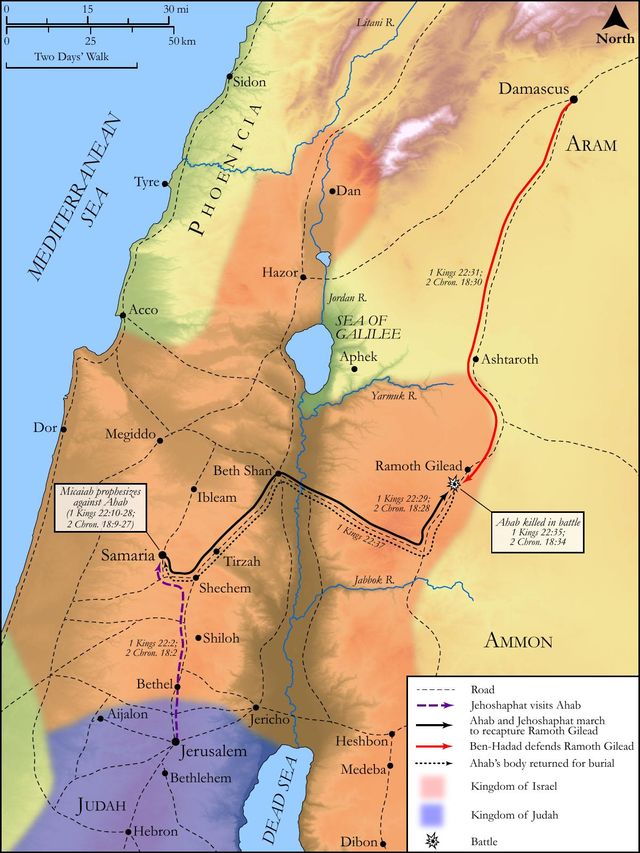
This verse is a crucial turning point within the broader narrative of 2 Chronicles 18 and its parallel in 1 Kings 22. The immediate context involves King Ahab of Israel and King Jehoshaphat of Judah forming an alliance to reclaim Ramoth-Gilead from the Arameans. Jehoshaphat, a righteous king, wisely insists on inquiring of the Lord before battle, despite Ahab's initial consultation with 400 of his own prophets who unanimously prophesy victory (2 Chronicles 18:4-6). Jehoshaphat's spiritual discernment leads him to question the authenticity of these prophets, prompting his direct inquiry: "Is there not here a prophet of the LORD besides, that we might inquire of him?" (2 Chronicles 18:6). Verse 8 is Ahab's grudging response, revealing his deep-seated animosity towards Micaiah, whom he admits "doth not prophesy good concerning me, but always evil" (2 Chronicles 18:7). This sets up the dramatic prophetic confrontation that follows, where Micaiah delivers a message of impending doom for Ahab.
Historical & Cultural Context
In ancient Israel, prophets served as God's direct spokespersons, often challenging kings and the prevailing societal norms. Their authority derived from divine inspiration, not political appointment, making them unique figures in the royal court. Kings, however, often preferred "yes-men" who would affirm their plans, as vividly seen with Ahab's 400 court prophets. The alliance between Ahab and Jehoshaphat was politically strategic, aimed at recovering territory, but it also reflects a complex relationship between the northern (Israel) and southern (Judah) kingdoms, which were often at odds. The practice of consulting prophets before military campaigns was common, reflecting the belief that divine favor was essential for success. However, discerning true prophecy from false was a constant challenge, particularly when the message was unwelcome. The setting of Samaria, Ahab's capital, underscores the opulence and moral decay of his reign, where true prophetic voices like Micaiah's were overlooked and even persecuted.
Key Themes
ShowHideThis verse powerfully contributes to several overarching themes within the prophetic books and historical narratives. Firstly, it highlights the conflict between truth and deception, illustrating how human leaders often prefer comforting lies to challenging truths, especially when personal ambition is at stake. Ahab's reluctance to summon Micaiah underscores his willful blindness and resistance to God's genuine word, a pattern seen throughout the history of Israel. Secondly, it emphasizes the integrity and unpopularity of God's true prophets. Micaiah stands as a stark contrast to the compliant court prophets, embodying the courage required to speak God's unvarnished message, regardless of personal cost or royal displeasure. This theme resonates with the experiences of many prophets throughout Israel's history, such as Jeremiah who faced imprisonment for his unpopular prophecies (Jeremiah 20:1-2). Finally, the narrative subtly reinforces the theme of divine sovereignty, demonstrating that even through the resistance and machinations of human kings, God's ultimate plan and purpose will prevail (Proverbs 19:21).
Exposition and Analysis
ShowHideKey Word Analysis
ShowHideThis term (H4428) denotes a monarch, the supreme ruler of a kingdom. In this context, it refers to Ahab, the king of Israel. The use of "king" here emphasizes his authority and the weight of his command, even though it is given reluctantly. It sets up the dynamic between the earthly ruler and the divine authority represented by the prophet.
This numeral (H259) means "united" or "one." Here, it functions as an indefinite article, "one of his officers." While seemingly simple, it highlights that Ahab did not send just any servant but a specific, high-ranking official, underscoring the formal nature of the summons, compelled by Jehoshaphat's insistence.
This primitive root (H4116) means "to hurry" or "to make haste." When used adverbially, as here, it signifies promptness and urgency. On the surface, it suggests Ahab's desire to expedite the process and move forward with his military plans. However, given Ahab's known disdain for Micaiah, the "quickly" might also betray an underlying impatience or a desire to "get it over with" so he could dismiss the unwelcome prophecy and proceed as he wished. It adds a layer of tension to the command, revealing Ahab's internal conflict.
This common noun (H1121) refers to a male offspring and is often used in patronymics to identify individuals by their father's name. "Micaiah the son of Imla" precisely identifies the prophet, distinguishing him from others and linking him to his lineage. This specific identification underscores Micaiah's known prophetic identity and ministry, implying that both kings were well aware of who he was and the nature of his previous prophecies.
Verse Breakdown
ShowHide"And the king of Israel called for one [of his] officers"
This clause establishes the initiator of the action, King Ahab of Israel, and his method of command. The "officer" (Hebrew: saris, H5631, often translated as "eunuch" or "court official") indicates a high-ranking palace attendant, suggesting a formal, official summons rather than a casual messenger. Ahab, though resistant, is compelled by Jehoshaphat's insistence to follow proper protocol for inquiring of the Lord, even if his heart is not in it. This action highlights the power dynamic and the reluctant concession on Ahab's part.
"and said, Fetch quickly Micaiah the son of Imla."
This is the direct command issued by Ahab. His words reveal his knowledge of Micaiah and his specific instruction to bring him without delay. The inclusion of "the son of Imla" identifies Micaiah precisely, distinguishing him from other prophets and highlighting his unique, often confrontational, prophetic ministry that Ahab had experienced before. The urgency implied by "quickly" underscores the pressure Ahab felt, either from Jehoshaphat's persistent demand for a true prophet or from his own desire to resolve the prophetic inquiry and proceed to battle, likely hoping to quickly dismiss Micaiah's expected negative word.
Literary Devices
ShowHideThe verse employs several literary devices that enrich its meaning and foreshadow the unfolding drama. Characterization is immediately evident, as Ahab's words and the context of his command reveal his resistant and resentful nature towards God's true prophets. His reluctance to call Micaiah, contrasted with his easy acceptance of the 400 false prophets, paints him as a king who prefers flattery over truth, highlighting his spiritual blindness and moral corruption. There is also a strong element of Foreshadowing, as Ahab's admission in the preceding verse (2 Chronicles 18:7) that Micaiah "doth not prophesy good concerning me, but always evil" sets the expectation for a negative, yet truthful, prophecy that will directly challenge Ahab's plans and ultimately lead to his demise. Finally, the scene contains Dramatic Irony, as Ahab, in his attempt to appease Jehoshaphat and perhaps dismiss Micaiah's word, is unwittingly setting in motion the very divine judgment he seeks to avoid. His reluctant summons becomes the catalyst for the revelation of his fate.
Theological and Thematic Connections
ShowHideThis verse underscores the profound biblical theme of God's persistent revelation of truth, even to those who are hostile or resistant to it. Despite Ahab's animosity and preference for false prophets, God ensures His true word is spoken through Micaiah. This highlights the divine commitment to warning and guidance, even when human leaders actively suppress it. It also speaks to the nature of true prophecy as often counter-cultural and challenging, rather than comforting or affirming of human desires, emphasizing that God's truth is not subject to human approval or political expediency.
Reflection and Application
ShowHideThe reluctant summoning of Micaiah serves as a timeless reminder of the human tendency to resist uncomfortable truths, especially when they challenge our cherished plans, desires, or self-perceptions. In an age saturated with information and competing voices, the discernment modeled by Jehoshaphat becomes critically important. We are called to cultivate a spiritual sensitivity that prioritizes God's unvarnished word over popular opinion, personal convenience, or the soothing lies that affirm our biases. This requires humility to acknowledge our own fallibility and a courageous willingness to submit to divine authority, even when it means abandoning our own agendas. True wisdom and spiritual growth are found not in seeking prophecies that confirm our desires, but in embracing the truth that transforms us, however challenging it may be. This verse invites us to examine our own hearts: do we genuinely seek God's truth, or do we, like Ahab, prefer messages that align with our preconceived notions and personal comfort?
Questions for Reflection
ShowHideFAQ
ShowHideWhy was Ahab so reluctant to call Micaiah?
ShowHideAhab's reluctance stemmed from Micaiah's consistent history of prophesying negative outcomes for him. As Ahab himself states in 2 Chronicles 18:7, Micaiah "doth not prophesy good concerning me, but always evil." This indicates that Micaiah's prophecies often contradicted Ahab's desires, exposed his wickedness, or foretold judgment, making him an unwelcome messenger in Ahab's court. Ahab preferred the 400 court prophets who consistently affirmed his plans and promised victory, aligning with his own ambitions. His summoning of Micaiah was not out of genuine desire for God's truth, but rather a reluctant concession to Jehoshaphat's insistence, a formality he likely hoped to quickly dismiss.
Christ-Centered Fulfillment
ShowHideMicaiah, the unpopular prophet who spoke God's truth to a resistant king, serves as a powerful Old Testament type of Jesus Christ. Just as Micaiah was despised and rejected by Ahab for speaking the inconvenient truth that led to the king's downfall, so too was Jesus, the ultimate Prophet, rejected by the religious and political leaders of His day because His message challenged their authority, exposed their hypocrisy, and called for radical repentance (John 1:11). Jesus consistently spoke the truth, even when it meant facing opposition, persecution, and ultimately, crucifixion (John 18:37). He did not prophesy "smooth things" (Isaiah 30:10) but declared the hard truths of sin, judgment, and the necessity of faith, proclaiming the kingdom of God. Yet, through His rejection and suffering, God's sovereign plan of salvation was fulfilled, just as Micaiah's unpopular prophecy ultimately revealed God's sovereign will concerning Ahab. Christ is the true and faithful witness, the Prophet who perfectly reveals the Father's will (Hebrews 1:1-2), and the Lamb of God whose sacrifice takes away the sin of the world for all who will hear and obey His voice (John 1:29). He is the one whom we must listen to, even when His words challenge our comfort or call us to a difficult path (Matthew 17:5).