


2 Chronicles 18:6
Bible text: King James Version (1769 Blayney text) · Public domain
Bible text: Berean Standard Bible · Public domain
Bible text: American Standard Version (1901) · Public domain
Bible text: World English Bible, Messianic edition · Public domain
Bible text: Geneva Bible (1599) · Public domain
Bible text: Young's Literal Translation · Public domain
- וַיֹּאמֶרvai·Yo·merand he saidH559Conj-w ¦ V-Qal-ConsecImperf-3msVerb Qal Consecutive Imperfect 3rd Singular Masculineוַandיֹּאמֶרhe said
- יְהוֹשָׁפָטye·Ho·o·sha·FatJehoshaphatH3092N-proper-mNoun Proper Masculine
- הַאֵיןha·'Ein¿ [is] there notH369Interrog ¦ N-mscNoun Singular Masculine Constructהַ¿אֵין[is] there not
- פֹּהpohhereH6311AdvAdverb
- נָבִיאna·Vi'a prophetH5030N-msNoun Singular Masculine Absolute
- לַיהוָהla·Yah·wehof YahwehH3068Prep-l ¦ N-properNoun Proper TitleלַofיהוָהYahweh
- עוֹדodstillH5750Adj-msAdjective Numerical Singular Masculine Absolute
- וְנִדְרְשָׁהve·nid·re·Shahso we may enquireH1875Conj-w ¦ V-Qal-Imperf-1cpVerb Qal Imperfect 1st Plural common genderוְsoנִדְרְשָׁהwe may enquire
- מֵאֹתוֹme·'o·Tofrom <obj.> himH853Prep-m ¦ DirObjM ¦ 3msParticle Object Indicatorמֵfromאֹת<obj.>וֹhim
English is a literal word-by-word gloss of the Hebrew, not the KJV's wording. Why?
This is the original text the KJV's translators worked from — each Hebrew word with its own literal English meaning in this verse, prepared by scholars at Tyndale House, Cambridge. The KJV translates whole sentences, not word by word, so its wording differs: one Hebrew word can become several English words, and the KJV may choose “the LORD” where the gloss reads “Yahweh”. Both are faithful — they answer different questions. For the KJV's own rendering, switch to the KJV text.
Details
See on the biblical-era map
Study this verse
Public-domain commentary
Matthew Henry
From his Commentary on the Whole Bible. Henry comments on passages, not single verses — this entry covers 2 Chronicles 18:4–27.
This is almost word for word the same with what we had, 1 Kings 22. We will not repeat what was there said, nor have we much to add, but may take occasion to think, 1. Of the great duty of acknowledging God in all our ways and enquiring at his word, whatever we undertake. Jehoshaphat was not willing to proceed till he had done this, Ch2 18:4. By particular believing prayer, by an unbiased consultation of the scripture and our own consciences, and by an observant regard to the hints of providence, we may make such enquiries and very much to our satisfaction. 2. Of the great danger of bad company even to good men. Those that have more wisdom, grace, and resolution, cannot be sure that they can converse familiarly with wicked people and get no hurt by them. Jehoshaphat here, in complaisance to Ahab, sits in his robes, patiently hearing the false prophets speaking lies in the name of the Lord (Ch2 18:9), can scarcely find in his heart to give him a too mild and gentle reproof for hating a prophet of the Lord (Ch2 18:7), and dares not rebuke that false prophet who basely abused the faithful seer nor oppose Ahab who committed him to prison. Those who venture among the seats of the scornful cannot come off without a great deal of the guilt attaching to at least the omission of their duty, unless they have such measures of wisdom and courage as few can pretend to. 3. Of the unhappiness of those who are surrounded with flatterers, especially flattering prophets, who cry peace to them and prophesy nothing but smooth things. Thus was Ahab cheated into his ruin, and justly; for he hearkened to such, and preferred those that humoured him before a good prophet that gave him fair warning of his danger. Those do best for themselves that give their friends leave, and particularly their ministers, to deal plainly and faithfully with them, and take their reproofs not only patiently, but kindly. That counsel is not always best for us that is most pleasing to us. 4. Of the power of Satan, by the divine permission, in the children of disobedience. One lying spirit can make 400 lying prophets and make use of them to deceive Ahab, Ch2 18:21. The devil becomes a murderer by being a liar and destroys men by deceiving them. 5. Of the justice of God in giving those up to strong delusions, to believe a lie, who will not receive the love of the truth, but rebel against it, Ch2 18:21. Let the lying spirit prevail to entice those to their ruin that will not be persuaded to their duty and happiness. 6. Of the hard case of faithful ministers, whose lot it has often been to be hated, and persecuted, and ill-treated, for being true to their God and just and kind to the souls of men. Micaiah, for discharging a good conscience, was buffeted, imprisoned, and condemned to the bread and water of affliction. But he could with assurance appeal to the issue, as all those may do who are persecuted for their faithfulness, Ch2 18:27. The day will declare who is in the right and who in the wrong, when Christ will appear, to the unspeakable consolation of his persecuted people and the everlasting confusion of their persecutors, who will be made to see in that day (Ch2 18:24) what they will not now believe.
Continue studying 2 Chronicles 18:6 across the web’s major study libraries — every link below opens this exact verse, chapter, or book on the destination site.
Read & Compare
 BibleGatewayThis verse in more than 200 translations and 70 languages.
 Bible.comThe YouVersion reader — hundreds of translations, reading plans, and highlights.
 ESV.orgCrossway's official English Standard Version reader.
 NET BibleThe NET translation with 60,000+ translators' notes on every rendering decision.
 STEP BibleTyndale House's free study tool — original text, vocabulary, and scholarly resources.
 BibliaLogos Bible Software's free web reader.
 USCCBThe New American Bible (Revised Edition) with the U.S. bishops' study notes.
Commentaries
 BibleHub CommentariesDozens of classic commentaries on this verse, gathered on one page.
 StudyLightMore than 100 commentary sets — the largest collection on the web.
 BibleRefPlain-English commentary on what this verse means, verse by verse.
 Enduring WordDavid Guzik's free commentary on this chapter, widely used by Bible teachers.
 Bible Study ToolsVerse commentary alongside Greek and Hebrew study aids.
Original Language & Research
- BibleHub InterlinearThe verse word by word — original language, transliteration, and English.
- BibleHub LexiconEvery word's original-language definition and Strong's entry.
 Blue Letter BibleDeep-study tools — Strong's numbers, concordance, and word studies.
 SefariaThe Hebrew text with Rashi and centuries of Jewish commentary.
Sermons, Hymns & Audio


TrulyRandomVerse is not affiliated with these sites and doesn’t control their content. They’re linked because they’re genuinely useful.
Summary
In 2 Chronicles 18:6, King Jehoshaphat of Judah demonstrates profound spiritual discernment amidst a perilous alliance with King Ahab of Israel. Faced with 400 court prophets who unanimously deliver a favorable but likely deceptive prophecy concerning the impending battle for Ramoth-Gilead, Jehoshaphat expresses a crucial reservation. His pointed question, seeking a "prophet of the LORD besides," reveals his deep unease with the consensus and his earnest desire for genuine, unadulterated divine counsel from the true God of Israel, Yahweh, rather than politically motivated flattery or false assurance. This moment is pivotal, setting the stage for the revelation of God's authentic, albeit challenging, word.
Context
ShowHideLiterary Context
This verse serves as a crucial turning point within the narrative of the ill-fated alliance between Jehoshaphat and Ahab, detailed in 2 Chronicles 18. Immediately preceding it, Ahab has gathered his 400 court prophets, who, in a display of unified flattery, assure the kings of victory against Ramoth-Gilead. Jehoshaphat's discerning question in 2 Chronicles 18:6 interrupts this chorus of false assurance, signaling his spiritual unease and setting the stage for the dramatic appearance of Micaiah, the true prophet of Yahweh, in 2 Chronicles 18:7. It highlights the profound tension between political expediency and the often inconvenient truth of God's Word, which ultimately leads to a stark prophetic confrontation and tragic consequences.
Historical & Cultural Context
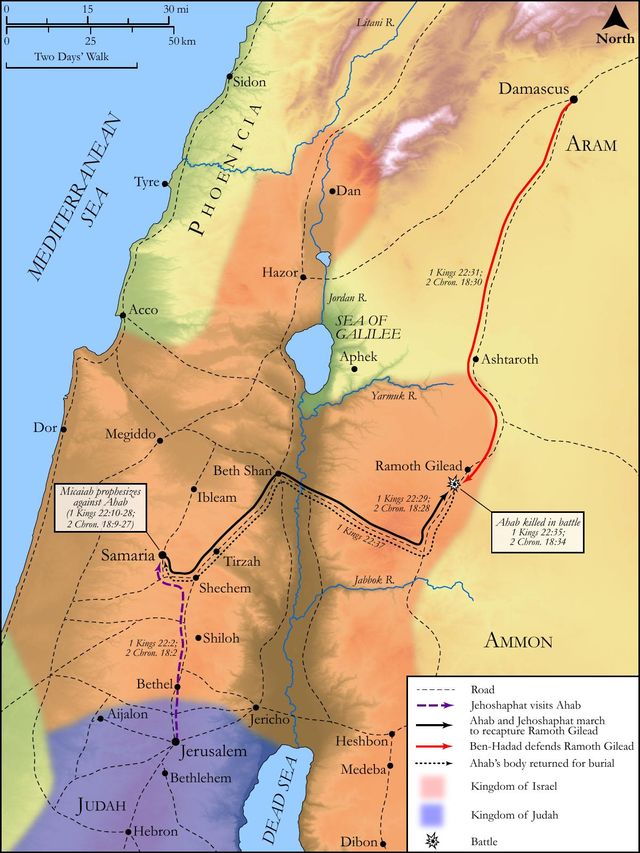
The alliance between the Northern Kingdom of Israel (under Ahab) and the Southern Kingdom of Judah (under Jehoshaphat) was a significant, though often precarious, political maneuver in ancient Israel, solidified by a marriage alliance (2 Chronicles 18:1). Ahab's reign was notoriously marked by widespread Baal worship, heavily influenced by his Phoenician wife, Jezebel, and a general persecution of Yahweh's prophets. In this cultural milieu, court prophets were common, often serving as royal advisors who delivered messages pleasing to the king, rather than challenging divine truth. Ramoth-Gilead was a strategically important city in Transjordan, frequently contested between Israel and Aram (Syria). Jehoshaphat, though generally a righteous king who sought the LORD (2 Chronicles 17:4), had entered into a compromising alliance, which ultimately led to divine rebuke (2 Chronicles 19:2).
Key Themes
ShowHideThis verse powerfully contributes to several key themes within 2 Chronicles and the broader biblical narrative. Firstly, it underscores the theme of spiritual discernment, showcasing Jehoshaphat's ability to perceive falsehood even when presented by a large, seemingly authoritative group. Secondly, it highlights the critical distinction between true and false prophecy, emphasizing that God's authentic word often contradicts human desires or popular opinion. Thirdly, it speaks to the importance of seeking God's authentic will in all matters, especially significant undertakings like warfare, even when one is in a compromising situation. Finally, it subtly foreshadows the consequences of ungodly alliances, as Jehoshaphat's initial political expediency, despite his later spiritual insight, ultimately places him in grave danger and draws divine disapproval.
Exposition and Analysis
ShowHideKey Word Analysis
ShowHideThis term, derived from a root meaning "to bubble forth" or "to announce," refers to one who is called by God to speak on His behalf, acting as a divine spokesperson. In ancient Israel, prophets delivered messages, warnings, and guidance from Yahweh. Jehoshaphat's specific request for a "prophet of the LORD" highlights his understanding that not all who claim the title "prophet" genuinely speak for the true God, especially in a kingdom where Baal worship was prevalent and many "prophets" served other gods or simply flattered the king.
The use of the covenant name of God, Yahweh (often rendered "LORD" in English translations), is crucial here. It distinguishes the true, self-existent God of Israel from the pagan deities like Baal or Asherah, whose prophets filled Ahab's court. Jehoshaphat is not merely seeking any spiritual guidance; he is specifically seeking a word from the one true God, indicating his commitment to Yahweh despite his alliance with the idolatrous Ahab. His spiritual antenna is attuned to the source of the message, not just its content.
This primitive root means "to tread or frequent," and by implication, "to seek or ask." In this context, it signifies to consult, seek, or make inquisition, often in a religious or judicial context to obtain an oracle or divine instruction. Jehoshaphat's desire to "enquire of him" indicates a serious intent to seek authoritative divine guidance for the battle, rather than merely seeking advice or affirmation. It implies a deep spiritual seeking for truth and direction.
Verse Breakdown
ShowHide"But Jehoshaphat said,"
This opening clause marks a significant pause and shift in the narrative. It signals Jehoshaphat's distinct perspective and independent thought, interrupting the unanimous, yet suspect, pronouncements of Ahab's 400 prophets. It underscores his role as a discerning leader, not easily swayed by popular opinion or political pressure, even when it comes from his ally.
"[Is there] not here a prophet of the LORD besides,"
This is a rhetorical question that carries the weight of a strong plea or demand. Jehoshaphat is not genuinely asking if such a prophet exists, but rather expressing his dissatisfaction and deep suspicion regarding the 400 prophets present. He specifically emphasizes "of the LORD" (Yahweh), indicating his desire for a true, uncompromised word from God, distinct from the likely flattering and false prophecies he has just heard. The word "besides" (עוֹד, ‘ôd) implies "yet another" or "still," suggesting that the current prophets are insufficient or untrustworthy.
"that we might enquire of him?"
This final clause states the purpose of Jehoshaphat's request. He seeks to consult this true prophet to obtain genuine divine guidance for the military campaign. This highlights his understanding that the success of their endeavor depends not on human strength or popular opinion, but on the authentic will and blessing of God, revealing a core tenet of his faith despite his compromised alliance.
Literary Devices
ShowHideThe verse effectively employs several literary devices. The primary device is a Rhetorical Question, "Is there not here a prophet of the LORD besides...?" This is not a genuine inquiry for information but a forceful expression of Jehoshaphat's deep skepticism and spiritual yearning for authentic divine counsel. It serves to highlight his discernment and dissatisfaction with the false prophets. There is also a strong Contrast implicitly drawn between the 400 prophets of Ahab's court and the singular "prophet of the LORD" that Jehoshaphat seeks, setting up the dramatic confrontation with Micaiah. This contrast underscores the qualitative difference between human-pleasing pronouncements and God's unvarnished truth. Furthermore, the verse functions as Foreshadowing, signaling that the initial consensus of the 400 prophets is flawed and that a different, true word from God is imminent, which will ultimately lead to a disastrous outcome for Ahab. Finally, it serves as a powerful piece of Characterization for Jehoshaphat, revealing his spiritual integrity and wisdom despite his compromised political alliance.
Theological and Thematic Connections
ShowHideJehoshaphat's discerning question in 2 Chronicles 18:6 resonates deeply with the enduring biblical theme of discerning truth from falsehood, a critical spiritual discipline for all believers. In a world saturated with competing voices, ideologies, and claims of spiritual authority, the ability to distinguish between genuine divine revelation and human invention or deception is paramount. God's truth, often challenging and counter-cultural, frequently stands in stark contrast to popular opinion, self-serving narratives, or messages that merely affirm human desires. Jehoshaphat's insistence on a "prophet of the LORD" underscores the necessity of seeking counsel rooted in the authentic character and revealed will of God, rather than succumbing to the pressure of consensus or the allure of flattering words. This principle is foundational to maintaining spiritual integrity and making decisions aligned with divine wisdom.
Reflection and Application
ShowHideJehoshaphat's profound discernment in 2 Chronicles 18:6 offers a timeless lesson for believers navigating the complexities of modern life. In an age of information overload, social media echo chambers, and diverse spiritual claims, the ability to "test the spirits" and discern truth from error is more crucial than ever. We are constantly bombarded with voices—from media, political figures, self-proclaimed gurus, and even within religious circles—that may sound convincing or appealing but lack genuine divine authority. Like Jehoshaphat, we must cultivate a healthy skepticism toward popular consensus, especially when it promises easy solutions or aligns perfectly with our preconceived desires. This requires grounding ourselves deeply in the unchanging Word of God, seeking the illumination of the Holy Spirit, and humbly submitting to the counsel of wise, biblically faithful mentors. Our ultimate aim should always be to hear the authentic voice of God, even if it challenges our comfort or contradicts our plans, for only His truth leads to genuine life and lasting wisdom.
Questions for Reflection
ShowHideFAQ
ShowHideWhy was Jehoshaphat allied with Ahab in the first place?
ShowHideJehoshaphat's alliance with Ahab, sealed by a marriage between their children (2 Chronicles 18:1), was likely a strategic political and military decision. While Jehoshaphat was generally a righteous king who sought the LORD, such alliances were common ways for ancient kingdoms to secure borders, consolidate power, or gain military advantage. However, from a spiritual perspective, this alliance with the idolatrous Ahab was a compromise that ultimately brought Jehoshaphat into grave danger and later drew a sharp rebuke from the prophet Jehu (2 Chronicles 19:2).
What was the significance of "prophet of the LORD" versus just "prophet"?
ShowHideThe distinction is critical. In the context of Ahab's kingdom, which was heavily influenced by Baal worship, there were many who claimed the title "prophet" but served pagan deities or simply flattered the king. The phrase "prophet of the LORD" (נָבִיא יְהוָה, nāḇî' YHWH) specifically designates a prophet who speaks for Yahweh, the covenant God of Israel. Jehoshaphat's insistence on this specific phrasing reveals his spiritual acumen: he was not looking for just any oracle or politically convenient advice, but for a true, uncompromised word from the one true God, the God of Abraham, Isaac, and Jacob.
How does this story relate to testing prophecies today?
ShowHideThis narrative provides a timeless model for spiritual discernment. Just as Jehoshaphat refused to accept the unanimous, yet suspect, consensus of the 400 prophets, believers today are called to critically evaluate all spiritual claims and messages. The New Testament echoes this principle, urging us to "test the spirits whether they are of God" (1 John 4:1). This means comparing what is said with the unchanging truth of God's written Word (Acts 17:11) and relying on the Holy Spirit for discernment (1 Corinthians 12:10). True prophecy and divine guidance will always align with God's character and revealed will, even if it is unpopular or challenging to our human desires.
Christ-Centered Fulfillment
ShowHideJehoshaphat's earnest quest for a "prophet of the LORD" in 2 Chronicles 18:6 finds its ultimate and perfect fulfillment in Jesus Christ. While Jehoshaphat sought a temporary human voice to speak God's will, the New Testament reveals Jesus as the supreme and final Prophet, the very Word of God incarnate (John 1:1). He is the one whom Moses foretold, the Prophet like himself, whom all must hear (Deuteronomy 18:15; Acts 3:22). Unlike the false prophets who spoke what kings wanted to hear, Jesus consistently spoke the challenging, life-giving truth of God, even when it led to His rejection and crucifixion (John 7:7). He perfectly reveals the Father's will and character, being the "radiance of God's glory and the exact representation of his being" (Hebrews 1:1-3). For believers today, discerning God's voice is no longer primarily through human prophets, but by listening to the voice of the Chief Shepherd, Jesus Christ, through His revealed Word and by the guidance of the Holy Spirit, whom He sent to lead us into all truth (John 16:13). Jesus is the ultimate "prophet of the LORD" who has spoken God's final and complete word to humanity.