


1 Kings 22:7
Bible text: King James Version (1769 Blayney text) · Public domain
Bible text: Berean Standard Bible · Public domain
Bible text: American Standard Version (1901) · Public domain
Bible text: World English Bible, Messianic edition · Public domain
Bible text: Geneva Bible (1599) · Public domain
Bible text: Young's Literal Translation · Public domain
- וַיֹּאמֶרvai·Yo·merand he saidH559Conj-w ¦ V-Qal-ConsecImperf-3msVerb Qal Consecutive Imperfect 3rd Singular Masculineוַandיֹּאמֶרhe said
- יְהוֹשָׁפָטye·Ho·o·sha·FatJehoshaphatH3092N-proper-mNoun Proper Masculine
- הַאֵיןha·'Ein¿ [is] there notH369Interrog ¦ N-mscNoun Singular Masculine Constructהַ¿אֵין[is] there not
- פֹּהpohhereH6311AdvAdverb
- נָבִיאna·Vi'a prophetH5030N-msNoun Singular Masculine Absolute
- לַיהוָהla·Yah·wehof YahwehH3068Prep-l ¦ N-properNoun Proper TitleלַofיהוָהYahweh
- עוֹדodstillH5750Adj-msAdjective Numerical Singular Masculine Absolute
- וְנִדְרְשָׁהve·nid·re·Shahso we may enquireH1875Conj-w ¦ V-Qal-Imperf-1cpVerb Qal Imperfect 1st Plural common genderוְsoנִדְרְשָׁהwe may enquire
- מֵאוֹתוֹme·'o·Tofrom <obj.> himH853Prep-m ¦ DirObjM ¦ 3msParticle Object Indicatorמֵfromאוֹת<obj.>וֹhim
English is a literal word-by-word gloss of the Hebrew, not the KJV's wording. Why?
This is the original text the KJV's translators worked from — each Hebrew word with its own literal English meaning in this verse, prepared by scholars at Tyndale House, Cambridge. The KJV translates whole sentences, not word by word, so its wording differs: one Hebrew word can become several English words, and the KJV may choose “the LORD” where the gloss reads “Yahweh”. Both are faithful — they answer different questions. For the KJV's own rendering, switch to the KJV text.
Details
See on the biblical-era maps
Study this verse
Public-domain commentary
Matthew Henry
From his Commentary on the Whole Bible. Henry comments on passages, not single verses — this entry covers 1 Kings 22:1–14. His two-level outline is real structure in the source text, so it is rendered as structure.
Though Ahab continued under guilt and wrath, and the dominion of the lusts to which he had sold himself, yet, as a reward for his professions of repentance and humiliation, though the time drew near when he should descend into battle and perish, yet we have him blessed with a three years' peace (Kg1 22:1) and an honourable visit made him by Jehoshaphat king of Judah, Kg1 22:2. The Jews have a fabulous conceit, that when Ahab humbled himself for his sin, and lay in sackcloth, he sent for Jehoshaphat to come to him, to chastise him; and that he staid with him for some time, and gave him so many stripes every day. This is a groundless tradition. He came now, it is probable, to consult him about the affairs of their kingdoms. It is strange that so great a man as Jehoshaphat would pay so much respect to a kingdom revolted from the house of David, and that so good a man should show so much kindness to a king revolted from the worship of God. But, though he was a godly man, his temper was too easy, which betrayed him into snares and inconveniences. The Syrians durst not give Ahab any disturbance. But,
I.Ahab here meditates a war against the Syrians, and advises concerning it with those about him, Kg1 22:3.
The king of Syria gave him the provocation; when he lay at his mercy, he promised to restore him his cities (Kg1 20:34), and Ahab foolishly took his word, when he ought not to have dismissed him till the cities were put into his possession. But now he knows by experience, what he ought before to have considered, that as the kisses, so the promises, of an enemy are deceitful, and there is no confidence to be put in leagues extorted by distress. Benhadad is one of those princes that think themselves bound by their word no further and no longer than it is for their interest. Whether any other cities were restored we do not find, but Ramoth-Gilead was not, a considerable city in the tribe of Gad, on the other side Jordan, a Levites' city, and one of the cities of refuge. Ahab blames himself, and his people, that they did not bestir themselves to recover it out of the hands of the Syrians, and to chastise Ben-hadad's violation of his league; and resolves to let that ungrateful perfidious prince know that as he had given him peace he could give him trouble. Ahab has a good cause, yet succeeds not. Equity is not to be judged of by prosperity.
II.He engages Jehoshaphat, and draws him in, to join with him in this expedition, for the recovery of Ramoth-Gilead, Kg1 22:4.
And here I do not wonder that Ahab should desire the assistance of so pious and prosperous a neighbour. Even bad men have often coveted the friendship of the good. It is desirable to have an interest in those that have an interest in heaven, and to have those with us that have God with them. But it is strange that Jehoshaphat will go so entirely into Ahab's interests as to say, I am as thou art, and my people as thy people. I hope not; Jehoshaphat and his people are not so wicked and corrupt as Ahab and his people. Too great a complaisance to evildoers has brought many good people, through unwariness, into a dangerous fellowship with the unfruitful works of darkness. Jehoshaphat had like to have paid dearly for his compliment when, in battle, he was taken for Ahab. Yet some observe that in joining with Israel against Syria he atoned for his father's fault in joining with Syria against Israel, Kg1 15:19, Kg1 15:20.
III.At the special instance and request of Jehoshaphat, he asks counsel of the prophets concerning this expedition.
Ahab thought it enough to consult with his statesmen, but Jehoshaphat moves that they should enquire of the word of the Lord, Kg1 22:5. Note,
1.Whithersoever a good man goes he desires to take God along with him, and will acknowledge him in all his ways, ask leave of him, and look up to him for success.
2.Whithersoever a good man goes he ought to take his religion along with him, and not be ashamed to own it, no, not when he is with those who have no kindness for it. Jehoshaphat has not left behind him, at Jerusalem, his affection, his veneration, for the word of the Lord, but both avows it and endeavours to introduce it into Ahab's court. If Ahab drew him into his wars, he will draw Ahab into his devotions.
IV.Ahab's 400 prophets, the standing regiment he had of them (prophets of the groves they called them), agreed to encourage him in this expedition and to assure him of success, Kg1 22:6. He put the question to them with a seeming fairness: Shall I go or shall I forbear? But they knew which way his inclination was and designed only to humour the two kings. To please Jehoshaphat, they made use of the name Jehovah: He shall deliver it into the hand of the king; they stole the word from the true prophets (Jer 23:30) and spoke their language. To please Ahab they said, Go up. They had indeed probabilities on their side: Ahab had, not long since, beaten the Syrians twice; he had now a good cause, and was much strengthened by his alliance with Jehoshaphat. But they pretended to speak by prophecy, not by rational conjecture, by divine, not human, foresight: "Thou shalt certainly recover Ramoth-Gilead." Zedekiah, a leading man among these prophets, in imitation of the true prophets, illustrated his false prophecy with a sign, Kg1 22:11. He made himself a pair of iron horns, representing the two kings, and their honour and power (both of which were signified by horns, exaltation and force), and with these the Syrians must be pushed. All the prophets agreed, as one man, that Ahab should return from this expedition a conqueror, Kg1 22:12. Unity is not always the mark of a true church and a true ministry. Here were 400 men that prophesied with one mind and one mouth, and yet all in an error.
V.Jehoshaphat cannot relish this sort of preaching; it is not like what he was used to.
The false prophets cannot so mimic the true but that he who had spiritual senses exercised could discern the fallacy, and therefore he enquired for a prophet of the Lord besides, Kg1 22:7. He is too much of a courtier to say any thing by way of reflection on the king's chaplains, but he waits to see a prophet of the Lord, intimating that he could not look upon these to be so. They seemed to be somewhat (whatever they were, it made no matter to him), but, in conference, they added nothing to him, they gave him no satisfaction, Gal 2:6. One faithful prophet of the Lord was worth them all.
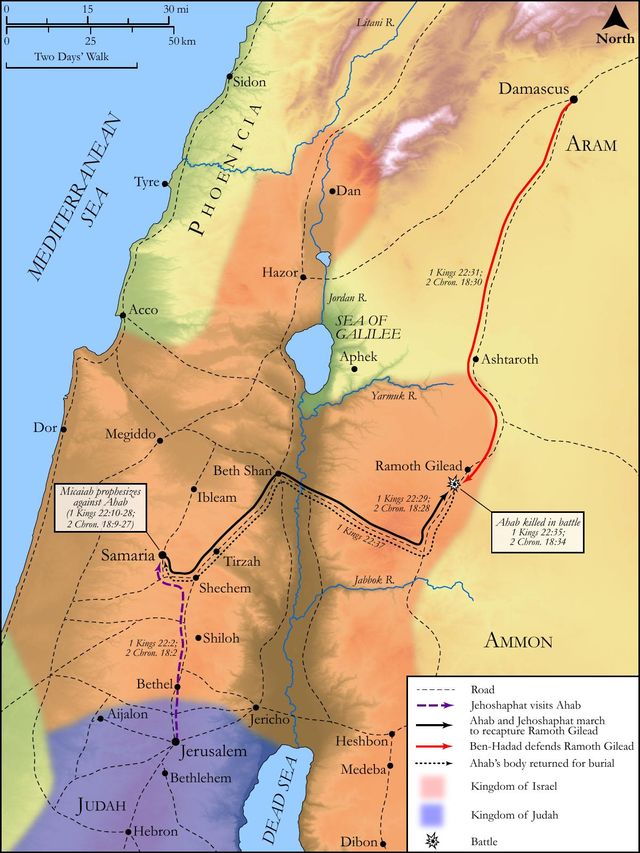
VI.Ahab has another, but one he hates, Micaiah by name, and, to please Jehoshaphat, he is willing to have him sent for, Kg1 22:8-10.
Ahab owned that they might enquire of the Lord by him, that he was a true prophet, and one that knew God's mind. And yet,
1.He hated him, and was not ashamed to own to the king of Judah that he did so, and to give this for a reason. He doth not prophesy good concerning me, but evil. And whose fault was that? If Ahab had done well, he would have heard nothing but good from heaven; if he do ill, he may thank himself for all the uneasiness which the reproofs and threats of God's word gave him. Note, Those are wretchedly hardened in sin, and are ripening apace for ruin, who hate God's ministers because they deal plainly with them and faithfully warn them of their misery and danger by reason of sin, and reckon those their enemies that tell them the truth.
2.He had (it should seem) imprisoned him; for, when he committed him (Kg1 22:26), he bade the officer carry him back, namely, to the place whence he came. We may suppose that this was he that reproved him for his clemency to Ben-hadad (Kg1 20:38, etc.) and for so doing was cast into prison, where he had lain these three years. This was the reason why Ahab knew where to find him so readily, Kg1 22:9. But his imprisonment had not excluded him for divine visits: the spirit of prophecy continued with him there. He was bound, but the word of the Lord was not. Nor did it in the lease abate his courage, nor make him less confident or faithful in delivering his message. Jehoshaphat gave too gentle a reproof to Ahab for expressing his indignation against a faithful prophet: Let not the king say so, Kg1 22:8. He should have said, "Thou art unjust to the prophet, unkind to thyself, and puttest an affront upon his Lord and thine, in saying so." Such sinners as Ahab must be rebuked sharply. However he so far yielded to the reproof that, for fear of provoking Jehoshaphat to break off from his alliance with him, he orders Micaiah to be sent for with all speed, Kg1 22:9. The two kings sat each in their robes and chairs of state, in the gate of Samaria, ready to receive this poor prophet, and to hear what he had to say; for many will give God's word the hearing that will not lend it an obedient ear. They were attended with a crowd of flattering prophets, that could not think of prophesying any thing but what was very sweet and very smooth to two such glorious princes now in confederacy. Those that love to be flattered shall not want flatterers.
VII.Micaiah is pressed by the officer that fetches him to follow the cry, Kg1 22:13.
That officer was unworthy the name of an Israelite who pretended to prescribe to a prophet; but he thought him altogether such a one as the rest, who studied to please men and not God. He told Micaiah how unanimous the other prophets were in foretelling the king's good success, how agreeable it was to the king, intimating that it was his interest to say as they said - he might thereby gain, not only enlargement, but preferment. Those that dote upon worldly things themselves think every body else should do so too, and true or false, right or wrong, speak and act for their secular interest only. He intimated likewise that it would be to no purpose to contradict such a numerous and unanimous vote; he would be ridiculed, as affecting a foolish singularity, if he should. But Micaiah, who knows better things, protests, and backs his protestation with an oath, that he will deliver his message from God with all faithfulness, whether it be pleasing or displeasing to his prince (Kg1 22:14): "What the Lord saith to me, that will I speak, without addition, diminution, or alteration." This was nobly resolved, and as became one who had his eye to a greater King than either of these, arrayed with brighter robes, and sitting on a higher throne.
Continue studying 1 Kings 22:7 across the web’s major study libraries — every link below opens this exact verse, chapter, or book on the destination site.
Read & Compare
 BibleGatewayThis verse in more than 200 translations and 70 languages.
 Bible.comThe YouVersion reader — hundreds of translations, reading plans, and highlights.
 ESV.orgCrossway's official English Standard Version reader.
 NET BibleThe NET translation with 60,000+ translators' notes on every rendering decision.
 STEP BibleTyndale House's free study tool — original text, vocabulary, and scholarly resources.
 BibliaLogos Bible Software's free web reader.
 USCCBThe New American Bible (Revised Edition) with the U.S. bishops' study notes.
Commentaries
 BibleHub CommentariesDozens of classic commentaries on this verse, gathered on one page.
 StudyLightMore than 100 commentary sets — the largest collection on the web.
 BibleRefPlain-English commentary on what this verse means, verse by verse.
 Enduring WordDavid Guzik's free commentary on this chapter, widely used by Bible teachers.
 Bible Study ToolsVerse commentary alongside Greek and Hebrew study aids.
Original Language & Research
- BibleHub InterlinearThe verse word by word — original language, transliteration, and English.
- BibleHub LexiconEvery word's original-language definition and Strong's entry.
 Blue Letter BibleDeep-study tools — Strong's numbers, concordance, and word studies.
 SefariaThe Hebrew text with Rashi and centuries of Jewish commentary.
Sermons, Hymns & Audio


TrulyRandomVerse is not affiliated with these sites and doesn’t control their content. They’re linked because they’re genuinely useful.
Summary
1 Kings 22:7 captures a pivotal moment in the uneasy alliance between King Ahab of Israel and King Jehoshaphat of Judah, as they deliberate a military campaign against Ramoth-Gilead. Despite the unanimous and favorable prophecies delivered by Ahab's 400 court prophets, Jehoshaphat, demonstrating profound spiritual discernment, voices a crucial question: "Is there not here a prophet of the LORD besides, that we might enquire of him?" This inquiry not only exposes the superficiality of Ahab's prophetic counsel but also underscores Jehoshaphat's unwavering commitment to seeking authentic divine guidance from the one true God, distinguishing genuine revelation from politically motivated flattery or popular consensus.
Context
ShowHideLiterary Context
This verse serves as a critical narrative pivot, immediately following the scene where King Ahab consults his 400 court prophets, who, with striking unanimity, assure him of victory in the impending battle for Ramoth-Gilead (1 Kings 22:6). Jehoshaphat's discerning question introduces a stark and profound contrast between the deceptive assurances of these sycophantic prophets and the uncomfortable, yet truthful, word of Yahweh, which is soon to be delivered by Micaiah ben Imlah. This moment is essential for understanding the unfolding tragedy of Ahab's reign, as it highlights his persistent pattern of rejecting divine warnings and embracing falsehoods, a characteristic seen throughout his rule, particularly in his promotion of Baal worship (1 Kings 16:30-33). The tension between true prophetic witness and corrupt royal power is a recurring and central theme throughout the books of 1 and 2 Kings, making Jehoshaphat's query a microcosm of the broader theological conflict.
Historical & Cultural Context
The historical backdrop for 1 Kings 22:7 is approximately 853 BCE, a period marked by complex dealings among the kingdoms round about Israel. King Ahab of the northern kingdom of Israel and King Jehoshaphat of the southern kingdom of Judah have formed an alliance, a significant diplomatic shift given their historical tensions. Ramoth-Gilead, a strategically vital city in Transjordan, was a contested territory between Israel and Aram (Syria). In ancient Israel, prophets held a unique and authoritative role as divine messengers, advising kings and the populace on matters of national policy, warfare, and justice. However, a crucial distinction existed between true prophets of the LORD, who often delivered unpopular truths, and "court prophets" or false prophets, who might speak what the king desired to hear, often for personal gain or out of fear. Ahab's 400 prophets likely belonged to the latter category, possibly even engaging in syncretistic practices that blended Yahwism with Baal worship, given Ahab's zealous promotion of Baalism (1 Kings 18). Jehoshaphat, renowned for his devotion to the LORD and his efforts to eradicate idolatry from Judah (2 Chronicles 17:3-6), would have been acutely aware of this distinction and inherently suspicious of any prophecy not genuinely rooted in Yahweh's unadulterated will.
Key Themes
ShowHideThis verse powerfully illuminates several profound theological and narrative themes. Foremost is Spiritual Discernment; Jehoshaphat, despite the overwhelming numerical consensus of 400 prophets, perceives a spiritual void in their pronouncements. His ability to distinguish between genuine divine counsel and human-driven rhetoric exemplifies a critical spiritual faculty, highlighting the enduring importance of seeking truth over popularity or convenience, a principle echoed in Proverbs 14:12. Secondly, the verse underscores the necessity of Seeking Authentic Divine Will, not merely a divine endorsement of one's pre-conceived plans. Jehoshaphat's insistence on finding "a prophet of the LORD" reveals a deep, reverent desire for Yahweh's true word, even if it might contradict royal desires or political expediency. This stands in stark contrast to Ahab's clear preference for agreeable falsehoods. Finally, it speaks to Integrity in Leadership. Even within the confines of a military alliance, Jehoshaphat prioritizes spiritual fidelity, demonstrating that true leadership demands an unwavering commitment to God's will above all else, even when it means challenging the status quo or risking diplomatic friction. This commitment to God's ways is a hallmark of righteous kingship, as exemplified by David's prayer for guidance in Psalm 25:4-5.
Exposition and Analysis
ShowHideKey Word Analysis
ShowHideThis term refers to one who is divinely called and appointed to speak on God's behalf, acting as His authoritative mouthpiece or oracle. The nâbîyʼ is not merely a prognosticator or a wise counselor, but a messenger who delivers God's direct word, often challenging societal norms, calling for repentance, or revealing divine plans and judgments. In this specific context, Jehoshaphat's pointed request for a nâbîyʼ "of the LORD" (YHWH) emphatically highlights his desire for a legitimate, divinely commissioned spokesperson, one distinct from the numerous false prophets who might claim divine inspiration or speak for other deities.
This is the sacred, covenantal, and personal name of God, famously revealed to Moses at the burning bush (Exodus 3:14). Its explicit inclusion by Jehoshaphat is profoundly significant. It signifies his precise theological intent: he seeks a prophet who speaks for the God of Israel, the one true and living God, as opposed to the prophets of Baal, Asherah, or any other pagan deity. It also distinguishes between those who might superficially invoke YHWH's name but whose words are not genuinely inspired by His character and will. This emphasizes Jehoshaphat's unwavering commitment to the exclusive worship of Yahweh.
This verb denotes "to seek," "to consult," or "to inquire," often carrying the connotation of diligent, earnest, and reverent seeking, particularly concerning God's will, presence, or instruction. Jehoshaphat's use of dârash indicates a serious, humble, and profound desire for divine guidance, far from a casual or superficial consultation. It implies a readiness to submit to the answer, whatever it may be, reflecting a posture of humility and dependence before God's sovereign authority.
Verse Breakdown
ShowHide"And Jehoshaphat said,"
This opening phrase immediately draws attention to Jehoshaphat's decisive intervention, underscoring his active role and the gravitas of his impending words. It marks a significant pause in the narrative, shifting the focus from Ahab's complacent consultation to Jehoshaphat's discerning spiritual inquiry, setting the stage for a critical turning point.
"[Is there] not here a prophet of the LORD besides,"
This rhetorical question is laden with spiritual discernment and a subtle, yet firm, challenge to Ahab's assembled prophets. Jehoshaphat's use of "besides" (Hebrew: ʻôwd, H5750) implicitly suggests that the 400 prophets already consulted are either insufficient in number or, more critically, illegitimate in their divine authority. His explicit emphasis on "a prophet of the LORD" (YHWH) underscores his unwavering commitment to seeking authentic divine revelation, distinguishing true prophecy from mere human opinion, flattery, or even syncretistic pronouncements.
"that we might enquire of him?"
This concluding clause articulates the profound purpose behind Jehoshaphat's search: to genuinely seek and receive God's authoritative will. The use of the plural "we" includes Ahab, indicating Jehoshaphat's earnest desire for both kings to receive true divine counsel before embarking on a potentially disastrous military campaign. It reflects a posture of humble dependence on God's wisdom, rather than relying solely on human strategy, political expediency, or popular consensus.
Literary Devices
ShowHide1 Kings 22:7 is rich with potent literary devices that amplify its theological and narrative impact. The most prominent is the Rhetorical Question, where Jehoshaphat's query, "Is there not here a prophet of the LORD besides, that we might enquire of him?", functions not as a request for information but as a powerful expression of his conviction and a catalyst for action—the search for a true prophet. This question immediately establishes a profound Contrast between the multitude of 400 false prophets, who speak with a unified, yet deceptive, voice, and the singular, true prophet of the LORD, highlighting the qualitative difference between divine truth and human deception. Furthermore, the verse employs Foreshadowing, as Jehoshaphat's discerning question directly anticipates the arrival of Micaiah, the genuine prophet, and the subsequent delivery of an unwelcome, yet accurate, prophecy that directly contradicts the prevailing narrative. Finally, the scene is imbued with Dramatic Irony, as the audience, privy to Ahab's deep-seated wickedness and the true nature of God's impending judgment, understands that the 400 prophets are speaking falsely, while Ahab remains either oblivious or willfully ignorant, thereby setting the stage for his tragic and inevitable demise.
Theological and Thematic Connections
ShowHideJehoshaphat's discerning question in 1 Kings 22:7 stands as a timeless theological anchor, emphasizing the critical and enduring importance of seeking authentic divine guidance above all else. It profoundly underscores that truth is not determined by popular consensus, numerical majority, or the loudest voices, but solely by its alignment with the immutable character and revealed will of God. This passage powerfully highlights God's unwavering commitment to communicate His truth to humanity, even when that truth is unwelcome or challenging, and humanity's solemn responsibility to discern, embrace, and submit to that truth, regardless of personal cost, societal pressure, or political expediency. It speaks to the ongoing, universal struggle between spiritual authenticity and human expediency, serving as a poignant reminder to all believers that true wisdom originates from the fear of the LORD and a humble, obedient submission to His authoritative word.
Reflection and Application
ShowHideJehoshaphat's profound spiritual sensitivity and unwavering commitment to truth in 1 Kings 22:7 offer invaluable lessons for contemporary believers navigating a world saturated with information, opinions, and competing voices. The ability to discern the authentic voice of God amidst the clamor of human perspectives, cultural trends, and personal desires is more vital now than ever before. We are challenged to cultivate a heart that prioritizes God's unwavering truth, even when it is counter-cultural, unpopular, or personally inconvenient. This requires a diligent and deep immersion in God's inspired Word, a humble reliance on the Holy Spirit for spiritual discernment, and a courageous willingness to question narratives, ideologies, or even personal inclinations that do not align with foundational biblical principles. Like Jehoshaphat, we must never be swayed by the majority, by those who tell us only what we wish to hear, or by the allure of convenience. Instead, we must diligently and earnestly seek the genuine counsel of the Lord, trusting implicitly that His ways are always ultimately best, even when they lead us through difficult or unexpected paths.
Questions for Reflection
ShowHideFAQ
ShowHideWhy was Jehoshaphat suspicious of Ahab's 400 prophets?
ShowHideJehoshaphat's suspicion stemmed from his genuine spiritual discernment, deeply rooted in his personal devotion to the LORD. While Ahab's 400 prophets delivered a unanimous and enthusiastically positive message of victory, Jehoshaphat, a righteous king who "walked in the first ways of his father David" (2 Chronicles 17:3), likely sensed that their words lacked the authentic ring of divine inspiration. True prophets of the LORD often spoke challenging or unpopular truths, and their prophecies typically carried a profound weight and divine authority that was distinct from mere flattery or political expediency. Given Ahab's notorious idolatry and the pervasive syncretistic religious climate in the northern kingdom of Israel (1 Kings 16:30-33), Jehoshaphat would have been acutely aware of the prevalence of false prophets and the inherent dangers of seeking counsel from those not genuinely aligned with Yahweh. His direct question, "Is there not here a prophet of the LORD besides," unequivocally indicates his earnest desire for a prophet who truly spoke for the God of Israel, not merely for the king's agenda or personal desires.
Christ-Centered Fulfillment
ShowHideJehoshaphat's earnest and discerning quest for "a prophet of the LORD" in 1 Kings 22:7 finds its ultimate, perfect, and complete fulfillment in the person of Jesus Christ. While Jehoshaphat sought a human messenger to articulate God's word, Jesus is the very Word of God incarnate, the supreme and final Prophet (John 1:1-14). He is the one of whom Moses prophetically spoke, declaring, "The LORD your God will raise up for you a prophet like me from among you, from your brothers—him you shall listen to" (Deuteronomy 18:15). Unlike the 400 sycophantic prophets who merely echoed Ahab's desires, or even Micaiah who delivered an unwelcome but true word, Jesus consistently spoke the Father's perfect and unvarnished will, regardless of popular opinion, personal cost, or societal rejection (John 8:28). He is the very embodiment of divine truth, the one through whom God has spoken His final, most complete, and authoritative revelation to humanity (Hebrews 1:1-3). In Him, the search for "a prophet besides" ceases, for He is the Way, the Truth, and the Life, the ultimate and inexhaustible source of all divine wisdom and guidance for all who genuinely seek to inquire of the LORD (John 14:6).