


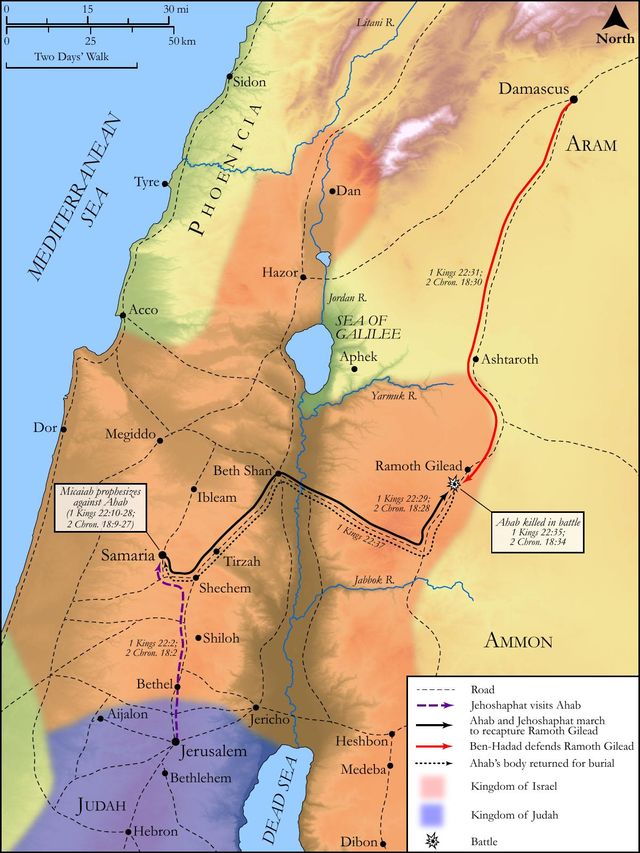
2 Chronicles 18:9
- וּמֶלֶךְu·Me·lekhand [the] king ofH4428Conj-w ¦ N-mscNoun Singular Masculine Constructוּandמֶלֶךְ[the] king of
- יִשְׂרָאֵלYis·ra·'ElIsraelH3478N-properNoun Proper Location
- וִיהוֹשָׁפָטvi·ho·sha·Fatand JehoshaphatH3092Conj-w ¦ N-proper-mNoun Proper MasculineוִandיהוֹשָׁפָטJehoshaphat
- מֶלֶךְMe·lekh[the] king ofH4428N-mscNoun Singular Masculine Construct
- יְהוּדָהye·hu·DahJudahH3063N-properNoun Proper Location
- יוֹשְׁבִיםyo·she·Vim[were] sittingH3427V-Qal-Prtcpl-mpVerb Qal Participle Plural Masculine Absolute
- אִישׁ'isheachH376N-msNoun Singular Masculine Absolute
- עַל'alonH5921PrepPreposition
- כִּסְאוֹkis·'Ohis throneH3678N-msc ¦ 3msNoun Singular Masculine Constructכִּסְאthroneוֹhis
- מְלֻבָּשִׁיםme·lu·ba·ShimclothedH3847V-Pual-PassPrtcpl-mpVerb Pual Participle Passive Plural Masculine Absolute
- בְּגָדִיםbe·ga·DimgarmentsH899N-mpNoun Plural Masculine Absolute
- וְיֹשְׁבִיםve·yo·she·Vimand sittingH3427Conj-w ¦ V-Qal-Prtcpl-mpVerb Qal Participle Plural Masculine Absoluteוְandיֹשְׁבִיםsitting
- בְּגֹרֶןbe·Go·renat [the] threshing floorH1637Prep-b ¦ N-fsNoun Singular Feminine Absoluteבְּatגֹרֶן[the] threshing floor
- פֶּתַחPe·tach[the] entrance ofH6607N-mscNoun Singular Masculine Construct
- שַׁעַרSha·'ar[the] gate ofH8179N-mscNoun Singular Masculine Construct
- שֹׁמְרוֹןsho·me·RonSamariaH8111N-properNoun Proper Location
- וְכָלve·kholand allH3605Conj-w ¦ N-mscNoun Singular Masculine Constructוְandכָלall
- הַנְּבִיאִיםha·ne·vi·'Imthe prophetsH5030Art ¦ N-mpNoun Plural Masculine Absoluteהַtheנְּבִיאִיםprophets
- מִתְנַבְּאִיםmit·na·be·'Im[were] prophesyingH5012V-Hithpael-Prtcpl-mpVerb Hithpael Participle Plural Masculine Absolute
- לִפְנֵיהֶםlif·nei·Hem<to> before themH6440Prep-l ¦ N-mpc ¦ 3mpNoun Plural Masculine Constructלִ<to>פְנֵיbeforeהֶםthem
English is a literal word-by-word gloss of the Hebrew, not the KJV's wording. Why?
This is the original text the KJV's translators worked from — each Hebrew word with its own literal English meaning in this verse, prepared by scholars at Tyndale House, Cambridge. The KJV translates whole sentences, not word by word, so its wording differs: one Hebrew word can become several English words, and the KJV may choose “the LORD” where the gloss reads “Yahweh”. Both are faithful — they answer different questions. For the KJV's own rendering, switch to the KJV text.
Details
See on the biblical-era map
Study this verse
Public-domain commentary
Matthew Henry
From his Commentary on the Whole Bible. Henry comments on passages, not single verses — this entry covers 2 Chronicles 18:4–27.
This is almost word for word the same with what we had, 1 Kings 22. We will not repeat what was there said, nor have we much to add, but may take occasion to think, 1. Of the great duty of acknowledging God in all our ways and enquiring at his word, whatever we undertake. Jehoshaphat was not willing to proceed till he had done this, Ch2 18:4. By particular believing prayer, by an unbiased consultation of the scripture and our own consciences, and by an observant regard to the hints of providence, we may make such enquiries and very much to our satisfaction. 2. Of the great danger of bad company even to good men. Those that have more wisdom, grace, and resolution, cannot be sure that they can converse familiarly with wicked people and get no hurt by them. Jehoshaphat here, in complaisance to Ahab, sits in his robes, patiently hearing the false prophets speaking lies in the name of the Lord (Ch2 18:9), can scarcely find in his heart to give him a too mild and gentle reproof for hating a prophet of the Lord (Ch2 18:7), and dares not rebuke that false prophet who basely abused the faithful seer nor oppose Ahab who committed him to prison. Those who venture among the seats of the scornful cannot come off without a great deal of the guilt attaching to at least the omission of their duty, unless they have such measures of wisdom and courage as few can pretend to. 3. Of the unhappiness of those who are surrounded with flatterers, especially flattering prophets, who cry peace to them and prophesy nothing but smooth things. Thus was Ahab cheated into his ruin, and justly; for he hearkened to such, and preferred those that humoured him before a good prophet that gave him fair warning of his danger. Those do best for themselves that give their friends leave, and particularly their ministers, to deal plainly and faithfully with them, and take their reproofs not only patiently, but kindly. That counsel is not always best for us that is most pleasing to us. 4. Of the power of Satan, by the divine permission, in the children of disobedience. One lying spirit can make 400 lying prophets and make use of them to deceive Ahab, Ch2 18:21. The devil becomes a murderer by being a liar and destroys men by deceiving them. 5. Of the justice of God in giving those up to strong delusions, to believe a lie, who will not receive the love of the truth, but rebel against it, Ch2 18:21. Let the lying spirit prevail to entice those to their ruin that will not be persuaded to their duty and happiness. 6. Of the hard case of faithful ministers, whose lot it has often been to be hated, and persecuted, and ill-treated, for being true to their God and just and kind to the souls of men. Micaiah, for discharging a good conscience, was buffeted, imprisoned, and condemned to the bread and water of affliction. But he could with assurance appeal to the issue, as all those may do who are persecuted for their faithfulness, Ch2 18:27. The day will declare who is in the right and who in the wrong, when Christ will appear, to the unspeakable consolation of his persecuted people and the everlasting confusion of their persecutors, who will be made to see in that day (Ch2 18:24) what they will not now believe.
Continue studying 2 Chronicles 18:9 across the web’s major study libraries — every link below opens this exact verse, chapter, or book on the destination site.
Read & Compare
 BibleGatewayThis verse in more than 200 translations and 70 languages.
 Bible.comThe YouVersion reader — hundreds of translations, reading plans, and highlights.
 ESV.orgCrossway's official English Standard Version reader.
 NET BibleThe NET translation with 60,000+ translators' notes on every rendering decision.
 STEP BibleTyndale House's free study tool — original text, vocabulary, and scholarly resources.
 BibliaLogos Bible Software's free web reader.
 USCCBThe New American Bible (Revised Edition) with the U.S. bishops' study notes.
Commentaries
 BibleHub CommentariesDozens of classic commentaries on this verse, gathered on one page.
 StudyLightMore than 100 commentary sets — the largest collection on the web.
 BibleRefPlain-English commentary on what this verse means, verse by verse.
 Enduring WordDavid Guzik's free commentary on this chapter, widely used by Bible teachers.
 Bible Study ToolsVerse commentary alongside Greek and Hebrew study aids.
Original Language & Research
- BibleHub InterlinearThe verse word by word — original language, transliteration, and English.
- BibleHub LexiconEvery word's original-language definition and Strong's entry.
 Blue Letter BibleDeep-study tools — Strong's numbers, concordance, and word studies.
 SefariaThe Hebrew text with Rashi and centuries of Jewish commentary.
Sermons, Hymns & Audio


TrulyRandomVerse is not affiliated with these sites and doesn’t control their content. They’re linked because they’re genuinely useful.
Summary
2 Chronicles 18:9 meticulously details the formal setting for a pivotal prophetic consultation between King Ahab of Israel and King Jehoshaphaphat of Judah. Seated on their thrones, arrayed in royal robes, the two monarchs convened in a public, open space, specifically a threshing floor, located at the entrance of Samaria's city gate—a traditional locus for judicial and public affairs. Before them, a multitude of prophets delivered their counsel, setting the stage for a dramatic confrontation between popular, flattering pronouncements and the singular, unvarnished truth of God's word. This scene underscores the gravity of the impending military decision and the critical role of divine guidance in kingship, while also subtly hinting at the spiritual discernment that will be required.
Context
ShowHideLiterary Context
This verse is deeply embedded within the narrative of Jehoshaphat's reign, particularly his controversial alliance with the wicked King Ahab of Israel, as detailed in 2 Chronicles 18. The preceding verses (2 Chronicles 18:1-8) establish the alliance, Ahab's desire to reclaim Ramoth-gilead, and Jehoshaphat's crucial insistence on consulting the Lord before battle. Verse 9 specifically sets the formal stage for this inquiry, immediately preceding the appearance of the 400 false prophets and the subsequent, solitary testimony of Micaiah, the true prophet of God (as seen in 2 Chronicles 18:18-27). This scene is paralleled in 1 Kings 22. The Chronicler's emphasis on the setting highlights the public nature of the impending deception and the stark contrast between human pomp and divine truth.
Historical & Cultural Context
The setting at the "entering in of the gate of Samaria" (which the KJV translates as "void place," but is more accurately understood as a threshing floor, goren) was highly significant in ancient Israelite culture. City gates were not merely entry points but served as vibrant centers for commerce, legal proceedings, public assemblies, and official pronouncements. A threshing floor, typically an open, flat area often near the city gate, was used for winnowing grain but also functioned as a spacious, accessible venue for large gatherings. The kings' attire ("clothed in their robes") and their seating on "thrones" emphasized their supreme royal authority and the solemn, official nature of the consultation. This public display ensured that the proceedings were transparent and authoritative, reflecting the cultural expectation for major decisions to be made publicly and with due ceremony, particularly when involving matters of war and state.
Key Themes
ShowHideThe verse powerfully contributes to several overarching themes within 2 Chronicles and the broader biblical narrative. It highlights the theme of royal authority and accountability, as kings, despite their power, are shown seeking divine counsel, underscoring their ultimate responsibility to God. The scene also emphasizes the critical importance of discerning true prophecy from false, a theme that becomes acutely evident as the narrative unfolds with the contrasting messages of the 400 prophets and Micaiah, echoing warnings found in Deuteronomy 13:1-5. Furthermore, it subtly introduces the dangers of unholy alliances, as Jehoshaphat's presence alongside Ahab, despite his personal piety, places him in a compromising and spiritually perilous position, a recurring motif in the Deuteronomistic History (e.g., 2 Chronicles 19:2). The very public nature of the consultation also speaks to the theme of public witness and divine judgment, as the events unfold before a gathered audience.
Exposition and Analysis
ShowHideKey Word Analysis
ShowHideThe Hebrew verb יָשַׁב (yâshab) means "to sit down," but carries significant connotations beyond mere physical posture. It can imply dwelling, remaining, settling, or taking one's place, often in a formal or authoritative capacity. Here, the kings "sat" on their thrones, indicating not just rest but the assumption of their official, judicial, and royal positions. This sitting signifies the solemnity and formal authority of the assembly, emphasizing that this was a deliberate and official consultation rather than a casual conversation.
The King James Version's translation "void place" is somewhat obscure. The Hebrew word is גֹּרֶן (gôren), which literally means "threshing floor." A threshing floor was a flat, open area, often paved, where grain was threshed and winnowed. Due to its open and accessible nature, it frequently served as a public gathering place for legal proceedings, assemblies, and official announcements. Its use here reinforces the public, formal, and judicial nature of the consultation, implying a place where truth would be "sifted" or revealed, much like grain from chaff, setting the stage for the discernment of true prophecy.
The term נָבִיא (nâbîyʼ), in its plural form נְבִיאִים (nâbîyʼim), refers to those who speak forth, specifically those who claim to speak on behalf of God. In this context, "all the prophets" refers to a large contingent of prophets in Ahab's court, likely those who were officially sanctioned and supported by the king. The verse sets the stage for the crucial distinction between these court prophets, who often delivered messages pleasing to the king, and the true prophet, Micaiah, who spoke God's unvarnished truth regardless of the consequences. The presence of "all" of them underscores the overwhelming, yet ultimately deceptive, consensus that Ahab had cultivated.
Verse Breakdown
ShowHide"And the king of Israel and Jehoshaphat king of Judah sat either of them on his throne, clothed in [their] robes"
This opening clause establishes the high status and official capacity of the two kings. "King of Israel" refers to Ahab, and "Jehoshaphat king of Judah" is explicitly named, highlighting the alliance between the northern and southern kingdoms. Their sitting "on his throne" signifies their sovereign authority and the formal nature of the assembly. "Clothed in their robes" further emphasizes their royal dignity and the solemnity of the occasion, suggesting a state ceremony rather than an informal meeting. This visual imagery immediately conveys the gravity and pomp of the moment.
"and they sat in a void place at the entering in of the gate of Samaria"
This phrase describes the specific location of the assembly. As discussed in "Key Word Analysis," "void place" is better understood as a "threshing floor" (goren). This location, at the city gate of Samaria (Ahab's capital), was a common public forum for legal judgments, commercial transactions, and important civic gatherings. Its open nature allowed for a large audience and public witness to the proceedings, underscoring the gravity and public accountability of the decisions being made. The choice of this public, well-known site adds to the formality and the expectation of a significant pronouncement.
"and all the prophets prophesied before them"
This final clause introduces the central action of the scene: the delivery of prophetic messages. The phrase "all the prophets" indicates a significant number, setting the stage for the overwhelming consensus of favorable prophecy that Ahab desired. Their act of "prophesying" implies speaking a divine message, which, in the context of the subsequent narrative, is revealed to be largely false and flattering, contrasting sharply with the lone, truthful voice of Micaiah. This clause immediately raises the question of the veracity of these many voices.
Literary Devices
ShowHideThe verse employs several literary devices to enhance its impact and foreshadow the unfolding drama. Symbolism is prominent in the setting: the "threshing floor" (goren) at the city gate symbolizes a place of public judgment and discernment, where truth is to be separated from falsehood, directly prefiguring the discernment required of the kings regarding the prophetic messages. This location, typically used for sifting grain, becomes a metaphor for sifting divine truth from human deception. The kings' Royal Display—sitting on thrones, clothed in robes—serves as a visual symbol of their earthly power and authority, yet it subtly contrasts with the ultimate spiritual authority of God's word, which they are about to hear. This juxtaposition highlights the tension between human sovereignty and divine revelation. The scene also utilizes Foreshadowing, as the formal assembly of "all the prophets" sets the stage for the dramatic confrontation between the many false prophets and the single true prophet, Micaiah, who will expose their deception and reveal God's true will. This creates a sense of impending spiritual conflict and the critical test of discernment that awaits the monarchs.
Theological and Thematic Connections
ShowHideThis verse, though descriptive, is rich with theological implications, particularly concerning divine guidance, the nature of kingship, and the critical importance of discerning truth. It highlights God's consistent expectation that His people, especially their leaders, seek His counsel in all matters, a principle deeply rooted in the covenant. The formal setting underscores the gravity of such inquiries, yet it also exposes the human tendency to prefer comforting lies over challenging truths. The presence of "all the prophets" who readily prophesy before the kings foreshadows the pervasive problem of false prophecy in Israel, where individuals claimed divine authority but spoke from their own desires or demonic influence, leading people astray. This scene serves as a stark reminder that even in seemingly pious settings, the source and content of "divine" messages must be rigorously tested against God's revealed character and word, emphasizing that popularity or consensus does not equate to truth.
Reflection and Application
ShowHideThe detailed portrayal in 2 Chronicles 18:9 serves as a timeless illustration of the critical need for discernment, especially for those in positions of leadership. Just as Ahab and Jehoshaphat sat poised to receive counsel that would determine the fate of their nations, so too are we constantly confronted with a multitude of voices—from media, culture, peers, and even within religious circles—all claiming to offer guidance or truth. This verse compels us to consider the source, nature, and alignment of the counsel we receive with the unchanging truth of God's Word. It challenges us to prioritize divine wisdom over popular opinion, personal comfort, or strategic advantage, even when the truth is unpopular or costly. Furthermore, it reminds leaders, in any sphere, of their profound responsibility to seek God's will diligently and to surround themselves with those who speak truth, not flattery, recognizing that decisions made under false counsel can have devastating consequences for themselves and those they lead. Our posture, like the kings', should be one of humble inquiry, but our ultimate allegiance must be to God's truth alone.
Questions for Reflection
ShowHideFAQ
ShowHideWhat is the significance of the "void place" or "threshing floor" at the city gate?
ShowHideThe "void place" (Hebrew gôren) is more accurately translated as a "threshing floor." This location was highly significant in ancient Israelite culture. While primarily used for processing grain, its open and accessible nature made it a common public assembly point. City gates were central hubs for legal proceedings, commercial transactions, and important civic announcements. Therefore, the threshing floor at the city gate combined practicality with symbolism: it was a spacious area for a large gathering, and culturally, it represented a place of public judgment, official pronouncements, and the "sifting" of truth, making it an ideal setting for a royal consultation where critical discernment was required. This setting underscores the public and formal nature of the kings' inquiry, emphasizing the gravity of the decisions to be made and the expectation that truth would be revealed.
Why were both kings "clothed in their robes" and seated on "thrones"?
ShowHideThe kings' attire and seating arrangement were deliberate displays of their royal authority and the official nature of the gathering. "Clothed in their robes" signifies their royal dignity and the solemnity of the occasion, indicating a state ceremony rather than an informal meeting. Sitting on "thrones" further emphasized their supreme sovereign power. This public display of pomp and authority was customary for significant royal decisions and public audiences in the ancient Near East. It aimed to convey legitimacy, power, and the gravity of the proceedings to all present, including the prophets and any onlookers. This visual symbolism sets the stage for a momentous decision, highlighting the earthly power of the monarchs even as they seek divine input.
What does this verse tell us about the role of prophets in ancient Israel?
ShowHideThis verse highlights the crucial role that prophets played as intermediaries between God and the kings in ancient Israel. They were expected to deliver divine messages, offer guidance, and sometimes rebuke rulers. The fact that "all the prophets prophesied before them" indicates that kings often maintained a retinue of prophets in their courts, who were consulted on matters of state, particularly military campaigns. However, the subsequent narrative in 2 Chronicles 18 reveals a critical distinction: while many prophets might speak, not all spoke God's truth. This scene sets up the dramatic contrast between the numerous false prophets who flattered King Ahab and the lone, courageous true prophet, Micaiah, underscoring the constant challenge of discerning genuine divine revelation from human or demonic deception, a theme central to the prophetic books like Jeremiah.
Christ-Centered Fulfillment
ShowHide2 Chronicles 18:9, with its depiction of kings seeking counsel from prophets in a formal setting, points forward to the ultimate Prophet and King, Jesus Christ. The scene highlights the human need for divine guidance, a need perfectly met in Christ, who is the very Word of God made flesh (John 1:14). Unlike the multitude of prophets, some of whom were false and spoke only what kings wanted to hear, Jesus is the singular, true Prophet who speaks with absolute authority and truth, never compromising God's message for human favor (Hebrews 1:1-2). The kings' display of earthly power, sitting on thrones in robes, pales in comparison to the eternal, heavenly throne of Christ, who is the King of kings and Lord of lords (Revelation 19:16). Furthermore, the "threshing floor" setting, a place of sifting and judgment, subtly foreshadows Christ's role as the one who will ultimately separate the wheat from the chaff, the righteous from the wicked, in the final judgment (Matthew 3:12). In Christ, all true prophecy finds its fulfillment, and all legitimate authority is ultimately derived from Him, the one true and faithful witness (Revelation 1:5), who alone offers perfect counsel and leads His people in truth.