


2 Chronicles 18:10
Bible text: King James Version (1769 Blayney text) · Public domain
Bible text: King James Version with Strong's numbers · Public domain
Bible text: Berean Standard Bible · Public domain
Bible text: American Standard Version (1901) · Public domain
Bible text: World English Bible, Messianic edition · Public domain
Bible text: Geneva Bible (1599) · Public domain
Bible text: Young's Literal Translation · Public domain
- וַיַּעַשׂvai·Ya·'asand he had madeH6213Conj-w ¦ V-Qal-ConsecImperf-3msVerb Qal Consecutive Imperfect 3rd Singular Masculineוַandיַּעַשׂhe had made
- לוֹlofor himselfPrep-l ¦ 3msSuffix Personal 3rd Singular Masculineלforוֹhimself
- צִדְקִיָּהוּtzid·ki·Ya·huZedekiahH6667N-proper-mNoun Proper Masculine
- בֶןven[the] son ofH1121N-mscNoun Singular Masculine Construct
- כְּנַעֲנָהke·na·'a·NahKenaanahH3668N-proper-mNoun Proper Masculine
- קַרְנֵיkar·Neihorns ofH7161N-fdcNoun Dual Feminine Construct
- בַרְזֶלvar·ZelironH1270N-msNoun Singular Masculine Absolute
- וַיֹּאמֶרvai·Yo·merand he saidH559Conj-w ¦ V-Qal-ConsecImperf-3msVerb Qal Consecutive Imperfect 3rd Singular Masculineוַandיֹּאמֶרhe said
- כֹּהkohthusH3541AdvAdverb
- אָמַר'a·Marhe saysH559V-Qal-Perf-3msVerb Qal Perfect 3rd Singular Masculine
- יְהוָהYah·wehYahwehH3068N-properNoun Proper Title
- בְּאֵלֶּהbe·'E·lehwith theseH428Prep-b ¦ PrtParticle Demonstrativeבְּwithאֵלֶּהthese
- תְּנַגַּחte·na·Gachyou will goreH5055V-Piel-Imperf-2msVerb Piel Imperfect 2nd Singular Masculine
- אֶת'et<obj.>H853DirObjMParticle Object Indicator
- אֲרָם'a·RamAramH758N-properNoun Proper Location
- עַד'aduntilH5704PrepPreposition
- כַּלּוֹתָםka·lo·Tamdestroy themH3615V-Piel-Inf ¦ 3mpVerb Piel Infinitive Constructכַּלּוֹתָdestroyםthem
English is a literal word-by-word gloss of the Hebrew, not the KJV's wording. Why?
This is the original text the KJV's translators worked from — each Hebrew word with its own literal English meaning in this verse, prepared by scholars at Tyndale House, Cambridge. The KJV translates whole sentences, not word by word, so its wording differs: one Hebrew word can become several English words, and the KJV may choose “the LORD” where the gloss reads “Yahweh”. Both are faithful — they answer different questions. For the KJV's own rendering, switch to the KJV text.
Details
See on the biblical-era map
Study this verse
Public-domain commentary
Matthew Henry
From his Commentary on the Whole Bible. Henry comments on passages, not single verses — this entry covers 2 Chronicles 18:4–27.
This is almost word for word the same with what we had, 1 Kings 22. We will not repeat what was there said, nor have we much to add, but may take occasion to think, 1. Of the great duty of acknowledging God in all our ways and enquiring at his word, whatever we undertake. Jehoshaphat was not willing to proceed till he had done this, Ch2 18:4. By particular believing prayer, by an unbiased consultation of the scripture and our own consciences, and by an observant regard to the hints of providence, we may make such enquiries and very much to our satisfaction. 2. Of the great danger of bad company even to good men. Those that have more wisdom, grace, and resolution, cannot be sure that they can converse familiarly with wicked people and get no hurt by them. Jehoshaphat here, in complaisance to Ahab, sits in his robes, patiently hearing the false prophets speaking lies in the name of the Lord (Ch2 18:9), can scarcely find in his heart to give him a too mild and gentle reproof for hating a prophet of the Lord (Ch2 18:7), and dares not rebuke that false prophet who basely abused the faithful seer nor oppose Ahab who committed him to prison. Those who venture among the seats of the scornful cannot come off without a great deal of the guilt attaching to at least the omission of their duty, unless they have such measures of wisdom and courage as few can pretend to. 3. Of the unhappiness of those who are surrounded with flatterers, especially flattering prophets, who cry peace to them and prophesy nothing but smooth things. Thus was Ahab cheated into his ruin, and justly; for he hearkened to such, and preferred those that humoured him before a good prophet that gave him fair warning of his danger. Those do best for themselves that give their friends leave, and particularly their ministers, to deal plainly and faithfully with them, and take their reproofs not only patiently, but kindly. That counsel is not always best for us that is most pleasing to us. 4. Of the power of Satan, by the divine permission, in the children of disobedience. One lying spirit can make 400 lying prophets and make use of them to deceive Ahab, Ch2 18:21. The devil becomes a murderer by being a liar and destroys men by deceiving them. 5. Of the justice of God in giving those up to strong delusions, to believe a lie, who will not receive the love of the truth, but rebel against it, Ch2 18:21. Let the lying spirit prevail to entice those to their ruin that will not be persuaded to their duty and happiness. 6. Of the hard case of faithful ministers, whose lot it has often been to be hated, and persecuted, and ill-treated, for being true to their God and just and kind to the souls of men. Micaiah, for discharging a good conscience, was buffeted, imprisoned, and condemned to the bread and water of affliction. But he could with assurance appeal to the issue, as all those may do who are persecuted for their faithfulness, Ch2 18:27. The day will declare who is in the right and who in the wrong, when Christ will appear, to the unspeakable consolation of his persecuted people and the everlasting confusion of their persecutors, who will be made to see in that day (Ch2 18:24) what they will not now believe.
Continue studying 2 Chronicles 18:10 across the web’s major study libraries — every link below opens this exact verse, chapter, or book on the destination site.
Read & Compare
 BibleGatewayThis verse in more than 200 translations and 70 languages.
 Bible.comThe YouVersion reader — hundreds of translations, reading plans, and highlights.
 ESV.orgCrossway's official English Standard Version reader.
 NET BibleThe NET translation with 60,000+ translators' notes on every rendering decision.
 STEP BibleTyndale House's free study tool — original text, vocabulary, and scholarly resources.
 BibliaLogos Bible Software's free web reader.
 USCCBThe New American Bible (Revised Edition) with the U.S. bishops' study notes.
Commentaries
 BibleHub CommentariesDozens of classic commentaries on this verse, gathered on one page.
 StudyLightMore than 100 commentary sets — the largest collection on the web.
 BibleRefPlain-English commentary on what this verse means, verse by verse.
 Enduring WordDavid Guzik's free commentary on this chapter, widely used by Bible teachers.
 Bible Study ToolsVerse commentary alongside Greek and Hebrew study aids.
Original Language & Research
- BibleHub InterlinearThe verse word by word — original language, transliteration, and English.
- BibleHub LexiconEvery word's original-language definition and Strong's entry.
 Blue Letter BibleDeep-study tools — Strong's numbers, concordance, and word studies.
 SefariaThe Hebrew text with Rashi and centuries of Jewish commentary.
Sermons, Hymns & Audio


TrulyRandomVerse is not affiliated with these sites and doesn’t control their content. They’re linked because they’re genuinely useful.
Summary
2 Chronicles 18:10 vividly portrays the deceptive act of Zedekiah, son of Chenaanah, a false prophet in King Ahab's court. He dramatically crafts iron horns and, claiming divine authority with the sacred prophetic formula "Thus saith the LORD," prophesies an assured and complete victory for Ahab against Syria. This theatrical, symbolic performance is designed to reinforce the king's desired outcome, standing in stark contrast to the unpopular but truthful message later delivered by the prophet Micaiah, and ultimately setting the stage for Ahab's tragic demise at Ramoth-gilead.
Context
ShowHideLiterary Context
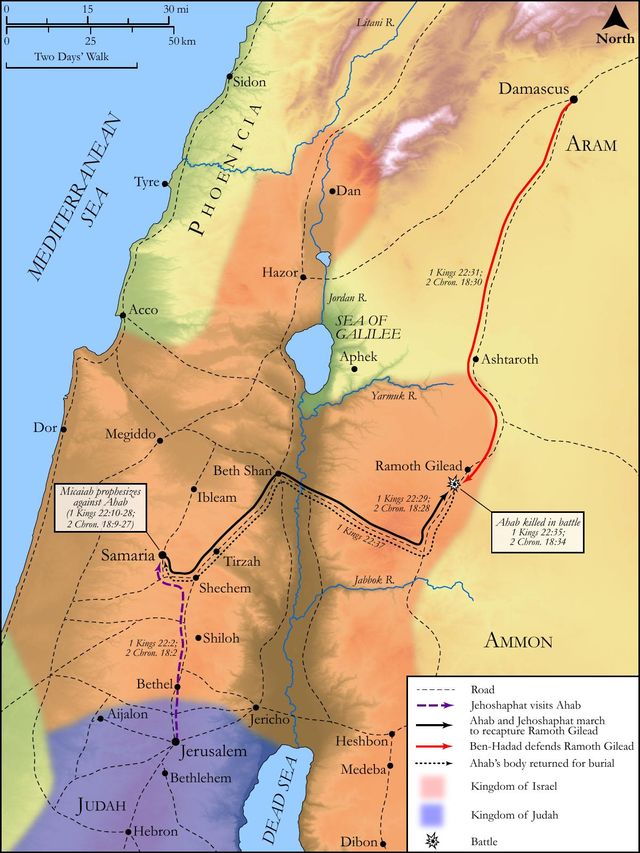
This verse is a pivotal moment within the broader narrative of 2 Chronicles 18, which closely parallels 1 Kings 22. The chapter begins with an unlikely and ill-fated alliance between King Jehoshaphat of Judah and King Ahab of Israel, solidified by a marriage covenant between their families. Ahab, eager to reclaim the strategically vital city of Ramoth-gilead from the Arameans (Syrians), seeks Jehoshaphat's military support. Jehoshaphat, demonstrating a measure of piety, insists on consulting a prophet of the LORD before committing to battle. In response, Ahab gathers his 400 court prophets, who, in a chorus of enthusiastic affirmation, unanimously endorse the war and promise an easy victory. Zedekiah's dramatic performance in this verse represents the culmination of this overwhelming, yet false, consensus, designed to solidify Ahab's conviction and dismiss any potential dissenting voices. His act directly precedes the arrival of Micaiah, the true prophet, whose unpopular but accurate prophecy exposes the deception and sets the stage for Ahab's downfall, building intense narrative tension between widespread falsehood and solitary truth.
Historical & Cultural Context
The setting is the mid-9th century BCE, a period marked by shifting political alliances and frequent conflicts among the kingdoms of Israel, Judah, and Aram. The city of Ramoth-gilead was a key strategic location, controlling vital trade routes, making its reclamation a significant military objective for Ahab. In Israel, prophets held considerable influence and were routinely consulted by kings for divine guidance, especially before major undertakings like military campaigns. Symbolic acts, such as Zedekiah's creation of the iron horns, were common prophetic practices, intended to visually and powerfully convey a divine message, making it more memorable and impactful than mere words. However, a critical distinction existed between true prophets, who spoke God's unvarnished truth often at great personal risk, and false prophets, who typically flattered the king and delivered messages aligned with royal desires. The "horns" themselves were a widespread symbol of power, strength, and dominion, particularly in military contexts, making Zedekiah's visual aid culturally resonant and highly persuasive to an ambitious king.
Key Themes
ShowHideThe central theme powerfully illuminated by this verse is the peril of false prophecy and the insidious nature of deception. Zedekiah's performance is a quintessential example of a prophet delivering a message not from God, but from human motivation—either his own desire for favor or the king's desire for affirmation. This demonstrates how easily power can corrupt the pursuit of truth. The narrative also highlights the theme of discerning truth versus popular opinion, as King Ahab tragically prefers the agreeable lies of 400 prophets over the harsh reality presented by one true prophet, Micaiah. Furthermore, the symbolism of power and conquest is vividly conveyed through the "horns of iron," which represent an irresistible, crushing force, assuring Ahab of total victory over Syria. This imagery reinforces the human tendency to rely on perceived strength rather than genuine divine guidance. Ultimately, the chapter underscores divine sovereignty, as God's true word, delivered through Micaiah despite overwhelming opposition, proves to be the one that comes to pass, demonstrating that no human deception can thwart God's ultimate plan, as seen in Ahab's demise at Ramoth-gilead. This narrative serves as a profound warning against seeking confirmation for one's own agenda rather than genuinely seeking God's will, a theme echoed throughout wisdom literature, such as in Proverbs 14:12.
Exposition and Analysis
ShowHideKey Word Analysis
ShowHideFrom קָרַן; a horn (as projecting); by implication, a flask, cornet; by resemblance. an elephant's tooth (i.e. ivory), a corner (of the altar), a peak (of a mountain), a ray (of light); figuratively, power; [idiom] hill, horn. In Scripture, "horn" consistently symbolizes strength, power, dignity, and dominion. Animals like bulls and rams used their horns for defense and offense, making them natural emblems of irresistible force. The imagery extends metaphorically to human power (e.g., "horn of salvation" in Psalm 18:2). Here, Zedekiah's act of making physical horns underscores the aggressive, conquering power he falsely attributes to Ahab's campaign.
Perhaps from the root of בִּרְזוֹת; iron (as cutting); by extension, an iron implement; (ax) head, iron. The addition of "iron" to "horns" intensifies the symbolism. Iron was known for its hardness, durability, and destructive capability, especially in weaponry. Unlike softer metals, iron suggests an unyielding, unbreakable, and utterly destructive force. Zedekiah's use of iron horns signifies a prophecy of total, irreversible, and overwhelming conquest, implying that Syria would be completely "consumed" without resistance.
A primitive root; to say (used with great latitude); answer, appoint, avouch, bid, boast self, call, certify, challenge, charge, [phrase] (at the, give) command(-ment), commune, consider, declare, demand, [idiom] desire, determine, [idiom] expressly, [idiom] indeed, [idiom] intend, name, [idiom] plainly, promise, publish, report, require, say, speak (against, of), [idiom] still, [idiom] suppose, talk, tell, term, [idiom] that is, [idiom] think, use (speech), utter, [idiom] verily, [idiom] yet. This verb is crucial as it introduces the quintessential prophetic formula, "Thus saith the LORD" (כֹּה אָמַר יְהוָה, koh amar Yahweh). Its appropriation by Zedekiah is a deliberate act of deception, lending a false veneer of divine authority to a message that originated from human flattery and a desire to please the king. This phrase, when used falsely, highlights the profound spiritual danger of misrepresenting God's word and the importance of discerning the true source of a message.
Verse Breakdown
ShowHide"And Zedekiah the son of Chenaanah had made him horns of iron"
This clause introduces Zedekiah, a prominent false prophet among King Ahab's 400 court prophets. His action of physically crafting "horns of iron" is a dramatic, symbolic gesture, a prophetic teaching aid of the kind Jeremiah later gave with the bonds and yokes he put upon his neck. The material, iron, emphasizes the strength, durability, and destructive power of the prophesied victory, designed to be visually compelling and psychologically persuasive to King Ahab, appealing to his desire for an unyielding military advantage.
"and said, Thus saith the LORD"
This is the critical moment of deception and usurpation of divine authority. Zedekiah directly claims divine inspiration, using the sacred formula reserved for genuine prophets who deliver God's direct message. By attributing his message to "the LORD" (Yahweh), he attempts to legitimize his false prophecy and imbue it with undeniable spiritual authority, thereby manipulating Ahab into believing his words are truly God's will and not merely human flattery or wishful thinking.
"With these thou shalt push Syria until they be consumed"
This is the content of Zedekiah's false prophecy, delivered with absolute conviction. The verb "push" (נָגַח, nagach) evokes the vivid image of a horned animal goring its opponent, signifying a forceful, aggressive, and irresistible attack. The phrase "until they be consumed" promises total annihilation and complete victory, leaving no doubt about the outcome. This absolute assurance of overwhelming triumph was precisely what Ahab wanted to hear, perfectly confirming his military ambitions and dismissing any potential reservations.
Literary Devices
ShowHideThe passage employs several potent Literary Devices to convey its message. Symbolism is central, with the "horns of iron" serving as a powerful visual metaphor for overwhelming, irresistible military might and total conquest. The choice of iron specifically emphasizes the unyielding, unbreakable, and utterly destructive nature of the prophesied victory, making the image more impactful. Dramatic Irony is also at play, particularly for readers familiar with the parallel account in 1 Kings 22 or those who continue reading 2 Chronicles 18. The audience knows, or will soon discover, that Zedekiah's prophecy is false and that Ahab's campaign will end in disaster, creating a profound tension between the prophet's confident declaration and the tragic reality that awaits the king. Furthermore, the narrative uses Contrast to highlight the stark difference between Zedekiah's flattering, self-serving prophecy and the later, truthful, but unpopular message of Micaiah. This juxtaposition underscores the critical theme of discerning truth from deception. Finally, Hyperbole is evident in the phrase "until they be consumed," which exaggerates the extent of the promised victory, aiming to instill absolute confidence and eliminate any doubt in Ahab's mind.
Theological and Thematic Connections
ShowHideThis verse powerfully illustrates the ancient and ongoing struggle between divine truth and human deception. Zedekiah's performance is a stark reminder that not all who claim to speak for God truly do so; some are motivated by self-interest, flattery, or a desire to please human authorities rather than God. The theological implication is profound: God's truth often runs contrary to human desires and popular opinion, requiring discernment, courage, and a willingness to stand apart from the crowd. The narrative underscores God's absolute sovereignty, demonstrating that even widespread deception cannot ultimately thwart His purposes or alter the true outcome He has ordained. It challenges believers to cultivate a deep reliance on God's revealed Word and to critically evaluate all claims of divine revelation, understanding that true prophecy will always align with God's character and His established principles, even when it is uncomfortable or unpopular.
Reflection and Application
ShowHideThe account of Zedekiah and his iron horns serves as a timeless warning for all who seek guidance, whether in personal decisions, corporate leadership, or spiritual matters. In an age saturated with information and competing voices, the challenge of discerning truth from falsehood remains paramount. We are often tempted to gravitate towards messages that affirm our existing biases, validate our desires, or promise easy success, much like Ahab preferred Zedekiah's comforting lie to Micaiah's difficult truth. This passage calls us to cultivate a posture of humility and discernment, prioritizing God's unvarnished truth, even when it is unpopular, uncomfortable, or contradicts our own plans. It reminds us that true wisdom often involves hearing what we need to hear, not just what we want to hear, and that genuine spiritual growth requires a willingness to submit to God's will, even when it leads us down unexpected or challenging paths. It compels us to examine the motivations behind the counsel we receive and to diligently compare all claims against the unchanging standard of God's Word.
Questions for Reflection
ShowHideFAQ
ShowHideWhy did Zedekiah physically make "horns of iron" instead of just speaking his prophecy?
ShowHideZedekiah's act of making "horns of iron" was a powerful visual aid, a practice found among the prophets of Israel. Such symbolic actions (e.g., Jeremiah wearing a yoke in Jeremiah 27:2 or Isaiah walking naked and barefoot in Isaiah 20:2-4) were intended to make the prophetic message more impactful, memorable, and persuasive. By crafting the horns and using them to demonstrate the "pushing" action, Zedekiah was not merely speaking words but performing a dramatic, tangible representation of the overwhelming victory he promised Ahab. The use of "iron" further emphasized the unyielding and destructive nature of the prophesied conquest, making the message even more compelling and seemingly authoritative. This theatricality was designed to appeal directly to Ahab's desire for an assured and total victory.
How could Zedekiah claim "Thus saith the LORD" if he was a false prophet?
ShowHideFalse prophets often appropriated the standard prophetic formula "Thus saith the LORD" (כֹּה אָמַר יְהוָה, koh amar Yahweh) to lend credibility and divine authority to their own messages, even when those messages did not originate from God. This was a deliberate act of deception, designed to mislead kings and the people, and it made it difficult for the average person to distinguish between true and false prophets without divine discernment. In Zedekiah's case, he was part of a larger group of 400 court prophets who likely understood that pleasing King Ahab was essential for their position and livelihood. By claiming divine sanction, Zedekiah sought to validate Ahab's military ambitions and provide the king with the spiritual endorsement he desired, regardless of whether it was true. The narrative of 2 Chronicles 18, particularly through Micaiah's later prophecy, reveals that God allowed a "lying spirit" to enter the mouths of these prophets to bring about Ahab's judgment, as described in 2 Chronicles 18:20-22.
Christ-Centered Fulfillment
ShowHideThe narrative of Zedekiah's false prophecy and the ultimate demise of King Ahab finds profound Christ-centered fulfillment in several ways. Firstly, Jesus Christ stands as the True Prophet par excellence, the one who perfectly embodies and speaks God's truth, in stark contrast to all false prophets like Zedekiah. While Zedekiah claimed "Thus saith the LORD" to deliver a lie that led to death, Jesus is the very Word of God made flesh, declaring "Truly, truly, I say to you" and embodying the truth that leads to life (John 1:1; John 14:6). Secondly, the "horn" imagery, which Zedekiah perverted for earthly conquest, is redeemed and elevated in Christ. The Old Testament often speaks of God raising up a "horn of salvation" (e.g., Psalm 18:2), a theme explicitly applied to Jesus in Luke 1:69 as the fulfillment of God's promise to David. He is the ultimate "horn" of strength and deliverance, not for physical warfare against nations like Syria, but for spiritual victory over sin, death, and the powers of darkness (Colossians 2:15). Finally, while Zedekiah promised Ahab a consuming victory that never materialized, Christ's victory is absolute and eternal. He is the Lamb who was slain, yet also the Lion of Judah, who will ultimately "push" and consume all evil and injustice, establishing His eternal kingdom (Revelation 5:5; Revelation 19:11-16). Thus, Zedekiah's deceptive act ultimately points to the necessity and glory of Christ, the faithful and true prophet, whose word is always truth and whose victory is always assured.