


Jeremiah 27:2
Bible text: King James Version (1769 Blayney text) · Public domain
Bible text: Berean Standard Bible · Public domain
Bible text: American Standard Version (1901) · Public domain
Bible text: World English Bible, Messianic edition · Public domain
Bible text: Geneva Bible (1599) · Public domain
Bible text: Young's Literal Translation · Public domain
- כֹּהkohthusH3541AdvAdverb
- אָמַר'a·Marhe saidH559V-Qal-Perf-3msVerb Qal Perfect 3rd Singular Masculine
- יְהוָהYah·wehYahwehH3068N-properNoun Proper Title
- אֵלַי'e·Laito meH413Prep ¦ 1csPreposition Definiteאֵלַtoיme
- עֲשֵׂה'a·SehmakeH6213V-Qal-Imp-2msVerb Qal Imperative 2nd Singular Masculine
- לְךָle·Khafor <the> yourselfPrep-l ¦ 2msSuffix Personal 2nd Singular Masculineלְfor <the>ךָyourself
- מוֹסֵרוֹתmo·se·RotfettersH4147N-fpNoun Plural Feminine Absolute
- וּמֹטוֹתu·mo·Totand yoke-barsH4133Conj-w ¦ N-fpNoun Plural Feminine Absoluteוּandמֹטוֹתyoke-bars
- וּנְתַתָּםu·ne·ta·Tamand you will put themH5414Conj-w ¦ V-Qal-ConsecPerf-2ms ¦ 3mpVerb Qal Consecutive Perfect 2nd Singular Masculineוּandנְתַתָּyou will putםthem
- עַל'alonH5921PrepPreposition
- צַוָּארֶךָtza·va·Re·khayour neckH6677N-msc ¦ 2msNoun Singular Masculine Constructצַוָּארֶneckךָyour
English is a literal word-by-word gloss of the Hebrew, not the KJV's wording. Why?
This is the original text the KJV's translators worked from — each Hebrew word with its own literal English meaning in this verse, prepared by scholars at Tyndale House, Cambridge. The KJV translates whole sentences, not word by word, so its wording differs: one Hebrew word can become several English words, and the KJV may choose “the LORD” where the gloss reads “Yahweh”. Both are faithful — they answer different questions. For the KJV's own rendering, switch to the KJV text.
Details
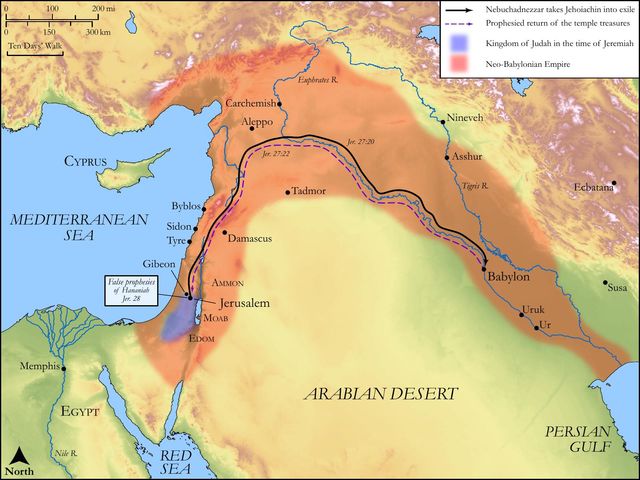
See on the biblical-era map
Study this verse
Public-domain commentary
Matthew Henry
From his Commentary on the Whole Bible. Henry comments on passages, not single verses — this entry covers Jeremiah 27:1–11. His two-level outline is real structure in the source text, so it is rendered as structure.
Some difficulty occurs in the date of this prophecy. This word is said to come to Jeremiah in the beginning of the reign of Jehoiakim (Jer 27:1), and yet the messengers, to whom he is to deliver the badges of servitude, are said (Jer 27:3) to come to Zedekiah king of Judah, who reigned not till eleven years after the beginning of Jehoiakim's reign. Some make it an error of the copy, and think that it should be read (Jer 27:1), In the beginning of the reign of Zedekiah, for which some negligent scribe, having his eye on the title of the foregoing chapter, wrote Jehoiakim. And, if one would admit a mistake any where, it should be here, for Zedekiah is mentioned again (Jer 27:12), and the next prophecy is dated the same year, and said to be in the beginning of the reign of Zedekiah, Jer 28:1. Dr. Lightfoot solves it thus: In the beginning of Jehoiakim's reign Jeremiah is to make these bonds and yokes, and to put them upon his own neck, in token of Judah's subjection to the king of Babylon, which began at that time; but he is to send them to the neighbouring kings afterwards in the reign of Zedekiah, of whose succession to Jehoiakim, and the ambassadors sent to him, mention is made by way of prediction.
I.Jeremiah is to prepare a sign of the general reduction of all these countries into subjection to the king of Babylon (Jer 27:2):
Make thee bonds and yokes, yokes with bonds to fasten them, that the beast may not slip his neck out of the yoke. Into these the prophet must put his own neck to make them taken notice of as a prophetic representation; for every one would enquire, What is the meaning of Jeremiah's yokes? We find him with one on, Jer 28:10. Hereby he intimated that he advised them to nothing but what he was resolved to do himself; for he was not one of those that bind heavy burdens on others, which they themselves will not touch with one of their fingers. Ministers must thus lay themselves under the weight and obligation of what they preach to others.
II.He is to send this, with a sermon annexed to it, to all the neighbouring princes; those are mentioned (Jer 27:3) that lay next to the land of Canaan. It should seem, there was a treaty of alliance on foot between the king of Judah and all those other kings. Jerusalem was the place appointed for the treaty. Thither they all sent their plenipotentiaries; and it was agreed that they should bind themselves in a league offensive and defensive, to stand by one another, in opposition to the growing threatening greatness of the king of Babylon, and to reduce his exorbitant power. They had great confidence in their strength thus united, and were ready to call themselves the high allies; but, when the envoys were returning to their respective masters with the ratification of this treaty, Jeremiah gives each of them a yoke to carry to his master, to signify to him that he must either by consent or by compulsion become a servant to the king of Babylon, let him choose which he will. In the sermon upon this sign,
1.God asserts his own indisputable right to dispose of kingdoms as he pleases, Jer 27:5. He is the Creator of all things; he made the earth at first, established it, and it abides: it is still the same, though one generation passes away and another comes. He still by a continued creation produces man and beast upon the ground, and it is by his great power and outstretched arm. His arm has infinite strength, though it be stretched out. Upon this account he may give and convey a property and dominion to whomsoever he pleases. As he hath graciously given the earth to the children of men in general (Psa 115:16), so he give to each his share of it, be it more or less. Note, Whatever any have of the good things of this world, it is what God sees fit to give them; we ourselves should therefore be content, though we have ever so little, and not envy any their share, though they have ever so much.
2.He publishes a grant of all these countries to Nebuchadnezzar. Know all men by these presents. Sciant praesentes et futuri - Let those of the present and those of the future age know. "This is to certify to all whom it may concern that I have given all these lands, with all the wealth of them, into the hands of the king of Babylon; even the beasts of the field, whether tame or wild, have I given to him, parks and pastures; they are all his own." Nebuchadnezzar was a proud wicked man, an idolater; and yet God, in his providence, gives him this large dominion, these vast possessions. Note, The things of this world are not the best things, for God often gives the largest share of them to bad men, that are rivals with him and rebels against him. He was a wicked man, and yet what he had he had by divine grant. Note, Dominion is not founded in grace. Those that have not any colourable title to eternal happiness may yet have a justifiable title to their temporal good things. Nebuchadnezzar is a very bad man, and yet God calls him his servant, because he employed him as an instrument of his providence for the chastising of the nations, and particularly his own people; and for his service therein he thus liberally repaid him. Those whom God makes use of shall not lose by him; much more will he be found the bountiful rewarder of all those that designedly and sincerely serve him.
3.He assures them that they should all be unavoidably brought under the dominion of the king of Babylon for a time (Jer 27:7): All nations, all these nations and many others, shall serve him, and his son, and his son's son. His son was Evil-merodach, and his son's son Belshazzar, in whom his kingdom ceased: then the time of reckoning with his land came, when the tables were turned, and many nations and great kings, incorporated into the empire of the Medes and Persians, served themselves of him, as before, Jer 25:14. Thus Adonibezek was trampled upon himself, as he had trampled on other kings.
4.He threatens those with military execution that stood out and would not submit to the king of Babylon (Jer 27:8): That nation that will not put their neck under his yoke I will punish with sword and famine, with one judgment after another, till it is consumed by his hand. Nebuchadnezzar was very unjust and barbarous in invading the rights and liberties of his neighbours thus, and forcing them into a subjection to him; yet God had just and holy ends in permitting him to do so, to punish these nations for their idolatry and gross immoralities. Those that would not serve the God that made them were justly made to serve their enemies that sought to ruin them.
5.He shows them the vanity of all the hopes they fed themselves with, that they should preserve their liberties, Jer 27:9, Jer 27:10. These nations had their prophets too, that pretended to foretell future events by the stars, or by dreams, or enchantments; and they, to please their patrons, and because they would themselves have it so, flattered them with assurances that they should not serve the king of Babylon. Thus they designed to animate them to a vigorous resistance; and, though they had no ground for it, they hoped hereby to do them service. But he tells them that it would prove to their destruction; for by resisting they would provoke the conqueror to deal severely with them, to remove them, and drive them out into a miserable captivity, in which they should all be lost and buried in oblivion. Particular prophecies against these nations that bordered on Israel severally, the ruin of which is here foretold in the general, we shall meet with, ch. 48 and 49, and Eze. 25, which had the same accomplishment with this here. Note, When God judges he will overcome.
6.He puts them in a fair way to prevent their destruction by a quiet and easy submission, Jer 27:11. The nations that will be content to serve the king of Babylon, and pay him tribute for seventy years (ten apprenticeships), those will I let remain still in their own land. Those that will bend shall not break. Perhaps the dominion of the king of Babylon may bear no harder upon them than that of their own kings had done. It is often more a point of honour than true wisdom to prefer liberty before life. It is not mentioned to the disgrace of Issachar that because he saw rest was good, and the land pleasant, that he might peaceably enjoy it, he bowed his shoulder to bear, and became a servant to tribute (Gen 49:14, Gen 49:15), as these are here advised to do: Serve the king of Babylon and you shall till the land and dwell therein. Some would condemn this as the evidence of a mean spirit, but the prophet recommends it as that of a meek spirit, which yields to necessity, and by a quiet submission to the hardest turns of Providence makes the best of bad: it is better to do so than by struggling to make it worse.
- Levius fit patientia
Quicquid corrigere est nefas.
- Hor.
- When we needs must bear,
Enduring patience makes the burden light.
- Creech.
Many might have prevented destroying providences by humbling themselves under humbling providences. It is better to take up a lighter cross in our way than to pull a heavier on our own head.
Historical interpretation
Historical reception
1 surviving comment on this verse from the historical church.
(Verse 2.) This is what the Lord says to me: Make for yourself chains and shackles. Or κλοιοὺς, which are called Mutoth () in Hebrew, and in the common language they are called Boias.
Continue studying Jeremiah 27:2 across the web’s major study libraries — every link below opens this exact verse, chapter, or book on the destination site.
Read & Compare
 BibleGatewayThis verse in more than 200 translations and 70 languages.
 Bible.comThe YouVersion reader — hundreds of translations, reading plans, and highlights.
 ESV.orgCrossway's official English Standard Version reader.
 NET BibleThe NET translation with 60,000+ translators' notes on every rendering decision.
 STEP BibleTyndale House's free study tool — original text, vocabulary, and scholarly resources.
 BibliaLogos Bible Software's free web reader.
 USCCBThe New American Bible (Revised Edition) with the U.S. bishops' study notes.
Commentaries
 BibleHub CommentariesDozens of classic commentaries on this verse, gathered on one page.
 StudyLightMore than 100 commentary sets — the largest collection on the web.
 BibleRefPlain-English commentary on what this verse means, verse by verse.
 Enduring WordDavid Guzik's free commentary on this chapter, widely used by Bible teachers.
 Bible Study ToolsVerse commentary alongside Greek and Hebrew study aids.
Original Language & Research
- BibleHub InterlinearThe verse word by word — original language, transliteration, and English.
- BibleHub LexiconEvery word's original-language definition and Strong's entry.
 Blue Letter BibleDeep-study tools — Strong's numbers, concordance, and word studies.
 SefariaThe Hebrew text with Rashi and centuries of Jewish commentary.
Sermons, Hymns & Audio


TrulyRandomVerse is not affiliated with these sites and doesn’t control their content. They’re linked because they’re genuinely useful.
Summary
Jeremiah 27:2 records a direct divine command to the prophet Jeremiah, instructing him to fashion literal bonds and yokes and to wear them around his neck. This dramatic, public act served as a powerful visual sermon, symbolizing the impending subjugation of Judah and surrounding nations under the dominion of Babylon, a divinely ordained period of servitude intended to humble and discipline God's people and the Gentile nations, demonstrating the LORD's absolute sovereignty over all earthly powers and challenging any resistance to His decreed will.
Context
ShowHideLiterary Context
This verse initiates a significant prophetic oracle spanning Jeremiah 27 and Jeremiah 28. Jeremiah 27:1 places this prophecy at the beginning of the reign of King Zedekiah, likely around 597 BC, shortly after the first Babylonian deportation of Judah's elite, including King Jehoiachin. The immediate preceding chapters, such as Jeremiah 25 and Jeremiah 26, have already established the theme of Babylon as God's instrument of judgment and the inevitability of exile. Jeremiah 27:2, therefore, introduces a vivid prophetic sign-act designed to reinforce this unpopular but crucial message against a backdrop of widespread false prophecy promising peace and swift deliverance from Babylonian power. The subsequent verses in Jeremiah 27 elaborate on the message conveyed by the yoke, explicitly naming the nations destined for servitude and warning against resistance to God's decreed plan.
Historical & Cultural Context
The late 7th and early 6th centuries BC were a period of intense geopolitical upheaval among the nations. The Neo-Assyrian Empire had fallen, and the Babylonian Empire, under Nebuchadnezzar, was rapidly asserting its dominance. Judah, a small kingdom, found itself precariously positioned between the declining power of Egypt and the rising might of Babylon. Many nations, including Edom, Moab, Ammon, Tyre, and Sidon (mentioned in Jeremiah 27:3), were contemplating rebellion against Babylon, often encouraged by false prophets and political opportunists who promised swift deliverance. The cultural understanding of a "yoke" was deeply ingrained in Israel: it was an instrument for harnessing beasts of burden for labor, symbolizing control, subjugation, and servitude. For a nation, wearing a yoke signified political submission, tribute payment, and loss of independence to a dominant empire. Jeremiah's public display of these items would have been immediately understood as a powerful, albeit humiliating, message of national enslavement and a call to accept God's sovereign will.
Key Themes
ShowHideThis verse powerfully contributes to several overarching themes within the book of Jeremiah. Firstly, it underscores Divine Sovereignty, demonstrating that the LORD is not merely the God of Israel but the sovereign ruler over all nations, even using pagan empires like Babylon as instruments of His will and judgment, as seen in Jeremiah 25:9. Secondly, it highlights the theme of Symbolic Prophecy or Prophetic Sign-Acts, where God commands His prophets to perform tangible, often dramatic, actions to embody and communicate His message more effectively than words alone, a pattern seen elsewhere with Jeremiah (e.g., the linen sash in Jeremiah 13) and other prophets (e.g., Ezekiel's siege model in Ezekiel 4). Thirdly, it emphasizes the difficult and unpopular Call to Submission to God's ordained path, even when that path involves hardship and national humiliation, contrasting sharply with the popular message of false prophets who promised immediate deliverance and peace, as detailed in Jeremiah 28. This verse also contributes to the theme of Judgment and Exile as a divine disciplinary measure.
Exposition and Analysis
ShowHideKey Word Analysis
ShowHideThis is the covenant name of God, emphasizing His self-existent, eternal, and unchanging nature. In this context, the use of "LORD" underscores that the command to Jeremiah is not a human political strategy or a mere prediction, but a divine decree from the ultimate authority. It highlights that the impending subjugation is not merely a geopolitical event but a sovereign act of the God of Israel, who controls the destinies of all nations and is faithful to His word.
This term properly refers to chastisement or a halter, and by implication, a bond or restraint. Its inclusion alongside "yokes" intensifies the imagery of complete and inescapable subjugation, implying not just forced labor or burden but also imprisonment or absolute control, from which there is no escape without divine intervention. It signifies a binding force that restricts freedom and movement, emphasizing the totality of the coming servitude.
This word specifically refers to a pole or an ox-bow, hence a yoke. It is a powerful symbol of forced labor, servitude, and the burden of oppression. When placed upon the neck, it signifies submission to a master. In this prophetic context, the "yoke" represents the heavy dominion and political servitude that Babylon would impose on Judah and the surrounding nations, a divinely appointed burden for a set period.
Verse Breakdown
ShowHide"Thus saith the LORD to me;"
This opening phrase immediately establishes the divine origin and absolute authority of the message. It is not Jeremiah's personal opinion, political forecast, or a mere human observation, but a direct, unequivocal word from YHWH, the sovereign God. The phrase "to me" emphasizes Jeremiah's unique and specific role as God's appointed messenger, tasked with delivering an unpopular but truthful prophecy, highlighting the personal nature of God's commission to His prophet.
"Make thee bonds and yokes,"
This is the core command for the prophetic sign-act. Jeremiah is instructed to physically construct these items. The "bonds" (likely ropes or chains) and "yokes" (wooden frames for oxen) are tangible objects that will serve as powerful, undeniable symbols. The act of making them underscores the deliberate and real nature of the impending servitude; it is not a vague threat but a concrete, divinely orchestrated reality that is already being prepared.
"and put them upon thy neck,"
This final clause specifies the public display of the symbolic items. By wearing them on his own neck, Jeremiah personally embodies the message, becoming a living visual aid. This public demonstration serves to visually communicate the message of inevitable subjugation and forced labor to the people of Judah, making the abstract concept of national servitude concrete and unavoidable. It also powerfully demonstrates Jeremiah's own submission to God's difficult and often humiliating command, reinforcing the prophet's obedience even in the face of public scorn.
Literary Devices
ShowHideJeremiah 27:2 is rich in Symbolism and functions as a Prophetic Sign-Act. The "bonds" and "yokes" are potent symbols of political subjugation, forced labor, and the loss of national autonomy. Just as an ox is harnessed by a yoke for work, so too would Judah and other nations be brought under the dominion of Babylon. This visual Metaphor of the nation as a beast of burden underscores the heavy, inescapable nature of the coming servitude. The entire command constitutes a Prophetic Sign-Act, a common literary and theological device in the prophetic books where the prophet performs a physical action to embody and communicate a divine message. This dramatic, public performance was intended to shock and impress upon the audience the reality and inevitability of God's judgment and plan, making the abstract concept of submission tangible and unforgettable, and serving as a direct challenge to the false prophets who offered a different, more palatable message.
Theological and Thematic Connections
ShowHideJeremiah 27:2 profoundly illustrates God's absolute sovereignty over all nations and His use of even pagan empires as instruments of His divine purpose. The command to make and wear the yoke signifies that the impending Babylonian dominance is not a random geopolitical event but a divinely ordained judgment and a call to submission. This theological truth challenges human notions of independence and self-reliance, asserting that true wisdom lies in discerning and aligning with God's overarching plan, even when it involves hardship or humiliation. It also highlights the nature of prophetic ministry, which often involves uncomfortable truths and symbolic actions that confront popular narratives and call people to repentance and obedience to God's revealed will.
Reflection and Application
ShowHideJeremiah's difficult commission in Jeremiah 27:2 serves as a powerful reminder that God's will is not always comfortable or popular, especially when it calls for submission to challenging circumstances. For us today, this passage encourages a posture of humility and discernment, urging us to recognize God's sovereign hand even in situations that seem oppressive, contrary to our desires, or beyond our control. It challenges us to consider whether our resistance to difficult circumstances might, in fact, be resistance to God's ordained path for our growth or discipline. Embracing God's sovereignty, even when His methods are inscrutable or His commands demanding, fosters a deeper trust in His ultimate goodness and wisdom. It calls us to examine our own "yokes"—the burdens, disciplines, or submissions God might be calling us to accept for our spiritual formation or for His broader purposes in the world, reminding us that true freedom often begins with surrender to divine authority.
Questions for Reflection
ShowHideFAQ
ShowHideWhy did God command Jeremiah to make and wear literal bonds and yokes?
ShowHideGod commanded Jeremiah to make and wear literal bonds and yokes as a prophetic sign-act, a common method in the Old Testament where prophets performed symbolic actions to vividly communicate a divine message. In this case, the physical act was a powerful visual sermon, making the abstract concept of national subjugation tangible and undeniable. The bonds and yokes symbolized the inevitable servitude that Judah and surrounding nations would experience under Babylonian rule, a divinely ordained period of discipline and judgment. This dramatic display was intended to confront the false prophets who promised peace and deliverance, reinforcing the difficult truth that submission to Babylon was God's will for their preservation, as explained in Jeremiah 27:6-8.
Did Jeremiah actually wear these bonds and yokes for an extended period?
ShowHideWhile the text doesn't specify the exact duration, it implies that Jeremiah publicly displayed these items, likely for a significant period or on multiple occasions, to convey the seriousness of the message. The purpose of a prophetic sign-act was its public visibility and impact. The narrative in Jeremiah 28, where the false prophet Hananiah breaks Jeremiah's wooden yoke, suggests that Jeremiah wore it long enough for it to become a recognized symbol, indicating it was not a fleeting gesture but a sustained public demonstration of God's will and a constant reminder of the impending judgment.
Christ-Centered Fulfillment
ShowHideWhile Jeremiah's yoke symbolized a burden of national servitude and divine judgment, it ultimately foreshadows both the spiritual yokes from which Christ delivers humanity and the new, liberating "yoke" He offers. The ultimate fulfillment of divine sovereignty, so powerfully demonstrated in Jeremiah's prophecy of Babylon's rise, is found in the reign of Christ, who is Lord over all creation and every earthly authority, having been given "all authority in heaven and on earth" as declared in Matthew 28:18 and Ephesians 1:20-22. The heavy yoke of sin and the Law, which humanity could not bear, is contrasted with the "easy yoke" and "light burden" offered by Jesus in Matthew 11:28-30. Where Jeremiah's yoke signified forced submission to an earthly empire for a season of disciplinary judgment, Christ's yoke signifies willing submission to Him, leading to rest for the soul and true freedom from the bondage of sin and death, as celebrated in John 8:36 and Galatians 5:1. Thus, the temporary, disciplinary yoke of Jeremiah's prophecy points forward to the eternal, redemptive reign of Christ, who ultimately breaks every bond of oppression and offers a yoke of grace, truth, and genuine liberation.