


2 Chronicles 18:34
- וַתַּעַלva·Ta·'aland it went upH5927Conj-w ¦ V-Qal-ConsecImperf-3fsVerb Qal Consecutive Imperfect 3rd Singular Feminineוַandתַּעַלit went up
- הַמִּלְחָמָהha·mil·cha·Mahthe battleH4421Art ¦ N-fsNoun Singular Feminine Absoluteהַtheמִּלְחָמָהbattle
- בַּיּוֹםbai·Yomon the dayH3117Prep-b ¦ N-msNoun Singular Masculine Absoluteבַּon theיּוֹםday
- הַהוּאha·Hu'<the> thatH1931Art ¦ Pro-3msPronoun Personal 3rd Singular Masculineהַ<the>הוּאthat
- וּמֶלֶךְu·Me·lekhand [the] king ofH4428Conj-w ¦ N-mscNoun Singular Masculine Constructוּandמֶלֶךְ[the] king of
- יִשְׂרָאֵלYis·ra·'ElIsraelH3478N-properNoun Proper Location
- הָיָהha·Yahhe wasH1961V-Qal-Perf-3msVerb Qal Perfect 3rd Singular Masculine
- מַעֲמִידma·'a·Mid[was] holding uprightH5975V-Hiphil-Prtcpl-msVerb Hiphil Participle Singular Masculine Absolute
- בַּמֶּרְכָּבָהba·mer·ka·Vahin the chariotH4818Prep-b ¦ N-fsNoun Singular Feminine Absoluteבַּin theמֶּרְכָּבָהchariot
- נֹכַחNo·khachopposite toH5227Adj-mscAdjective Numerical Singular Masculine Construct
- אֲרָם'a·RamAramH758N-properNoun Proper Location
- עַד'aduntilH5704PrepPreposition
- הָעָרֶבha·'A·revthe eveningH6153Art ¦ N-msNoun Singular Masculine Absoluteהָtheעָרֶבevening
- וַיָּמָתvai·Ya·motand he diedH4191Conj-w ¦ V-Qal-ConsecImperf-3msVerb Qal Consecutive Imperfect 3rd Singular Masculineוַandיָּמָתhe died
- לְעֵתle·'Etto [the] time ofH6256Prep-l ¦ N-cscNoun Singular common gender Constructלְtoעֵת[the] time of
- בּוֹאBo'[the] going ofH935V-Qal-InfVerb Qal Infinitive Construct
- הַשָּׁמֶשׁha·Sha·meshthe sunH8121Art ¦ N-csNoun Singular common gender Absoluteהַtheשָּׁמֶשׁsun
English is a literal word-by-word gloss of the Hebrew, not the KJV's wording. Why?
This is the original text the KJV's translators worked from — each Hebrew word with its own literal English meaning in this verse, prepared by scholars at Tyndale House, Cambridge. The KJV translates whole sentences, not word by word, so its wording differs: one Hebrew word can become several English words, and the KJV may choose “the LORD” where the gloss reads “Yahweh”. Both are faithful — they answer different questions. For the KJV's own rendering, switch to the KJV text.
Details
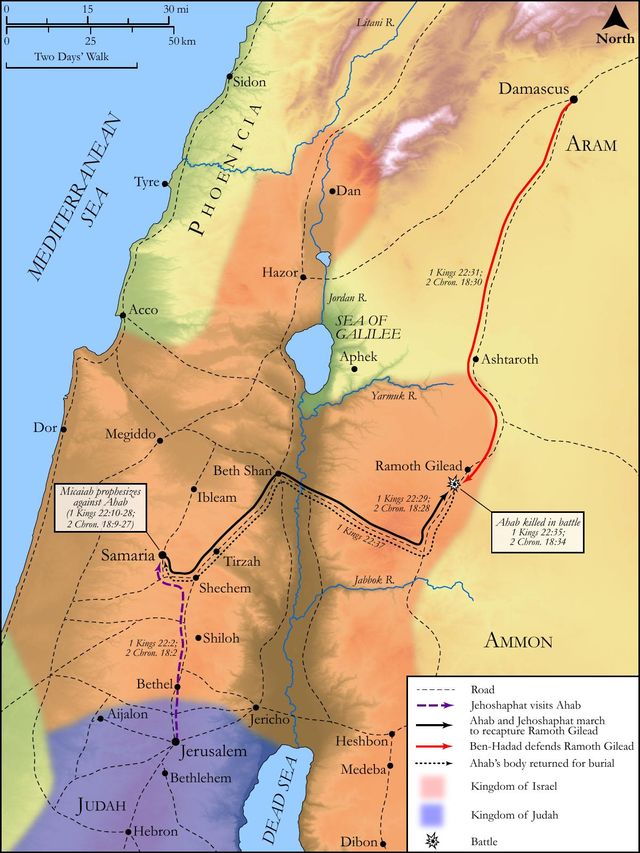
See on the biblical-era map
Study this verse
Public-domain commentary
Matthew Henry
From his Commentary on the Whole Bible. Henry comments on passages, not single verses — this entry covers 2 Chronicles 18:28–34.
We have here, 1. Good Jehoshaphat exposing himself in his robes, thereby endangered, and yet delivered. We have reason to think that Ahab, while he pretended friendship, really aimed at Jehoshaphat's life, to take him off, that he might have the management of his successor, who was his son-in-law, else he would never have advised him to enter into the battle with his robes on, which was but to make himself an easy mark to the enemy: and, if really he intended that, it was as unprincipled a piece of treachery as ever man was guilty of, and justly was he himself taken in the pit he digged for his friend. The enemy had soon an eye upon the robes, and vigorously attacked the unwary prince who now, when it was too late, wished himself in the habit of the poorest soldier, rather than in his princely raiment. he cried out, either to his friends to relieve him (but Ahab took no care of that), or to his enemies, to rectify their mistake, and let them know that he was not the king of Israel. Or perhaps he cried to God for succour and deliverance (to whom else should he cry?) and he found it was not in vain: The Lord helped him out of his distress, by moving the captains to depart from him, Ch2 18:31. God has all men's hearts in his hand, and turns them as he pleases, contrary to their own first intentions, to serve his purposes. Many are moved unaccountably both to themselves and others, but an invisible power moves them. 2. Wicked Ahab disguising himself, arming himself thereby as he thought securing himself, and yet slain, Ch2 18:33. No art, no arms, can save those whom God has appointed to ruin. What can hurt those whom God will protect? And what can shelter those whom God will destroy? Jehoshaphat is safe in his robes, Ahab killed in his armour; for the race is not to the swift nor the battle to the strong.
Continue studying 2 Chronicles 18:34 across the web’s major study libraries — every link below opens this exact verse, chapter, or book on the destination site.
Read & Compare
 BibleGatewayThis verse in more than 200 translations and 70 languages.
 Bible.comThe YouVersion reader — hundreds of translations, reading plans, and highlights.
 ESV.orgCrossway's official English Standard Version reader.
 NET BibleThe NET translation with 60,000+ translators' notes on every rendering decision.
 STEP BibleTyndale House's free study tool — original text, vocabulary, and scholarly resources.
 BibliaLogos Bible Software's free web reader.
 USCCBThe New American Bible (Revised Edition) with the U.S. bishops' study notes.
Commentaries
 BibleHub CommentariesDozens of classic commentaries on this verse, gathered on one page.
 StudyLightMore than 100 commentary sets — the largest collection on the web.
 BibleRefPlain-English commentary on what this verse means, verse by verse.
 Enduring WordDavid Guzik's free commentary on this chapter, widely used by Bible teachers.
 Bible Study ToolsVerse commentary alongside Greek and Hebrew study aids.
Original Language & Research
- BibleHub InterlinearThe verse word by word — original language, transliteration, and English.
- BibleHub LexiconEvery word's original-language definition and Strong's entry.
 Blue Letter BibleDeep-study tools — Strong's numbers, concordance, and word studies.
 SefariaThe Hebrew text with Rashi and centuries of Jewish commentary.
Sermons, Hymns & Audio


TrulyRandomVerse is not affiliated with these sites and doesn’t control their content. They’re linked because they’re genuinely useful.
Summary
Second Chronicles 18:34 powerfully depicts the final, climactic moments of King Ahab of Israel's life during the intense battle against the Arameans (Syrians) at Ramoth-Gilead. Despite being mortally wounded by an arrow, the king was propped up in his chariot, a defiant act of concealment intended to sustain the morale of his troops amidst the escalating conflict. This grim determination persisted until the setting of the sun, at which point he finally succumbed to his injuries, bringing a definitive end to his wicked reign and serving as the precise fulfillment of divine prophecy.
Context
ShowHideLiterary Context
This verse serves as the dramatic culmination of the narrative found in 2 Chronicles 18, which closely parallels 1 Kings 22. It follows King Jehoshaphat of Judah's ill-advised alliance with King Ahab of Israel for a joint military campaign to reclaim Ramoth-Gilead from Aram. The chapter is dominated by the prophetic confrontation between the 400 false prophets, who assured Ahab of victory, and the lone, true prophet Micaiah, who courageously foretold Ahab's death and the scattering of Israel without their shepherd (2 Chronicles 18:18-27). Despite Micaiah's clear warning and Ahab's attempt to evade his fate by disguising himself, he entered the battle. The preceding verses describe the intensity of the fighting and the specific targeting of Ahab by the Aramean charioteers, though the fatal shot is described in the parallel account as seemingly random (1 Kings 22:34). This verse, therefore, marks the dramatic and inevitable fulfillment of God's word, underscoring the futility of human attempts to thwart divine decree.
Historical & Cultural Context
The battle for Ramoth-Gilead was a significant event in the long-standing conflict between the northern kingdom of Israel and the kingdom of Aram (Syria). Ramoth-Gilead was a strategically vital city in Transjordan, controlling key trade routes and offering a defensive advantage. Kings in the ancient Near East often led their armies from chariots, which were powerful symbols of military might and royal authority. For a king to be seen alive and in his chariot, even wounded, was crucial for maintaining troop morale and preventing panic or rout. The act of propping up a dying king was a desperate measure to preserve the appearance of leadership and control, highlighting the cultural importance of a king's presence on the battlefield. The timing of death "at the time of the sun going down" held symbolic weight, marking the end of a day, and in this context, the end of a wicked reign, often associated with divine judgment and the conclusion of a divinely appointed period.
Key Themes
ShowHideThe most prominent theme is the unassailable sovereignty of God and the certainty of His prophetic word. Despite Ahab's attempts to evade his prophesied doom through disguise and strategic maneuvering, God's decree, delivered through Micaiah, came to pass with precise and undeniable finality (2 Chronicles 18:27). This powerfully illustrates that no human will or power can ultimately thwart the divine plan. Another crucial theme is the consequences of persistent disobedience and idolatry. Ahab's reign was characterized by egregious wickedness, including the promotion of Baal worship and the persecution of God's prophets (1 Kings 16:30-33). His death is presented as the direct and just culmination of divine judgment for his unrepentant rebellion against the Lord. Finally, the narrative subtly touches upon the futility of human resistance against divine will, demonstrating that even the most determined efforts to escape God's judgment are ultimately vain.
Exposition and Analysis
ShowHideKey Word Analysis
ShowHideThis verb (H5927) signifies "to ascend," "to go up," or "to rise." In the context of battle, it describes the intensity of the conflict not merely continuing but escalating, growing in ferocity and pressure. It conveys the overwhelming nature of the engagement, emphasizing the relentless and mounting danger that surrounded King Ahab, ultimately leading to his demise. The battle was not just ongoing but becoming more severe and relentless.
This verb (H5975) means "to stand," "to remain," or "to endure." Here, it vividly portrays Ahab's desperate and defiant act of maintaining an upright position in his chariot despite being mortally wounded. It implies a forced, sustained posture, likely achieved with the assistance of his attendants, to preserve the illusion of his continued leadership and vitality. This act speaks to his stubborn will, his desire to conceal his injury, and his grim determination to remain in command until the very end.
This verb (H935) means "to go" or "to come," and in this context, specifically "to go down" in reference to the setting sun. The timing of the sun's descent is highly significant, not only marking the literal end of the battle day but also powerfully symbolizing the definitive end of Ahab's life and his wicked reign. It adds a solemn, almost predestined, finality to his death, emphasizing that his time had run out, precisely as God had ordained.
Verse Breakdown
ShowHide"And the battle increased that day:"
This opening clause immediately establishes the escalating intensity and ferocity of the conflict. It highlights the perilous environment in which Ahab found himself, suggesting a relentless assault that wore down the Israelite forces and contributed to the king's ultimate vulnerability. The increasing pressure underscores the inevitability of the outcome, setting the stage for the king's demise.
"howbeit the king of Israel stayed [himself] up in [his] chariot against the Syrians until the even:"
This is the central action of the verse, detailing Ahab's extraordinary and defiant act. Despite being mortally wounded (as the parallel account in 1 Kings 22:34-35 clarifies), he refused to be removed from his battle position. Being propped up in his chariot served two main purposes: to maintain the morale of his troops by concealing his injury and to continue his presence as commander. This grim endurance lasted throughout the day, a testament to his stubborn will, even in the face of death. The phrase "until the even" specifies the duration of his suffering and the precise timing of his final collapse.
"and about the time of the sun going down he died."
This final clause delivers the ultimate and inevitable outcome. The "time of the sun going down" reiterates the "even," emphasizing the precise moment of his demise. This timing is highly significant, not only marking the end of the day's fighting but also serving as a powerful symbolic closure to Ahab's life and reign. His death at this specific moment underscores the divine orchestration of events, fulfilling the prophecies against him with chilling accuracy and bringing a definitive end to one of Israel's most wicked kings.
Literary Devices
ShowHideThe passage employs several potent Literary Devices to enhance its impact and theological message. Irony is profoundly evident, as Ahab's elaborate attempt to evade prophecy by disguising himself is utterly foiled; the "random" arrow (from the parallel account in 1 Kings 22:34) finds its mark precisely because of divine orchestration, rendering his efforts futile. Symbolism is powerfully utilized with the phrase "the time of the sun going down," which serves as a poignant symbol for the definitive end of Ahab's life and the conclusion of his ungodly reign, marking a divinely appointed closure. The chariot itself functions as a potent symbol of royal power and defiance, as Ahab, even in his dying moments, maintains his position within it, a final, grim assertion of his kingship and stubborn will. There is also a strong element of Foreshadowing throughout the preceding narrative, particularly through Micaiah's unwavering prophecy, which builds narrative tension and makes Ahab's death feel inevitable rather than accidental. Finally, Dramatic Irony is present, as the reader is fully aware of Ahab's prophesied doom and mortal wound, while the soldiers fighting alongside him are kept ignorant of their king's true condition, making his defiant stand all the more poignant and tragic.
Theological and Thematic Connections
ShowHideThe death of King Ahab in 2 Chronicles 18:34 powerfully illustrates the unyielding sovereignty of God over human affairs and the absolute certainty of His prophetic word. Despite Ahab's attempts to circumvent his destiny through disguise and strategic maneuvering, God's judgment, foretold by Micaiah, came to pass with chilling precision. This event serves as a stark reminder that no human will, power, or cunning can ultimately thwart the divine plan or escape the consequences of persistent rebellion against the Lord. It underscores the principle that God is faithful to His word, both in warning and in fulfillment, and that His justice will ultimately prevail, even against the most defiant of rulers.
Reflection and Application
ShowHideThe tragic and divinely ordained end of King Ahab serves as a profound and enduring lesson for all who seek to live under God's authority. His story reminds us that while God is infinitely patient and merciful, there are indeed serious and unavoidable consequences for persistent, unrepentant rebellion against His commands and His revealed will. Ahab's futile attempts to escape his fate underscore the absolute futility of resisting God's sovereign plan; ultimately, human defiance is no match for divine decree. This narrative calls us to a posture of humility and submission, urging us to align our lives with God's truth rather than attempting to manipulate circumstances or ignore prophetic warnings. It reinforces the trustworthiness of Scripture, demonstrating that God's word, whether of promise or judgment, will always come to pass. We are invited to examine our own lives: are we living in defiance of God's known will, perhaps attempting to "disguise" our disobedience, or are we walking in humble obedience, trusting in His wisdom and justice?
Questions for Reflection
ShowHideFAQ
ShowHideWas Ahab's death truly accidental, or divinely ordained?
ShowHideWhile the parallel account in 1 Kings 22:34 states that Ahab was struck by an arrow "shot at a venture," implying it was not specifically aimed at him, the biblical narrative clearly presents his death as divinely ordained and the direct fulfillment of prophecy. The prophet Micaiah had explicitly foretold Ahab's demise in battle (2 Chronicles 18:16-27), and earlier, Elijah had prophesied a bloody end for him (1 Kings 21:19). Therefore, even a seemingly random event was orchestrated by God's sovereign hand to bring about His just judgment against a wicked king.
Why did Ahab stay propped up in his chariot despite being mortally wounded?
ShowHideAhab's decision to remain propped up in his chariot, even while bleeding and dying, was a desperate and defiant act primarily aimed at maintaining the morale of his troops. In ancient warfare, the king's presence on the battlefield was crucial for leadership and preventing panic or rout. If his soldiers knew their king was mortally wounded or dead, it could lead to a collapse of morale and a disorderly retreat. By concealing his injury and maintaining his position, Ahab sought to keep up appearances, prolong the battle, and prevent a collapse of his forces, even though it prolonged his own suffering and ultimately proved futile against God's decree.
What is the significance of Ahab dying "at the time of the sun going down"?
ShowHideThe timing of Ahab's death "at the time of the sun going down" carries significant symbolic weight. It not only marks the literal end of the day's battle but also serves as a powerful symbol for the definitive end of Ahab's life and, more broadly, the conclusion of his wicked and idolatrous reign. In biblical thought, the setting sun can often represent a finality, a closure, or the culmination of a period. For Ahab, it signifies the conclusive arrival of divine judgment, bringing a solemn and predestined end to his defiance against God.
Christ-Centered Fulfillment
ShowHideAhab's death in 2 Chronicles 18:34, marked by divine judgment for his unrepentant sin and the futility of his resistance to God's will, stands in stark contrast to the death of Jesus Christ, yet it powerfully illuminates the nature of God's justice and sovereignty, which find their ultimate expression in Christ. Ahab, a king who defied God and suffered the consequences, foreshadows the universal human condition of rebellion against a holy God. However, unlike Ahab, who desperately tried to escape his fate, Jesus willingly embraced His divine mission, submitting to the Father's will even unto death on the cross (Matthew 26:39). Ahab's death was a judgment for his own sin; Christ's death was a substitutionary sacrifice for the sins of humanity (Isaiah 53:5). While Ahab's reign ended in defeat and finality at sunset, Christ's death, though seemingly a defeat, was a triumphant cry of "It is finished!" (John 19:30), ushering in a new covenant and culminating in His glorious resurrection, which conquered death itself and secured eternal life for believers (Revelation 1:18). Thus, Ahab's story, a testament to the certainty of God's judgment on sin, points us to the Lamb of God, who bore that judgment in our place, offering not a mere end to a wicked reign, but the beginning of eternal life for all who believe (John 3:16).