


2 Chronicles 18:19
- וַיֹּאמֶרvai·Yo·merand he saidH559Conj-w ¦ V-Qal-ConsecImperf-3msVerb Qal Consecutive Imperfect 3rd Singular Masculineוַandיֹּאמֶרhe said
- יְהוָהYah·wehYahwehH3068N-properNoun Proper Title
- מִיmiwho?H4310InterrogPronoun Interrogative
- יְפַתֶּהye·fa·Tehwill he deceiveH6601V-Piel-Imperf-3msVerb Piel Imperfect 3rd Singular Masculine
- אֶת'et<obj.>H853DirObjMParticle Object Indicator
- אַחְאָב'ach·'AvAhabH256N-proper-mNoun Proper Masculine
- מֶלֶךְMe·lekh[the] king ofH4428N-mscNoun Singular Masculine Construct
- יִשְׂרָאֵלYis·ra·'ElIsraelH3478N-properNoun Proper Location
- וְיַעַלve·Ya·'also he may go upH5927Conj-w ¦ V-Qal-ConjImperf-3msVerb Qal Conjunction+Imperfect 3rd Singular Masculineוְsoיַעַלhe may go up
- וְיִפֹּלve·yi·Poland he may fallH5307Conj-w ¦ V-Qal-ConjImperf-3msVerb Qal Conjunction+Imperfect 3rd Singular Masculineוְandיִפֹּלhe may fall
- בְּרָמוֹתbe·ra·Motat RamothH7418Prep-b ¦ N-properNoun Proper LocationבְּatרָמוֹתRamoth
- גִּלְעָדgil·'AdGileadH1568N-properNoun Proper Location
- וַיֹּאמֶרvai·Yo·merand he saidH559Conj-w ¦ V-Qal-ConsecImperf-3msVerb Qal Consecutive Imperfect 3rd Singular Masculineוַandיֹּאמֶרhe said
- זֶהzehthis oneH2088PrtParticle Demonstrative
- אֹמֵר'o·Mer[was] sayingH559V-Qal-Prtcpl-msVerb Qal Participle Singular Masculine Absolute
- כָּכָהKa·khahthusH3602AdvAdverb
- וְזֶהve·Zehand this oneH2088Conj-w ¦ PrtParticle Demonstrativeוְandזֶהthis one
- אֹמֵר'o·Mer[was] sayingH559V-Qal-Prtcpl-msVerb Qal Participle Singular Masculine Absolute
- כָּכָהKa·khahthusH3602AdvAdverb
English is a literal word-by-word gloss of the Hebrew, not the KJV's wording. Why?
This is the original text the KJV's translators worked from — each Hebrew word with its own literal English meaning in this verse, prepared by scholars at Tyndale House, Cambridge. The KJV translates whole sentences, not word by word, so its wording differs: one Hebrew word can become several English words, and the KJV may choose “the LORD” where the gloss reads “Yahweh”. Both are faithful — they answer different questions. For the KJV's own rendering, switch to the KJV text.
Details
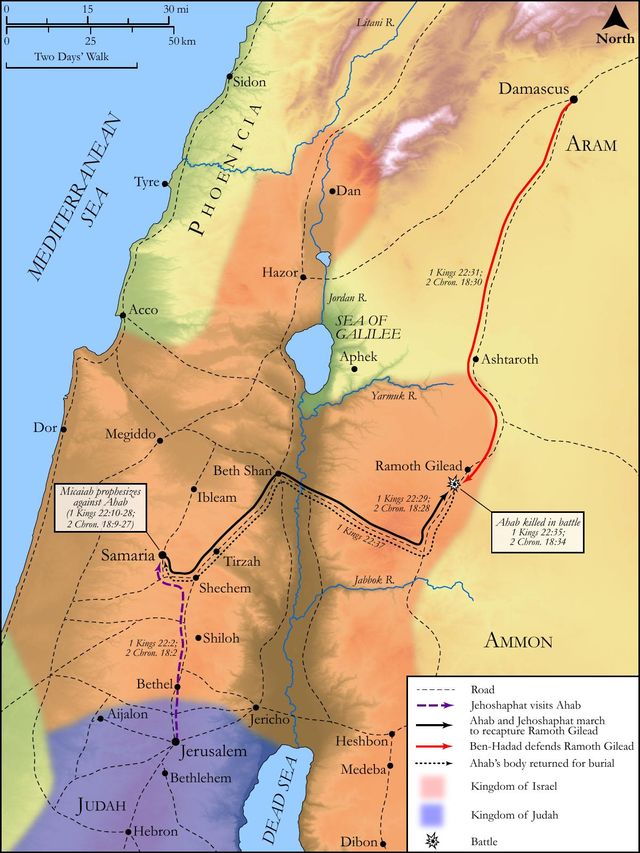
See on the biblical-era map
Study this verse
Public-domain commentary
Matthew Henry
From his Commentary on the Whole Bible. Henry comments on passages, not single verses — this entry covers 2 Chronicles 18:4–27.
This is almost word for word the same with what we had, 1 Kings 22. We will not repeat what was there said, nor have we much to add, but may take occasion to think, 1. Of the great duty of acknowledging God in all our ways and enquiring at his word, whatever we undertake. Jehoshaphat was not willing to proceed till he had done this, Ch2 18:4. By particular believing prayer, by an unbiased consultation of the scripture and our own consciences, and by an observant regard to the hints of providence, we may make such enquiries and very much to our satisfaction. 2. Of the great danger of bad company even to good men. Those that have more wisdom, grace, and resolution, cannot be sure that they can converse familiarly with wicked people and get no hurt by them. Jehoshaphat here, in complaisance to Ahab, sits in his robes, patiently hearing the false prophets speaking lies in the name of the Lord (Ch2 18:9), can scarcely find in his heart to give him a too mild and gentle reproof for hating a prophet of the Lord (Ch2 18:7), and dares not rebuke that false prophet who basely abused the faithful seer nor oppose Ahab who committed him to prison. Those who venture among the seats of the scornful cannot come off without a great deal of the guilt attaching to at least the omission of their duty, unless they have such measures of wisdom and courage as few can pretend to. 3. Of the unhappiness of those who are surrounded with flatterers, especially flattering prophets, who cry peace to them and prophesy nothing but smooth things. Thus was Ahab cheated into his ruin, and justly; for he hearkened to such, and preferred those that humoured him before a good prophet that gave him fair warning of his danger. Those do best for themselves that give their friends leave, and particularly their ministers, to deal plainly and faithfully with them, and take their reproofs not only patiently, but kindly. That counsel is not always best for us that is most pleasing to us. 4. Of the power of Satan, by the divine permission, in the children of disobedience. One lying spirit can make 400 lying prophets and make use of them to deceive Ahab, Ch2 18:21. The devil becomes a murderer by being a liar and destroys men by deceiving them. 5. Of the justice of God in giving those up to strong delusions, to believe a lie, who will not receive the love of the truth, but rebel against it, Ch2 18:21. Let the lying spirit prevail to entice those to their ruin that will not be persuaded to their duty and happiness. 6. Of the hard case of faithful ministers, whose lot it has often been to be hated, and persecuted, and ill-treated, for being true to their God and just and kind to the souls of men. Micaiah, for discharging a good conscience, was buffeted, imprisoned, and condemned to the bread and water of affliction. But he could with assurance appeal to the issue, as all those may do who are persecuted for their faithfulness, Ch2 18:27. The day will declare who is in the right and who in the wrong, when Christ will appear, to the unspeakable consolation of his persecuted people and the everlasting confusion of their persecutors, who will be made to see in that day (Ch2 18:24) what they will not now believe.
Historical interpretation
Historical reception
1 surviving comment on this verse from the historical church.
In the case of Ahab, God said, “Who shall deceive Ahab for me?” In addition, there is also the fact that he always made himself available for comparison with the pagan gods, and all this is below the dignity of God. However, viewed in another way, it becomes worthy of him. I say this for he is so merciful that for the sake of our salvation he foregoes being spoken of in terms befitting his dignity.
Continue studying 2 Chronicles 18:19 across the web’s major study libraries — every link below opens this exact verse, chapter, or book on the destination site.
Read & Compare
 BibleGatewayThis verse in more than 200 translations and 70 languages.
 Bible.comThe YouVersion reader — hundreds of translations, reading plans, and highlights.
 ESV.orgCrossway's official English Standard Version reader.
 NET BibleThe NET translation with 60,000+ translators' notes on every rendering decision.
 STEP BibleTyndale House's free study tool — original text, vocabulary, and scholarly resources.
 BibliaLogos Bible Software's free web reader.
 USCCBThe New American Bible (Revised Edition) with the U.S. bishops' study notes.
Commentaries
 BibleHub CommentariesDozens of classic commentaries on this verse, gathered on one page.
 StudyLightMore than 100 commentary sets — the largest collection on the web.
 BibleRefPlain-English commentary on what this verse means, verse by verse.
 Enduring WordDavid Guzik's free commentary on this chapter, widely used by Bible teachers.
 Bible Study ToolsVerse commentary alongside Greek and Hebrew study aids.
Original Language & Research
- BibleHub InterlinearThe verse word by word — original language, transliteration, and English.
- BibleHub LexiconEvery word's original-language definition and Strong's entry.
 Blue Letter BibleDeep-study tools — Strong's numbers, concordance, and word studies.
 SefariaThe Hebrew text with Rashi and centuries of Jewish commentary.
Sermons, Hymns & Audio


TrulyRandomVerse is not affiliated with these sites and doesn’t control their content. They’re linked because they’re genuinely useful.
Summary
This verse unveils a profound scene within Micaiah's prophetic vision, depicting the LORD's direct inquiry in the heavenly council concerning the means by which King Ahab of Israel would be led to his demise. It powerfully underscores God's absolute and active sovereignty over human history and the destinies of rulers, even in orchestrating the judgment of a wicked king, setting the divine stage for the deceptive events that would lead Ahab to his preordained death at Ramoth-Gilead.
Context
ShowHideLiterary Context
2 Chronicles 18:19 serves as the dramatic core of Micaiah's prophetic confrontation with King Ahab and King Jehoshaphat. The preceding narrative details Ahab's determination to reclaim Ramoth-Gilead from Aram, prompting his alliance with Jehoshaphat. While 400 of Ahab's court prophets enthusiastically promised victory, Jehoshaphat, discerning their lack of genuine divine inspiration, insisted on consulting a true prophet of the LORD. This led to the reluctant summoning of Micaiah, who, after an initial sarcastic affirmation of the false prophets' message, then unveiled a disturbing vision of God's heavenly court. Verse 19 specifically details the LORD's direct inquiry about how Ahab would be "enticed" to his death, revealing the divine decree behind the impending battle. This scene stands in stark contrast to the deceptive assurances given by Ahab's own prophets, providing a crucial divine perspective on human events and directly paralleling the account found in 1 Kings 22.
Historical & Cultural Context
The historical backdrop is the mid-9th century BCE, a period marked by significant geopolitical instability and shifting power dynamics between Israel and its neighbors, particularly Aram (Syria). Ramoth-Gilead was a strategically vital city, frequently a flashpoint in the ongoing conflicts between these kingdoms. King Ahab, known for his egregious idolatry, particularly the promotion of Baal worship, and his persecution of true prophets (as detailed in 1 Kings 16), had consistently defied God's covenant. The concept of a "heavenly council" or "divine assembly" was a recognized motif in ancient Near Eastern cultures. However, in Israelite theology, unlike polytheistic pantheons, the LORD's sovereignty over such a council was absolute and singular, affirming His supreme authority. This vision thus powerfully asserts God's ultimate control over the destinies of kings and nations, even utilizing the actions of spiritual beings to accomplish His righteous judgments against those who persistently rebel against His will.
Key Themes
ShowHideThis verse profoundly illustrates several core theological themes. Firstly, Divine Sovereignty is paramount; God is not a passive observer but actively orchestrates events, including the downfall of a wicked king, demonstrating His absolute control over all creation and human history. This is a recurring motif throughout the biblical narrative, emphasizing that no human action or geopolitical maneuver falls outside His ultimate decree, as powerfully articulated in passages like Daniel 4:17. Secondly, the verse highlights Judgment for Disobedience. King Ahab's prolonged history of rebellion, idolatry, and persecution of God's prophets had reached a critical juncture where divine judgment was inevitable. The vision reveals that Ahab's desire for war would become the very instrument of his preordained demise, a direct consequence of his unrepentant sin. Finally, it touches upon Spiritual Deception and the perilous dangers of rejecting divine truth. The LORD's question about enticement, and the subsequent role of a lying spirit (further elaborated in the following verses), underscore how those who refuse to heed divine truth can be led astray by deceptive influences, ultimately fulfilling God's righteous judgment. This serves as a stark warning about the critical importance of spiritual discernment, echoing admonitions found in 1 John 4:1.
Exposition and Analysis
ShowHideKey Word Analysis
ShowHideThe Hebrew verb אָמַר (ʼâmar, H559) is a primitive root meaning "to say," but used with great latitude. In this context, "And the LORD said" conveys not merely speech but a declarative act of divine will and initiation. It signifies the LORD's active involvement in the unfolding events, establishing His authority and purpose in the heavenly council.
The Hebrew verb פָּתָה (pâthâh, H6601) carries a range of meanings, from "to persuade," "to open," or "to allure," to "to deceive," "to mislead," or "to beguile." In this context, it strongly implies a deliberate act of leading someone astray, often into a trap or harmful situation. The LORD's question is not about tempting Ahab to sin, but about finding a means to lead him to the place of his predetermined judgment, a judgment already deserved due to his persistent wickedness.
The Hebrew verb נָפָל (nâphal, H5307) literally means "to fall" or "to drop." In military contexts, as here, it is a common idiom for "to fall in battle," meaning "to be killed" or "to die." Thus, the question is explicitly about how Ahab will be led to his death at Ramoth-Gilead, emphasizing the certainty and precision of his demise as a divinely decreed outcome.
Verse Breakdown
ShowHide"And the LORD said, Who shall entice Ahab king of Israel, that he may go up and fall at Ramothgilead?"
This opening clause dramatically establishes the divine initiative and absolute sovereignty. The LORD is depicted as presiding over a heavenly council, actively seeking a means to bring about His predetermined judgment upon King Ahab. The question is rhetorical in its ultimate purpose, as the outcome is fixed, but it invites a response regarding the method of enticement. The precise naming of the location, "Ramothgilead," and the manner of death, "go up and fall," highlights the specificity and certainty of the divine decree, underscoring that Ahab's fate is sealed.
"And one spake saying after this manner, and another saying after that manner."
This second clause briefly describes the initial responses from the heavenly assembly. It indicates a deliberation or proposal process among the spiritual beings present, suggesting that various strategies or methods were considered before a specific plan was approved. This sets the stage for the more detailed account in the subsequent verses, where a "lying spirit" offers the successful proposal. It emphasizes that the divine will is not arbitrary but involves a process, albeit one entirely under God's ultimate control and supervision, demonstrating the ordered nature of the divine realm.
Literary Devices
ShowHideThe verse employs several potent literary devices to convey its powerful message. Anthropomorphism is evident in the depiction of the LORD "speaking" and posing a question within a heavenly court, attributing human-like communication and deliberation to God to make His divine decree comprehensible and relatable to human readers. There is a strong element of Foreshadowing, as the LORD's question explicitly outlines Ahab's precise fate—to "fall at Ramothgilead"—long before the battle takes place, building suspense and highlighting the inevitability of divine judgment. Dramatic Irony is also powerfully present, as the audience is made privy to this heavenly decree and the means of Ahab's downfall, while Ahab himself remains tragically oblivious, trusting in false prophets and his own military might. Finally, the scene invokes the ancient and significant Divine Council Motif, a common biblical and ancient Near Eastern literary convention, where God is portrayed as surrounded by heavenly beings, underscoring His supreme authority and the ordered nature of His cosmic governance over all spiritual and earthly affairs.
Theological and Thematic Connections
ShowHide2 Chronicles 18:19 offers a profound theological statement on God's active governance of the world, even amidst the darkest corners of human rebellion and deception. It reveals that divine judgment is not merely reactive but can be divinely orchestrated, utilizing various means, including the permission of deceptive spirits, to bring about righteous ends against those who have persistently rejected truth and embraced wickedness. This passage challenges simplistic views of divine intervention, showing a God who is both perfectly just and absolutely sovereign, capable of using even the forces of evil to achieve His purposes, without Himself being the author or instigator of evil. It underscores the gravity of persistent sin and the certainty of God's ultimate accountability for all human actions.
Reflection and Application
ShowHideThis dramatic scene from Micaiah's prophecy serves as a potent reminder for believers today about the profound nature of God, the inevitable consequences of rebellion, and the critical need for spiritual discernment. We are called to recognize that God remains sovereign over all circumstances, even when events seem chaotic or driven by human folly and evil. Ahab's story is a stark warning: persistent disobedience to God's revealed will, coupled with a preference for comforting lies over uncomfortable truth, inevitably leads to judgment. We must cultivate a deep reliance on God's Word and the Holy Spirit to discern between truth and deception, diligently testing all voices and counsel against the plumb line of Scripture. This passage encourages us to trust in God's ultimate plan, knowing that His justice will prevail, and His purposes will be accomplished, even through the most unexpected means. It calls us to humility, repentance, and an unwavering commitment to seeking and obeying divine truth above all else, for our own spiritual well-being and to avoid the tragic path of those who choose to live by lies.
Questions for Reflection
ShowHideFAQ
ShowHideDoes this verse imply God directly causes evil or tempts people to sin?
ShowHideNo, this verse does not imply that God directly causes evil or tempts people to sin. Theologically, the Bible is clear that God is holy and righteous, and He does not tempt anyone to do evil (James 1:13). Rather, this passage illustrates God's ultimate sovereignty and His ability to use even the actions of evil or deceptive spirits to accomplish His righteous judgments upon those who have already chosen a path of rebellion and persistent sin. In Ahab's case, his heart was already hardened, and he had a long history of rejecting God's prophets and embracing idolatry (1 Kings 16:30-33). The "enticement" was not to make Ahab sin, but to lead him to the place where his preordained judgment would be executed. God permitted a lying spirit to influence Ahab's false prophets, knowing that Ahab would readily accept their deceitful counsel because it aligned with his own desires, thereby leading him to his demise at Ramoth-Gilead (1 Kings 22:20-23). This demonstrates God's profound control over all things, including the actions of spiritual beings, to fulfill His just and holy purposes.
Christ-Centered Fulfillment
ShowHideWhile 2 Chronicles 18:19 vividly depicts God's judgment upon a wicked king, it profoundly foreshadows the ultimate outworking of divine sovereignty and justice in the person and redemptive work of Jesus Christ. Just as Ahab's death was divinely orchestrated as a consequence of his rebellion, so too was the crucifixion of Jesus, though seemingly a human act of betrayal and injustice, part of God's eternal, predetermined plan for the redemption of humanity (Acts 2:23). Unlike Ahab, who embraced deception leading to his demise, Jesus is the very embodiment of divine truth, exposing all lies and spiritual deception, declaring Himself to be "the way, the truth, and the life" (John 14:6). The "enticement" that led Ahab to his death stands in stark contrast to the divine "enticement" of the cross, where Christ willingly laid down His life, not as a victim of judgment, but as the sinless Lamb of God who takes away the sin of the world (John 1:29). Through His death and glorious resurrection, Christ disarmed the powers of darkness and triumphed over all spiritual deception (Colossians 2:15), offering salvation, true discernment, and eternal life to all who believe, thereby fulfilling God's ultimate purpose not in judgment, but in grace, reconciliation, and the establishment of His everlasting kingdom.