


1 Kings 22:20
- וַיֹּאמֶרvai·Yo·merand he saidH559Conj-w ¦ V-Qal-ConsecImperf-3msVerb Qal Consecutive Imperfect 3rd Singular Masculineוַandיֹּאמֶרhe said
- יְהוָהYah·wehYahwehH3068N-properNoun Proper Title
- מִיmiwho?H4310InterrogPronoun Interrogative
- יְפַתֶּהye·fa·Tehwill he deceiveH6601V-Piel-Imperf-3msVerb Piel Imperfect 3rd Singular Masculine
- אֶת'et<obj.>H853DirObjMParticle Object Indicator
- אַחְאָב'ach·'AvAhabH256N-proper-mNoun Proper Masculine
- וְיַעַלve·Ya·'also he may go upH5927Conj-w ¦ V-Qal-Imperf-3msVerb Qal Imperfect 3rd Singular Masculineוְsoיַעַלhe may go up
- וְיִפֹּלve·yi·Poland he may fallH5307Conj-w ¦ V-Qal-ConjImperf-3msVerb Qal Conjunction+Imperfect 3rd Singular Masculineוְandיִפֹּלhe may fall
- בְּרָמֹתbe·ra·Motat RamothH7418Prep-b ¦ N-properNoun Proper LocationבְּatרָמֹתRamoth
- גִּלְעָדgil·'AdGileadH1568N-properNoun Proper Location
- וַיֹּאמֶרvai·Yo·merand it saidH559Conj-w ¦ V-Qal-ConsecImperf-3msVerb Qal Consecutive Imperfect 3rd Singular Masculineוַandיֹּאמֶרit said
- זֶהzehthis [one]H2088PrtParticle Demonstrative
- בְּכֹהbe·Khohby thusH3541Prep-b ¦ AdvAdverbבְּbyכֹהthus
- וְזֶהve·Zehand this [one]H2088Conj-w ¦ PrtParticle Demonstrativeוְandזֶהthis [one]
- אֹמֵר'o·Mer[was] sayingH559V-Qal-Prtcpl-msVerb Qal Participle Singular Masculine Absolute
- בְּכֹהbe·Khohby thusH3541Prep-b ¦ AdvAdverbבְּbyכֹהthus
English is a literal word-by-word gloss of the Hebrew, not the KJV's wording. Why?
This is the original text the KJV's translators worked from — each Hebrew word with its own literal English meaning in this verse, prepared by scholars at Tyndale House, Cambridge. The KJV translates whole sentences, not word by word, so its wording differs: one Hebrew word can become several English words, and the KJV may choose “the LORD” where the gloss reads “Yahweh”. Both are faithful — they answer different questions. For the KJV's own rendering, switch to the KJV text.
Details
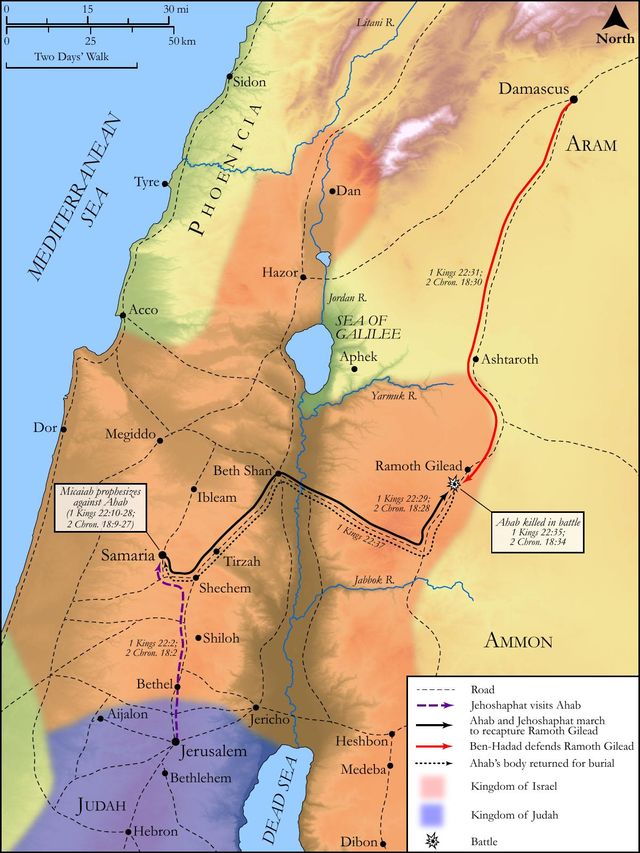
See on the biblical-era maps

Study this verse
Public-domain commentary
Matthew Henry
From his Commentary on the Whole Bible. Henry comments on passages, not single verses — this entry covers 1 Kings 22:15–28. His three-level outline is real structure in the source text, so it is rendered as structure.
Here Micaiah does well, but, as is common, suffers ill for so doing.
I.We are told how faithfully he delivered his message, as one that was more solicitous to please God than to humour either the great or the many. In three ways he delivers his message, and all displeasing to Ahab: -
1.He spoke as the rest of the prophets had spoken, but ironically: Go, and prosper, Kg1 22:15. Ahab put the same question to him that he had put to his own prophets (Shall we go, or shall we forbear?) seeming desirous to know God's mind, when, like Balaam, he was strongly bent to do his own, which Micaiah plainly took notice of when he bade him go, but with such an air and pronunciation as plainly showed he spoke it by way of derision; as if he had said, "I know you are determined to go, and I hear your own prophets are unanimous in assuring you of success; go then and take what follows. They say, The Lord shall deliver it into the hand of the king; but I do not tell thee that thus saith the Lord; no, he saith otherwise." Note, Those deserve to be bantered that love to be flattered; and it is just with God to give up those to their own counsels that give up themselves to their own lusts. Ecc 11:9. In answer to this Ahab adjured him to tell him the truth, and not to jest with him (v. 16), as if he sincerely desired to know both what God would have him to do and what he would do with him, yet intending to represent the prophet as a perverse ill-humoured man, that would not tell him the truth till he was thus put to his oath, or adjured to do it.
2.Being thus pressed, he plainly foretold that the king would be cut off in this expedition, and his army scattered, Kg1 22:17. He saw them in a vision, or in a dream, dispersed upon the mountains, as sheep that had no one to guide them. Smite the shepherd, and the sheep will be scattered, Zac 13:7. This intimates,
(1.)That Israel should be deprived of their king, who was their shepherd. God took notice of it, These have no master.
(2.)That they would be obliged to retire re infecta - without accomplishing their object. He does not foresee any great slaughter in the army, but that they should make a dishonorable retreat. Let them return every man to his house in peace, put into disorder indeed for the present, but no great losers by the death of their king; he shall fall in war, but they shall go home in peace. Thus Micaiah, in his prophecy, testified what he had seen and heard (let them take it how they pleased), while the others prophesied merely out of their own hearts; see Jer 23:28. "The prophet that has a dream let him tell that, and so quote his authority; and he that has my word, let him speak my word faithfully, and not his own; for what is the chaff to the wheat?" Now Ahab finds himself aggrieved, turns to Jehoshaphat, and appeals to him whether Micaiah had not manifestly a spite against him, Kg1 22:18. Those that bear malice to others are generally willing to believe that others bear malice to them, though they have no cause for it, and therefore to put the worst constructions upon all they say. What evil did Micaiah prophesy to Ahab in telling him that, if he proceeded in this expedition, it would be fatal to him, while he might choose whether he would proceed in it or no? The greatest kindness we can do to one that is going a dangerous way is to tell him of his danger.
3.He informed the king how it was that all his prophets encouraged him to proceed, that God permitted Satan by them to deceive him into his ruin, and he by vision knew of it; it was represented to him, and he represented it to Ahab, that the God of heaven had determined he should fall at Ramoth-Gilead (Kg1 22:19, Kg1 22:20), that the favour he had wickedly shown to Ben-hadad might be punished by him and his Syrians, and that he being in some doubt whether he should go to Ramoth-Gilead or no, and resolving to be advised by his prophets, they should persuade him to it and prevail (Kg1 22:21, Kg1 22:22); and hence it was that they encouraged him with so much assurance (Kg1 22:23); it was a lie from the father of lies, but by divine permission. This matter is here represented after the manner of men. We are not to imagine that God is ever put upon new counsels, or is ever at a loss for means whereby to effect his purposes, nor that he needs to consult with angels, or any creature, about the methods he should take, nor that he is the author of sin or the cause of any man's either telling or believing a lie; but, besides what was intended by this with reference to Ahab himself, it is to teach us, (1.) That God is a great king above all kings, and has a throne above all the thrones of earthly princes. "You have your thrones," said Micaiah to these two kings, "and you think you may do what you will, and we must all say as you would have us; but I saw the Lord sitting upon his throne, and every man's judgment proceeding from him, and therefore I must say as he says; he is not a man, as you are." (2.) That he is continually attended and served by an innumerable company of angels, those heavenly hosts, who stand by him, ready to go where he sends them and to do what he bids them, messengers of mercy on his right hand, of wrath on his left hand. (3.) That he not only takes cognizance of, but presides over, all the affairs of this lower world, and overrules them according to the counsel of his own will. The rise and fall of princes, the issues of war, and all the great affairs of state, which are the subject of the consultations of wise and great men, are no more above God's direction than the meanest concerns of the poorest cottages are below his notice. (4.) That God has many ways of bringing about his own counsels, particularly concerning the fall of sinners when they are ripe for ruin; he can do it either in this manner or in that manner. (5.) That there are malicious and lying spirits which go about continually seeking to devour, and, in order to that, seeking to deceive, and especially to put lies into the mouths of prophets, by them to entice many to their destruction. (6.) It is not without the divine permission that the devil deceives men, and even thereby God serves his own purposes. With him are strength and wisdom, the deceived and the deceivers are his, Job 12:16. When he pleases, for the punishment of those who receive not the truth in the love of it, he not only lets Satan loose to deceive them (Rev 20:7, Rev 20:8), but gives men up to strong delusions to believe him, Th2 2:11, Th2 2:12. (7.) Those are manifestly marked for ruin that are thus given up. God has certainly spoken evil concerning those whom he had given up to be imposed upon by lying prophets. Thus Micaiah gave Ahab fair warning, not only of the danger of proceeding in this war, but of the danger of believing those that encouraged him to proceed. Thus we are warned to beware of false prophets, and to try the spirits; the lying spirit never deceives so fatally as in the mouth of prophets.
II.We are told how he was abused for delivering his message thus faithfully, thus plainly, in a way so very proper both to convince and to affect.
1.Zedekiah, a wicked prophet, impudently insulted him in the face of the court, smote him on the cheek, to reproach him, to silence him and stop his mouth, and to express his indignation at him (thus was our blessed Saviour abused, Mat 26:67, that Judge of Israel, Mic 5:1); and as if he not only had the spirit of the Lord, but the monopoly of this Spirit, that he might not go without his leave, he asks, Which way went the Spirit of the Lord from me to speak to thee? Kg1 22:24. The false prophets were always the worst enemies the true prophets had, and not only stirred up the government against them, but were themselves abusive to them, as Zedekiah here. To strike within the verge of the court, especially in the king's presence, is looked upon by our law as a high misdemeanour; yet this wicked prophet gives this abuse to a prophet of the Lord, and is not reprimanded nor bound to his good behaviour for it. Ahab was pleased with it, and Jehoshaphat had not courage to appear for the injured prophet, pretending it was out of his jurisdiction; but Micaiah, though he returns not his blow (God's prophets are not strikers nor persecutors, dare not avenge themselves, render blow for blow, or be in any way accessory to the breach of the peace), yet, since he boasted so much of the Spirit, as those commonly do that know least of his operations, he leaves him to be convinced of his error by the event: Thou shalt know when thou hidest thyself in an inner chamber, Kg1 22:25. It is likely Zedekiah went with Ahab to the battle, and took his horns of iron with him to encourage the soldiers, to see with pleasure the accomplishment of his prophecy, and return in triumph with the king; but, the army being routed, he fled among the rest from the sword of the enemy, sheltered himself as Ben-hadad had done in a chamber within a chamber (Kg1 20:30), lest he should perish, as he knew he deserved to do, with those whom he had deluded, as Balaam did (Num 31:8), and lest the blind prophet should fall into the ditch with the blinded prince whom he had misled. Note, Those that will not have their mistakes rectified in time by the word of God will be undeceived, when it is too late, by the judgments of God.
2.Ahab, that wicked king, committed him to prison (Kg1 22:27), not only ordered him to be taken into custody, or remitted to the prison whence he came, but to be fed with bread and water, coarse bread and puddle-water, till he should return, not doubting but that he should return a conqueror, and then he would put him to death for a false prophet (Kg1 22:27) - hard usage for one that would have prevented his ruin! But by this it appeared that God had determined to destroy him, as Ch2 25:16. How confident is Ahab of success. He doubts not but he shall return in peace, forgetting what he himself had reminded Ben-hadad of, Let not him that girdeth on the harness boast; but there was little likelihood of his coming home in peace when he left one of God's prophets behind him in prison. Micaiah put it upon the issue, and called all the people to be witnesses that he did so: "If thou return in peace, the Lord has not spoken by me, Kg1 22:28. Let me incur the reproach and punishment of a false prophet, if the king come home alive." He ran no hazard by this appeal, for he knew whom he had believed; he that is terrible to the kings of the earth, and treads upon princes as mortar, will rather let thousands of them fall to the ground than one jot or tittle of his own word; he will not fail to confirm the word of his servants, Isa 44:26.
Historical interpretation
Historical reception
1 surviving comment on this verse from the historical church.
The Lord said: God standeth not in need of any counsellor; nor are we to suppose that things pass in heaven in the manner here described: but this representation was made to the prophet, to be delivered by him in a manner adapted to the common ways and notions of men.
Continue studying 1 Kings 22:20 across the web’s major study libraries — every link below opens this exact verse, chapter, or book on the destination site.
Read & Compare
 BibleGatewayThis verse in more than 200 translations and 70 languages.
 Bible.comThe YouVersion reader — hundreds of translations, reading plans, and highlights.
 ESV.orgCrossway's official English Standard Version reader.
 NET BibleThe NET translation with 60,000+ translators' notes on every rendering decision.
 STEP BibleTyndale House's free study tool — original text, vocabulary, and scholarly resources.
 BibliaLogos Bible Software's free web reader.
 USCCBThe New American Bible (Revised Edition) with the U.S. bishops' study notes.
Commentaries
 BibleHub CommentariesDozens of classic commentaries on this verse, gathered on one page.
 StudyLightMore than 100 commentary sets — the largest collection on the web.
 BibleRefPlain-English commentary on what this verse means, verse by verse.
 Enduring WordDavid Guzik's free commentary on this chapter, widely used by Bible teachers.
 Bible Study ToolsVerse commentary alongside Greek and Hebrew study aids.
Original Language & Research
- BibleHub InterlinearThe verse word by word — original language, transliteration, and English.
- BibleHub LexiconEvery word's original-language definition and Strong's entry.
 Blue Letter BibleDeep-study tools — Strong's numbers, concordance, and word studies.
 SefariaThe Hebrew text with Rashi and centuries of Jewish commentary.
Sermons, Hymns & Audio


TrulyRandomVerse is not affiliated with these sites and doesn’t control their content. They’re linked because they’re genuinely useful.
Summary
First Kings 22:20 offers a profound and sobering glimpse into the divine council, revealing the LORD's sovereign orchestration of events leading to King Ahab's demise. Following Ahab's persistent rebellion and rejection of true prophecy, this verse captures God's rhetorical question to His heavenly court: "Who shall persuade Ahab, that he may go up and fall at Ramothgilead?" This inquiry sets the stage for a deceptive spirit to volunteer to mislead Ahab's false prophets, ensuring the king's self-chosen path of destruction culminates in the judgment prophesied against him. It powerfully underscores God's ultimate control even over the actions of wicked rulers and the spread of falsehood, all for the fulfillment of His righteous and just purposes.
Context
ShowHideLiterary Context
This pivotal verse is embedded within the dramatic narrative of King Ahab's final confrontation with the prophet Micaiah, immediately preceding Ahab's ill-fated battle against Ramoth-Gilead. The preceding verses (1 Kings 22:1-12) establish Ahab's desire to reclaim Ramoth-Gilead from the Arameans and his alliance with King Jehoshaphat of Judah. Ahab, characteristic of his reign, consults 400 of his own court prophets, who unanimously deliver favorable prophecies of victory. However, Jehoshaphat, discerning the superficiality of their words, insists on hearing from a true prophet of the LORD. Micaiah, known for delivering unfavorable but truthful prophecies, is reluctantly summoned. The scene then shifts dramatically in 1 Kings 22:19-23 to Micaiah's stunning vision of the heavenly council, where God Himself is depicted orchestrating the events that will lead to Ahab's downfall, providing the divine rationale behind the false prophecies. Verse 20 specifically introduces the LORD's question, initiating the plan for Ahab's deception and eventual judgment.
Historical & Cultural Context
King Ahab of Israel (reigned c. 874-853 BC) was one of the most wicked kings in Israel's history, notorious for promoting Baal worship through his Phoenician wife, Jezebel, and for his blatant disregard for the Mosaic covenant, exemplified by the murder of Naboth to seize his vineyard (see 1 Kings 21). Ramoth-Gilead was a strategically vital city in Transjordan, frequently contested between Israel and Aram (Syria), representing a point of ongoing conflict and a symbol of Israel's territorial claims. The alliance between Ahab and Jehoshaphat, despite their theological differences, was a political necessity for regional stability against Aram. Culturally, ancient Near Eastern kings often consulted prophets and diviners before military campaigns to ascertain divine favor or outcome. The concept of a "heavenly council" or divine assembly (e.g., Job 1:6; Psalm 82:1) was a recognized motif in the ancient world, though the biblical portrayal uniquely emphasizes Yahweh's singular authority and moral governance over such a council, demonstrating His absolute control over all spiritual beings.
Key Themes
ShowHideThis verse powerfully contributes to several overarching themes within 1 Kings and the broader biblical narrative. Firstly, it highlights Divine Sovereignty, demonstrating God's ultimate control over all events, including the actions of wicked rulers and the spread of deception, to fulfill His purposes and judgments. Secondly, it offers a rare and profound glimpse into The Heavenly Council, underscoring God's absolute authority and the orderly nature of His governance over creation, even in the execution of judgment. Thirdly, it starkly illustrates Judgment on Disobedience, as Ahab's persistent rebellion against the LORD reaches its climax, with God permitting a deceptive influence to confirm the king in his already chosen path of self-destruction (as foreshadowed in 1 Kings 21:20-25). Finally, the scene provides a dramatic contrast between True vs. False Prophecy, emphasizing the critical importance of discerning God's authentic word from human or demonic deception, a theme further elaborated in 1 Kings 22:23.
Exposition and Analysis
ShowHideKey Word Analysis
ShowHideThe Hebrew verb פָּתָה (pâthâh') means "to open," "to entice," "to allure," "to deceive," or "to beguile." In this context, it carries a strong connotation of leading astray or seducing, often with negative consequences. It is not about God coercing Ahab against his will, but rather allowing or even orchestrating a deceptive influence to confirm Ahab in his already chosen path of rebellion and self-deception. This word highlights the subtle yet powerful nature of spiritual deception and its role in God's judgment against those who persistently refuse to hear the truth.
The Hebrew verb עָלָה (ʻâlâh') means "to ascend," "to rise," or "to go up." Here, it specifically refers to Ahab going up to battle at Ramoth-Gilead. The phrase "go up and fall" is a deliberate juxtaposition. While "go up" signifies the initiation of the military campaign, it is immediately linked to the fatal outcome, emphasizing the certainty of God's decree and the king's predetermined demise as a consequence of his actions.
The Hebrew verb נָפַל (nâphal') means "to fall," "to collapse," or "to die." In this context, it unequivocally signifies Ahab's death in battle. The LORD's question explicitly links Ahab's ascent to battle with his certain downfall, leaving no ambiguity about the outcome. This word underscores the finality of divine judgment and the inescapable consequences of persistent disobedience and rejection of God's warnings.
Verse Breakdown
ShowHide"And the LORD said,"
This opening phrase immediately establishes the divine source of the subsequent inquiry, placing the events firmly within the realm of God's sovereign will and decree. It indicates a direct pronouncement or question from the ultimate authority in the heavenly council, setting the stage for a divinely sanctioned plan.
"Who shall persuade Ahab,"
This is a rhetorical question posed by the LORD to His heavenly assembly. It is not an expression of divine ignorance or indecision, but rather an invitation for a volunteer to execute a specific aspect of God's predetermined plan. The use of "persuade" (פָּתָה, pâthâh') implies a leading astray or deception, suggesting that Ahab's demise will come through a process of being misled rather than outright divine compulsion, confirming him in his chosen path.
"that he may go up and fall at Ramothgilead?"
This clause explicitly states the purpose and outcome of the persuasion: Ahab's ascent to battle and his certain death at Ramoth-Gilead. It reveals God's specific judgment against Ahab, demonstrating that the king's fate is sealed and that the divine plan is precise in its execution, even down to the location of his death, as a just consequence for his persistent wickedness.
"And one said on this manner, and another said on that manner."
This indicates that various suggestions or proposals were offered by members of the heavenly council in response to the LORD's question. While the text doesn't detail these initial suggestions, it sets the stage for the specific volunteer (the "lying spirit" in 1 Kings 22:21-23) whose plan will ultimately be approved and implemented by God. It highlights the deliberative, yet divinely controlled, nature of the heavenly court, where God remains supreme.
Literary Devices
ShowHideThe passage in 1 Kings 22:20 is rich in literary devices that enhance its theological impact and dramatic tension. Anthropomorphism is evident in the depiction of the LORD "saying" and presiding over a council, attributing human-like actions and a deliberative process to God to make His divine governance comprehensible to human readers. Dramatic Irony pervades the entire scene, as the audience is privy to the divine plan for Ahab's downfall, while Ahab himself remains tragically oblivious, convinced by the false prophets that victory awaits him. This creates a profound tension between what the characters know and what the reader knows, heightening the sense of impending doom. Foreshadowing is powerfully employed, as the LORD's question explicitly predetermines Ahab's "fall at Ramothgilead," signaling his imminent death before the battle even begins, leaving no doubt about the outcome. The entire scene operates as a Divine Council Motif, a recurring biblical and ancient Near Eastern literary trope where God deliberates with celestial beings, but here it uniquely emphasizes Yahweh's absolute sovereignty and the subservience of all other spiritual entities to His will and righteous judgments. Finally, there is a strong Contrast between the true prophecy of Micaiah, rooted in divine revelation, and the false prophecies of Ahab's 400 prophets, which are revealed to be the product of a deceptive spirit sanctioned by God for judgment.
Theological and Thematic Connections
ShowHideFirst Kings 22:20 is a profound theological statement on God's absolute sovereignty, even over the forces of evil and deception. It challenges a simplistic understanding of divine action, revealing that God can permit or even orchestrate deceptive influences to achieve His righteous judgments against those who persistently reject His truth. This passage underscores that human free will, while real, operates within the larger framework of God's ultimate control. Ahab's choices led him to a place where God's judgment was inevitable, and the heavenly council scene illustrates the divine means by which that judgment was brought to pass. It is a powerful reminder that God is not merely reactive but actively governs all things, ensuring His purposes prevail and that justice is ultimately served, even through seemingly paradoxical means.
Reflection and Application
ShowHideThis passage from 1 Kings 22:20 serves as a sobering reminder of the gravity of persistent rebellion against God and the critical importance of spiritual discernment. In a world saturated with information and competing voices, believers are called to cultivate a deep reliance on God's Spirit to distinguish truth from falsehood. Ahab's desire to hear only what pleased him led him to embrace deception, ultimately to his ruin. We must guard against the temptation to seek out voices that merely affirm our biases or desires, rather than humbly submitting to the often-challenging truth of God's Word. This verse also offers profound comfort in the face of apparent chaos or injustice: God remains on His throne, sovereign over all circumstances, even those involving deception and evil. His ultimate plan for justice and redemption will prevail, assuring us that no force can thwart His purposes. Therefore, we are called to walk in humility, seeking truth above comfort, and trusting in the unfailing sovereignty of our God.
Questions for Reflection
ShowHideFAQ
ShowHideDoes God truly send evil spirits to deceive people?
ShowHideThe text of 1 Kings 22:20-23 indicates that God permits or commissions a spirit to act deceptively. This is not to say God is the author of evil or deception in an inherent sense, as God is light and in Him is no darkness at all (1 John 1:5). Rather, it signifies that He can use even evil instruments to accomplish His righteous judgments. In this case, Ahab had consistently rejected God's true prophets and embraced wickedness (e.g., 1 Kings 21:25). God's action here is a judicial one, allowing Ahab to be confirmed in his chosen path of self-deception and leading him to the judgment he had earned. It's a powerful demonstration of divine sovereignty over all spiritual forces, even those that are malevolent, for the purpose of executing justice and revealing the consequences of persistent rebellion.
Was Ahab's death predestined, or did he still have free will?
ShowHideThis passage presents a complex interplay between divine sovereignty and human responsibility. Ahab certainly exercised his free will throughout his reign by consistently choosing to reject the LORD, embrace Baal worship, and persecute true prophets. His persistent choices led him to a point of no return, where divine judgment became inevitable. God's question in 1 Kings 22:20 and the subsequent plan for deception are the means by which God brings about the judgment Ahab's choices warranted. So, while the outcome of Ahab's death was divinely decreed as a just consequence of his unrepentant wickedness, his path to that outcome was paved by his own willful rebellion and refusal to heed God's warnings. He was not forced into wickedness, but rather given over to the consequences of his chosen path, illustrating that God's sovereignty does not negate human accountability.
Christ-Centered Fulfillment
ShowHideThe scene in 1 Kings 22:20 with its portrayal of a sovereign God orchestrating judgment through permitted deception, finds its ultimate fulfillment and resolution in Jesus Christ. While Ahab was led to his death by a lying spirit, confirming him in his self-chosen path of rebellion, Christ is the very embodiment of truth, the one who exposes and defeats all deception. He is the "way, the truth, and the life" (John 14:6), and His coming brought divine light into a world shrouded in spiritual darkness and lies (John 1:5). The judgment enacted upon Ahab by divine decree foreshadows the ultimate judgment that will be executed by Christ, who has been appointed by the Father as judge of all (John 5:27). Furthermore, the "lying spirit" in the heavenly council points to the reality of spiritual warfare and the "father of lies," Satan (John 8:44), whose power Christ definitively broke through His death and resurrection (Colossians 2:15). Thus, the divine sovereignty seen in 1 Kings 22:20 culminates in Christ's triumph over all forces of evil and deception, securing eternal truth and justice for those who believe in Him, and bringing ultimate judgment upon those who persistently reject the light of His Gospel.