


1 Kings 22:22
Bible text: King James Version (1769 Blayney text) · Public domain
Bible text: King James Version with Strong's numbers · Public domain
Bible text: Berean Standard Bible · Public domain
Bible text: American Standard Version (1901) · Public domain
Bible text: World English Bible, Messianic edition · Public domain
Bible text: Geneva Bible (1599) · Public domain
Bible text: Young's Literal Translation · Public domain
- וַיֹּאמֶרvai·Yo·merand it saidH559Conj-w ¦ V-Qal-ConsecImperf-3msVerb Qal Consecutive Imperfect 3rd Singular Masculineוַandיֹּאמֶרit said
- אֵצֵא'e·Tze'I will go outH3318V-Qal-Imperf-1csVerb Qal Imperfect 1st Singular common gender
- וְהָיִיתִיve·ha·Yi·tiand I will beH1961Conj-w ¦ V-Qal-ConsecPerf-1csVerb Qal Consecutive Perfect 1st Singular common genderוְandהָיִיתִיI will be
- רוּחַRu·acha spirit ofH7307N-fscNoun Singular Feminine Construct
- שֶׁקֶרShe·kerfalsehoodH8267N-msNoun Singular Masculine Absolute
- בְּפִיbe·Fiin [the] mouth ofH6310Prep-b ¦ N-mscNoun Singular Masculine Constructבְּinפִי[the] mouth of
- כָּלkolallH3605N-mscNoun Singular Masculine Construct
- נְבִיאָיוne·vi·'Avhis prophetsH5030N-mpc ¦ 3msNoun Plural Masculine Constructנְבִיאָיprophetsוhis
- וַיֹּאמֶרvai·Yo·merand he saidH559Conj-w ¦ V-Qal-ConsecImperf-3msVerb Qal Consecutive Imperfect 3rd Singular Masculineוַandיֹּאמֶרhe said
- וַיֹּאמֶרvai·Yo·merand he saidH559Conj-w ¦ V-Qal-ConsecImperf-3msVerb Qal Consecutive Imperfect 3rd Singular Masculineוַandיֹּאמֶרhe said
- יְהוָהYah·wehYahwehH3068N-properNoun Proper Title
- תְּפַתֶּהte·fa·Tehyou will deceiveH6601V-Piel-Imperf-2msVerb Piel Imperfect 2nd Singular Masculine
- אֵלָיו'e·Lavto itH413Prep ¦ 3msPrepositionאֵלָיtoוit
- וְגַםve·gamand alsoH1571Conj-w ¦ AdvAdverbוְandגַםalso
- בַּמָּהba·Mah<in> how?H4100Prep-b ¦ InterrogPronoun Interrogativeבַּ<in>מָּהhow?
- תּוּכָלtu·Khalyou will prevailH3201V-Qal-Imperf-2msVerb Qal Imperfect 2nd Singular Masculine
- צֵאtze'go outH3318V-Qal-Imp-2msVerb Qal Imperative 2nd Singular Masculine
- וַעֲשֵׂהva·'a·sehand doH6213Conj-w ¦ V-Qal-Imp-2msVerb Qal Imperative 2nd Singular Masculineוַandעֲשֵׂהdo
- כֵןKhenthusH3651AdvAdverb
English is a literal word-by-word gloss of the Hebrew, not the KJV's wording. Why?
This is the original text the KJV's translators worked from — each Hebrew word with its own literal English meaning in this verse, prepared by scholars at Tyndale House, Cambridge. The KJV translates whole sentences, not word by word, so its wording differs: one Hebrew word can become several English words, and the KJV may choose “the LORD” where the gloss reads “Yahweh”. Both are faithful — they answer different questions. For the KJV's own rendering, switch to the KJV text.
Details
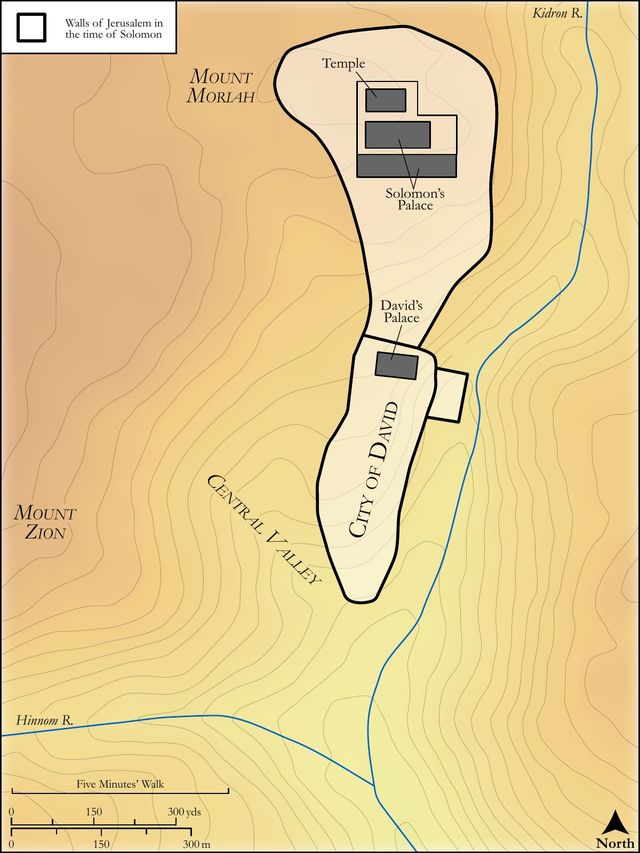
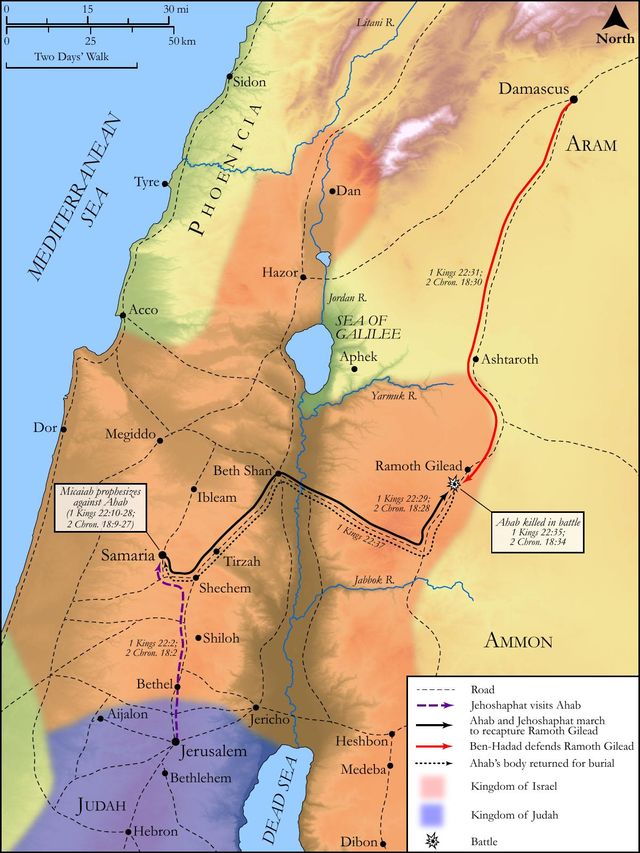
See on the biblical-era maps
Study this verse
Public-domain commentary
Matthew Henry
From his Commentary on the Whole Bible. Henry comments on passages, not single verses — this entry covers 1 Kings 22:15–28. His three-level outline is real structure in the source text, so it is rendered as structure.
Here Micaiah does well, but, as is common, suffers ill for so doing.
I.We are told how faithfully he delivered his message, as one that was more solicitous to please God than to humour either the great or the many. In three ways he delivers his message, and all displeasing to Ahab: -
1.He spoke as the rest of the prophets had spoken, but ironically: Go, and prosper, Kg1 22:15. Ahab put the same question to him that he had put to his own prophets (Shall we go, or shall we forbear?) seeming desirous to know God's mind, when, like Balaam, he was strongly bent to do his own, which Micaiah plainly took notice of when he bade him go, but with such an air and pronunciation as plainly showed he spoke it by way of derision; as if he had said, "I know you are determined to go, and I hear your own prophets are unanimous in assuring you of success; go then and take what follows. They say, The Lord shall deliver it into the hand of the king; but I do not tell thee that thus saith the Lord; no, he saith otherwise." Note, Those deserve to be bantered that love to be flattered; and it is just with God to give up those to their own counsels that give up themselves to their own lusts. Ecc 11:9. In answer to this Ahab adjured him to tell him the truth, and not to jest with him (v. 16), as if he sincerely desired to know both what God would have him to do and what he would do with him, yet intending to represent the prophet as a perverse ill-humoured man, that would not tell him the truth till he was thus put to his oath, or adjured to do it.
2.Being thus pressed, he plainly foretold that the king would be cut off in this expedition, and his army scattered, Kg1 22:17. He saw them in a vision, or in a dream, dispersed upon the mountains, as sheep that had no one to guide them. Smite the shepherd, and the sheep will be scattered, Zac 13:7. This intimates,
(1.)That Israel should be deprived of their king, who was their shepherd. God took notice of it, These have no master.
(2.)That they would be obliged to retire re infecta - without accomplishing their object. He does not foresee any great slaughter in the army, but that they should make a dishonorable retreat. Let them return every man to his house in peace, put into disorder indeed for the present, but no great losers by the death of their king; he shall fall in war, but they shall go home in peace. Thus Micaiah, in his prophecy, testified what he had seen and heard (let them take it how they pleased), while the others prophesied merely out of their own hearts; see Jer 23:28. "The prophet that has a dream let him tell that, and so quote his authority; and he that has my word, let him speak my word faithfully, and not his own; for what is the chaff to the wheat?" Now Ahab finds himself aggrieved, turns to Jehoshaphat, and appeals to him whether Micaiah had not manifestly a spite against him, Kg1 22:18. Those that bear malice to others are generally willing to believe that others bear malice to them, though they have no cause for it, and therefore to put the worst constructions upon all they say. What evil did Micaiah prophesy to Ahab in telling him that, if he proceeded in this expedition, it would be fatal to him, while he might choose whether he would proceed in it or no? The greatest kindness we can do to one that is going a dangerous way is to tell him of his danger.
3.He informed the king how it was that all his prophets encouraged him to proceed, that God permitted Satan by them to deceive him into his ruin, and he by vision knew of it; it was represented to him, and he represented it to Ahab, that the God of heaven had determined he should fall at Ramoth-Gilead (Kg1 22:19, Kg1 22:20), that the favour he had wickedly shown to Ben-hadad might be punished by him and his Syrians, and that he being in some doubt whether he should go to Ramoth-Gilead or no, and resolving to be advised by his prophets, they should persuade him to it and prevail (Kg1 22:21, Kg1 22:22); and hence it was that they encouraged him with so much assurance (Kg1 22:23); it was a lie from the father of lies, but by divine permission. This matter is here represented after the manner of men. We are not to imagine that God is ever put upon new counsels, or is ever at a loss for means whereby to effect his purposes, nor that he needs to consult with angels, or any creature, about the methods he should take, nor that he is the author of sin or the cause of any man's either telling or believing a lie; but, besides what was intended by this with reference to Ahab himself, it is to teach us, (1.) That God is a great king above all kings, and has a throne above all the thrones of earthly princes. "You have your thrones," said Micaiah to these two kings, "and you think you may do what you will, and we must all say as you would have us; but I saw the Lord sitting upon his throne, and every man's judgment proceeding from him, and therefore I must say as he says; he is not a man, as you are." (2.) That he is continually attended and served by an innumerable company of angels, those heavenly hosts, who stand by him, ready to go where he sends them and to do what he bids them, messengers of mercy on his right hand, of wrath on his left hand. (3.) That he not only takes cognizance of, but presides over, all the affairs of this lower world, and overrules them according to the counsel of his own will. The rise and fall of princes, the issues of war, and all the great affairs of state, which are the subject of the consultations of wise and great men, are no more above God's direction than the meanest concerns of the poorest cottages are below his notice. (4.) That God has many ways of bringing about his own counsels, particularly concerning the fall of sinners when they are ripe for ruin; he can do it either in this manner or in that manner. (5.) That there are malicious and lying spirits which go about continually seeking to devour, and, in order to that, seeking to deceive, and especially to put lies into the mouths of prophets, by them to entice many to their destruction. (6.) It is not without the divine permission that the devil deceives men, and even thereby God serves his own purposes. With him are strength and wisdom, the deceived and the deceivers are his, Job 12:16. When he pleases, for the punishment of those who receive not the truth in the love of it, he not only lets Satan loose to deceive them (Rev 20:7, Rev 20:8), but gives men up to strong delusions to believe him, Th2 2:11, Th2 2:12. (7.) Those are manifestly marked for ruin that are thus given up. God has certainly spoken evil concerning those whom he had given up to be imposed upon by lying prophets. Thus Micaiah gave Ahab fair warning, not only of the danger of proceeding in this war, but of the danger of believing those that encouraged him to proceed. Thus we are warned to beware of false prophets, and to try the spirits; the lying spirit never deceives so fatally as in the mouth of prophets.
II.We are told how he was abused for delivering his message thus faithfully, thus plainly, in a way so very proper both to convince and to affect.
1.Zedekiah, a wicked prophet, impudently insulted him in the face of the court, smote him on the cheek, to reproach him, to silence him and stop his mouth, and to express his indignation at him (thus was our blessed Saviour abused, Mat 26:67, that Judge of Israel, Mic 5:1); and as if he not only had the spirit of the Lord, but the monopoly of this Spirit, that he might not go without his leave, he asks, Which way went the Spirit of the Lord from me to speak to thee? Kg1 22:24. The false prophets were always the worst enemies the true prophets had, and not only stirred up the government against them, but were themselves abusive to them, as Zedekiah here. To strike within the verge of the court, especially in the king's presence, is looked upon by our law as a high misdemeanour; yet this wicked prophet gives this abuse to a prophet of the Lord, and is not reprimanded nor bound to his good behaviour for it. Ahab was pleased with it, and Jehoshaphat had not courage to appear for the injured prophet, pretending it was out of his jurisdiction; but Micaiah, though he returns not his blow (God's prophets are not strikers nor persecutors, dare not avenge themselves, render blow for blow, or be in any way accessory to the breach of the peace), yet, since he boasted so much of the Spirit, as those commonly do that know least of his operations, he leaves him to be convinced of his error by the event: Thou shalt know when thou hidest thyself in an inner chamber, Kg1 22:25. It is likely Zedekiah went with Ahab to the battle, and took his horns of iron with him to encourage the soldiers, to see with pleasure the accomplishment of his prophecy, and return in triumph with the king; but, the army being routed, he fled among the rest from the sword of the enemy, sheltered himself as Ben-hadad had done in a chamber within a chamber (Kg1 20:30), lest he should perish, as he knew he deserved to do, with those whom he had deluded, as Balaam did (Num 31:8), and lest the blind prophet should fall into the ditch with the blinded prince whom he had misled. Note, Those that will not have their mistakes rectified in time by the word of God will be undeceived, when it is too late, by the judgments of God.
2.Ahab, that wicked king, committed him to prison (Kg1 22:27), not only ordered him to be taken into custody, or remitted to the prison whence he came, but to be fed with bread and water, coarse bread and puddle-water, till he should return, not doubting but that he should return a conqueror, and then he would put him to death for a false prophet (Kg1 22:27) - hard usage for one that would have prevented his ruin! But by this it appeared that God had determined to destroy him, as Ch2 25:16. How confident is Ahab of success. He doubts not but he shall return in peace, forgetting what he himself had reminded Ben-hadad of, Let not him that girdeth on the harness boast; but there was little likelihood of his coming home in peace when he left one of God's prophets behind him in prison. Micaiah put it upon the issue, and called all the people to be witnesses that he did so: "If thou return in peace, the Lord has not spoken by me, Kg1 22:28. Let me incur the reproach and punishment of a false prophet, if the king come home alive." He ran no hazard by this appeal, for he knew whom he had believed; he that is terrible to the kings of the earth, and treads upon princes as mortar, will rather let thousands of them fall to the ground than one jot or tittle of his own word; he will not fail to confirm the word of his servants, Isa 44:26.
Historical interpretation
Fifteen Centuries of Reception
4 surviving comments on this verse. Each one is dated, so this reads as a timeline rather than a list.
Select a marker to jump to its quote. Markers stagger vertically where authors wrote within a few decades of each other.
I think every evil and deceitful spirit is a lie, and whenever anyone of these speaks, it speaks from its own resources and by no means from the resources of God. And the father of these [spirits] is the liar, the devil. We will now present what moved us to say that every inferior spirit is false. It is written in the third book of Kings that at the time Micaiah was called by Ahab to prophesy concerning whether he should go to Ramoth-gilead for war or stay, he said, “I saw the God of Israel sitting on his throne, and all the host of heaven stood around him on his right and on his left. And he said, ‘Who will deceive Ahab, king of Israel, and he will go up and fall in Ramoth-gilead?’ ” And he spoke in this manner. And a spirit came forth and stood before the Lord and said, “I will deceive him.” And the Lord said to him, “By what means?” And he said, “I will go forth and will be a false spirit in the mouth of all these prophets of yours.’ ”And in the second book of Paralipomenon, the same Micaiah says to Ahab and Jehoshaphat, “Hear the word of the Lord. I saw the Lord sitting on his throne, and every power of heaven stood at his right and at his left. And the Lord said, ‘Who will deceive Ahab, king of Israel, and he will go up and fall in Ramoth-gilead?’ ” And he spoke in this manner. And a spirit came forth and stood before the Lord and said, “I will deceive him.” And the Lord said, “By what means?” And he said, “I will go forth and be a false spirit in the mouth of all his prophets.”
These words show clearly, then, that if any spirit is the lying spirit, all similar spirits would be lying spirits, indebted to their lying father for being lying spirits in accordance with their falsehood and evil, not because this belongs to their essence.
Perhaps someone says, “How can it happen that one who sins in his flesh by dissipation possesses the devil in his soul?” What we have said, dearly beloved, we will prove with evidence from sacred Scripture. Listen to the Scriptures saying that the proud person is filled with the devil: “Everyone who exalts his own heart is unclean in the sight of God,” and “All pride is the beginning of falling off from God.” What does it mean to fall from God, except to depart from him? Moreover, if a person is separated from God, he is necessarily united to the devil. Furthermore, Scripture says that the envious person cannot be without a devil: “By the envy of the devil, death came into the world, and they follow him that are of his side.” The canonical writings attest no less that the fornicator is also enslaved by the devil, for the prophet says, “You have been deceived by the spirit of fornication.” The fact that no liar can be without an evil spirit is evidenced by Scripture, too: “You will destroy all that speak a lie,” and again: “The mouth that belies kills the soul.” In the book of Kings we read that the evil spirit said to the Lord, “I will deceive Ahab.” And the Lord said to him, “By what means?” And he answered, “I will go forth and be a lying spirit in the mouth of his prophets.” And the Lord said, “You shall deceive him and shall prevail.” We should believe that the case is similar with all the other serious sins and offenses, because no one commits them without the devil’s prompting.
The “spirit” who “came forward and stood [before the Lord]” is an angel and not an evil spirit, namely, Satan, as certain [authors] suggest. In fact, why would an evil spirit stand before the Lord? On the contrary, this spirit is Michael, the leader of the people. It is he who says in his zeal, “I will entice him,” that is, “Allow me to leave and abandon the prophets of lies, instead of hindering them, as I have done many times, in order to stop and prevent their false prophecies. As a consequence, the destiny of Ahab will be according to what justice requires, because he will obey [his false prophets] with all his heart, if I do not prevent this.”
Go forth, and do so: This was not a command, but a permission: for God never ordaineth lies; though he often permitteth the lying spirit to deceive those who love not the truth. 2 Thess. 2. 10. And in this sense it is said in the following verse, The Lord hath given a lying spirit in the mouth of all thy prophets.
Continue studying 1 Kings 22:22 across the web’s major study libraries — every link below opens this exact verse, chapter, or book on the destination site.
Read & Compare
 BibleGatewayThis verse in more than 200 translations and 70 languages.
 Bible.comThe YouVersion reader — hundreds of translations, reading plans, and highlights.
 ESV.orgCrossway's official English Standard Version reader.
 NET BibleThe NET translation with 60,000+ translators' notes on every rendering decision.
 STEP BibleTyndale House's free study tool — original text, vocabulary, and scholarly resources.
 BibliaLogos Bible Software's free web reader.
 USCCBThe New American Bible (Revised Edition) with the U.S. bishops' study notes.
Commentaries
 BibleHub CommentariesDozens of classic commentaries on this verse, gathered on one page.
 StudyLightMore than 100 commentary sets — the largest collection on the web.
 BibleRefPlain-English commentary on what this verse means, verse by verse.
 Enduring WordDavid Guzik's free commentary on this chapter, widely used by Bible teachers.
 Bible Study ToolsVerse commentary alongside Greek and Hebrew study aids.
Original Language & Research
- BibleHub InterlinearThe verse word by word — original language, transliteration, and English.
- BibleHub LexiconEvery word's original-language definition and Strong's entry.
 Blue Letter BibleDeep-study tools — Strong's numbers, concordance, and word studies.
 SefariaThe Hebrew text with Rashi and centuries of Jewish commentary.
Sermons, Hymns & Audio


TrulyRandomVerse is not affiliated with these sites and doesn’t control their content. They’re linked because they’re genuinely useful.
Summary
1 Kings 22:22 presents a profound and challenging moment within the narrative of King Ahab's final days, revealing a chilling facet of divine sovereignty and judgment. It depicts a scene in the heavenly court where a "lying spirit" volunteers, and is subsequently commissioned by the LORD, to deceive Ahab's 400 court prophets, ensuring his predetermined downfall in the battle for Ramoth-gilead. This verse underscores the severe consequences of persistent rebellion against God, illustrating how divine judgment can manifest through the permission and orchestration of deceptive forces to bring about the just recompense for hardened hearts that have repeatedly spurned divine truth.
Context
ShowHideLiterary Context
This pivotal verse is embedded within the dramatic confrontation between King Ahab of Israel and the prophet Micaiah, following King Jehoshaphat of Judah's insistence on consulting a true prophet of the LORD before engaging in battle against Aram for Ramoth-gilead. Ahab's 400 court prophets unanimously prophesy victory, echoing the king's desires rather than divine truth. Micaiah, whom Ahab despises for consistently prophesying ill concerning him, initially offers a sarcastic affirmation of the false prophets' message. However, under oath, Micaiah unveils a profound vision of the heavenly throne room, where the LORD directly orchestrates the deception that will lead to Ahab's demise. Our verse, 1 Kings 22:22, is the LORD's explicit authorization of the "lying spirit" to fulfill this divine decree, setting the stage for Ahab's inevitable death and serving as a stark contrast to the true prophetic word of God.
Historical & Cultural Context
The narrative unfolds during a period of significant geopolitical tension between the northern kingdom of Israel and Aram (Syria), with Ramoth-gilead being a strategically vital city in Transjordan. Kings of that day, as Ahab and Jehoshaphat here, routinely consulted prophets or diviners before military campaigns to ascertain divine favor and predict outcomes. Ahab, notorious for his idolatry and wickedness, particularly his promotion of Baal worship and the persecution of true prophets (as detailed in 1 Kings 16:30-33 and 1 Kings 18), had surrounded himself with court prophets who affirmed his desires rather than challenging his sin. This cultural practice provides the backdrop for the dramatic clash between the false prophets, who served the king's agenda, and the lone, courageous voice of Micaiah, who delivered the unvarnished word of the LORD, even at great personal risk and in the face of certain persecution.
Key Themes
ShowHideThe passage powerfully articulates several profound themes. Firstly, it highlights Divine Sovereignty and Judgment, demonstrating God's ultimate control even over forces of deception and His capacity to use them to execute His righteous judgments against those, like Ahab, who have persistently hardened their hearts against Him, as seen in the prophecies against Ahab's house in 1 Kings 21:20-29. Secondly, it underscores the stark contrast between Truth vs. Falsehood, with Micaiah's solitary, unpopular truth standing against the overwhelming, comforting lies of 400 court prophets, a theme echoed in warnings against false prophets throughout the Old Testament, such as in Jeremiah 23:16-22. Thirdly, it vividly illustrates the Consequences of Unrepentance, as Ahab's repeated rejection of divine warnings and his embrace of idolatry and injustice lead directly to his predetermined destruction, a principle consistent with the covenant curses outlined in Deuteronomy 28. Finally, it reveals God's Use of Instruments, showing how God can orchestrate events through various means, even those seemingly contrary to His character, to achieve His just purposes, emphasizing His absolute authority over all spiritual realms.
Exposition and Analysis
ShowHideKey Word Analysis
ShowHideThe Hebrew term רוּחַ (rûwach, H7307) is multifaceted, capable of meaning "wind," "breath," or "spirit." In this context, particularly when paired with "lying," it unequivocally refers to a spiritual being or entity, distinct from a human spirit. The narrative presents it as an active agent within the heavenly court, capable of volition and communication. While the text does not explicitly identify it as inherently good or evil, its stated purpose—to be a "lying spirit" (רוּחַ שֶׁקֶר, rûwach sheqer from H8267, sheqer meaning "untruth" or "falsehood")—marks it as an instrument of deception. The significance lies in God's sovereign authority over all spiritual realms, demonstrating His ability to permit and direct even such entities to fulfill His decreed judgments.
The verb פָּתָה (pâthâh, H6601) means "to open," "to entice," "to deceive," or "to persuade." Here, it carries the strong connotation of seduction or enticement into error, often implying a deliberate act of leading someone astray through false information or promises. The LORD's command, "Thou shalt persuade him," signifies not merely a passive allowance but an active commission for this spirit to engage in a specific, deceptive act designed to bring about Ahab's doom. This highlights the intentionality of the divine judgment, where the means of deception are precisely tailored to the recipient's predisposition to believe lies.
The verb יָכֹל (yâkôl, H3201) means "to be able," "to be capable," or "to prevail." When the LORD declares, "and prevail also," it underscores the absolute certainty and effectiveness of the lying spirit's mission. There is no doubt that the deception will succeed, and Ahab will be led to his death. This emphasizes the irresistible nature of divine judgment once it is set in motion against a persistently rebellious individual. It signifies that the outcome is fixed, and the means (the lying spirit) are guaranteed to achieve the intended result, demonstrating God's ultimate control over the unfolding of His will.
Verse Breakdown
ShowHide"And the LORD said unto him, Wherewith?"
This opening clause immediately places the scene in the heavenly court, emphasizing the LORD's (Yᵉhôvâh, H3068) direct involvement and sovereign oversight. The question "Wherewith?" (literally, "How?") is an invitation for the spirit to propose a method for deceiving Ahab. It highlights God's deliberative process in judgment, allowing for a proposal from His divine council, yet retaining ultimate authority over the execution of the plan. This is not a search for a solution but a confirmation of the means.
"And he said, I will go forth, and I will be a lying spirit in the mouth of all his prophets."
This is the spirit's direct response, volunteering a specific, insidious method of deception. The phrase "lying spirit" (רוּחַ שֶׁקֶר, ruach sheqer) explicitly defines its nature and purpose. The target is "all his prophets" (nâbîyʼ, H5030), indicating the comprehensive nature of the deception—it will permeate the entire prophetic counsel Ahab relies upon. This reveals the precise nature of the judgment: Ahab, who has consistently rejected true prophecy and surrounded himself with flatterers, will now be led to destruction by the very voices he chose to trust, speaking through their "mouth" (peh, H6310).
"And he said, Thou shalt persuade [him], and prevail also: go forth, and do so."
This final clause is the LORD's explicit authorization and commission. "Thou shalt persuade [him]" (pâthâh, H6601) reiterates the active, deceptive nature of the spirit's task. "and prevail also" (yâkôl, H3201) guarantees the success of the mission, underscoring the inevitability of Ahab's fate. The concluding commands, "go forth" (yâtsâʼ, H3318), "and do so" (ʻâsâh, H6213), serve as a divine mandate, confirming that this deceptive act is part of God's sovereign plan for judgment. It demonstrates God's ability to use even deceptive means to bring about His righteous, predetermined will against those who have spurned His truth.
Literary Devices
ShowHideThe passage employs several potent literary devices to convey its profound theological message. Dramatic Irony is central, as the audience is privy to the divine council's decree and the nature of the "lying spirit," while Ahab remains completely ignorant, confidently proceeding toward his doom based on false assurances. This creates a sense of tragic inevitability. Anthropomorphism is evident in the depiction of the LORD "speaking" and engaging in dialogue with a spirit, making the divine decision-making process relatable to human understanding, though it reminds us that God's ways are higher than ours. The "lying spirit" itself functions as Symbolism, representing not merely a literal entity but also the culmination of divine judgment and the consequences of persistent rebellion against truth. It symbolizes the spiritual blindness and deception that befalls those who choose to reject God's genuine word. Furthermore, the entire scene serves as Foreshadowing, explicitly predicting and orchestrating Ahab's death, thereby building narrative tension and emphasizing the certainty of divine retribution.
Theological and Thematic Connections
ShowHideThis challenging passage profoundly illuminates God's absolute sovereignty, even over the forces of evil and deception. It does not imply that God is the author of evil, but rather that He maintains ultimate control and can permit or even commission deceptive influences as a precise act of judgment upon those who have persistently rejected His truth and hardened their hearts. Ahab's long history of idolatry, injustice, and rejection of God's true prophets (like Elijah and Micaiah) had brought him to a point where divine judgment was inevitable. The "lying spirit" becomes an instrument in God's hand to execute a just recompense, allowing Ahab to be deceived by the very kind of voices he preferred to hear, leading him to the destruction he had, in essence, chosen through his unrepentant lifestyle. This demonstrates that God's justice is not merely reactive but can involve active orchestration to bring about deserved consequences, particularly when mercy and warnings have been repeatedly spurned.
Reflection and Application
ShowHideThe narrative of 1 Kings 22:22 serves as a sobering reminder of the profound consequences of spiritual rebellion and the critical importance of discernment. In a world saturated with competing voices and ideologies, we are constantly challenged to distinguish between truth and falsehood. Like Ahab, we can be tempted to seek out voices that affirm our desires, tell us what we want to hear, or justify our unrighteousness, rather than confronting us with uncomfortable truths from God's Word. This passage compels us to cultivate a deep love for truth, to diligently test every spirit and teaching against the infallible standard of Scripture, and to be wary of flattery or prophecies that promise peace where there is no peace. It reminds us that while God is infinitely merciful and patient, there are indeed ultimate consequences for persistent, unrepentant rejection of His divine will. Our ultimate safety lies not in seeking agreeable counsel, but in humbly submitting to God's revealed truth, even when it challenges our preconceived notions or personal desires. This passage calls us to examine our own hearts: are we truly open to God's truth, or do we, like Ahab, prefer comforting lies that lead to destruction?
Questions for Reflection
ShowHideFAQ
ShowHideDoes this verse mean God causes evil or directly sends evil spirits?
ShowHideThis verse does not imply that God is the author or source of evil. Instead, it illustrates God's absolute sovereignty over all creation, including spiritual entities, even those with malevolent intent. The "lying spirit" is presented as an existing entity that volunteers for a task, and God permits and commissions it to act as an instrument of His righteous judgment. Ahab had a long history of persistent rebellion, idolatry, and rejection of God's true prophets (e.g., 1 Kings 18). His heart was hardened, and he had chosen to believe lies over truth. In such cases, God, in His justice, can give people over to the deception they prefer, allowing them to reap the consequences of their choices. This is a judicial act, not an act of originating evil, but of using existing evil to bring about a just outcome for someone who has rejected truth and mercy. It's similar to how God "hardened Pharaoh's heart" in Exodus 4:21—not by making him evil, but by confirming him in the evil he already chose and allowing him to experience the full weight of his own stubbornness.
How does this passage reconcile with God's character as a God of truth and love?
ShowHideWhile challenging, this passage is consistent with God's character as both a God of truth and a God of justice. God's truthfulness is upheld because He had sent numerous true prophets, like Elijah and Micaiah, to warn Ahab repeatedly (e.g., 1 Kings 21:17-24). Ahab consistently rejected these truths and chose to believe lies that affirmed his sinful desires. In this context, the "lying spirit" is not a contradiction of God's truth but a manifestation of His judgment upon those who have willfully and persistently rejected truth. It demonstrates that God's love, while patient, also involves justice. When warnings are spurned and hearts are hardened beyond repentance, God's justice prevails. This act is a consequence of Ahab's choices, not a capricious act by God. It underscores that God's truth is ultimate, and those who reject it will ultimately face the consequences, even through means that seem paradoxical to His nature, but which serve His righteous purposes. God's ultimate desire is for humanity to embrace truth, but He respects the freedom of choice, even if that choice leads to self-deception and destruction.
Christ-Centered Fulfillment
ShowHideThe narrative of 1 Kings 22:22, with its chilling depiction of a "lying spirit" commissioned for judgment, finds its ultimate Christ-centered fulfillment in the person and work of Jesus Christ. While the Old Testament passage reveals God's sovereignty over deception and judgment, the New Testament presents Christ as the embodiment of absolute Truth, the one who exposes all lies and liberates from spiritual blindness. Unlike Ahab's false prophets, who spoke what the king wanted to hear, Jesus declared, "I am the way, the truth, and the life" (John 14:6), embodying the very antithesis of the lying spirit. He is the ultimate Prophet, whose words are always faithful and true, even when they confront sin and call for repentance (Matthew 5:17-48). Furthermore, Christ's victory on the cross and His resurrection demonstrate His triumph over all spiritual forces of darkness and deception, including the "prince of this world" (John 12:31) who is the father of lies (John 8:44). For those who, unlike Ahab, turn from their rebellion and embrace Christ by faith, the judgment of a "lying spirit" is replaced by the indwelling of the Spirit of Truth (John 16:13), who guides into all truth and empowers believers to discern and resist deception (1 John 4:1-6). Thus, Christ fulfills the need for a true prophetic voice and offers deliverance from the very judgment and deception that befell Ahab, providing salvation and eternal life to all who believe.