


1 Kings 22:28
- וַיֹּאמֶרvai·Yo·merand he saidH559Conj-w ¦ V-Qal-ConsecImperf-3msVerb Qal Consecutive Imperfect 3rd Singular Masculineוַandיֹּאמֶרhe said
- מִיכָיְהוּmi·Kha·ye·huMicaiahH4321N-proper-mNoun Proper Masculine
- אִם'im<if>H518PrtParticle Conditional
- שׁוֹבShovcertainly [if] <to return>H7725V-Qal-InfAbsVerb Qal Infinitive Absolute
- תָּשׁוּבta·Shuvyou will returnH7725V-Qal-Imperf-2msVerb Qal Imperfect 2nd Singular Masculine
- בְּשָׁלוֹםbe·sha·Lomin peaceH7965Prep-b ¦ N-msNoun Singular Masculine Absoluteבְּinשָׁלוֹםpeace
- לֹאlo'notH3808NegParticle Negative
- דִבֶּרdi·Berhe has spokenH1696V-Piel-Perf-3msVerb Piel Perfect 3rd Singular Masculine
- יְהוָהYah·wehYahwehH3068N-properNoun Proper Title
- בִּיBiby mePrep-b ¦ 1csSuffix Personal 1st Singular common genderבִּbyיme
- וַיֹּאמֶרvai·Yo·merand he saidH559Conj-w ¦ V-Qal-ConsecImperf-3msVerb Qal Consecutive Imperfect 3rd Singular Masculineוַandיֹּאמֶרhe said
- שִׁמְעוּshim·'UlistenH8085V-Qal-Imp-2mpVerb Qal Imperative 2nd Plural Masculine
- עַמִּים'a·MimO peoplesH5971N-mpNoun Plural Masculine Absolute
- כֻּלָּםku·Lamall of themH3605N-msc ¦ 3mpNoun Singular Masculine Constructכֻּלָּall ofםthem
English is a literal word-by-word gloss of the Hebrew, not the KJV's wording. Why?
This is the original text the KJV's translators worked from — each Hebrew word with its own literal English meaning in this verse, prepared by scholars at Tyndale House, Cambridge. The KJV translates whole sentences, not word by word, so its wording differs: one Hebrew word can become several English words, and the KJV may choose “the LORD” where the gloss reads “Yahweh”. Both are faithful — they answer different questions. For the KJV's own rendering, switch to the KJV text.
Details
See on the biblical-era maps

Study this verse
Public-domain commentary
Matthew Henry
From his Commentary on the Whole Bible. Henry comments on passages, not single verses — this entry covers 1 Kings 22:15–28. His three-level outline is real structure in the source text, so it is rendered as structure.
Here Micaiah does well, but, as is common, suffers ill for so doing.
I.We are told how faithfully he delivered his message, as one that was more solicitous to please God than to humour either the great or the many. In three ways he delivers his message, and all displeasing to Ahab: -
1.He spoke as the rest of the prophets had spoken, but ironically: Go, and prosper, Kg1 22:15. Ahab put the same question to him that he had put to his own prophets (Shall we go, or shall we forbear?) seeming desirous to know God's mind, when, like Balaam, he was strongly bent to do his own, which Micaiah plainly took notice of when he bade him go, but with such an air and pronunciation as plainly showed he spoke it by way of derision; as if he had said, "I know you are determined to go, and I hear your own prophets are unanimous in assuring you of success; go then and take what follows. They say, The Lord shall deliver it into the hand of the king; but I do not tell thee that thus saith the Lord; no, he saith otherwise." Note, Those deserve to be bantered that love to be flattered; and it is just with God to give up those to their own counsels that give up themselves to their own lusts. Ecc 11:9. In answer to this Ahab adjured him to tell him the truth, and not to jest with him (v. 16), as if he sincerely desired to know both what God would have him to do and what he would do with him, yet intending to represent the prophet as a perverse ill-humoured man, that would not tell him the truth till he was thus put to his oath, or adjured to do it.
2.Being thus pressed, he plainly foretold that the king would be cut off in this expedition, and his army scattered, Kg1 22:17. He saw them in a vision, or in a dream, dispersed upon the mountains, as sheep that had no one to guide them. Smite the shepherd, and the sheep will be scattered, Zac 13:7. This intimates,
(1.)That Israel should be deprived of their king, who was their shepherd. God took notice of it, These have no master.
(2.)That they would be obliged to retire re infecta - without accomplishing their object. He does not foresee any great slaughter in the army, but that they should make a dishonorable retreat. Let them return every man to his house in peace, put into disorder indeed for the present, but no great losers by the death of their king; he shall fall in war, but they shall go home in peace. Thus Micaiah, in his prophecy, testified what he had seen and heard (let them take it how they pleased), while the others prophesied merely out of their own hearts; see Jer 23:28. "The prophet that has a dream let him tell that, and so quote his authority; and he that has my word, let him speak my word faithfully, and not his own; for what is the chaff to the wheat?" Now Ahab finds himself aggrieved, turns to Jehoshaphat, and appeals to him whether Micaiah had not manifestly a spite against him, Kg1 22:18. Those that bear malice to others are generally willing to believe that others bear malice to them, though they have no cause for it, and therefore to put the worst constructions upon all they say. What evil did Micaiah prophesy to Ahab in telling him that, if he proceeded in this expedition, it would be fatal to him, while he might choose whether he would proceed in it or no? The greatest kindness we can do to one that is going a dangerous way is to tell him of his danger.
3.He informed the king how it was that all his prophets encouraged him to proceed, that God permitted Satan by them to deceive him into his ruin, and he by vision knew of it; it was represented to him, and he represented it to Ahab, that the God of heaven had determined he should fall at Ramoth-Gilead (Kg1 22:19, Kg1 22:20), that the favour he had wickedly shown to Ben-hadad might be punished by him and his Syrians, and that he being in some doubt whether he should go to Ramoth-Gilead or no, and resolving to be advised by his prophets, they should persuade him to it and prevail (Kg1 22:21, Kg1 22:22); and hence it was that they encouraged him with so much assurance (Kg1 22:23); it was a lie from the father of lies, but by divine permission. This matter is here represented after the manner of men. We are not to imagine that God is ever put upon new counsels, or is ever at a loss for means whereby to effect his purposes, nor that he needs to consult with angels, or any creature, about the methods he should take, nor that he is the author of sin or the cause of any man's either telling or believing a lie; but, besides what was intended by this with reference to Ahab himself, it is to teach us, (1.) That God is a great king above all kings, and has a throne above all the thrones of earthly princes. "You have your thrones," said Micaiah to these two kings, "and you think you may do what you will, and we must all say as you would have us; but I saw the Lord sitting upon his throne, and every man's judgment proceeding from him, and therefore I must say as he says; he is not a man, as you are." (2.) That he is continually attended and served by an innumerable company of angels, those heavenly hosts, who stand by him, ready to go where he sends them and to do what he bids them, messengers of mercy on his right hand, of wrath on his left hand. (3.) That he not only takes cognizance of, but presides over, all the affairs of this lower world, and overrules them according to the counsel of his own will. The rise and fall of princes, the issues of war, and all the great affairs of state, which are the subject of the consultations of wise and great men, are no more above God's direction than the meanest concerns of the poorest cottages are below his notice. (4.) That God has many ways of bringing about his own counsels, particularly concerning the fall of sinners when they are ripe for ruin; he can do it either in this manner or in that manner. (5.) That there are malicious and lying spirits which go about continually seeking to devour, and, in order to that, seeking to deceive, and especially to put lies into the mouths of prophets, by them to entice many to their destruction. (6.) It is not without the divine permission that the devil deceives men, and even thereby God serves his own purposes. With him are strength and wisdom, the deceived and the deceivers are his, Job 12:16. When he pleases, for the punishment of those who receive not the truth in the love of it, he not only lets Satan loose to deceive them (Rev 20:7, Rev 20:8), but gives men up to strong delusions to believe him, Th2 2:11, Th2 2:12. (7.) Those are manifestly marked for ruin that are thus given up. God has certainly spoken evil concerning those whom he had given up to be imposed upon by lying prophets. Thus Micaiah gave Ahab fair warning, not only of the danger of proceeding in this war, but of the danger of believing those that encouraged him to proceed. Thus we are warned to beware of false prophets, and to try the spirits; the lying spirit never deceives so fatally as in the mouth of prophets.
II.We are told how he was abused for delivering his message thus faithfully, thus plainly, in a way so very proper both to convince and to affect.
1.Zedekiah, a wicked prophet, impudently insulted him in the face of the court, smote him on the cheek, to reproach him, to silence him and stop his mouth, and to express his indignation at him (thus was our blessed Saviour abused, Mat 26:67, that Judge of Israel, Mic 5:1); and as if he not only had the spirit of the Lord, but the monopoly of this Spirit, that he might not go without his leave, he asks, Which way went the Spirit of the Lord from me to speak to thee? Kg1 22:24. The false prophets were always the worst enemies the true prophets had, and not only stirred up the government against them, but were themselves abusive to them, as Zedekiah here. To strike within the verge of the court, especially in the king's presence, is looked upon by our law as a high misdemeanour; yet this wicked prophet gives this abuse to a prophet of the Lord, and is not reprimanded nor bound to his good behaviour for it. Ahab was pleased with it, and Jehoshaphat had not courage to appear for the injured prophet, pretending it was out of his jurisdiction; but Micaiah, though he returns not his blow (God's prophets are not strikers nor persecutors, dare not avenge themselves, render blow for blow, or be in any way accessory to the breach of the peace), yet, since he boasted so much of the Spirit, as those commonly do that know least of his operations, he leaves him to be convinced of his error by the event: Thou shalt know when thou hidest thyself in an inner chamber, Kg1 22:25. It is likely Zedekiah went with Ahab to the battle, and took his horns of iron with him to encourage the soldiers, to see with pleasure the accomplishment of his prophecy, and return in triumph with the king; but, the army being routed, he fled among the rest from the sword of the enemy, sheltered himself as Ben-hadad had done in a chamber within a chamber (Kg1 20:30), lest he should perish, as he knew he deserved to do, with those whom he had deluded, as Balaam did (Num 31:8), and lest the blind prophet should fall into the ditch with the blinded prince whom he had misled. Note, Those that will not have their mistakes rectified in time by the word of God will be undeceived, when it is too late, by the judgments of God.
2.Ahab, that wicked king, committed him to prison (Kg1 22:27), not only ordered him to be taken into custody, or remitted to the prison whence he came, but to be fed with bread and water, coarse bread and puddle-water, till he should return, not doubting but that he should return a conqueror, and then he would put him to death for a false prophet (Kg1 22:27) - hard usage for one that would have prevented his ruin! But by this it appeared that God had determined to destroy him, as Ch2 25:16. How confident is Ahab of success. He doubts not but he shall return in peace, forgetting what he himself had reminded Ben-hadad of, Let not him that girdeth on the harness boast; but there was little likelihood of his coming home in peace when he left one of God's prophets behind him in prison. Micaiah put it upon the issue, and called all the people to be witnesses that he did so: "If thou return in peace, the Lord has not spoken by me, Kg1 22:28. Let me incur the reproach and punishment of a false prophet, if the king come home alive." He ran no hazard by this appeal, for he knew whom he had believed; he that is terrible to the kings of the earth, and treads upon princes as mortar, will rather let thousands of them fall to the ground than one jot or tittle of his own word; he will not fail to confirm the word of his servants, Isa 44:26.
Continue studying 1 Kings 22:28 across the web’s major study libraries — every link below opens this exact verse, chapter, or book on the destination site.
Read & Compare
 BibleGatewayThis verse in more than 200 translations and 70 languages.
 Bible.comThe YouVersion reader — hundreds of translations, reading plans, and highlights.
 ESV.orgCrossway's official English Standard Version reader.
 NET BibleThe NET translation with 60,000+ translators' notes on every rendering decision.
 STEP BibleTyndale House's free study tool — original text, vocabulary, and scholarly resources.
 BibliaLogos Bible Software's free web reader.
 USCCBThe New American Bible (Revised Edition) with the U.S. bishops' study notes.
Commentaries
 BibleHub CommentariesDozens of classic commentaries on this verse, gathered on one page.
 StudyLightMore than 100 commentary sets — the largest collection on the web.
 BibleRefPlain-English commentary on what this verse means, verse by verse.
 Enduring WordDavid Guzik's free commentary on this chapter, widely used by Bible teachers.
 Bible Study ToolsVerse commentary alongside Greek and Hebrew study aids.
Original Language & Research
- BibleHub InterlinearThe verse word by word — original language, transliteration, and English.
- BibleHub LexiconEvery word's original-language definition and Strong's entry.
 Blue Letter BibleDeep-study tools — Strong's numbers, concordance, and word studies.
 SefariaThe Hebrew text with Rashi and centuries of Jewish commentary.
Sermons, Hymns & Audio


TrulyRandomVerse is not affiliated with these sites and doesn’t control their content. They’re linked because they’re genuinely useful.
Summary
In 1 Kings 22:28, the prophet Micaiah delivers a definitive and public challenge to King Ahab of Israel, declaring that if Ahab returns safely from the impending battle for Ramoth-Gilead, then the Lord has not spoken through him. This audacious statement, made before a large assembly, serves as a direct and unyielding counter-prophecy to the uniformly favorable predictions of Ahab's 400 court prophets, staking Micaiah's prophetic credibility and the very truthfulness of God's word on the outcome of the conflict.
Context
ShowHideLiterary Context
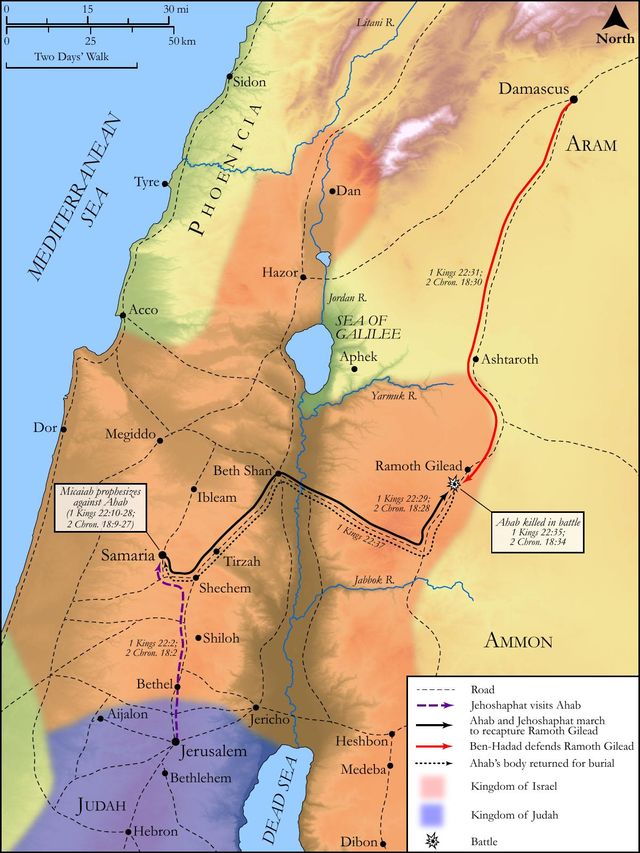
This verse represents the climactic and unyielding pronouncement by Micaiah within a broader narrative of prophetic confrontation and divine judgment. Immediately preceding this, King Ahab, at the urging of King Jehoshaphat of Judah, reluctantly agrees to consult a true prophet after his 400 court prophets unanimously promise victory against Aram at Ramoth-Gilead. Micaiah, initially pressured to conform, first delivers a sarcastic affirmation of their prophecy, then, under oath, reveals a terrifying vision of Israel scattered and Ahab's demise. This verse is Micaiah's final, emphatic, and public declaration, serving as a direct challenge to Ahab and the false prophets, sealing his prophetic word against all opposition. Following this, Ahab imprisons Micaiah, but the narrative swiftly moves to the battle where Micaiah's prophecy is precisely fulfilled, as seen in the account of Ahab's death.
Historical & Cultural Context
The setting is the mid-9th century BCE, a period marked by significant geopolitical tension between the northern kingdom of Israel (under Ahab) and the Aramean kingdom of Damascus. Ramoth-Gilead was a strategically vital city on the eastern frontier, frequently contested between these powers. Prophets played a crucial role in ancient Israelite society, serving as divine messengers who spoke God's word to kings and people. However, there was a constant struggle to distinguish true prophets from false ones, often based on the fulfillment of their predictions and their alignment with God's covenant. Ahab's court, like many ancient Near Eastern courts, maintained a retinue of "prophets" who often functioned as royal advisors, tailoring their messages to the king's desires. This contrasted sharply with the independent, often confrontational, role of true prophets like Micaiah, Elijah, or Elisha. The public nature of Micaiah's declaration, calling "O people, every one of you," underscores the importance of public witness in validating prophetic truth in a culture where oral declarations held significant weight and were often delivered before assemblies.
Key Themes
ShowHideThe passage powerfully articulates several key themes central to the Deuteronomistic history. First, it highlights the authenticity and validation of true prophecy versus false prophecy, a critical concern throughout the Old Testament. Micaiah's challenge echoes the test of a prophet outlined in Deuteronomy 18:22, where the fulfillment of a prophecy determines its divine origin. Second, it underscores divine sovereignty and judgment, demonstrating that God's word, even when unpopular or seemingly defied by human will, will ultimately prevail. Ahab's attempt to circumvent God's decree through disguise, as seen in 1 Kings 22:30, proves futile against the certainty of God's judgment. Third, the verse exemplifies boldness and faithfulness in rebuking the powerful. Micaiah stands alone against the king, his false prophets, and the entire court, embodying the courage required to deliver God's unvarnished message, regardless of personal cost. Finally, it reinforces the certainty and efficacy of God's word, a concept profoundly articulated in Isaiah 55:11, where God declares that His word will not return to Him empty but will accomplish its intended purpose.
Exposition and Analysis
ShowHideKey Word Analysis
ShowHideThe Hebrew word שָׁלֹום (shâlôwm), from Strong's H7965, is far richer than the English "peace." It signifies not merely the absence of conflict but a state of wholeness, well-being, completeness, prosperity, and health. For Ahab to return "in peace" would mean a safe, successful, and unharmed return from battle, a state of comprehensive well-being. Micaiah's declaration that Ahab will not return in shâlôwm is a comprehensive denial of any positive outcome for the king, encompassing defeat, injury, and ultimately, death. This word choice emphasizes the totality of the impending judgment.
The Hebrew name יְהוָה (Yᵉhôvâh), from Strong's H3068, often transliterated as Yahweh and traditionally rendered "LORD" in English translations, is God's covenant name, emphasizing His self-existence, faithfulness, and active presence in Israel's history. Micaiah's phrase "the LORD hath not spoken by me" explicitly invokes the authority and character of the covenant God of Israel. It is not just a god or a divine being, but the sovereign, unchanging God of Abraham, Isaac, and Jacob, who is the ultimate source of his prophecy. This elevates the stakes, making the fulfillment of the prophecy a direct test of YHWH's own truthfulness and power.
The verb דָּבַר (dâbar), from Strong's H1696, means "to speak, declare, command, promise." In a prophetic context, it refers to the divine utterance, the authoritative word of God delivered through His messenger. When Micaiah says "the LORD hath not spoken by me," he is asserting that if his prediction fails, it proves that he is not a true prophet, and more profoundly, that YHWH Himself has not communicated through him. This highlights the direct, personal, and authoritative nature of divine revelation in the prophetic tradition, emphasizing that the prophet is merely a mouthpiece for God's unerring word.
Verse Breakdown
ShowHide"And Micaiah said, If thou return at all in peace, the LORD hath not spoken by me."
This opening clause is Micaiah's direct challenge and prophetic test. He sets a clear, verifiable condition: Ahab's safe and prosperous return from the battle. If this condition is met, Micaiah is willing to concede that his prophecy was false, implying he is a false prophet and, by extension, that YHWH did not send him or speak through him. This statement places the burden of proof squarely on the outcome, a critical element in discerning true prophecy in ancient Israel, as outlined in Deuteronomy 18:22. It is a bold, almost defiant, assertion of the certainty of his message and the divine authority behind it, demonstrating unwavering conviction in the face of royal displeasure and popular opposition.
"And he said, Hearken, O people, every one of you."
This second part of the verse shifts Micaiah's address from Ahab personally to the wider audience—the king's court, the assembled officials, and perhaps even the soldiers or common people present. By calling on "every one of you" to "hearken" (listen intently and obey), Micaiah makes his prophecy a public declaration, a matter of public record. This ensures that when the outcome occurs, there will be no denying the prophecy's fulfillment or its divine origin. It also serves as a solemn warning to all present about the impending judgment and the folly of ignoring God's true word, inviting them to be witnesses to the unfolding drama and to consider the implications for their own understanding of divine authority.
Literary Devices
ShowHideThe verse is rich in Prophetic Challenge, as Micaiah directly confronts King Ahab and his false prophets, staking his very credibility and the veracity of God's word on the outcome of the battle. This creates intense Dramatic Irony, as the audience (and the reader of the full narrative) knows that Ahab will indeed not return in peace, making Micaiah's conditional statement a certainty in reverse. The phrase "Hearken, O people, every one of you" is an example of Public Declaration or Solemn Address, transforming what might have been a private confrontation into a public test of divine truth. This public appeal heightens the dramatic tension and ensures that the fulfillment of the prophecy will be widely recognized, underscoring the Verifiability of Prophecy as a key theme. The entire scene functions as an Ordeal or Trial by Combat of prophetic truth, where the battlefield will serve as the ultimate arbiter of who truly speaks for God.
Theological and Thematic Connections
ShowHideMicaiah's unflinching declaration in 1 Kings 22:28 stands as a powerful testament to the nature of divine truth and the integrity required of God's messengers. It highlights that God's word is not subject to human manipulation or popular opinion; it is absolute and will inevitably come to pass. This confrontation between truth and falsehood, divine sovereignty and human rebellion, is a recurring motif in biblical theology, emphasizing that God's plans cannot be thwarted, and His warnings are certain. The verse also underscores the moral imperative for God's prophets to speak His unvarnished truth, regardless of the personal cost or the powerful opposition they face, serving as a model of courageous faithfulness and a reminder that true prophecy finds its validation not in popularity but in divine fulfillment.
Reflection and Application
ShowHideMicaiah's bold stand in 1 Kings 22:28 offers profound lessons for believers today. In a world saturated with diverse voices and competing claims to truth, the call to "hearken, O people, every one of you" resonates powerfully. It challenges us to cultivate discernment, not merely accepting what is popular or comfortable, but rigorously testing all claims against the unchanging standard of God's revealed word, the Bible. This verse encourages us to value truth above personal gain, social acceptance, or even perceived peace. Like Micaiah, we are called to be courageous in proclaiming biblical truth, even when it is unpopular or confronts prevailing cultural narratives. Our faithfulness is not measured by the applause of people, but by our unwavering commitment to God's word, trusting that His purposes will ultimately prevail. It reminds us that God's warnings, like His promises, are certain, urging us to take them seriously and align our lives accordingly, recognizing that true peace comes from obedience to divine truth, not from avoiding it.
Questions for Reflection
ShowHideFAQ
ShowHideWhat was the significance of Micaiah's public declaration, "Hearken, O people, every one of you"?
ShowHideMicaiah's public declaration was crucial for several reasons. First, it made his prophecy a matter of public record, ensuring that when the outcome of the battle was known, there could be no denying the fulfillment of his word. This served to validate his authenticity as a true prophet of the Lord, contrasting sharply with the 400 false prophets who had spoken only what Ahab wanted to hear. Second, it acted as a solemn warning to all present, not just Ahab, emphasizing the gravity of the situation and the certainty of God's judgment. It underscored the principle found in Deuteronomy 18:22 that a true prophet's words will come to pass. By calling everyone to witness, Micaiah ensured that the divine message would be undeniably recognized, regardless of Ahab's attempts to suppress it or ignore it.
Why did King Ahab ignore Micaiah's prophecy, despite its clear and public nature?
ShowHideKing Ahab ignored Micaiah's prophecy primarily because he had a long-standing pattern of rebellion against God and a deep-seated aversion to hearing uncomfortable truths. As noted in 1 Kings 22:8, Ahab explicitly stated, "I hate him, for he never prophesies good concerning me, but evil." His pride, desire for military glory, and reliance on his own preferred prophets blinded him to God's clear warning. Furthermore, he had already committed to the battle and likely felt he could outmaneuver fate, even attempting to disguise himself in battle, as seen in 1 Kings 22:30. Ahab's actions illustrate the profound human tendency to reject divine truth when it conflicts with personal desires or plans, ultimately leading to self-inflicted judgment.
Christ-Centered Fulfillment
ShowHideMicaiah, standing alone against a multitude of false prophets and a defiant king, serves as a powerful Old Testament type of Christ. Like Micaiah, Jesus was the ultimate Prophet, speaking the unvarnished truth of God, often to a hostile audience that preferred comforting lies. Just as Micaiah's words were authenticated by their precise fulfillment, so too were the words of Jesus, who declared, "Heaven and earth will pass away, but my words will not pass away". Jesus, the Lamb of God who takes away the sin of the world, faced rejection and hostility from religious authorities and political powers, much like Micaiah faced Ahab. He was imprisoned and ultimately executed for speaking God's truth, yet His death was not a defeat but the ultimate fulfillment of God's redemptive plan, establishing a new covenant through His blood, as He proclaimed, "This cup is the new covenant in my blood". Unlike Ahab, who sought a false "peace" and met his demise, Christ offers true and lasting peace, not through military victory but through reconciliation with God, for "He himself is our peace". Micaiah's challenge to "Hearken, O people, every one of you" finds its ultimate echo in the call of the gospel, inviting all humanity to hear and believe in the one true word of God, Jesus Christ, whose words bring life and whose prophecies of His kingdom will surely come to pass, for "Lord, to whom shall we go? You have the words of eternal life".