


1 Kings 22:29
- וַיַּעַלvai·Ya·'aland he went upH5927Conj-w ¦ V-Qal-ConsecImperf-3msVerb Qal Consecutive Imperfect 3rd Singular Masculineוַandיַּעַלhe went up
- מֶלֶךְMe·lekh[the] king ofH4428N-mscNoun Singular Masculine Construct
- יִשְׂרָאֵלYis·ra·'ElIsraelH3478N-properNoun Proper Location
- וְיהוֹשָׁפָטv·iho·sha·Fatand JehoshaphatH3092Conj-w ¦ N-proper-mNoun Proper MasculineוְandיהוֹשָׁפָטJehoshaphat
- מֶלֶךְMe·lekh[the] king ofH4428N-mscNoun Singular Masculine Construct
- יְהוּדָהye·hu·DahJudahH3063N-properNoun Proper Location
- רָמֹתra·MotRamothH7418N-properNoun Proper Location
- גִּלְעָדgil·'AdGileadH1568N-properNoun Proper Location
English is a literal word-by-word gloss of the Hebrew, not the KJV's wording. Why?
This is the original text the KJV's translators worked from — each Hebrew word with its own literal English meaning in this verse, prepared by scholars at Tyndale House, Cambridge. The KJV translates whole sentences, not word by word, so its wording differs: one Hebrew word can become several English words, and the KJV may choose “the LORD” where the gloss reads “Yahweh”. Both are faithful — they answer different questions. For the KJV's own rendering, switch to the KJV text.
Details
See on the biblical-era maps
Study this verse
Public-domain commentary
Matthew Henry
From his Commentary on the Whole Bible. Henry comments on passages, not single verses — this entry covers 1 Kings 22:29–40. His two-level outline is real structure in the source text, so it is rendered as structure.
The matter in contest between God's prophet and Ahab's prophets is here soon determined, and it is made to appear which was in the right. Here,
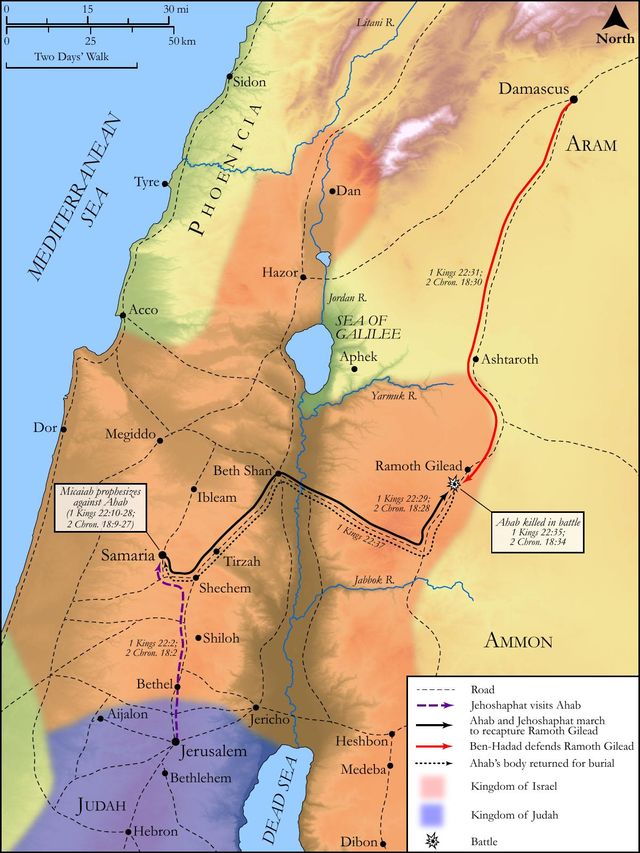
I.The two kings march with their forces to Ramoth-Gilead, Kg1 22:29.
That the king of Israel, who hated God's prophet, should so far disbelieve his admonition as to persist in his resolution, notwithstanding, is not strange; but that Jehoshaphat, that pious prince, who had desired to enquire by a prophet of the Lord, as disrelishing and discrediting Ahab's prophets, should yet proceed, after so fair a warning, is matter of astonishment. But by the easiness of his temper he was carried away with the delusion (as Barnabas was with the dissimulation, Gal 2:13) of his friends. He gave too much heed to Ahab's prophets, because they pretended to speak from God too, and in his country he had never been imposed upon by such cheats. He was ready to give his opinion with the majority, and to conclude that it was 400 to one but they should succeed. Micaiah had not forbidden them to go; nay, at first, he said, Go, and prosper. If it came to the worst, it was only Ahab's fall that was foretold, and therefore Jehoshaphat hoped he might safely venture.
II.Ahab adopts a contrivance by which he hopes to secure himself and expose his friend (Kg1 22:30):
"I will disguise myself, and go in the habit of a common soldier, but let Jehoshaphat put on his robes, to appear in the dress of a general." He pretended thereby to do honour to Jehoshaphat, and to compliment him with the sole command of the army in this action. He shall direct and give orders, and Ahab will serve as a soldier under him. But he intended,
1.To make a liar of a good prophet. Thus he hoped to elude the danger, and so to defeat the threatening, as if, by disguising himself, he could escape the divine cognizance and the judgments that pursued him.
2.To make a fool of a good king, whom he did not cordially love, because he was one that adhered to God and so condemned his apostasy. He knew that if any perished it must be the shepherd (so Micaiah had foretold); and perhaps he had intimation of the charge the enemy had to fight chiefly against the king of Israel, and therefore basely intended to betray Jehoshaphat to the danger, that he might secure himself. Ahab was marked for ruin; one would not have been in his coat for a great sum; yet he will over-persuade this godly king to muster for him. See what those get that join in affinity with vicious men, whose consciences are debauched, and who are lost to every thing that is honourable. How can it be expected that he should be true to his friend that has been false to his God?
III.Jehoshaphat, having more piety than policy, put himself into the post of honour, though it was the post of danger, and was thereby brought into the peril of his life, but God graciously delivered him. The king of Syria charged his captains to level their force, not against the king of Judah, for with him he had no quarrel, but against the king of Israel only (Kg1 22:31), to aim at his person, as if against him he had a particular enmity. Now Ahab was justly repaid for sparing Ben-hadad, who, as the seed of the serpent commonly do, stung the bosom in which he was fostered and saved from perishing. Some think that he designed only to have him taken prisoner, that he might now give him as honourable a treatment as he had formerly received from him. Whatever was the reason, this charge the officers received, and endeavoured to oblige their prince in this matter; for, seeing Jehoshaphat in his royal habit, they took him for the king of Israel, and surrounded him. Now,
1.By his danger God let him know that he was displeased with him for joining in confederacy with Ahab. Jehoshaphat had said, in compliment to Ahab (Kg1 22:4), I am as thou art; and now he was indeed taken for him. Those that associate with evil doers are in danger of sharing in their plagues.
2.By his deliverance God let him know that, though he was displeased with him, yet he had not deserted him. Some of the captains that knew him perceived their mistake, and so retired from the pursuit of him; but it is said (Ch2 18:31) that God moved them (for he has all hearts in his hand) to depart from him. To him he cried out, not in cowardice, but devotion, and from him his relief came: Ahab was in no care to succour him. God is a friend that will not fail us when other friends do.
IV.Ahab receives his mortal wound in the battle, notwithstanding his endeavours to secure himself in the habit of a private sentinel.
Let no man think to hide himself from God's judgment, no, not in masquerade. Thy hand shall find out all thy enemies, whatever disguise they are in, Kg1 22:34. The Syrian that shot him little thought of doing such a piece of service to God and his king; for he drew a bow at a venture, not aiming particularly at any man, yet God so directed the arrow that,
1.He hit the right person, the man that was marked for destruction, whom, if they had taken alive, as was designed, perhaps Ben-hadad would have spared. Those cannot escape with life whom God hath doomed to death.
2.He hit him in the right place, between the joints of the harness, the only place about him where this arrow of death could find entrance. No armour is of proof against the darts of divine vengeance. Case the criminal in steel, and it is all one, he that made him can make his sword to approach him. That which to us seems altogether casual is done by the determinate counsel and fore-knowledge of God.
V.The army is dispersed by the enemy and sent home by the king.
Either Jehoshaphat or Ahab ordered the retreat of the sheep, when the shepherd was smitten: Every man to his city, for it is to no purpose to attempt any thing more, Kg1 22:36. Ahab himself lived long enough to see that part of Micaiah's prophecy accomplished that all Israel should be scattered upon the mountains of Gilead (Kg1 22:17), and perhaps with his dying lips did himself give orders for it; for though he would be carried out of the army, to have his wounds dressed (Kg1 22:34), yet he would be held up in his chariot, to see if his army were victorious. But, when he saw the battle increase against them, his spirits sunk, and he died, but his death was so lingering that he had time to feel himself die; and we may well imagine with what horror he now reflected upon the wickedness he had committed, the warnings he had slighted, Baal's altars, Naboth's vineyard, Micaiah's imprisonment. Now he sees himself flattered into his own ruin, and Zedekiah's horns of iron pushing, not the Syrians, but himself, into destruction. Thus is he brought to the king of terrors without hope in his death.
VI.The royal corpse is brought to Samaria and buried there (Kg1 22:37), and hither are brought the bloody chariot and bloody armour in which he died, Kg1 22:38. One particular circumstance is taken notice of, because there was in it the accomplishment of a prophecy, that when they brought the chariot to the pool of Samaria, to be washed, the dogs (and swine, says the Septuagint) gathered about it, and, as is usual, licked the blood, or, as some think, the water in which it was washed, with which the blood was mingled: the dogs made no difference between royal blood and other blood. Now Naboth's blood was avenged (Kg1 21:19), and that word of David, as well as Elijah's word, was fulfilled (Psa 68:23), That thy foot may be dipped in the blood of thy enemies, and the tongue of thy dogs in the same. The dogs licking the guilty blood was perhaps designed to represent the terrors that prey upon the guilty soul after death.
Lastly, The story of Ahab is here concluded in the usual form, Kg1 22:39, Kg1 22:40. Among his works mention is made of an ivory house which he built, so called because many parts of it were inlaid with ivory; perhaps it was intended to vie with the stately palace of the kings of Judah, which Solomon built.
Continue studying 1 Kings 22:29 across the web’s major study libraries — every link below opens this exact verse, chapter, or book on the destination site.
Read & Compare
 BibleGatewayThis verse in more than 200 translations and 70 languages.
 Bible.comThe YouVersion reader — hundreds of translations, reading plans, and highlights.
 ESV.orgCrossway's official English Standard Version reader.
 NET BibleThe NET translation with 60,000+ translators' notes on every rendering decision.
 STEP BibleTyndale House's free study tool — original text, vocabulary, and scholarly resources.
 BibliaLogos Bible Software's free web reader.
 USCCBThe New American Bible (Revised Edition) with the U.S. bishops' study notes.
Commentaries
 BibleHub CommentariesDozens of classic commentaries on this verse, gathered on one page.
 StudyLightMore than 100 commentary sets — the largest collection on the web.
 BibleRefPlain-English commentary on what this verse means, verse by verse.
 Enduring WordDavid Guzik's free commentary on this chapter, widely used by Bible teachers.
 Bible Study ToolsVerse commentary alongside Greek and Hebrew study aids.
Original Language & Research
- BibleHub InterlinearThe verse word by word — original language, transliteration, and English.
- BibleHub LexiconEvery word's original-language definition and Strong's entry.
 Blue Letter BibleDeep-study tools — Strong's numbers, concordance, and word studies.
 SefariaThe Hebrew text with Rashi and centuries of Jewish commentary.
Sermons, Hymns & Audio


TrulyRandomVerse is not affiliated with these sites and doesn’t control their content. They’re linked because they’re genuinely useful.
Summary
1 Kings 22:29 chronicles the pivotal moment when King Ahab of Israel and King Jehoshaphat of Judah set out on a joint military campaign to reclaim Ramoth-Gilead from Syrian control. This seemingly simple statement of movement is imbued with profound dramatic irony and theological weight, serving as the direct prelude to the fulfillment of Micaiah's dire prophecy concerning Ahab's demise and powerfully illustrating the perilous consequences of rejecting divine counsel and forging unholy alliances.
Context
ShowHideLiterary Context
This verse immediately follows a highly charged prophetic confrontation detailed in 1 Kings 22. King Ahab, resolute in his ambition to retake Ramoth-Gilead, has already consulted his 400 court prophets, who, in unison, affirm his military plans. However, King Jehoshaphat of Judah, visiting Ahab, insists on seeking counsel from a true prophet of the Lord. This leads to the reluctant summoning of Micaiah, who, in stark contrast to the false prophets, delivers an unambiguous prophecy of Ahab's defeat and death in battle, as recorded in 1 Kings 22:17. Despite Micaiah's clear warning and his exposition of a deceiving spirit sent by God to Ahab's prophets (1 Kings 22:23), Ahab defiantly chooses to disregard the truth, imprison Micaiah, and proceed with his military objectives. Therefore, this verse represents the kings' physical movement towards the prophesied confrontation, meticulously setting the stage for the dramatic and tragic events that unfold in the subsequent verses (1 Kings 22:30-38).
Historical & Cultural Context
Ramoth-Gilead was a city of immense strategic importance, situated east of the Jordan River within the tribal territory of Gad. Its control was vital for securing key trade routes and establishing a robust defensive outpost against the Arameans (Syrians), with whom Israel had a protracted and often violent conflict. Ahab's fervent desire to reclaim this city reflects the ongoing geopolitical struggles and territorial disputes characteristic of the era. The practice of kings consulting prophets before engaging in battle was a common cultural norm, though the critical distinction between genuine and false prophecy, as vividly illuminated in this chapter, held paramount significance. Jehoshaphat's alliance with Ahab, despite the latter's notorious idolatry and wickedness, was likely part of a broader political strategy within the fragmented monarchy, aimed at fostering stability or forming a united front against common adversaries. However, such alliances frequently carried profound spiritual and political risks, as evidenced by Jehoshaphat's subsequent divine rebuke for this very partnership (2 Chronicles 19:2).
Key Themes
ShowHideThis verse encapsulates several major themes woven throughout 1 Kings and the broader Deuteronomistic History. Central among these is the consequences of disobedience to God's revealed word, powerfully exemplified by Ahab's stubborn rejection of Micaiah's prophecy in favor of flattering falsehoods. It vividly illustrates the dangers of compromise and unholy alliances, particularly through Jehoshaphat's decision to join forces with a wicked king, despite his own general righteousness. This alliance ultimately places him in grave peril and draws divine disapproval. Furthermore, the narrative underscores divine sovereignty; even as human kings make their defiant plans and disregard God's warnings, His ultimate purpose and righteous judgment invariably prevail. The journey to Ramoth-Gilead is thus not merely a military maneuver but a divinely orchestrated step towards the inevitable fulfillment of God's judgment against Ahab and his house, as previously foretold by Elijah (1 Kings 21:19-24).
Exposition and Analysis
ShowHideKey Word Analysis
ShowHideThis verb literally means "to go up," "ascend," or "climb." In a military context, it frequently denotes marching towards a battle or a fortified city, which were often situated on elevated terrain. However, within the narrative of 1 Kings 22, it carries a deeper, almost ominous, metaphorical weight. It signifies the kings' deliberate and purposeful movement towards a confrontation that, for Ahab, is an ascent to his preordained judgment. The act of "going up" implies a decisive, irreversible commitment to the chosen path, despite the clear and unequivocal divine warning.
Meaning "heights of Gilead," this geographical name transcends a mere location; it is presented as a crucial focal point of conflict and a potent symbol of contested territory. Its repeated mention throughout the chapter emphasizes its strategic importance and its role as the predestined stage for the unfolding divine drama. The name itself, "heights," subtly underscores the elevated, exposed, and vulnerable nature of the impending battle, both physically and spiritually, for those who choose to defy God's word there.
Verse Breakdown
ShowHide"So the king of Israel"
This phrase identifies Ahab as the primary instigator and central figure of this ill-fated military campaign. The introductory "So" directly links this action to the preceding narrative, emphasizing that despite all divine warnings and revelations, Ahab's stubborn resolve to proceed to battle remains unyielding. It powerfully highlights his obstinacy, self-will, and defiant disregard for God's explicit word.
"and Jehoshaphat the king of Judah"
The inclusion of Jehoshaphat is critically important, underscoring the problematic and spiritually perilous alliance between the generally righteous king of Judah and the notoriously wicked king of Israel. His presence signifies his compromise and willingness to participate in an endeavor that God had clearly indicated would lead to disaster, at least for Ahab. This phrase emphasizes the shared, albeit misguided, commitment to the military objective, highlighting Jehoshaphat's entanglement in Ahab's rebellion.
"went up"
This active verb signifies the physical commencement of the journey and the decisive movement towards the battleground. It marks a point of no return for both kings, conveying their determination and the practical implementation of their plans, thereby setting the narrative inexorably in motion towards its tragic climax.
"to Ramothgilead"
This specifies the precise destination, which is not merely a city but the prophesied theater of war and the site of Ahab's impending doom. The journey to Ramoth-Gilead is, in essence, a journey towards the inevitable fulfillment of God's word, whether acknowledged or defiantly ignored by the human participants.
Literary Devices
ShowHideThe verse, though remarkably concise, is profoundly rich in literary devices. It is steeped in Foreshadowing, as it directly precedes the climactic fulfillment of Micaiah's prophecy concerning Ahab's death. The simple statement of movement generates intense Dramatic Irony, for the reader is acutely aware of the tragic outcome awaiting Ahab, while the king himself, blinded by pride and seduced by false counsel, confidently marches towards his demise. There is also an implicit Contrast between the two kings: Ahab, the wicked monarch leading himself to divine judgment, and Jehoshaphat, the generally righteous king, dangerously aligning himself with evil and thereby placing himself in peril. Furthermore, the very act of "going up" can be interpreted as powerful Symbolism, representing not merely a physical ascent to battle but also a metaphorical ascent to a moment of divine reckoning and ultimate judgment.
Theological and Thematic Connections
ShowHide1 Kings 22:29 stands as a stark and enduring reminder of the profound gravity of human choices when confronted with divine revelation. It powerfully illustrates the immutable principle that rejecting God's clear warnings, whether communicated through His prophets or explicitly embedded in His written word, inevitably leads to destructive and often tragic consequences. Ahab's determined journey to Ramoth-Gilead serves as a poignant testament to the dangers inherent in pride, self-deception, and the perilous preference for comforting lies over uncomfortable truths. Moreover, Jehoshaphat's participation highlights the profound perils of compromising one's faith and core values through unholy alliances, even when such compromises are ostensibly motivated by political expediency or a desire for peace. Ultimately, God's unwavering sovereignty is on full display, demonstrating that even human defiance and rebellion ultimately serve to fulfill His divine purposes and bring about His just judgment.
Reflection and Application
ShowHideThis seemingly straightforward verse carries profound and enduring lessons for believers today. It compels us to critically examine whose voices we heed and what counsel we allow to shape our most significant decisions. Are we, like King Ahab, prone to seeking affirmation for our own desires and plans, even when they stand in direct contradiction to God's clear will revealed in Scripture? Or are we, like King Jehoshaphat, susceptible to compromising our deeply held convictions for the sake of worldly alliances, perceived stability, or the desire for social acceptance? This narrative powerfully reminds us that ignoring divine warnings, whether they come from the explicit teachings of Scripture, the wise counsel of godly mentors, or the conviction of the Holy Spirit, inevitably leads to painful and often regrettable consequences. True wisdom lies not in surrounding ourselves with those who merely tell us what we want to hear, but in humbly and diligently seeking and obeying God's truth, even when it demands a difficult, unpopular, or counter-cultural path. Our ultimate allegiances and partnerships must always be aligned with our supreme allegiance to Christ, ensuring that we never compromise our spiritual integrity for temporary gain, comfort, or worldly approval.
Questions for Reflection
ShowHideFAQ
ShowHideWhy did Jehoshaphat go with Ahab despite the warning from Micaiah?
ShowHideJehoshaphat's decision to accompany Ahab, despite the clear and dire prophecy from Micaiah, is a complex and often debated point. Several factors likely contributed to his choice. Firstly, a pre-existing political alliance and familial tie bound the two kingdoms, solidified by the marriage of Ahab's daughter Athaliah to Jehoshaphat's son Jehoram. Jehoshaphat had already given his word to Ahab, declaring, "I am as you are, my people as your people, my horses as your horses" (1 Kings 22:4). To publicly retract such a declaration might have been perceived as a breach of covenant or a sign of weakness in the eyes of his allies and adversaries. Secondly, while Jehoshaphat was generally a righteous king who sought the Lord, he may have struggled with a lack of courage to defy Ahab directly, or perhaps he harbored a hope that God's judgment might still be averted, or that Micaiah's prophecy was specifically for Ahab and not for him. His actions here serve as a powerful cautionary tale about the dangers of compromising one's principles and aligning with those who openly disregard God's will, a mistake for which he was later directly rebuked by a prophet (2 Chronicles 19:2).
What was the strategic importance of Ramoth-Gilead?
ShowHideRamoth-Gilead was a city of immense strategic importance, located in the Transjordan region, east of the Jordan River. It was situated on a vital trade route, making its control crucial for economic prosperity, and served as a key frontier defense point. Control of Ramoth-Gilead meant control over significant commercial pathways and a strong defensive position against the Arameans (Syrians) to the north and east. Throughout the history of the divided kingdom, this city was frequently contested between Israel and Aram, indicating its immense military and economic value. Ahab's determination to reclaim it underscores its critical importance to the security and prosperity of his kingdom.
Christ-Centered Fulfillment
ShowHideThe journey of Ahab and Jehoshaphat to Ramoth-Gilead, a path chosen in defiant disregard of divine counsel and leading inevitably to judgment, serves as a poignant shadow pointing to a far greater journey. While Ahab's ascent to battle was an act of rebellion culminating in his demise, it ultimately directs our gaze to the true King, Jesus Christ, who willingly "went up" to Jerusalem, not in defiance, but in perfect and unwavering obedience to the Father's will, to face the ultimate spiritual battle. Unlike Ahab, who desperately sought to preserve his own life and kingdom through human might and the flattery of false counsel, Christ, the true King of Israel, willingly laid down His life to secure eternal salvation for His people (John 10:18). The false prophets who flattered Ahab stand in stark contrast to Christ, the ultimate Prophet, who always spoke the unvarnished truth of God, even when it led to His rejection, suffering, and crucifixion (John 14:6). Furthermore, Jehoshaphat's flawed and dangerous alliance with a wicked king underscores humanity's profound need for a perfect and righteous covenant. Christ, through His atoning sacrifice, establishes a new and better covenant, forging a perfect and unbreakable alliance with His people, drawing them into His righteousness and delivering them from the consequences of their own spiritual compromises (Hebrews 8:6). The judgment that fell upon Ahab at Ramoth-Gilead foreshadows the ultimate judgment for sin, which Christ, the Lamb of God, bore on the cross, triumphing over all spiritual enemies and securing eternal victory and redemption for all who trust in Him (Colossians 2:15).