


1 Kings 22:31
- וּמֶלֶךְu·Me·lekhand king ofH4428Conj-w ¦ N-mscNoun Singular Masculine Constructוּandמֶלֶךְking of
- אֲרָם'a·RamAramH758N-properNoun Proper Location
- צִוָּהtzi·Vahhe had commandedH6680V-Piel-Perf-3msVerb Piel Perfect 3rd Singular Masculine
- אֶת'et<obj.>H853DirObjMParticle Object Indicator
- שָׂרֵיsa·Rei[the] commanders ofH8269N-mpcNoun Plural Masculine Construct
- הָרֶכֶבha·Re·khevthe chariotryH7393Art ¦ N-msNoun Singular Masculine Absoluteהָtheרֶכֶבchariotry
- אֲשֶׁר'a·SherwhichH834RelParticle Relative
- לוֹlo[belonged] to himPrep-l ¦ 3msSuffix Personal 3rd Singular Masculineל[belonged] toוֹhim
- שְׁלֹשִׁיםshe·lo·ShimthirtyH7970N-mpNoun Plural Masculine Absolute
- וּשְׁנַיִםu·she·Na·yimand twoH8147Conj-w ¦ N-cdNoun Dual common gender Absoluteוּandשְׁנַיִםtwo
- לֵאמֹרle·Mor<to> sayingH559Prep-l ¦ V-Qal-InfVerb Qal Infinitive Constructלֵ<to>אמֹרsaying
- לֹאlo'notH3808NegParticle Negative
- תִּלָּחֲמוּti·La·cha·Muyou must do battleH3898V-Niphal-Imperf-2mpVerb Niphal Imperfect 2nd Plural Masculine
- אֶת'etwithH854PrepPreposition
- קָטֹןka·Ton[the] smallH6996Adj-msAdjective Singular Masculine Absolute
- וְאֶתve·'Etand withH854Conj-w ¦ PrepPrepositionוְandאֶתwith
- גָּדוֹלga·Dol[the] greatH1419Adj-msAdjective Singular Masculine Absolute
- כִּיkithatH3588PrtParticle Conditional
- אִם'imexceptH518PrtParticle Conditional
- אֶת'etwithH854PrepPreposition
- מֶלֶךְMe·lekh[the] king ofH4428N-mscNoun Singular Masculine Construct
- יִשְׂרָאֵלYis·ra·'ElIsraelH3478N-properNoun Proper Location
- לְבַדּוֹle·va·Doto only himH905Prep-l ¦ N-msc ¦ 3msNoun Singular Masculine Constructלְtoבַדּonlyוֹhim
English is a literal word-by-word gloss of the Hebrew, not the KJV's wording. Why?
This is the original text the KJV's translators worked from — each Hebrew word with its own literal English meaning in this verse, prepared by scholars at Tyndale House, Cambridge. The KJV translates whole sentences, not word by word, so its wording differs: one Hebrew word can become several English words, and the KJV may choose “the LORD” where the gloss reads “Yahweh”. Both are faithful — they answer different questions. For the KJV's own rendering, switch to the KJV text.
Details
See on the biblical-era maps

Study this verse
Public-domain commentary
Matthew Henry
From his Commentary on the Whole Bible. Henry comments on passages, not single verses — this entry covers 1 Kings 22:29–40. His two-level outline is real structure in the source text, so it is rendered as structure.
The matter in contest between God's prophet and Ahab's prophets is here soon determined, and it is made to appear which was in the right. Here,
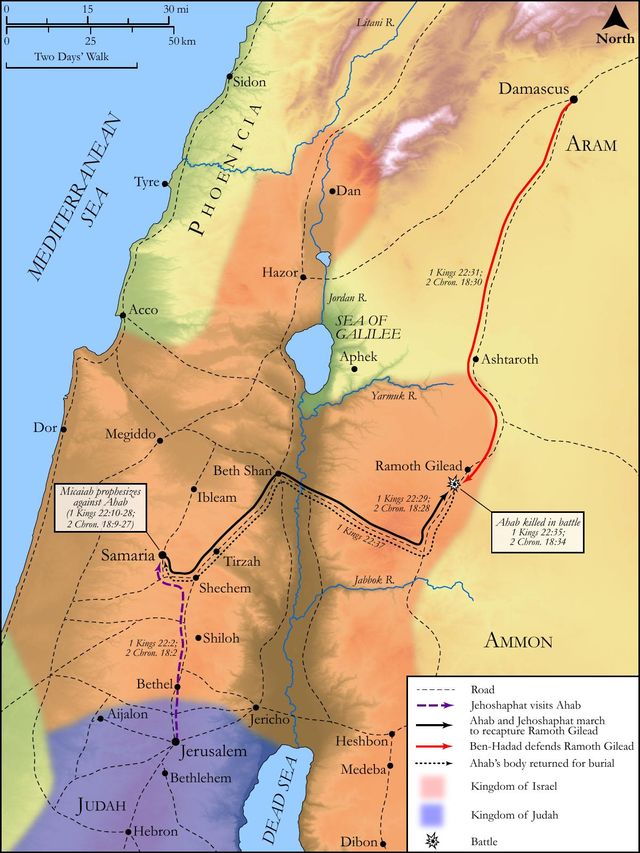
I.The two kings march with their forces to Ramoth-Gilead, Kg1 22:29.
That the king of Israel, who hated God's prophet, should so far disbelieve his admonition as to persist in his resolution, notwithstanding, is not strange; but that Jehoshaphat, that pious prince, who had desired to enquire by a prophet of the Lord, as disrelishing and discrediting Ahab's prophets, should yet proceed, after so fair a warning, is matter of astonishment. But by the easiness of his temper he was carried away with the delusion (as Barnabas was with the dissimulation, Gal 2:13) of his friends. He gave too much heed to Ahab's prophets, because they pretended to speak from God too, and in his country he had never been imposed upon by such cheats. He was ready to give his opinion with the majority, and to conclude that it was 400 to one but they should succeed. Micaiah had not forbidden them to go; nay, at first, he said, Go, and prosper. If it came to the worst, it was only Ahab's fall that was foretold, and therefore Jehoshaphat hoped he might safely venture.
II.Ahab adopts a contrivance by which he hopes to secure himself and expose his friend (Kg1 22:30):
"I will disguise myself, and go in the habit of a common soldier, but let Jehoshaphat put on his robes, to appear in the dress of a general." He pretended thereby to do honour to Jehoshaphat, and to compliment him with the sole command of the army in this action. He shall direct and give orders, and Ahab will serve as a soldier under him. But he intended,
1.To make a liar of a good prophet. Thus he hoped to elude the danger, and so to defeat the threatening, as if, by disguising himself, he could escape the divine cognizance and the judgments that pursued him.
2.To make a fool of a good king, whom he did not cordially love, because he was one that adhered to God and so condemned his apostasy. He knew that if any perished it must be the shepherd (so Micaiah had foretold); and perhaps he had intimation of the charge the enemy had to fight chiefly against the king of Israel, and therefore basely intended to betray Jehoshaphat to the danger, that he might secure himself. Ahab was marked for ruin; one would not have been in his coat for a great sum; yet he will over-persuade this godly king to muster for him. See what those get that join in affinity with vicious men, whose consciences are debauched, and who are lost to every thing that is honourable. How can it be expected that he should be true to his friend that has been false to his God?
III.Jehoshaphat, having more piety than policy, put himself into the post of honour, though it was the post of danger, and was thereby brought into the peril of his life, but God graciously delivered him. The king of Syria charged his captains to level their force, not against the king of Judah, for with him he had no quarrel, but against the king of Israel only (Kg1 22:31), to aim at his person, as if against him he had a particular enmity. Now Ahab was justly repaid for sparing Ben-hadad, who, as the seed of the serpent commonly do, stung the bosom in which he was fostered and saved from perishing. Some think that he designed only to have him taken prisoner, that he might now give him as honourable a treatment as he had formerly received from him. Whatever was the reason, this charge the officers received, and endeavoured to oblige their prince in this matter; for, seeing Jehoshaphat in his royal habit, they took him for the king of Israel, and surrounded him. Now,
1.By his danger God let him know that he was displeased with him for joining in confederacy with Ahab. Jehoshaphat had said, in compliment to Ahab (Kg1 22:4), I am as thou art; and now he was indeed taken for him. Those that associate with evil doers are in danger of sharing in their plagues.
2.By his deliverance God let him know that, though he was displeased with him, yet he had not deserted him. Some of the captains that knew him perceived their mistake, and so retired from the pursuit of him; but it is said (Ch2 18:31) that God moved them (for he has all hearts in his hand) to depart from him. To him he cried out, not in cowardice, but devotion, and from him his relief came: Ahab was in no care to succour him. God is a friend that will not fail us when other friends do.
IV.Ahab receives his mortal wound in the battle, notwithstanding his endeavours to secure himself in the habit of a private sentinel.
Let no man think to hide himself from God's judgment, no, not in masquerade. Thy hand shall find out all thy enemies, whatever disguise they are in, Kg1 22:34. The Syrian that shot him little thought of doing such a piece of service to God and his king; for he drew a bow at a venture, not aiming particularly at any man, yet God so directed the arrow that,
1.He hit the right person, the man that was marked for destruction, whom, if they had taken alive, as was designed, perhaps Ben-hadad would have spared. Those cannot escape with life whom God hath doomed to death.
2.He hit him in the right place, between the joints of the harness, the only place about him where this arrow of death could find entrance. No armour is of proof against the darts of divine vengeance. Case the criminal in steel, and it is all one, he that made him can make his sword to approach him. That which to us seems altogether casual is done by the determinate counsel and fore-knowledge of God.
V.The army is dispersed by the enemy and sent home by the king.
Either Jehoshaphat or Ahab ordered the retreat of the sheep, when the shepherd was smitten: Every man to his city, for it is to no purpose to attempt any thing more, Kg1 22:36. Ahab himself lived long enough to see that part of Micaiah's prophecy accomplished that all Israel should be scattered upon the mountains of Gilead (Kg1 22:17), and perhaps with his dying lips did himself give orders for it; for though he would be carried out of the army, to have his wounds dressed (Kg1 22:34), yet he would be held up in his chariot, to see if his army were victorious. But, when he saw the battle increase against them, his spirits sunk, and he died, but his death was so lingering that he had time to feel himself die; and we may well imagine with what horror he now reflected upon the wickedness he had committed, the warnings he had slighted, Baal's altars, Naboth's vineyard, Micaiah's imprisonment. Now he sees himself flattered into his own ruin, and Zedekiah's horns of iron pushing, not the Syrians, but himself, into destruction. Thus is he brought to the king of terrors without hope in his death.
VI.The royal corpse is brought to Samaria and buried there (Kg1 22:37), and hither are brought the bloody chariot and bloody armour in which he died, Kg1 22:38. One particular circumstance is taken notice of, because there was in it the accomplishment of a prophecy, that when they brought the chariot to the pool of Samaria, to be washed, the dogs (and swine, says the Septuagint) gathered about it, and, as is usual, licked the blood, or, as some think, the water in which it was washed, with which the blood was mingled: the dogs made no difference between royal blood and other blood. Now Naboth's blood was avenged (Kg1 21:19), and that word of David, as well as Elijah's word, was fulfilled (Psa 68:23), That thy foot may be dipped in the blood of thy enemies, and the tongue of thy dogs in the same. The dogs licking the guilty blood was perhaps designed to represent the terrors that prey upon the guilty soul after death.
Lastly, The story of Ahab is here concluded in the usual form, Kg1 22:39, Kg1 22:40. Among his works mention is made of an ivory house which he built, so called because many parts of it were inlaid with ivory; perhaps it was intended to vie with the stately palace of the kings of Judah, which Solomon built.
Continue studying 1 Kings 22:31 across the web’s major study libraries — every link below opens this exact verse, chapter, or book on the destination site.
Read & Compare
 BibleGatewayThis verse in more than 200 translations and 70 languages.
 Bible.comThe YouVersion reader — hundreds of translations, reading plans, and highlights.
 ESV.orgCrossway's official English Standard Version reader.
 NET BibleThe NET translation with 60,000+ translators' notes on every rendering decision.
 STEP BibleTyndale House's free study tool — original text, vocabulary, and scholarly resources.
 BibliaLogos Bible Software's free web reader.
 USCCBThe New American Bible (Revised Edition) with the U.S. bishops' study notes.
Commentaries
 BibleHub CommentariesDozens of classic commentaries on this verse, gathered on one page.
 StudyLightMore than 100 commentary sets — the largest collection on the web.
 BibleRefPlain-English commentary on what this verse means, verse by verse.
 Enduring WordDavid Guzik's free commentary on this chapter, widely used by Bible teachers.
 Bible Study ToolsVerse commentary alongside Greek and Hebrew study aids.
Original Language & Research
- BibleHub InterlinearThe verse word by word — original language, transliteration, and English.
- BibleHub LexiconEvery word's original-language definition and Strong's entry.
 Blue Letter BibleDeep-study tools — Strong's numbers, concordance, and word studies.
 SefariaThe Hebrew text with Rashi and centuries of Jewish commentary.
Sermons, Hymns & Audio


TrulyRandomVerse is not affiliated with these sites and doesn’t control their content. They’re linked because they’re genuinely useful.
Summary
The precise and ruthless directive issued by King Ben-Hadad of Syria to his elite chariot commanders during the climactic Battle of Ramoth-Gilead: to disregard all other combatants and focus their entire efforts on engaging and eliminating King Ahab of Israel. This strategic command not only underscores the intensity and high stakes of the conflict but also profoundly serves as an unwitting instrument in the unfolding of divine prophecy concerning Ahab's demise, despite the Israelite king's desperate attempts to evade his foretold fate through disguise.
Context
ShowHideLiterary Context
This pivotal verse is situated within the dramatic climax of King Ahab's reign, specifically detailing a crucial moment in the Battle of Ramoth-Gilead found in 1 Kings 22. Prior to this, Ahab, despite a previous peace treaty and the clear, albeit unwelcome, prophetic warnings from Micaiah son of Imlah, had determined to reclaim Ramoth-Gilead from the Arameans. Micaiah's prophecy, chillingly articulated in 1 Kings 22:17, explicitly foretold Ahab's death in the impending battle. In a desperate attempt to circumvent this divine decree, Ahab devised a cunning plan to disguise himself as an ordinary soldier, while his ally, King Jehoshaphat of Judah, wore his royal robes into battle, as narrated in 1 Kings 22:30. Ben-Hadad's command in verse 31 directly follows this act of deception, meticulously setting the stage for the dramatic and divinely orchestrated fulfillment of Micaiah's word, thereby emphasizing the profound futility of human schemes against God's sovereign will, a recurring and powerful theme throughout the Deuteronomistic History.
Historical & Cultural Context
The 9th century BCE was characterized by persistent conflict between the northern kingdom of Israel and Aram (Syria), largely driven by control over strategically vital cities like Ramoth-Gilead, which lay on crucial trade routes. In ancient Near Eastern warfare, targeting the enemy king was a highly effective and common military strategy. Eliminating the supreme commander could swiftly demoralize the opposing army, disrupt its chain of command, and often lead to the rapid collapse of resistance. Ben-Hadad's command to his "thirty and two captains"—likely commanders of his elite chariot divisions, which constituted the most formidable military unit of the era—underscores the critical importance placed on this tactic. The practice of disguising oneself to avoid becoming a prime target was also known, but as this verse powerfully illustrates, such human cunning could not ultimately thwart a determined enemy or, more significantly, a divine purpose. The intensity and singular focus of the command ("fight neither with small nor great, save only with the king of Israel") vividly reflect the personal animosity and strategic imperative driving Ben-Hadad's military objective.
Key Themes
ShowHideThis verse powerfully contributes to several overarching themes within 1 Kings and the broader biblical narrative. Firstly, it profoundly highlights the Sovereignty of God, demonstrating with striking clarity that even the seemingly independent actions of foreign kings and the cunning schemes of human leaders are ultimately instruments in the fulfillment of God's immutable purposes. Ahab's elaborate disguise, meticulously designed to evade prophecy, ironically serves to isolate him as the sole target, thereby ensuring the prophecy's precise fulfillment. Secondly, the verse powerfully underscores the Futility of Human Evasion when confronted with divine judgment. Ahab's persistent rebellion against the Lord and His prophets, particularly his egregious idolatry and flagrant injustice (epitomized by the Naboth's vineyard incident in 1 Kings 21), had sealed his fate, and no human strategy, however clever, could alter God's decree. Lastly, it robustly reinforces the Reliability of Prophetic Word, showcasing how God's spoken word, delivered through His chosen prophets, inevitably comes to pass, thereby validating the authority, truthfulness, and unfailing nature of His divine messengers. The precision of Ben-Hadad's command, though entirely unknown to him, perfectly aligns with God's predetermined plan for Ahab's judgment.
Exposition and Analysis
ShowHideKey Word Analysis
ShowHideThe Hebrew verb צָוָה (tsâvâh, H6680) signifies "to constitute, enjoin, appoint, or give a charge." Its deployment here emphasizes the direct, authoritative, and non-negotiable nature of Ben-Hadad's instruction. This was not a mere suggestion but a strict military order, indicating the paramount strategic importance and absolute priority placed on eliminating Ahab. The specificity of the command underscores the deliberate and focused intent behind the Syrian military's actions, leaving no room for misinterpretation or deviation.
The Hebrew word שַׂר (sar, H8269) denotes "a head person (of any rank or class); a chief, prince, or ruler." In this context, "captains" refers to the commanders of the chariot units, which were the elite and most formidable fighting force in ancient warfare (from rekeb, H7393, "chariot"). The fact that this specific, high-stakes command was given to these particular, highly skilled officers highlights the extreme seriousness of the objective and the expectation of its precise and swift execution. It suggests a well-organized, disciplined military operation aimed at a singular, high-value target.
The Hebrew word מֶלֶךְ (melek, H4428) simply means "a king" or "royal." Its repeated use in the phrase "king of Israel" underscores the singular focus of Ben-Hadad's command. This was not a general engagement of enemy forces, but a targeted assassination attempt on the opposing monarch. The emphasis on "the king" (Ahab) makes his disguise ultimately futile, as the entire elite force was implicitly directed to find and engage this specific individual, regardless of his outward appearance.
Verse Breakdown
ShowHide"But the king of Syria commanded his thirty and two captains that had rule over his chariots"
This opening clause meticulously establishes the source of the command—King Ben-Hadad of Syria—and its precise recipients: his thirty-two elite chariot commanders. The specific number of captains suggests a significant and formidable force, indicating the seriousness and strategic depth with which Ben-Hadad pursued his objective. This sets the stage for a highly targeted and specialized military operation rather than a general, undifferentiated engagement.
"saying, Fight neither with small nor great"
This explicit instruction clarifies the narrow and exclusive scope of the command. It dictates that no other combatant, irrespective of their rank, status, or perceived importance ("small nor great" encompassing everyone from common soldiers to high-ranking officers), was to be engaged. This directive ensures that the entire focus, resources, and formidable power of these elite chariot units would be singularly concentrated on the primary target, preventing any diversion of effort or attention. It underscores the absolute, singular importance of the objective.
"save only with the king of Israel."
This concluding clause precisely reveals the exclusive and absolute target of the Syrian military's efforts. The phrase "save only" emphatically highlights the singular and absolute nature of the objective. Despite King Ahab's cunning disguise, the entire elite force was now, by direct command, effectively hunting specifically for him, rendering his attempt at evasion ultimately irrelevant and tragically ironic. This command, though human in origin and intent, becomes the precise and divinely orchestrated mechanism through which God's prophecy concerning Ahab's death would be fulfilled.
Literary Devices
ShowHideThe narrative in 1 Kings 22:31 masterfully employs several potent literary devices that deepen its theological impact. Dramatic Irony is profoundly evident, as the audience is fully aware of Micaiah's prophecy regarding Ahab's demise (1 Kings 22:17) and Ahab's desperate attempt at disguise (1 Kings 22:30), while King Ben-Hadad, in issuing his precise command, remains entirely oblivious that his directive will inadvertently and perfectly lead to the fulfillment of God's immutable word. This creates a palpable sense of impending doom for Ahab, significantly heightening the narrative tension. The command itself functions as a powerful form of Foreshadowing, signaling with grim certainty that Ahab's death is imminent and utterly unavoidable, despite his cunning. The stark Contrast between Ahab's futile human scheme of disguise and Ben-Hadad's seemingly sovereign command (though ultimately a human one) powerfully underscores the ultimate Divine Sovereignty at play; God's will is unequivocally shown to transcend, orchestrate, and even utilize the seemingly independent actions of human kings and their military strategies. The remarkable Specificity of Ben-Hadad's order ("fight neither with small nor great, save only with the king of Israel") functions as a literary magnifying glass, focusing the reader's attention on the precise and divinely appointed mechanism of God's judgment, making the fulfillment of prophecy all the more striking, undeniable, and awe-inspiring.
Theological and Thematic Connections
ShowHide1 Kings 22:31 serves as a profound and chilling testament to the unyielding sovereignty of God, demonstrating with absolute clarity that His divine purposes cannot be thwarted by human cunning, resistance, or even the most meticulously planned evasion. Despite King Ahab's elaborate attempt to circumvent his prophesied death by disguising himself, Ben-Hadad's precise and focused command inadvertently ensures that Ahab becomes the singular target, thereby orchestrating the very outcome Ahab sought to avoid. This narrative powerfully illustrates a foundational biblical truth: God's plans are immutable and ultimately prevail, and He can sovereignly use even the seemingly independent actions of wicked kings and their military strategies to accomplish His divine will and execute His righteous judgments. The utter futility of resisting God's decree is starkly portrayed, offering a powerful and enduring lesson on humility, the limits of human agency, and the ultimate accountability of all individuals before a sovereign Creator.
Reflection and Application
ShowHideThe chilling precision of Ben-Hadad's command in 1 Kings 22:31 offers a profound and enduring spiritual lesson: no human scheme, however clever, elaborate, or seemingly foolproof, can ultimately circumvent the sovereign and unyielding will of God. For believers, this foundational truth provides immense comfort and serves as a powerful call to trust implicitly in divine providence. In a world often characterized by chaos, injustice, and complex human machinations, this verse serves as a potent reminder that God remains firmly on His throne, actively orchestrating events—even through the plans and actions of those who do not acknowledge Him—to meticulously fulfill His ultimate purposes. It profoundly encourages us to surrender our own anxious attempts to control outcomes and instead to rest in His unfailing providence, knowing with certainty that His plans for us are good and will ultimately prevail (Jeremiah 29:11). Conversely, for those who might be tempted to live in defiance of God's commands or to cunningly evade the inevitable consequences of their actions, this verse serves as a sobering and inescapable warning. Ahab's tragic story is a stark reminder that divine justice, though sometimes seemingly delayed, is ultimately inevitable, and no disguise, deception, or human cunning can ultimately shield one from accountability before the Almighty. Our truest security, profoundest peace, and ultimate flourishing are found not in our own cleverness or self-reliance, but in humbly aligning our lives with God's revealed will and trusting wholeheartedly in His righteous and sovereign governance of all things.
Questions for Reflection
ShowHideFAQ
ShowHideWhy did Ben-Hadad specifically target King Ahab?
ShowHideWhile the biblical text does not explicitly detail Ben-Hadad's personal motive, several strategic and historical factors likely contributed to this precise command. Strategically, eliminating the enemy king was a decisive blow in ancient warfare, capable of swiftly ending the battle, demoralizing the opposing army, and disrupting its chain of command. It was a common and highly effective tactic. Furthermore, there was a well-documented history of intense conflict and personal animosity between Ben-Hadad and Ahab, including a previous instance where Ahab had controversially spared Ben-Hadad's life (1 Kings 20:31-34), which may have created a complex and vengeful dynamic. The most profound reason, however, is theological: Ben-Hadad's human command became an unwitting yet precise instrument in the sovereign plan of God to fulfill the prophecy of Ahab's death, as foretold by Micaiah in 1 Kings 22:17.
How does this verse demonstrate God's sovereignty despite human actions?
ShowHideThis verse powerfully illustrates God's sovereignty through profound dramatic irony and meticulous divine orchestration. King Ahab, fully aware of the prophecy of his impending death, attempts to cunningly evade it by disguising himself as an ordinary soldier (1 Kings 22:30). Simultaneously, King Ben-Hadad, completely unaware of Ahab's disguise or God's specific prophecy, issues a military command that precisely targets the "king of Israel." This seemingly independent human decision perfectly aligns with and meticulously facilitates the fulfillment of God's preordained plan for Ahab's judgment. It demonstrates that God's will is not dependent on human cooperation but can even utilize the intentions and actions of those who oppose Him to achieve His ultimate purposes, thereby proving that no human wisdom, cunning, or strategy can ultimately thwart His divine and immutable decree (Proverbs 21:30).
What was the significance of Ahab's disguise in relation to this command?
ShowHideAhab's disguise was his desperate and cunning attempt to circumvent the prophecy delivered by Micaiah, which foretold his death in the battle of Ramoth-Gilead. By appearing as an ordinary soldier, he hoped to avoid being singled out as a primary target by the Syrian forces. However, Ben-Hadad's precise command to his elite captains to focus solely on the "king of Israel" rendered Ahab's disguise utterly futile and tragically ironic. The profound irony lies in the fact that Ahab's attempt to hide only served to make him the exclusive person the entire elite Syrian chariot force was actively seeking. This ensured that the very fate he desperately tried to escape would inevitably find him, highlighting that human cunning is no match for divine purpose, and God's righteous judgment will ultimately be carried out, as vividly seen in Ahab's eventual demise in 1 Kings 22:34-35.
Christ-Centered Fulfillment
ShowHideThe narrative of 1 Kings 22:31, with its profound demonstration of divine sovereignty orchestrating human schemes, finds its ultimate and most glorious fulfillment in the person and redemptive work of Jesus Christ. Just as Ben-Hadad's command, unbeknownst to him, served God's precise purpose in bringing about Ahab's judgment, so too did the seemingly independent actions and malicious intentions of human authorities and individuals serve God's eternal, predetermined plan for redemption through Christ. The chief priests, scribes, and Roman authorities who conspired against Jesus genuinely believed they were eliminating a threat and securing their own power, yet their actions were precisely what God's "power and will had decided beforehand should happen" (Acts 4:27-28). Unlike King Ahab, who desperately tried to escape his prophesied death through disguise, Jesus willingly embraced His divine mission, declaring with sovereign authority, "No one takes it from me, but I lay it down of my own accord" (John 10:18). The "targeted" nature of Ben-Hadad's command on Ahab powerfully foreshadows the focused, intentional, and divinely ordained plan for God's Son to be the ultimate sacrifice. Jesus, the true King of Israel and the King of kings, was indeed the singular target—not of human vengeance, but of God's redemptive plan to bear the sins of the world as the Lamb of God (John 1:29). His death was not an accident or a thwarting of His purpose, but the very means by which God's sovereign love and perfect justice were flawlessly reconciled, culminating in His glorious resurrection and the triumph over sin and death for all who believe and are called according to His purpose (Romans 8:28).