


1 Kings 20:16
Bible text: King James Version (1769 Blayney text) · Public domain
Bible text: Berean Standard Bible · Public domain
Bible text: American Standard Version (1901) · Public domain
Bible text: World English Bible, Messianic edition · Public domain
Bible text: Geneva Bible (1599) · Public domain
Bible text: Young's Literal Translation · Public domain
- וַיֵּצְאוּvai·ye·tze·'Uand they went outH3318Conj-w ¦ V-Qal-ConsecImperf-3mpVerb Qal Consecutive Imperfect 3rd Plural Masculineוַandיֵּצְאוּthey went out
- בַּצָּהֳרָיִםba·tzo·ho·Ra·yimat the noontide<s>H6672Prep-b ¦ N-mdNoun Dual Masculine Absoluteבַּat theצָּהֳרָיִםnoontide<s>
- וּבֶןu·venand BenH1130Conj-w ¦ N-proper-mNoun Proper MasculineוּandבֶןBen
- הֲדַדha·DadHadadH1130N-proper-mNoun Proper Masculine
- שֹׁתֶהsho·Teh[was] drinkingH8354V-Qal-Prtcpl-msVerb Qal Participle Singular Masculine Absolute
- שִׁכּוֹרshi·KordrunkenH7910Adj-msAdjective Singular Masculine Absolute
- בַּסֻּכּוֹתba·su·Kotin the boothsH5521Prep-b ¦ N-fpNoun Plural Feminine Absoluteבַּin theסֻּכּוֹתbooths
- הוּאhu'heH1931Pro-3msPronoun Personal 3rd Singular Masculine
- וְהַמְּלָכִיםve·ha·me·la·Khimand the kingsH4428Conj-w ¦ Art ¦ N-mpNoun Plural Masculine Absoluteוְandהַtheמְּלָכִיםkings
- שְׁלֹשִׁיםshe·lo·shimthirtyH7970N-mpNoun Plural Masculine Absolute
- וּשְׁנַיִםu·she·Na·yimand twoH8147Conj-w ¦ N-cdNoun Dual common gender Absoluteוּandשְׁנַיִםtwo
- מֶלֶךְMe·lekhking[s]H4428N-msNoun Singular Masculine Absolute
- עֹזֵר'o·Zer[who] was helpingH5826V-Qal-Prtcpl-msVerb Qal Participle Singular Masculine Absolute
- אֹתוֹ'o·To<obj.> himH853DirObjM ¦ 3msParticle Object Indicatorאֹת<obj.>וֹhim
English is a literal word-by-word gloss of the Hebrew, not the KJV's wording. Why?
This is the original text the KJV's translators worked from — each Hebrew word with its own literal English meaning in this verse, prepared by scholars at Tyndale House, Cambridge. The KJV translates whole sentences, not word by word, so its wording differs: one Hebrew word can become several English words, and the KJV may choose “the LORD” where the gloss reads “Yahweh”. Both are faithful — they answer different questions. For the KJV's own rendering, switch to the KJV text.
Details
See on the biblical-era maps

Study this verse
Public-domain commentary
Matthew Henry
From his Commentary on the Whole Bible. Henry comments on passages, not single verses — this entry covers 1 Kings 20:12–21. His three-level outline is real structure in the source text, so it is rendered as structure.
The treaty between the besiegers and the besieged being broken off abruptly, we have here an account of the battle that ensued immediately.
I.The Syrians, the besiegers, had their directions from a drunken king, who gave orders over his cups, as he was drinking (Kg1 20:12), drinking himself drunk (Kg1 20:16) with the kings in the pavilions, and this at noon. Drunkenness is a sin which armies and their officers have of old been addicted to. Say not thou then that the former days were, in this respect, better than these, though these are bad enough. Had he not been very secure he would not have sat to drink; and, had he not bee intoxicated, he would not have been so very secure. Security and sensuality went together in the old world, and Sodom, Luk 17:26, etc. Ben-hadad's drunkenness was the forerunner of his fall, as Belshazzar's was, Dan. 5. How could he prosper that preferred his pleasure before his business, and kept his kings to drink with him when they should have been at their respective posts to fight for him? In his drink, 1. He orders the town to be invested, the engines fixed, and every thing got ready for the making of a general attack (Kg1 20:12), but stirs not from his drunken club to see it done. Woe unto thee, O land! when thy king is such a child. 2. When the besieged made a sally (and, by that time, he was far gone) he gave orders to take them alive (Kg1 20:18), not to kill them, which might have been done more easily and safely, but to seize them, which gave them an opportunity of killing the aggressors; so imprudent was he in the orders he gave, as well as unjust, in ordering them to be taken prisoners though they came for peace and to renew the treaty. Thus, as is usual, he drinks, and forgets the law, both the policies and the justice of war.
II.The Israelites, the besieged, had their directions from an inspired prophet, one of the prophets of the Lord, whom Ahab had hated and persecuted: And behold a prophet, even one, drew near to the king of Israel; so it may be read, Kg1 20:13.
1.Behold, and wonder, that God should send a prophet with a kind and gracious message to so wicked a prince as Ahab was; but he did it,
(1.)For his people Israel's sake, who, though wickedly degenerated, were the seed of Abraham his friend and Jacob his chosen, the children of the covenant, and not yet cast off.
(2.)That he might magnify his mercy, in doing good to one so evil and unthankful, might either bring him to repentance or leave him the more inexcusable.
(3.)That he might mortify the pride of Ben-hadad and check his insolence. Ahab's idolatry shall be punished hereafter, but Ben-hadad's haughtiness shall be chastised now; for God resists the proud, and is pleased to say that he fears the wrath of the enemy, Deu 32:26, Deu 32:27. There was but one prophet perhaps to be had in Samaria, and he drew near with this message, intimating that he had been forced to keep at a distance. Ahab, in his prosperity, would not have borne the sight of him, but now he bids him welcome, when none of the prophets of the groves can give him any assistance. He enquired not for a prophet of the Lord, but God sent one to him unasked, for he waits to be gracious.
2.Two things the prophet does: - (1.) He animates Ahab with an assurance of victory, which was more than all the elders of Israel could give him (Kg1 20:8), though they promised to stand by him. This prophet, who is not named (for he spoke in God's name), tells him from God that this very day the siege shall be raised, and the army of the Syrians routed, Kg1 20:13. When the prophet said, Thus saith the Lord, we may suppose Ahab began to tremble, expecting a message of wrath; but he is revived when it proves a gracious one. He is informed what use he ought to make of this blessed turn of affairs: "Thou shalt know that I am Jehovah, the sovereign Lord of all." God's foretelling a thing that was so very unlikely proved that it was his own doing. (2.) He instructs him what to do for the gaining of this victory. [1.] He must not stay till the enemy attacked him, but must sally out upon them and surprise them in their trenches. [2.] The persons employed must be the young men of the princes of the provinces, the pages, the footmen, who were few in number, only 232, utterly unacquainted with war, and the unlikeliest men that could be thought of for such a bold attempt; yet these must do it, these weak and foolish things must be instruments of confounding the wise and strong, that, while Ben-hadad's boasting is punished, Ahab's may be prevented and precluded, and the excellency of the power may appear to be of God. [3.] Ahab must himself so far testify his confidence in the word of God as to command in person, though, in the eye of reason, he exposed himself to the utmost danger by it. But it is fit that those who have the benefit of God's promises should enter upon them. Yet, [4.] He is allowed to make use of what other forces he has at hand, to follow the blow, when these young men have broken the ice. All he had in Samaria, or within call, were but 7000 men, Kg1 20:15. It is observable that it is the same number with theirs that he not bowed the knee to Baal (Kg1 19:18), though, it is likely, not the same men.
III.The issue was accordingly.
The proud Syrians were beaten, and the poor despised Israelites were more than conquerors. The young men gave an alarm to the Syrians just at noon, at high dinner-time, supported by what little force they had, Kg1 20:16. Ben-hadad despised them at first (Kg1 20:18), but when they had, with unparalleled bravery and dexterity, slain every one his man, and so put the army into disorder, that proud man durst not face them, but mounted immediately, drunk as he was, and made the best of his way, Kg1 20:20. See how God takes away the spirit of princes, and makes himself terrible to the kings of the earth. Now where are the silver and gold he demanded of Ahab? Where are the handfuls of Samaria's dust? Those that are most secure are commonly least courageous. Ahab failed not to improve this advantage, but slew the Syrians with a great slaughter, Kg1 20:21. Note, God oftentimes makes one wicked man a scourge to another.
Continue studying 1 Kings 20:16 across the web’s major study libraries — every link below opens this exact verse, chapter, or book on the destination site.
Read & Compare
 BibleGatewayThis verse in more than 200 translations and 70 languages.
 Bible.comThe YouVersion reader — hundreds of translations, reading plans, and highlights.
 ESV.orgCrossway's official English Standard Version reader.
 NET BibleThe NET translation with 60,000+ translators' notes on every rendering decision.
 STEP BibleTyndale House's free study tool — original text, vocabulary, and scholarly resources.
 BibliaLogos Bible Software's free web reader.
 USCCBThe New American Bible (Revised Edition) with the U.S. bishops' study notes.
Commentaries
 BibleHub CommentariesDozens of classic commentaries on this verse, gathered on one page.
 StudyLightMore than 100 commentary sets — the largest collection on the web.
 BibleRefPlain-English commentary on what this verse means, verse by verse.
 Enduring WordDavid Guzik's free commentary on this chapter, widely used by Bible teachers.
 Bible Study ToolsVerse commentary alongside Greek and Hebrew study aids.
Original Language & Research
- BibleHub InterlinearThe verse word by word — original language, transliteration, and English.
- BibleHub LexiconEvery word's original-language definition and Strong's entry.
 Blue Letter BibleDeep-study tools — Strong's numbers, concordance, and word studies.
 SefariaThe Hebrew text with Rashi and centuries of Jewish commentary.
Sermons, Hymns & Audio


TrulyRandomVerse is not affiliated with these sites and doesn’t control their content. They’re linked because they’re genuinely useful.
Summary
First Kings 20:16 vividly portrays the arrogant complacency and profound vulnerability of King Ben-hadad of Syria and his thirty-two allied kings. While besieging Samaria, they were found reveling in drunken indulgence within their temporary shelters at noon, a stark contrast to the impending, divinely orchestrated counter-attack by King Ahab's numerically inferior Israelite forces. This pivotal scene sets the stage for a dramatic reversal of fortunes, powerfully underscoring God's absolute sovereignty over human pride, military might, and strategic folly.
Context
ShowHideLiterary Context
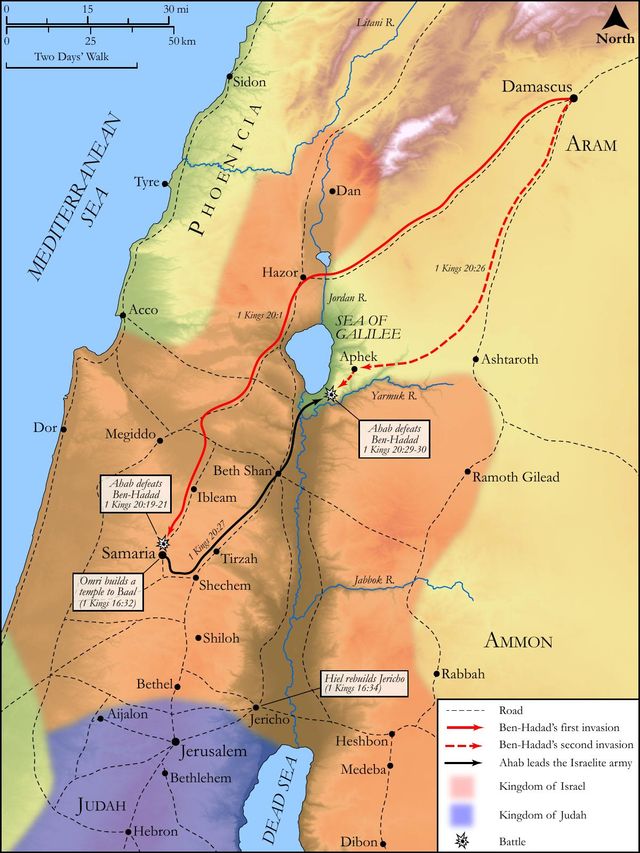
This verse is strategically positioned within the broader narrative of 1 Kings 20, which recounts two significant conflicts between Israel and Aram (Syria) during the tumultuous reign of King Ahab. The immediate preceding verses (1 Kings 20:1-15) detail Ben-hadad's initial, overwhelming siege of Samaria, his outrageous demands for tribute, and Ahab's desperate but ultimately God-directed plea for help. Crucially, a prophet of the Lord appears to Ahab, promising an unexpected victory despite Israel's severe numerical disadvantage, explicitly stating that this triumph is intended to demonstrate God's sovereignty (see 1 Kings 20:13). The instruction to attack at noon, implicitly followed by Ahab's forces and highlighted in 1 Kings 20:16, directly precedes and sets up the dramatic counter-offensive that commences in 1 Kings 20:17. Thus, this verse serves as a critical narrative pivot, exposing the enemy's profound vulnerability just before God's power is spectacularly displayed.
Historical & Cultural Context
The period of King Ahab's reign (circa 874-853 BC) was characterized by significant political instability and frequent military confrontations between Israel and its powerful northern neighbor, Aram (Syria). Samaria, Israel's capital, was a strategically vital city, and its siege by a formidable coalition of thirty-two kings signifies a grave existential threat to the northern kingdom. Such large alliances, often formed for conquest or defense, were a common feature of the warfare of that day. Military camps, even amidst active sieges, could become sites of revelry, especially if the besieging army perceived victory as assured. The "pavilions" (Hebrew: sukkot) refer to temporary shelters or booths, typical of a vast military encampment. While feasting was part of ancient military life, drunkenness, particularly among commanders, represented a severe and dangerous lapse in discipline and vigilance. This cultural backdrop of intense warfare juxtaposed with the enemy's indulgent complacency provides a stark and dramatic contrast to the disciplined, divinely-empowered actions of the Israelite forces.
Key Themes
ShowHideFirst Kings 20:16 significantly contributes to several overarching themes prevalent in 1 Kings and the broader Deuteronomistic History. Firstly, it powerfully underscores the theme of divine sovereignty and intervention, demonstrating God's ability to orchestrate victory even through the most unlikely circumstances and the weakest instruments, particularly when human arrogance reaches its zenith (compare 1 Samuel 17:47). Secondly, the verse highlights the profound dangers of pride and overconfidence, vividly exemplified by Ben-hadad's drunken revelry, which blinds him and his allies to the impending danger and precipitates their dramatic downfall (see Proverbs 16:18). Thirdly, the passage subtly introduces the crucial theme of vigilance versus complacency, contrasting the unsuspecting Syrian kings with the divinely instructed Israelite forces, who are poised for decisive action. This narrative serves as a potent reminder that human strength, numbers, and perceived invincibility are ultimately secondary to God's omnipotent power and strategic wisdom.
Exposition and Analysis
ShowHideKey Word Analysis
ShowHideThis name (H1130), meaning "son of Hadad," refers to the king of Aram (Syria), a prominent and powerful adversary of Israel during this period. The name itself invokes the Syrian storm god, Hadad, highlighting the pagan context of Ben-hadad's rule and his reliance on false deities and worldly power. His presence as the central figure in this scene of drunken revelry underscores the spiritual bankruptcy and ultimate vulnerability of a kingdom built on human pride rather than divine truth.
The KJV phrase "drinking himself drunk" incorporates the Hebrew term שִׁכֹּר (H7910, shikkôwr'), which describes a state of intoxication, either temporary or habitual. This word emphasizes not merely consuming alcohol, but reaching a profound state of inebriation where judgment is severely impaired, and self-control is lost. In a military context, such a state signifies a catastrophic lapse in discipline and readiness, rendering the individual and their forces highly vulnerable. It denotes a deliberate indulgence to the point of incapacitation, highlighting Ben-hadad's utter disregard for the ongoing siege and the potential for a counter-attack.
The Hebrew term סֻכָּה (H5521, çukkâh'), used here in its plural form, refers to temporary shelters, booths, or tents. While these were standard components of a military encampment, the context in 1 Kings 20:16 suggests they were being used for leisure, feasting, and revelry rather than vigilant military operations. The term evokes a sense of temporary comfort and indulgence, standing in stark contrast to the harsh realities and strategic demands of a siege. It implies a setting where the kings felt secure and unthreatened, further emphasizing their overconfidence and detachment from the immediate strategic situation.
Verse Breakdown
ShowHide"And they went out at noon."
This initial clause refers to King Ahab's forces, specifically the young officers and the Israelite army, acting upon the precise instructions given by the prophet of the Lord (see 1 Kings 20:17). The timing, "at noon," is profoundly significant. It was an unexpected hour for a major military movement, as the intense midday heat would typically deter such actions, and it was precisely when Ben-hadad and his allies were most vulnerable due to their indulgence. This detail highlights the strategic wisdom, undoubtedly divinely inspired, behind the timing of the assault, maximizing the element of surprise.
"But Benhadad [was] drinking himself drunk in the pavilions,"
This clause immediately introduces a stark and dramatic contrast to the readiness of the Israelite forces. While Ahab's army was preparing for battle, Ben-hadad, the supreme commander of the formidable Syrian coalition, was in a state of self-induced inebriation. The phrase "drinking himself drunk" emphasizes a deliberate and excessive indulgence, leading to impaired judgment and a complete lack of military readiness. His location "in the pavilions" suggests a scene of comfort, luxury, and revelry, far removed from the disciplined vigilance expected of a commander during an active siege.
"he and the kings, the thirty and two kings that helped him."
This final clause expands the scope of the revelry, revealing that Ben-hadad was not alone in his profound indulgence. The entire leadership of the vast allied army—a formidable coalition of thirty-two kings—were participating in this drunken feast. This detail magnifies the collective complacency, arrogance, and spiritual blindness of the enemy, demonstrating that the highest echelons of their military command were utterly unprepared and vulnerable. It sets the stage for a dramatic and divinely orchestrated downfall, emphasizing that the entire formidable coalition was compromised by its leaders' lack of discipline and their overestimation of their own power.
Literary Devices
ShowHideThe passage in 1 Kings 20:16 masterfully employs several literary devices to enhance its impact and convey its theological message. Contrast is a primary device, immediately evident in the juxtaposition of Ahab's forces "going out at noon" (implying decisive action, discipline, and readiness) with Ben-hadad and his allies "drinking himself drunk" (implying inaction, indulgence, and profound vulnerability). This sharp contrast highlights the divine strategy at play, where God's perfect timing exploits the enemy's self-inflicted weakness. Irony is also powerfully present; the mighty coalition of thirty-two kings, confident in their overwhelming numbers and assured of victory, are caught entirely off guard and ultimately defeated not by superior force, but by their own indulgence and complacency. Their assumed strength becomes their greatest weakness. Furthermore, the scene serves as powerful Foreshadowing, as Ben-hadad's state of drunken stupor clearly anticipates his impending defeat and the dramatic reversal of fortunes that follows. The "pavilions" and the act of "drinking" can also be seen as potent Symbolism for false security, worldly indulgence, and spiritual blindness, which ultimately lead to destruction and humiliation.
Theological and Thematic Connections
ShowHideThe vivid scene in 1 Kings 20:16 offers profound theological insights into God's character and the nature of human pride. It powerfully illustrates God's absolute sovereignty over all human affairs, including the outcomes of military conflicts. Despite Israel's numerical inferiority and King Ahab's persistent moral failings, God intervenes to deliver a decisive victory, not for Ahab's merit, but solely to demonstrate His own omnipotence and unwavering faithfulness. Ben-hadad's arrogance and self-indulgence serve as a stark and timeless warning against the dangers of pride, which blinds individuals and nations to their true vulnerabilities and invariably precedes destruction. This narrative underscores the profound biblical principle that true security and lasting victory come not from human strength, overwhelming numbers, or self-indulgent revelry, but from humble reliance on God and vigilant obedience to His divine commands. It powerfully reminds us that God often chooses to work through the weak and the unexpected to confound the strong and the self-assured, ensuring that all glory redounds solely to Him.
Reflection and Application
ShowHideThe vivid imagery of Ben-hadad's drunken revelry in 1 Kings 20:16 serves as a timeless and potent cautionary tale for believers today. It compels us to engage in honest self-examination, scrutinizing areas of our lives where complacency, overconfidence, or excessive indulgence might be dulling our spiritual senses and leaving us vulnerable to spiritual attack. Just as Ben-hadad's physical drunkenness led to a critical lapse in military judgment and ultimately defeat, spiritual "drunkenness"—whether stemming from worldly distractions, self-sufficiency, a lack of prayer, or a failure to engage with God's Word—can severely impair our discernment and readiness for the spiritual battles we inevitably face. This passage profoundly challenges us to cultivate a spirit of profound humility and unwavering dependence on God, recognizing that our true strength and security originate solely from Him, not from our own perceived abilities, accumulated resources, or worldly achievements. It encourages us to remain sober-minded and spiritually alert, always prepared to respond with obedience to God's leading and to stand firm against the subtle and overt schemes of the enemy, knowing with confidence that God delights in displaying His magnificent power through our weakness when we wholeheartedly trust and obey Him.
Questions for Reflection
ShowHideFAQ
ShowHideWhy was Ben-hadad drinking himself drunk during a siege?
ShowHideBen-hadad's drunken state during the siege of Samaria, as vividly described in 1 Kings 20:16, indicates an extreme level of overconfidence, arrogance, and a profound underestimation of his enemy. He and his thirty-two allied kings likely believed their overwhelming numerical superiority and the prolonged siege had already guaranteed their victory, leading them to abandon military discipline for revelry. This deep-seated complacency, fueled by excessive indulgence, resulted in a severe lapse in military vigilance, leaving them utterly unprepared for the unexpected and divinely orchestrated counter-attack by King Ahab and the Israelite forces. It serves as a powerful biblical illustration of the dangers of pride and the false sense of security that can accompany perceived power and worldly success.
Christ-Centered Fulfillment
ShowHideThe narrative of Ben-hadad's drunken complacency and subsequent humiliating defeat in 1 Kings 20:16 finds profound and ultimate Christ-centered fulfillment in the triumphant victory of Jesus Christ over the spiritual forces of sin, death, and the devil. Ben-hadad, representing worldly power, arrogance, and a false sense of security, is caught off guard and vanquished by a divinely empowered, seemingly weaker foe. This powerfully foreshadows the ultimate triumph of Christ, who, though appearing in humility and weakness as the Lamb of God who takes away the sin of the world, utterly defeated the spiritual enemies that held humanity captive. Unlike Ben-hadad's revelry leading to vulnerability and defeat, Christ's self-emptying on the cross, a moment of apparent weakness and humiliation, was the very act through which He disarmed principalities and powers, triumphing over them in it (see Colossians 2:15). His decisive victory was not achieved through worldly might, strategic cunning, or self-indulgent revelry, but through perfect obedience, sacrificial love, and divine power, echoing the profound biblical principle that God often chooses the weak, foolish, and despised things of the world to shame the strong and wise (1 Corinthians 1:27-29). As believers, we are called to emulate Christ's vigilance, sobriety, and humble dependence (1 Peter 5:8), not the spiritual drunkenness or complacency of the world, for our true and eternal victory is found solely in Him, the conquering King who has decisively overcome the world (see John 16:33).