


1 Kings 16:9
Bible text: King James Version (1769 Blayney text) · Public domain
Bible text: King James Version with Strong's numbers · Public domain
Bible text: Berean Standard Bible · Public domain
Bible text: American Standard Version (1901) · Public domain
Bible text: World English Bible, Messianic edition · Public domain
Bible text: Geneva Bible (1599) · Public domain
Bible text: Young's Literal Translation · Public domain
- וַיִּקְשֹׁרvai·yik·Shorand he conspiredH7194Conj-w ¦ V-Qal-ConsecImperf-3msVerb Qal Consecutive Imperfect 3rd Singular Masculineוַandיִּקְשֹׁרhe conspired
- עָלָיו'a·Lavon himH5921Prep ¦ 3msPrepositionעָלָיonוhim
- עַבְדּוֹav·Dohis servantH5650N-msc ¦ 3msNoun Singular Masculine Constructעַבְדּservantוֹhis
- זִמְרִיzim·RiZimriH2174N-proper-mNoun Proper Masculine
- שַׂרsar[the] commander ofH8269N-mscNoun Singular Masculine Construct
- מַחֲצִיתma·cha·Tzit<the> half ofH4276N-fscNoun Singular Feminine Construct
- הָרָכֶבha·Ra·khevthe chariotryH7393Art ¦ N-msNoun Singular Masculine Absoluteהָtheרָכֶבchariotry
- וְהוּאve·Hu'and heH1931Conj-w ¦ Pro-3msPronoun Personal 3rd Singular Masculineוְandהוּאhe
- בְתִרְצָהve·tir·Tzahin TirzahH8656Prep-b ¦ N-properNoun Proper LocationבְinתִרְצָהTirzah
- שֹׁתֶהsho·Teh[was] drinkingH8354V-Qal-Prtcpl-msVerb Qal Participle Singular Masculine Absolute
- שִׁכּוֹרshi·KordrunkenH7910Adj-msAdjective Singular Masculine Absolute
- בֵּיתbeit[the] house ofH1004N-mscNoun Singular Masculine Construct
- אַרְצָא'ar·Tza'ArzaH777N-proper-mNoun Proper Masculine
- אֲשֶׁר'a·SherwhoH834RelParticle Relative
- עַל'al[was] overH5921PrepPreposition
- הַבַּיִתha·Ba·yitthe householdH1004Art ¦ N-msNoun Singular Masculine Absoluteהַtheבַּיִתhousehold
- בְּתִרְצָהbe·tir·Tzahin TirzahH8656Prep-b ¦ N-properNoun Proper LocationבְּinתִרְצָהTirzah
English is a literal word-by-word gloss of the Hebrew, not the KJV's wording. Why?
This is the original text the KJV's translators worked from — each Hebrew word with its own literal English meaning in this verse, prepared by scholars at Tyndale House, Cambridge. The KJV translates whole sentences, not word by word, so its wording differs: one Hebrew word can become several English words, and the KJV may choose “the LORD” where the gloss reads “Yahweh”. Both are faithful — they answer different questions. For the KJV's own rendering, switch to the KJV text.
Details
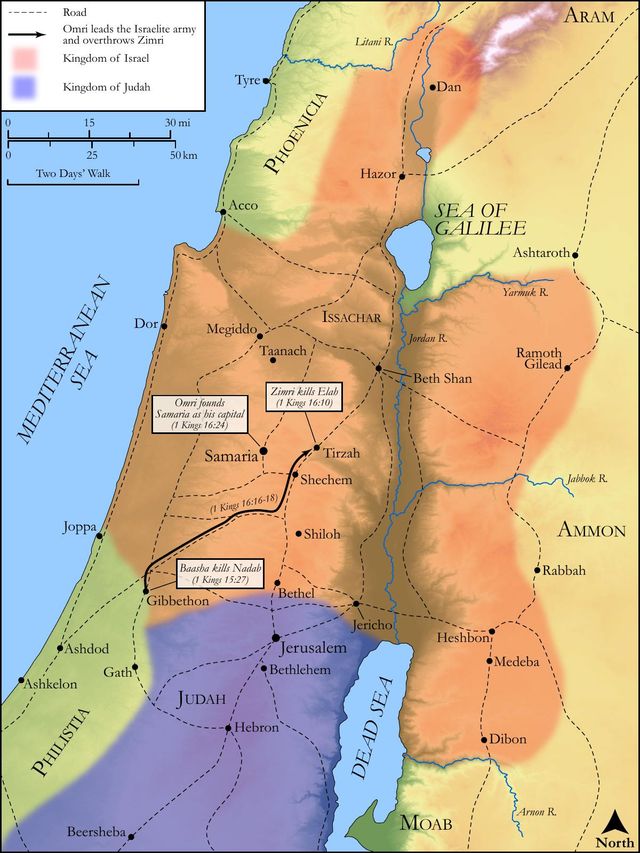
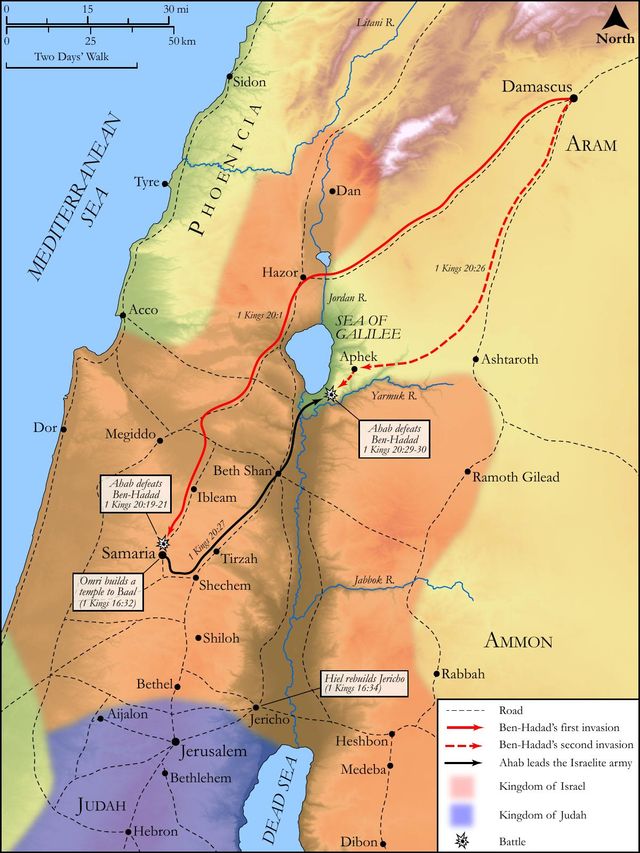
See on the biblical-era maps

Study this verse
Public-domain commentary
Matthew Henry
From his Commentary on the Whole Bible. Henry comments on passages, not single verses — this entry covers 1 Kings 16:1–14. His four-level outline is real structure in the source text, so it is rendered as structure.
Here is, I. The ruin of the family of Baasha foretold. He was a man likely enough to have raised and established his family - active, politic, and daring; but he was an idolater, and this brought destruction upon his family.
1.God sent him warning of it before.
(1.)That, if he were thereby wrought upon to repent and reform, the ruin might be prevented; for God threatens, that he may not strike, as one that desires not the death of sinners.
(2.)That, if not, it might appear that the destruction when it did come, whoever might be instruments of it, was the act of God's justice and the punishment of sin.
2.The warning was sent by Jehu the son of Hanani. The father was a seer, or prophet, at the same time (Ch2 16:7), and was sent to Asa king of Judah; but the son, who was young and more active, was sent on this longer and more dangerous expedition to Baasha king of Israel. Juniores ad labores - Toil and adventure are for the young. This Jehu was a prophet and the son of a prophet. Prophecy, thus happily entailed, was worthy of so much the more honour. This Jehu continued long in his usefulness, for we find him reproving Jehoshaphat (Ch2 19:2) above forty years after, and writing the annals of that prince, Ch2 20:34. The message which this prophet brought to Baasha is much the same with that which Ahijah sent to Jeroboam by his wife.
(1.)He reminds Baasha of the great things God had done for him (Kg1 16:2): I exalted thee out of the dust to the throne of glory, a great instance of the divine sovereignty and power, Sa1 2:8. Baasha seemed to have raised himself by his own treachery and cruelty, yet there was a hand of Providence in it, to bring about God's counsel, concerning Jeroboam's house; and God's owning his advancement as his act and deed does by no means amount to the patronising of his ambition and treachery. It is God that puts power into bad men's hands, which he makes to serve his good purposes, notwithstanding the bad use they make of it. I made thee prince over my people. God calls Israel his people still, though wretchedly corrupted, because they retained the covenant of circumcision, and there were many good people among them; it was not till long after that they were called Loammi, not a people, Hos 1:9.
(2.)He charges him with high crimes and misdemeanours,
[1.]That he had caused Israel to sin, had seduced God's subjects from their allegiance and brought them to pay to dunghill-deities the homage due to him only, and herein he had walked in the way of Jeroboam (Kg1 16:2), and been like his house, Kg1 16:7.
[2.]That he had himself provoked God to anger with the work of his hands, that is, by worshipping images, the work of men's hands; though perhaps others made them, yet he served them and thereby avowed the making of them, and they are therefore called the work of his hands.
[3.]That he had destroyed the house of Jeroboam (Kg1 16:7), because he killed him, namely, Jeroboam's son and all his: if he had done that with an eye to God, to his will and glory, and from a holy indignation against the sins of Jeroboam and his house, he would have been accepted and applauded as a minister of God's justice; but, as he did it, he was only the tool of God's justice, but a servant to his own lusts, and is justly punished for the malice and ambition which actuated and governed him in all he did. Note, Those who are in any way employed in denouncing or executing the justice of God (magistrates or ministers) are concerned to do it from a good principle and in a holy manner, lest it turn into sin to them and they make themselves obnoxious by it.
(3.)He foretels the same destruction to come upon his family which he himself had been employed to bring upon the family of Jeroboam, Kg1 16:3, Kg1 16:4. Note, Those who resemble others in their sins may expect to resemble them in their plagues, especially those who seem zealous against such sins in others as they allow themselves in; the house of Jehu was reckoned with for the blood of the house of Ahab, Hos 1:4.
II.A reprieve granted for some time, so long that Baasha himself dies in peace, and is buried with honour in his own royal city (Kg1 16:6), so far is he from being a prey either to the dogs or to the fowls, which yet was threatened to his house, Kg1 16:4. He lives not either to see or feel the punishment threatened, yet he was himself the greatest delinquent. Certainly there must be a future state, in which impenitent sinners will suffer in their own persons, and not escape, as often they do in this world. Baasha died under no visible stroke of divine vengeance for aught that appears, but God laid up his iniquity for his children, as Job speaks, Job 21:19. Thus he often visits sin. Observe, Baasha is punished by the destruction of his children after his death, and his children are punished by the abuse of their bodies after their death; that is the only thing which the threatening specifies (Kg1 16:4), that the dogs and the fowls of the air should eat them, as if herein were designed a tacit intimation that there are punishments after death, when death has done its worst, which will be the sorest punishments and are most to be dreaded; these judgments on the body and posterity signified judgments on the soul when separated from the body, by him who, after he has killed, has power to cast into hell.
III.Execution done at last.
Baasha's son Elah, like Jeroboam's son Nadab, reigned two years, and then was slain by Zimri, one of his own soldiers, as Nadab was by Baasha; so like was his house made to that of Jeroboam, as was threatened, Kg1 16:3. Because his idolatry was like his, and one of the sins for which God contended with him being the destruction of Jeroboam's family, the more the destruction of his own resembled that, the nearer did the punishment resemble the sin, as face answers to face in a glass.
1.As then, so now, the king himself was first slain, but Elah fell more ingloriously than Nadab. Nadab was slain in the field of action and honour, he and his army then besieging Gibbethon (Kg1 15:27); but the siege being then raised upon that disaster, and the city remaining still in the Philistines' hands, the army of Israel was now renewing the attempt (Kg1 16:15) and Elah should have been with them to command in chief, but he loved his own ease and safety better than his honour or duty, or the public good, and therefore staid behind to take his pleasure; and, when he was drinking himself drunk in his servant's house, Zimri killed him, Kg1 16:9, Kg1 16:10. Let it be a warning to drunkards, especially to those who designedly drink themselves drunk, that they know not but death may surprise them in that condition.
(1.)Death comes easily upon men when they are drunk. Besides the chronic diseases which men frequently bring themselves into by hard drinking, and which cut them off in the midst of their days, men in that condition are more easily overcome by an enemy, as Amnon by Absalom, and are liable to more bad accidents, being unable to help themselves,
(2.)Death comes terribly upon men in that condition. Finding them in the act of sin, and incapacitated for any act of devotion, that day comes upon them unawares (Luk 21:34), like a thief.
2.As then, so now, the whole family was cut off, and rooted out. The traitor was the successor, to whom the unthinking people tamely submitted, as if it were all one to them what kind they had, so that they had one. The first thing Zimri did was to slay all the house of Baasha; thus he held by cruelty what he got by treason. His cruelty seems to have extended further than Baasha's did against the house of Jeroboam, for he left to Elah none of his kinsfolks or friends (Kg1 16:11), none of his avengers (so the word is), none that were likely to avenge his death; yet divine justice soon avenged it so remarkably that it was used as a proverb long after, Had Zimri peace who slew his master? Kg2 9:31. In this,
(1.)The word of God was fulfilled, Kg1 16:12.
(2.)The sins of Baasha and Elah were reckoned for, with which they provoked God by their vanities, Kg1 16:13. Their idols are called their vanities, for they cannot profit nor help. Miserable are those whose deities are vanities.
Continue studying 1 Kings 16:9 across the web’s major study libraries — every link below opens this exact verse, chapter, or book on the destination site.
Read & Compare
 BibleGatewayThis verse in more than 200 translations and 70 languages.
 Bible.comThe YouVersion reader — hundreds of translations, reading plans, and highlights.
 ESV.orgCrossway's official English Standard Version reader.
 NET BibleThe NET translation with 60,000+ translators' notes on every rendering decision.
 STEP BibleTyndale House's free study tool — original text, vocabulary, and scholarly resources.
 BibliaLogos Bible Software's free web reader.
 USCCBThe New American Bible (Revised Edition) with the U.S. bishops' study notes.
Commentaries
 BibleHub CommentariesDozens of classic commentaries on this verse, gathered on one page.
 StudyLightMore than 100 commentary sets — the largest collection on the web.
 BibleRefPlain-English commentary on what this verse means, verse by verse.
 Enduring WordDavid Guzik's free commentary on this chapter, widely used by Bible teachers.
 Bible Study ToolsVerse commentary alongside Greek and Hebrew study aids.
Original Language & Research
- BibleHub InterlinearThe verse word by word — original language, transliteration, and English.
- BibleHub LexiconEvery word's original-language definition and Strong's entry.
 Blue Letter BibleDeep-study tools — Strong's numbers, concordance, and word studies.
 SefariaThe Hebrew text with Rashi and centuries of Jewish commentary.
Sermons, Hymns & Audio


TrulyRandomVerse is not affiliated with these sites and doesn’t control their content. They’re linked because they’re genuinely useful.
Summary
1 Kings 16:9 vividly recounts the meticulously planned conspiracy by Zimri, a prominent military commander, against King Elah of Israel. This pivotal verse captures the moment of profound vulnerability and betrayal, revealing Elah's complete incapacitation due to severe intoxication in Tirzah, the capital, within the private residence of his trusted royal steward, Arza. This audacious act of treachery not only brought an abrupt and ignominious end to Elah's brief and unrighteous reign but also initiated yet another violent and transient transfer of power, characteristic of the turbulent and morally compromised history of the Northern Kingdom.
Context
ShowHideLiterary Context
This verse is strategically placed within the rapid succession of short, violent, and unrighteous reigns that characterize the Northern Kingdom of Israel, immediately following the brief two-year rule of King Elah, son of Baasha (1 Kings 16:8). It serves as the dramatic and tragic climax of the divine prophecy delivered against the house of Baasha by the prophet Jehu son of Hanani, as detailed in 1 Kings 16:1-4. The swift and brutal termination of Elah's reign directly fulfills this pronouncement of divine judgment, powerfully illustrating God's active and sovereign involvement in the political instability of a kingdom that had consistently turned away from Him. The narrative immediately transitions to Zimri's equally brief reign and the subsequent rise of Omri, further emphasizing the cyclical nature of sin, judgment, and political upheaval that plagued Israel's northern monarchy.
Historical & Cultural Context
Tirzah, serving as the capital of the Northern Kingdom during this tumultuous period, was renowned for its beauty and strategic importance, even being likened to Jerusalem in its splendor (Song of Solomon 6:4). However, despite its aesthetic appeal, the political landscape of Israel was marked by profound instability, frequent coups, and a pervasive atmosphere of idolatry that deeply permeated both the royal court and the nation at large. Unlike the relatively stable and divinely ordained Davidic dynasty in Judah, the Northern Kingdom experienced a succession of non-dynastic rulers who frequently seized power through violence, a pattern often presented by the biblical author as divine judgment for their wickedness and the nation's apostasy. Zimri, holding the significant position of "captain of half his chariots," possessed substantial military authority and close proximity to the king, rendering his betrayal particularly potent and effective. The act of "drinking himself drunk" was not merely a personal failing but a culturally understood sign of a leader's lack of self-control, vulnerability, and unfitness for rule, leaving him dangerously exposed to internal threats.
Key Themes
ShowHideThe verse powerfully illustrates several recurring themes found throughout 1 Kings and the broader Old Testament narrative. First, Treachery and Usurpation are vividly portrayed as Zimri, a trusted servant, exploits his king's profound vulnerability to seize power. This highlights the precarious nature of authority in ancient monarchies, especially those not grounded in divine appointment or obedience. Second, the Consequences of Indulgence are starkly evident in King Elah's state of "drinking himself drunk." This rendered him oblivious and defenseless, making him an easy target and serving as a potent warning about the dangers of excessive indulgence, particularly for those in positions of leadership. Biblical wisdom literature frequently cautions against such behavior, as seen in Proverbs 20:1 which warns that "wine is a mocker, strong drink is raging." Finally, the underlying theme of Divine Judgment and Sovereignty is implicitly but powerfully present. While human actions drive the immediate plot, the biblical author consistently frames these tumultuous events as part of God's righteous judgment against wicked kings and their idolatrous dynasties, fulfilling prophecies like that delivered against Baasha's house in 1 Kings 16:1-4.
Exposition and Analysis
ShowHideKey Word Analysis
ShowHideA primitive root meaning "to tie," "to bind," or "to league together." In the context of political intrigue, as used here, it signifies the formation of a secret agreement, a plot, or a conspiracy, often with violent and rebellious intent against a reigning authority. The use of qâshar consistently denotes a treacherous and illicit act of rebellion, emphasizing the premeditated and disloyal nature of Zimri's actions against his king.
This phrase combines H8354 (shâthâh), meaning "to imbibe," and H7910 (shikkôwr), meaning "intoxicated, as a state or a habit." The combination creates an intensive construction, emphasizing a state of profound and self-induced intoxication. It implies a complete loss of control, awareness, and capacity for self-defense. The reflexive nature ("drinking himself") underscores Elah's active participation in his own incapacitation, which directly contributed to his vulnerability and downfall.
Verse Breakdown
ShowHide"And his servant Zimri, captain of half [his] chariots, conspired against him"
This opening clause immediately introduces the antagonist, Zimri, and highlights his significant military standing. As "captain of half his chariots," he commanded a substantial portion of the king's military might, placing him in a position of trust and power that he ultimately abused. The term "servant" here is deeply ironic, underscoring the profound betrayal inherent in his "conspiracy" against his master.
"as he was in Tirzah, drinking himself drunk"
This part of the verse sets the scene and reveals the king's compromised state. Tirzah, as the capital, should have been a secure stronghold, but Elah's self-inflicted intoxication rendered him utterly defenseless and oblivious to the impending danger. His drunkenness is presented as the immediate catalyst for his vulnerability, making him an easy target.
"in the house of Arza steward of [his] house in Tirzah"
The specific location further emphasizes the king's relaxed and unguarded state, as well as the intimate nature of the betrayal. Arza, as the "steward of his house" (H1004, bayith, also indicating household), was a high-ranking and trusted official responsible for the king's domestic affairs. That the assassination occurred in his private residence underscores the king's misplaced trust and the conspirator's opportunistic exploitation of a moment of personal indulgence and presumed security.
Literary Devices
ShowHideThe narrative of 1 Kings 16:9 employs several potent literary devices to convey its message with dramatic impact. Irony is prominently featured, as Zimri, explicitly identified as "his servant," betrays the very king he is sworn to serve, transforming a position of trust into an instrument of treachery. Furthermore, the king, who should embody strength and protection for his nation, is depicted as utterly helpless and vulnerable due to his own self-indulgence, creating a stark ironic contrast. The verse also utilizes Foreshadowing, as the swift and violent end of Elah's reign foreshadows the equally brief and tumultuous reign of Zimri himself (1 Kings 16:15-19), illustrating the cyclical nature of unrighteous power grabs and divine judgment in the Northern Kingdom. There is a clear Contrast between Elah's regal title and his undignified, incapacitated state, highlighting the moral decay at the heart of the kingdom's leadership. Finally, Elah's drunkenness can be seen as Symbolism, representing not only his personal moral failing but also the spiritual and moral intoxication of the Northern Kingdom's leadership and its pervasive idolatry, which ultimately led to its downfall and divine judgment.
Theological and Thematic Connections
ShowHideThe account of Zimri's conspiracy against King Elah serves as a potent theological commentary on the profound instability and moral decay that plagued the Northern Kingdom of Israel. It underscores the severe consequences of unrighteous leadership, particularly when coupled with personal indulgence and a blatant disregard for divine principles. While Zimri's treachery is undeniably a human act, the biblical narrative consistently frames such events within God's overarching sovereignty and righteous judgment against those who lead His people astray through idolatry and disobedience. The swift, violent end of Elah's reign is presented as a direct fulfillment of prophecy, demonstrating that God holds even kings accountable for their actions and that no earthly power, however secure it may seem, can ultimately stand against His righteous decrees. This narrative powerfully reinforces the truth that true security and lasting authority derive not from military might or political cunning, but from faithfulness to God and adherence to His covenant.
Reflection and Application
ShowHideThe tragic demise of King Elah offers timeless lessons on the critical importance of vigilance, self-control, and moral sobriety, especially for those entrusted with leadership in any sphere. Elah's profound vulnerability, brought on by his own unchecked indulgence, serves as a stark warning: unchecked personal habits can have catastrophic consequences, not only for the individual but for all those under their influence or authority. Whether in a family, a business, a church, or a nation, leaders are called to maintain integrity and discipline, recognizing that their choices profoundly impact the well-being and security of others. This narrative also challenges us to consider the "intoxications" in our own lives – whether literal substances, unchecked desires, or distracting pursuits – that might blind us to spiritual dangers, compromise our effectiveness, or make us vulnerable to temptation and sin. It reminds us that true strength and lasting security lie not in worldly power or fleeting pleasures, but in a disciplined spirit, a steadfast walk with God, and a commitment to righteousness.
Questions for Reflection
ShowHideFAQ
ShowHideWhy was Elah drinking in Arza's house, not his own palace?
ShowHideArza was the "steward of his house" (H1004, bayith), a highly trusted and significant position within the royal court, responsible for managing the king's household affairs and likely overseeing his personal residence. While the king would have had his own private chambers within the palace, it was not uncommon for monarchs to visit or reside in the homes of their most trusted officials, especially for private gatherings or moments of relaxation. This setting, though seemingly secure and intimate, ironically became the scene of Elah's betrayal, highlighting the profound breach of trust and the conspirator's opportunistic timing. It implies a more informal, perhaps less guarded, environment than the formal palace, making Elah even more vulnerable to the conspiracy.
How long did Zimri's reign last after this coup?
ShowHideZimri's reign was remarkably brief, lasting only seven days, as explicitly recorded in 1 Kings 16:15. This extremely short duration underscores the volatile and unstable nature of the Northern Kingdom's monarchy during this period, where power was often seized through violence and quickly lost through similar means. His swift downfall, leading to his self-immolation, is presented as divine judgment for his own sins and for perpetuating the wickedness of the house of Baasha, further emphasizing the cyclical nature of divine retribution in Israel's history.
Christ-Centered Fulfillment
ShowHideThe tumultuous narrative of 1 Kings 16:9, with its themes of betrayal, vulnerable leadership, and fleeting earthly power, finds its ultimate contrast and profound fulfillment in the person and reign of Jesus Christ. Unlike King Elah, who was incapacitated by self-indulgence and tragically betrayed by a trusted servant, Jesus, the true and eternal King, was never compromised by sin or weakness. He was indeed betrayed by one of His own disciples, Judas Iscariot (Matthew 26:47-50), but this betrayal did not stem from His vulnerability or lack of self-control, but rather from the darkness of humanity's sin and the sovereign plan of God for redemption. While earthly kings like Elah fall due to their flaws and the transience of their power, Christ willingly laid down His life, not in weakness, but in ultimate strength and perfect obedience, to conquer sin and death (John 10:18). His kingdom is not established through violence or political intrigue, but through self-sacrifice, righteousness, and truth (John 18:36). He is the vigilant Shepherd who never slumbers nor sleeps (Psalm 121:4), the sober and righteous King whose reign is eternal and unshakeable, utterly unlike the fleeting and violent reigns of Israel's kings (Revelation 11:15). In Christ, we see the perfect King who was betrayed for our sake, not because of His own folly, but to establish a kingdom of peace, righteousness, and everlasting life that will never end.