


1 Kings 16:8
Bible text: King James Version (1769 Blayney text) · Public domain
Bible text: Berean Standard Bible · Public domain
Bible text: American Standard Version (1901) · Public domain
Bible text: World English Bible, Messianic edition · Public domain
Bible text: Geneva Bible (1599) · Public domain
Bible text: Young's Literal Translation · Public domain
- בִּשְׁנַתbish·Natin yearH8141Prep-b ¦ N-fscNoun Singular Feminine Constructבִּinשְׁנַתyear
- עֶשְׂרִים'es·RimtwentyH6242N-mpNoun Plural Masculine Absolute
- וָשֵׁשׁva·Sheshand sixH8337Conj-w ¦ N-csNoun Singular common gender Absoluteוָandשֵׁשׁsix
- שָׁנָהsha·NahyearH8141N-fsNoun Singular Feminine Absolute
- לְאָסָאle·'a·Sa'of AsaH609Prep-l ¦ N-proper-mNoun Proper MasculineלְofאָסָאAsa
- מֶלֶךְMe·lekh[the] king ofH4428N-mscNoun Singular Masculine Construct
- יְהוּדָהye·hu·DahJudahH3063N-properNoun Proper Location
- מָלַךְMa·lakhhe became kingH4427V-Qal-Perf-3msVerb Qal Perfect 3rd Singular Masculine
- אֵלָה'e·LahElahH425N-proper-mNoun Proper Masculine
- בֶןven[the] son ofH1121N-mscNoun Singular Masculine Construct
- בַּעְשָׁאba'·Sha'BaashaH1201N-proper-mNoun Proper Masculine
- עַל'aloverH5921PrepPreposition
- יִשְׂרָאֵלYis·ra·'ElIsraelH3478N-properNoun Proper Location
- בְּתִרְצָהbe·tir·Tzahin TirzahH8656Prep-b ¦ N-properNoun Proper LocationבְּinתִרְצָהTirzah
- שְׁנָתָיִםshe·na·Ta·yimtwo yearsH8141N-fdNoun Dual Feminine Absolute
English is a literal word-by-word gloss of the Hebrew, not the KJV's wording. Why?
This is the original text the KJV's translators worked from — each Hebrew word with its own literal English meaning in this verse, prepared by scholars at Tyndale House, Cambridge. The KJV translates whole sentences, not word by word, so its wording differs: one Hebrew word can become several English words, and the KJV may choose “the LORD” where the gloss reads “Yahweh”. Both are faithful — they answer different questions. For the KJV's own rendering, switch to the KJV text.
Details
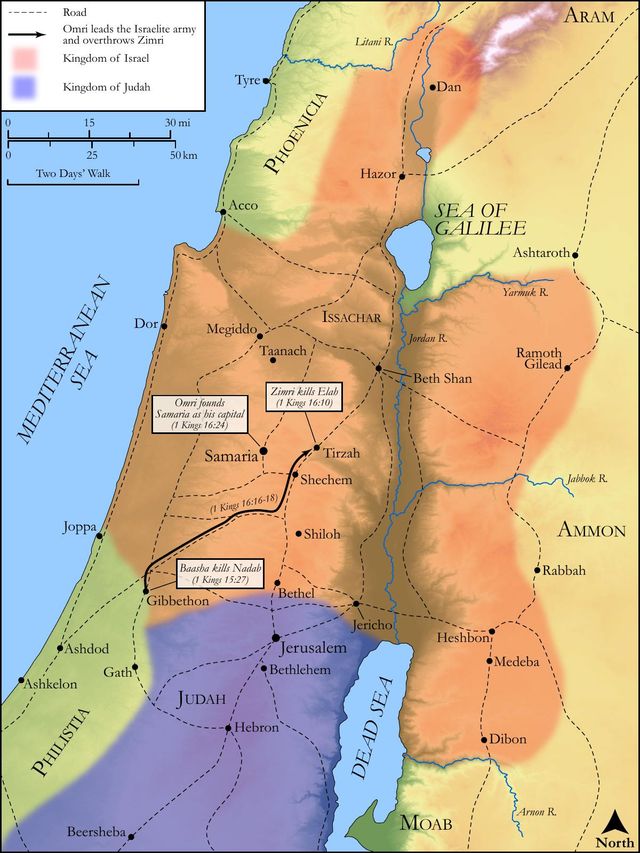
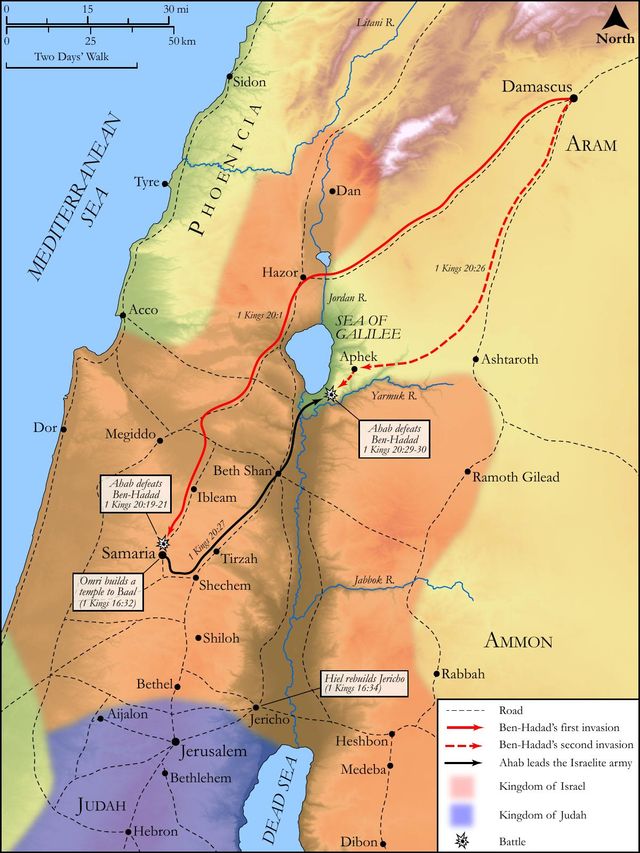
See on the biblical-era maps

Study this verse
Public-domain commentary
Matthew Henry
From his Commentary on the Whole Bible. Henry comments on passages, not single verses — this entry covers 1 Kings 16:1–14. His four-level outline is real structure in the source text, so it is rendered as structure.
Here is, I. The ruin of the family of Baasha foretold. He was a man likely enough to have raised and established his family - active, politic, and daring; but he was an idolater, and this brought destruction upon his family.
1.God sent him warning of it before.
(1.)That, if he were thereby wrought upon to repent and reform, the ruin might be prevented; for God threatens, that he may not strike, as one that desires not the death of sinners.
(2.)That, if not, it might appear that the destruction when it did come, whoever might be instruments of it, was the act of God's justice and the punishment of sin.
2.The warning was sent by Jehu the son of Hanani. The father was a seer, or prophet, at the same time (Ch2 16:7), and was sent to Asa king of Judah; but the son, who was young and more active, was sent on this longer and more dangerous expedition to Baasha king of Israel. Juniores ad labores - Toil and adventure are for the young. This Jehu was a prophet and the son of a prophet. Prophecy, thus happily entailed, was worthy of so much the more honour. This Jehu continued long in his usefulness, for we find him reproving Jehoshaphat (Ch2 19:2) above forty years after, and writing the annals of that prince, Ch2 20:34. The message which this prophet brought to Baasha is much the same with that which Ahijah sent to Jeroboam by his wife.
(1.)He reminds Baasha of the great things God had done for him (Kg1 16:2): I exalted thee out of the dust to the throne of glory, a great instance of the divine sovereignty and power, Sa1 2:8. Baasha seemed to have raised himself by his own treachery and cruelty, yet there was a hand of Providence in it, to bring about God's counsel, concerning Jeroboam's house; and God's owning his advancement as his act and deed does by no means amount to the patronising of his ambition and treachery. It is God that puts power into bad men's hands, which he makes to serve his good purposes, notwithstanding the bad use they make of it. I made thee prince over my people. God calls Israel his people still, though wretchedly corrupted, because they retained the covenant of circumcision, and there were many good people among them; it was not till long after that they were called Loammi, not a people, Hos 1:9.
(2.)He charges him with high crimes and misdemeanours,
[1.]That he had caused Israel to sin, had seduced God's subjects from their allegiance and brought them to pay to dunghill-deities the homage due to him only, and herein he had walked in the way of Jeroboam (Kg1 16:2), and been like his house, Kg1 16:7.
[2.]That he had himself provoked God to anger with the work of his hands, that is, by worshipping images, the work of men's hands; though perhaps others made them, yet he served them and thereby avowed the making of them, and they are therefore called the work of his hands.
[3.]That he had destroyed the house of Jeroboam (Kg1 16:7), because he killed him, namely, Jeroboam's son and all his: if he had done that with an eye to God, to his will and glory, and from a holy indignation against the sins of Jeroboam and his house, he would have been accepted and applauded as a minister of God's justice; but, as he did it, he was only the tool of God's justice, but a servant to his own lusts, and is justly punished for the malice and ambition which actuated and governed him in all he did. Note, Those who are in any way employed in denouncing or executing the justice of God (magistrates or ministers) are concerned to do it from a good principle and in a holy manner, lest it turn into sin to them and they make themselves obnoxious by it.
(3.)He foretels the same destruction to come upon his family which he himself had been employed to bring upon the family of Jeroboam, Kg1 16:3, Kg1 16:4. Note, Those who resemble others in their sins may expect to resemble them in their plagues, especially those who seem zealous against such sins in others as they allow themselves in; the house of Jehu was reckoned with for the blood of the house of Ahab, Hos 1:4.
II.A reprieve granted for some time, so long that Baasha himself dies in peace, and is buried with honour in his own royal city (Kg1 16:6), so far is he from being a prey either to the dogs or to the fowls, which yet was threatened to his house, Kg1 16:4. He lives not either to see or feel the punishment threatened, yet he was himself the greatest delinquent. Certainly there must be a future state, in which impenitent sinners will suffer in their own persons, and not escape, as often they do in this world. Baasha died under no visible stroke of divine vengeance for aught that appears, but God laid up his iniquity for his children, as Job speaks, Job 21:19. Thus he often visits sin. Observe, Baasha is punished by the destruction of his children after his death, and his children are punished by the abuse of their bodies after their death; that is the only thing which the threatening specifies (Kg1 16:4), that the dogs and the fowls of the air should eat them, as if herein were designed a tacit intimation that there are punishments after death, when death has done its worst, which will be the sorest punishments and are most to be dreaded; these judgments on the body and posterity signified judgments on the soul when separated from the body, by him who, after he has killed, has power to cast into hell.
III.Execution done at last.
Baasha's son Elah, like Jeroboam's son Nadab, reigned two years, and then was slain by Zimri, one of his own soldiers, as Nadab was by Baasha; so like was his house made to that of Jeroboam, as was threatened, Kg1 16:3. Because his idolatry was like his, and one of the sins for which God contended with him being the destruction of Jeroboam's family, the more the destruction of his own resembled that, the nearer did the punishment resemble the sin, as face answers to face in a glass.
1.As then, so now, the king himself was first slain, but Elah fell more ingloriously than Nadab. Nadab was slain in the field of action and honour, he and his army then besieging Gibbethon (Kg1 15:27); but the siege being then raised upon that disaster, and the city remaining still in the Philistines' hands, the army of Israel was now renewing the attempt (Kg1 16:15) and Elah should have been with them to command in chief, but he loved his own ease and safety better than his honour or duty, or the public good, and therefore staid behind to take his pleasure; and, when he was drinking himself drunk in his servant's house, Zimri killed him, Kg1 16:9, Kg1 16:10. Let it be a warning to drunkards, especially to those who designedly drink themselves drunk, that they know not but death may surprise them in that condition.
(1.)Death comes easily upon men when they are drunk. Besides the chronic diseases which men frequently bring themselves into by hard drinking, and which cut them off in the midst of their days, men in that condition are more easily overcome by an enemy, as Amnon by Absalom, and are liable to more bad accidents, being unable to help themselves,
(2.)Death comes terribly upon men in that condition. Finding them in the act of sin, and incapacitated for any act of devotion, that day comes upon them unawares (Luk 21:34), like a thief.
2.As then, so now, the whole family was cut off, and rooted out. The traitor was the successor, to whom the unthinking people tamely submitted, as if it were all one to them what kind they had, so that they had one. The first thing Zimri did was to slay all the house of Baasha; thus he held by cruelty what he got by treason. His cruelty seems to have extended further than Baasha's did against the house of Jeroboam, for he left to Elah none of his kinsfolks or friends (Kg1 16:11), none of his avengers (so the word is), none that were likely to avenge his death; yet divine justice soon avenged it so remarkably that it was used as a proverb long after, Had Zimri peace who slew his master? Kg2 9:31. In this,
(1.)The word of God was fulfilled, Kg1 16:12.
(2.)The sins of Baasha and Elah were reckoned for, with which they provoked God by their vanities, Kg1 16:13. Their idols are called their vanities, for they cannot profit nor help. Miserable are those whose deities are vanities.
Continue studying 1 Kings 16:8 across the web’s major study libraries — every link below opens this exact verse, chapter, or book on the destination site.
Read & Compare
 BibleGatewayThis verse in more than 200 translations and 70 languages.
 Bible.comThe YouVersion reader — hundreds of translations, reading plans, and highlights.
 ESV.orgCrossway's official English Standard Version reader.
 NET BibleThe NET translation with 60,000+ translators' notes on every rendering decision.
 STEP BibleTyndale House's free study tool — original text, vocabulary, and scholarly resources.
 BibliaLogos Bible Software's free web reader.
 USCCBThe New American Bible (Revised Edition) with the U.S. bishops' study notes.
Commentaries
 BibleHub CommentariesDozens of classic commentaries on this verse, gathered on one page.
 StudyLightMore than 100 commentary sets — the largest collection on the web.
 BibleRefPlain-English commentary on what this verse means, verse by verse.
 Enduring WordDavid Guzik's free commentary on this chapter, widely used by Bible teachers.
 Bible Study ToolsVerse commentary alongside Greek and Hebrew study aids.
Original Language & Research
- BibleHub InterlinearThe verse word by word — original language, transliteration, and English.
- BibleHub LexiconEvery word's original-language definition and Strong's entry.
 Blue Letter BibleDeep-study tools — Strong's numbers, concordance, and word studies.
 SefariaThe Hebrew text with Rashi and centuries of Jewish commentary.
Sermons, Hymns & Audio


TrulyRandomVerse is not affiliated with these sites and doesn’t control their content. They’re linked because they’re genuinely useful.
Summary
1 Kings 16:8 succinctly records the commencement and brief duration of Elah's reign over the Northern Kingdom of Israel, dating it precisely to the twenty-sixth year of King Asa of Judah. This chronological anchor not only demonstrates the biblical author's meticulous historical record-keeping but also immediately signals the profound instability and brevity characteristic of Israelite kingships outside the divinely appointed Davidic line. Elah's two-year tenure in Tirzah serves as a stark and immediate fulfillment of the prophetic judgment pronounced against his father Baasha's house, underscoring God's sovereign control over human history and the inevitable consequences of persistent national and dynastic disobedience.
Context
ShowHideLiterary Context
This verse is deeply embedded within a continuous narrative of rapid dynastic succession and upheaval in the Northern Kingdom of Israel, which stands in stark contrast to the more stable Davidic line in Judah. It directly follows the divine pronouncement of judgment against the house of Baasha delivered by the prophet Jehu, son of Hanani, in 1 Kings 16:1-4. The explicit mention of Elah's "two years" of reign immediately sets the stage for the swift and violent fulfillment of this prophecy, detailed in the subsequent verses where his chariot commander, Zimri, assassinate him while he is drunk in Tirzah (1 Kings 16:9-10). This rapid sequence of events powerfully reinforces the certainty of God's word and the severe consequences for kings who perpetuate the idolatry initiated by Jeroboam, a sin consistently highlighted throughout 1 Kings.
Historical & Cultural Context
The period of the divided monarchy (Israel in the North, Judah in the South) was marked by significant political instability in the Northern Kingdom, particularly in contrast to the relative, though not perfect, stability of the Davidic dynasty in Judah. Tirzah, mentioned as the capital, served as the administrative and royal seat of the Northern Kingdom from the time of Jeroboam until Omri moved the capital to the newly built Samaria (1 Kings 16:23-24). Known for its beauty (as alluded to in Song of Solomon 6:4), Tirzah ironically became a witness to numerous coups and short reigns, embodying the turbulent nature of Israelite kingship. The practice of dating events in one kingdom by reference to the reign of the contemporary king in the other kingdom was a standard convention of the scribes of Kings, providing a crucial chronological framework for understanding the interwoven histories of Israel and Judah.
Key Themes
ShowHideThis verse significantly contributes to several overarching themes prevalent in the book of 1 Kings. A primary theme is Divine Judgment and Retribution, vividly illustrated by the swift downfall of Elah's dynasty as a direct consequence of his father Baasha's wickedness and continued idolatry, which is consistently referred to as "the sin of Jeroboam" (1 Kings 14:16). Elah's brief and violent end serves as a powerful testament to God's covenant faithfulness to His word, even in its judgmental aspects. Another prominent theme is the Instability of the Northern Kingdom's Dynasties compared to the enduring Davidic line in Judah, highlighting the consequences of rejecting God's chosen leadership and covenant. Finally, the Sovereignty of God over Human Rulers is powerfully demonstrated, as even the brevity of a king's reign and the precise timing of his demise are part of God's overarching plan and prophetic fulfillment.
Exposition and Analysis
ShowHideKey Word Analysis
ShowHideThis common Hebrew noun (H1121) signifies a male offspring, but in biblical genealogies and successions, it carries significant weight, indicating lineage and inheritance. In the context of "Elah the son of Baasha," it establishes Elah's dynastic claim, which is immediately undermined by the prophecy against Baasha's house, making Elah's status as "son" a marker of inherited judgment rather than secure succession.
This proper noun (H1201) is derived from a root meaning "to stink" or "offensiveness." Baasha was a king of Israel who violently seized the throne and perpetuated the idolatry of Jeroboam. His name, therefore, carries a connotation of moral and spiritual offense, and the mention of Elah as his son immediately links Elah to his father's wicked legacy and the impending divine judgment pronounced upon their house.
This primitive root verb (H4427) means "to reign" or, inceptively, "to ascend the throne." In the context of 1 Kings, its repeated use for the Northern Kingdom's kings often highlights the transient and often illegitimate nature of power apart from divine appointment and obedience. Elah's "reign" was not a stable, divinely sanctioned rule but a brief, ill-fated interlude before another usurpation, underscoring the fragility of his authority and the instability of the Northern Kingdom's throne.
Verse Breakdown
ShowHide"In the twenty and sixth year of Asa king of Judah"
This precise chronological marker serves a crucial purpose: to synchronize the history of the Northern Kingdom of Israel with that of the Southern Kingdom of Judah. It demonstrates the meticulous historical record-keeping of the biblical author and provides a fixed point in time, allowing for a comparative understanding of the two kingdoms' trajectories. Asa's reign in Judah, though not without its flaws, represented a period of relative stability compared to the tumultuous succession in Israel, a contrast subtly highlighted by this dating method.
"began Elah the son of Baasha to reign over Israel"
This clause introduces the new king of the Northern Kingdom, Elah, identifying him by his father, Baasha. The phrase "began...to reign" is standard biblical terminology for a monarch's ascension to the throne. The fact that he is Baasha's son is profoundly significant, as it immediately brings to mind the prophecy against Baasha's house (1 Kings 16:1-4), setting an ominous tone for Elah's rule and hinting at its impending brevity and violent end.
"in Tirzah, two years"
This final phrase provides both the geographical location of Elah's reign and, most importantly, its remarkably short duration. The brevity of "two years" is striking and immediately signals the instability of his rule, directly foreshadowing the violent end that is detailed in the subsequent verses. It is a concise yet powerful testament to the swift and decisive nature of divine judgment prophesied against the house of Baasha, demonstrating that God's word is active and effective in shaping historical outcomes.
Literary Devices
ShowHideThe verse employs several key literary devices to convey its profound message. Chronological Precision is paramount, with the specific dating relative to Asa's reign providing a firm historical anchor and demonstrating the meticulous nature of the biblical record. This precision also facilitates Juxtaposition, subtly contrasting the longer, more stable (though not perfect) reign of Asa in Judah with the fleeting, unstable reigns in Israel, thereby highlighting the consequences of covenant faithfulness versus apostasy. Furthermore, the explicit mention of "two years" serves as powerful Foreshadowing, immediately signaling the impending doom and violent overthrow of Elah, which directly fulfills the prophecy against Baasha's house. The conciseness of the statement itself, devoid of elaborate description, contributes to a sense of dramatic irony and inevitable judgment regarding Elah's fate.
Theological and Thematic Connections
ShowHideThis seemingly simple chronological statement carries profound theological weight, underscoring God's absolute sovereignty over human affairs and the certainty of His prophetic word. Elah's brief reign is not merely a historical footnote but a vivid illustration of divine judgment against a disobedient dynasty. It demonstrates that earthly power is fleeting and subject to the will of God, especially when it is used to perpetuate idolatry and injustice. The instability of the Northern Kingdom's throne, epitomized by Elah's short tenure, stands as a stark warning against rejecting God's covenant and His appointed ways. God's word, spoken through His prophets, is not idle; it actively shapes history and brings about His purposes, whether in blessing or in judgment, proving that no human ruler or dynasty can ultimately thwart the divine will.
Reflection and Application
ShowHideThe brief, ill-fated reign of Elah serves as a powerful and enduring reminder of the transient nature of earthly power and the ultimate, unyielding sovereignty of God. In a world often captivated by status, influence, and political maneuvering, this verse calls us to remember that true authority and lasting stability come only from aligning with God's perfect will and righteous character. It challenges us to critically examine the foundations upon which we build our lives, our aspirations, and our leadership, whether in our homes, workplaces, or communities. If human kings, even those with apparent power and dynastic claims, are subject to God's precise judgment and their reigns are cut short according to His word, how much more should we, as individuals, live in humble submission to His divine authority? This passage encourages a posture of profound trust in God's overarching plan, even when human events seem chaotic, unjust, or beyond our control, knowing that He is working all things according to the counsel of His will, bringing about justice, fulfilling His promises, and ultimately establishing His eternal kingdom.
Questions for Reflection
ShowHideFAQ
ShowHideWhy was Elah's reign so short, and what is its significance?
ShowHideElah's reign lasted only two years, a brevity that is profoundly significant. It was a direct and immediate fulfillment of the prophecy delivered by the prophet Jehu, son of Hanani, against Elah's father, Baasha, and his entire house (see 1 Kings 16:1-4). Baasha had violently seized the throne from Nadab, annihilating Jeroboam's house, and then perpetuated the idolatrous sins of Jeroboam, leading Israel astray. God's judgment, therefore, fell upon Baasha's dynasty in turn, demonstrating the principle of divine retribution. Elah's short reign highlights the swift and certain nature of divine judgment against kings who lead Israel into sin and disobedience, underscoring the theme that God is sovereign over human rulers and that no earthly power can thwart His righteous will.
What was the significance of Tirzah as the capital during Elah's reign?
ShowHideTirzah was the initial capital of the Northern Kingdom of Israel after the split of the united monarchy, established by Jeroboam. It remained the capital through the reigns of Nadab, Baasha, Elah, and Zimri. Its name, meaning "pleasant" or "delight," suggests it was a beautiful city. However, its history as a capital was ironically marked by frequent political instability, violent coups, and bloodshed, making it a symbol of the Northern Kingdom's turbulent nature. In the context of Elah's reign, Tirzah was the seat of a dynasty that was about to be violently overthrown. Shortly after Elah's death, Zimri burned the king's house in Tirzah, and later, Omri, who succeeded Zimri, moved the capital to the newly built city of Samaria (1 Kings 16:18 and 1 Kings 16:23-24). Thus, Tirzah represents a period of profound political turbulence and the transitional nature of early Northern Kingdom rule, a stark contrast to the enduring capital of Jerusalem in Judah.
How does the dating by Asa's reign relate to the broader biblical narrative?
ShowHideThe biblical author's consistent practice of dating events in one kingdom by reference to the contemporary king in the other (e.g., "In the twenty and sixth year of Asa king of Judah") serves a crucial purpose. It provides a precise chronological framework for the history of the divided monarchy, allowing readers to understand the parallel developments and intricate interconnections between Israel and Judah. This method also subtly highlights the different trajectories of the two kingdoms: Judah, though imperfect, maintained the Davidic line, which God had promised would endure forever (2 Samuel 7:16). In stark contrast, the Northern Kingdom experienced frequent dynastic changes and violent coups, often due to their persistent idolatry and rejection of God's covenant. The chronological anchor here underscores the profound contrast between the relative stability of Judah, rooted in God's covenant with David, and the chronic instability of Israel, which ultimately led to its downfall and exile.
Christ-Centered Fulfillment
ShowHideThe turbulent and transient reign of Elah, a mere two years in a succession of unstable Northern Kingdom kings, stands in stark and profound contrast to the eternal and unshakeable reign of Jesus Christ. The constant cycle of human kings rising and falling, often through violence, disobedience, and the perpetuation of sin, underscores the deep human need for a perfect, righteous, and enduring King. While earthly monarchs like Elah ruled briefly from a specific city like Tirzah and ultimately failed to bring true peace or justice, the New Testament proclaims the advent of the true and everlasting King, whose kingdom "shall have no end" (Luke 1:33). Jesus, the Lamb of God who takes away the sin of the world, came not to seize an earthly throne through force or political maneuvering, but to establish a spiritual kingdom through self-sacrifice and redemptive love, reigning in perfect righteousness and truth. His dominion is not confined to a single earthly capital but extends over all creation, and His throne is "forever and ever" (Hebrews 1:8). The instability, judgment, and ultimate failure experienced by the house of Baasha and other earthly dynasties in 1 Kings ultimately point to the glorious, secure, and eternal reign of Christ, who alone brings lasting peace, perfect justice, and ultimate salvation, fulfilling all the hopes and promises of God's kingdom proclaimed throughout the ages (Revelation 11:15).