


1 Kings 16:3
Bible text: King James Version (1769 Blayney text) · Public domain
Bible text: King James Version with Strong's numbers · Public domain
Bible text: Berean Standard Bible · Public domain
Bible text: American Standard Version (1901) · Public domain
Bible text: World English Bible, Messianic edition · Public domain
Bible text: Geneva Bible (1599) · Public domain
Bible text: Young's Literal Translation · Public domain
- הִנְנִיhi·Nihere IH2005Prt ¦ 1csParticle InterjectionהִנְhereנִיI
- מַבְעִירmav·'Ir[am] about to sweep awayH1197V-Hiphil-Prtcpl-msVerb Hiphil Participle Singular Masculine Absolute
- אַחֲרֵי'a·cha·ReiafterH310Adj-mpcAdjective Numerical Plural Masculine Construct
- בַעְשָׁאva'·Sha'BaashaH1201N-proper-mNoun Proper Masculine
- וְאַחֲרֵיve·'a·cha·Reiand afterH310Conj-w ¦ Adj-mpcAdjective Numerical Plural Masculine Constructוְandאַחֲרֵיafter
- בֵיתוֹvei·Tohis houseH1004N-msc ¦ 3msNoun Singular Masculine Constructבֵיתhouseוֹhis
- וְנָתַתִּיve·na·ta·Tiand I will makeH5414Conj-w ¦ V-Qal-ConsecPerf-1csVerb Qal Consecutive Perfect 1st Singular common genderוְandנָתַתִּיI will make
- אֶת'et<obj.>H853DirObjMParticle Object Indicator
- בֵּיתְךָbei·te·khayour houseH1004N-msc ¦ 2msNoun Singular Masculine Constructבֵּיתְhouseךָyour
- כְּבֵיתke·Veitlike [the] house ofH1004Prep-k ¦ N-mscNoun Singular Masculine Constructכְּlikeבֵית[the] house of
- יָרָבְעָםya·ra·ve·'AmJeroboamH3379N-proper-mNoun Proper Masculine
- בֶּןben[the] son ofH1121N-mscNoun Singular Masculine Construct
- נְבָטne·VatNebatH5028N-proper-mNoun Proper Masculine
English is a literal word-by-word gloss of the Hebrew, not the KJV's wording. Why?
This is the original text the KJV's translators worked from — each Hebrew word with its own literal English meaning in this verse, prepared by scholars at Tyndale House, Cambridge. The KJV translates whole sentences, not word by word, so its wording differs: one Hebrew word can become several English words, and the KJV may choose “the LORD” where the gloss reads “Yahweh”. Both are faithful — they answer different questions. For the KJV's own rendering, switch to the KJV text.
Details
See on the biblical-era maps

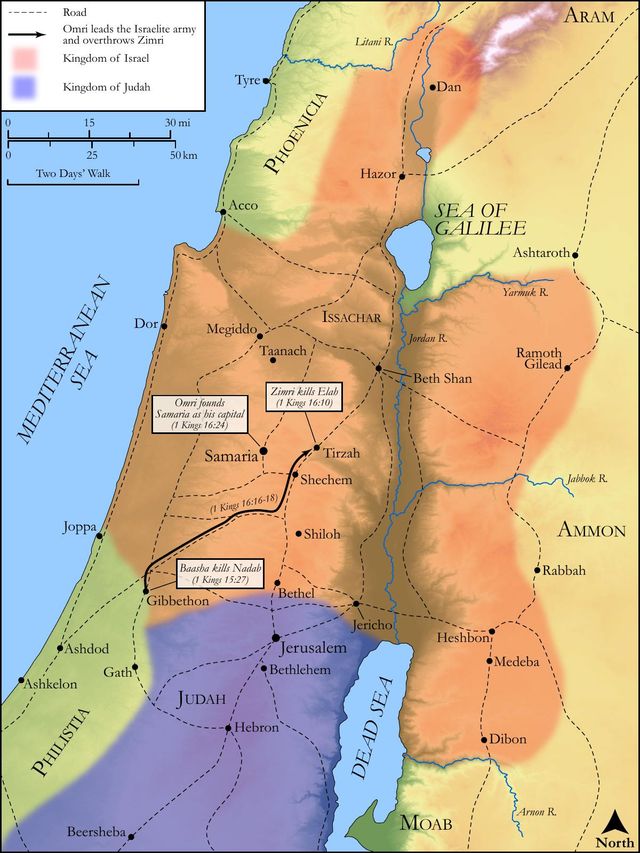
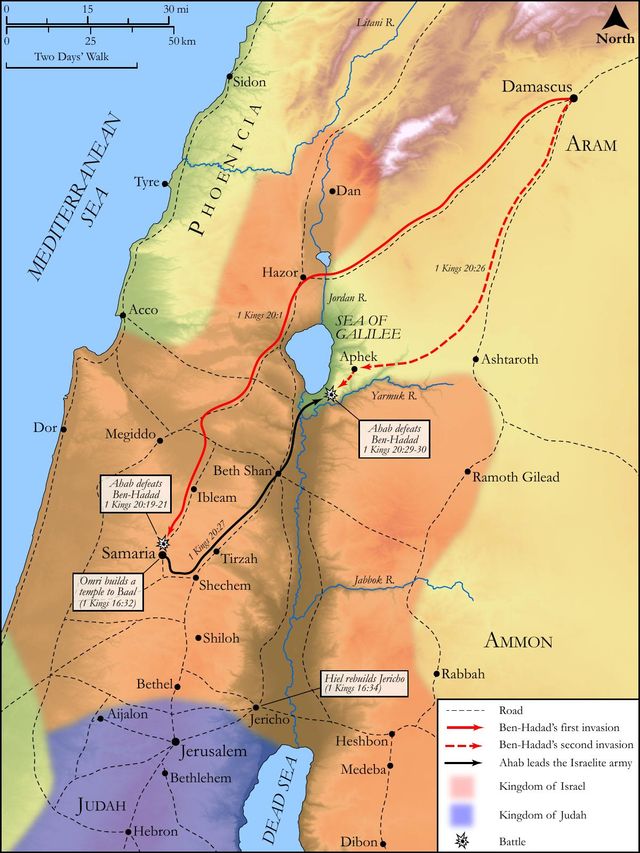
Study this verse
Public-domain commentary
Matthew Henry
From his Commentary on the Whole Bible. Henry comments on passages, not single verses — this entry covers 1 Kings 16:1–14. His four-level outline is real structure in the source text, so it is rendered as structure.
Here is, I. The ruin of the family of Baasha foretold. He was a man likely enough to have raised and established his family - active, politic, and daring; but he was an idolater, and this brought destruction upon his family.
1.God sent him warning of it before.
(1.)That, if he were thereby wrought upon to repent and reform, the ruin might be prevented; for God threatens, that he may not strike, as one that desires not the death of sinners.
(2.)That, if not, it might appear that the destruction when it did come, whoever might be instruments of it, was the act of God's justice and the punishment of sin.
2.The warning was sent by Jehu the son of Hanani. The father was a seer, or prophet, at the same time (Ch2 16:7), and was sent to Asa king of Judah; but the son, who was young and more active, was sent on this longer and more dangerous expedition to Baasha king of Israel. Juniores ad labores - Toil and adventure are for the young. This Jehu was a prophet and the son of a prophet. Prophecy, thus happily entailed, was worthy of so much the more honour. This Jehu continued long in his usefulness, for we find him reproving Jehoshaphat (Ch2 19:2) above forty years after, and writing the annals of that prince, Ch2 20:34. The message which this prophet brought to Baasha is much the same with that which Ahijah sent to Jeroboam by his wife.
(1.)He reminds Baasha of the great things God had done for him (Kg1 16:2): I exalted thee out of the dust to the throne of glory, a great instance of the divine sovereignty and power, Sa1 2:8. Baasha seemed to have raised himself by his own treachery and cruelty, yet there was a hand of Providence in it, to bring about God's counsel, concerning Jeroboam's house; and God's owning his advancement as his act and deed does by no means amount to the patronising of his ambition and treachery. It is God that puts power into bad men's hands, which he makes to serve his good purposes, notwithstanding the bad use they make of it. I made thee prince over my people. God calls Israel his people still, though wretchedly corrupted, because they retained the covenant of circumcision, and there were many good people among them; it was not till long after that they were called Loammi, not a people, Hos 1:9.
(2.)He charges him with high crimes and misdemeanours,
[1.]That he had caused Israel to sin, had seduced God's subjects from their allegiance and brought them to pay to dunghill-deities the homage due to him only, and herein he had walked in the way of Jeroboam (Kg1 16:2), and been like his house, Kg1 16:7.
[2.]That he had himself provoked God to anger with the work of his hands, that is, by worshipping images, the work of men's hands; though perhaps others made them, yet he served them and thereby avowed the making of them, and they are therefore called the work of his hands.
[3.]That he had destroyed the house of Jeroboam (Kg1 16:7), because he killed him, namely, Jeroboam's son and all his: if he had done that with an eye to God, to his will and glory, and from a holy indignation against the sins of Jeroboam and his house, he would have been accepted and applauded as a minister of God's justice; but, as he did it, he was only the tool of God's justice, but a servant to his own lusts, and is justly punished for the malice and ambition which actuated and governed him in all he did. Note, Those who are in any way employed in denouncing or executing the justice of God (magistrates or ministers) are concerned to do it from a good principle and in a holy manner, lest it turn into sin to them and they make themselves obnoxious by it.
(3.)He foretels the same destruction to come upon his family which he himself had been employed to bring upon the family of Jeroboam, Kg1 16:3, Kg1 16:4. Note, Those who resemble others in their sins may expect to resemble them in their plagues, especially those who seem zealous against such sins in others as they allow themselves in; the house of Jehu was reckoned with for the blood of the house of Ahab, Hos 1:4.
II.A reprieve granted for some time, so long that Baasha himself dies in peace, and is buried with honour in his own royal city (Kg1 16:6), so far is he from being a prey either to the dogs or to the fowls, which yet was threatened to his house, Kg1 16:4. He lives not either to see or feel the punishment threatened, yet he was himself the greatest delinquent. Certainly there must be a future state, in which impenitent sinners will suffer in their own persons, and not escape, as often they do in this world. Baasha died under no visible stroke of divine vengeance for aught that appears, but God laid up his iniquity for his children, as Job speaks, Job 21:19. Thus he often visits sin. Observe, Baasha is punished by the destruction of his children after his death, and his children are punished by the abuse of their bodies after their death; that is the only thing which the threatening specifies (Kg1 16:4), that the dogs and the fowls of the air should eat them, as if herein were designed a tacit intimation that there are punishments after death, when death has done its worst, which will be the sorest punishments and are most to be dreaded; these judgments on the body and posterity signified judgments on the soul when separated from the body, by him who, after he has killed, has power to cast into hell.
III.Execution done at last.
Baasha's son Elah, like Jeroboam's son Nadab, reigned two years, and then was slain by Zimri, one of his own soldiers, as Nadab was by Baasha; so like was his house made to that of Jeroboam, as was threatened, Kg1 16:3. Because his idolatry was like his, and one of the sins for which God contended with him being the destruction of Jeroboam's family, the more the destruction of his own resembled that, the nearer did the punishment resemble the sin, as face answers to face in a glass.
1.As then, so now, the king himself was first slain, but Elah fell more ingloriously than Nadab. Nadab was slain in the field of action and honour, he and his army then besieging Gibbethon (Kg1 15:27); but the siege being then raised upon that disaster, and the city remaining still in the Philistines' hands, the army of Israel was now renewing the attempt (Kg1 16:15) and Elah should have been with them to command in chief, but he loved his own ease and safety better than his honour or duty, or the public good, and therefore staid behind to take his pleasure; and, when he was drinking himself drunk in his servant's house, Zimri killed him, Kg1 16:9, Kg1 16:10. Let it be a warning to drunkards, especially to those who designedly drink themselves drunk, that they know not but death may surprise them in that condition.
(1.)Death comes easily upon men when they are drunk. Besides the chronic diseases which men frequently bring themselves into by hard drinking, and which cut them off in the midst of their days, men in that condition are more easily overcome by an enemy, as Amnon by Absalom, and are liable to more bad accidents, being unable to help themselves,
(2.)Death comes terribly upon men in that condition. Finding them in the act of sin, and incapacitated for any act of devotion, that day comes upon them unawares (Luk 21:34), like a thief.
2.As then, so now, the whole family was cut off, and rooted out. The traitor was the successor, to whom the unthinking people tamely submitted, as if it were all one to them what kind they had, so that they had one. The first thing Zimri did was to slay all the house of Baasha; thus he held by cruelty what he got by treason. His cruelty seems to have extended further than Baasha's did against the house of Jeroboam, for he left to Elah none of his kinsfolks or friends (Kg1 16:11), none of his avengers (so the word is), none that were likely to avenge his death; yet divine justice soon avenged it so remarkably that it was used as a proverb long after, Had Zimri peace who slew his master? Kg2 9:31. In this,
(1.)The word of God was fulfilled, Kg1 16:12.
(2.)The sins of Baasha and Elah were reckoned for, with which they provoked God by their vanities, Kg1 16:13. Their idols are called their vanities, for they cannot profit nor help. Miserable are those whose deities are vanities.
Historical interpretation
Historical reception
1 surviving comment on this verse from the historical church.
“Since I exalted you out of the dust and made you leader over my people Israel, and you have walked in the way of Jeroboam and have caused my people Israel to sin, provoking me to anger with their sins, therefore, I will consume the past actions of Baasha and the past actions of his house, and I will make your house like the house of Jeroboam son of Nebat. Anyone belonging to Baasha who dies in the city the dogs shall eat; and anyone of his who dies in the field the birds of the air shall eat.” These words were pronounced against all sinners, and especially against the pagans and the heretics. Indeed, those who always add new sins to their old sins and are depraved by the examples of evil become the greatest in their crimes. “I will cut off the past actions of Baasha,” [the Lord] says, “and the past actions of his house, and I will make your house like the house of Jeroboam son of Nebat.” The Lord cuts off the past actions of Baasha when he takes revenge on the sin of the wicked after the end of life. And he cuts off the past actions of his house when he condemns the inhabitants of that house to eternal torments. And he will make the house of Baasha like the house of Jeroboam son of Nabat when he gives the sinners who persevere in their iniquity to the torments of hell together with the devil and his angels. In fact, Baasha, as we have already said, is interpreted as “confusion” or “dryness,” Jeroboam as “he who divides the people,” and Nabat as “spontaneous.” Therefore, when one follows the confusions of errors and sinners and neglects the possibility of having a wife of spiritual grace, then his past actions will be cut off as those of the devil.
Continue studying 1 Kings 16:3 across the web’s major study libraries — every link below opens this exact verse, chapter, or book on the destination site.
Read & Compare
 BibleGatewayThis verse in more than 200 translations and 70 languages.
 Bible.comThe YouVersion reader — hundreds of translations, reading plans, and highlights.
 ESV.orgCrossway's official English Standard Version reader.
 NET BibleThe NET translation with 60,000+ translators' notes on every rendering decision.
 STEP BibleTyndale House's free study tool — original text, vocabulary, and scholarly resources.
 BibliaLogos Bible Software's free web reader.
 USCCBThe New American Bible (Revised Edition) with the U.S. bishops' study notes.
Commentaries
 BibleHub CommentariesDozens of classic commentaries on this verse, gathered on one page.
 StudyLightMore than 100 commentary sets — the largest collection on the web.
 BibleRefPlain-English commentary on what this verse means, verse by verse.
 Enduring WordDavid Guzik's free commentary on this chapter, widely used by Bible teachers.
 Bible Study ToolsVerse commentary alongside Greek and Hebrew study aids.
Original Language & Research
- BibleHub InterlinearThe verse word by word — original language, transliteration, and English.
- BibleHub LexiconEvery word's original-language definition and Strong's entry.
 Blue Letter BibleDeep-study tools — Strong's numbers, concordance, and word studies.
 SefariaThe Hebrew text with Rashi and centuries of Jewish commentary.
Sermons, Hymns & Audio


TrulyRandomVerse is not affiliated with these sites and doesn’t control their content. They’re linked because they’re genuinely useful.
Summary
This potent prophetic oracle, delivered by Jehu, son of Hanani, pronounces a severe divine judgment against King Baasha of Israel, decreeing the utter annihilation of his royal dynasty. The pronouncement explicitly declares that Baasha's house will suffer the identical devastating fate as that of Jeroboam, the previous king whose lineage was completely eradicated due to his egregious idolatry and his leading Israel into profound sin. This serves as a stark and uncompromising reminder of God's unwavering justice and the dire consequences of persistent rebellion, particularly when one has firsthand knowledge of prior divine retributions.
Context
ShowHideLiterary Context
This prophetic oracle from Jehu, son of Hanani, to King Baasha (1 Kings 16:1-4) marks a pivotal moment in the narrative of the divided kingdom. It immediately follows the account of Baasha's ascension to the throne, where he assassinated Nadab, son of Jeroboam, and subsequently wiped out Jeroboam's entire household, fulfilling the prophecy against Jeroboam's sin (1 Kings 15:29). Despite witnessing God's judgment firsthand and even being an instrument in its fulfillment, Baasha himself "walked in the way of Jeroboam, and in his sin wherewith he made Israel to sin" (1 Kings 16:2). This verse, therefore, is God's direct response to Baasha's continued apostasy, setting the stage for the swift and brutal fulfillment of this new judgment, as recorded just a few verses later with Zimri's conspiracy (1 Kings 16:8-12).
Historical & Cultural Context
The period of the Northern Kingdom of Israel was characterized by profound political instability, frequent coups, and a recurring cycle of idolatry and divine judgment. Kings often seized power through violence, only to perpetuate the very sins that brought down their predecessors. The "sin of Jeroboam"—the establishment of golden calves at Dan and Bethel and an unauthorized priesthood (1 Kings 12:28-33)—became the defining apostasy for subsequent Northern kings. The complete eradication of a royal house, including all male descendants, was a common and devastating form of judgment among the kings of that day, designed to prevent any future claim to the throne and to erase the condemned dynasty's memory and influence. This practice, while brutal, served as a stark public demonstration of divine justice and the consequences of violating covenant obligations.
Key Themes
ShowHideThe primary themes highlighted by this verse include Divine Justice and Retribution, underscoring God's unwavering commitment to hold leaders accountable for their actions, especially when they lead His people into idolatry and rebellion. It powerfully illustrates the Consequences of Persistent Sin, demonstrating that even after witnessing the downfall of others due to disobedience, choosing to continue in the same path inevitably invites severe divine wrath. The phrase "like the house of Jeroboam" establishes The Sin of Jeroboam as a Benchmark for wickedness and the standard for divine judgment in the Northern Kingdom. Finally, the pronouncement through the prophet Jehu emphasizes the Certainty of God's Prophetic Word, assuring that what God declares will surely come to pass, often with precise and swift fulfillment, as seen in the subsequent events of 1 Kings 16.
Exposition and Analysis
ShowHideKey Word Analysis
ShowHideThe Hebrew verb here conveys a strong sense of consumption, sweeping away, or utter removal, often implying destruction by fire or complete eradication. It is a powerful word indicating a definitive and destructive act of divine judgment, leaving nothing remaining of the condemned lineage. This is not a gradual decline but a swift, decisive, and annihilating act of God's wrath, reflecting the severity of Baasha's offenses.
This term, derived from a root meaning "hind part," refers to the descendants, offspring, or future generations. In this context, it specifically denotes the entire lineage or male heirs who would perpetuate the family name and royal succession. The repetition of "posterity of Baasha, and the posterity of his house" powerfully emphasizes the comprehensive nature of God's judgment: not merely Baasha's immediate children, but his entire dynastic line would be utterly cut off, preventing any future claim to the throne and ensuring the complete end of his royal legacy.
While literally meaning a physical dwelling, in this context, "house" (Hebrew bayith) functions as a metonym for the entire royal dynasty, family, or lineage. It encompasses the king, his immediate family, and all descendants who would have a claim to the throne. The phrase "posterity of his house" further solidifies this meaning, indicating that the judgment extends beyond Baasha himself to the very foundation and future of his ruling line, ensuring its complete and irreversible termination.
Verse Breakdown
ShowHide"Behold, I will take away the posterity of Baasha, and the posterity of his house;"
This opening declaration is a direct, authoritative divine judgment, introduced by the attention-grabbing "Behold." The use of the first-person pronoun "I" emphasizes God's personal initiative and sovereignty in executing this judgment. The repetition of "posterity" (or "descendants") underscores the totality of the impending destruction. It signifies not just the end of Baasha's reign, but the complete eradication of his family line, ensuring no male heir would survive to continue his dynasty. This was a common and devastating form of judgment in ancient monarchies, designed to erase the very memory and influence of the condemned ruler.
"and will make thy house like the house of Jeroboam the son of Nebat."
This clause provides the specific template for Baasha's judgment, serving as a powerful and ominous comparison. Jeroboam's house had been utterly destroyed due to his leading Israel into idolatry with the golden calves (1 Kings 14:10-11). By explicitly comparing Baasha's fate to Jeroboam's, God emphasizes the consistent nature of His justice and the severe consequences of persistent rebellion and idolatry in the Northern Kingdom. Baasha, despite witnessing Jeroboam's downfall and even participating in its fulfillment, had replicated his sins, thus incurring the same divine retribution. This comparison highlights a recurring pattern of judgment for unfaithful kings in Israel.
Literary Devices
ShowHideThe verse employs several potent literary devices to convey its message with divine authority and impact. It functions as a Prophetic Oracle, signaled by the direct divine declaration "Behold, I will take away..." which lends it absolute authority and certainty, indicating a pronouncement directly from God. A prominent device is Simile (or Analogy), found in the phrase "like the house of Jeroboam," which draws a direct comparison to a well-known historical precedent of divine judgment, instantly conveying the severity and comprehensive nature of Baasha's impending doom. This simile also contributes to the theme of Repetition in the broader narrative, as God's judgment follows a discernible pattern for those who lead His people astray. Furthermore, the repetition of "posterity... and the posterity of his house" serves as a form of Emphasis, underscoring the absolute and complete eradication of Baasha's lineage, leaving no doubt about the totality of the impending destruction.
Theological and Thematic Connections
ShowHideThis verse powerfully articulates God's unwavering commitment to justice and His absolute sovereignty over human history, particularly in the realm of kingship and national leadership. It demonstrates that God holds leaders to a higher standard, and their spiritual choices have profound consequences for themselves and the people they govern. The judgment on Baasha, mirroring that of Jeroboam, reveals a consistent divine pattern: persistent idolatry and leading God's people into sin will inevitably result in severe retribution, often involving the complete eradication of the offending dynasty. This reinforces the theological truth that God's covenant with Israel included blessings for obedience and curses for disobedience, and He remains faithful to His word, whether in promise or warning. The "sin of Jeroboam" became a tragic benchmark for apostasy in the Northern Kingdom, illustrating the cumulative nature of sin and the ultimate futility of establishing a kingdom apart from God's righteous standards.
Reflection and Application
ShowHideThis passage serves as a timeless and sobering warning about the nature of leadership, the gravity of spiritual rebellion, and the certainty of divine justice. For believers today, it highlights the profound accountability that comes with any position of influence, whether in family, church, or society. Those who lead are called to guide others in righteousness, and to lead them astray is to incur a greater judgment. The recurring pattern of sin and judgment in the Northern Kingdom, particularly Baasha's failure to learn from Jeroboam's downfall, challenges us to introspectively examine our own lives. Are we repeating patterns of disobedience, even after witnessing their destructive consequences in others or in history? This verse calls for a genuine turning away from anything that displeases God, emphasizing that true repentance involves a change of direction, not just a change of personnel. Ultimately, God's unwavering commitment to His word—both in warning and fulfillment—provides both comfort for the righteous who trust in His faithfulness and a sober warning for the disobedient, reminding us that His justice is sure and His character unchanging.
Questions for Reflection
ShowHideFAQ
ShowHideWhy was Baasha's judgment so severe, especially since he overthrew a wicked king?
ShowHideWhile Baasha's coup against Nadab (Jeroboam's son) initially seemed to fulfill prophecy and remove a wicked ruler, God's judgment on Baasha was not merely about his political actions but his spiritual rebellion. 1 Kings 16:2 explicitly states that Baasha "walked in the way of Jeroboam, and in his sin wherewith he made Israel to sin." Despite witnessing the devastating consequences of Jeroboam's idolatry, Baasha chose to perpetuate the same fundamental sin by maintaining the golden calves and leading the people away from true worship of Yahweh. God's judgment is not a reward for political expediency, but a response to covenant faithfulness. Baasha had the opportunity to learn from history and lead Israel back to the Lord, but he chose instead to continue the very idolatry that brought divine wrath, thus incurring the same severe retribution. The severity underscores God's intolerance for sin, especially when it involves leading His people astray and breaking His covenant.
Christ-Centered Fulfillment
ShowHideThe relentless cycle of sin, judgment, and the eradication of royal lines in the Old Testament, as seen in the judgment on Baasha and Jeroboam, profoundly underscores the inherent instability and corruption of human kingship and the desperate need for a perfect, eternal King. The repeated "taking away of posterity" points to the brokenness of humanity's lineage, tainted by sin from Adam onward, and the inability of any human king to establish a lasting, righteous kingdom. This narrative foreshadows the coming of the true King, Jesus Christ, who is the promised "seed" or "posterity" (Genesis 3:15; Galatians 3:16) who would not be taken away, but would establish an everlasting kingdom. Unlike Baasha or Jeroboam, who perpetuated sin and faced divine wrath, Jesus, the Lamb of God, perfectly fulfilled God's will, bore the judgment for all sin on the cross (2 Corinthians 5:21), and rose to secure an eternal, righteous reign. Through Him, believers are adopted into a new, spiritual "posterity" that will never be cut off, but will inherit eternal life and participate in His unshakeable kingdom (Hebrews 12:28).