


1 Kings 16:4
Bible text: King James Version (1769 Blayney text) · Public domain
Bible text: Berean Standard Bible · Public domain
Bible text: American Standard Version (1901) · Public domain
Bible text: World English Bible, Messianic edition · Public domain
Bible text: Geneva Bible (1599) · Public domain
Bible text: Young's Literal Translation · Public domain
- הַמֵּתha·Metthe [one who] diesH4191Art ¦ V-Qal-Prtcpl-msVerb Qal Participle Singular Masculine Absoluteהַtheמֵּת[one who] dies
- לְבַעְשָׁאle·va'·Sha'of BaashaH1201Prep-l ¦ N-proper-mNoun Proper MasculineלְofבַעְשָׁאBaasha
- בָּעִירba·'Irin the cityH5892Prep-b ¦ N-fsNoun Singular Feminine Absoluteבָּin theעִירcity
- יֹאכְלוּyo·khe·Luthey will devourH398V-Qal-Imperf-3mpVerb Qal Imperfect 3rd Plural Masculine
- הַכְּלָבִיםha·ke·la·Vimthe dogsH3611Art ¦ N-mpNoun Plural Masculine Absoluteהַtheכְּלָבִיםdogs
- וְהַמֵּתve·ha·Metand the [one who] diesH4191Conj-w ¦ Art ¦ V-Qal-Prtcpl-msVerb Qal Participle Singular Masculine Absoluteוְandהַtheמֵּת[one who] dies
- לוֹloof himPrep-l ¦ 3msSuffix Personal 3rd Singular Masculineלofוֹhim
- בַּשָּׂדֶהba·sa·Dehin the open countryH7704Prep-b ¦ N-msNoun Singular Masculine Absoluteבַּin theשָּׂדֶהopen country
- יֹאכְלוּyo·khe·Luthey will devourH398V-Qal-Imperf-3mpVerb Qal Imperfect 3rd Plural Masculine
- עוֹףof[the] bird[s] ofH5775N-mscNoun Singular Masculine Construct
- הַשָּׁמָיִםha·sha·Ma·yimthe heavensH8064Art ¦ N-mpNoun Plural Masculine Absoluteהַtheשָּׁמָיִםheavens
English is a literal word-by-word gloss of the Hebrew, not the KJV's wording. Why?
This is the original text the KJV's translators worked from — each Hebrew word with its own literal English meaning in this verse, prepared by scholars at Tyndale House, Cambridge. The KJV translates whole sentences, not word by word, so its wording differs: one Hebrew word can become several English words, and the KJV may choose “the LORD” where the gloss reads “Yahweh”. Both are faithful — they answer different questions. For the KJV's own rendering, switch to the KJV text.
Details
See on the biblical-era maps
Study this verse
Public-domain commentary
Matthew Henry
From his Commentary on the Whole Bible. Henry comments on passages, not single verses — this entry covers 1 Kings 16:1–14. His four-level outline is real structure in the source text, so it is rendered as structure.
Here is, I. The ruin of the family of Baasha foretold. He was a man likely enough to have raised and established his family - active, politic, and daring; but he was an idolater, and this brought destruction upon his family.
1.God sent him warning of it before.
(1.)That, if he were thereby wrought upon to repent and reform, the ruin might be prevented; for God threatens, that he may not strike, as one that desires not the death of sinners.
(2.)That, if not, it might appear that the destruction when it did come, whoever might be instruments of it, was the act of God's justice and the punishment of sin.
2.The warning was sent by Jehu the son of Hanani. The father was a seer, or prophet, at the same time (Ch2 16:7), and was sent to Asa king of Judah; but the son, who was young and more active, was sent on this longer and more dangerous expedition to Baasha king of Israel. Juniores ad labores - Toil and adventure are for the young. This Jehu was a prophet and the son of a prophet. Prophecy, thus happily entailed, was worthy of so much the more honour. This Jehu continued long in his usefulness, for we find him reproving Jehoshaphat (Ch2 19:2) above forty years after, and writing the annals of that prince, Ch2 20:34. The message which this prophet brought to Baasha is much the same with that which Ahijah sent to Jeroboam by his wife.
(1.)He reminds Baasha of the great things God had done for him (Kg1 16:2): I exalted thee out of the dust to the throne of glory, a great instance of the divine sovereignty and power, Sa1 2:8. Baasha seemed to have raised himself by his own treachery and cruelty, yet there was a hand of Providence in it, to bring about God's counsel, concerning Jeroboam's house; and God's owning his advancement as his act and deed does by no means amount to the patronising of his ambition and treachery. It is God that puts power into bad men's hands, which he makes to serve his good purposes, notwithstanding the bad use they make of it. I made thee prince over my people. God calls Israel his people still, though wretchedly corrupted, because they retained the covenant of circumcision, and there were many good people among them; it was not till long after that they were called Loammi, not a people, Hos 1:9.
(2.)He charges him with high crimes and misdemeanours,
[1.]That he had caused Israel to sin, had seduced God's subjects from their allegiance and brought them to pay to dunghill-deities the homage due to him only, and herein he had walked in the way of Jeroboam (Kg1 16:2), and been like his house, Kg1 16:7.
[2.]That he had himself provoked God to anger with the work of his hands, that is, by worshipping images, the work of men's hands; though perhaps others made them, yet he served them and thereby avowed the making of them, and they are therefore called the work of his hands.
[3.]That he had destroyed the house of Jeroboam (Kg1 16:7), because he killed him, namely, Jeroboam's son and all his: if he had done that with an eye to God, to his will and glory, and from a holy indignation against the sins of Jeroboam and his house, he would have been accepted and applauded as a minister of God's justice; but, as he did it, he was only the tool of God's justice, but a servant to his own lusts, and is justly punished for the malice and ambition which actuated and governed him in all he did. Note, Those who are in any way employed in denouncing or executing the justice of God (magistrates or ministers) are concerned to do it from a good principle and in a holy manner, lest it turn into sin to them and they make themselves obnoxious by it.
(3.)He foretels the same destruction to come upon his family which he himself had been employed to bring upon the family of Jeroboam, Kg1 16:3, Kg1 16:4. Note, Those who resemble others in their sins may expect to resemble them in their plagues, especially those who seem zealous against such sins in others as they allow themselves in; the house of Jehu was reckoned with for the blood of the house of Ahab, Hos 1:4.
II.A reprieve granted for some time, so long that Baasha himself dies in peace, and is buried with honour in his own royal city (Kg1 16:6), so far is he from being a prey either to the dogs or to the fowls, which yet was threatened to his house, Kg1 16:4. He lives not either to see or feel the punishment threatened, yet he was himself the greatest delinquent. Certainly there must be a future state, in which impenitent sinners will suffer in their own persons, and not escape, as often they do in this world. Baasha died under no visible stroke of divine vengeance for aught that appears, but God laid up his iniquity for his children, as Job speaks, Job 21:19. Thus he often visits sin. Observe, Baasha is punished by the destruction of his children after his death, and his children are punished by the abuse of their bodies after their death; that is the only thing which the threatening specifies (Kg1 16:4), that the dogs and the fowls of the air should eat them, as if herein were designed a tacit intimation that there are punishments after death, when death has done its worst, which will be the sorest punishments and are most to be dreaded; these judgments on the body and posterity signified judgments on the soul when separated from the body, by him who, after he has killed, has power to cast into hell.
III.Execution done at last.
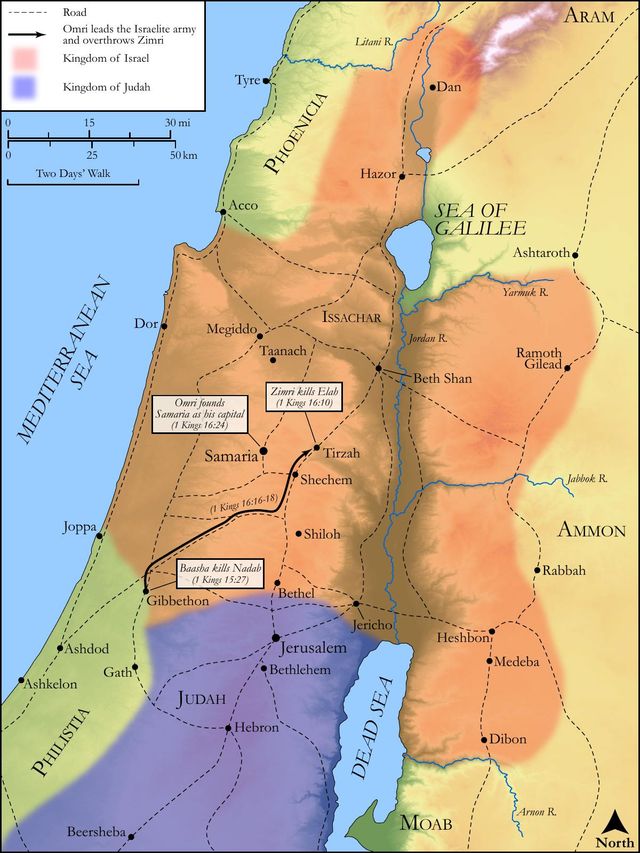
Baasha's son Elah, like Jeroboam's son Nadab, reigned two years, and then was slain by Zimri, one of his own soldiers, as Nadab was by Baasha; so like was his house made to that of Jeroboam, as was threatened, Kg1 16:3. Because his idolatry was like his, and one of the sins for which God contended with him being the destruction of Jeroboam's family, the more the destruction of his own resembled that, the nearer did the punishment resemble the sin, as face answers to face in a glass.
1.As then, so now, the king himself was first slain, but Elah fell more ingloriously than Nadab. Nadab was slain in the field of action and honour, he and his army then besieging Gibbethon (Kg1 15:27); but the siege being then raised upon that disaster, and the city remaining still in the Philistines' hands, the army of Israel was now renewing the attempt (Kg1 16:15) and Elah should have been with them to command in chief, but he loved his own ease and safety better than his honour or duty, or the public good, and therefore staid behind to take his pleasure; and, when he was drinking himself drunk in his servant's house, Zimri killed him, Kg1 16:9, Kg1 16:10. Let it be a warning to drunkards, especially to those who designedly drink themselves drunk, that they know not but death may surprise them in that condition.
(1.)Death comes easily upon men when they are drunk. Besides the chronic diseases which men frequently bring themselves into by hard drinking, and which cut them off in the midst of their days, men in that condition are more easily overcome by an enemy, as Amnon by Absalom, and are liable to more bad accidents, being unable to help themselves,
(2.)Death comes terribly upon men in that condition. Finding them in the act of sin, and incapacitated for any act of devotion, that day comes upon them unawares (Luk 21:34), like a thief.
2.As then, so now, the whole family was cut off, and rooted out. The traitor was the successor, to whom the unthinking people tamely submitted, as if it were all one to them what kind they had, so that they had one. The first thing Zimri did was to slay all the house of Baasha; thus he held by cruelty what he got by treason. His cruelty seems to have extended further than Baasha's did against the house of Jeroboam, for he left to Elah none of his kinsfolks or friends (Kg1 16:11), none of his avengers (so the word is), none that were likely to avenge his death; yet divine justice soon avenged it so remarkably that it was used as a proverb long after, Had Zimri peace who slew his master? Kg2 9:31. In this,
(1.)The word of God was fulfilled, Kg1 16:12.
(2.)The sins of Baasha and Elah were reckoned for, with which they provoked God by their vanities, Kg1 16:13. Their idols are called their vanities, for they cannot profit nor help. Miserable are those whose deities are vanities.
Historical interpretation
Historical reception
1 surviving comment on this verse from the historical church.
“Since I exalted you out of the dust and made you leader over my people Israel, and you have walked in the way of Jeroboam and have caused my people Israel to sin, provoking me to anger with their sins, therefore, I will consume the past actions of Baasha and the past actions of his house, and I will make your house like the house of Jeroboam son of Nebat. Anyone belonging to Baasha who dies in the city the dogs shall eat; and anyone of his who dies in the field the birds of the air shall eat.” These words were pronounced against all sinners, and especially against the pagans and the heretics. Indeed, those who always add new sins to their old sins and are depraved by the examples of evil become the greatest in their crimes. “I will cut off the past actions of Baasha,” [the Lord] says, “and the past actions of his house, and I will make your house like the house of Jeroboam son of Nebat.” The Lord cuts off the past actions of Baasha when he takes revenge on the sin of the wicked after the end of life. And he cuts off the past actions of his house when he condemns the inhabitants of that house to eternal torments. And he will make the house of Baasha like the house of Jeroboam son of Nabat when he gives the sinners who persevere in their iniquity to the torments of hell together with the devil and his angels. In fact, Baasha, as we have already said, is interpreted as “confusion” or “dryness,” Jeroboam as “he who divides the people,” and Nabat as “spontaneous.” Therefore, when one follows the confusions of errors and sinners and neglects the possibility of having a wife of spiritual grace, then his past actions will be cut off as those of the devil.
Continue studying 1 Kings 16:4 across the web’s major study libraries — every link below opens this exact verse, chapter, or book on the destination site.
Read & Compare
 BibleGatewayThis verse in more than 200 translations and 70 languages.
 Bible.comThe YouVersion reader — hundreds of translations, reading plans, and highlights.
 ESV.orgCrossway's official English Standard Version reader.
 NET BibleThe NET translation with 60,000+ translators' notes on every rendering decision.
 STEP BibleTyndale House's free study tool — original text, vocabulary, and scholarly resources.
 BibliaLogos Bible Software's free web reader.
 USCCBThe New American Bible (Revised Edition) with the U.S. bishops' study notes.
Commentaries
 BibleHub CommentariesDozens of classic commentaries on this verse, gathered on one page.
 StudyLightMore than 100 commentary sets — the largest collection on the web.
 BibleRefPlain-English commentary on what this verse means, verse by verse.
 Enduring WordDavid Guzik's free commentary on this chapter, widely used by Bible teachers.
 Bible Study ToolsVerse commentary alongside Greek and Hebrew study aids.
Original Language & Research
- BibleHub InterlinearThe verse word by word — original language, transliteration, and English.
- BibleHub LexiconEvery word's original-language definition and Strong's entry.
 Blue Letter BibleDeep-study tools — Strong's numbers, concordance, and word studies.
 SefariaThe Hebrew text with Rashi and centuries of Jewish commentary.
Sermons, Hymns & Audio


TrulyRandomVerse is not affiliated with these sites and doesn’t control their content. They’re linked because they’re genuinely useful.
Summary
This verse pronounces a severe divine judgment against King Baasha of Israel, delivered through the prophet Jehu, son of Hanani. It foretells a gruesome end for Baasha's dynasty, where those who die in the city will be consumed by dogs, and those who perish in the fields will be devoured by birds of prey. This prophecy underscores God's unwavering justice against idolatry and disobedience, mirroring previous judgments against wicked kings and highlighting the profound disgrace associated with an unburied, scavenged corpse in Israel.
Context
ShowHideLiterary Context
This prophecy in 1 Kings 16:4 is an integral part of a larger divine pronouncement against King Baasha, found in 1 Kings 16:1-7. The prophet Jehu, son of Hanani, is divinely commissioned to deliver this message, specifically because Baasha "did evil in the sight of the LORD, and walked in the way of Jeroboam, and in his sin wherewith he made Israel to sin" (1 Kings 16:2). The verses immediately preceding this judgment detail God's sovereign elevation of Baasha from obscurity to kingship and his subsequent profound failure to remain faithful. Instead, Baasha perpetuated the idolatrous practices initiated by Jeroboam, the first king of Israel, thereby leading the nation further into sin. The swift and brutal fulfillment of this grim prophecy is recorded shortly thereafter in 1 Kings 16:11-12, when Zimri conspires against Elah, Baasha's son, and utterly destroys Baasha's entire household, leaving no male survivor, precisely as prophesied.
Historical & Cultural Context
In Israel, a proper burial was of paramount importance, signifying respect, honor, and a peaceful rest for the deceased. It was a fundamental human right and a social expectation, deeply intertwined with cultural and religious beliefs about dignity in death. To be left unburied and exposed to scavengers like dogs and birds was considered the ultimate curse, a profound disgrace, and a clear sign of divine abandonment and utter contempt. Such a fate was typically reserved for the most heinous criminals or those under a severe divine judgment, marking them as utterly rejected by both God and society. Kings, in particular, were expected to receive elaborate and honorable burials, making this prophecy against Baasha's house a stark and humiliating reversal of expected royal treatment. This cultural understanding amplifies the severity and ignominy of the judgment pronounced against Baasha and his descendants, marking them as utterly rejected by God and society.
Key Themes
ShowHideThe central themes woven through this verse and its immediate context include Divine Judgment and Retribution, particularly against unfaithful leadership. God's active involvement in the affairs of kings is profoundly evident, demonstrating His absolute sovereignty and justice in holding even powerful rulers accountable for their actions and their influence on the nation. The recurring pattern of Idolatry and its Consequences is also prominently displayed; Baasha's sin is explicitly linked to that of Jeroboam, highlighting the persistent spiritual infidelity of the Northern Kingdom and the severe repercussions for turning away from the Lord. Furthermore, the theme of Disgraceful Death underscores the cultural significance of proper burial and the ultimate humiliation of being denied it, serving as a powerful visual of divine curse. This judgment also reinforces the Certainty of God's Word, as the prophecy is delivered and then swiftly and completely fulfilled, demonstrating the reliability of divine pronouncements throughout the book of 1 Kings.
Exposition and Analysis
ShowHideKey Word Analysis
ShowHideThis primitive root signifies not only physical cessation of life but also, in a causative sense, to kill. In this context, it emphasizes the inevitability and finality of the judgment, indicating that the demise of Baasha's lineage is a divinely ordained event, leading to a state of utter lifelessness and vulnerability.
From an unused root meaning to yelp or attack, this term refers to wild, scavenging dogs. In Israel, these animals were not revered companions but often despised scavengers that roamed cities, feeding on refuse and carrion. To be eaten by dogs was a deeply humiliating and disgraceful end, signifying a lack of proper burial and a state of utter abandonment and contempt, both human and divine. This imagery evokes a sense of defilement and utter rejection.
Derived from a root meaning "to fly," this term refers collectively to birds, specifically birds of prey or scavengers, such as vultures or ravens. Like dogs, these birds consumed carrion, and to be left unburied in the open fields for them to devour was an equally abhorrent and shameful fate. It emphasized the complete absence of respect for the deceased and the severity of the divine curse upon them, denying them any peace or dignity in death.
Verse Breakdown
ShowHide"Him that dieth of Baasha in the city shall the dogs eat;"
This clause specifies the grim fate awaiting those belonging to Baasha's lineage who perish within the urban confines. The mention of "dogs" immediately conveys a sense of desecration and public humiliation. It implies that their bodies will be left unburied, exposed to the elements and to scavenging animals, a fate considered the ultimate disgrace in ancient Israelite society, signifying divine judgment and utter rejection by both God and man.
"and him that dieth of his in the fields shall the fowls of the air eat."
This parallel clause extends the comprehensive judgment to those of Baasha's house who perish outside the city, in the open country. The "fowls of the air" (birds of prey) serve the same function as the dogs in the city – they are scavengers that consume unburied corpses. This detail emphasizes the pervasive nature of the judgment, ensuring that no matter where Baasha's descendants die, their end will be one of profound disgrace and public ignominy, a clear and inescapable sign of God's severe and comprehensive judgment against their house.
Literary Devices
ShowHideThe verse employs several powerful literary devices to convey its message of severe judgment. Parallelism is strikingly evident in the two clauses, "Him that dieth of Baasha in the city shall the dogs eat; and him that dieth of his in the fields shall the fowls of the air eat." This balanced structure not only enhances the poetic quality but also emphasizes the comprehensive and inescapable nature of the judgment, covering all locations and ensuring a universal disgraceful end for Baasha's house. Imagery is central, painting a vivid and gruesome picture of bodies left unburied and consumed by scavengers. This stark imagery is not merely descriptive but deeply symbolic, representing the ultimate curse, divine abandonment, and utter defilement. The use of Synecdoche can also be observed, where "dogs" and "fowls of the air" represent the broader concept of utter defilement and the denial of a proper burial, which was culturally understood as the greatest indignity. Finally, the verse functions as a Prophecy, a divinely inspired declaration of future events, highlighting God's sovereign control over history and His unwavering commitment to justice.
Theological and Thematic Connections
ShowHideThis verse powerfully illustrates God's unwavering justice and His active involvement in the affairs of human rulers. It underscores the profound consequences of disobedience and idolatry, particularly for those in positions of leadership who lead others astray. The judgment against Baasha's house serves as a stark reminder that God holds individuals accountable for their actions, and that persistent rebellion against His commands, especially through false worship and the leading of His people into sin, will inevitably lead to severe divine retribution. This pattern of judgment against unfaithful kings is a recurring theme throughout the Old Testament, emphasizing God's covenant faithfulness even as He punishes sin. The disgraceful nature of the death highlights the depth of God's displeasure and the utter rejection of those who defiantly turn from Him, serving as a solemn warning against spiritual apostasy and unrighteous leadership.
Reflection and Application
ShowHideThe grim prophecy against Baasha's house in 1 Kings 16:4 offers profound lessons for believers today. It serves as a powerful reminder that God is a God of justice who holds all people, especially those in positions of authority, accountable for their actions. Our choices, particularly regarding our faithfulness to God and our rejection of idolatry, have far-reaching consequences, not only for ourselves but potentially for those who follow us and for the spiritual health of our communities. This passage challenges us to examine our own lives: Are we walking in obedience to God's commands, or are we, like Baasha, succumbing to the temptations of the world and leading others astray through our compromises or indifference? It compels us to consider the seriousness of sin, especially spiritual infidelity and the pursuit of false gods (whether literal idols or modern-day substitutes like power, wealth, or self-gratification), and to recognize that God's patience, though vast, is not endless. Ultimately, it calls us to a life of humble submission and unwavering devotion to the one true God, trusting in His justice and seeking His boundless mercy through Christ.
Questions for Reflection
ShowHideFAQ
ShowHideWhy was this specific type of death (being eaten by dogs and fowls) considered such a severe judgment in ancient times?
ShowHideIn Israel, a proper burial was considered a sacred and essential rite, signifying respect for the deceased and ensuring their peaceful rest and honor in the community. To be denied burial and left exposed for scavengers like dogs and birds of prey was the ultimate disgrace and a profound curse. It symbolized complete abandonment by both God and man, a public declaration of the deceased's wickedness, and the denial of any honor or dignity in death. This fate was often associated with the most heinous crimes or severe divine disfavor, making it a particularly potent and humiliating form of judgment. It was a visible and horrifying sign of God's utter rejection of Baasha's house due to their persistent idolatry and sin, serving as a deterrent and a stark warning to others.
Christ-Centered Fulfillment
ShowHideWhile 1 Kings 16:4 speaks of the gruesome judgment upon Baasha's house for their sin and idolatry, its Christ-centered fulfillment points not to a similar physical judgment for believers, but to the ultimate judgment on sin itself, which Jesus Christ bore on the cross. The disgrace and exposure of Baasha's descendants foreshadow, in a paradoxical way, the shame and curse that Christ willingly took upon Himself. He became a curse for us, as Galatians 3:13 states, bearing the full weight of divine wrath against sin, a wrath that would otherwise lead to spiritual death and eternal separation from God. Unlike Baasha's house, whose bodies were left to scavengers, Jesus' body, though crucified and exposed to public shame, was not left to decay or be consumed by animals. Rather, He was buried and, most significantly, raised from the dead, conquering death and the grave (1 Corinthians 15:3-4). Through His perfect sacrifice, believers are spared the ultimate judgment and disgrace of sin, receiving instead the promise of eternal life and a glorious resurrection, where our bodies will be transformed, no longer subject to decay or the curses of this fallen world (Philippians 3:20-21). Thus, the judgment on Baasha's house highlights the severity of sin and the certainty of divine justice, while Christ's work on the cross demonstrates God's perfect justice and His boundless mercy in providing a way of escape from sin's ultimate, eternal consequences.