


1 Kings 15:30
- עַל'alonH5921PrepPreposition
- חַטֹּאותcha·Tot[the] sins ofH2403N-fpcNoun Plural Feminine Construct
- יָרָבְעָםya·ra·ve·'AmJeroboamH3379N-proper-mNoun Proper Masculine
- אֲשֶׁר'a·SherwhichH834RelParticle Relative
- חָטָאcha·Ta'he sinnedH2398V-Qal-Perf-3msVerb Qal Perfect 3rd Singular Masculine
- וַאֲשֶׁרva·'a·Sherand whichH834Conj-w ¦ RelParticle Relativeוַandאֲשֶׁרwhich
- הֶחֱטִיאhe·che·Ti'he caused to sinH2398V-Hiphil-Perf-3msVerb Hiphil Perfect 3rd Singular Masculine
- אֶת'et<obj.>H853DirObjMParticle Object Indicator
- יִשְׂרָאֵלYis·ra·'ElIsraelH3478N-properNoun Proper Location
- בְּכַעְסוֹbe·kha'·Soby his provocationH3708Prep-b ¦ N-msc ¦ 3msNoun Singular Masculine Constructבְּbyכַעְסprovocationוֹhis
- אֲשֶׁר'a·SherwhichH834RelParticle Relative
- הִכְעִיסhikh·'Ishe provoked to angerH3707V-Hiphil-Perf-3msVerb Hiphil Perfect 3rd Singular Masculine
- אֶת'et<obj.>H853DirObjMParticle Object Indicator
- יְהוָהYah·wehYahwehH3068N-properNoun Proper Title
- אֱלֹהֵי'e·lo·Hei[the] God ofH430N-mpcNoun Plural Masculine Construct
- יִשְׂרָאֵלYis·ra·'ElIsraelH3478N-properNoun Proper Location
English is a literal word-by-word gloss of the Hebrew, not the KJV's wording. Why?
This is the original text the KJV's translators worked from — each Hebrew word with its own literal English meaning in this verse, prepared by scholars at Tyndale House, Cambridge. The KJV translates whole sentences, not word by word, so its wording differs: one Hebrew word can become several English words, and the KJV may choose “the LORD” where the gloss reads “Yahweh”. Both are faithful — they answer different questions. For the KJV's own rendering, switch to the KJV text.
Details
See on the biblical-era map

Study this verse
Public-domain commentary
Matthew Henry
From his Commentary on the Whole Bible. Henry comments on passages, not single verses — this entry covers 1 Kings 15:25–34.
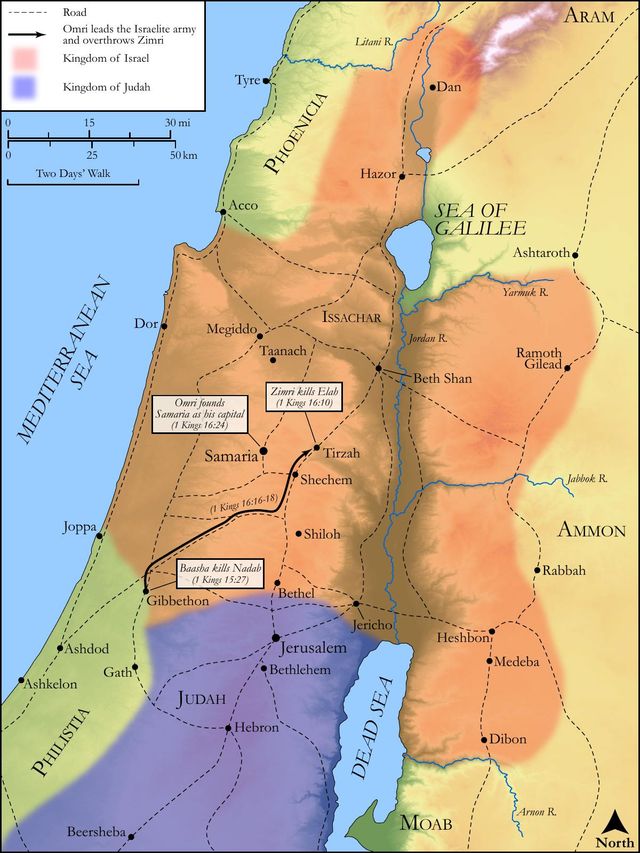
We are now to take a view of the miserable state of Israel, while the kingdom of Judah was happy under Asa's good government. It was threatened that they should be as a reed shaken in the water (Kg1 14:15), and so they were, when, during the single reign of Asa, the government of their kingdom was in six or seven different hands, as we find in this and the following chapter. Jeroboam was upon the throne in the beginning of his reign and Ahab at the end of it, and between them were Nadab, Baasha, Elah, Zimri, Tibni, and Omri, undermining and destroying one another. This they got by deserting the house both of God and of David. Here we have, 1. The ruin and extirpation of the family of Jeroboam, according to the word of the Lord by Ahijah. His son Nadab succeeded him. If the death of his brother Abijah had had a due influence upon him to make him religious, and the honour done him at his death had engaged him to follow his good example, his reign might have been long and glorious; but he walked in the way of his father (Kg1 15:26), kept up the worship of his calves, and forbade his subjects to go up to Jerusalem to worship, sinned and made Israel to sin, and therefore God brought ruin upon him quickly, in the second year of his reign. He was besieging Gibbethon, a city which the Philistines had taken from the Danites, and was endeavouring to re-take it; and there, in the midst of his army, did Baasha, with others, conspire against him and kill him, (Kg1 15:27), and so little interest had he in the affections of his people that his army did not only not avenge his death, but chose his murderer for his successor. Whether Baasha did it upon a personal pique against Nadab, or to be avenged on the house of Jeroboam for some affront received from them, or whether under pretence of freeing his country from the tyranny of a bad prince, or whether merely from a principle of ambition, to make way for himself to the throne, does not appear; but he slew him and reigned in his stead, Kg1 15:28. And the first thing he did when he came to the crown was to cut off all the house of Jeroboam, that he might the better secure himself and his own usurped government. He thought it not enough to imprison or banish them, but he destroyed them, left not only no males (as was foretold, Kg1 14:10), but none that breathed. Herein he was barbarous, but God was righteous. Jeroboam's sin was punished (Kg1 15:30); for those that provoke God do it to their own confusion; see Jer 7:19. Ahijah's prophecy was accomplished (Kg1 15:29); for no word of God shall fall to the ground. Divine threatenings are not bugbears. 2. The elevation of Baasha. He shall be tried awhile, as Jeroboam was. Twenty-four years he reigned (Kg1 15:33), but showed that it was not from any dislike to Jeroboam's sin that he destroyed his family, but from malice and ambition; for, when he had rooted out the sinner, he himself clave to the sin, and walked in the way of Jeroboam (Kg1 15:34), though he had seen the end of that way; so strangely was his heart hardened with the deceitfulness of sin.
Continue studying 1 Kings 15:30 across the web’s major study libraries — every link below opens this exact verse, chapter, or book on the destination site.
Read & Compare
 BibleGatewayThis verse in more than 200 translations and 70 languages.
 Bible.comThe YouVersion reader — hundreds of translations, reading plans, and highlights.
 ESV.orgCrossway's official English Standard Version reader.
 NET BibleThe NET translation with 60,000+ translators' notes on every rendering decision.
 STEP BibleTyndale House's free study tool — original text, vocabulary, and scholarly resources.
 BibliaLogos Bible Software's free web reader.
 USCCBThe New American Bible (Revised Edition) with the U.S. bishops' study notes.
Commentaries
 BibleHub CommentariesDozens of classic commentaries on this verse, gathered on one page.
 StudyLightMore than 100 commentary sets — the largest collection on the web.
 BibleRefPlain-English commentary on what this verse means, verse by verse.
 Enduring WordDavid Guzik's free commentary on this chapter, widely used by Bible teachers.
 Bible Study ToolsVerse commentary alongside Greek and Hebrew study aids.
Original Language & Research
- BibleHub InterlinearThe verse word by word — original language, transliteration, and English.
- BibleHub LexiconEvery word's original-language definition and Strong's entry.
 Blue Letter BibleDeep-study tools — Strong's numbers, concordance, and word studies.
 SefariaThe Hebrew text with Rashi and centuries of Jewish commentary.
Sermons, Hymns & Audio


TrulyRandomVerse is not affiliated with these sites and doesn’t control their content. They’re linked because they’re genuinely useful.
Summary
This pivotal verse, 1 Kings 15:30, serves as the divine explanation for the swift and utter destruction of King Nadab and the entire dynastic line of Jeroboam, the inaugural king of the Northern Kingdom of Israel. It unequivocally attributes this catastrophic judgment to the pervasive and institutionalized sins initiated by Jeroboam, particularly his leading of the nation into idolatry, which profoundly provoked the righteous anger of the LORD God of Israel. The verse highlights the severe consequences of spiritual rebellion, especially when perpetrated by those in leadership who cause an entire people to stray from divine covenant.
Context
ShowHideLiterary Context
This verse is strategically placed within the historical account of the divided monarchy, specifically detailing the tumultuous reign of Nadab, son of Jeroboam, in the Northern Kingdom of Israel. Immediately preceding it, 1 Kings 15:29 recounts the violent overthrow and complete eradication of Jeroboam's house by Baasha, fulfilling the prophecy delivered by the prophet Ahijah in 1 Kings 14:7-11. Verse 30 functions as the divine commentary, providing the theological rationale for this devastating judgment. It clarifies that the destruction was not a mere political coup but a direct, righteous consequence of Jeroboam's deep-seated rebellion and his leading of Israel into widespread apostasy, thereby linking the immediate historical event to the overarching divine narrative of covenant faithfulness and judgment. The narrative flow in 1 Kings consistently ties the fate of Israel's kings and their dynasties to their faithfulness (or unfaithfulness) to the LORD.
Historical & Cultural Context
Jeroboam I, the first king of the Northern Kingdom of Israel, established his reign by politically and religiously fracturing the unified kingdom. Fearing that continued worship at the temple in Jerusalem would lead his people back to the Davidic dynasty in Judah, he instituted alternative worship centers at Dan and Bethel. At these sites, he set up golden calves, declaring them to be the gods who brought Israel out of Egypt (1 Kings 12:28). This act was a deliberate syncretism, blending Israelite Yahwism with Canaanite idolatry, and a direct violation of the Mosaic covenant, particularly the First and Second Commandments (Exodus 20:3-6). By institutionalizing this idolatry and appointing non-Levitical priests, Jeroboam fundamentally altered the religious landscape of Israel, setting a precedent of apostasy that profoundly influenced subsequent kings and contributed to the nation's spiritual decline. This context reveals the profound challenge to the uniqueness of Yahweh worship in ancient Israel.
Key Themes
ShowHide1 Kings 15:30 powerfully underscores several enduring theological themes. First, it highlights the Gravity of Idolatry, revealing God's absolute intolerance for any form of worship that deviates from His prescribed ways. Jeroboam's sin was not merely personal; it was a public, institutionalized affront to God, leading an entire nation into spiritual adultery. Second, the phrase "which he made Israel sin" emphasizes the profound Leadership Responsibility. Leaders, especially kings, bear immense spiritual weight, and their choices have far-reaching consequences, not just for themselves but for those they govern. Jeroboam's actions set a dangerous spiritual precedent that plagued the Northern Kingdom for centuries, as seen in the recurring condemnation of subsequent kings who "walked in the ways of Jeroboam" (1 Kings 16:2). Finally, the verse powerfully demonstrates Divine Justice and Prophecy Fulfilled. The destruction of Jeroboam's house is presented as a direct, righteous judgment, confirming God's unwavering faithfulness to His prophetic word, whether in warning or in execution, as initially pronounced by Ahijah (1 Kings 14:10-11). This verse encapsulates a core message of the Deuteronomistic History, which frames Israel's story as a cycle of obedience and blessing, or disobedience and judgment.
Exposition and Analysis
ShowHideKey Word Analysis
ShowHideThis noun (H2403) refers to an offense, often indicating habitual sinfulness, and encompasses its penalty, occasion, or expiation. In Jeroboam's case, it refers to his widespread and pervasive acts of rebellion against God's covenant, particularly his establishment of idolatrous worship, which constituted a fundamental deviation from the LORD's commands. These "sins" were not isolated incidents but a foundational pattern of spiritual rebellion.
This verb (H2398), when used in the Hiphil (causative) stem as it is here, means "to cause to sin," "to lead astray," or "to entice into sin." This grammatical form powerfully emphasizes Jeroboam's active and deliberate role in leading the entire nation of Israel into apostasy. He didn't merely fall short himself; he engineered a system that encouraged and even compelled the people to participate in idolatry, thereby bearing a greater culpability for their collective transgression.
This noun (H3708) denotes vexation, grief, anger, or indignation. When used in relation to God, as here, it describes the profound displeasure and righteous wrath aroused by human rebellion and idolatry. Jeroboam's establishment of false worship, in direct defiance of the LORD's commands and covenant, was an act of extreme insolence and spiritual infidelity that deeply offended God's holiness and sovereignty, stirring His righteous anger.
Verse Breakdown
ShowHide"Because of the sins of Jeroboam which he sinned"
This initial clause establishes the direct causal link between Jeroboam's personal transgressions and the subsequent divine judgment. It emphasizes that the root of the catastrophe lies squarely with Jeroboam's own choices and actions, particularly his abandonment of the true worship of the LORD and his initiation of a rival religious system. His personal culpability is foundational to the unfolding judgment.
"and which he made Israel sin"
This crucial addition highlights the expansive and devastating impact of Jeroboam's leadership. His sin was not confined to himself; he actively engineered a religious system that led the entire Northern Kingdom into idolatry and apostasy. This underscores the immense responsibility of leaders, whose choices can have profound and lasting spiritual consequences for those under their influence, extending the reach of their sin far beyond their own person.
"by his provocation wherewith he provoked the LORD God of Israel to anger"
This final clause identifies the specific nature and consequence of Jeroboam's actions. His "provocation" refers to his deliberate and persistent defiance of God's commands, especially his institutionalization of calf worship at Dan and Bethel. This act of spiritual rebellion and idolatry was a direct affront to God's holiness and covenant, stirring His righteous indignation and ultimately leading to the judgment against his dynasty. It underscores that God's anger is not capricious but a just response to defiant unfaithfulness.
Literary Devices
ShowHideThe verse effectively employs several literary devices to convey its powerful theological message. The most prominent is Causality, as the entire statement functions as a divine explanation, directly linking the destruction of Jeroboam's house to his specific sins. The opening phrase "Because of the sins..." clearly establishes this cause-and-effect relationship, underscoring God's righteous judgment as a direct consequence of human action. There is also a powerful Repetition or Emphasis in the use of "sinned" and "made Israel sin," and "provocation" and "provoked," which intensifies the culpability of Jeroboam. This linguistic reinforcement highlights both his personal transgression and his active, causative role in leading others astray, magnifying the gravity of his offenses. Furthermore, the phrase "provoked the LORD God of Israel to anger" utilizes Anthropomorphism, attributing human emotion (anger) to God. This device helps human readers grasp the depth of God's displeasure and His righteous indignation against idolatry and rebellion, making His response more relatable while still preserving His divine nature and perfect justice.
Theological and Thematic Connections
ShowHideThis verse profoundly articulates the theological principle of divine retribution for covenant infidelity, particularly when compounded by leadership that leads an entire nation into apostasy. It underscores God's unwavering holiness and His demand for exclusive worship, demonstrating that He will not tolerate rivals to His glory. Jeroboam's institutionalized idolatry was not merely a political maneuver but a direct assault on the covenant relationship between the LORD and Israel, a spiritual adultery that deeply grieved and angered the divine Husband. The swift and total destruction of his dynasty serves as a stark warning about the gravity of sin, the ripple effect of unrighteous leadership, and the certainty of God's righteous judgment against those who defiantly turn from Him and cause others to stumble. This principle resonates throughout biblical history, affirming God's justice and His faithfulness to His declared word.
Reflection and Application
ShowHideThe historical account of Jeroboam's downfall, as explained in this verse, offers profound and timeless lessons for contemporary believers. It compels us to examine our own lives for any "golden calves"—anything that subtly or overtly competes for the supreme allegiance and worship due to God alone. This could manifest as excessive devotion to career, possessions, relationships, or even self-image, allowing these things to shape our identity and decisions more than God's word. Furthermore, the verse serves as a sober reminder of the immense responsibility that accompanies any form of leadership, whether in the church, family, workplace, or community. Our actions and decisions, especially those that influence others, carry spiritual weight and can either lead people closer to God or cause them to stumble. Ultimately, this passage calls us to vigilance, humility, and unwavering faithfulness, trusting in God's justice while striving to live lives that honor Him and point others towards His truth, recognizing that true flourishing comes only from undivided devotion to the LORD.
Questions for Reflection
ShowHideFAQ
ShowHideWhat was Jeroboam's primary sin, and why was it so offensive to God?
ShowHideJeroboam's primary and most egregious sin was the establishment of alternative worship centers at Dan and Bethel, where he set up golden calves for the people to worship, instructing them that these were the gods who brought Israel out of Egypt (1 Kings 12:28-30). This act was a direct and flagrant violation of the First and Second Commandments (Exodus 20:3-6), which forbid having other gods before the LORD and making graven images for worship. It was offensive to God because it represented a deliberate rejection of His exclusive sovereignty, His covenant faithfulness, and His prescribed means of worship. By institutionalizing idolatry, Jeroboam not only sinned personally but also actively led the entire nation into spiritual apostasy, thereby provoking the LORD God of Israel to anger.
Why did God punish Jeroboam's entire dynasty for his sin?
ShowHideGod's judgment against Jeroboam's entire house was a direct fulfillment of the prophecy delivered by the prophet Ahijah (1 Kings 14:7-11). This collective punishment highlights the principle of corporate responsibility, especially in the context of a covenant relationship. As the king, Jeroboam's actions had profound national implications. His institutionalized idolatry corrupted the entire nation's spiritual life, setting a dangerous precedent for future generations of kings in Israel. The complete eradication of his dynasty served as a stark, public demonstration of God's unwavering justice, His intolerance for spiritual rebellion, and His faithfulness to His warnings. It underscored that unchecked sin, particularly from those in leadership who lead others astray, carries severe and far-reaching consequences, extending beyond the individual to their lineage and the community they influence.
Christ-Centered Fulfillment
ShowHideThe tragic narrative of Jeroboam's sin and the subsequent judgment, as explained in 1 Kings 15:30, profoundly foreshadows the perfect and ultimate leadership of Jesus Christ. Jeroboam, a king who "made Israel sin" and provoked God's anger through idolatry, stands in stark contrast to Jesus, the Good Shepherd who perfectly leads His people in righteousness and reconciles them to God. While Jeroboam established false worship that led to death, Christ inaugurated a new covenant, teaching His followers to worship the Father in spirit and truth. The judgment that fell upon Jeroboam's house for his egregious sin underscores the absolute holiness of God and the severity of sin, particularly that which leads others astray. This divine justice finds its ultimate satisfaction not in the destruction of a human dynasty, but in the atoning sacrifice of Christ, who, as the Lamb of God, bore the full wrath of God against sin on the cross, thereby making a way for humanity to be reconciled. Through His perfect obedience and sacrificial death, Jesus broke the power of sin and established an everlasting kingdom that will never be overthrown, a kingdom built not on human rebellion but on divine grace and truth. He is the true King who leads His people not into sin, but into eternal life and worship of the One True God.