


1 Kings 15:31
Bible text: King James Version (1769 Blayney text) · Public domain
Bible text: Berean Standard Bible · Public domain
Bible text: American Standard Version (1901) · Public domain
Bible text: World English Bible, Messianic edition · Public domain
Bible text: Geneva Bible (1599) · Public domain
Bible text: Young's Literal Translation · Public domain
- וְיֶתֶרve·Ye·terand [the] rest ofH3499Conj-w ¦ N-mscNoun Singular Masculine Constructוְandיֶתֶר[the] rest of
- דִּבְרֵיdiv·Rei[the] matters ofH1697N-mpcNoun Plural Masculine Construct
- נָדָבna·DavNadabH5070N-proper-mNoun Proper Masculine
- וְכָלve·kholand allH3605Conj-w ¦ N-msNoun Singular Masculine Absoluteוְandכָלall
- אֲשֶׁר'a·SherthatH834RelParticle Relative
- עָשָׂה'a·Sahhe didH6213V-Qal-Perf-3msVerb Qal Perfect 3rd Singular Masculine
- הֲלֹאha·lo'¿ notH3808Interrog ¦ NegParticle Negativeהֲ¿לֹאnot
- הֵםhem[are] theyH1992Pro-3mpPronoun Personal 3rd Plural Masculine
- כְּתוּבִיםke·tu·VimwrittenH3789V-Qal-PassPrtcpl-mpVerb Qal Participle Passive Plural Masculine Absolute
- עַל'alonH5921PrepPreposition
- סֵפֶרSe·fer[the] scroll ofH5612N-mscNoun Singular Masculine Construct
- דִּבְרֵיdiv·Rei[the] matters ofH1697N-mpcNoun Title Plural Masculine Construct
- הַיָּמִיםhai·ya·Mimthe daysH3117Art ¦ N-mpNoun Plural Masculine Absoluteהַtheיָּמִיםdays
- לְמַלְכֵיle·mal·Kheiof [the] kings ofH4428Prep-l ¦ N-mpcNoun Plural Masculine Constructלְofמַלְכֵי[the] kings of
- יִשְׂרָאֵלYis·ra·'ElIsraelH3478N-properNoun Proper Location
English is a literal word-by-word gloss of the Hebrew, not the KJV's wording. Why?
This is the original text the KJV's translators worked from — each Hebrew word with its own literal English meaning in this verse, prepared by scholars at Tyndale House, Cambridge. The KJV translates whole sentences, not word by word, so its wording differs: one Hebrew word can become several English words, and the KJV may choose “the LORD” where the gloss reads “Yahweh”. Both are faithful — they answer different questions. For the KJV's own rendering, switch to the KJV text.
Details
See on the biblical-era maps

Study this verse
Public-domain commentary
Matthew Henry
From his Commentary on the Whole Bible. Henry comments on passages, not single verses — this entry covers 1 Kings 15:25–34.
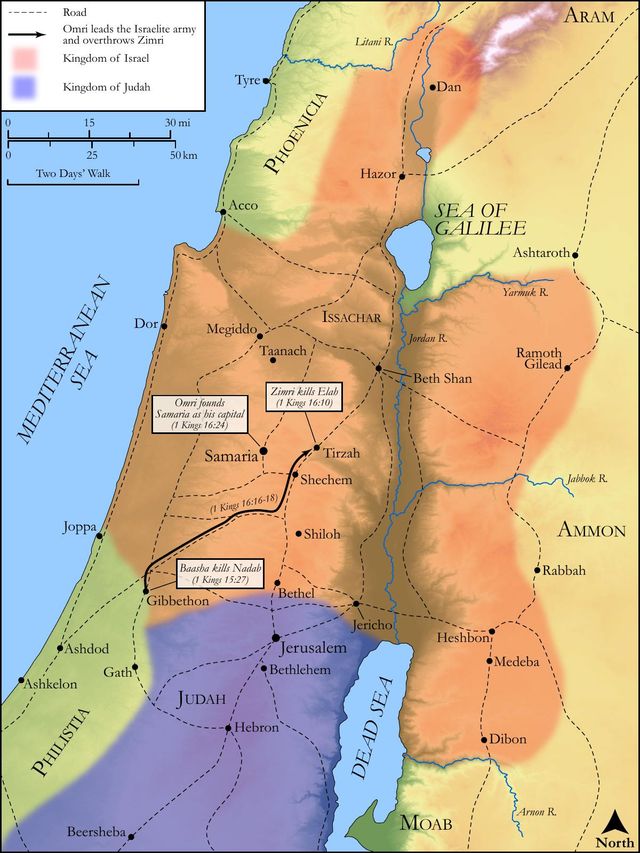
We are now to take a view of the miserable state of Israel, while the kingdom of Judah was happy under Asa's good government. It was threatened that they should be as a reed shaken in the water (Kg1 14:15), and so they were, when, during the single reign of Asa, the government of their kingdom was in six or seven different hands, as we find in this and the following chapter. Jeroboam was upon the throne in the beginning of his reign and Ahab at the end of it, and between them were Nadab, Baasha, Elah, Zimri, Tibni, and Omri, undermining and destroying one another. This they got by deserting the house both of God and of David. Here we have, 1. The ruin and extirpation of the family of Jeroboam, according to the word of the Lord by Ahijah. His son Nadab succeeded him. If the death of his brother Abijah had had a due influence upon him to make him religious, and the honour done him at his death had engaged him to follow his good example, his reign might have been long and glorious; but he walked in the way of his father (Kg1 15:26), kept up the worship of his calves, and forbade his subjects to go up to Jerusalem to worship, sinned and made Israel to sin, and therefore God brought ruin upon him quickly, in the second year of his reign. He was besieging Gibbethon, a city which the Philistines had taken from the Danites, and was endeavouring to re-take it; and there, in the midst of his army, did Baasha, with others, conspire against him and kill him, (Kg1 15:27), and so little interest had he in the affections of his people that his army did not only not avenge his death, but chose his murderer for his successor. Whether Baasha did it upon a personal pique against Nadab, or to be avenged on the house of Jeroboam for some affront received from them, or whether under pretence of freeing his country from the tyranny of a bad prince, or whether merely from a principle of ambition, to make way for himself to the throne, does not appear; but he slew him and reigned in his stead, Kg1 15:28. And the first thing he did when he came to the crown was to cut off all the house of Jeroboam, that he might the better secure himself and his own usurped government. He thought it not enough to imprison or banish them, but he destroyed them, left not only no males (as was foretold, Kg1 14:10), but none that breathed. Herein he was barbarous, but God was righteous. Jeroboam's sin was punished (Kg1 15:30); for those that provoke God do it to their own confusion; see Jer 7:19. Ahijah's prophecy was accomplished (Kg1 15:29); for no word of God shall fall to the ground. Divine threatenings are not bugbears. 2. The elevation of Baasha. He shall be tried awhile, as Jeroboam was. Twenty-four years he reigned (Kg1 15:33), but showed that it was not from any dislike to Jeroboam's sin that he destroyed his family, but from malice and ambition; for, when he had rooted out the sinner, he himself clave to the sin, and walked in the way of Jeroboam (Kg1 15:34), though he had seen the end of that way; so strangely was his heart hardened with the deceitfulness of sin.
Continue studying 1 Kings 15:31 across the web’s major study libraries — every link below opens this exact verse, chapter, or book on the destination site.
Read & Compare
 BibleGatewayThis verse in more than 200 translations and 70 languages.
 Bible.comThe YouVersion reader — hundreds of translations, reading plans, and highlights.
 ESV.orgCrossway's official English Standard Version reader.
 NET BibleThe NET translation with 60,000+ translators' notes on every rendering decision.
 STEP BibleTyndale House's free study tool — original text, vocabulary, and scholarly resources.
 BibliaLogos Bible Software's free web reader.
 USCCBThe New American Bible (Revised Edition) with the U.S. bishops' study notes.
Commentaries
 BibleHub CommentariesDozens of classic commentaries on this verse, gathered on one page.
 StudyLightMore than 100 commentary sets — the largest collection on the web.
 BibleRefPlain-English commentary on what this verse means, verse by verse.
 Enduring WordDavid Guzik's free commentary on this chapter, widely used by Bible teachers.
 Bible Study ToolsVerse commentary alongside Greek and Hebrew study aids.
Original Language & Research
- BibleHub InterlinearThe verse word by word — original language, transliteration, and English.
- BibleHub LexiconEvery word's original-language definition and Strong's entry.
 Blue Letter BibleDeep-study tools — Strong's numbers, concordance, and word studies.
 SefariaThe Hebrew text with Rashi and centuries of Jewish commentary.
Sermons, Hymns & Audio


TrulyRandomVerse is not affiliated with these sites and doesn’t control their content. They’re linked because they’re genuinely useful.
Summary
First Kings 15:31 serves as a characteristic concluding formula for the reign of King Nadab of Israel, succinctly summarizing his time on the throne by directing the reader to external historical records for further details. This verse, emblematic of the Deuteronomistic History, emphasizes the selective nature of the biblical narrative, which prioritizes theological and spiritual lessons over exhaustive historical documentation, while simultaneously affirming the historical grounding and verifiability of the events described. It formally marks the end of Nadab's brief and wicked rule, setting the narrative stage for the subsequent monarch and the unfolding of God's sovereign plan for Israel.
Context
ShowHideLiterary Context
This verse provides the formal narrative closure to the account of Nadab's two-year reign, which commenced in 1 Kings 15:25. It immediately follows the detailed description of his assassination by Baasha during the siege of Gibbethon, a Philistine city (1 Kings 15:27-28). Crucially, the preceding verses (1 Kings 15:29-30) recount Baasha's ruthless extermination of Jeroboam's entire house, a brutal act that precisely fulfilled the prophecy delivered by the prophet Ahijah in 1 Kings 14:10-11. Thus, 1 Kings 15:31 acts as a concise narrative bookend, not only to Nadab's individual story but also to the tragic and divinely ordained end of Jeroboam's idolatrous dynasty, thereby preparing the reader for the introduction of Baasha's subsequent reign.
Historical & Cultural Context
Nadab's brief reign took place in the northern kingdom of Israel, a tumultuous period characterized by profound political instability, frequent coups, and widespread, persistent idolatry following the division of the united monarchy. His father, Jeroboam I, had strategically established golden calf worship at Dan and Bethel, not out of genuine religious conviction but to prevent his subjects from returning to Jerusalem for worship, thereby consolidating his political power but leading Israel into egregious sin (1 Kings 12:26-33). Nadab continued this idolatrous path, explicitly described as "walking in the way of his father, and in his sin wherewith he made Israel to sin" (1 Kings 15:26). The recurring phrase "the book of the chronicles of the kings of Israel" (and Judah) throughout the books of Kings points to the existence of official court records or national annals. This practice was common in the courts of kings, where scribes meticulously documented royal activities, military campaigns, and administrative decisions, serving as primary historical sources for the biblical authors.
Key Themes
ShowHideThis verse significantly contributes to several prominent themes woven throughout the books of Kings. Firstly, it powerfully underscores the theme of Divine Judgment pronounced against those who lead Israel into idolatry and disobedience. Nadab's swift and violent end, mirroring the destruction of his father's house, is presented as a direct consequence of their sin and a precise fulfillment of divine prophecy (1 Kings 14:10). Secondly, it highlights the Sovereignty of God over human history, demonstrating that even the chaotic political upheavals, assassinations, and dynastic changes are ultimately within His purview and serve His overarching purposes. Thirdly, the consistent use of this formulaic reference emphasizes the Historical Veracity of the biblical narrative, grounding its theological claims in verifiable (though now lost to us) historical records. Finally, and perhaps most importantly, it illustrates the Theological Purpose of Scripture, showing that the biblical authors were highly selective in their historical reporting, including only what was necessary to convey God's character, His covenant faithfulness, and the inevitable consequences of obedience or rebellion, rather than providing an exhaustive historical account for its own sake.
Exposition and Analysis
ShowHideKey Word Analysis
ShowHideThis word, derived from a root meaning "to be hot" or "to be left over," refers to an overhanging, excess, or remainder. In this context, "the rest of the acts" signifies the remaining, unrecorded portion of Nadab's deeds and events, implying that the biblical narrative has provided only a summary, with more extensive details available in the external chronicles. It points to the biblical author's selective approach.
This versatile Hebrew word encompasses "word," "matter," "thing," or "deed." Here, it specifically refers to the deeds, events, or accomplishments of a king's reign. It broadly covers the full scope of his activities, including military campaigns, administrative policies, and personal conduct. The phrase "the rest of the acts" clearly indicates that the biblical account is not exhaustive but focuses on what is theologically pertinent.
A primitive root meaning "to grave" or "to write" (describe, inscribe, prescribe, subscribe). In this verse, it confirms that Nadab's full historical record was indeed put down in writing, affirming the existence and accessibility of these official state documents to the biblical author and, by extension, to the original audience. It underscores the historical basis of the biblical claims.
Verse Breakdown
ShowHide"Now the rest of the acts of Nadab,"
This opening phrase functions as a narrative transition and a summary statement. It explicitly indicates that the biblical account of King Nadab's reign, though concise, is not exhaustive. The "acts" refer to his deeds, decisions, and all significant events during his time as king, implying a broader scope of activities than what is detailed in the sacred text.
"and all that he did,"
This clause serves as an intensifier, emphasizing the comprehensive nature of the unrecorded details. It assures the reader that every action Nadab accomplished or was involved in, beyond the immediate theological narrative, was indeed documented in the external records. This reiteration reinforces the idea of a complete historical record existing elsewhere.
"[are] they not written in the book of the chronicles of the kings of Israel?"
This rhetorical question is a distinctive literary device frequently employed in the books of Kings. It is not a genuine inquiry seeking information but rather a strong affirmation, confirming the existence of a more detailed, external historical record. It directs the reader to these official annals for further information, simultaneously providing a formal conclusion to Nadab's narrative segment and underscoring the biblical author's selective, theologically driven approach to history. The "book of the chronicles of the kings of Israel" refers to the official state records of the northern kingdom, distinct from the canonical books of the Bible.
Literary Devices
ShowHideThe primary literary device prominently featured in 1 Kings 15:31 is the Rhetorical Question. The phrase "[are] they not written?" is not posed to elicit information, but rather serves as a powerful affirmation, asserting that the stated information is indeed recorded in external sources. This device fulfills multiple functions: it confirms the existence of non-canonical historical sources, thereby lending an air of historical credibility and verifiability to the biblical narrative, and it formally concludes the account of a particular king's reign. Furthermore, this verse exemplifies the pervasive Formulaic Structure characteristic of the books of Kings. The consistent use of such summary statements (e.g., "Now the rest of the acts of King X, and all that he did, are they not written in the book of the chronicles of the kings of Israel/Judah?") provides a predictable rhythm to the narrative, signaling transitions between reigns and reinforcing the Deuteronomistic author's consistent theological and historical framework. This practice also demonstrates Intertextuality, as the biblical text explicitly references non-canonical historical documents, indicating a conscious engagement with and reliance upon existing historical documentation.
Theological and Thematic Connections
ShowHideThe seemingly mundane administrative note in 1 Kings 15:31 carries significant theological weight. It profoundly affirms the historical grounding of God's interaction with His people, demonstrating that the biblical narrative is not a collection of myths or fables but a divinely inspired interpretation of real, verifiable events. The consistent reference to external chronicles underscores God's absolute sovereignty over all of human history, even the reigns of wicked kings like Nadab, whose brief and violent end fulfilled divine prophecy and demonstrated the consequences of rebellion. This verse reminds us that while human history unfolds with its complexities, chaos, and seemingly random events, God remains the ultimate Author and Director, weaving every "act" into His grand redemptive plan. The Bible's selective reporting, focusing on spiritual obedience and its consequences, teaches us to prioritize God's perspective on history over a mere chronological recounting of events, discerning the divine hand at work.
Reflection and Application
ShowHideFirst Kings 15:31, though brief and formulaic, offers profound insights for contemporary believers. It serves as a powerful reminder that God is deeply engaged with human history, even in its most tumultuous and seemingly insignificant moments. The confident assertion of external records, to which the biblical author points, reinforces the trustworthiness and historical reliability of God's Word. It is not a collection of fables or allegories but a divinely guided account rooted in verifiable historical reality. For us, this means we can place our unwavering trust in the grand narrative of salvation history that culminates in Jesus Christ. Furthermore, the Bible's selective focus teaches us a crucial lesson about discerning what truly matters in life: not merely the accumulation of "acts" or worldly achievements, but the spiritual trajectory of our lives—our obedience to God and our faithfulness to His covenant. Nadab's story, though summarized, serves as a poignant reminder of the swift and certain consequences of persistent sin and rebellion against God's commands. Every human life, no matter how short or seemingly inconsequential, is recorded in God's ultimate chronicle, and its true significance is measured by its relationship to Him and His divine purposes.
Questions for Reflection
ShowHideFAQ
ShowHideWhat are "the book of the chronicles of the kings of Israel" and are they part of the Bible?
ShowHide"The book of the chronicles of the kings of Israel" (and its counterpart, "the book of the chronicles of the kings of Judah") refers to official state annals or court records meticulously maintained by the scribes of the respective kingdoms. These were secular historical documents, not considered part of the inspired biblical canon. The biblical authors of Kings frequently cite them as sources, indicating that they were drawing upon existing, reliable historical records for their narrative. While these external chronicles are no longer extant today, their repeated mention underscores the historical grounding of the biblical accounts and the selective, theologically driven nature of the inspired text. It is crucial to distinguish these ancient state records from the canonical books of 1 and 2 Chronicles, which are distinct compositions written much later, providing a theological reinterpretation of Israel's history, often drawing upon similar source material but with a different emphasis, particularly on the Davidic covenant and the temple.
Christ-Centered Fulfillment
ShowHideWhile 1 Kings 15:31 appears to be a dry historical footnote, it subtly points to Christ in several profound ways. The very concept of a "book of chronicles" foreshadows God's perfect and exhaustive record-keeping, culminating in the Lamb's Book of Life, where the names of the redeemed are eternally inscribed. Unlike the earthly chronicles that record the "acts" of fallible kings, God's ultimate record is one of grace and redemption, centered on the perfect "acts" of His Son. Nadab's brief and wicked reign, ending in judgment and the fulfillment of prophecy, highlights the desperate need for a true and righteous King—one who would not "walk in the way of his father" in sin, but would perfectly obey God's will. Jesus Christ is this ultimate King, the Son of David who reigns eternally and whose kingdom will never be overthrown by human conspiracy or divine judgment (Luke 1:33). His "acts" were not recorded in fallible human chronicles, but in the Gospels, bearing witness to His sinless life, atoning death, and glorious resurrection, which are the very foundation of our salvation and eternal life (John 20:30-31). Thus, even in a verse summarizing a failed human monarchy, we are reminded of God's sovereign control over history, His unwavering commitment to justice, and His ultimate provision of a perfect King whose story is the very center of God's eternal chronicles.