


1 Kings 14:9
- וַתָּרַעva·Ta·ra'and you have done evilH7489Conj-w ¦ V-Hiphil-ConsecImperf-2msVerb Hiphil Consecutive Imperfect 2nd Singular Masculineוַandתָּרַעyou have done evil
- לַעֲשׂוֹתla·'a·Sotto actH6213Prep-l ¦ V-Qal-InfVerb Qal Infinitive Constructלַtoעֲשׂוֹתact
- מִכֹּלmi·Kolmore than allH3605Prep-m ¦ N-msNoun Singular Masculine Absoluteמִmore thanכֹּלall
- אֲשֶׁר'a·Sher[those] whoH834RelParticle Relative
- הָיוּha·Yuthey wereH1961V-Qal-Perf-3cpVerb Qal Perfect 3rd Plural common gender
- לְפָנֶיךָle·fa·Nei·kha<to> before youH6440Prep-l ¦ N-mpc ¦ 2msNoun Plural Masculine Constructלְ<to>פָנֶיbeforeךָyou
- וַתֵּלֶךְva·Te·lekhand you have goneH1980Conj-w ¦ V-Qal-ConsecImperf-2msVerb Qal Consecutive Imperfect 2nd Singular Masculineוַandתֵּלֶךְyou have gone
- וַתַּעֲשֶׂהva·ta·'a·sehand you have madeH6213Conj-w ¦ V-Qal-ConsecImperf-2msVerb Qal Consecutive Imperfect 2nd Singular Masculineוַandתַּעֲשֶׂהyou have made
- לְּךָle·Khafor yourselfPrep-l ¦ 2msSuffix Personal 2nd Singular Masculineלְּforךָyourself
- אֱלֹהִים'E·lo·HimgodsH430N-mpNoun Plural Masculine Absolute
- אֲחֵרִים'a·che·RimotherH312Adj-mpAdjective Plural Masculine Absolute
- וּמַסֵּכוֹתu·ma·se·khOtand molten imagesH4541Conj-w ¦ N-fpNoun Plural Feminine Absoluteוּandמַסֵּכוֹתmolten images
- לְהַכְעִיסֵנִיle·hakh·'i·Se·nito provoke to anger meH3707Prep-l ¦ V-Hiphil-Inf ¦ 1csVerb Hiphil Infinitive Constructלְtoהַכְעִיסֵprovoke to angerנִיme
- וְאֹתִיve·'o·Tiand <obj.> meH853Conj-w ¦ DirObjM ¦ 1csParticle Object Indicatorוְandאֹתִ<obj.>יme
- הִשְׁלַכְתָּhish·Lakh·tayou have castH7993V-Hiphil-Perf-2msVerb Hiphil Perfect 2nd Singular Masculine
- אַחֲרֵי'a·cha·ReibehindH310Adj-mpcAdjective Numerical Plural Masculine Construct
- גַוֶּךָga·Ve·khayour backH1458N-msc ¦ 2msNoun Singular Masculine Constructגַוֶּbackךָyour
English is a literal word-by-word gloss of the Hebrew, not the KJV's wording. Why?
This is the original text the KJV's translators worked from — each Hebrew word with its own literal English meaning in this verse, prepared by scholars at Tyndale House, Cambridge. The KJV translates whole sentences, not word by word, so its wording differs: one Hebrew word can become several English words, and the KJV may choose “the LORD” where the gloss reads “Yahweh”. Both are faithful — they answer different questions. For the KJV's own rendering, switch to the KJV text.
Details
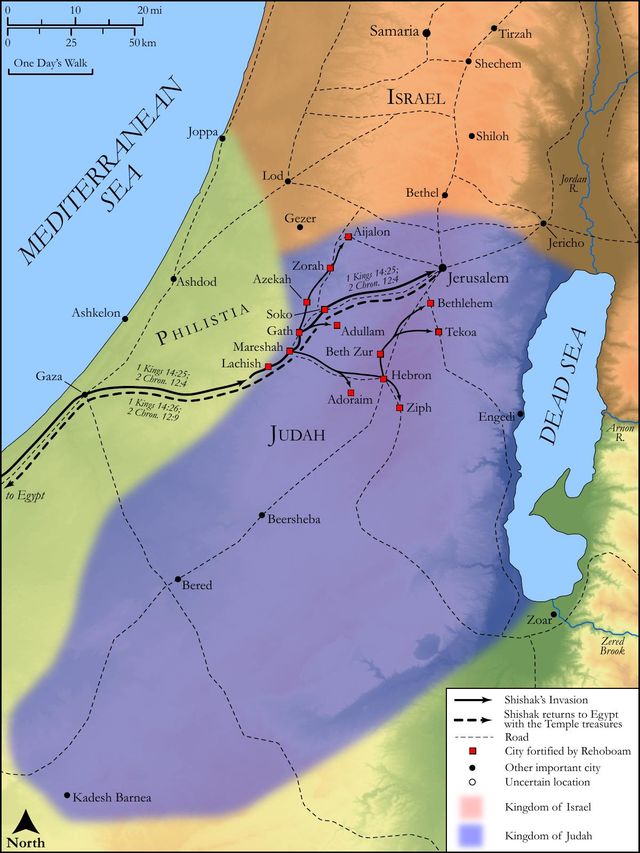
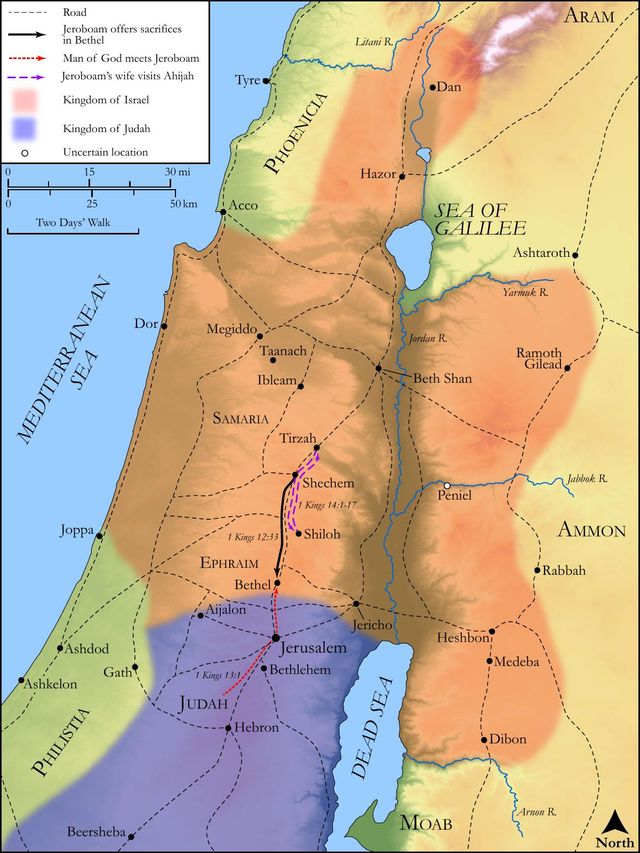
See on the biblical-era maps

Study this verse
Public-domain commentary
Matthew Henry
From his Commentary on the Whole Bible. Henry comments on passages, not single verses — this entry covers 1 Kings 14:7–20. His four-level outline is real structure in the source text, so it is rendered as structure.
When those that set up idols, and keep them up, go to enquire of the Lord, he determines to answer them, not according to the pretensions of their enquiry, but according to the multitude of their idols, Eze 14:4. So Jeroboam is answered here.
I.The prophet anticipates the enquiry concerning the child, and foretels the ruin of Jeroboam's house for the wickedness of it.
No one else durst have carried such a message: a servant would have smothered it, but his own wife cannot be suspected of ill-will to him.
1.God calls himself the Lord God of Israel. Though Israel had forsaken God, God had not cast them off, nor given them a bill of divorce for their whoredoms. He is Israel's God, and therefore will take vengeance on him who did them the greatest mischief he could do them, debauched them and drew them away from God.
2.He upbraids Jeroboam with the great favour he had bestowed upon him, in making him king, exalting him from among the people, the common people, to be prince over God's chosen Israel, and taking the kingdom from the house of David, to bestow it upon him. Whether we keep an account of God's mercies to us or no, he does, and will set even them in order before us, if we be ungrateful, to our greater confusion; otherwise he gives and upbraids not.
3.He charges him with his impiety and apostasy, and his idolatry particularly: Thou hast done evil above all that were before thee, Kg1 14:9. Saul, that was rejected, never worshipped idols; Solomon did it but occasionally, in his dotage, and never made Israel to sin. Jeroboam's calves, though pretended to be set up in honour of the God of Israel, that brought them up out of Egypt, yet are here called other gods, or strange gods, because in them he worshipped God as the heathen worshipped their strange gods, because by them he changed the truth of God into a lie and represented him as altogether different from what he is, and because many of the ignorant worshippers terminated their devotion in the image, and did not at all regard the God of Israel. Though they were calves of gold, the richness of the metal was so far from making them acceptable to God that they provoked him to anger, designedly affronted him, under colour of pleasing him. In doing this,
(1.)He had not set David before him (Kg1 14:8): Thou hast not been as my servant David, who, though he had his faults and some bad ones, yet never forsook the worship of God nor grew loose nor cold to that; his faithful adherence to that gained him this honourable character, that he followed God with all his heart, and herein he was proposed for an example to all his successors. Those did not do well that did not do like David.
(2.)He had not set God before him, but (Kg1 14:9), "Thou hast cast me behind thy back, my law, my fear; thou hast neglected me, forgotten me, and preferred thy policies before my precepts."
4.He foretels the utter ruin of Jeroboam's house, Kg1 14:10, Kg1 14:11. He thought, by his idolatry, to establish his government, and by that he not only lost it, but brought destruction upon his family, the universal destruction of all the males, whether shut up or left, married or unmarried.
(1.)Shameful destruction. They shall be taken away as dung, which is loathsome and which men are glad to be rid of. He worshipped dunghill-deities, and God removed his family as a great dunghill. Noble and royal families, if wicked, are no better in God's account.
(2.)Unusual destruction. Their very dead bodies should be meat for the dogs in the street, or the birds of prey in the field, Kg1 14:11. Thus evil pursues sinners. See this fulfilled, Kg1 15:29.
5.He foretels the immediate death of the sick child, Kg1 14:12, Kg1 14:13.
(1.)In mercy to him, lest, if he live, he be infected with the sin, and so involved in the ruin, of his father's house. Observe the character given of him: In him was found some good thing towards the Lord God of Israel, in the house of Jeroboam. He had an affection for the true worship of God and disliked the worship of the calves. Note,
[1.]Those are good in whom are good things towards the Lord God of Israel, good inclinations, good intentions, good desires, towards him.
[2.]Where there is but some good thing of that kind it will be found: God, who seeks it, sees it be it ever so little and is pleased with it.
[3.]A little grace goes a great way with great people. It is so rare to find princes well affected to religion that, when they are so, they are worthy of double honour.
[4.]Pious dispositions are in a peculiar manner amiable and acceptable when they are found in those that are young. The divine image in miniature has a peculiar beauty and lustre in it.
[5.]Those that are good in bad times and places shine very brightly in the eyes of God. A good child in the house of Jeroboam is a miracle of divine grace: to be there untainted is like being in the fiery furnace unhurt, unsinged. Observe the care taken of him: he only, of all Jeroboam's family, shall die in honour, shall be buried, and shall be lamented as one that lived desired. Note, Those that are distinguished by divine grace shall be distinguished by divine providence. This hopeful child dies first of all the family, for God often takes those soonest whom he loves best. Heaven is the fittest place for them; this earth is not worthy of them.
(2.)In wrath to the family.
[1.]It was a sign the family would be ruined when he was taken by whom it might have been reformed. The righteous are removed from the evil to come in this world, to the good to come in a better world. It is a bad omen to a family when the best in it are buried out of it; when what was valuable is picked out the rest is for the fire.
[2.]It was likewise a present affliction to the family and kingdom, by which both ought to have been bettered; and this aggravated the affliction to the poor mother that she should not reach home time enough to see her son alive: When thy feet enter into the city, just then the child shall die. This was to be a sign to her of the accomplishment of the rest of the threatenings, as Sa1 2:34.
6.He foretels the setting up of another family to rule over Israel, Kg1 14:14. This was fulfilled in Baasha of Issachar, who conspired against Nadab the son of Jeroboam, in the second year of his reign, murdered him and all his family. "But what? Even now. Why do I speak of it as a thing at a distance? It is at the door. It shall be done even now." Sometimes God makes quick work with sinners; he did so with the house of Jeroboam. It was not twenty-four years from his first elevation to the final extirpation of his family.
7.He foretels the judgments which should come upon the people of Israel for conforming to the worship which Jeroboam had established. If the blind lead the blind, both the blind leaders and the blind followers shall fall into the ditch. It is here foretold, Kg1 14:15,
(1.)That they should never be easy, nor rightly settled in their land, but continually shaken like a reed in the water. After they left the house of David, the government never continued long in one family, but one undermined and destroyed another, which must needs occasion great disorders and disturbances among the people.
(2.)That they should, ere long, be totally expelled out of their land, that good land, and given up to ruin, Kg1 14:16. This was fulfilled in the captivity of the ten tribes by the king of Assyria. Families and kingdoms are ruined by sin, ruined by the wickedness of the heads of them. Jeroboam did sin, and made Israel to sin. If great men do wickedly, they involve many others both in the guilt and in the snare; multitudes follow their pernicious ways. They go to hell with a long train, and their condemnation will be the more intolerable, for they must answer, not only for their own sins, but for the sins which others have been drawn into and kept in by their influence.
II.Jeroboam's wife has nothing to say against the word of the Lord, but she goes home with a heavy heart to their house in Tirzah, a sweet delightful place, so the name signifies, famed for its beauty, Sol 6:4. But death, which will stain its beauty and embitter all its delights, cannot be shut out from it. Hither she came, and here we leave her attending the funeral of her son, and expecting the fate of her family.
1.The child died (Kg1 14:17), and justly did all Israel mourn, not only for the loss of so hopeful a prince, whom they were not worthy of, but because his death plucked up the flood-gates, and made a breach, at which an inundation of judgments broke in.
2.Jeroboam himself died soon after, Kg1 14:20. It is said (Ch2 13:20), The Lord struck him with some sore disease, so that he died miserably, when he had reigned twenty-two years, and left his crown to a son who lost it, and his life too, and all the lives of his family, within two years after. For a further account of him the reader is referred to the annals of his reign, drawn up by his own secretaries, or to the public records, like those in the Tower, called here, The Book or register, of the Chronicles of the Kings of Israel, to which recourse might then be had; but, not being divinely inspired, these records are long since lost.
Continue studying 1 Kings 14:9 across the web’s major study libraries — every link below opens this exact verse, chapter, or book on the destination site.
Read & Compare
 BibleGatewayThis verse in more than 200 translations and 70 languages.
 Bible.comThe YouVersion reader — hundreds of translations, reading plans, and highlights.
 ESV.orgCrossway's official English Standard Version reader.
 NET BibleThe NET translation with 60,000+ translators' notes on every rendering decision.
 STEP BibleTyndale House's free study tool — original text, vocabulary, and scholarly resources.
 BibliaLogos Bible Software's free web reader.
 USCCBThe New American Bible (Revised Edition) with the U.S. bishops' study notes.
Commentaries
 BibleHub CommentariesDozens of classic commentaries on this verse, gathered on one page.
 StudyLightMore than 100 commentary sets — the largest collection on the web.
 BibleRefPlain-English commentary on what this verse means, verse by verse.
 Enduring WordDavid Guzik's free commentary on this chapter, widely used by Bible teachers.
 Bible Study ToolsVerse commentary alongside Greek and Hebrew study aids.
Original Language & Research
- BibleHub InterlinearThe verse word by word — original language, transliteration, and English.
- BibleHub LexiconEvery word's original-language definition and Strong's entry.
 Blue Letter BibleDeep-study tools — Strong's numbers, concordance, and word studies.
 SefariaThe Hebrew text with Rashi and centuries of Jewish commentary.
Sermons, Hymns & Audio


TrulyRandomVerse is not affiliated with these sites and doesn’t control their content. They’re linked because they’re genuinely useful.
Summary
1 Kings 14:9 delivers a severe divine indictment against King Jeroboam, pronounced through the prophet Ahijah, condemning him for his unparalleled wickedness. His egregious sin is characterized by the establishment of idolatrous worship through "other gods and molten images," a direct affront to God's covenant and an act designed to provoke His righteous anger. This verse powerfully highlights Jeroboam's deliberate and profound rejection of the Lord, whom he metaphorically "cast behind his back," signifying utter disregard for divine commands, covenant fidelity, and the very presence of God.
Context
ShowHideLiterary Context
This verse is a crucial part of a prophetic judgment delivered by the aged and blind prophet Ahijah to Jeroboam's wife, who had come in disguise to inquire about their sick son, Abijah. The preceding verses, specifically 1 Kings 14:7-8, recount God's gracious elevation of Jeroboam from obscurity to kingship over the ten tribes of Israel, fulfilling the prophecy of the kingdom's division from Solomon's house found in 1 Kings 11:29-39. Despite this divine favor and clear instructions, Jeroboam immediately established a corrupt religious system, setting up golden calves in Dan and Bethel, creating an alternative to Jerusalem's legitimate worship, as detailed in 1 Kings 12:28-30. This verse, therefore, serves as the climactic charge within God's indictment, explaining why such a harsh judgment, including the complete eradication of Jeroboam's dynasty, is deserved.
Historical & Cultural Context
The historical backdrop is the newly divided kingdom of Israel, following the tumultuous reign of Solomon. Jeroboam, as the first king of the northern kingdom (Israel), faced the political challenge of consolidating his power and preventing his subjects from returning to Jerusalem for worship, which he feared would lead to their renewed allegiance to the Davidic dynasty in Judah, as outlined in 1 Kings 12:26-27. His solution was to institute state-sponsored idolatry, a syncretistic blend of Yahwism with Canaanite practices, symbolized by the golden calves reminiscent of the wilderness apostasy at Sinai in Exodus 32:1-6. This act was not merely a personal sin but a national policy, fundamentally altering the religious landscape of Israel and leading generations into persistent apostasy, thus earning him the infamous title "Jeroboam son of Nebat, who caused Israel to sin," a phrase that echoes throughout 1 Kings 14 and subsequent books.
Key Themes
ShowHideThis verse powerfully contributes to several key themes within the book of 1 Kings and the broader Deuteronomistic History. The primary theme is Idolatry and Covenant Faithfulness, highlighting the direct violation of the first two commandments found in Exodus 20:3-4 and the devastating consequences of rejecting the exclusive worship of Yahweh. It underscores the theme of Divine Judgment, demonstrating God's righteous anger and swift retribution against those who lead His people astray and profane His name. Furthermore, it speaks profoundly to the theme of Kingship and Responsibility, emphasizing that a king's spiritual leadership profoundly impacts the nation's destiny. Jeroboam's actions set a destructive precedent for future kings of Israel, many of whom "walked in the ways of Jeroboam," perpetuating the sin that ultimately led to the kingdom's downfall and exile.
Exposition and Analysis
ShowHideKey Word Analysis
ShowHideThis term (H3707) signifies more than mere annoyance; it denotes deep vexation, indignation, or grief. When applied to God, it conveys His righteous displeasure and sorrow over the betrayal of the covenant relationship. Jeroboam's actions were not simply disobedient but were an active affront to God's holiness and His loving commitment to His people, eliciting a profound divine emotional response of anger and grief.
The Hebrew word (H4541) specifically refers to idols cast from metal, often in the form of animals. In this context, it directly points to the golden calves Jeroboam set up in Dan and Bethel. This term emphasizes the deliberate, man-made nature of the false gods, contrasting sharply with the living, uncreated God of Israel. The act of creating and worshipping these images was a direct violation of the second commandment, which prohibits the making of graven images.
The verb (H7993) means "to throw out, down or away." In the phrase "hast cast me behind thy back," it is used figuratively to describe a deliberate and utter rejection. Combined with "behind thy back" (H310, H1458), this idiom signifies treating God as something unwanted, irrelevant, or to be ignored. It implies a conscious turning away from God's presence, His commands, and the covenant relationship, showing profound contempt and a complete disregard for His authority and faithfulness.
Verse Breakdown
ShowHide"But hast done evil above all that were before thee:"
This opening clause establishes the unparalleled nature of Jeroboam's sin, asserting that his wickedness surpassed that of any previous leader or even the collective apostasies of the people. This distinction is crucial because Jeroboam's sin was not merely personal failure but an institutionalized, state-sponsored corruption of worship, actively leading an entire nation away from the Lord. It sets the stage for the severity of the impending judgment.
"for thou hast gone and made thee other gods, and molten images,"
This provides the specific and damning charge against Jeroboam: the creation and promotion of idolatry. The "other gods" refer to foreign deities or syncretistic worship, while "molten images" explicitly points to the golden calves he erected. This was a direct and flagrant violation of the first two commandments, which demanded exclusive worship of Yahweh and prohibited the making of idols, thus striking at the heart of Israel's covenant identity.
"to provoke me to anger,"
This clarifies the divine response to Jeroboam's actions. God's anger is not arbitrary but a righteous and just reaction to the profound betrayal of His covenant and the spiritual adultery of His people. Jeroboam's deliberate actions were an open challenge to God's sovereignty and holiness, inevitably leading to divine displeasure and the outpouring of His just wrath.
"and hast cast me behind thy back:"
This powerful metaphorical statement describes the profound depth of Jeroboam's rejection of God. It signifies a conscious and complete disregard for God's presence, His laws, and His covenant. Instead of keeping God's word "before their eyes" as commanded in Deuteronomy 6:8, Jeroboam treated God as something to be discarded or ignored, demonstrating contempt for the divine relationship and a profound act of spiritual rebellion.
Literary Devices
ShowHideThe verse employs several potent Literary Devices to convey the gravity of Jeroboam's sin and the intensity of God's response. The phrase "done evil above all that were before thee" is a form of Hyperbole, emphasizing the extreme and unprecedented nature of his wickedness, particularly in its institutionalized form, setting him apart in infamy. The declaration "to provoke me to anger" is a clear instance of Anthropomorphism, attributing human emotion (anger) to God, thereby making His righteous indignation relatable and impactful, underscoring the personal offense Jeroboam's actions caused the Holy God. Most strikingly, "hast cast me behind thy back" is a vivid Metaphor that powerfully illustrates Jeroboam's deliberate and contemptuous rejection of God and His covenant. This imagery contrasts sharply with the covenant expectation of keeping God's commands "before your eyes," underscoring the depth of his apostasy and contempt. The entire passage is delivered as Divine Speech, lending it ultimate authority and solemnity as God Himself pronounces judgment.
Theological and Thematic Connections
ShowHide1 Kings 14:9 is a pivotal verse that profoundly articulates God's unwavering demand for exclusive worship and His severe judgment against idolatry. Jeroboam's sin was not merely a personal transgression but a state-sanctioned act of spiritual rebellion that led an entire nation astray, fundamentally corrupting the covenant relationship. This verse underscores that God views the turning away from Him to "other gods" as a profound betrayal, provoking His righteous anger. It highlights the principle that true worship involves wholehearted devotion and obedience, and any attempt to replace or diminish God's rightful place in the lives of His people, whether through physical idols or the idols of the heart, is an act of profound rejection that invites divine judgment.
Reflection and Application
ShowHideJeroboam's story serves as a timeless warning against the insidious nature of idolatry and the grave consequences of spiritual compromise, particularly for those in positions of leadership. His sin was rooted in a desire for political security, leading him to prioritize human strategy over divine command and covenant faithfulness. For us today, "other gods" may not be molten images but rather power, wealth, comfort, reputation, or even our own self-sufficiency—anything that displaces God from the supreme position in our hearts and lives. When we chase after these things, we effectively "cast God behind our back," treating His commands and presence as inconvenient or irrelevant to our daily decisions and ultimate allegiances. This verse calls us to a radical self-examination: are we truly living with God "before our eyes," or are we, like Jeroboam, constructing systems or habits that subtly or overtly lead us away from wholehearted devotion to Him? God's righteous anger against Jeroboam's sin reminds us that He takes our allegiance seriously and desires our complete and undivided worship, for our good and His glory.
Questions for Reflection
ShowHideFAQ
ShowHideWhy was Jeroboam's sin considered "above all that were before him"?
ShowHideJeroboam's sin was deemed "above all that were before him" primarily because he institutionalized idolatry as a national policy, compelling an entire kingdom to abandon the exclusive worship of Yahweh. Unlike previous individual acts of apostasy, Jeroboam's actions were a deliberate, state-sponsored effort to create an alternative religious system with new priests, festivals, and places of worship (Dan and Bethel) to prevent his subjects from going to Jerusalem. This was a direct, calculated affront to God's covenant and a systematic corruption of Israel's spiritual life, setting a destructive precedent for future wicked kings of Israel and leading generations into sin, as highlighted in 1 Kings 14:16 and beyond.
What does "cast me behind thy back" mean in this context?
ShowHide"Cast me behind thy back" is a powerful metaphor signifying a deliberate and contemptuous rejection of God. It implies treating God as something unwanted, irrelevant, or to be ignored. Instead of keeping God's commands and presence "before their eyes" as instructed in the Law (e.g., Deuteronomy 6:8), Jeroboam consciously turned away from God, disregarding His authority and the covenant relationship. This phrase highlights the intentionality and profound disrespect inherent in his actions, demonstrating a complete lack of regard for the Lord who had elevated him to power and to whom he owed his allegiance.
Christ-Centered Fulfillment
ShowHideJeroboam's profound failure as king, characterized by his unparalleled idolatry and the deliberate casting of God "behind his back," starkly illuminates humanity's desperate need for a perfect King and a true Mediator. Jeroboam, driven by political expediency, led his people into spiritual ruin, violating the very covenant God had established. In stark contrast, Jesus Christ is the King who perfectly fulfills the law and never leads His people astray. He is the one who never "casts God behind His back" but always does the will of the Father, as He declares in John 6:38. Unlike Jeroboam's lifeless molten images, Jesus is the true image of the invisible God, the very radiance of God's glory, as revealed in Colossians 1:15 and Hebrews 1:3, through whom we can truly know and worship the Father. His sacrifice on the cross utterly destroys the power of idolatry and sin, providing the ultimate atonement that Jeroboam's apostasy rejected. Through Christ, we are not only forgiven for our own tendencies to cast God aside but are also empowered by His Spirit to turn from all "other gods" and worship the Lord in spirit and truth, drawing near to Him with confidence rather than pushing Him away, as encouraged in Hebrews 10:19-22. He is the Lamb of God who takes away the sin of the world, including the sin of idolatry, as proclaimed in John 1:29, offering true reconciliation and eternal life to all who turn to Him.