


2 Chronicles 11:15
- וַיַּעֲמֶדvai·ya·'a·medand he appointedH5975Conj-w ¦ V-Hiphil-ConsecImperf-3msVerb Hiphil Consecutive Imperfect 3rd Singular Masculineוַandיַּעֲמֶדhe appointed
- לוֹlofor himselfPrep-l ¦ 3msSuffix Personal 3rd Singular Masculineלforוֹhimself
- כֹּהֲנִיםko·ha·NimpriestsH3548N-mpNoun Plural Masculine Absolute
- לַבָּמוֹתla·ba·Motfor the high placesH1116Prep-l ¦ N-fpNoun Plural Feminine Absoluteלַfor theבָּמוֹתhigh places
- וְלַשְּׂעִירִיםve·la·se·'i·Rimand for the goatsH8163Conj-w ¦ Prep-l ¦ N-mpNoun Plural Masculine Absoluteוְandלַfor theשְּׂעִירִיםgoats
- וְלָעֲגָלִיםve·la·'a·ga·Limand for the calvesH5695Conj-w ¦ Prep-l ¦ N-mpNoun Plural Masculine Absoluteוְandלָfor theעֲגָלִיםcalves
- אֲשֶׁר'a·SherwhichH834RelParticle Relative
- עָשָׂה'a·Sahhe had madeH6213V-Qal-Perf-3msVerb Qal Perfect 3rd Singular Masculine
English is a literal word-by-word gloss of the Hebrew, not the KJV's wording. Why?
This is the original text the KJV's translators worked from — each Hebrew word with its own literal English meaning in this verse, prepared by scholars at Tyndale House, Cambridge. The KJV translates whole sentences, not word by word, so its wording differs: one Hebrew word can become several English words, and the KJV may choose “the LORD” where the gloss reads “Yahweh”. Both are faithful — they answer different questions. For the KJV's own rendering, switch to the KJV text.
Details
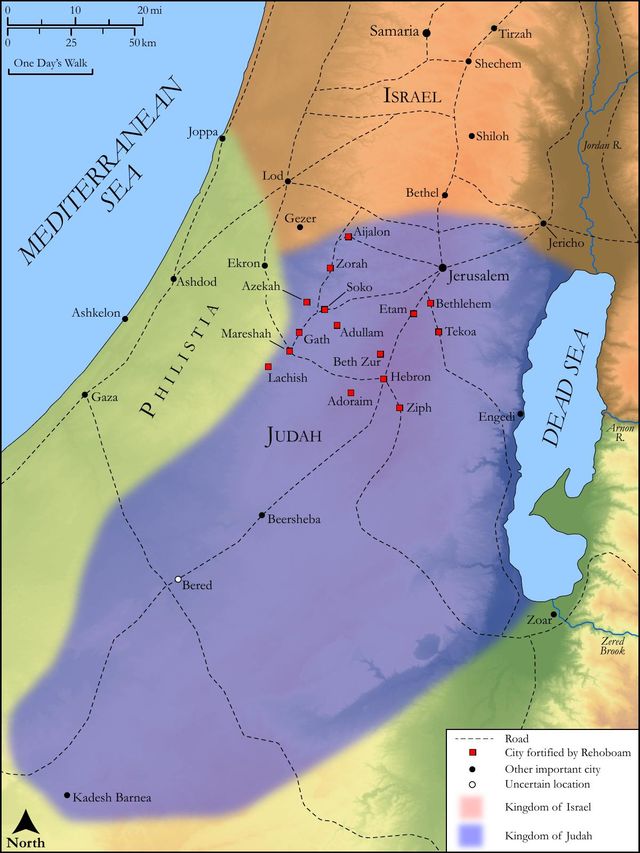
See on the biblical-era map
Study this verse
Public-domain commentary
Matthew Henry
From his Commentary on the Whole Bible. Henry comments on passages, not single verses — this entry covers 2 Chronicles 11:13–23. His three-level outline is real structure in the source text, so it is rendered as structure.
See here,
I.How Rehoboam was strengthened by the accession of the priests and Levites, and all the devout and pious Israelites, to him, even all that were true to their God and their religion.
1.Jeroboam cast them off, that is, he set up such a way of worship as he knew they could not in conscience comply with, which obliged them to withdraw from his altar, and at the same time he would not allow them to go up to Jerusalem to worship at the altar there; so that he totally cast them off from executing the priest's office, Ch2 11:14. And very willing he was that they should turn themselves out of their places, that room might be made for those mean and scandalous persons whom he ordained priests for the high places, Ch2 11:15. Compare Kg1 12:31. No marvel if he that cast off God cast off his ministers; they were not for his purpose, would not do whatever he might bid them do, would not serve his gods, nor worship the golden image which he had set up.
2.They thereupon left their suburbs and possessions, Ch2 11:14. Out of the lot of each tribe the Levites had cities allowed them, where they were comfortable provided for and had opportunity of doing much good. But now they were driven out of all their cities except those in Judah and Benjamin. One would think their maintenance well settled, and yet they lost it. It was a comfort to them that the law so often reminded them that the Lord was their inheritance, and so they should find him when they were turned out of their house and possessions. But why did they leave their possessions?
(1.)Because they saw they could do no good among their neighbours, in whom (now that Jeroboam set up his calves) the old proneness to idolatry revived.
(2.)Because they themselves would be in continual temptation to some base compliances, and in danger of being drawn insensibly to that which was evil. If we pray, in sincerity, not to be led into temptation, we shall get and keep as far as we can out of the way of it.
(3.)Because, if they retained their integrity, they had reason to expect persecution from Jeroboam and his sons. The priests they made for the devils would not let the Lord's priests be long among them. No secular advantages whatsoever should draw us thither, or detain us there, where we are in danger of making shipwreck of faith and a good conscience.
3.They came to Judah and Jerusalem (Ch2 11:14) and presented themselves to Rehoboam, Ch2 11:13, margin. Where should God's priests and Levites be, but where his altar was? Thither they came because it was their business to attend at the times appointed.
(1.)It was a mercy to them that they had a place of refuge to flee to, and that when Jeroboam cast them off there were those so near that would entertain them, and bid them welcome, and they were not forced into the lands of the heathen.
(2.)It was an evidence that they loved their work better than their maintenance, in that they left their suburbs and possessions in the country (where they might have lived at ease upon their own), because they were restrained from serving God there, and cast themselves upon God's providence and the charity of their brethren in coming to a place where they might have the free enjoyment of God's ordinances, according to his institution. Poverty in the way of duty is to be chosen rather than plenty in the way of sin. Better live upon alms, or die in a prison, with a good conscience, than roll in wealth and pleasure with a prostituted one.
(3.)It was the wisdom and praise of Rehoboam and his people that they bade them welcome, though they crowded themselves perhaps to make room for them. Conscientious refugees will bring a blessing along with them to the countries that entertain them, as they leave a curse behind them with those that expel them. Open the gates, that the righteous nation, which keepeth truth, may enter in; it will be good policy. See Isa 26:1, Isa 26:2.
4.When the priests and Levites came to Jerusalem all the devout pious Israelites of every tribe followed them. Such as set their hearts to seek the Lord God of Israel, that made conscience of their duty to God and were sincere and resolute in it, left the inheritance of their fathers and went and took houses in Jerusalem, that they might have free access to the altar of God and be out of the temptation to worship the calves, Ch2 11:16. Note,
(1.)That is best for us which is best for our souls; and, in all our choices, advantages for religion must take place of all outward conveniences.
(2.)Where God's faithful priests are his faithful people should be. If Jeroboam cast off God's ministers, every true-born Israelite will think himself obliged to own them and stand by them. Forsake not the Levite, the out-cast Levite, as long as thou livest. When the ark removes do you remove and go after it, Jos 3:3.
5.They strengthened the kingdom of Judah (Ch2 11:17), not only by the addition of so many persons to it, who, it is likely, brought what they could of their effects with them, but by their piety and their prayers they procured a blessing upon the kingdom which was a sanctuary to them. See Zac 12:5. It is the interest of a nation to protect and encourage religion and religious people, and adds more than any thing to its strength. They made him and his people strong three years; for so long they walked in the way of David and Solomon, their good way. But when they forsook that, and so threw themselves out of God's favour and protection, the best friends they had could no longer help to strengthen them. We retain our strength while we cleave to God and our duty, and no longer.
II.How Rehoboam was weakened by indulging himself in his pleasures. He desired many wives, as his father did (Ch2 11:23), yet,
1.In this he was more wise than his father, that he does not appear to have married strange wives. The wives mentioned here were not only daughters of Israel, but of the family of David; one was a descendant from Eliab, David's brother (Ch2 11:18), another from Absalom, probably that Absalom who was David's son (Ch2 11:20), another from Jerimoth, David's son.
2.In this he was more happy than his father, that he had many sons and daughters; whereas we read not of more than one son that his father had. One can scarcely imagine that he had no more; but, if he had, they were not worth mentioning; whereas several of Rehoboam's sons are here named (Ch2 11:19, Ch2 11:20) as men of note, and such active men that he thought it his wisdom to disperse them throughout the countries of Judah and Benjamin (Ch2 11:23), either,
(1.)That they might not be rivals with his son Abijah, whom he designed for his successor, or rather,
(2.)Because he could repose a confidence in them for the preserving of the public peace and safety, could trust them with fenced cities, which he took care to have well victualled, that they might stand him in stead in case of an invasion. After-wisdom is better than none at all; nay, they say, "Wit is never good till it is bought;" though he was dearly bought with the loss of a kingdom.
Continue studying 2 Chronicles 11:15 across the web’s major study libraries — every link below opens this exact verse, chapter, or book on the destination site.
Read & Compare
 BibleGatewayThis verse in more than 200 translations and 70 languages.
 Bible.comThe YouVersion reader — hundreds of translations, reading plans, and highlights.
 ESV.orgCrossway's official English Standard Version reader.
 NET BibleThe NET translation with 60,000+ translators' notes on every rendering decision.
 STEP BibleTyndale House's free study tool — original text, vocabulary, and scholarly resources.
 BibliaLogos Bible Software's free web reader.
 USCCBThe New American Bible (Revised Edition) with the U.S. bishops' study notes.
Commentaries
 BibleHub CommentariesDozens of classic commentaries on this verse, gathered on one page.
 StudyLightMore than 100 commentary sets — the largest collection on the web.
 BibleRefPlain-English commentary on what this verse means, verse by verse.
 Enduring WordDavid Guzik's free commentary on this chapter, widely used by Bible teachers.
 Bible Study ToolsVerse commentary alongside Greek and Hebrew study aids.
Original Language & Research
- BibleHub InterlinearThe verse word by word — original language, transliteration, and English.
- BibleHub LexiconEvery word's original-language definition and Strong's entry.
 Blue Letter BibleDeep-study tools — Strong's numbers, concordance, and word studies.
 SefariaThe Hebrew text with Rashi and centuries of Jewish commentary.
Sermons, Hymns & Audio


TrulyRandomVerse is not affiliated with these sites and doesn’t control their content. They’re linked because they’re genuinely useful.
Summary
Second Chronicles 11:15 vividly portrays King Jeroboam's profound spiritual apostasy in the newly formed Northern Kingdom of Israel. Driven by political expediency and a desire to consolidate his power, Jeroboam established an alternative, illicit religious system after the legitimate Levites and priests had departed to Judah. This system involved ordaining unauthorized priests, not of the Levitical lineage, to serve at pagan "high places," to minister to "devils" (demonic goat-idols), and to offer sacrifices to the golden calves he had fashioned. This deliberate act of spiritual rebellion cemented a pattern of idolatry and deviation from Yahweh worship that would tragically define the Northern Kingdom until its eventual downfall.
Context
ShowHideLiterary Context
This verse is strategically placed within the narrative of Israel's divided monarchy, immediately following the death of Solomon. Rehoboam reigns over Judah, while Jeroboam I assumes kingship over the ten northern tribes. The preceding verses, 2 Chronicles 11:13-14, describe the pivotal exodus of the legitimate priests and Levites from all parts of Israel. They abandoned their homes and ancestral lands, migrating to Judah and Jerusalem precisely because Jeroboam and his sons had "cast them off" from their divinely appointed duties to the Lord. Verse 15 directly explains the reason for this unprecedented expulsion: Jeroboam's establishment of a rival, idolatrous religious system, which rendered the true priesthood obsolete and unwelcome in his kingdom. This narrative sequence powerfully highlights the stark contrast between Judah's initial adherence to the Davidic covenant and the Northern Kingdom's immediate and foundational deviation into apostasy.
Historical & Cultural Context
Jeroboam's actions, though religiously devastating, were primarily motivated by political pragmatism, as elaborated in 1 Kings 12:26-30. He feared that if his subjects continued to go to Jerusalem for the prescribed annual festivals, their allegiance would inevitably return to Rehoboam and the house of David, potentially leading to his own assassination. To prevent this, he established new cultic centers at Bethel and Dan, strategically located at the southern and northern borders of his kingdom, respectively. These sites were equipped with golden calves, a direct and ominous echo of Aaron's sin at Mount Sinai, recorded in Exodus 32:4. The "high places" were common ancient Near Eastern worship sites, often on elevated ground, which, while occasionally used for Yahweh worship in early Israel, became consistently condemned in later prophetic literature due to their pervasive association with pagan practices and syncretism. The "devils" (Hebrew: se'irim) refer to goat-demons or satyrs, commonly worshipped in Canaanite fertility cults, signifying a complete departure from Yahwistic monotheism into outright demon worship.
Key Themes
ShowHideThe central theme permeating 2 Chronicles 11 and particularly emphasized in this verse is apostasy and idolatry. Jeroboam's deliberate rejection of the Lord's prescribed worship system, including the legitimate priesthood and the Jerusalem Temple, constitutes a foundational act of spiritual rebellion that would plague the Northern Kingdom for centuries. This leads directly to the theme of the rejection of true priesthood and worship, as the Levites' migration underscores the incompatibility of Jeroboam's innovations with God's covenantal demands for pure worship. Furthermore, the verse highlights the dire consequences of disobedience and the corrupting influence of political expediency on spiritual truth. Jeroboam's actions established a pattern of unfaithfulness that would define the Northern Kingdom's religious life, ultimately leading to its destruction and exile, demonstrating how deviations from God's commands can have far-reaching and devastating consequences for a nation, as detailed in 2 Kings 17:7-23.
Exposition and Analysis
ShowHideKey Word Analysis
ShowHideA primitive root meaning "to stand, in various relations (literal and figurative, intransitive and transitive); abide (behind), appoint, arise, cease, confirm, continue, dwell, be employed, endure, establish, leave, make, ordain, be (over), place, (be) present (self), raise up, remain, repair, [phrase] serve, set (forth, over, -tle, up), (make to, make to be at a, with-) stand (by, fast, firm, still, up), (be at a) stay (up), tarry." In this context, "ordained" signifies Jeroboam's unauthorized act of appointing or establishing a new, illegitimate priesthood. This was a usurpation of divine authority, as the priesthood was divinely instituted and hereditary, not subject to royal decree or political manipulation. His "ordination" was a human invention, directly contrary to God's law.
Meaning "shaggy; as noun, a he-goat; by analogy, a faun; devil, goat, hairy, kid, rough, satyr." This term refers to goat-demons or satyrs, commonly worshipped in Canaanite fertility cults and associated with wilderness spirits and grotesque practices. The KJV's translation "devils" accurately conveys the sinister, demonic, and inherently idolatrous nature of these false gods. This indicates that Jeroboam's religious innovations involved the worship of malevolent spiritual forces, representing a profound descent into demonolatry, not merely an alternative form of Yahweh worship.
Meaning "a (male) calf (as frisking round), especially one nearly grown (i.e. a steer); bullock, calf." This refers to the golden calves Jeroboam set up in Bethel and Dan. These were not merely symbols of Yahweh but became objects of worship themselves, echoing the infamous incident at Mount Sinai. Their creation represented a visible, tangible, and controllable deity, a stark rejection of the invisible, transcendent God of Israel. This act became the quintessential symbol of Northern Israel's spiritual unfaithfulness and rebellion against the Lord.
Verse Breakdown
ShowHide"And he ordained him priests"
The subject "he" refers unequivocally to King Jeroboam I. The act of "ordaining" here is a deliberate and unauthorized appointment, not a legitimate priestly consecration according to Mosaic law. Jeroboam arrogated to himself the authority to establish a new priesthood, bypassing the divinely mandated Levitical lineage and the established system of worship. This highlights his usurpation of religious authority for political ends, demonstrating a profound disregard for God's revealed will.
"for the high places"
These newly appointed priests were specifically designated to minister at the bāmōt, the elevated pagan worship sites. This indicates that Jeroboam's new religious system was not merely an alternative to Jerusalem but one that embraced practices explicitly forbidden by God. By integrating elements of Canaanite idolatry into Israelite worship, he led the people into syncretism and spiritual compromise, directly opposing the centralized worship commanded at the Jerusalem Temple.
"and for the devils"
This phrase specifies one of the abominable deities these new priests were to serve. The worship of śəʿīrīm (goat-demons) was a direct violation of the first commandment, representing a descent into outright demonolatry and a complete abandonment of the worship of the one true God. It underscores the profound depth of Jeroboam's spiritual rebellion and the malevolent nature of the forces he introduced into Israelite religious life.
"and for the calves which he had made"
This clause points to the most iconic and enduring symbol of Jeroboam's apostasy. The golden calves at Bethel and Dan became the central objects of worship in the Northern Kingdom. The phrase "which he had made" emphasizes Jeroboam's human agency in creating these idols, contrasting them sharply with the God of Israel who is unmade, eternal, and transcendent. These calves were not merely symbols; they became objects of veneration, leading Israel into profound and pervasive idolatry.
Literary Devices
ShowHideThe verse employs several powerful literary devices to convey its message and underscore the gravity of Jeroboam's actions. Irony is profoundly present, as Jeroboam's attempt to secure his kingdom through religious innovation and political pragmatism ultimately leads to its spiritual decay and eventual destruction, demonstrating the futility of human schemes when they defy divine will. There is significant foreshadowing, as this foundational act of establishing a false priesthood and idolatrous worship sets the tragic trajectory for the Northern Kingdom's consistent unfaithfulness, which culminates in its exile by Assyria. The verse presents a stark contrast between the legitimate, divinely ordained priesthood and worship centered in Jerusalem (as championed by the faithful Levites in the preceding verses) and Jeroboam's man-made, politically motivated, and idolatrous religious system. Finally, symbolism is powerfully used: the "high places" symbolize syncretism and forbidden worship, the "devils" symbolize outright demonolatry and spiritual perversion, and the "calves" symbolize the repeated temptation of Israel to create a visible, controllable god, echoing the sin of Aaron and embodying the nation's spiritual harlotry.
Theological and Thematic Connections
ShowHideThe theological implications of 2 Chronicles 11:15 are profound, speaking to the very nature of true worship, the insidious dangers of idolatry, and the inevitable consequences of spiritual compromise. Jeroboam's actions represent a deliberate and audacious rejection of God's revealed will concerning worship, priesthood, and the sanctity of the Jerusalem Temple as the sole legitimate center of worship. This act underscores that true worship must be God-ordained, rooted in His commands and character, not man-made, politically expedient, or culturally adapted. Any deviation from divine instruction, even if motivated by perceived national security or convenience, constitutes a grave sin. The verse highlights the insidious nature of idolatry, which often begins with a desire to make God more accessible or controllable, but inevitably devolves into the worship of created things, human constructs, or even demonic entities. It serves as a stark reminder that God demands exclusive devotion and that spiritual innovation outside of His command is an act of rebellion with devastating spiritual and national repercussions.
Reflection and Application
ShowHideThe historical account of Jeroboam's apostasy in 2 Chronicles 11:15 serves as a timeless and potent warning for believers today. It powerfully illustrates the dangers of spiritual compromise, particularly when faith is sacrificed for worldly gain, political stability, or personal convenience. Jeroboam's motivation was to secure his earthly kingdom, but in doing so, he led his people into profound spiritual darkness and set them on a path to destruction. This narrative challenges us to critically examine our own lives: are there areas where we compromise our convictions for comfort, popularity, perceived security, or social acceptance? Furthermore, the verse warns against the allure of man-made religion. When we deviate from God's revealed will and create worship practices or theological interpretations based on human desires, traditions, or perceived needs rather than divine instruction, we risk falling into modern forms of idolatry. True worship, as Jesus declared, must be "in spirit and truth," as found in John 4:24. This passage encourages us to remain vigilant against subtle forms of idolatry in our own lives, whether it be the worship of material possessions, self-image, success, political ideologies, or anything that subtly takes the place of God as the ultimate object of our devotion and trust. It calls us to unwavering fidelity to God's Word and His prescribed ways, even when it is costly or unpopular in a world that constantly pressures us to conform.
Questions for Reflection
ShowHideFAQ
ShowHideWhy did Jeroboam establish these new places of worship and ordain his own priests?
ShowHideJeroboam's primary motivation was political, not spiritual. As detailed in 1 Kings 12:26-27, he feared that if his subjects continued to go to Jerusalem for the prescribed annual festivals, their hearts would return to Rehoboam, the king of Judah, and they would ultimately kill Jeroboam and return to the house of David. To prevent this, he created an alternative religious system within his own kingdom, complete with new worship sites at Bethel and Dan, golden calves, and an unauthorized priesthood, thereby severing his people's spiritual ties to Jerusalem and the legitimate Davidic monarchy.
What exactly are the "devils" (śəʿīrīm) mentioned in this verse?
ShowHideThe Hebrew term śəʿīrīm literally translates to "hairy ones" and refers to goat-demons or satyrs. These were pagan deities or demonic entities often associated with wilderness spirits, lust, and grotesque fertility cults in the ancient Near East. Their worship involved practices contrary to the worship of Yahweh and was considered an abomination. The KJV's translation "devils" accurately conveys the sinister and demonic nature of these entities, indicating that Jeroboam's religious innovations led the Northern Kingdom into outright demonolatry, not merely a different form of Yahweh worship.
What happened to the legitimate priests and Levites after Jeroboam's actions?
ShowHideAccording to 2 Chronicles 11:13-14, the legitimate priests and Levites from all over Israel, who were faithful to the Lord, left their homes and possessions in the Northern Kingdom. They migrated to Judah and Jerusalem because Jeroboam and his sons had cast them off from their duties to the Lord, preventing them from serving in the legitimate worship of God. This mass exodus of faithful religious leaders further solidified Jeroboam's apostasy and deprived the Northern Kingdom of spiritual guidance and the true practice of the Mosaic law.
Christ-Centered Fulfillment
ShowHideThe spiritual void and illicit worship established by Jeroboam in 2 Chronicles 11:15 find their ultimate contrast and glorious fulfillment in Jesus Christ. Jeroboam ordained false priests and instituted a man-made religion centered on idols, but Christ is the true and perfect High Priest, not ordained by human hands or earthly lineage, but "according to the power of an indestructible life," as proclaimed in Hebrews 7:16. Unlike the ineffective and repeated sacrifices offered at Jeroboam's high places, Christ offered one perfect, all-sufficient sacrifice on the cross, taking away the sin of the world once for all, as beautifully articulated in Hebrews 9:26-28. The golden calves and goat-demons represented a futile attempt to worship a tangible, controllable deity, but Jesus reveals the invisible God in His fullness, declaring, "Whoever has seen me has seen the Father" in John 14:9. Furthermore, Jeroboam's system led to spiritual blindness and eventual judgment, but Christ establishes a new covenant where true worship is not confined to a physical temple or specific high place, but is "in spirit and truth," as taught in John 4:24, making every believer a priest in His kingdom, as affirmed in 1 Peter 2:9. Thus, the tragedy of Jeroboam's apostasy ultimately points to the glorious reality of Christ, who perfectly fulfills the law, purifies worship, and delivers His people from all forms of idolatry, leading them into genuine, unmediated communion with the living God.