


1 Kings 14:13
Bible text: King James Version (1769 Blayney text) · Public domain
Bible text: King James Version with Strong's numbers · Public domain
Bible text: Berean Standard Bible · Public domain
Bible text: American Standard Version (1901) · Public domain
Bible text: World English Bible, Messianic edition · Public domain
Bible text: Geneva Bible (1599) · Public domain
Bible text: Young's Literal Translation · Public domain
- וְסָפְדוּve·sa·fe·duand they will mournH5594Conj-w ¦ V-Qal-ConsecPerf-3cpVerb Qal Consecutive Perfect 3rd Plural common genderוְandסָפְדוּthey will mourn
- לוֹlofor himPrep-l ¦ 3msSuffix Personal 3rd Singular Masculineלforוֹhim
- כָלkholallH3605N-mscNoun Singular Masculine Construct
- יִשְׂרָאֵלYis·ra·'ElIsraelH3478N-properNoun Proper Location
- וְקָבְרוּve·ka·ve·Ruand they will buryH6912Conj-w ¦ V-Qal-ConsecPerf-3cpVerb Qal Consecutive Perfect 3rd Plural common genderוְandקָבְרוּthey will bury
- אֹתוֹ'o·To<obj.> himH853DirObjM ¦ 3msParticle Object Indicatorאֹת<obj.>וֹhim
- כִּיkiforH3588PrtParticle Conditional
- זֶהzehthis [one]H2088PrtParticle Demonstrative
- לְבַדּוֹle·va·Doto only himH905Prep-l ¦ N-msc ¦ 3msNoun Singular Masculine Constructלְtoבַדּonlyוֹhim
- יָבֹאya·Vo'he will goH935V-Qal-Imperf-3msVerb Qal Imperfect 3rd Singular Masculine
- לְיָרָבְעָםle·ya·ra·ve·'Amof JeroboamH3379Prep-l ¦ N-proper-mNoun Proper MasculineלְofיָרָבְעָםJeroboam
- אֶל'elintoH413PrepPreposition
- קָבֶרKa·vera graveH6913N-msNoun Singular Masculine Absolute
- יַעַןYa·'anbecauseH3282ConjConjunction
- נִמְצָאnim·tza'it was foundH4672V-Niphal-Perf-3msVerb Niphal Perfect 3rd Singular Masculine
- בוֹvoin himPrep-b ¦ 3msSuffix Personal 3rd Singular Masculineבinוֹhim
- דָּבָרda·VarsomethingH1697N-msNoun Singular Masculine Absolute
- טוֹבTovgoodH2896Adj-msAdjective Singular Masculine Absolute
- אֶל'eltoH413PrepPreposition
- יְהוָהYah·wehYahwehH3068N-properNoun Proper Title
- אֱלֹהֵי'e·lo·Hei[the] God ofH430N-mpcNoun Plural Masculine Construct
- יִשְׂרָאֵלYis·ra·'ElIsraelH3478N-properNoun Proper Location
- בְּבֵיתbe·Veitin [the] house ofH1004Prep-b ¦ N-mscNoun Singular Masculine Constructבְּinבֵית[the] house of
- יָרָבְעָםya·ra·ve·'AmJeroboamH3379N-proper-mNoun Proper Masculine
English is a literal word-by-word gloss of the Hebrew, not the KJV's wording. Why?
This is the original text the KJV's translators worked from — each Hebrew word with its own literal English meaning in this verse, prepared by scholars at Tyndale House, Cambridge. The KJV translates whole sentences, not word by word, so its wording differs: one Hebrew word can become several English words, and the KJV may choose “the LORD” where the gloss reads “Yahweh”. Both are faithful — they answer different questions. For the KJV's own rendering, switch to the KJV text.
Details
See on the biblical-era maps
Study this verse
Public-domain commentary
Matthew Henry
From his Commentary on the Whole Bible. Henry comments on passages, not single verses — this entry covers 1 Kings 14:7–20. His four-level outline is real structure in the source text, so it is rendered as structure.
When those that set up idols, and keep them up, go to enquire of the Lord, he determines to answer them, not according to the pretensions of their enquiry, but according to the multitude of their idols, Eze 14:4. So Jeroboam is answered here.
I.The prophet anticipates the enquiry concerning the child, and foretels the ruin of Jeroboam's house for the wickedness of it.
No one else durst have carried such a message: a servant would have smothered it, but his own wife cannot be suspected of ill-will to him.
1.God calls himself the Lord God of Israel. Though Israel had forsaken God, God had not cast them off, nor given them a bill of divorce for their whoredoms. He is Israel's God, and therefore will take vengeance on him who did them the greatest mischief he could do them, debauched them and drew them away from God.
2.He upbraids Jeroboam with the great favour he had bestowed upon him, in making him king, exalting him from among the people, the common people, to be prince over God's chosen Israel, and taking the kingdom from the house of David, to bestow it upon him. Whether we keep an account of God's mercies to us or no, he does, and will set even them in order before us, if we be ungrateful, to our greater confusion; otherwise he gives and upbraids not.
3.He charges him with his impiety and apostasy, and his idolatry particularly: Thou hast done evil above all that were before thee, Kg1 14:9. Saul, that was rejected, never worshipped idols; Solomon did it but occasionally, in his dotage, and never made Israel to sin. Jeroboam's calves, though pretended to be set up in honour of the God of Israel, that brought them up out of Egypt, yet are here called other gods, or strange gods, because in them he worshipped God as the heathen worshipped their strange gods, because by them he changed the truth of God into a lie and represented him as altogether different from what he is, and because many of the ignorant worshippers terminated their devotion in the image, and did not at all regard the God of Israel. Though they were calves of gold, the richness of the metal was so far from making them acceptable to God that they provoked him to anger, designedly affronted him, under colour of pleasing him. In doing this,
(1.)He had not set David before him (Kg1 14:8): Thou hast not been as my servant David, who, though he had his faults and some bad ones, yet never forsook the worship of God nor grew loose nor cold to that; his faithful adherence to that gained him this honourable character, that he followed God with all his heart, and herein he was proposed for an example to all his successors. Those did not do well that did not do like David.
(2.)He had not set God before him, but (Kg1 14:9), "Thou hast cast me behind thy back, my law, my fear; thou hast neglected me, forgotten me, and preferred thy policies before my precepts."
4.He foretels the utter ruin of Jeroboam's house, Kg1 14:10, Kg1 14:11. He thought, by his idolatry, to establish his government, and by that he not only lost it, but brought destruction upon his family, the universal destruction of all the males, whether shut up or left, married or unmarried.
(1.)Shameful destruction. They shall be taken away as dung, which is loathsome and which men are glad to be rid of. He worshipped dunghill-deities, and God removed his family as a great dunghill. Noble and royal families, if wicked, are no better in God's account.
(2.)Unusual destruction. Their very dead bodies should be meat for the dogs in the street, or the birds of prey in the field, Kg1 14:11. Thus evil pursues sinners. See this fulfilled, Kg1 15:29.
5.He foretels the immediate death of the sick child, Kg1 14:12, Kg1 14:13.
(1.)In mercy to him, lest, if he live, he be infected with the sin, and so involved in the ruin, of his father's house. Observe the character given of him: In him was found some good thing towards the Lord God of Israel, in the house of Jeroboam. He had an affection for the true worship of God and disliked the worship of the calves. Note,
[1.]Those are good in whom are good things towards the Lord God of Israel, good inclinations, good intentions, good desires, towards him.
[2.]Where there is but some good thing of that kind it will be found: God, who seeks it, sees it be it ever so little and is pleased with it.
[3.]A little grace goes a great way with great people. It is so rare to find princes well affected to religion that, when they are so, they are worthy of double honour.
[4.]Pious dispositions are in a peculiar manner amiable and acceptable when they are found in those that are young. The divine image in miniature has a peculiar beauty and lustre in it.
[5.]Those that are good in bad times and places shine very brightly in the eyes of God. A good child in the house of Jeroboam is a miracle of divine grace: to be there untainted is like being in the fiery furnace unhurt, unsinged. Observe the care taken of him: he only, of all Jeroboam's family, shall die in honour, shall be buried, and shall be lamented as one that lived desired. Note, Those that are distinguished by divine grace shall be distinguished by divine providence. This hopeful child dies first of all the family, for God often takes those soonest whom he loves best. Heaven is the fittest place for them; this earth is not worthy of them.
(2.)In wrath to the family.
[1.]It was a sign the family would be ruined when he was taken by whom it might have been reformed. The righteous are removed from the evil to come in this world, to the good to come in a better world. It is a bad omen to a family when the best in it are buried out of it; when what was valuable is picked out the rest is for the fire.
[2.]It was likewise a present affliction to the family and kingdom, by which both ought to have been bettered; and this aggravated the affliction to the poor mother that she should not reach home time enough to see her son alive: When thy feet enter into the city, just then the child shall die. This was to be a sign to her of the accomplishment of the rest of the threatenings, as Sa1 2:34.
6.He foretels the setting up of another family to rule over Israel, Kg1 14:14. This was fulfilled in Baasha of Issachar, who conspired against Nadab the son of Jeroboam, in the second year of his reign, murdered him and all his family. "But what? Even now. Why do I speak of it as a thing at a distance? It is at the door. It shall be done even now." Sometimes God makes quick work with sinners; he did so with the house of Jeroboam. It was not twenty-four years from his first elevation to the final extirpation of his family.
7.He foretels the judgments which should come upon the people of Israel for conforming to the worship which Jeroboam had established. If the blind lead the blind, both the blind leaders and the blind followers shall fall into the ditch. It is here foretold, Kg1 14:15,
(1.)That they should never be easy, nor rightly settled in their land, but continually shaken like a reed in the water. After they left the house of David, the government never continued long in one family, but one undermined and destroyed another, which must needs occasion great disorders and disturbances among the people.
(2.)That they should, ere long, be totally expelled out of their land, that good land, and given up to ruin, Kg1 14:16. This was fulfilled in the captivity of the ten tribes by the king of Assyria. Families and kingdoms are ruined by sin, ruined by the wickedness of the heads of them. Jeroboam did sin, and made Israel to sin. If great men do wickedly, they involve many others both in the guilt and in the snare; multitudes follow their pernicious ways. They go to hell with a long train, and their condemnation will be the more intolerable, for they must answer, not only for their own sins, but for the sins which others have been drawn into and kept in by their influence.
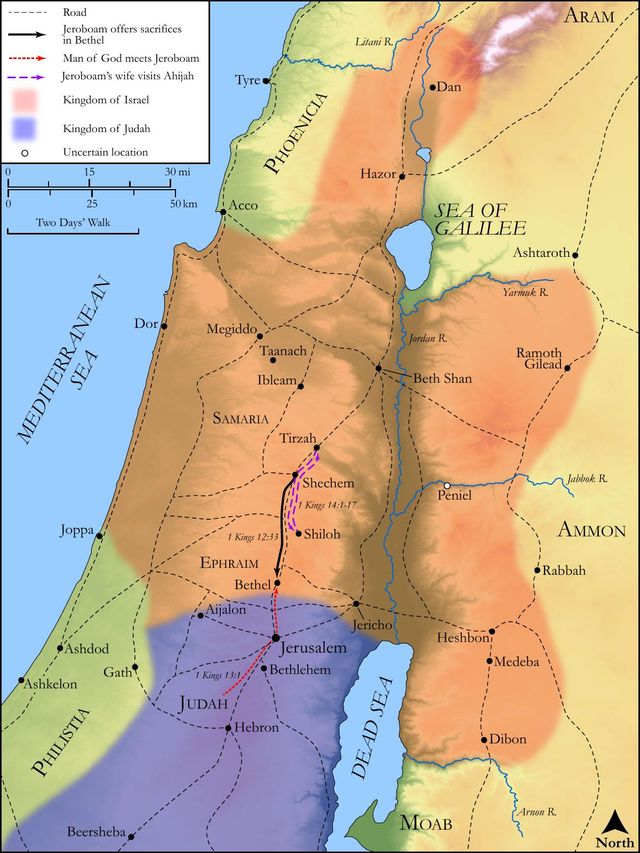
II.Jeroboam's wife has nothing to say against the word of the Lord, but she goes home with a heavy heart to their house in Tirzah, a sweet delightful place, so the name signifies, famed for its beauty, Sol 6:4. But death, which will stain its beauty and embitter all its delights, cannot be shut out from it. Hither she came, and here we leave her attending the funeral of her son, and expecting the fate of her family.
1.The child died (Kg1 14:17), and justly did all Israel mourn, not only for the loss of so hopeful a prince, whom they were not worthy of, but because his death plucked up the flood-gates, and made a breach, at which an inundation of judgments broke in.
2.Jeroboam himself died soon after, Kg1 14:20. It is said (Ch2 13:20), The Lord struck him with some sore disease, so that he died miserably, when he had reigned twenty-two years, and left his crown to a son who lost it, and his life too, and all the lives of his family, within two years after. For a further account of him the reader is referred to the annals of his reign, drawn up by his own secretaries, or to the public records, like those in the Tower, called here, The Book or register, of the Chronicles of the Kings of Israel, to which recourse might then be had; but, not being divinely inspired, these records are long since lost.
Historical interpretation
Historical reception
1 surviving comment on this verse from the historical church.
[The Scripture] calls “something pleasing” the fact that [Jeroboam] sent his wife to the prophet of God and not to the impostors and diviners. We must constantly admire the mercy of God, who increases many times over every good [action] performed by mortals and then returns it to them. This is quite evident from what he did for that father of the error of the calves and protector of the iniquity of Baal, namely, Ahab. Because of his fast of one day, and the night in which he slept in sackcloth, punishment was averted from his house and his kingdom for three years in order to show [God’s] mercy and exhort sinners to repentance.
Continue studying 1 Kings 14:13 across the web’s major study libraries — every link below opens this exact verse, chapter, or book on the destination site.
Read & Compare
 BibleGatewayThis verse in more than 200 translations and 70 languages.
 Bible.comThe YouVersion reader — hundreds of translations, reading plans, and highlights.
 ESV.orgCrossway's official English Standard Version reader.
 NET BibleThe NET translation with 60,000+ translators' notes on every rendering decision.
 STEP BibleTyndale House's free study tool — original text, vocabulary, and scholarly resources.
 BibliaLogos Bible Software's free web reader.
 USCCBThe New American Bible (Revised Edition) with the U.S. bishops' study notes.
Commentaries
 BibleHub CommentariesDozens of classic commentaries on this verse, gathered on one page.
 StudyLightMore than 100 commentary sets — the largest collection on the web.
 BibleRefPlain-English commentary on what this verse means, verse by verse.
 Enduring WordDavid Guzik's free commentary on this chapter, widely used by Bible teachers.
 Bible Study ToolsVerse commentary alongside Greek and Hebrew study aids.
Original Language & Research
- BibleHub InterlinearThe verse word by word — original language, transliteration, and English.
- BibleHub LexiconEvery word's original-language definition and Strong's entry.
 Blue Letter BibleDeep-study tools — Strong's numbers, concordance, and word studies.
 SefariaThe Hebrew text with Rashi and centuries of Jewish commentary.
Sermons, Hymns & Audio


TrulyRandomVerse is not affiliated with these sites and doesn’t control their content. They’re linked because they’re genuinely useful.
Summary
1 Kings 14:13 unveils a singular act of divine mercy and precise justice amidst the sweeping judgment pronounced upon the apostate house of King Jeroboam. It records the unique privilege granted to Jeroboam's son, Abijah, who alone among his lineage would receive a proper burial and national mourning. This exceptional favor is attributed to a "good thing" found within him by the LORD God of Israel, a profound testament to God's omniscience and His ability to discern genuine spiritual inclination even within a household steeped in profound idolatry and rebellion.
Context
ShowHideLiterary Context
This verse is an integral part of a severe prophetic oracle delivered by the aged prophet Ahijah of Shiloh to Jeroboam's disguised wife. The preceding verses, specifically 1 Kings 14:7-11, detail a comprehensive and devastating judgment against Jeroboam's dynasty. This judgment includes the complete destruction of his house and the ignominious fate of its members, whose bodies would be consumed by dogs and birds, signifying a total lack of proper burial and honor. Verse 13 stands in stark contrast to this grim pronouncement, highlighting a singular act of mercy. It follows the announcement of Abijah's imminent death upon his mother's return home, framing his demise not merely as a judgment on the house but also as a distinct act of grace for the individual. The narrative emphasizes the immediate fulfillment of Ahijah's prophecy, underscoring God's absolute sovereignty and the certainty of His word.
Historical & Cultural Context
King Jeroboam I had famously orchestrated a profound spiritual rebellion in the Northern Kingdom of Israel. To solidify his political power and prevent his people from returning to Jerusalem for worship, he established rival cult centers at Bethel and Dan, installing golden calves as objects of worship (1 Kings 12:26-33). This act was a direct and egregious violation of God's covenant and the First Commandment, incurring severe divine wrath that would plague his dynasty. In ancient Israelite culture, a proper burial was of paramount importance, signifying honor, peace, and a connection to one's ancestors and the land. To be unburied, or to have one's body consumed by scavengers, was considered the ultimate disgrace and a clear sign of God's most severe judgment, as frequently warned in prophetic literature (Deuteronomy 28:26; Jeremiah 8:2). Abijah's proper burial, therefore, was not merely a cultural custom but a profound, divinely orchestrated act of grace within a context of overwhelming and deserved judgment.
Key Themes
ShowHideThe verse powerfully articulates the tension between divine justice and individual mercy. While God's judgment on Jeroboam's house was absolute due to its pervasive idolatry and leadership in apostasy, His omniscience and discernment are profoundly highlighted by His ability to perceive a "good thing" in Abijah's heart. This demonstrates that God looks beyond outward appearances and corporate associations to the true state of the heart, a truth echoed in 1 Samuel 16:7. The passage also underscores the severe consequences of national apostasy while simultaneously affirming the value of personal piety even within the most corrupt environments. Abijah's story serves as a unique testament to God's readiness to acknowledge and honor genuine spiritual inclination, however small or hidden, even amidst profound wickedness and a general outpouring of divine wrath.
Exposition and Analysis
ShowHideKey Word Analysis
ShowHideThe Hebrew word טוֹב (ṭôwb') is a versatile term signifying "good," "pleasant," "agreeable," "right," or "morally upright." In this context, it refers to a genuine, perhaps nascent or private, inclination, disposition, or act that was pleasing to the LORD. It was not necessarily a grand public display of righteousness but an internal spiritual quality or a series of quiet choices that stood in stark contrast to the pervasive idolatry and wickedness of his father Jeroboam and the prevailing culture. God recognized an authentic, if perhaps incomplete, turning towards Him.
The Hebrew verb מָצָא (mâtsâʾ') means "to come forth to," "to appear," "to exist," or "to attain, find, acquire." Its use here emphasizes God's active perception and discernment. It implies that this "good thing" was not merely assumed or hoped for, but was genuinely present and discovered by God's omniscient gaze within Abijah, even amidst the spiritual darkness of his family. This highlights God's ability to see and acknowledge hidden spiritual realities.
The Hebrew word בַּיִת (bayith') primarily means "house," but extends to encompass "household," "family," or "dynasty." The phrase "in the house of Jeroboam" emphasizes the unlikely and remarkable context in which this "good thing" was found. The "house of Jeroboam" was synonymous with profound spiritual rebellion and was under a severe divine curse. To find anything "good" or God-ward within such a corrupt environment underscores the depth of God's discernment and His ability to see beyond the corporate identity to the individual heart. It highlights Abijah's unique spiritual integrity despite being raised in a household of apostasy.
Verse Breakdown
ShowHide"And all Israel shall mourn for him, and bury him"
This clause describes the unique privilege granted to Abijah, setting him apart from the rest of his family. In a culture where proper burial and mourning were highly valued, this signifies a measure of honor and divine favor. The phrase "all Israel" suggests a widespread, national recognition of his passing, contrasting sharply with the ignominious, unmourned deaths prophesied for the rest of Jeroboam's lineage. It implies a public acknowledgment of his distinction and the divine approval of his character.
"for he only of Jeroboam shall come to the grave"
This is the stark declaration of Abijah's exceptional fate, emphasizing the singularity of God's mercy. The word "only" (Hebrew, raq) underscores that this privilege was exclusive to Abijah. While the rest of Jeroboam's family would suffer the disgrace of unburied bodies, becoming carrion, Abijah alone would receive a proper burial. This highlights the severity of the judgment on the "house of Jeroboam" as a whole, making Abijah's fate a powerful testament to God's individualized discernment and the precision of His justice.
"because in him there is found [some] good thing toward the LORD God of Israel in the house of Jeroboam"
This is the divine rationale for Abijah's unique treatment. God's omniscience allowed Him to perceive an inner spiritual disposition in Abijah that was oriented towards the true God, despite his family's pervasive idolatry. This "good thing" was the basis for God's mercy, demonstrating that even a subtle or private inclination towards the LORD is recognized and honored by Him, even in the most ungodly of environments. It reveals that God's judgment is not indiscriminate but deeply personal and discerning.
Literary Devices
ShowHideThe passage employs several potent literary devices to convey its profound message. Contrast is paramount, setting Abijah's fate in stark opposition to the utter destruction and dishonor prophesied for the rest of Jeroboam's house. This highlights the exceptional nature of God's mercy towards an individual amidst corporate judgment. There is also a strong element of irony in the phrase "good thing... in the house of Jeroboam," as Jeroboam's household was the epitome of wickedness and rebellion against the LORD. The presence of any "good thing" within such a context is unexpected and underscores God's ability to find and honor genuine faith even in the most unlikely and corrupt places. Furthermore, the act of proper burial serves as a powerful symbolism of divine favor, peace, and honor, contrasting sharply with the symbolic disgrace of unburied bodies and the ultimate rejection by God. The entire narrative also functions as a prophecy, with Ahijah's words precisely foretelling Abijah's death and burial, thereby validating the prophet's authority and God's sovereign control over human events.
Theological and Thematic Connections
ShowHideThis verse profoundly illustrates the tension between corporate judgment and individual accountability, revealing God's character as both perfectly just and infinitely merciful. While the consequences of Jeroboam's apostasy were dire and extended to his entire lineage, God's discerning eye recognized a unique spiritual inclination in Abijah. This demonstrates that God's judgment is not a blind sweep but a precise and personal assessment of the heart. It underscores the biblical truth that God sees beyond outward appearances and family associations, valuing genuine, internal devotion even when it is hidden or imperfect. This encourages believers to cultivate an authentic relationship with the LORD, knowing that even small acts of faithfulness or a sincere heart orientation towards Him are seen and honored.
Reflection and Application
ShowHide1 Kings 14:13 offers a powerful message of hope and challenge for believers today. It reminds us that God's grace and discernment extend to individuals, even when they are part of a spiritually compromised family, community, or society. Abijah's story emphasizes the profound value of personal piety: even a "some good thing" in the heart, a genuine turning towards God, is recognized and honored by Him. This encourages us to cultivate an authentic relationship with the LORD, regardless of our surroundings, knowing that our internal disposition matters deeply to God. For those who find themselves in environments hostile to faith, Abijah's example shows that personal integrity and devotion to God can still be maintained and will be acknowledged. It also serves as a sobering reminder that while God's judgment for corporate and national sin is real, His justice is also highly individualized, recognizing the heart of each person. We are called to live with integrity, knowing that God sees our hearts and honors genuine faith, even when it is unseen by others, offering a profound comfort that our sincere efforts to please Him are never overlooked.
Questions for Reflection
ShowHideFAQ
ShowHideWhy was Abijah the only one of Jeroboam's house to receive a proper burial?
ShowHideAbijah was uniquely favored because God found "some good thing toward the LORD God of Israel" in him. This indicates a genuine, though perhaps private, spiritual inclination or devotion to the true God, which stood in stark contrast to the pervasive idolatry and wickedness of his father Jeroboam and the rest of the household. God's omniscience allowed Him to discern this internal disposition, distinguishing Abijah from his family who were under severe divine judgment for their apostasy.
What exactly was this "good thing" found in Abijah?
ShowHideThe Bible does not specify the exact nature of this "good thing." It likely refers to a genuine, perhaps nascent or private, reverence for the LORD, a turning of his heart towards the covenant God of Israel, or actions consistent with such a disposition. It was not necessarily a grand public act of righteousness, but an internal spiritual quality that God recognized and honored. This contrasts sharply with Jeroboam's deliberate and public rejection of the LORD in favor of idol worship, as detailed in 1 Kings 12.
Does this mean God is unfair to Jeroboam's other descendants who did not receive proper burial?
ShowHideNo, it does not imply unfairness. Instead, it highlights God's mercy and discernment towards Abijah. The judgment on Jeroboam's house was a just consequence of their widespread and persistent sin of leading Israel into idolatry. The ignominious deaths prophesied for the rest of the family were a deserved outcome for their rebellion. Abijah's proper burial was an exception, a specific act of grace based on God's unique perception of his heart, demonstrating that God's justice is precise and His mercy is sovereign, even amidst corporate judgment. This aligns with the principle that God's ways are always just, as seen throughout the biblical narrative, for example, in Deuteronomy 32:4.
Christ-Centered Fulfillment
ShowHideThe "good thing" found in Abijah, which garnered God's unique favor and a proper burial, points forward to the ultimate "good thing" in the person of Jesus Christ. While Abijah's goodness was partial and imperfect, Christ embodied perfect righteousness and complete devotion "toward the LORD God." In Jesus, God found not "some good thing," but the absolute and perfect good, the very Son who perfectly pleased the Father (Matthew 3:17). Abijah's burial was an act of mercy for one individual, but Christ's death and burial on the cross secured eternal life and spiritual burial for all who believe, taking away the sin of the world (John 1:29). Through faith in Him, we are not merely found with "some good thing," but are clothed in His perfect righteousness (2 Corinthians 5:21). The divine discernment that saw Abijah's heart now sees those who are "in Christ," granting them not just a physical grave but an eternal inheritance and resurrection life, fulfilling God's ultimate plan of justice and mercy through the perfect sacrifice of His Son (Romans 6:4). This ultimate act of divine favor through Christ far surpasses any earthly burial, offering eternal peace and communion with God.