


2 Chronicles 12:12
Bible text: King James Version (1769 Blayney text) · Public domain
Bible text: Berean Standard Bible · Public domain
Bible text: American Standard Version (1901) · Public domain
Bible text: World English Bible, Messianic edition · Public domain
Bible text: Geneva Bible (1599) · Public domain
Bible text: Young's Literal Translation · Public domain
- וּבְהִכָּנְעוֹu·ve·hi·ka·ne·'Oand when he humbled himselfH3665Conj-w ¦ Prep-b ¦ V-Niphal-Inf ¦ 3msVerb Niphal Infinitive Constructוּandבְwhenהִכָּנְעhe humbledוֹhimself
- שָׁבshavit turned backH7725V-Qal-Perf-3msVerb Qal Perfect 3rd Singular Masculine
- מִמֶּנּוּmi·Me·nufrom himH4480Prep ¦ 3msPrepositionמִמֶּfromנּוּhim
- אַף'af[the] anger ofH639N-mscNoun Singular Masculine Construct
- יְהוָהYah·wehYahwehH3068N-properNoun Proper Title
- וְלֹאve·Lo'and notH3808Conj-w ¦ NegParticle Negativeוְandלֹאnot
- לְהַשְׁחִיתle·hash·Chitto destroyH7843Prep-l ¦ V-Hiphil-InfVerb Hiphil Infinitive Constructלְtoהַשְׁחִיתdestroy
- לְכָלָהle·kha·Lahto complete destructionH3617Prep-l ¦ N-fsNoun Singular Feminine Absoluteלְtoכָלָהcomplete destruction
- וְגַםve·Gamand alsoH1571Conj-w ¦ AdvAdverbוְandגַםalso
- בִּיהוּדָהbi·hu·Dahin JudahH3063Prep-b ¦ N-properNoun Proper LocationבִּinיהוּדָהJudah
- הָיָהha·Yahit wasH1961V-Qal-Perf-3msVerb Qal Perfect 3rd Singular Masculine
- דְּבָרִיםde·va·RimthingsH1697N-mpNoun Plural Masculine Absolute
- טוֹבִיםto·VimgoodH2896Adj-mpAdjective Plural Masculine Absolute
English is a literal word-by-word gloss of the Hebrew, not the KJV's wording. Why?
This is the original text the KJV's translators worked from — each Hebrew word with its own literal English meaning in this verse, prepared by scholars at Tyndale House, Cambridge. The KJV translates whole sentences, not word by word, so its wording differs: one Hebrew word can become several English words, and the KJV may choose “the LORD” where the gloss reads “Yahweh”. Both are faithful — they answer different questions. For the KJV's own rendering, switch to the KJV text.
Details
See on the biblical-era map
Study this verse
Public-domain commentary
Matthew Henry
From his Commentary on the Whole Bible. Henry comments on passages, not single verses — this entry covers 2 Chronicles 12:1–12. His four-level outline is real structure in the source text, so it is rendered as structure.
Israel was very much disgraced and weakened by being divided into two kingdoms; yet the kingdom of Judah, having both the temple and the royal city, both the house of David and the house of Aaron, might have done very well if they had continued in the way of their duty; but here we have all out of order there.
I.Rehoboam and his people left God:
He forsook the law of the Lord, and so in effect forsook God, and all Israel with him, Ch2 12:1. He had his happy triennium, when he walked in the way of David and Solomon (Ch2 11:17), but it expired, and he grew remiss in the worship of God; in what instances we are not told, but he fell off, and Judah with him, here called Israel, because they walked in the evil ways into which Jeroboam had drawn the kingdom of Israel. Thus he did when he had established the kingdom and strengthened himself. As long as he thought his throne tottered he kept to his duty, that he might make God his friend; but, when he found it stood pretty firmly, he thought he had no more occasion for religion; he was safe enough without it. Thus the prosperity of fools destroys them. Jeshurun waxed fat and kicked. When men prosper, and are in no apprehension of troubles, they are ready to say to God, Depart from us.
II.God quickly brought troubles upon them, to awaken them, and recover them to repentance, before their hearts were hardened.
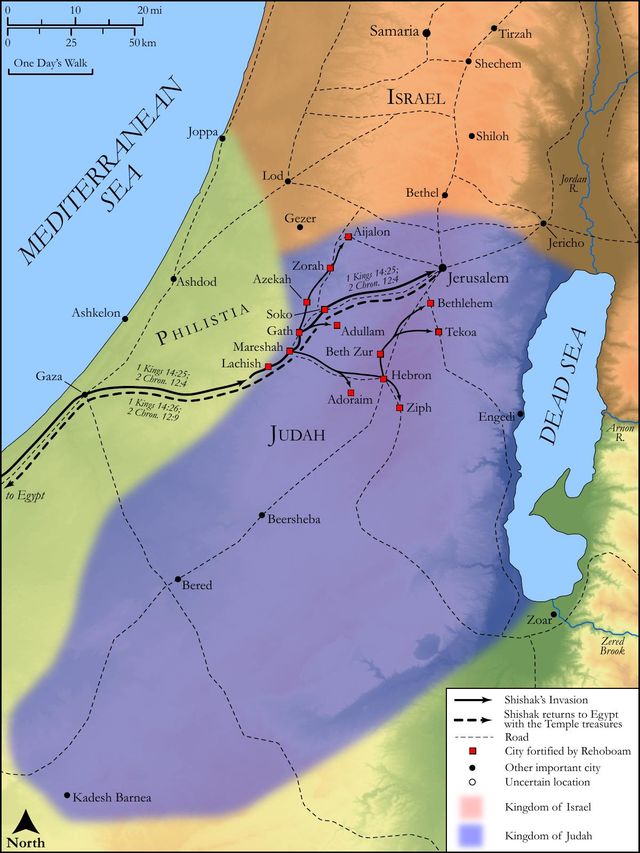
It was but in the fourth year of Rehoboam that they began to corrupt themselves, and in the fifth year the king of Egypt came up against them with a vast army, took the fenced cities of Judah, and came against Jerusalem, Ch2 12:2, Ch2 12:3, Ch2 12:4. This great calamity coming upon them so soon after they began to desert the worship of God, by a hand they had little reason to suspect (having had a great deal of friendly correspondence with Egypt in the last reign), and coming with so much violence that all the fenced cities of Judah, which Rehoboam had lately fortified and garrisoned and on which he relied much for the safety of his kingdom, fell immediately into the hands of the enemy, without making any resistance, plainly showed that it was from the Lord, because they had transgressed against him.
III.Lest they should not readily or not rightly understand the meaning of this providence, God by the word explains the rod, Ch2 12:5.
When the princes of Judah had all met at Jerusalem, probably in a great council of war, to concert measures for their own safety in this critical juncture, he sent a prophet to them, the same that had brought them an injunction from God not to fight against the ten tribes (Ch2 11:2), Shemaiah by name; he told them plainly that the reason why Shishak prevailed against them was not because they had been impolitic in the management of their affairs (which perhaps the princes in this congress were at this time scrutinizing), but because they had forsaken God. God never leaves any till they first leave him.
IV.The rebukes both of the word and of the rod being thus joined, the king and princes humbled themselves before God for their iniquity, penitently acknowledged the sin, and patiently accepted the punishment of it, saying, The Lord is righteous, Ch2 12:6. "We have none to blame but ourselves; let God be clear when he judgeth." Thus it becomes us, when we are under the rebukes of Providence, to justify God and judge ourselves. Even kings and princes must either bend or break before God, either be humbled or be ruined.
V.Upon the profession they made of repentance God showed them some favour, saved them from ruin, and yet left them under some remaining fears of the judgment, to prevent their revolt again.
1.God, in mercy, prevented the destruction they were now upon the brink of. Such a vast and now victorious army as Shishak had, having made themselves masters of all the fenced cities, what could be expected but that the whole country, and even Jerusalem itself, would in a little time be theirs? But when God saith, Here shall the proud waves be stayed, the most threatening force strangely dwindles and becomes impotent. Here again the destroying angel, when he comes to Jerusalem, is forbidden to destroy it: "My wrath shall not be poured out upon Jerusalem; not at this time, not by this hand, not utterly to destroy it," Ch2 12:7, Ch2 12:12. Note, Those that acknowledge God righteous in afflicting them shall find him gracious. Those that humble themselves before him shall find favour with him. So ready is the God of mercy to take the first occasion to show mercy. If we have humbled hearts under humbling providences, the affliction has done its work, and it shall either be removed or the property of it altered.
2.He granted them some deliverance, not complete, but in part; he gave them some advantages against the enemy, so that they recruited a little; he gave them deliverance for a little while, so some. They reformed but partially, and for a little while, soon relapsing again; and, as their reformation was, so was their deliverance. Yet it is said (Ch2 12:12), in Judah things went well, and began to look with a better face.
(1.)In respect of piety. There were good things in Judah (so it is in the margin), good ministers, good people, good families, who were made better by the calamities of their country. Note, In times of great corruption and degeneracy it is some comfort if there be a remnant among whom good things ar found; this is a ground of hope in Israel.
(2.)In respect of prosperity. In Judah things went ill when all the fenced cities were taken (Ch2 12:4), but when they repented the posture of their affairs altered, and things went well. Note, If things do not go so well as we could wish, yet we have reason to take notice of it with thankfulness if they go better than was to have been expected, better than formerly, and better than we deserved. We should own God's goodness if he do but grant us some deliverance.
3.Yet he left them to smart sorely by the hand of Shishak, both in their liberty and in their wealth.
(1.)In their liberty (Ch2 12:8): They shall be his servants (that is, they shall lie much at his mercy and be put under contribution by him, and some of them perhaps be taken prisoners and held in captivity by him), that they may know my service, and the service of the kingdoms of the countries. They complained, it may be, of the strictness of their religion, and forsook the law of the Lord (Ch2 12:1) because they thought it a yoke to hard, too heavy, upon them. "Well," saith God, "let them better themselves if they can; let the neighbouring princes rule them awhile, since they are not willing that I should rule them, and let them try how they like that. They might have served God with joyfulness and gladness of heart, and would not; let them serve their enemies then in hunger and thirst (Deu 28:47, Deu 28:48), till they think of returning to their first Master, for then it was better with them," Hos 2:7. This, some think, is the meaning of Eze 20:24, Eze 20:25. Because they despised my statutes, I gave them statutes that were not good. Note,
[1.]The more God's service is compared with other services the more reasonable and easy it will appear.
[2.]Whatever difficulties or hardships we may imagine there are in the way of obedience, it is better a thousand times to go through them than to expose ourselves to the punishment of disobedience. Are the laws of temperance thought hard? The effects of intemperance will be much harder. The service of virtue is perfect liberty; the service of lust is perfect slavery.
(2.)In their wealth. The king of Egypt plundered both the temple and the exchequer, the treasuries of both which Solomon left very full; but he took them away; yea, he took all, all he could lay his hands on, Ch2 12:9. This was what he came for. David and Solomon, who walked in the way of God, filled the treasuries, one by war and the other by merchandise; but Rehoboam, who forsook the law of God, emptied them. The taking away of the golden shields, and the substituting of brazen ones in their place (Ch2 12:9-11), we had an account of before, Kg1 14:25-28.
Continue studying 2 Chronicles 12:12 across the web’s major study libraries — every link below opens this exact verse, chapter, or book on the destination site.
Read & Compare
 BibleGatewayThis verse in more than 200 translations and 70 languages.
 Bible.comThe YouVersion reader — hundreds of translations, reading plans, and highlights.
 ESV.orgCrossway's official English Standard Version reader.
 NET BibleThe NET translation with 60,000+ translators' notes on every rendering decision.
 STEP BibleTyndale House's free study tool — original text, vocabulary, and scholarly resources.
 BibliaLogos Bible Software's free web reader.
 USCCBThe New American Bible (Revised Edition) with the U.S. bishops' study notes.
Commentaries
 BibleHub CommentariesDozens of classic commentaries on this verse, gathered on one page.
 StudyLightMore than 100 commentary sets — the largest collection on the web.
 BibleRefPlain-English commentary on what this verse means, verse by verse.
 Enduring WordDavid Guzik's free commentary on this chapter, widely used by Bible teachers.
 Bible Study ToolsVerse commentary alongside Greek and Hebrew study aids.
Original Language & Research
- BibleHub InterlinearThe verse word by word — original language, transliteration, and English.
- BibleHub LexiconEvery word's original-language definition and Strong's entry.
 Blue Letter BibleDeep-study tools — Strong's numbers, concordance, and word studies.
 SefariaThe Hebrew text with Rashi and centuries of Jewish commentary.
Sermons, Hymns & Audio


TrulyRandomVerse is not affiliated with these sites and doesn’t control their content. They’re linked because they’re genuinely useful.
Summary
Second Chronicles 12:12 encapsulates a pivotal moment in King Rehoboam's reign, demonstrating the transformative power of genuine humility before God. Following Judah's widespread apostasy and the subsequent divine judgment manifested through the invasion of Shishak, king of Egypt, Rehoboam and the nation's leaders responded with contrition. This act of self-abasement prompted the LORD to mitigate His full wrath, preventing total destruction and allowing a measure of well-being and stability to remain in Judah, thereby powerfully illustrating God's responsive mercy to sincere repentance.
Context
ShowHideLiterary Context
This verse is strategically placed within the narrative detailing the consequences of Rehoboam's and Judah's unfaithfulness. The preceding chapters, 2 Chronicles 10 and 2 Chronicles 11, describe the tragic division of the united monarchy and Rehoboam's initial efforts to fortify his southern kingdom. However, 2 Chronicles 12:1 reveals a critical turning point: "when Rehoboam's royal power was established and he had become strong, he abandoned the law of the LORD, and all Israel with him." This abandonment provokes God's righteous judgment, which arrives swiftly in the form of Shishak's Egyptian invasion, meticulously described in 2 Chronicles 12:2-4. The prophet Shemaiah then delivers a direct divine message in 2 Chronicles 12:5, explicitly linking the invasion to their forsaking the LORD. Critically, 2 Chronicles 12:6-7 recount Rehoboam and the princes humbling themselves, leading directly to God's compassionate decision to not utterly destroy them, thus setting the immediate stage for the summary statement in verse 12.
Historical & Cultural Context
Rehoboam's reign, spanning approximately 931-913 BC, marked a significant decline from the Solomonic golden age, culminating in the permanent schism of Israel. The invasion by Shishak I of Egypt (Sheshonq I), mentioned in the biblical text, is a well-attested historical event, corroborated by Egyptian inscriptions, notably on the Bubastite Portal at Karnak, which lists cities conquered in Judah and Israel. This invasion was a major geopolitical tremor, signifying Egypt's resurgence as a regional power and its renewed influence in the Levant. Culturally, the act of "humbling oneself" in Israel was a profound demonstration of submission, often involving outward expressions such as prostration, wearing sackcloth, fasting, and lamentation. These actions were not merely performative but signified an internal acknowledgment of guilt, a surrender of pride, and an appeal for mercy from a superior authority—in this case, the sovereign God of Israel. The Israelite understanding of divine judgment for covenant disobedience was deeply ingrained, and the principle of God's turning away wrath in response to genuine repentance was a foundational theological concept, frequently illustrated throughout their history.
Key Themes
ShowHideThe overarching theme permeating 2 Chronicles 12, and powerfully encapsulated in verse 12, is the direct and undeniable correlation between obedience or disobedience and divine blessing or judgment. Rehoboam's initial abandonment of the LORD's law directly precipitates the severe judgment of the Egyptian invasion. However, the narrative pivots to introduce the profound theme of divine mercy and God's responsiveness to sincere repentance. God's character is revealed not merely as a righteous judge but as one who is "compassionate and gracious, slow to anger, abounding in love and faithfulness" (Psalm 86:15). The verse also underscores the corporate impact of a leader's spiritual condition. Rehoboam's personal act of humility had far-reaching consequences, extending a measure of reprieve and well-being to the entire nation of Judah. This highlights the theological principle that the spiritual health and moral choices of those in authority can profoundly influence the destiny and welfare of the community they govern, echoing the Chronicler's consistent emphasis on the importance of righteous kingship for national prosperity.
Exposition and Analysis
ShowHideKey Word Analysis
ShowHideThis verb (H3665, כָּנַע) is a primitive root meaning "to bend the knee," and by extension, "to humiliate" or "vanquish." In this context, it signifies a deep, internal submission and a bowing down, not merely an external act. It implies a recognition of one's own weakness, sinfulness, and utter dependence on a higher power. For Rehoboam and the princes, it meant acknowledging God's righteous judgment and their own culpability, leading to a profound change of heart and posture before the LORD. It represents a surrender of pride and an embrace of penitence.
This noun (H639, אָף) literally refers to the "nose" or "nostril," but by extension, it signifies the "face" and, most commonly, "ire" or "anger" due to the rapid breathing associated with passion. "The wrath of the LORD" (חֲרוֹן יְהוָה, ḥārôn YHWH) refers to God's holy indignation against sin, a righteous anger that justly responds to covenant breaking and rebellion. Its presence indicates divine displeasure and the impending consequences of disobedience.
This primitive root (H7725, שׁוּב) means "to turn back" or "turn away," transitively or intransitively. Here, it describes God's active decision to withdraw or redirect His impending, full judgment. The turning away of God's wrath signifies His mercy and willingness to relent when genuine repentance is offered, demonstrating His sovereignty over judgment and His compassionate nature. It implies a change in the course of divine action due to a change in human posture.
This noun (H3617, כָּלָה) means "a completion" or "consummation," and by extension, "destruction." Used adverbially here, it means "completely" or "utterly." The phrase "would not destroy him altogether" emphasizes that while judgment was severe, it was not total. God's mercy prevented the complete annihilation or utter ruin that their sins deserved, preserving a remnant and demonstrating His restraint even in discipline.
Verse Breakdown
ShowHide"And when he humbled himself"
This clause refers primarily to King Rehoboam, but it also implicitly encompasses the princes of Israel who humbled themselves alongside him, as explicitly stated in 2 Chronicles 12:6. Their act of humbling was a direct, penitent response to the prophet Shemaiah's declaration of God's impending judgment through the Egyptian invasion. It signified a recognition of their sin, an admission of God's just hand in their affliction, and a crucial shift from defiance to submission.
"the wrath of the LORD turned from him"
This signifies God's immediate and merciful response to their repentance. The LORD, who had brought the invasion as a form of disciplinary wrath for their covenant breaking, now chose to mitigate its full destructive power. This turning away of wrath is not a sign of God's weakness or indecisiveness, but rather a profound demonstration of His covenant faithfulness and His readiness to extend mercy to those who genuinely seek Him with a contrite heart.
"that he would not destroy [him] altogether"
This phrase clarifies the precise extent and nature of God's mercy. While judgment was indeed executed (Shishak plundered Jerusalem and took treasures, as detailed in 2 Chronicles 12:9), the ultimate, total destruction that could have befallen Judah was averted. God's restraint prevented the complete annihilation of the kingdom or the dynasty, preserving a remnant in accordance with His larger redemptive plan for His people.
"and also in Judah things went well"
This final clause indicates the positive, albeit partial, outcome of Rehoboam's and Judah's humility. Despite the plundering and the subsequent subjugation to Egypt (as mentioned in 2 Chronicles 12:8), the nation experienced a measure of reprieve, stability, and continued existence. "Things went well" suggests that the worst of the judgment was averted, allowing for a degree of recovery and continued function, a direct consequence of God's compassionate intervention.
Literary Devices
ShowHideThe verse powerfully employs Cause and Effect, establishing a clear and direct link between Rehoboam's act of humility and God's subsequent averted wrath and the resulting measure of well-being in Judah. This highlights a foundational biblical principle that divine judgment, while just, can be mitigated or turned away by genuine repentance. There is also a strong element of Divine Retribution and Mercy, where God's just response to sin (His wrath) is balanced by His compassionate willingness to relent when His people humble themselves. The narrative further presents a profound Contrast between the deserved total destruction ("destroy him altogether") and the actual partial preservation ("would not destroy him altogether" and "things went well"). This contrast underscores the redemptive and restorative character of God, who desires not to utterly destroy but to offer a path to restoration, even amidst necessary discipline.
Theological and Thematic Connections
ShowHide2 Chronicles 12:12 profoundly illustrates God's sovereign control over nations and His unwavering commitment to justice, yet always tempered by boundless mercy. It reinforces the theological truth that while God's wrath is a righteous and just response to sin and covenant unfaithfulness, His nature is also one of profound compassion, always open to genuine repentance. This narrative serves as a powerful testament to the efficacy of humility before God, demonstrating that a sincere change of heart, even from a national leader, can alter the course of divine judgment. It underscores the covenant principle that God responds dynamically to His people's posture, offering reprieve and restoration even when they have justly earned severe consequences.
Reflection and Application
ShowHideThis verse offers timeless spiritual lessons for individuals, families, and communities alike. It serves as a powerful reminder that our posture before God in times of difficulty, consequence, or correction is of paramount importance. When we face the natural or divine consequences of our choices—whether personal sin, corporate rebellion, or societal decay—the most potent and redemptive response is not defiance, self-justification, or despair, but genuine humility. This humility involves acknowledging our sin, taking full responsibility for our actions, and submitting to God's righteous hand. In doing so, we open ourselves to God's profound mercy, which possesses the power to turn away impending judgment and bring about a measure of peace, healing, and restoration, even if not a complete reversal of all consequences. The passage calls us to cultivate a spirit of brokenness and contrition, trusting that God is always ready to meet us in our repentance, just as He graciously did for Rehoboam and the nation of Judah.
Questions for Reflection
ShowHideFAQ
ShowHideDid Rehoboam's humility lead to a complete reversal of all negative consequences for Judah?
ShowHideNo, Rehoboam's humility did not lead to a complete reversal of all negative consequences for Judah. While the verse states that "the wrath of the LORD turned from him, that he would not destroy [him] altogether," and "also in Judah things went well," the preceding verses clarify that significant judgment was still executed. Shishak did indeed plunder the treasures of the house of the LORD and the king's house, including Solomon's golden shields, which had to be replaced with bronze ones (2 Chronicles 12:9-10). Furthermore, 2 Chronicles 12:8 explicitly states that Judah became Shishak's servants, so "they may learn the difference between serving me and serving the kingdoms of other lands." This demonstrates that while God's ultimate destructive wrath was averted, and a measure of well-being and continued existence was granted, the nation still experienced significant discipline, lost some of its former glory, and suffered a reduction in autonomy. God's mercy is profound and powerful, but it does not always negate all the painful or instructive consequences of sin.
Christ-Centered Fulfillment
ShowHide2 Chronicles 12:12, with its powerful depiction of a leader's humility averting divine wrath and bringing a measure of well-being, finds its ultimate and perfect fulfillment in the person and work of Jesus Christ. Rehoboam's act of humbling himself was a temporary and imperfect turning away of judgment for a specific nation; Christ's humility, however, is the eternal and perfect means by which the wrath of God is turned away from all who believe. The "wrath of the LORD" that justly falls upon all humanity for its sin (Romans 1:18) was fully borne by the Son of God on the cross. Jesus, "who, being in very nature God, did not consider equality with God something to be used to his own advantage; rather, he emptied himself, by taking the very nature of a servant, being made in human likeness. And being found in appearance as a man, he humbled himself by becoming obedient to death—even death on a cross!" (Philippians 2:6-8). Through His ultimate act of humility and perfect obedience, Christ became the "Lamb of God, who takes away the sin of the world!" (John 1:29), thereby turning God's righteous wrath from His people forever. While "things went well" for Judah in a temporal and limited sense, for believers, in Christ, "things go well" eternally, as we are fully reconciled to God and receive the ultimate well-being of eternal life, peace with God, and adoption into His family (Romans 5:1).