


1 Kings 15:29
- וַיְהִיvay·Hiand it wasH1961Conj-w ¦ V-Qal-ConsecImperf-3msVerb Qal Consecutive Imperfect 3rd Singular Masculineוַandיְהִיit was
- כְמָלְכוֹkhe·ma·le·Khowhen he became kingH4427Prep-k ¦ V-Qal-Inf ¦ 3msVerb Qal Infinitive Constructכְwhenמָלְכbecame kingוֹhe
- הִכָּהhi·Kahhe struck downH5221V-Hiphil-Perf-3msVerb Hiphil Perfect 3rd Singular Masculine
- אֶת'et<obj.>H853DirObjMParticle Object Indicator
- כָּלkolallH3605N-mscNoun Singular Masculine Construct
- בֵּיתbeit[the] house ofH1004N-mscNoun Singular Masculine Construct
- יָרָבְעָםya·ra·ve·'AmJeroboamH3379N-proper-mNoun Proper Masculine
- לֹאlo'notH3808NegParticle Negative
- הִשְׁאִירhish·'Irhe leftH7604V-Hiphil-Perf-3msVerb Hiphil Perfect 3rd Singular Masculine
- כָּלkolanyH3605N-mscNoun Singular Masculine Construct
- נְשָׁמָהne·sha·Mahbreathing thingH5397N-fsNoun Singular Feminine Absolute
- לְיָרָבְעָםle·ya·ra·ve·'Amof JeroboamH3379Prep-l ¦ N-proper-mNoun Proper MasculineלְofיָרָבְעָםJeroboam
- עַד'aduntilH5704PrepPreposition
- הִשְׁמִדוֹhish·mi·Dohe had destroyed itH8045V-Hiphil-Perf-3ms ¦ 3msVerb Hiphil Perfect 3rd Singular Masculineהִשְׁמִדhe had destroyedוֹit
- כִּדְבַרkid·Varaccording to [the] word ofH1697Prep-k ¦ N-mscNoun Singular Masculine Constructכִּaccording toדְבַר[the] word of
- יְהוָהYah·wehYahwehH3068N-properNoun Proper Title
- אֲשֶׁר'a·SherwhichH834RelParticle Relative
- דִּבֶּרdi·Berhe spokeH1696V-Piel-Perf-3msVerb Piel Perfect 3rd Singular Masculine
- בְּיַדbe·yadby [the] hand ofH3027Prep-b ¦ N-cscNoun Singular common gender Constructבְּbyיַד[the] hand of
- עַבְדּוֹav·Dohis servantH5650N-msc ¦ 3msNoun Singular Masculine Constructעַבְדּservantוֹhis
- אֲחִיָּה'a·chi·YahAhijahH281N-proper-mNoun Proper Masculine
- הַשִּׁילֹנִיha·shi·lo·Ni<the> ShiloniteH7888Art ¦ N-msNoun Gentilic Singular Masculine Absoluteהַ<the>שִּׁילֹנִיShilonite
English is a literal word-by-word gloss of the Hebrew, not the KJV's wording. Why?
This is the original text the KJV's translators worked from — each Hebrew word with its own literal English meaning in this verse, prepared by scholars at Tyndale House, Cambridge. The KJV translates whole sentences, not word by word, so its wording differs: one Hebrew word can become several English words, and the KJV may choose “the LORD” where the gloss reads “Yahweh”. Both are faithful — they answer different questions. For the KJV's own rendering, switch to the KJV text.
Details
See on the biblical-era map
Study this verse
Public-domain commentary
Matthew Henry
From his Commentary on the Whole Bible. Henry comments on passages, not single verses — this entry covers 1 Kings 15:25–34.
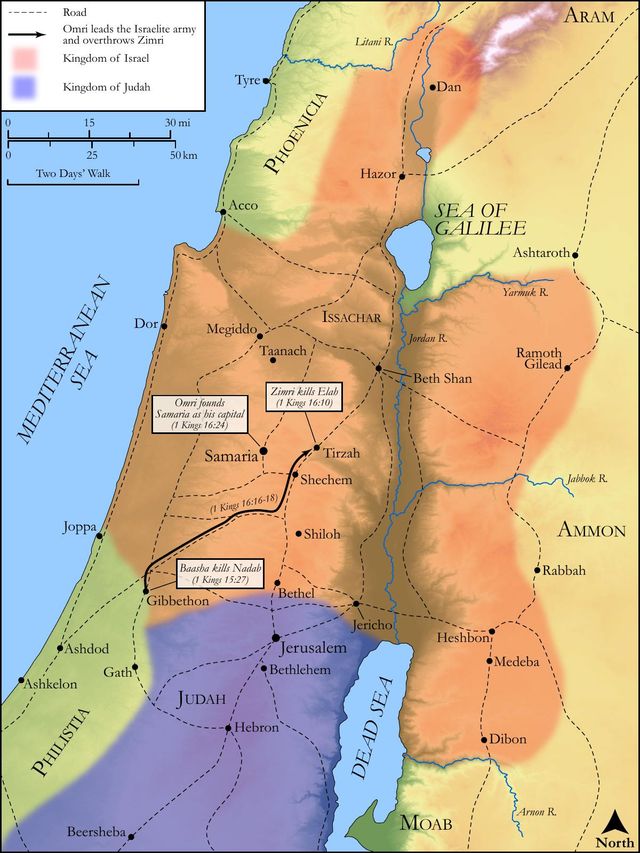
We are now to take a view of the miserable state of Israel, while the kingdom of Judah was happy under Asa's good government. It was threatened that they should be as a reed shaken in the water (Kg1 14:15), and so they were, when, during the single reign of Asa, the government of their kingdom was in six or seven different hands, as we find in this and the following chapter. Jeroboam was upon the throne in the beginning of his reign and Ahab at the end of it, and between them were Nadab, Baasha, Elah, Zimri, Tibni, and Omri, undermining and destroying one another. This they got by deserting the house both of God and of David. Here we have, 1. The ruin and extirpation of the family of Jeroboam, according to the word of the Lord by Ahijah. His son Nadab succeeded him. If the death of his brother Abijah had had a due influence upon him to make him religious, and the honour done him at his death had engaged him to follow his good example, his reign might have been long and glorious; but he walked in the way of his father (Kg1 15:26), kept up the worship of his calves, and forbade his subjects to go up to Jerusalem to worship, sinned and made Israel to sin, and therefore God brought ruin upon him quickly, in the second year of his reign. He was besieging Gibbethon, a city which the Philistines had taken from the Danites, and was endeavouring to re-take it; and there, in the midst of his army, did Baasha, with others, conspire against him and kill him, (Kg1 15:27), and so little interest had he in the affections of his people that his army did not only not avenge his death, but chose his murderer for his successor. Whether Baasha did it upon a personal pique against Nadab, or to be avenged on the house of Jeroboam for some affront received from them, or whether under pretence of freeing his country from the tyranny of a bad prince, or whether merely from a principle of ambition, to make way for himself to the throne, does not appear; but he slew him and reigned in his stead, Kg1 15:28. And the first thing he did when he came to the crown was to cut off all the house of Jeroboam, that he might the better secure himself and his own usurped government. He thought it not enough to imprison or banish them, but he destroyed them, left not only no males (as was foretold, Kg1 14:10), but none that breathed. Herein he was barbarous, but God was righteous. Jeroboam's sin was punished (Kg1 15:30); for those that provoke God do it to their own confusion; see Jer 7:19. Ahijah's prophecy was accomplished (Kg1 15:29); for no word of God shall fall to the ground. Divine threatenings are not bugbears. 2. The elevation of Baasha. He shall be tried awhile, as Jeroboam was. Twenty-four years he reigned (Kg1 15:33), but showed that it was not from any dislike to Jeroboam's sin that he destroyed his family, but from malice and ambition; for, when he had rooted out the sinner, he himself clave to the sin, and walked in the way of Jeroboam (Kg1 15:34), though he had seen the end of that way; so strangely was his heart hardened with the deceitfulness of sin.
Continue studying 1 Kings 15:29 across the web’s major study libraries — every link below opens this exact verse, chapter, or book on the destination site.
Read & Compare
 BibleGatewayThis verse in more than 200 translations and 70 languages.
 Bible.comThe YouVersion reader — hundreds of translations, reading plans, and highlights.
 ESV.orgCrossway's official English Standard Version reader.
 NET BibleThe NET translation with 60,000+ translators' notes on every rendering decision.
 STEP BibleTyndale House's free study tool — original text, vocabulary, and scholarly resources.
 BibliaLogos Bible Software's free web reader.
 USCCBThe New American Bible (Revised Edition) with the U.S. bishops' study notes.
Commentaries
 BibleHub CommentariesDozens of classic commentaries on this verse, gathered on one page.
 StudyLightMore than 100 commentary sets — the largest collection on the web.
 BibleRefPlain-English commentary on what this verse means, verse by verse.
 Enduring WordDavid Guzik's free commentary on this chapter, widely used by Bible teachers.
 Bible Study ToolsVerse commentary alongside Greek and Hebrew study aids.
Original Language & Research
- BibleHub InterlinearThe verse word by word — original language, transliteration, and English.
- BibleHub LexiconEvery word's original-language definition and Strong's entry.
 Blue Letter BibleDeep-study tools — Strong's numbers, concordance, and word studies.
 SefariaThe Hebrew text with Rashi and centuries of Jewish commentary.
Sermons, Hymns & Audio


TrulyRandomVerse is not affiliated with these sites and doesn’t control their content. They’re linked because they’re genuinely useful.
Summary
First Kings 15:29 records the brutal and complete annihilation of King Jeroboam's entire household by Baasha, who had recently usurped the throne of Israel. This violent purge, which left no living descendant of Jeroboam, is explicitly presented not merely as a political power grab but as the direct and precise fulfillment of a divine prophecy delivered earlier by the prophet Ahijah the Shilonite, underscoring God's absolute sovereignty over human affairs and His unwavering justice.
Context
ShowHideLiterary Context
This verse immediately follows Baasha's successful assassination of Nadab, Jeroboam's son, and his subsequent ascension to the throne of the Northern Kingdom of Israel (1 Kings 15:27-28). The narrative of 1 Kings consistently highlights the instability of the Northern Kingdom's dynasties, often contrasted with the more stable (though not perfect) Davidic line in Judah. Jeroboam himself was the first king of the divided Northern Kingdom, chosen by God but quickly falling into grievous idolatry by establishing golden calves for worship in Bethel and Dan (see 1 Kings 12:28-30). This act of apostasy, leading the entire nation astray, provoked God's severe judgment, which was pronounced by the prophet Ahijah against Jeroboam's house in 1 Kings 14:7-16. Verse 29, therefore, marks the dramatic and irreversible conclusion of Jeroboam's dynasty, fulfilling the specific and dire warnings given by the prophet.
Historical & Cultural Context
The extermination of a predecessor's entire household was a common, albeit brutal, practice in ancient Near Eastern monarchies following a coup. This practice served to eliminate all potential rivals, especially male heirs, who might later challenge the new king's legitimacy or attempt to reclaim the throne. Such purges were designed to secure the new dynasty's power and prevent future rebellions. The Northern Kingdom of Israel, unlike Judah with its covenantal promise to the Davidic line, experienced frequent dynastic changes marked by violence and instability. Baasha's actions fit this pattern of securing power through ruthless means. However, the unique aspect here is the explicit theological interpretation: what appears as a purely political act is revealed as a divinely orchestrated judgment, demonstrating that God works through human agents, even those driven by their own ambition, to accomplish His purposes.
Key Themes
ShowHideThe most prominent theme in 1 Kings 15:29 is the Fulfillment of Prophecy. The text unequivocally states that Baasha's actions were "according unto the saying of the LORD, which he spake by his servant Ahijah the Shilonite." This highlights God's absolute sovereignty and the certainty of His word, demonstrating that His declared will, whether of blessing or judgment, will inevitably come to pass (Isaiah 46:10). Closely related is the theme of Divine Judgment. The complete destruction of Jeroboam's dynasty serves as a stark and severe example of God's righteous judgment against persistent sin, particularly idolatry and leading His people into spiritual rebellion. It underscores the profound consequences of rejecting God's commands and leading others astray, a pattern repeated throughout the books of Kings. Finally, the verse illustrates God's Use of Human Agents. Baasha, driven by his own ambition and desire for power, unknowingly or knowingly became an instrument through which God's predetermined judgment was executed. This demonstrates God's ability to use even the wicked actions of men to accomplish His divine purposes, maintaining His ultimate control over history (Proverbs 16:4).
Exposition and Analysis
ShowHideKey Word Analysis
ShowHideThe Hebrew verb נָכָה (nakah) is a common term that means "to strike, to smite, to beat, to kill." In this context, coupled with the subsequent phrase "he left not... any that breathed," it carries the strong connotation of a decisive and violent act of killing, specifically a military or judicial execution rather than a mere physical blow. It implies a thorough and intentional act of destruction.
The Hebrew verb שָׁמַד (shâmad) means "to desolate, to destroy, to annihilate." When used in the Hiphil stem (as implied by the KJV "destroyed him"), it emphasizes causing utter destruction or extermination. In conjunction with "smote" and "left not any that breathed," it leaves no doubt that Baasha's purge was absolute, aiming for the complete eradication of Jeroboam's lineage.
The Hebrew word נְשָׁמָה (nᵉshâmâh), meaning "breath" or "soul," is used here in the phrase "any that breathed" (כָּל־נְשָׁמָה, kol-neshamah). This powerful idiom signifies absolute annihilation, conveying the idea that no living being, no male heir, no one with the breath of life, was left from Jeroboam's house. This underscores the ruthlessness and comprehensiveness of the purge, ensuring no one remained to challenge Baasha's new reign or to perpetuate Jeroboam's lineage.
Verse Breakdown
ShowHide"And it came to pass, when he reigned, [that] he smote all the house of Jeroboam;"
This clause establishes the immediate context of Baasha's actions. Upon securing the throne after assassinating Nadab, his first order of business was to eliminate any potential threats to his reign. "All the house of Jeroboam" signifies not just his immediate family but his entire extended household and male descendants, ensuring the complete eradication of his dynastic claim.
"he left not to Jeroboam any that breathed, until he had destroyed him,"
This phrase vividly describes the extreme nature of the purge. It emphasizes the totality of the destruction, leaving no survivor, no one who could carry on Jeroboam's name or challenge Baasha. The repetition of "destroyed him" (referring to the house/lineage) reinforces the decisive and thorough nature of the extermination, leaving no remnant.
"according unto the saying of the LORD, which he spake by his servant Ahijah the Shilonite:"
This is the crucial theological commentary on the historical event. It elevates Baasha's violent act from a mere political maneuver to a divinely ordained fulfillment. The author explicitly connects the event to the prophecy delivered by Ahijah in 1 Kings 14, asserting that God's word, once spoken, is certain to come to pass, even through the seemingly independent actions of human agents. This highlights God's sovereign control over history and His unwavering justice.
Literary Devices
ShowHideThe passage employs several potent literary devices to convey its message. Divine Commentary is central, as the narrator explicitly states that Baasha's actions were "according unto the saying of the LORD," providing a theological lens through which to interpret the violent political event. This direct intervention by the narrator ensures the audience understands the divine hand at work. Hyperbole is evident in the phrase "he left not... any that breathed," which emphasizes the absolute and total annihilation of Jeroboam's lineage, leaving no living soul. While perhaps not literally every single person, it conveys the complete eradication of the dynastic line. There is also a strong element of Irony, as Baasha, driven by his own ambition and desire for power, unwittingly or unwillingly becomes the instrument of God's judgment, fulfilling a prophecy he may not have even known about. This underscores God's ability to use even the wicked actions of humans to achieve His righteous purposes.
Theological and Thematic Connections
ShowHideThe eradication of Jeroboam's house in 1 Kings 15:29 serves as a powerful testament to God's unwavering justice and the absolute certainty of His prophetic word. Jeroboam's sin of establishing idolatry and leading Israel astray was not a minor transgression; it was a profound act of rebellion against the covenant God and His commands, setting a dangerous precedent for the Northern Kingdom. This severe judgment demonstrates that while God is merciful and patient, He is also just and will not allow unrepentant sin, especially that which leads His people into apostasy, to go unpunished indefinitely. The fulfillment of Ahijah's prophecy, even through a violent human agent like Baasha, underscores God's sovereign control over history and His commitment to upholding His moral order. It reminds us that God's plans and pronouncements are immutable, regardless of human actions or the passage of time.
Reflection and Application
ShowHideThe chilling account of 1 Kings 15:29, though set in a distant historical context, offers profound and enduring lessons for believers today. It calls us to a deep reverence for the word of God, recognizing that His promises and warnings are not idle threats but certain realities that will come to pass. Just as Ahijah's prophecy against Jeroboam's house was fulfilled to the letter, so too will all of God's declarations concerning sin, judgment, and salvation be realized. This should instill both a healthy fear of God's justice and an unwavering confidence in His faithfulness. The story also serves as a stark reminder of the devastating long-term consequences of persistent disobedience and, particularly for those in positions of influence, the grave responsibility of leading others. Jeroboam's sin was not just personal; it infected an entire nation, and the judgment reflected the severity of that spiritual corruption. Ultimately, this narrative points to God's ultimate sovereignty, even amidst human chaos and violence. We can find comfort in knowing that God is always at work, orchestrating events according to His divine purpose, even when human actions seem random or purely self-serving. Our call is to align our lives with His will, trusting in His righteous character and the certainty of His word.
Questions for Reflection
ShowHideFAQ
ShowHideWhy was Jeroboam's house destroyed so completely?
ShowHideJeroboam's house was destroyed so completely as a direct divine judgment for his profound and persistent sin of idolatry. After the division of the kingdom, Jeroboam established golden calves in Bethel and Dan, instructing the people to worship them instead of going to Jerusalem (see 1 Kings 12:28-30). This act led the entire Northern Kingdom of Israel into widespread apostasy. God viewed this as a grave offense, a direct violation of the first two commandments. The prophet Ahijah the Shilonite had pronounced this judgment, stating that God would "cut off from Jeroboam every male, him that is shut up and left in Israel, and will take away the remnant of the house of Jeroboam, as a man takes away dung, till it be all gone" (1 Kings 14:10). The complete destruction symbolized the utter rejection of Jeroboam's ungodly legacy and served as a stark warning to future kings and the nation about the severity of idolatry.
Did Baasha know he was fulfilling God's prophecy when he annihilated Jeroboam's house?
ShowHideThe text does not explicitly state whether Baasha was aware of Ahijah's prophecy. It is most likely that Baasha was primarily driven by his own political ambition and the common practice of eliminating rivals to secure his newly seized throne. In ancient Near Eastern coups, it was standard procedure to eradicate the previous ruling family to prevent any future claims to the throne. However, the biblical author's explicit commentary—"according unto the saying of the LORD, which he spake by his servant Ahijah the Shilonite"—reveals that regardless of Baasha's personal motives, he was an unwitting instrument in God's sovereign plan. This highlights a key theological truth: God can use the actions of individuals, even those driven by their own sinful desires, to accomplish His righteous purposes and fulfill His divine word (Isaiah 10:5-7).
Christ-Centered Fulfillment
ShowHideThe brutal but divinely ordained extermination of Jeroboam's house in 1 Kings 15:29, a stark demonstration of God's justice against idolatry and rebellion, finds its ultimate fulfillment and resolution in the person and work of Jesus Christ. The instability and violent ends of the Northern Kingdom's dynasties, including Jeroboam's, highlight the futility of human efforts to establish lasting kingdoms apart from God's righteous rule. In contrast, Jesus Christ establishes an eternal kingdom, not through violence and human ambition, but through self-sacrificial love and perfect obedience. The judgment against Jeroboam's house foreshadows the absolute judgment of God against all sin, a judgment that humanity could not escape. However, in Christ, this judgment was fully borne on the cross, as the Lamb of God who takes away the sin of the world. Those who trust in Him are spared the wrath that sin deserves (Romans 5:9). Furthermore, while earthly kings like Baasha rise and fall, Jesus's kingship is eternal and unshakeable, fulfilling the promise of a perpetual throne for David's greater Son (Luke 1:32-33). The sovereignty of God, so evident in the fulfillment of Ahijah's prophecy, reaches its pinnacle in God's sovereign plan of salvation through Christ, demonstrating that every event in history ultimately points to His redemptive purposes and the establishment of His righteous and everlasting reign (Colossians 1:16-17).