


1 Kings 15:28
Bible text: King James Version (1769 Blayney text) · Public domain
Bible text: Berean Standard Bible · Public domain
Bible text: American Standard Version (1901) · Public domain
Bible text: World English Bible, Messianic edition · Public domain
Bible text: Geneva Bible (1599) · Public domain
Bible text: Young's Literal Translation · Public domain
- וַיְמִתֵהוּvay·mi·Te·huand he killed himH4191Conj-w ¦ V-Hiphil-ConsecImperf-3ms ¦ 3msVerb Hiphil Consecutive Imperfect 3rd Singular Masculineוַandיְמִתֵhe killedהוּhim
- בַעְשָׁאva'·Sha'BaashaH1201N-proper-mNoun Proper Masculine
- בִּשְׁנַתbish·Natin yearH8141Prep-b ¦ N-fscNoun Singular Feminine Constructבִּinשְׁנַתyear
- שָׁלֹשׁsha·LoshthreeH7969N-csNoun Singular common gender Absolute
- לְאָסָאle·'a·Sa'of AsaH609Prep-l ¦ N-proper-mNoun Proper MasculineלְofאָסָאAsa
- מֶלֶךְMe·lekh[the] king ofH4428N-mscNoun Singular Masculine Construct
- יְהוּדָהye·hu·DahJudahH3063N-properNoun Proper Location
- וַיִּמְלֹךְvai·yim·Lokhand he became kingH4427Conj-w ¦ V-Qal-ConsecImperf-3msVerb Qal Consecutive Imperfect 3rd Singular Masculineוַandיִּמְלֹךְhe became king
- תַּחְתָּיוtach·Tavin place of himH8478N-mpc ¦ 3msNoun Plural Masculine Constructתַּחְתָּיin place ofוhim
English is a literal word-by-word gloss of the Hebrew, not the KJV's wording. Why?
This is the original text the KJV's translators worked from — each Hebrew word with its own literal English meaning in this verse, prepared by scholars at Tyndale House, Cambridge. The KJV translates whole sentences, not word by word, so its wording differs: one Hebrew word can become several English words, and the KJV may choose “the LORD” where the gloss reads “Yahweh”. Both are faithful — they answer different questions. For the KJV's own rendering, switch to the KJV text.
Details
See on the biblical-era maps
Study this verse
Public-domain commentary
Matthew Henry
From his Commentary on the Whole Bible. Henry comments on passages, not single verses — this entry covers 1 Kings 15:25–34.
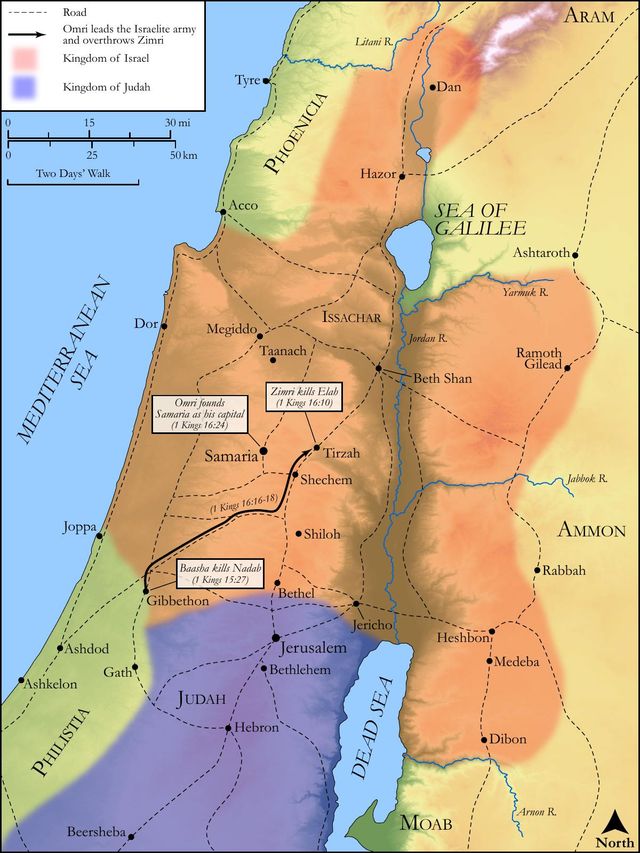
We are now to take a view of the miserable state of Israel, while the kingdom of Judah was happy under Asa's good government. It was threatened that they should be as a reed shaken in the water (Kg1 14:15), and so they were, when, during the single reign of Asa, the government of their kingdom was in six or seven different hands, as we find in this and the following chapter. Jeroboam was upon the throne in the beginning of his reign and Ahab at the end of it, and between them were Nadab, Baasha, Elah, Zimri, Tibni, and Omri, undermining and destroying one another. This they got by deserting the house both of God and of David. Here we have, 1. The ruin and extirpation of the family of Jeroboam, according to the word of the Lord by Ahijah. His son Nadab succeeded him. If the death of his brother Abijah had had a due influence upon him to make him religious, and the honour done him at his death had engaged him to follow his good example, his reign might have been long and glorious; but he walked in the way of his father (Kg1 15:26), kept up the worship of his calves, and forbade his subjects to go up to Jerusalem to worship, sinned and made Israel to sin, and therefore God brought ruin upon him quickly, in the second year of his reign. He was besieging Gibbethon, a city which the Philistines had taken from the Danites, and was endeavouring to re-take it; and there, in the midst of his army, did Baasha, with others, conspire against him and kill him, (Kg1 15:27), and so little interest had he in the affections of his people that his army did not only not avenge his death, but chose his murderer for his successor. Whether Baasha did it upon a personal pique against Nadab, or to be avenged on the house of Jeroboam for some affront received from them, or whether under pretence of freeing his country from the tyranny of a bad prince, or whether merely from a principle of ambition, to make way for himself to the throne, does not appear; but he slew him and reigned in his stead, Kg1 15:28. And the first thing he did when he came to the crown was to cut off all the house of Jeroboam, that he might the better secure himself and his own usurped government. He thought it not enough to imprison or banish them, but he destroyed them, left not only no males (as was foretold, Kg1 14:10), but none that breathed. Herein he was barbarous, but God was righteous. Jeroboam's sin was punished (Kg1 15:30); for those that provoke God do it to their own confusion; see Jer 7:19. Ahijah's prophecy was accomplished (Kg1 15:29); for no word of God shall fall to the ground. Divine threatenings are not bugbears. 2. The elevation of Baasha. He shall be tried awhile, as Jeroboam was. Twenty-four years he reigned (Kg1 15:33), but showed that it was not from any dislike to Jeroboam's sin that he destroyed his family, but from malice and ambition; for, when he had rooted out the sinner, he himself clave to the sin, and walked in the way of Jeroboam (Kg1 15:34), though he had seen the end of that way; so strangely was his heart hardened with the deceitfulness of sin.
Continue studying 1 Kings 15:28 across the web’s major study libraries — every link below opens this exact verse, chapter, or book on the destination site.
Read & Compare
 BibleGatewayThis verse in more than 200 translations and 70 languages.
 Bible.comThe YouVersion reader — hundreds of translations, reading plans, and highlights.
 ESV.orgCrossway's official English Standard Version reader.
 NET BibleThe NET translation with 60,000+ translators' notes on every rendering decision.
 STEP BibleTyndale House's free study tool — original text, vocabulary, and scholarly resources.
 BibliaLogos Bible Software's free web reader.
 USCCBThe New American Bible (Revised Edition) with the U.S. bishops' study notes.
Commentaries
 BibleHub CommentariesDozens of classic commentaries on this verse, gathered on one page.
 StudyLightMore than 100 commentary sets — the largest collection on the web.
 BibleRefPlain-English commentary on what this verse means, verse by verse.
 Enduring WordDavid Guzik's free commentary on this chapter, widely used by Bible teachers.
 Bible Study ToolsVerse commentary alongside Greek and Hebrew study aids.
Original Language & Research
- BibleHub InterlinearThe verse word by word — original language, transliteration, and English.
- BibleHub LexiconEvery word's original-language definition and Strong's entry.
 Blue Letter BibleDeep-study tools — Strong's numbers, concordance, and word studies.
 SefariaThe Hebrew text with Rashi and centuries of Jewish commentary.
Sermons, Hymns & Audio


TrulyRandomVerse is not affiliated with these sites and doesn’t control their content. They’re linked because they’re genuinely useful.
Summary
1 Kings 15:28 meticulously records a pivotal and violent transfer of power in the Northern Kingdom of Israel, detailing the assassination of King Nadab by Baasha, a commander from the tribe of Issachar. This momentous event, precisely dated to the third year of Judah's King Asa, not only highlights the chronic instability and ruthless ambition that plagued Israel's early monarchy but also serves as a stark fulfillment of divine prophecy regarding the judgment against the house of Jeroboam I due to his profound idolatry and leading the nation into sin. It powerfully underscores God's sovereign oversight and unwavering justice, even amidst the most chaotic human wickedness and political turmoil.
Context
ShowHideLiterary Context
This verse is strategically placed within a broader narrative that contrasts the reigns of kings in the divided monarchy. It immediately follows the brief and wicked two-year reign of Nadab, son of Jeroboam I (1 Kings 15:25-26), and precedes the detailed account of Baasha's subsequent actions, including his complete eradication of Jeroboam's lineage (1 Kings 15:29). The chapter meticulously tracks the parallel reigns of Asa in Judah and various tumultuous kings in Israel, emphasizing the stark difference between the relatively stable Davidic dynasty in the south and the volatile, coup-ridden successions in the north. Crucially, verse 28 explicitly presents Baasha's coup not merely as a political power grab but as the direct and undeniable fulfillment of the divine judgment pronounced by the prophet Ahijah against Jeroboam's house in 1 Kings 14:10-11, underscoring the certainty of God's word and His active involvement in human history.
Historical & Cultural Context
The period depicted in 1 Kings 15 is set within the turbulent era of the divided monarchy, which commenced after the death of King Solomon. Unlike the Southern Kingdom of Judah, which maintained a continuous, divinely promised Davidic line, the Northern Kingdom of Israel lacked a stable, hereditary dynasty. This fundamental difference frequently led to military coups, assassinations, and rapid changes in leadership, as kings often ascended to power through force rather than legitimate succession. Baasha's act of slaying Nadab and then systematically eliminating all of Jeroboam's descendants (1 Kings 15:29) was a brutal practice of those who seized a throne, as Abimelech slew the seventy sons of Jerubbaal, designed to prevent any future claims to the throne from the deposed dynasty. This violent method of securing power was a hallmark of Israel's early history, starkly contrasting with the more stable and enduring Davidic line in Judah, which continued through Asa's reign and beyond, highlighting the theological implications of covenant faithfulness.
Key Themes
ShowHideThe events chronicled in 1 Kings 15 powerfully illustrate several pervasive themes found throughout the Books of Kings. Foremost among these is the theme of Divine Judgment and Prophecy Fulfillment, as Baasha's ruthless act is explicitly presented as the direct execution of God's pronouncement against Jeroboam's idolatrous house. This demonstrates God's active sovereignty over human affairs and the unwavering certainty of His word, even when carried out by wicked human agents. Second, the narrative vividly portrays the Instability and Violence of the Northern Kingdom, revealing a monarchy perpetually plagued by internal strife, regicide, and a lack of legitimate, enduring succession, standing in stark contrast to the divinely promised stability of the Davidic line in Judah (2 Samuel 7:16). Finally, the chapter highlights Human Ambition and Ruthlessness, as Baasha seizes power through bloodshed, illustrating the corrupting influence of power when pursued apart from divine guidance and moral constraint.
Exposition and Analysis
ShowHideKey Word Analysis
ShowHideFrom an unused root meaning "to stink" or "offensiveness," this name, H1201, ironically describes the man who becomes king through a bloody coup. While the name itself may not directly comment on his character, the context of his actions—assassinating the king and eradicating his lineage—certainly aligns with a sense of moral offensiveness. Baasha's rise to power is marked by violence and a disregard for established order, setting a tone for his own reign which would later be condemned by God.
The KJV "slay" translates the Hebrew root H4191, mûwth, a primitive root meaning "to die" or, causatively, "to kill." In this context, it is used in the causative sense, emphasizing that Baasha actively brought about Nadab's death. This is not a passive or accidental event but a deliberate, violent act of homicide, underscoring the brutal nature of the coup. The term highlights the finality and decisiveness of Nadab's demise, a direct fulfillment of the divine judgment against his father's house.
The Hebrew root H4427, mâlak, means "to reign" or "to be king," and inceptively, "to ascend the throne." The use of this verb immediately following the act of slaying indicates a direct and immediate succession achieved through violence. Baasha's kingship is presented as a direct consequence of his usurpation, emphasizing the illegitimate and forceful nature of his claim to the throne. This contrasts sharply with the divinely sanctioned and hereditary succession within the Davidic line in Judah.
Verse Breakdown
ShowHide"Even in the third year of Asa king of Judah"
This initial clause provides a precise chronological marker, synchronizing the events in the Northern Kingdom of Israel with the reign of the contemporary king of the Southern Kingdom of Judah. This synchronism is a characteristic feature of the Books of Kings, allowing the reader to track the parallel histories of the two nations. It also subtly highlights the relative stability and longer duration of Asa's reign in Judah (which would last 41 years) in contrast to the rapid and violent changes in Israel.
"did Baasha slay him"
This is the core action of the verse, identifying the perpetrator and the victim. Baasha, previously introduced as the son of Ahijah, from the tribe of Issachar (1 Kings 15:27), is the agent of the assassination. The pronoun "him" refers to Nadab, the son and successor of Jeroboam I. This act is presented not merely as a political coup but as the direct fulfillment of the divine prophecy against Jeroboam's house, demonstrating God's sovereign hand in bringing judgment through human agents, even those driven by their own wicked ambition.
"and reigned in his stead"
This concluding clause states the immediate consequence of the assassination: Baasha's usurpation of the throne. The phrase "in his stead" explicitly emphasizes the direct replacement of Nadab by Baasha, solidifying the transfer of power through violence. This marks the abrupt end of the dynasty of Jeroboam and the beginning of a new, equally unstable, royal line in the Northern Kingdom of Israel.
Literary Devices
ShowHideThe verse employs several significant literary devices to convey its powerful message. Conciseness is evident in the direct, unadorned reporting of a momentous and violent event, allowing the stark facts to speak for themselves without elaborate description. This terse style is characteristic of the historical narrative in Kings, focusing on actions and their theological implications. Foreshadowing is present, as this violent coup establishes a recurring pattern of instability, regicide, and short-lived dynasties in the Northern Kingdom, which stands in stark contrast to the more stable and divinely ordained succession in Judah. The narrative implicitly uses Juxtaposition or Contrast by situating the turbulent reign of Nadab and the violent rise of Baasha within the chronological framework of Asa's reign in Judah. This contrast highlights the theological distinction between the two kingdoms: one plagued by sin and chaos, the other striving for covenant faithfulness and experiencing relative stability. Furthermore, there is a strong element of Irony in Baasha's actions: while he fulfills God's judgment against Jeroboam's house, he does so out of his own ambition and wickedness, not piety. The text later reveals that Baasha himself would commit similar sins to Jeroboam, ultimately incurring divine judgment upon his own house (1 Kings 16:1-4), demonstrating a cyclical pattern of sin and judgment.
Theological and Thematic Connections
ShowHide1 Kings 15:28 profoundly illustrates the principle of divine sovereignty over human affairs, even amidst the most chaotic and morally reprehensible acts. Baasha's violent usurpation of the throne, though undoubtedly driven by human ambition and ruthlessness, is presented as the direct fulfillment of God's prophetic word against Jeroboam's idolatrous dynasty. This demonstrates that God's justice is certain, His word is unfailing, and He actively intervenes in history to bring judgment upon those who lead His people into sin and rebellion. The chronic instability of the Northern Kingdom, marked by such frequent and bloody transitions of power, serves as a theological commentary on the devastating consequences of rejecting God's established order and pursuing self-serving leadership. It highlights the stark difference between a kingdom founded on human might and one rooted in divine covenant and faithfulness, emphasizing that true stability and blessing derive from obedience to God.
Reflection and Application
ShowHideThe brief, stark account of Baasha's coup in 1 Kings 15:28 offers profound lessons for believers today, reminding us that even in the most tumultuous and seemingly chaotic human events—political upheavals, shifts in power, acts of violence—God remains absolutely sovereign. His overarching purposes are never thwarted by human wickedness; rather, He can even use the ambition and sin of individuals to bring about His righteous judgments and fulfill His infallible word. This truth should instill in us a deep and abiding trust in God's ultimate control, even when circumstances appear overwhelming, unjust, or beyond human comprehension. Furthermore, the narrative serves as a powerful warning against the corrupting influence of unchecked ambition and the devastating consequences of leading others astray through idolatry and disobedience. It calls us to examine our own hearts, ensuring that our pursuit of influence or power, whether in personal life, work, or ministry, is aligned with God's will and not driven by selfish motives. Our true stability, security, and hope are found not in fleeting earthly power structures, but in faithful obedience to the unchanging King of kings and His eternal kingdom.
Questions for Reflection
ShowHideFAQ
ShowHideWho was Nadab and why was he slain?
ShowHideNadab was the son and immediate successor of Jeroboam I, the first king of the Northern Kingdom of Israel, reigning for only two years (1 Kings 15:25). Like his father, Nadab "did evil in the sight of the LORD, and walked in the way of his father, and in his sin wherewith he made Israel to sin" (1 Kings 15:26), perpetuating the idolatry introduced by Jeroboam. He was slain by Baasha, a commander, during a siege of Gibbethon. His assassination was not merely a political coup but a direct fulfillment of the prophecy given by the prophet Ahijah against Jeroboam's house, declaring that his entire lineage would be cut off due to their grievous idolatry and leading Israel into sin (1 Kings 14:10-11).
How does this event fulfill prophecy?
ShowHideThe slaying of Nadab by Baasha directly fulfills the severe prophecy delivered by the prophet Ahijah to Jeroboam's wife in 1 Kings 14:10-11. God declared, "Behold, I will bring evil upon the house of Jeroboam, and will cut off from Jeroboam every male, bond and free, in Israel, and will take away the remnant of the house of Jeroboam, as a man takes away dung, till it be all gone." He further specified that "Him that dieth of Jeroboam in the city shall the dogs eat; and him that dieth in the field shall the fowls of the air eat: for the LORD hath spoken it." Baasha's subsequent act of striking down all of Jeroboam's house, leaving none alive (1 Kings 15:29), precisely executed this divine judgment, demonstrating God's unwavering commitment to His word and His righteous response to profound sin.
What was the significance of Asa's reign in Judah at this time?
ShowHideThe mention of Asa's reign in Judah provides a crucial chronological and theological contrast within the narrative. While Israel was experiencing violent coups, regicide, and profound instability due to its kings' persistent idolatry and rejection of God's covenant, Judah, under King Asa, was undergoing a period of significant religious reform and relative stability. Asa "did that which was good and right in the eyes of the LORD his God" (1 Kings 15:11), actively removing idols, male cult prostitutes, and even deposing his own grandmother from her position for her idolatry (1 Kings 15:12-13). This juxtaposition powerfully highlights a key theological message of the Books of Kings: faithfulness to God brings blessing and stability to a nation and its leadership, while disobedience and idolatry inevitably lead to chaos, judgment, and the collapse of human-established power. The enduring Davidic covenant provided a foundational stability for Judah that was conspicuously absent in the Northern Kingdom.
Christ-Centered Fulfillment
ShowHideThe turbulent succession in 1 Kings 15:28, where human ambition, violence, and sin dictate the rise and fall of kings, powerfully underscores humanity's desperate need for a truly righteous, stable, and eternal King. The failure of Nadab's short, wicked reign and Baasha's bloody ascent to power reveal the inherent brokenness, transience, and instability of earthly kingdoms established by human might and flawed leadership. This constant cycle of sin, judgment, and political upheaval in ancient Israel points forward with profound theological significance to the ultimate, perfect King, Jesus Christ. Unlike the kings of Israel who were prone to idolatry and consistently led their people astray, Jesus, the true Son of David, reigns in perfect righteousness and establishes a kingdom that "shall have no end" (Luke 1:33). His kingship is not seized through violence or human maneuvering but is inaugurated through His willing self-sacrifice on the cross, where He conquered sin, death, and all opposing powers (Colossians 2:15). He is the Lamb of God who takes away the sin of the world (John 1:29), and His reign brings true peace, eternal justice, and unshakable stability, fulfilling all the promises of God for a perfect ruler and a lasting kingdom (Revelation 11:15). The instability and tragic cycles of 1 Kings 15:28 thus serve as a dark, yet essential, backdrop against which the glorious, unshakable, and redemptive kingdom of Christ shines ever brighter, offering the only true hope for humanity.