


1 Kings 15:27
- וַיִּקְשֹׁרvai·yik·Shorand he conspiredH7194Conj-w ¦ V-Qal-ConsecImperf-3msVerb Qal Consecutive Imperfect 3rd Singular Masculineוַandיִּקְשֹׁרhe conspired
- עָלָיו'a·Lavon himH5921Prep ¦ 3msPrepositionעָלָיonוhim
- בַּעְשָׁאba'·Sha'BaashaH1201N-proper-mNoun Proper Masculine
- בֶןven[the] son ofH1121N-mscNoun Singular Masculine Construct
- אֲחִיָּה'a·chi·YahAhijahH281N-proper-mNoun Proper Masculine
- לְבֵיתle·Veitof [the] house ofH1004Prep-l ¦ N-mscNoun Singular Masculine Constructלְofבֵית[the] house of
- יִשָּׂשכָרyi·so·sh·KharIssacharH3485N-proper-mNoun Proper Masculine
- וַיַּכֵּהוּvai·ya·Ke·huand he struck down himH5221Conj-w ¦ V-Hiphil-ConsecImperf-3ms ¦ 3msVerb Hiphil Consecutive Imperfect 3rd Singular Masculineוַandיַּכֵּhe struck downהוּhim
- בַעְשָׁאva'·Sha'BaashaH1201N-proper-mNoun Proper Masculine
- בְּגִבְּתוֹןbe·gi·be·Tonat GibbethonH1405Prep-b ¦ N-properNoun Proper LocationבְּatגִבְּתוֹןGibbethon
- אֲשֶׁר'a·SherwhichH834RelParticle Relative
- לַפְּלִשְׁתִּיםla·pe·lish·Tim[belonged] to the PhilistinesH6430Prep-l ¦ N-mpNoun Gentilic Plural Masculine Absoluteלַ[belonged] to theפְּלִשְׁתִּיםPhilistines
- וְנָדָבve·na·Davand NadabH5070Conj-w ¦ N-proper-mNoun Proper MasculineוְandנָדָבNadab
- וְכָלve·kholand allH3605Conj-w ¦ N-mscNoun Singular Masculine Constructוְandכָלall
- יִשְׂרָאֵלYis·ra·'ElIsraelH3478N-properNoun Proper Location
- צָרִיםtza·Rim[were] laying siegeH6696V-Qal-Prtcpl-mpVerb Qal Participle Plural Masculine Absolute
- עַל'alonH5921PrepPreposition
- גִּבְּתוֹןgi·be·TonGibbethonH1405N-properNoun Proper Location
English is a literal word-by-word gloss of the Hebrew, not the KJV's wording. Why?
This is the original text the KJV's translators worked from — each Hebrew word with its own literal English meaning in this verse, prepared by scholars at Tyndale House, Cambridge. The KJV translates whole sentences, not word by word, so its wording differs: one Hebrew word can become several English words, and the KJV may choose “the LORD” where the gloss reads “Yahweh”. Both are faithful — they answer different questions. For the KJV's own rendering, switch to the KJV text.
Details
See on the biblical-era map
Study this verse
Public-domain commentary
Matthew Henry
From his Commentary on the Whole Bible. Henry comments on passages, not single verses — this entry covers 1 Kings 15:25–34.
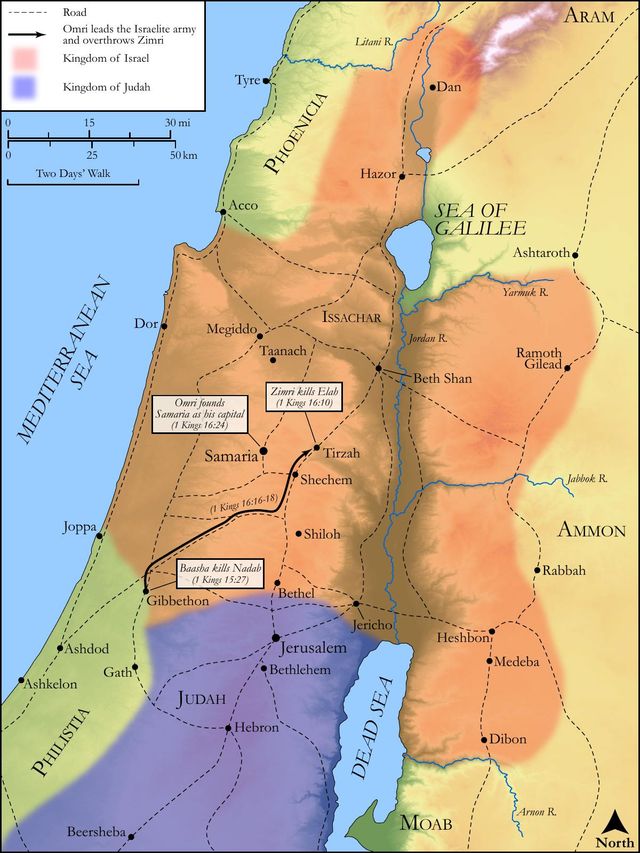
We are now to take a view of the miserable state of Israel, while the kingdom of Judah was happy under Asa's good government. It was threatened that they should be as a reed shaken in the water (Kg1 14:15), and so they were, when, during the single reign of Asa, the government of their kingdom was in six or seven different hands, as we find in this and the following chapter. Jeroboam was upon the throne in the beginning of his reign and Ahab at the end of it, and between them were Nadab, Baasha, Elah, Zimri, Tibni, and Omri, undermining and destroying one another. This they got by deserting the house both of God and of David. Here we have, 1. The ruin and extirpation of the family of Jeroboam, according to the word of the Lord by Ahijah. His son Nadab succeeded him. If the death of his brother Abijah had had a due influence upon him to make him religious, and the honour done him at his death had engaged him to follow his good example, his reign might have been long and glorious; but he walked in the way of his father (Kg1 15:26), kept up the worship of his calves, and forbade his subjects to go up to Jerusalem to worship, sinned and made Israel to sin, and therefore God brought ruin upon him quickly, in the second year of his reign. He was besieging Gibbethon, a city which the Philistines had taken from the Danites, and was endeavouring to re-take it; and there, in the midst of his army, did Baasha, with others, conspire against him and kill him, (Kg1 15:27), and so little interest had he in the affections of his people that his army did not only not avenge his death, but chose his murderer for his successor. Whether Baasha did it upon a personal pique against Nadab, or to be avenged on the house of Jeroboam for some affront received from them, or whether under pretence of freeing his country from the tyranny of a bad prince, or whether merely from a principle of ambition, to make way for himself to the throne, does not appear; but he slew him and reigned in his stead, Kg1 15:28. And the first thing he did when he came to the crown was to cut off all the house of Jeroboam, that he might the better secure himself and his own usurped government. He thought it not enough to imprison or banish them, but he destroyed them, left not only no males (as was foretold, Kg1 14:10), but none that breathed. Herein he was barbarous, but God was righteous. Jeroboam's sin was punished (Kg1 15:30); for those that provoke God do it to their own confusion; see Jer 7:19. Ahijah's prophecy was accomplished (Kg1 15:29); for no word of God shall fall to the ground. Divine threatenings are not bugbears. 2. The elevation of Baasha. He shall be tried awhile, as Jeroboam was. Twenty-four years he reigned (Kg1 15:33), but showed that it was not from any dislike to Jeroboam's sin that he destroyed his family, but from malice and ambition; for, when he had rooted out the sinner, he himself clave to the sin, and walked in the way of Jeroboam (Kg1 15:34), though he had seen the end of that way; so strangely was his heart hardened with the deceitfulness of sin.
Continue studying 1 Kings 15:27 across the web’s major study libraries — every link below opens this exact verse, chapter, or book on the destination site.
Read & Compare
 BibleGatewayThis verse in more than 200 translations and 70 languages.
 Bible.comThe YouVersion reader — hundreds of translations, reading plans, and highlights.
 ESV.orgCrossway's official English Standard Version reader.
 NET BibleThe NET translation with 60,000+ translators' notes on every rendering decision.
 STEP BibleTyndale House's free study tool — original text, vocabulary, and scholarly resources.
 BibliaLogos Bible Software's free web reader.
 USCCBThe New American Bible (Revised Edition) with the U.S. bishops' study notes.
Commentaries
 BibleHub CommentariesDozens of classic commentaries on this verse, gathered on one page.
 StudyLightMore than 100 commentary sets — the largest collection on the web.
 BibleRefPlain-English commentary on what this verse means, verse by verse.
 Enduring WordDavid Guzik's free commentary on this chapter, widely used by Bible teachers.
 Bible Study ToolsVerse commentary alongside Greek and Hebrew study aids.
Original Language & Research
- BibleHub InterlinearThe verse word by word — original language, transliteration, and English.
- BibleHub LexiconEvery word's original-language definition and Strong's entry.
 Blue Letter BibleDeep-study tools — Strong's numbers, concordance, and word studies.
 SefariaThe Hebrew text with Rashi and centuries of Jewish commentary.
Sermons, Hymns & Audio


TrulyRandomVerse is not affiliated with these sites and doesn’t control their content. They’re linked because they’re genuinely useful.
Summary
1 Kings 15:27 records the violent and pivotal overthrow of King Nadab of Israel by Baasha, a commander from the tribe of Issachar. This assassination, which occurred during Nadab's siege of the Philistine city of Gibbethon, marked the abrupt and brutal end of the Jeroboam dynasty. The event serves as a stark demonstration of divine judgment against Jeroboam's house for their profound idolatry and for leading Israel into sin, fulfilling a specific prophecy. It also powerfully illustrates the inherent instability and recurring pattern of violent regime change that characterized the northern kingdom's monarchy, contrasting sharply with the more stable, divinely-ordained Davidic line in Judah.
Context
ShowHideLiterary Context
This verse is strategically placed within 1 Kings, a book meticulously detailing the history of the Israelite monarchy from Solomon's reign through the divided kingdom. It immediately follows the brief and wicked two-year reign of Nadab, son of Jeroboam I, whose sin is explicitly stated: he "walked in the way of his father and in his sin which he had committed to make Israel sin" (1 Kings 15:26). The narrative consistently evaluates kings based on their adherence to or deviation from God's covenant, with idolatry being the most severe transgression. The military campaign against Gibbethon provides the immediate setting for the prophecy's fulfillment, as Baasha seizes the opportune moment. The verses that follow this event, specifically 1 Kings 15:28 and 1 Kings 15:29, explicitly detail Baasha's ascension and his ruthless eradication of Jeroboam's entire household, confirming the precise fulfillment of the word of the Lord spoken by Ahijah the Shilonite in 1 Kings 14. This rapid succession of events underscores the swift and decisive nature of divine judgment.
Historical & Cultural Context
The events described in 1 Kings 15:27 occurred during the early period of the divided monarchy, approximately 910-909 BC. Following the schism that divided the kingdom after Solomon's death, the northern kingdom of Israel (often referred to as Ephraim) fundamentally lacked the dynastic stability that characterized the southern kingdom of Judah, which maintained the continuous rule of the Davidic line. The frequent coups, assassinations, and rapid succession of rulers, such as the one described here, were a hallmark of Israel's political landscape. This instability often reflected a lack of divine endorsement for its kings, many of whom were "set up... but not by me" as later critiqued in Hosea 8:4. Gibbethon, though a Levitical city in the territory of Dan (Joshua 21:23), was under Philistine control at this time, indicating ongoing border conflicts and its strategic importance as a Philistine stronghold. Sieges were common military operations in the ancient Near East, and kings frequently led their armies into battle, making them vulnerable to internal plots. The concept of a "house" or dynasty was paramount in ancient monarchies, and the complete destruction of a royal house, as carried out by Baasha, was a brutal but effective means to consolidate power and eliminate any future claims to the throne from the previous ruling family.
Key Themes
ShowHideThe narrative of 1 Kings 15:27 powerfully illuminates several core themes. Foremost among them is Divine Judgment and Prophecy Fulfillment, which underscores God's absolute sovereignty over human affairs and His unwavering faithfulness to His word, even when executed through human treachery. The prophecy against Jeroboam's house, delivered by Ahijah in 1 Kings 14:7-16, is brought to a dramatic and violent conclusion here, demonstrating that no human scheme, however wicked, can thwart God's ultimate purposes. Another significant theme is Dynastic Instability and the Cycle of Sin, particularly evident in the northern kingdom. Unlike the enduring Davidic covenant in Judah, Israel's monarchy was plagued by a recurring pattern of kings who "walked in the sin of Jeroboam," leading to divine disfavor and violent regime changes. This instability highlights the severe consequences of rejecting God's chosen path and establishing idolatrous worship. Finally, the theme of Usurpation and Betrayal is starkly displayed in Baasha's actions, showcasing the corrupting influence of unchecked ambition and the pursuit of power outside of God's will, a tragic pattern that would repeat throughout Israel's turbulent history.
Exposition and Analysis
ShowHideKey Word Analysis
ShowHideThis verb, from the root meaning "to tie," signifies a secret plot, a binding together of individuals for a treasonous purpose, or a rebellion against legitimate authority. In this context, it highlights the clandestine and treacherous nature of Baasha's actions, indicating a deliberate and premeditated act of disloyalty and a subversion of the established order. The use of this word immediately frames Baasha's ascent to power as illegitimate and violent, emphasizing the calculated malice behind the coup.
A primitive root, nakah is a common biblical verb denoting striking, beating, or killing. Here, it unequivocally means to strike a fatal blow, resulting in death. It conveys the brutal, decisive, and irreversible nature of Nadab's assassination, emphasizing the sudden and complete end of his life and reign. The directness of the word leaves no ambiguity about the violence involved and the immediate consequence for the king.
This term describes the military action of surrounding a city with hostile forces to compel its surrender. Derived from a root meaning "to cramp" or "confine," it vividly sets the scene for Nadab's vulnerability. His attention and resources were focused externally on the Philistine enemy, creating an opportune moment for an internal plot. The fact that the coup occurred during a siege suggests a moment of strategic weakness for the king, expertly exploited by his ambitious commander.
Verse Breakdown
ShowHide"And Baasha the son of Ahijah, of the house of Issachar, conspired against him"
This opening clause introduces Baasha, identifying him by his father's name (Ahijah, distinct from the prophet) and his tribal affiliation (Issachar). The phrase "conspired against him" immediately establishes the treacherous nature of his actions, indicating a deliberate, premeditated plot to overthrow King Nadab. This act of conspiracy highlights the deep political instability and moral decay within the northern kingdom's leadership, where loyalty was fragile and ambition often led to violence.
"and Baasha smote him at Gibbethon, which [belonged] to the Philistines"
This part describes the violent execution of the conspiracy. Baasha "smote" (killed) Nadab, emphasizing the fatal and decisive nature of the blow. The location, Gibbethon, is crucial. It was a city in the territory of Dan but under Philistine control, suggesting a strategic military campaign by Nadab to reclaim or secure territory. The fact that the king was killed on the battlefield, while leading his troops, underscores his vulnerability and the opportunistic nature of Baasha's coup, exploiting a moment of external focus for internal gain.
"for Nadab and all Israel laid siege to Gibbethon"
This final clause provides the immediate context and rationale for the assassination's timing and location. Nadab's engagement in a demanding military siege meant his focus was divided, and his forces potentially stretched, creating an opportune moment for a commander like Baasha to act. The phrase "all Israel laid siege" indicates a national military effort, making Nadab's downfall a public and significant event for the entire kingdom, revealing the fragility of its leadership.
Literary Devices
ShowHideThe verse employs several significant literary devices that enrich its meaning and impact. Irony is prominently displayed, as King Nadab, while leading a national military effort against an external enemy (the Philistines), is ultimately not defeated by them but by an internal betrayal from within his own ranks. The very act of asserting royal authority through military leadership becomes the stage for his downfall. There is also a strong element of Prophecy Fulfillment, as the narrative implicitly (and explicitly in subsequent verses) links Baasha's actions to the divine judgment pronounced against Jeroboam's house by the prophet Ahijah (1 Kings 14). This serves to underscore God's sovereignty, demonstrating that even through human sin and treachery, His word will be accomplished. The rapid succession of kings and violent coups characteristic of the northern kingdom also exemplifies Foreshadowing, hinting at the ongoing instability and cycles of sin and judgment that will characterize much of Israel's future history, contrasting sharply with the more stable Davidic dynasty in Judah.
Theological and Thematic Connections
ShowHideThe assassination of Nadab by Baasha is a profound theological statement on divine judgment and the severe consequences of disobedience. It powerfully illustrates God's absolute sovereignty over human history, demonstrating that even through the wicked acts of men, His purposes are ultimately fulfilled. The swift and brutal end of Jeroboam's dynasty, initiated by Nadab's death, serves as a stark warning that rebellion against God's commands—particularly the establishment of idolatry and the leading of His people astray—will not go unpunished. This event highlights the precarious nature of power when divorced from divine anointing and obedience, contrasting the inherent instability of Israel's monarchy with the enduring covenant God made with David. It underscores that true authority, lasting security, and genuine peace come from aligning with God's will and submitting to His righteous rule, not from human strength, political maneuvering, or treacherous ambition.
Reflection and Application
ShowHide1 Kings 15:27 offers enduring lessons for believers today, reminding us of the profound and often far-reaching consequences of disobedience, especially when it involves spiritual rebellion against God and leading others into sin. The instability and violence that plagued the northern kingdom serve as a cautionary tale about the corrupting influence of unchecked ambition, the pursuit of power outside of God's will, and the devastating impact of idolatry. Even amidst the chaos of human treachery and political upheaval, the narrative powerfully demonstrates God's unwavering sovereignty. His word, spoken through His prophets, is always fulfilled, assuring us that His purposes will prevail regardless of human schemes or the apparent triumph of evil. This should inspire both humility and confidence: humility in recognizing our absolute dependence on God's guidance and the perils of straying from His path, and confidence in His ultimate control over all things, even when circumstances seem chaotic or unjust. We are called to seek God's kingdom and righteousness first, trusting that He orchestrates all events for His glory and our ultimate good, and that true peace and stability are found only in Him.
Questions for Reflection
ShowHideFAQ
ShowHideWho was Nadab and why was his reign so short?
ShowHideNadab was the son and successor of Jeroboam I, who was the first king of the northern kingdom of Israel after the kingdom divided. His reign was remarkably short, lasting only two years (as noted in 1 Kings 15:25). His brief time on the throne was characterized by his continuation of his father's idolatrous practices, particularly the worship of golden calves, which were a direct affront to God's commands. His short reign and violent end were a direct fulfillment of the prophecy delivered by Ahijah the prophet against Jeroboam's house, foretelling its complete destruction due to their profound sin.
What was the significance of Gibbethon in this event?
ShowHideGibbethon was a city located in the tribal territory of Dan, but at the time of Nadab's reign, it was under Philistine control. Its strategic location made it a persistent point of conflict between Israel and the Philistines, indicating its military importance. Nadab's decision to lead "all Israel" in a siege against Gibbethon presented a critical opportunity for Baasha. While the king and his forces were engaged in a demanding military campaign, their focus was external, making Nadab vulnerable to an internal plot. Thus, Gibbethon became the stage for the coup, not just a random location, but a place where the king's attention was diverted and his position compromised, enabling Baasha's treacherous act.
How does this event fulfill prophecy?
ShowHideNadab's assassination by Baasha and the subsequent purge of Jeroboam's entire household (as explicitly described in 1 Kings 15:29) directly fulfilled the chilling prophecy spoken by the prophet Ahijah the Shilonite in 1 Kings 14:10-11. Ahijah had foretold that God would "utterly sweep away the house of Jeroboam, as one sweeps away dung until it is all gone," and that those belonging to Jeroboam who died in the city would be eaten by dogs, and those in the open country by birds. This brutal and complete fulfillment underscored God's faithfulness to His word and His righteous judgment against Jeroboam's profound idolatry and his leading Israel into sin.
Christ-Centered Fulfillment
ShowHideThe turbulent narrative of 1 Kings 15:27, marked by dynastic instability, violent usurpation, and the tragic consequences of human sin, ultimately points to the profound need for a perfect and eternal King—Jesus Christ. The repeated failures of Israel's kings, who often seized power through treachery and perpetuated idolatry, highlight the futility of human attempts to establish lasting peace and righteous rule apart from God's design. Unlike Nadab, whose brief reign ended abruptly in betrayal and death, Jesus is the true Son of David, whose kingdom "will have no end" (Luke 1:32-33). He did not come to seize power through violence or conspiracy, but rather to lay down His life as the ultimate, atoning sacrifice for His people (John 10:18). The judgment upon Jeroboam's house for their idolatry and rebellion foreshadows the ultimate divine judgment that all humanity faces, a judgment from which only Christ can deliver through His atoning work on the cross (Acts 17:31). In Christ, we find the stable, righteous, and eternal reign that Israel's flawed kings could never provide, fulfilling the deepest longings for true justice, peace, and an unshakable kingdom (Isaiah 9:6-7).