


1 Kings 16:12
Bible text: King James Version (1769 Blayney text) · Public domain
Bible text: Berean Standard Bible · Public domain
Bible text: American Standard Version (1901) · Public domain
Bible text: World English Bible, Messianic edition · Public domain
Bible text: Geneva Bible (1599) · Public domain
Bible text: Young's Literal Translation · Public domain
- וַיַּשְׁמֵדvai·yash·Medand he destroyedH8045Conj-w ¦ V-Hiphil-ConsecImperf-3msVerb Hiphil Consecutive Imperfect 3rd Singular Masculineוַandיַּשְׁמֵדhe destroyed
- זִמְרִיzim·RiZimriH2174N-proper-mNoun Proper Masculine
- אֵת'et<obj.>H853DirObjMParticle Object Indicator
- כָּלkolallH3605N-mscNoun Singular Masculine Construct
- בֵּיתbeit[the] house ofH1004N-mscNoun Singular Masculine Construct
- בַּעְשָׁאba'·Sha'BaashaH1201N-proper-mNoun Proper Masculine
- כִּדְבַרkid·Varaccording to [the] word ofH1697Prep-k ¦ N-mscNoun Singular Masculine Constructכִּaccording toדְבַר[the] word of
- יְהוָהYah·wehYahwehH3068N-properNoun Proper Title
- אֲשֶׁר'a·SherwhichH834RelParticle Relative
- דִּבֶּרdi·Berhe had spokenH1696V-Piel-Perf-3msVerb Piel Perfect 3rd Singular Masculine
- אֶל'elagainstH413PrepPreposition
- בַּעְשָׁאba'·Sha'BaashaH1201N-proper-mNoun Proper Masculine
- בְּיַדbe·Yadby [the] hand ofH3027Prep-b ¦ N-cscNoun Singular common gender Constructבְּbyיַד[the] hand of
- יֵהוּאye·Hu'JehuH3058N-proper-mNoun Proper Masculine
- הַנָּבִיאha·na·Vi'the prophetH5030Art ¦ N-msNoun Singular Masculine Absoluteהַtheנָּבִיאprophet
English is a literal word-by-word gloss of the Hebrew, not the KJV's wording. Why?
This is the original text the KJV's translators worked from — each Hebrew word with its own literal English meaning in this verse, prepared by scholars at Tyndale House, Cambridge. The KJV translates whole sentences, not word by word, so its wording differs: one Hebrew word can become several English words, and the KJV may choose “the LORD” where the gloss reads “Yahweh”. Both are faithful — they answer different questions. For the KJV's own rendering, switch to the KJV text.
Details
See on the biblical-era maps
Study this verse
Public-domain commentary
Matthew Henry
From his Commentary on the Whole Bible. Henry comments on passages, not single verses — this entry covers 1 Kings 16:1–14. His four-level outline is real structure in the source text, so it is rendered as structure.
Here is, I. The ruin of the family of Baasha foretold. He was a man likely enough to have raised and established his family - active, politic, and daring; but he was an idolater, and this brought destruction upon his family.
1.God sent him warning of it before.
(1.)That, if he were thereby wrought upon to repent and reform, the ruin might be prevented; for God threatens, that he may not strike, as one that desires not the death of sinners.
(2.)That, if not, it might appear that the destruction when it did come, whoever might be instruments of it, was the act of God's justice and the punishment of sin.
2.The warning was sent by Jehu the son of Hanani. The father was a seer, or prophet, at the same time (Ch2 16:7), and was sent to Asa king of Judah; but the son, who was young and more active, was sent on this longer and more dangerous expedition to Baasha king of Israel. Juniores ad labores - Toil and adventure are for the young. This Jehu was a prophet and the son of a prophet. Prophecy, thus happily entailed, was worthy of so much the more honour. This Jehu continued long in his usefulness, for we find him reproving Jehoshaphat (Ch2 19:2) above forty years after, and writing the annals of that prince, Ch2 20:34. The message which this prophet brought to Baasha is much the same with that which Ahijah sent to Jeroboam by his wife.
(1.)He reminds Baasha of the great things God had done for him (Kg1 16:2): I exalted thee out of the dust to the throne of glory, a great instance of the divine sovereignty and power, Sa1 2:8. Baasha seemed to have raised himself by his own treachery and cruelty, yet there was a hand of Providence in it, to bring about God's counsel, concerning Jeroboam's house; and God's owning his advancement as his act and deed does by no means amount to the patronising of his ambition and treachery. It is God that puts power into bad men's hands, which he makes to serve his good purposes, notwithstanding the bad use they make of it. I made thee prince over my people. God calls Israel his people still, though wretchedly corrupted, because they retained the covenant of circumcision, and there were many good people among them; it was not till long after that they were called Loammi, not a people, Hos 1:9.
(2.)He charges him with high crimes and misdemeanours,
[1.]That he had caused Israel to sin, had seduced God's subjects from their allegiance and brought them to pay to dunghill-deities the homage due to him only, and herein he had walked in the way of Jeroboam (Kg1 16:2), and been like his house, Kg1 16:7.
[2.]That he had himself provoked God to anger with the work of his hands, that is, by worshipping images, the work of men's hands; though perhaps others made them, yet he served them and thereby avowed the making of them, and they are therefore called the work of his hands.
[3.]That he had destroyed the house of Jeroboam (Kg1 16:7), because he killed him, namely, Jeroboam's son and all his: if he had done that with an eye to God, to his will and glory, and from a holy indignation against the sins of Jeroboam and his house, he would have been accepted and applauded as a minister of God's justice; but, as he did it, he was only the tool of God's justice, but a servant to his own lusts, and is justly punished for the malice and ambition which actuated and governed him in all he did. Note, Those who are in any way employed in denouncing or executing the justice of God (magistrates or ministers) are concerned to do it from a good principle and in a holy manner, lest it turn into sin to them and they make themselves obnoxious by it.
(3.)He foretels the same destruction to come upon his family which he himself had been employed to bring upon the family of Jeroboam, Kg1 16:3, Kg1 16:4. Note, Those who resemble others in their sins may expect to resemble them in their plagues, especially those who seem zealous against such sins in others as they allow themselves in; the house of Jehu was reckoned with for the blood of the house of Ahab, Hos 1:4.
II.A reprieve granted for some time, so long that Baasha himself dies in peace, and is buried with honour in his own royal city (Kg1 16:6), so far is he from being a prey either to the dogs or to the fowls, which yet was threatened to his house, Kg1 16:4. He lives not either to see or feel the punishment threatened, yet he was himself the greatest delinquent. Certainly there must be a future state, in which impenitent sinners will suffer in their own persons, and not escape, as often they do in this world. Baasha died under no visible stroke of divine vengeance for aught that appears, but God laid up his iniquity for his children, as Job speaks, Job 21:19. Thus he often visits sin. Observe, Baasha is punished by the destruction of his children after his death, and his children are punished by the abuse of their bodies after their death; that is the only thing which the threatening specifies (Kg1 16:4), that the dogs and the fowls of the air should eat them, as if herein were designed a tacit intimation that there are punishments after death, when death has done its worst, which will be the sorest punishments and are most to be dreaded; these judgments on the body and posterity signified judgments on the soul when separated from the body, by him who, after he has killed, has power to cast into hell.
III.Execution done at last.
Baasha's son Elah, like Jeroboam's son Nadab, reigned two years, and then was slain by Zimri, one of his own soldiers, as Nadab was by Baasha; so like was his house made to that of Jeroboam, as was threatened, Kg1 16:3. Because his idolatry was like his, and one of the sins for which God contended with him being the destruction of Jeroboam's family, the more the destruction of his own resembled that, the nearer did the punishment resemble the sin, as face answers to face in a glass.
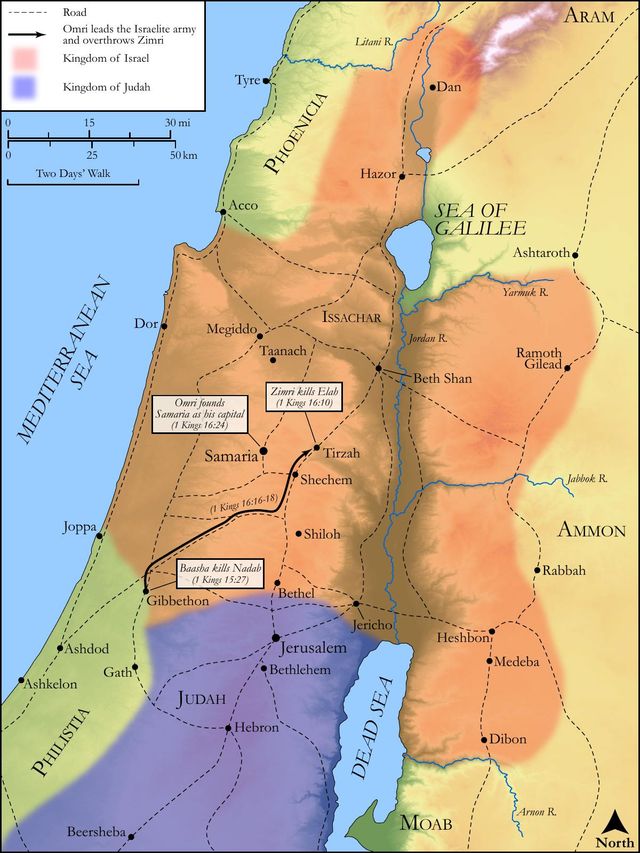
1.As then, so now, the king himself was first slain, but Elah fell more ingloriously than Nadab. Nadab was slain in the field of action and honour, he and his army then besieging Gibbethon (Kg1 15:27); but the siege being then raised upon that disaster, and the city remaining still in the Philistines' hands, the army of Israel was now renewing the attempt (Kg1 16:15) and Elah should have been with them to command in chief, but he loved his own ease and safety better than his honour or duty, or the public good, and therefore staid behind to take his pleasure; and, when he was drinking himself drunk in his servant's house, Zimri killed him, Kg1 16:9, Kg1 16:10. Let it be a warning to drunkards, especially to those who designedly drink themselves drunk, that they know not but death may surprise them in that condition.
(1.)Death comes easily upon men when they are drunk. Besides the chronic diseases which men frequently bring themselves into by hard drinking, and which cut them off in the midst of their days, men in that condition are more easily overcome by an enemy, as Amnon by Absalom, and are liable to more bad accidents, being unable to help themselves,
(2.)Death comes terribly upon men in that condition. Finding them in the act of sin, and incapacitated for any act of devotion, that day comes upon them unawares (Luk 21:34), like a thief.
2.As then, so now, the whole family was cut off, and rooted out. The traitor was the successor, to whom the unthinking people tamely submitted, as if it were all one to them what kind they had, so that they had one. The first thing Zimri did was to slay all the house of Baasha; thus he held by cruelty what he got by treason. His cruelty seems to have extended further than Baasha's did against the house of Jeroboam, for he left to Elah none of his kinsfolks or friends (Kg1 16:11), none of his avengers (so the word is), none that were likely to avenge his death; yet divine justice soon avenged it so remarkably that it was used as a proverb long after, Had Zimri peace who slew his master? Kg2 9:31. In this,
(1.)The word of God was fulfilled, Kg1 16:12.
(2.)The sins of Baasha and Elah were reckoned for, with which they provoked God by their vanities, Kg1 16:13. Their idols are called their vanities, for they cannot profit nor help. Miserable are those whose deities are vanities.
Continue studying 1 Kings 16:12 across the web’s major study libraries — every link below opens this exact verse, chapter, or book on the destination site.
Read & Compare
 BibleGatewayThis verse in more than 200 translations and 70 languages.
 Bible.comThe YouVersion reader — hundreds of translations, reading plans, and highlights.
 ESV.orgCrossway's official English Standard Version reader.
 NET BibleThe NET translation with 60,000+ translators' notes on every rendering decision.
 STEP BibleTyndale House's free study tool — original text, vocabulary, and scholarly resources.
 BibliaLogos Bible Software's free web reader.
 USCCBThe New American Bible (Revised Edition) with the U.S. bishops' study notes.
Commentaries
 BibleHub CommentariesDozens of classic commentaries on this verse, gathered on one page.
 StudyLightMore than 100 commentary sets — the largest collection on the web.
 BibleRefPlain-English commentary on what this verse means, verse by verse.
 Enduring WordDavid Guzik's free commentary on this chapter, widely used by Bible teachers.
 Bible Study ToolsVerse commentary alongside Greek and Hebrew study aids.
Original Language & Research
- BibleHub InterlinearThe verse word by word — original language, transliteration, and English.
- BibleHub LexiconEvery word's original-language definition and Strong's entry.
 Blue Letter BibleDeep-study tools — Strong's numbers, concordance, and word studies.
 SefariaThe Hebrew text with Rashi and centuries of Jewish commentary.
Sermons, Hymns & Audio


TrulyRandomVerse is not affiliated with these sites and doesn’t control their content. They’re linked because they’re genuinely useful.
Summary
1 Kings 16:12 succinctly records the dramatic and brutal fulfillment of divine judgment upon the royal house of Baasha, king of Israel. Through the ambitious actions of Zimri, a chariot commander, Baasha's entire lineage was utterly destroyed, precisely as foretold by the prophet Jehu. This event powerfully underscores God's absolute sovereignty over human history and the inevitable, devastating consequences of persistent disobedience and idolatry against His covenant.
Context
ShowHideLiterary Context
This verse marks the climactic execution of a prophetic judgment within a larger narrative of dynastic instability and divine retribution in the Northern Kingdom of Israel. The preceding chapters establish a pattern: a king rises, often by violent means, commits to the idolatrous ways of Jeroboam, and then faces divine condemnation and the promise of his house's destruction. Baasha himself ascended to the throne by destroying the house of Jeroboam, fulfilling God's word against that wicked dynasty, as recounted in 1 Kings 15:29. However, Baasha quickly replicated Jeroboam's sins, provoking the Lord's anger (1 Kings 15:34). Consequently, God sent the prophet Jehu, son of Hanani, to pronounce a similar judgment upon Baasha's house (1 Kings 16:1-4). The narrative then details the brief, dissolute reign of Elah, Baasha's son, and his assassination by Zimri (1 Kings 16:8-10). Verse 12 explicitly states that Zimri's subsequent purge, which included the systematic elimination of all male members and supporters of Baasha's family as described in 1 Kings 16:11, was the direct fulfillment of Jehu's prophecy.
Historical & Cultural Context
The events of 1 Kings 16:12 are set within the tumultuous history of the divided monarchy, specifically the Northern Kingdom of Israel (often referred to as Ephraim or Samaria). Unlike the relatively stable Davidic dynasty in Judah, the kingship in Israel was plagued by frequent coups, assassinations, and short-lived reigns, largely due to the kings' persistent idolatry and abandonment of the Mosaic covenant. The concept of a "house" in the monarchies of Israel and Judah extended beyond the immediate family to encompass the entire dynastic lineage, including close relatives, officials, and even loyal supporters. The complete destruction of a royal "house" was a brutal but common strategy for a new ruler to eliminate all potential rivals and consolidate power, ensuring the new dynasty's security. In this volatile environment, prophets played a crucial role, acting as divine messengers who often intervened in political affairs, pronouncing God's judgment, legitimizing or condemning rulers, and revealing God's overarching hand in the rise and fall of kingdoms.
Key Themes
ShowHideThis verse powerfully contributes to several foundational theological and narrative themes prevalent throughout 1 Kings and the broader Deuteronomistic History. Firstly, it emphatically highlights Divine Sovereignty and Judgment. Zimri's ruthless actions, though driven by his own ambition, are presented not as random political violence but as divinely orchestrated means to bring about God's righteous judgment against Baasha's sins. This underscores God's ultimate control over human affairs and the destinies of nations, a truth echoed in Proverbs 21:1. Secondly, it reinforces the severe Consequences of Disobedience and Idolatry. Baasha's persistent wickedness and his leading Israel into sin, despite having witnessed God's judgment on Jeroboam, directly led to the utter annihilation of his own royal line. This serves as a stark warning that sin carries severe, often generational, repercussions, a theme deeply embedded in the covenant curses of Deuteronomy 28. Finally, the explicit statement "according to the word of the LORD... by Jehu the prophet" emphasizes Prophetic Fulfillment and the unfailing reliability of God's word. What God declares through His chosen messengers will inevitably come to pass, affirming the prophetic office as a legitimate and powerful channel of divine revelation.
Exposition and Analysis
ShowHideKey Word Analysis
ShowHideThis verb (שָׁמַד, H8045) signifies complete annihilation, utter devastation, or eradication. Its use here emphasizes the totality and finality of the judgment meted out against Baasha's house, indicating that no male descendant or claimant to the throne was left alive, ensuring the absolute termination of the dynasty.
This noun (בַּיִת, H1004), when used in the context of a royal figure, refers to the entire family, descendants, and dynastic lineage. The phrase "house of Baasha" therefore encompasses his immediate family, his male heirs, and all those with a claim or association to his royal line, whose destruction ensures the complete end of his dynasty.
This noun (דָּבָר, H1697) refers to a spoken utterance, a matter, or a thing. In the context "the word of the LORD," it denotes a divine decree, a prophetic pronouncement, or a command. Its inclusion here is crucial, as it elevates Zimri's actions from mere political ambition to the precise execution of God's pre-declared will.
Verse Breakdown
ShowHide"Thus did Zimri destroy all the house of Baasha"
This opening clause directly attributes the violent action to Zimri, the chariot commander who had just assassinated King Elah. It specifies the target of his destruction as "all the house of Baasha," indicating a comprehensive and ruthless purge designed to eliminate every male heir and supporter of the former dynasty. This was a common, albeit brutal, method in the coups of Israel to consolidate power and prevent future challenges to the new regime.
"according to the word of the LORD"
This pivotal phrase immediately shifts the reader's perspective from human agency to divine orchestration. It asserts that Zimri's brutal actions, while driven by his own ambition and wickedness, were not random but were precisely aligned with God's overarching plan and divine decree. This emphasizes God's ultimate control over the unfolding events, demonstrating that even the sinful actions of humanity can be bent to serve His righteous purposes.
"which he spake against Baasha by Jehu the prophet"
This final segment provides the specific divine source and messenger for the judgment. It explicitly refers back to the prophecy delivered by Jehu, son of Hanani, recorded in 1 Kings 16:1-4. In that prophecy, God explicitly declared that He would "utterly sweep away Baasha and his house" because of Baasha's sins, particularly his continuation of Jeroboam's idolatry. This confirms the direct and precise fulfillment of a specific, prior divine utterance, underscoring the reliability and certainty of God's prophetic word.
Literary Devices
ShowHideThe verse employs several significant literary devices that enrich its theological impact. Foremost is Fulfillment, explicitly highlighted by the phrase "according to the word of the LORD, which he spake against Baasha by Jehu the prophet." This device not only confirms the veracity and reliability of God's prophetic word but also establishes a recurring pattern of divine judgment and sovereignty throughout the book of Kings. There is also a strong sense of Irony at play; Baasha himself rose to power by destroying the house of Jeroboam, acting as God's instrument of judgment. Now, his own house is destroyed in a strikingly similar fashion, demonstrating a cyclical pattern of sin and judgment in the Northern Kingdom and illustrating the principle that those who sow wickedness will ultimately reap its bitter fruit. Furthermore, the narrative powerfully illustrates Divine Sovereignty, showing that even the chaotic and violent actions of human agents, driven by their own sinful desires (like Zimri's ambition for power), are ultimately subservient to God's overarching will and used by Him to accomplish His righteous purposes.
Theological and Thematic Connections
ShowHide1 Kings 16:12 serves as a profound theological statement regarding God's unwavering commitment to His covenant and His absolute sovereignty over the affairs of humanity. It reveals that no human power, no matter how entrenched or seemingly secure, can thwart the divine will or escape the consequences of persistent disobedience and idolatry. The swift and total destruction of Baasha's house underscores the gravity of spiritual compromise and the profound responsibility of leadership, particularly for those entrusted with guiding God's people in righteousness. This event stands as a powerful reminder that God is not mocked; His word, whether of promise or judgment, will always come to pass, demonstrating His justice, faithfulness, and ultimate control across generations.
Reflection and Application
ShowHideThe ancient and violent account of Zimri's destruction of Baasha's house offers profound and enduring lessons for believers today. It calls us to a deeper trust in the absolute reliability of God's word, recognizing that His promises of blessing for obedience and warnings of judgment for rebellion are equally certain and will inevitably come to pass. We are reminded that spiritual compromise, idolatry, and persistent disobedience, in any form, carry severe consequences, not only for individuals but potentially for communities and future generations. This sobering truth should prompt us to humbly examine our own hearts for any divided loyalties, hidden idols, or areas where we might be provoking the Lord through our choices. Moreover, the passage powerfully illustrates God's sovereignty even amidst human chaos, sin, and political upheaval. He can use any means, even the wicked intentions of individuals like Zimri, to accomplish His ultimate righteous purposes. This truth can bring both profound comfort, knowing that God is always in control and working His plan, and a powerful challenge, urging us to align our lives fully with His revealed will, rather than resisting His purposes or presuming upon His grace.
Questions for Reflection
ShowHideFAQ
ShowHideWhy did God use a wicked man like Zimri to carry out His judgment?
ShowHideThis passage highlights a profound aspect of God's sovereignty: His ability to use any instrument, even those with wicked intentions, to accomplish His righteous purposes. Zimri's actions were driven by personal ambition and a desire for power, and he was certainly not acting out of obedience to God. However, God, in His absolute control over human history, orchestrated events such that Zimri's coup precisely fulfilled the prophecy He had given through Jehu. This demonstrates that God's plan is not dependent on human righteousness or cooperation; He can bend even the sinful choices of humanity to serve His ultimate will, without condoning their sin. This is a recurring theme in Scripture, where God uses nations, individuals, and even natural disasters to bring about His judgment or deliver His people, as seen in passages like Isaiah 10:5-7.
What was Baasha's specific sin that led to such a severe judgment?
ShowHideBaasha's primary sin was his continuation of the idolatrous practices established by Jeroboam, the first king of the Northern Kingdom. Despite witnessing God's judgment on Jeroboam's house for his apostasy, Baasha "walked in the way of Jeroboam and in his sin, which he made Israel to sin, provoking the LORD God of Israel to anger with their idols" (1 Kings 15:34). This included maintaining the golden calves at Bethel and Dan, which were meant to prevent the people from going to Jerusalem to worship the Lord. This persistent idolatry and his role in leading the people astray constituted a direct violation of God's covenant and provoked His righteous wrath, leading to the prophecy of the utter destruction of Baasha's house.
Christ-Centered Fulfillment
ShowHideWhile 1 Kings 16:12 vividly portrays divine judgment and the fulfillment of prophecy through human instruments, its ultimate Christ-centered fulfillment lies profoundly in the person and work of Jesus Christ. The fleeting, often violent, and ultimately failed dynasties of Israel, like that of Baasha, stand in stark contrast to the eternal, righteous, and perfectly obedient reign of Jesus, the true King of Israel. Unlike the kings who provoked God's wrath through idolatry and disobedience, Jesus perfectly fulfilled the Law and the Prophets (Matthew 5:17), never once provoking God's anger but always doing the Father's will (John 8:29). The judgment meted out on Baasha's house for sin foreshadows the ultimate judgment against all sin, which was fully borne by Christ on the cross. He became the Lamb of God who takes away the sin of the world (John 1:29), enduring the divine wrath so that those who believe in Him might escape the condemnation that justly falls upon disobedience (Romans 6:23). Thus, the prophetic certainty seen in Zimri's actions finds its grandest expression in the unwavering certainty of God's plan of salvation, perfectly executed through Christ's death and resurrection, ensuring the establishment of an eternal kingdom that will never be destroyed (Daniel 2:44).